islamic Republic of 11311 Bahar & Tabc�tal1 137H SprinG & Summer I'NI
PITUITARY DEPENDENT CUSHING'S
SYNDROME IN IRAN
DJ. MOFID, M.D., A.A.M.S.
GHAZI, M.D., A.A.
TAVAKKOLPOUR, M.D., AND M.T. SALEHIAN, M.D.From the DepartmclIl of Surgery, Talegltan; Hospital, Shalteed Behes/lli University of Medical Sciences, Tehrall, Islamic Republic of Iran.
ABSTRACT
During a 5-year experience with 32 adrenal tumors with different basic problems in the Department of Endocrinology , Taleghani Hospital, 25 were found pituitary dependent Cushing's syndrome, "Cushing's disease." The treatment of patients with Cushing's disease depends on the presence or absence of pituitary tumor. Ifno pituitary tumor is demonstrated, irradiation can be given to the pituitary gland and if a pituitary tumor is present, hypophysectomy is the treatment of choice. If pituitary ablation fails to relieve the symptoms of Cushing's syndrome, bilateral adrenalectomy is usually performed through the posterior approach. With regard to the poor results of radiation and hypophysectomy in Iran, these patients were referred directly for bilateral adrenalectomy to the Department of Surgery, Taleghani Hospital. The disease was predominatly seen in the young age group, females were more frequently affected than males and the common manifestation of hyperadrenocorticism were obesity, plethora, amenor rhea, and hirsutism. The diagnosis was made by a series of laboratory, roentgenographic, and C. T. scan studies. The surgical ablation of the target organs was usually performed by the posterior approach, and the pathologic results of operated patients were nodular hyperplasia and diffuse hyperpla sia.
M/fRI, Vo1.5, No. f,2, 29-33, 1991
INTRODUCTION
Table I. Estimated frequency ormanifestations or 27 orJ2 hyperadre nocorticism in Taleghani Hospital and the literature
In 1932, Harvey Cushing described a syndrome characterized by weakness, central obesity, cutaneous stria, plethora, diabetes mellitus, hypertension, and osteoporosis. 1 He believed that it represented a dis order of the pituitary gland that he called "pituitary basophiIism." It was later established that the findings were secondary to excessive production of cortisol.
Cushing's syndrome may be caused by three basic problems:
(1)
Cushing's disease,' resulting from excess pro duction of ACTH by the pituitary gland owing to either a pituitary adenoma or, more commonly, increased production of corticotropin releasing factor (C.R.F.)Sips and symploms
obesity plcthora amenorrhea hirsutism
fatigue and weakness cutaneous stria
hemorrhagic manifestations diabetes mcllitus
(FBS>140mgldl) personality changes hypertension
(BP>16OI90 mm Hg)
literature TatCjlbanl (t89 case) 'Yo (27 case) % H .. pllat
97 69
50 96
81 94
69 94
50 81
67 78
23 79
20 69
66 63
85 52
-f
o
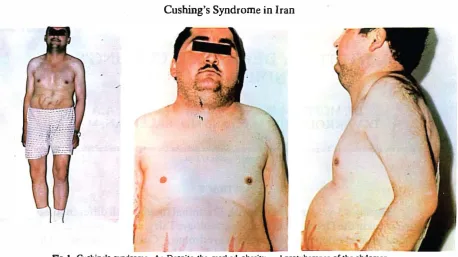
FIg 1. Cushing's syndrome. A: Despite the marked obesity and protuberance of the abdomen, the extremities arc thin. B: Lateral view of the same patient.
TlIhk n. 1)pes olCIIIhiDg'. syndrome in Taleghanl HospUal
pilllitaJydependeDtCUshing'ssyndrome 25
Cushing'ssyudromeduetooatceUcarcinomaofthclung 1
Cushing'sayndromeduetoadrenalcarcinoma 1
CUshing' .. yndromedueloadreoaltumor 1
undcrworlt-up 4
total 32
by the hypothalamus, which accounts for about 70% of all cases of Cushing's syndrome.
(2) An extra adrenal ACTII producing tumor, most commonly oat cell carcinoma of the lung, thymic tumors, and islet cell tumor of the pancreas which accounts for 5 to 10 percent of all cases of Cushing's syndrome.'
(3)
Primary tumor of the adrenal cortex, either benign adenoma or malignant adenocarcinoma or nodular dysplasia which accounts for about 20 percent of all cases of Cushing's syndrome (Table II). 2With regard to the Endocrinology Department of Taleghani Hospital experiences, the efficacy and result of radiation and hypophysectomy is not good enough and valuable in Iran. Therefore, the Endocrinology Ward referred patients with Cushing's disease for bilateral adrenalectomy to the Surgury Ward.
MATERIALS AND METHODS
The differential diagnosis in Cushing's syndrome is made by a series of laboratory and other studies. All patients had high serum cortisol levels, with the loss of nonnal circadian rhythm of cortisol. 5 Low doses of dexamethasone (2 mg) will suppress serum cortisol
Tobie Ill. Dexamethasone suppression test. The effect of u low and
high dose of dexamethasone on 17·0HCS, 17-KS, and urine free cortisol in TuJcglmni Hospital cases
Serum Urine Free 17- \7-0H
Test Conisol COrti501
KCloslcroids oids Cortif.-oslcr·
Base 41.5±24 Rnngc: 128-2756 719 ± 806.9 17.4± 10.2 21.5 ± 12.6
Low Dose 25 ± 8.7 Range: 128·2756 15.7 ± 10.2 11.5 ± 8.8
High Dose 19.7 ± \7 Range: 128·2756 15.9± 13.7 9.9± 8.1
Nonna1 Range: (1) Cortisol: 8-28 pgldl
(2) 17-Kc[os[croids: 5-14 mgl24 hr (3) 17-0H corticoids: 9-17 mg/24 hr (4) Urine [rcc cortisol: 35-120 pg/24 hr
level in nonnal SUb
j
ects but not in patients with Cushing'S syndrome. High doses of dexamethasone (2 mg four times for two days) will suppress cortisol level in patients with bilateral adrenal hyperplasia due to Cushing'S disease.Those patients in whom high doses of dexametha sone does not suppress serum cortisol level, will have either a primary adrenal tumor or an extra-adrenal ACTH producing tumor. The ACTII level then must be measured. If it is low, it indicates suppression by the cortisol produced by the adrenal tumor, whereas if it is high, it indicates excess ACTH production from an extra-adrenal source.
Urinary free cortisol is usually elevated, as are the metabolites of cortisol (17-hydroxycorticosteroids). In patients exhibiting virilism, the 17-ketosteroids are usually elevated (Table III). 7
It is important for the surgeon to localize an adrenal tumor causing Cushing's syndrome. CT-scanning has
B: Posterior approach
A: Anterior approach
C; Thoracicoabdominal approach
D: Retroperitoneal laternl approach
Figure 2. Four diUcrent approaches of adrenalectomy.
been both cost effective and aocurate in localizing adrenal tumor as well as delineating their relationship to surrounding structures. B
Adrenal angiography and adrenal venogram, are seldom obtained; and a poly tomogram of the sella turcica will usually identify small pituitary tumors.
The treatment of patients with Cushing's disease depends on the presence or absence of a pituitary tumor. If no pituitary tumpr is demonstrated m�dIa tion can be given to the pituitary gland. If a pitUItary tumor is present, hypophysectomy is the treatment of
choice.ll If these procedures fail to relieve the symp toms of Cushing's disease, bilateral adrenalectomy is performed.12 Radical adrenalectomy is indicated in most cases of primary adrenal tumor. Since it may be difficult for the surgeon to be sure whether the patient has a benign or malignant adenoma preoperatively in most patients, this procedure is easily performed t�rough a posterior approach. The posterior approach, performed through incision on each side of the spine, through the bed of the 11th or 12th rib, with the patient lying prone, is better tolerated postoperatively but
Table IV. Comparisons of different approaches in the treatment of Cushing's syndrome in Tnleghoni Hospital
Posterior approach 21
anterior approach 2
lateral approach
thoracicoabdominal approach
total 25
gives only limited exposure. The anterior or transperi toneal approach through a bilateral subcostal incision, anterior Chevron incision, is used mostly for pheochro mocytoma. Unfortunately, the postoperative period is painful. Ileus is a problem and the patient is exposed to the risks of poor healing, such as evisceration. If the adrenal tumor is quite large and particularly if it involves the right adrenal gland, a thoracicoabdominal approach should be used. This gives a better exposure, ailows excellent vascular control, and permits removal of very large adrenal tumors.
A lateral approach through the bed of the 11th rib, exposing the adrenai retroperitoneally, is seldom used because it gives rather poor exposure to the adrenal gland (Fig.
2),
(Table IV).RESULTS
The treatment of patients with Cushing's syndrome due to extra-adrenal ACTH-producing tumor is re moval of the primary tumor, if possible. Unfortunate ly, many of these tumors are malignant and have already metastasized. In these cases bilateral total adrenalectomy through the posterior approach should be considered,I2 if the neoplastic process is not far advanced.
All patients having surgical extirpation of an adren al tumor involving one adrenal gland or bilateral adrenalectomy should be prepared with cortisol admi nistration preoperatively, intraoperatively, and post operatively. Since adrenal carcinomas are resistant to radiotherapy and not dramatically responsive to che motherapy with mitotane (O,P-DDD, Lysodren),(a DDT derivative that is toxic to the adrenal cortex but has serious side effects at effective doses) complete surgical removal offers the only real hope for survival in ndrenal carcinomas. 13
Surgical results and comparison of mortality and complications of 25 cases by the author in Taleghani
Hospital and Professor K. Rhamy of Vanderbilt Uni
versity, Nashville, Tennesee, '4 is presented in Table V. !n our exoerience, the results of treatment in Cushing's disease a
�
e excellent unless one is dealing with adreno cortical carcinoma.Approximately 10 percent of patients subjected to bilateral adrenalectomy will develop a pituitary tumor that is nearly always an ACTH chromophobe adenoma
Table V
"
zs ... 25cas�
PrordSOr Tnleghani
K. RIuomy Hospital
Mortality 3.4%
Wound Infection (staphylococcal) 21% Two Cases
Laceration of Vena Cava 3% .
L:;ceration of Adrenal Vein TwoCases
I
Pulmonary Embolism 0,0 "0'
Renal Failure 3'70
Nephrectomy One Case
Pulmonary infusion 3";" .
Acute Cholecystitis 13%
• Dunng '.acllon on the nght kidney, the renal vein anothe renal pedicle was injured and repair or autotransplantation of the injured kidney W<lS not possible. The pathologic report of the injured kidnev
wns chronic pyelonephritis. .
Table VI. Pathologic rcsulls of 25 operated paticnL'i with Cushing's syndrome
Nodular Diffuse
No ofca.ws S ..
HypcrplllSla lIyperplasia
69/4% 30/6% 17 Farnale
1'215% 87/5% 8 Male
521>/ .. .t8% 25 fatal
(Nelson's syndrome). These tumors are usually seen three to 10 years after surgical treatment. Over time hyperpigmentation and, if the adenoma becomes large enough, visual symptoms will be accompanied. Treat·
ment of the tumor, when identified, is
hypophysectomy.
In our series three cases of Nelson's syndrome uitimately developed.
DISCUSSION
Surgical management of adrenal disease varies and depends on the disease itself. Accurate preoperative diagnosis and localization of the lesion is important in planning the proper surgical approach of the lesion.
Owing to the diagnostic, localization, and surgical techniques that are now available, the result of treati!1g Cushing's disease by bilateral adrenalectomy is good and acceptable as compared to the poor results and
!
I
I
efficacy of radiation and hypophysectomy in Iran. The surgical outlook in patients with benign adeno ma producing Cushing'ssyndrome should be excellent. The prognosis in patients with malignant adenocarci noma producing Cushing's syndrome, nonfunctioning adrenal carcinomas, and extra-adrenal ACTH produc ing Cushing's syndrome are less favorable and depend primarily on the extent of the disease found at the surgery. The wide variety of adrenal disease requiring surgery continues to make this an exciting and ever challenging field for the surgeon.
REFERENCES
1- Cushing H: The basophil adenomas of the pituitary body and their clinical manifestation (pituitary basophilism). BuU Johns Hop kins Hosp 1:137.1932.
2- Kriegcr DT: Physiopathology of Cushing's disease. Endocrine Rev 4:22. 1983.
3-Inura H, MatsukuraS. et a1: Studiesonectopic ACfH-producing tumors. II. Clinical and biochemical features 0(30 cases. Cancer 35:1430,1975.
4- Meador CK, Bowdoin B, et at: Primary adrenocortical nodular dysplasia: a rare cause of Cushing's syndrome. J Clio Endocrin 27:1255,1967.
5- Aschoff J: Circadian rhythms: general features and endocrinolo gical aspects. In: Krieger DT (cd): Endocrine Rhythms. New York: Raven, 1974.
6-Asfeldt WH: Simplified dexamethasone suppression test. Acta Endocrinol 61: 219,1969.
7- Bruke CW, Bearwell CG: Cushing's syndrome: an evaluation of the clinical usefullness of urinary free cortisol and other urinary steriod measurements in diagnosis. OT Med 42: 175, 1973.
8-Cuenn CK, Wahner HW, Gonnan CA: Computed tomographic scanning versus radioisotope imaging in adrenocortical diagno sis. AM J Med 75:653,1983.
9- Corrigan DF, SchaffM, Whaley RA: Selective venous sampling to differentiate ectopic ACIli secretion from pituitary Cushing's syndrome. N EnglJ Med 296:861, 19n.
10- Linfoot JA: Heavy-ion alpha-particle therapy of pituitary tumors. In: Linfoot JA (cd): Recent Advances in the Diagnosis and Treatment of Pituirary Tumors. New York: Raven. 1975. 11-Salassa RM, Lauis ER, Carpenter PC: Transsphenoidal removal
of pituitary adenoma in Cushing's disease. mayo Clio Proc53:24, 1978.
12- Stewart BH: Operative Urology. Baltimore: Williams and Wilkins, 1975.
13- LutanJP, MabjoudeauJA, Bouchard P: Treatment of Cushing's disease by O·P' ·DDD. N EnglJ Mod 300:459,1979.
14- Rhamy RK: Cushing's syndrome. In: Glenn JF (ed). Urologic Surgery. third edition, 1983.
15- Nelson DH, Spront JG: Pituitary tumors postadreoalectomy for
Cushing's syndrome. Proc lot Congr Endocrinol,- 2nd London,
1964.