Iranian (Iranica) Journal of Energy & Environment
Journal Homepage: www.ijee.net
IJEE an official peer review journal of Babol Noshirvani University of Technology, ISSN:2079-2115
Application of Response Surface Methodology for the Prediction of Different
Operating Parameters in the Production of Mesua Ferrea Oil Methyl Ester
S. Jaikumar1*, S. K. Bhatti2, V. Srinivas1, S. B. Padal3, D. Chandravathi3 1 Department of Mechanical Engineering, GITAM Deemed to be University, Visakhapatnam, India 2 Department of Mechanical Engineering, Andhra University, Visakhapatnam, India
3 Department of Botany, Andhra University, Visakhapatnam, India
P A P E R I N F O
Paper history:
Received 03 June 2019
Accepted in revised form 09 September 2019
Keywords:
Mesua Ferrea Reaction Temperature Transesterification Trisodium Phosphate Tripotassium Phosphate
A B S T R A C T
This study is projected to regard as characteristics related to the viability of the preparation of methyl ester from Mesua ferrea oil through transesterification using Trisodium phosphate (Na3PO4) and Tripotassium
phosphate (K3PO4). Na3PO4 and K3PO4 have high catalytic properties intended for the reaction of
transesterification and cost-effective compared to other catalysts. The transesterification process was undergone at diverse operating constraints such as methanol to oil molar ratio (4:1 to 12:1), catalyst concentration (0.75 to 1.75%), and reaction temperature (55-70oC). The duration of transesterification was
fixed at 60 min. The maximum yield was obtained at a molar ratio of 8:1 and a catalyst concentration of 1.25% at a reaction temperature of 65oC for the duration of one hour. The yield of Mesua ferrea oil methyl ester
(MFOME) with K3PO4 catalyst has specified more compared to Na3PO4. Further, the MFOME was analyzed for
physic-chemical properties and all the properties were found to be matched with ASTM standards. Particularly, the superior cetane number was achieved with MFOME. The biodiesel yield of RSM predicted values using both catalysts were well correlated with experimental results.
doi: 10.5829/ijee.2019.10.03.03
INTRODUCTION1
In the present situation, the energy demand in the world is significantly increasing on account of enhanced living standards, urbanization, and increasing pollution. Hence, the researchers are exploring for the alternative sources for petroleum-based fuels owing to depletion in crude oil resources. The petroleum fuels play a major role in the growth of transportation zone, industrial development, and agricultural sector to accomplish human requirements. Biodiesel is the finest solution over conventional diesel in terms of its sulphur, aromatic content, and flash point for reducing of green pollution [1, 2].
Free fatty acid (FFA) content of vegetable oils strongly influences the conversion of methyl ester and high FFA oils could not be easily converted into biodiesel. However, endeavor the oil gets converted into soaps which in turn results in less ester conversion as a result of the curtailed separation of glycerol [3]. The high FFA content and water presence in the oil results in reduction of the efficiency of the catalyst. The transesterification of oils and free fatty acid esterification
*Corresponding Author Email:[email protected] (S. Jaikumar)
with alcohol could be completed using conventional techniques for the preparation of biodiesels. In the transesterification process, regularly used alcohols are methanol and ethanol [4]. Methanol is frequently preferred owing to its economic benefits [5]. Agarwal et al. [6] examined the transesterification process and established an impressive method of bringing down the viscosity of vegetable oils. The preference of the catalyst significantly directs the yield of biodiesel and it typically depends on the quantity of FFA present in the oil. The basic (NaOH, KOH, NaOCH3, and KOCH3) [7] or acidic
(H2SO4) [8] catalysts are used to convert the esters from
triglycerides. Also, Jiang et al. [9] used sodium phosphate (Na3PO4) in their study and Guan et al. [10] used
tripotassium phosphate (K3PO4) for their investigation in
179 They optimized the biodiesel yield at different operating parameters and predicted the experimental result with RSM. From their comparison, the results were matched and 80% optimality condition was reported. Komers et al. [13] studied the most frequently used catalysts in biodiesel production. The importance of sodium methoxide (NaOCH3) and potassium methoxide
(KOCH3) catalysts in methanol as most preferred for
large-scale production were studied. Ali et al. [14] investigated the influence of reaction operating characteristics such as molar ratio, temperature, and time for palm oil biodiesel conversion. The most favorable biodiesel conversion (88%) with a 6:1 molar ratio, the reaction temperature of 60OC and reaction time of one
hour. Further, they concluded that the properties are similar in nature when compared to ASTM D 6751 standards.
From the literature review, a few attempts have been made with phosphate-based catalysts. Hence, this study is intended to explore the production of biodiesel from Mesua ferrea oil, shows potential non-edible sources, with two standardized alkaline catalysts such Na3PO4 and
K3PO4 at different operating conditions to assess the
yield (or) methyl ester conversion. Subsequently, the physic-chemical properties of attained biodiesel were evaluated as stated by ASTM method [14-16]. The response surface methodology (RSM) was used to identify the connection between the operating parameters and biodiesel conversion, and to establish desired optimum conditions for biodiesel production.
MATERIALS AND METHODS Materials and oil extraction
The common name of the Mesua ferrea is Ceylon ironwood and it belongs to Caryophyllaceae family. Mesua ferrea seeds were collected from the tribal region of Visakhapatnam District, Andhra Pradesh, India. The seeds were dried in an oven at a temperature of 60 ˚C and crushed with the help of seed crusher. Thus, the oil was extracted from the oil mill. The yield of the oil was estimated and the seed kernel contains approximately 70-75 wt% with reddish-brown color oil. Each seed contains 1-4 kernels. Figure 1(a,b) shows the pictorial representation of Mesua ferrea tree and seeds.
Figure 1. (a) Mesua ferrea tree (b) Mesua ferrea seed
Chemicals used and experimental setup
The chemicals used in this study were analytical grade with purity of 99.99%. Methanol, 0.1 M NaOH solution, bleaching powder, isopropyl alcohol, Phosphoric acid, trisodium phosphate, and Tripotassium phosphate were used for the study and collected from the Chemistry and Pharmacy department of GITAM Deemed to be University, Visakhapatnam, India.
In the present investigation, a small extent laboratory consists of a heater, condenser set, thermometer, magnetic stirrer, conical flask and single neck flask with one litre volume, separating funnel, and cold and hot water provision was used to produce methyl ester from the Mesua ferrea oil.
Removal of FFA
The removal of free fatty acids (FFA) substance of Mesua ferrea oil is a significant aspect for the production of biodiesel. Hence, the oil must undergo FFA estimation using the standard procedure [16]. A 10 g of Mesua ferrea oil sample was taken and mixed with 40 ml of isopropyl alcohol by adding Phenolphthalein indicator at a quantity of 3 to 4 drops. Further, the titration was carried out with 0.1 M NaOH solution and the rundown (summery) in burette was noted down. The FFA can be calculated using the following equation [16].
𝐹𝐹𝐴 =282×𝑁𝑎𝑂𝐻 𝑁𝑜𝑟𝑚𝑎𝑙𝑖𝑡𝑦×𝑅𝑢𝑛𝑑𝑜𝑤𝑛 (𝑠𝑢𝑚𝑚𝑒𝑟𝑦)
10×𝑜𝑖𝑙 𝑠𝑎𝑚𝑝𝑙𝑒 𝑤𝑒𝑖𝑔ℎ𝑡 (1) The result showed that the FFA content of the Mesua ferrea oil was about 6 % and hence the oil must undertake the degumming process to remove FFA. The degumming process may well not remove the FFA content completely. However, it takes away the gums present in the oil. This process takes in with adding 0.01% water and 0.1% phosphoric acid (H3PO4) to the raw Mesua
ferrea oil and this mixture was heated by stirring in an electrical heater about 30 min by maintaining the temperature at 60°C. Subsequent to heating, the hot solution was allowed to reconcile for 24 hours. Finally, the gums were removed and heated the oil to about 100oC
[17]. After the degumming process, the oil undertook the bleaching process to remove the impurities contained in the oil. The bleaching powder was added to the heated oil at a quantity of 2-3 wt%. Further, the temperature slowly increased to 120oC and the reaction was continued for 30
Transesterification process
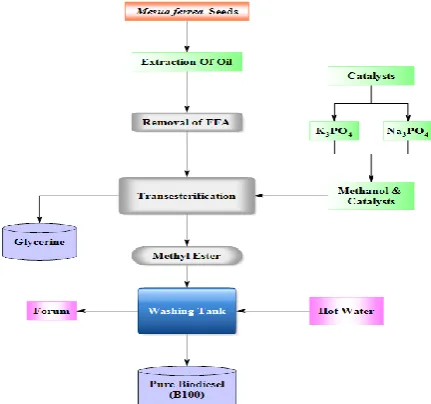
In the present examination, the biodiesel was delivered through transesterification response through lessening the viscosity of raw Mesua ferrea oil. Figure 2 portrays to the arrangement of MFOME. At first, an amount of 200 ml Mesua ferrea oil was taken in a solitary neck round glass cup and warmed up to 70oC using a heater.
Accordingly, the methanol and catalyst blend was included into the warmed oil and the condenser set is fixed at the highest point of the single neck carafe by flowing cooling water.
This solution was mixed using the magnetic pellet and the speed was kept up at 900 rpm. The examination was conducted with two distinctive soluble based catalysts (Na3PO4 and K3PO4) at various methanol to oil
molar proportion from 4:1 to10:1, catalyst amount of 1% to 1.75%, and at the reaction temperatures of 60 to 70oC
with the span of 60 minutes. The procedure was ceased after the reaction has finished and the item was permitted to settle down in isolating channel for 12 hours. Consequently, the glycerine and methyl ester were isolated with two layers comprising the upper layer as methyl ester and the lower layer as glycerine. The oil was further water washed at a temperature of 60oC to evacuate
the cleansers present in it. At long last, the methyl ester was warmed to expel the water particles present in the methyl ester [17].
Properties of KOME
MFOME was tested for physic-chemical properties as per standards namely ASTM 1298 [18], ASTM D-4808 [19], ASTM D-445 [20], ASTM D-92 [21], ASTM D-976 [22], ASTM D-97 [23], and ASTMD-130 [24]. Table 1 shows the thermo-physical properties of pure NSOME.
Figure 2. Preparation steps of MFOME
TABLE 1. The properties characterization of MFOME oil based on ASTM standards
Fuel property (units)
Method (ASTM)
Test range
MFOME
Na3PO4 K3PO4
Density at 15°C
(kg/m3) D-1298
860-900 872 869
Calorific value
(MJ/kg) D-4809 42 39.26 39.82
Kinematic Viscosity at 40°C (Cts)
D-445 2.5-6 4.6 4.4
Flashpoint (oC) D-92 130
(min) 151 149
Cetane Number D-976 47
(min) 54 54
Cloud point (oC) D-97 6 (max) -4 -4
Copper
corrosion D-130 1 (max) 1a 1a
The flash point and cetane numbers were improved which in turn results in the enhanced combustion characteristics in the diesel engine when operated with blends of standards diesel and MFOME. Further, the copper corrosion has a better grade which influences the corrosion properties. The calorific value of MFOME was observed less due to high moisture content present in the oil [25]. Also, the density and viscosity of the MFOME were observed to maintain within the ASTM standards range. All the properties obtained with Na3PO4 and
K3PO4 catalyst were contained by ASTM range.
RESPONSE SURFACE METHODOLOGY (RSM)
The numerical analysis was conceded with Design expert 11 software and the optimization analysis was attained with the help of analysis of variance (ANOVA). The optimization has been carried out for attainment of MFOME yield with three experimentation independent operating conditions of methanol to oil molar ratio (4:1, 6:1, 8:1, 10:1, and 12:1), catalyst concentration (0.75, 1, 1.25, 1.5, and 1.75%), and reaction temperature (55, 60, 65 and 70oC) using Box-Behnken design. This model
evaluates the result of every independent operating condition of the yield. The following quadratic equation was used in this model.
2 0
1 1 1 1
j j j j
i i ii i ik i k
i i i k i
Y X X X X
= = = = +
= +
+
+
(2)0
,i,ii, and
ikare the constant, the coefficient of linear term, the coefficient of quadratic term, and the coefficient of cross term, correspondingly. i and k are the linear and quadratic factors, j is the number of factors studied and optimized. Xi and Xk are independent181 RESULTS AND DISCUSSIONS
Effect of various operating parameters on MFOME yield
The MFOME yield was assessed by using two unlike catalysts and different operating parameters of reaction viz., methanol to oil molar ratio, the catalyst concentration, and reaction temperature. The parametric trends these operating parameters were discussed below. Effect of molar ratio
Figure 3 depicts the change in yield of MFOME with different methanol to oil molar ratios. It was observed that the yield of biodiesel begun with a growing trend as the ratio increased from 4:1. Further, the yield reached to maximum at a molar ratio of 8:1 and a further increase in molar ratio diminished the yield. The key cause behind the reduction in biodiesel yield at high molar ratios was that owing to the continuation of huge amount of alcohol and due to reduced chemical activity of the catalyst. Also, augment in insolubility which influences the glycerin separation.
The uppermost biodiesel yields of MFOME for Na3Po4 and K3PO4 at the molar ratio of 8:1 were found to
be 97.4 and 98.2%, respectively. Further, there was not much effect of molar ratio on biodiesel yield [17, 26].
Effect of catalyst concentration
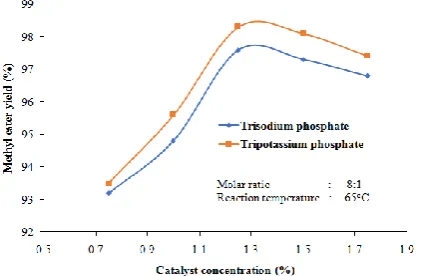
Figure 4 presents the effect of catalyst concentration on MFOME yield. At the start, the yield was increased with an increase of the catalyst concentration and reached to maximum at 1.25% for both the catalysts. The catalyst range was varied from 0.75 to 1.75 % and above 1.25% of catalyst concentration, the yield of MFOME was decreased. The reason at the back of this was that on account of lower glycerin separation which was influenced by methyl ester emulsification [17, 27].
Effect of reaction temperature
Figure 5 shows the variation in yield of MFOME at different reaction temperatures. It can be observed that an
Figure 3. Variation in yield with molar ratio
Figure 4. Variation in yield with catalyst concentration
increase in reaction temperature increased the yield of MFOME from 55 to 65oC.
The reaction rate increases with an increase in temperature up to some extent but the further increase may reduce the yield and hence it was reduced after 65oC.
The cause intended for this adds to in yield at higher temperatures because of methanol loss in extreme and emulsification of biodiesel and an extreme loss of methanol [28, 29]. Consequently, the separation of glycerine is smaller in amount which thus reduces the biodiesel yield. The maximum yield obtained was 98.8% with Na3Po4 and 99% with K3PO4 catalysts.
Model fitting using RSM
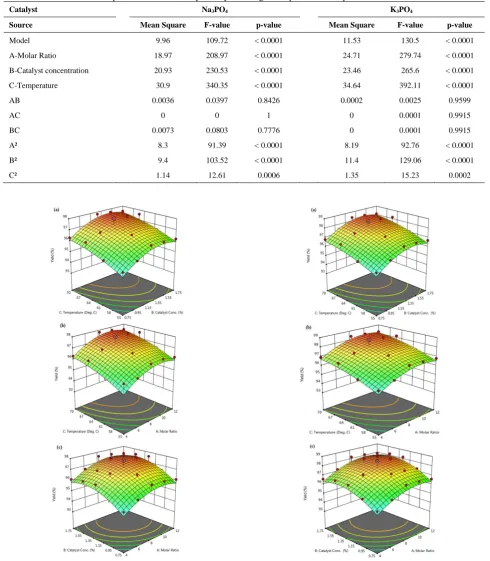
The multi-regression statistical technique was used for analyzing the relation between input responses and the output parameter (yield of biodiesel). The significance of each value is expressed in terms of p-values and F-values. The results of the second-order response surface model fitting in the form of ANOVA are given in Table 2.
Figures 6 (a)-(c) and 7 (a)-(c) show the 3D response surface connecting any two operating conditions for the quantity of methyl ester yield. It is evident from Table 2 that the model is significant. Since the F value is 109.72 and 130.5 for Na3PO4 and K3PO4, respectively. Hence,
TABLE 2. The predicted level of methyl ester yield using for response surface quadratic model ANOVA
Catalyst Na3PO4 K3PO4
Source Mean Square F-value p-value Mean Square F-value p-value
Model 9.96 109.72 < 0.0001 11.53 130.5 < 0.0001
A-Molar Ratio 18.97 208.97 < 0.0001 24.71 279.74 < 0.0001
B-Catalyst concentration 20.93 230.53 < 0.0001 23.46 265.6 < 0.0001
C-Temperature 30.9 340.35 < 0.0001 34.64 392.11 < 0.0001
AB 0.0036 0.0397 0.8426 0.0002 0.0025 0.9599
AC 0 0 1 0 0.0001 0.9915
BC 0.0073 0.0803 0.7776 0 0.0001 0.9915
A² 8.3 91.39 < 0.0001 8.19 92.76 < 0.0001
B² 9.4 103.52 < 0.0001 11.4 129.06 < 0.0001
C² 1.14 12.61 0.0006 1.35 15.23 0.0002
Figure 6. 3D representation of response surface between any two parameters for methyl ester yield for Na3PO4 catalyst (a) Reaction temperature and catalyst concentration with fixed molar ratio (8:1) (b) Reaction temperature and molar ratio with fixed catalyst concentration (1.25%), and (c) Catalyst concentration and molar ratio at fixed reaction temperature (65oC).
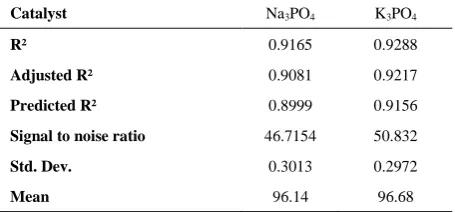
183 there is no further than a 0.01% possibility that an F-value this large may well take place as a result of noise. Smaller the F value, the model is more significant. Further, the methanol to oil molar ratios has smaller F value compared to catalyst concentration and reaction temperature. Therefore, the methanol to oil molar ratio has a significant effect on the methyl ester yield. A two-way ANOVA was used and p < 0.05 was considered for the quadratic model as statistically significant. The analogous trends were continued with both the catalysts Na3PO4 and K3PO4. The statistical regression analysis
was presented in Table 3.
The regression correlation coefficient (R2) for
Na3PO4 and K3PO4 models is 0.9165 and 0.9288,
respectively. The designated R2 values the association
between experimental and predicted values of methyl ester yield with good fittingness. The signal to noise ratio > 4 is desirable and model can be used to find the way in design space.
It can be observed from the 3D response surfaces that the yield was increased with increase in a molar ratio (up to 8:1), catalyst concentration (up to 1.25%), and reaction temperature (up to 65oC). Further increase in the
operating conditions may lead to decrease in the methyl ester yield.
The polynomial regression equations of methyl ester yield for Na3PO4 and K3PO4 catalysts are as follows:
𝑌𝑖𝑒𝑙𝑑(%) = 96.99 + 0.6160 × 𝐴 + 0.6470 × 𝐵 + 0.7458 × 𝐶 + 0.0120 × 𝐴 × 𝐵 + 0.000 × 𝐴 × 𝐶 − 0.0162 × 𝐵 × 𝐶 − 0.6886 × 𝐴2−
0.7329 × 𝐵2− 0.2408 × 𝐶2
(3)
𝑌𝑖𝑒𝑙𝑑(%) = 97.57 + 0.7030 × 𝐴 + 0.6850 × 𝐵 + 0.7896 × 𝐶 + 0.0030 × 𝐴 × 𝐵 +
0.0006 × 𝐴 × 𝐶 − 0.0006 × 𝐵 × 𝐶 − 0.6843 × 𝐴2− 0.8071 × 𝐵2− 0.2610 × 𝐶2
(4)
The coded values of test variables are A (molar ratio), B (catalyst concentration, and C (reaction temperature) while the yield (%) is the output response predicted value for the quantity of ester conversion.
TABLE 3. Statistical regression analysis of quadratic model
Catalyst Na3PO4 K3PO4
R² 0.9165 0.9288
Adjusted R² 0.9081 0.9217
Predicted R² 0.8999 0.9156
Signal to noise ratio 46.7154 50.832
Std. Dev. 0.3013 0.2972
Mean 96.14 96.68
CONCLUSIONS
The study was focused on the production of Mesua ferrea
oil methyl ester and optimization of biodiesel yields using RSM (Response surface methodology) with dissimilar operating characteristics. FFA of Masua ferrea oil was reduced to 1.2% by degumming and deodorization processes and this value is preferable for the transesterification process. The transesterification of Mesua ferrea oil with Na3PO4 and K3PO4 catalyst have
improved the reaction rates and yield of the methyl ester. The phosphate-based catalyst has shown slightly better yield due to its higher chemical reaction characteristics and K3PO4 has many reactive properties than Na3PO4.
Hence, the yield of MFOME was advanced with K3PO4.
The physico-chemical properties of MFOME were improved and hence, the MFOME blends are the better substitute to diesel for operating in the diesel engine. RMS predicted yield was observed closer as experimentally estimated biodiesel yield with the same operating conditions. The analysis of variance (ANOVA) test was shown desired correlation coefficient values for p and F-values.
REFERENCES
1. Wakil, M.A., Kalam, M.A., Masjuki, H.H., Atabani, A.E. and Fattah, I.R., 2015, Influence of biodiesel blending on physicochemical properties and importance of mathematical model for predicting the properties of biodiesel blend, Energy Conversion and Management, 94, pp.51-67.
2. Serrano, M., Oliveros, R., Sánchez, M., Moraschini, A., Martínez, M. and Aracil, J., 2014, Influence of blending vegetable oil methyl esters on biodiesel fuel properties: oxidative stability and cold flow properties, Energy, 65, pp.109-115.
3. Demirbaş, A., 2002, Biodiesel from vegetable oils via transesterification in supercritical methanol, Energy conversion and management, 43(17), pp.2349-2356.
4. Ramadhas, A.S., Muraleedharan, C. and Jayaraj, S., 2005, Performance and emission evaluation of a diesel engine fueled with methyl esters of rubber seed oil, Renewable energy, 30(12), pp.1789-1800.
5. Demirbas, A., 2009, Production of biodiesel fuels from linseed oil using methanol and ethanol in non-catalytic SCF conditions,
Biomass and bioenergy, 33(1), pp.113-118.
6. Agarwal, D., Kumar, L. and Agarwal, A.K., 2008, Performance evaluation of a vegetable oil fuelled compression ignition engine,
Renewable energy, 33(6), pp.1147-1156.
7. Cavalcante, K.S., Penha, M.N., Mendonça, K.K., Louzeiro, H.C., Vasconcelos, A.C., Maciel, A.P., de Souza, A.G. and Silva, F.C., 2010, Optimization of transesterification of castor oil with ethanol using a central composite rotatable design (CCRD), Fuel, 89(5), pp.1172-1176.
8. D’Oca, M.G.M., Haertel, P.L., De Moraes, D.C., Callegaro, F.J., Kurz, M.H., Primel, E.G., Clementin, R.M. and Morón-Villarreyes, J.A., 2011, Base/acid-catalyzed FAEE production from hydroxylated vegetable oils, Fuel, 90(2), pp.912-916. 9. Jiang, S.T., Zhang, F.J. and Pan, L.J., 2010, Sodium phosphate as
a solid catalyst for biodiesel preparation. Brazilian Journal of Chemical Engineering, 27(1), pp.137-144.
10. Guan, G., Kusakabe, K. and Yamasaki, S., 2009, Tri-potassium phosphate as a solid catalyst for biodiesel production from waste cooking oil, Fuel Processing Technology, 90(4), pp.520-524. 11. Rad, A.S., Nia, M.H., Ardestani, F. and Nayebzadeh, H., 2018,
12. Ebrahimi, S., Najafpour, G.D. and Ardestani, F., 2017, Transesterification of waste cooking sunflower oil by porcine pancreas lipase using response surface methodology for biodiesel production, Applied Food Biotechnology, 4(4), pp.203-210. 13. Komers, K., Machek, J. and Stloukal, R., 2001, Biodiesel from
rapeseed oil, methanol and KOH. 2. Composition of solution of KOH in methanol as reaction partner of oil, European journal of lipid science and technology, 103(6), pp.359-362.
14. Ali, E.N. and Tay, C.I., 2013, Characterization of biodiesel produced from palm oil via base catalyzed transesterification,
Procedia Engineering, 53, pp.7-12.
15. Ali, O.M., Mamat, R., Abdullah, N.R. and Abdullah, A.A., 2016, Analysis of blended fuel properties and engine performance with palm biodiesel–diesel blended fuel, Renewable Energy, 86, pp.59-67.
16. ASTM D6571-01, 2001, Standard Test Method for Determination of Compression Resistance and Recovery Properties of Highloft Nonwoven Fabric Using Static Force Loading, ASTM International, West Conshohocken, PA.
17. Jaikumar, S., Bhatti, S.K., and Srinivas, V., 2018, Effect of catalyst on transesterification of Niger seed oil methyl ester,
International Journal of Mechanical and Production Engineering Research and Development, 8 (3), pp.309-316.
18. ASTM D1298-12b, 2017, Standard Test Method for Density, Relative Density, or API Gravity of Crude Petroleum and Liquid Petroleum Products by Hydrometer Method, ASTM International, West Conshohocken, PA.
19. ASTM D4809-18, 2018, Standard Test Method for Heat of Combustion of Liquid Hydrocarbon Fuels by Bomb Calorimeter (Precision Method), ASTM International, West Conshohocken, PA.
20. ASTM D445-18, 2018, Standard Test Method for Kinematic Viscosity of Transparent and Opaque Liquids (and Calculation of
Dynamic Viscosity), ASTM International, West Conshohocken, PA.
21. ASTM D92-18, 2018, Standard Test Method for Flash and Fire Points by Cleveland Open Cup Tester, ASTM International, West Conshohocken, PA.
22. ASTM D976-06(2016), 2016, Standard Test Method for Calculated Cetane Index of Distillate Fuels, ASTM International, West Conshohocken, PA.
23. ASTM D97-17b, 2017, Standard Test Method for Pour Point of Petroleum Products, ASTM International, West Conshohocken, PA.
24. ASTM D130-19, 2019, Standard Test Method for Corrosiveness to Copper from Petroleum Products by Copper Strip Test, ASTM International, West Conshohocken, PA.
25. Cecrle, E., Depcik, C., Duncan, A., Guo, J., Mangus, M., Peltier, E., Stagg-Williams, S. and Zhong, Y., 2012, Investigation of the effects of biodiesel feedstock on the performance and emissions of a single-cylinder diesel engine ,Energy & Fuels, 26(4), pp.2331-2341.
26. Pukale, D.D., Maddikeri, G.L., Gogate, P.R., Pandit, A.B. and Pratap, A.P., 2015, Ultrasound assisted transesterification of waste cooking oil using heterogeneous solid catalyst, Ultrasonics sonochemistry, 22, pp.278-286.
27. Encinar, J.M., González, J.F. and Rodríguez-Reinares, A., 2007, Ethanolysis of used frying oil. Biodiesel preparation and characterization, Fuel processing technology, 88(5), pp.513-522. 28. Lin, L., Ying, D., Chaitep, S. and Vittayapadung, S., 2009, Biodiesel production from crude rice bran oil and properties as fuel, Applied Energy, 86(5), pp.681-688.
29. Alptekin, E. and Canakci, M., 2010, Optimization of pretreatment reaction for methyl ester production from chicken fat, Fuel,
89(12), pp.4035-4039.