DEMOGRAPHIC RESEARCH
VOLUME 33, ARTICLE 38, PAGES 1067–1104
PUBLISHED 17 NOVEMBER 2015
http://www.demographic-research.org/Volumes/Vol33/38/ DOI: 10.4054/DemRes.2015.33.38
Research Article
Earnings and first birth probability among
Norwegian men and women 1995–2010
Rannveig Kaldager Hart
©2015 Rannveig Kaldager Hart.
This open-access work is published under the terms of the Creative Commons Attribution NonCommercial License 2.0 Germany, which permits use, reproduction & distribution in any medium for non-commercial purposes, provided the original author(s) and source are given credit.
1 Introduction 1068
2 Theoretical perspectives on earnings and the transition to
parenthood
1069
2.1 A rational choice perspective on couples’ fertility choices 1069
2.2 Union entry and stability as a mediator 1072
3 Theoretical perspectives on change over time in Norway 1073
4 Method and data 1075
4.1 Data 1075
4.2 Method 1076
4.3 Variables 1076
5 Results 1078
5.1 Results from main specification 1082
5.2 Changes over time 1083
5.3 Specification checks 1085
5.4 Study limitations 1086
6 Discussion and conclusion 1087
7 Acknowledgements 1090
References 1091
Appendix A: Additional figures and tables 1097
Earnings and first birth probability among Norwegian men and
women 1995–2010
Rannveig Kaldager Hart1
Abstract
BACKGROUND
The relationship between earnings and fertility and how it varies with context are among the core investigations of demography. Cross-country comparisons show that when parenting and employment are in conflict, this relationship is less positive for women. We lack knowledge of how this relationship is shaped by context for men and how it varies with contextual changes over time rather than between countries.
OBJECTIVE
I investigate how the relationship between earnings and first-birth probability changes over time for men and women, in a period when efforts in parenting and paid work become increasingly similar across sex.
METHODS
Discrete-time hazard regressions are applied to highly accurate data from Norwegian population registers. Through estimation of separate models for each of the years 1995 through 2010, I assess whether the correlation between yearly earnings and the first birth probabilities changed over period time. The correlation is estimated net of observable confounders, such as educational enrolment and attainment and region of birth.
RESULTS
The correlation between earnings and fertility has become substantially more positive over time for women, and also somewhat more positive among men.
CONCLUSIONS
Though the potential opportunity cost of fathering increases, there is no evidence of a weaker correlation between earnings and first birth probability for men. I suggest that decreasing opportunity costs of motherhood as well as strategic timing of fertility are both plausible explanations for the increasingly positive correlation among women.
1. Introduction
The relationship between female earnings and fertility is context dependent. Cross-country comparisons indicate that in contexts with weak institutional support for families and/or gender traditional division of labour in the family, a conflict between employment and childbearing leads to a negative relationship between earnings and fertility for women. As the institutional support for families increase and/or the division of labour in the family becomes more gender equal, employment facilitates the transition to motherhood for women, and a positive correlation between female earnings and fertility emerges (Andersson, Kreyenfeld, and Mika 2014; Berninger 2013; Matysiak 2011). The fact that employment comes to facilitate the transition to motherhood is among the main explanations suggested for the shift to a positive correlation between human development and fertility found in macro-level analysis (Luci-Greulich and Thévenon 2014; Myrskylä, Kohler, and Billari 2009). However, no previous study has used micro-level data to assess how the correlation between earnings and fertility responds to changes over time in gender relations and the institutions surrounding the family.
As common in fertility research, women have been the focal persons in studies of earnings and fertility (Goldscheider and Kaufman 1996). Knowledge of how context shapes the relationship between men’s earnings and fertility is therefore limited. Over the last few decades, the time fathers spend with their young children has increased substantially, particularly in the Nordic countries (Dribe and Stanfors 2009; Hook 2006; Kitterød and Rønsen 2013). As men spend an increasing amount of time on childrearing, a conflict between fathering and career development may emerge, potentially inducing some high-earning men to forgo fatherhood. If so, the correlation between men’s earnings and fertility is expected to become less positive over time. 2
Norway constitutes a prime example of convergence of gender roles in the family and workplace. Since the 1980s, mothers have increased their efforts in paid work, while fathers have increasingly participated in household work (Kitterød and Rønsen 2013). As these changes play out, the relationship between earnings and fertility may be affected: Previous comparative studies lead to the expectation that the relationship between female earnings and fertility will become more positive as women’s opportunity cost decreases, while the relationship between male earnings and fertility becomes less positive due to the increasing opportunity cost of childbearing for men.
2 The mechanisms discussed throughout the paper are not expected to depend upon the sign of the correlation
Using data from Norwegian administrative registers, I study the way the correlation between lagged annual earnings and first birth probability changes in the period 1995 to 2010. The study is based on highly accurate register information on the annual earnings and first births of all Norwegian men and women who at some point in the period from 1995 to 2010 were both in the age range 22–45 and at risk for a first birth (N~ 8 million person years). I estimate the correlation between earned income and the yearly probability of entering parenthood using discrete time hazard regression. The extraordinarily rich data set allows one to describe changes over time separately, by sex, through estimation of separate models by year and sex.
2. Theoretical perspectives on earnings and the transition to
parenthood
The correlation between earnings and fertility is driven by two main mechanisms: His and her current earnings may affect a couple’s fertility decisions, and earnings may affect the propensity to enter and dissolve unions. This section first outlines a theoretical framework for the impact of earnings on couples’ fertility decisions, taking rational choice theory (i.e. the microeconomic theory of fertility) as a starting point. I expand upon previous research by explicitly addressing rational choice theories of fertility timing. While rational choice theories are typically developed under the assumption of gender specialisation, I pay particular attention to the relevance of these theories in contexts where gender specialisation is, at most, partial (Kitterød and Rønsen 2013). Finally, I briefly discuss how union entry and stability could mediate the impact of earnings on fertility.
2.1 A rational choice perspective on couples’ fertility choices
weak for men, and high-earning men are expected to have more children than low-earning men due to the income effect.3 However, the amount of resources spent on each child is expected to increase along with income, weakening the positive relationship between income and fertility among men (Becker 1991).
While the rational choice theory of fertility in its original form addressed completed fertility, the topic of this study is the transition to parenthood – both whether and when a first child is born. While theories of completed fertility may remain relevant, theories of fertility timing are particularly important, and I refer to empirical studies of the transition to first birth unless otherwise mentioned. A key idea in theories of fertility timing is that, all else equal, it would be optimal to postpone the transition to parenthood to the end of the fecund years, when earnings are highest (Happel, Hill, and Low 1984; Hotz, Klerman, and Willis 1997, see also Polachek 2008:192 for a description of earnings development over age).4 Consumption smoothing motivates this postponement; when fertility is postponed until earnings are high, couples can spend money on childrearing without reducing other consumption to a very low level.5 Presumably, individuals with higher earnings in a given year will more often be near a peak in their earnings curve. This leads to the expectation that individuals with high current earnings will be more likely to enter parenthood, as their current utility loss from consumption reduction will be comparatively low. In line with the expectations from this theory, a qualitative study of economic security and childbearing in Norway indicates that couples prefer to postpone childbearing until earnings are relatively high in order to maintain a relatively high living standard after children are born (Ellingsæter and Pedersen 2013).
Fertility timing decisions may also aim to minimize the negative effect of childbearing on earnings both in the short and the long term (Gustavsson 2001). Short-term effects of childbearing on earnings are driven by the fact that (at least one of the) parents usually withdraws from the labour market for a short period to care for infants (and to some extent for toddlers). The immediate cost of such labour market withdrawal increases with wages, making for a negative correlation between earnings and the probability to enter parenthood. However, this immediate cost may to a large extent be compensated by family policies: Parental allowance schemes with full income replacement allow a parent to stay home with a child for a certain period of time (almost) without any (immediate) monetary costs, and availability of subsidized high-quality child care for toddlers contributes to speed up the return to work after that period. If both of these arrangements are in place, the immediate monetary cost due to
3 This holds as long as children are «normal goods», that is, goods for which demand increases with income.
4 This restriction applies if one cannot borrow freely against the future.
5 The utility loss from consumption reduction decreases with income level (given decreasing marginal returns
temporary job interruptions will be (close to) zero, and considerations regarding the long-term effects of childbearing on wages may be given more weight in fertility decisions.
The long-term negative effects of childbearing on wage development is commonly explained by the fact that childbearing hinders new investment in human capital – and/or reduces the value of human capital already accumulated (Even 1987). Empirical studies indicate that postponing motherhood until a level of career maturity is reached reduces the total wage penalty of motherhood (Buckles 2008; Miller 2011; Taniguchi 1999; Wilde, Batchelder, and Ellwod 2010).6 On a similar note, Matysiak (2011) finds that Polish women prefer to establish a foothold in the labour market before they have a first child. In sum, to the extent that higher earnings indicate career maturity, attempts to minimize long-term wage penalties may contribute to a positive correlation between earnings and first birth probability. This corresponds to the more sociological notion that men and women prefer an ordering of life course transitions where a foothold in the labour market is established before the first child is born. As pointed out by, e.g., Vosko, MacDonald, and Campbell (2009), low earnings and precarious work are strongly interlinked, and lower (perceived) job security is again linked to fertility postponement (Kreyenfeld 2010). Hence, higher earnings may also serve as a proxy for higher job stability.
The relationship between current earnings and first birth risk is further complicated by the fact that the wage penalty for early childbearing may increase with expected lifetime earnings. Qualitative evidence from Norway supports the notion that more career oriented women are more inclined toward postponing fertility until they have accumulated work experience than are women who are less career oriented (Ellingsæter and Pedersen 2013). Possibly, women on high-earning tracks, employed in “career jobs”, face relatively larger wage penalties for early childbearing. If the penalty for early childbearing is largest for women with high life time earnings, women with high current earnings may be more likely to postpone parenthood than women with lower earnings. Such heterogeneous postponement would make the correlation between earnings and fertility more negative. This stands in contrast to uniform postponement – as outlined in the previous paragraph – which would contribute to a positive correlation between earnings and fertility.
In the above, I have outlined two possible drivers of a positive correlation between earnings and first birth probability: Higher earnings means that it is less straining to reduce consumption of other goods upon the birth of a child, and may also indicate that
6 Different theoretical mechanisms could explain such a postponement premium. One possible explanation is
that motherhood implies a long-term wage growth penalty – a penalty that would be smallest relatively late in
the career when the wage would not increase much anyway (Gustavsson 2001). Another explanation is that
a foothold is established in the labour market, which may in turn reduce the long-term wage penalty of childbearing. Two mechanisms pull in the opposite direction, making the correlation between earnings and fertility more negative. As the opportunity cost of childbearing increases with earnings, some high-earning individuals may prefer not to have a child. Additionally, to the extent that individuals with high earnings over the life course have a preference for delayed childbearing, this will also contribute to a less positive correlation between earnings and first birth probability.
Finally, anticipatory effects may shape the correlation, and expectedly vary by sex: Norwegian men who eventually become fathers tend to sort into higher-earnings sectors and occupations, a behaviour that could be motivated by anticipated provider responsibilities (Petersen, Penner, and Høgsnes 2011). For women, the expected direction of the anticipatory effects is less clear: On one hand, the setup of the Norwegian parental leave system encourages women to increase their efforts in paid work before having a child. On the other hand, qualitative studies show that Norwegian women shift to jobs with higher family compatibility (sometimes implying lower earnings) when planning a first child (Halrynjo and Lyng 2009; Pedersen 2014). In sum, anticipatory effects are likely to make the correlation more positive for men, while they could push the correlation for women in either direction.
In the Nordic context, the mechanisms driving a positive correlation between earnings and fertility dominate mechanisms pulling in the opposite direction, as the correlation between annual earnings and the probability to enter motherhood is consistently found to be positive (Andersson 2000 (Sweden); Andersson, Kreyenfeld, and Mika 2014 (Denmark); Berninger 2013 (Denmark and Finland); Jalovaara and Miettinen 2013 (Finland); Kravdal 1994 (Norway)); Vikat 2004 (Finland)). However, it should be noted that studies of the transition to parenthood using predicted wages rather than observed earnings have found significant negative effects for Norway: Rønsen (2004) finds an overall negative effect, and Kornstad and Rønsen (2014) find significant negative effects of wages at the average level or lower. For men, Lappegård, and Rønsen (2013) and Jalovaara and Miettinen (2013) find positive correlation between annual earnings and the transition to parenthood, while some older Swedish studies find an insignificant (Heckman and Walker 1990) or even, in some specifications negative effects (Taşiran 1995).
2.2 Union entry and stability as a mediator
Selecting the sample on union status implies conditioning on an endogenous variable, which could both net out part of the total impact of earnings on fertility and introduce further selection bias in the model (Winship and Elwert 2014). The following section outlines theoretical perspectives on the role of union entry and stability as a mediator of the earnings-fertility relationship.
Earnings are important for union entry partly because the spouses cover the costs of childbearing and various other expenses together: A high-earning partner can contribute more to the (monetary) cost of childbearing, giving a higher overall material living standard. While the theory of gender specialisation (Becker 1991) predicts that only women prefer a high-earning partner, the theory of pooling of resources (Oppenheimer 1997, 2003) suggests that this preference holds across sexes. In the Nordic context, empirical studies show a positive impact of earnings on union entry for both men (Petersen, Penner, and Høgsnes 2011; Sweeney 2002) and women (Bracher and Santow 1998; Jalovaara 2012), overall lending support to the theory of pooling of resources. The results for union dissolution are more mixed: A similar earnings level between cohabiting spouses is correlated with reduced risk of union dissolution (Brines and Joyner 1999; Jalovaara 2013; Kalmijn, Loeve, and Manting 2007), while his higher earnings protect against divorce and her higher earnings elevates the divorce risk (Lyngstad 2004 for Norway; Jalovaara 2003 for Finland). In sum, higher earnings are expected to facilitate union entry and stability across sex – though slightly more for men than for women – contributing to a positive correlation between earnings and the transition to parenthood.
3. Theoretical perspectives on change over time in Norway
In the period of study (1995–2010) father’s involvement has increased substantially in Norway. From 1990 to 2010, fathers increased the time spent on household work with 20%, or 35 minutes per day (Kitterød and Rønsen 2013:18). In 1993, one month reserved exclusively for the father was added to the parental leave, and in the period 1993–2003, more than 70% of Norwegian men took at least some leave when their first or second child was born (Duvander, Lappegård, and Andersson 2010). Though the career breaks often were relatively short, Rege and Solli (2013) find that the father’s quota caused significant reduction in men’s long term earnings.7 Furthermore, men with higher earnings were slightly more likely to use the fathers’ quota (Lappegård 2008). In the same period, Cools and Strøm (2014) find evidence of a fatherhood wage penalty emerging in the private sector. Taken together, this indicates that the substitution effect
7 However, see Cools, Fiva, and Kirkebøen (2015) for a counterexample using a more conservative
has become stronger for men in the period of study. This could induce some high-earning men to not enter parenthood – a development that would make the correlation between earnings and fertility less positive for men. However, it is not obvious that men will take this relatively small substitution effect into account in their fertility decisions (see, e.g., Ellingsæter and Pedersen 2013). If not, we expect a stable correlation between earnings and fertility for men across the period of study.
Some trends indicate that the long-term negative effects of childbearing on women’s lifetime earnings may have decreased over time: The combination of a slight decrease in the time mothers of small children spend on care work and an observed increase in mothers’ labour supply (Kitterød and Rønsen 2013) indicates that mothers have shifted their efforts, to some extent, from home production to market production in the period of study. There is evidence that mothers return to work increasingly early after childbirth towards the end of the period of study – indicating that the human capital loss caused by the birth of a child decreases over time (Rønsen and Kitterød 2014). One plausible explanation for the increase in mothers’ labour supply is the massive expansion of available publicly subsidized childcare in the period of study, a development also shown to increase fertility among women whose opportunity costs of childbearing are high (Rindfuss et al. 2010). In sum, these developments lower the opportunity cost of childbearing, which may induce some high-earning women who would otherwise have remained childless, to have a first child, making the correlation between women’s earnings and chance of first birth more positive.
Previous studies found substantial earnings homogamy between partners (see e.g., Schwartz 2010 for the US, Nakosteen, Westerlund, and Zimmer 2004 for Sweden), and an increase in such assortative mating over time (Schwartz 2010). If high-earning men increasingly partner with high-earning women, and the correlation between women’s earnings and fertility becomes more positive, this should also contribute to an increasingly positive correlation between men’s earnings and first birth risk over time.
Finally, there are some indications that the monetary cost of childbearing has increased in the period of study. The value of cash transfers to parents has declined relative to real earnings, effectively increasing the monetary cost of childrearing.8 Some studies also indicate that spending on children has increased (Kornrich and Furstenberg 2013). In the Norwegian context, characterized by strong norms toward home
8 Child allowances (not means tested) are given from the first child. In the early 1990s, child allowances made
a substantial contribution to covering the monetary cost of childbearing. Since then, the absolute value of child allowances has remained virtually unchanged. After adjustment for price growth, the purchasing value
of the child allowances has declined in the period of study. Mothers who have not earned rights to parental
leave allowance receive a lump-sum transfer upon birth(“engangsstønad”). After a marked increase in the
ownership and high real estate prices, housing costs make up a substantial amount of the monetary cost of childbearing. The almost linear increase in housing prices in the period of study has thus likely raised the monetary costs of childbearing.9
If the monetary cost of childbearing increases, individuals may increasingly prefer to have a child at a time point when their earnings are high. This development may also imply that women with higher earnings potential are increasingly attractive as partners, making the correlation between earnings and fertility more positive for women especially (see Oppenheimer (1997) for a discussion of this). In sum, both changing gender-relations, as well as the increasing monetary cost of children, are expected to make the correlation between earnings and fertility increasingly positive for women over time. For men, new fathering practices are likely to make for a less positive correlation between earnings and fertility, while the increasing monetary costs of childrearing and assortative mating on earnings pulls the correlation in the opposite direction. Whether one of these mechanisms dominates the other, or the two mechanisms cancel each other out, thus remains an empirical question.
4. Method and data
4.1 Data
The analysis is based on data on births, earnings, unemployment benefits, health related benefits, and educational attainment and enrolment taken from administrative registers. Our starting point is men and women who resided in Norway in 2010. The data set is restricted to persons who have at least one Norwegian-born parent, are born in Norway, and have resided continuously in Norway from their birth year.10 In Norway, high school (academic track) is completed at age 19, and higher earnings before age 20 may thus indicate high withdrawal for school rather than higher earnings potential. For validity of the earnings measure, earnings are measured from age 20 only, meaning that the outcome is observed from age 22 onwards. As Norwegian men and women have very low fertility in their teens and early 20s, the sample is still observed through their main years of childbearing.11 First births are observed in the period 1995–2010, and observations are censored at whatever occurs first of a first birth, age 45 or calendar year 2010.
9 http://www.ssb.no/en/statistikkbanken, Table 07230, House price index, whole country.
10 The latter restriction is due to excessive missingness on the earnings variable, likely to be related to
unregistered outmigration, see below.
11 www.ssb.no/en/statbank, Table 08555 “Age-specific fertility rates”, and Table 08452 “Age specific fertility
4.2 Method
Discrete-time hazard regression models for first birth rates are estimated with the baseline rate (hazard) specified as a linear spline with 5-year knots. After data are transformed into person years, logistic regression models are estimated in Stata, using the logit command. The prefix mi impute is added for models run on imputed data. For ease of interpretation and comparability with similar studies, results are presented on odds scale. As odds ratios are vulnerable to changes in unobserved variance between samples, I have also estimated marginal effects for the main results, as these are not vulnerable to bias from such changes (Mood 2010).
4.3 Variables
The earnings variable is based on information reported to the tax authorities, taken from Statistics Norway’s Tax Reports Registry (Selvangivelsesregisteret), which covers all individuals taxing to Norway (Steinkellner 2003). Earnings are defined as the sum of earnings from employment, and primary and secondary business income. Primary or secondary business income typically stems from self-employment, an alternative or supplement to wage earnings: working in fisheries or forestry generates household income through efforts that alternatively could have been channelled into wage labour. Omitting income from these sources would mean that many “zero earners” actually make a substantial amount of money through own work. Hence, for a valid measure of earnings potential and capacity, these types of incomes are included in the variable. The variable is still referred to as “earnings” for brevity.
Earnings quintiles are calculated based on the position in the earnings distribution relative to all individuals (i.e., both parents and (currently) childless persons) of the same sex and age in the same year. Individuals who have reported zero earnings to the tax authorities are included in the calculation of quintiles, and all fall in the lowest quintile. Calculations are done separately by year and age to avoid contamination from period and age effects.
imperfect, this indicates that these individuals are not actually living in (or at least not taxing to) Norway in all the years they are registered as Norwegian residents (“bosatt”). As the tax data seemingly is a less reliable indicator of earnings potential in this group, individuals who have changed residence code after the year they were born are excluded from the study sample.12 The main model is estimated with imputed values for missing earnings. I use multiple imputations by way of the Stata command mi impute (details described in Appendix B). Results taking missing values as a separate category are shown in Appendix A (Figure A1).
Potential confounders are included in the empirical model to net out spurious elements of the association between earnings and first birth probability. Being enrolled in full-time education reduces earned income (as less time is allocated to paid work), and also reduces the probability of having a child for reasons unrelated to earnings. To capture full-time education rather than participation in shorter courses, educational enrolment is defined as enrolment for at least 4 months of the previous year. Educational attainment also affects earnings as well as fertility decisions (see e.g., Kravdal and Rindfuss 2008; Lappegård and Rønsen 2005), and is therefore included in the model. Unemployment may affect fertility through reducing income, but also through creating uncertainty about future economic prospects (see e.g., Kreyenfeld 2010). To avoid that such effects of unemployment are captured by the earnings estimates, a control for reception of unemployment benefits is included. A dummy for receipt of disability pension or rehabilitation transfers was constructed to capture health limitations that affect earnings potential, as such health limitations may affect childbearing probabilities through channels other than reduced earnings.13 As fertility and earnings level both change over time, period is a potential confounder. This is handled either through including a set of dummy variables for period as controls (Model 1) or by running regressions separately by calendar year (Model 2). Finally, a set of dummies for region of birth is included, to capture regional variation in earnings level and fertility that may confound the estimates for earnings.14
A couple’s decision to get married may result from an intention to have a first child, and if so, a control for marital status would be a control for an intention to have a child (see Rindfuss and St. John (1983) for a discussion of this). Including marital status in the model would then control out any indirect effect of earnings potential on fertility that is mediated by marriage. For this reason, controls for marital status are
12
Individuals who live or work abroad for a year or less typically do not change residence code, and are hence not excluded.
13 The health dummy is based on a measure from FD Trygd, which includes old age pensions as well as child
allowances. However, as childless persons under age 50 do not have the right to neither of these additional benefits the measure constitutes a fairly good proxy for reception of health benefits in this group. “Sykepenger”, which is given for the first year of sickness absence, is included in the earnings variable.
omitted from the main results. A covariate for marital status could also make comparisons over time less clear, as the proportion of births to (unmarried) cohabiters increase over the period of study (Noack 2010:30). However, I have also estimated models with controls for being married (lagged with two years), as well as a separate model for individuals who are registered as married, to investigate if earnings have importance for the transition to parenthood also after partnership formation.
5. Results
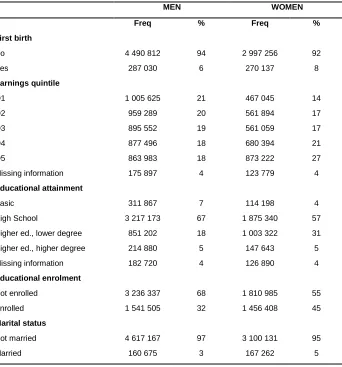
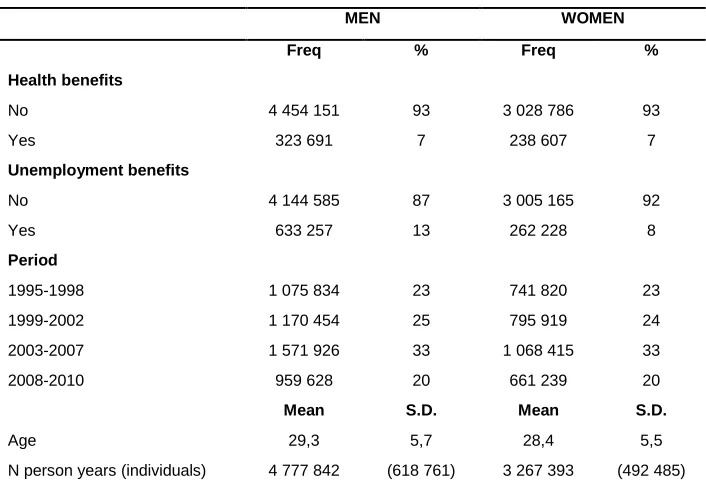
Summary statistics of person years are shown in Table 1. The study sample consists of 4, 777, 842 person years for men and 3, 267, 393 person years for women, with 287, 030 and 270, 137 events (first births) respectively. This amounts to a mean yearly probability of first birth of 6 per cent among men, and 8 per cent among women. In a relatively large per cent of the person years (32 per cent among men and 45 per cent among women) the individual was enrolled in education for at least four months. Men are more likely than women to have received unemployment benefits in any given year (13 versus 8 per cent).
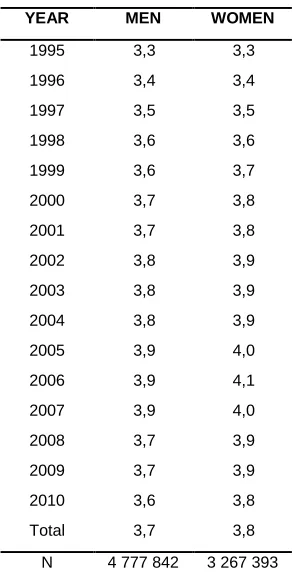
Because earnings quintile is calculated based on the position in the earnings distribution relative to all persons of the same sex and age – not just the (still) childless individuals in the study sample – the earnings quintile groups in the study sample are of uneven size. It should be noted that while individuals with zero earnings are included in the calculation of earnings quintiles (and all grouped into the first earnings quintile); individuals for whom information on earnings is not available are not. As shown in Appendix A, Table A1, information of earnings is lacking in approximately 4 per cent of the sample, with small variations by year.
Mean earnings increased over period in all parts of the earnings distribution, but the absolute increase is highest in the highest earnings quintile (results not shown). Thus, both purchasing power and earnings inequality increase over time.15 This development stands in contrast to the stable or declining value of cash transfers through the period of study (as described in Section 3). As the value of earnings and earnings-based benefits (such as parental leave allowance) increases relative to the value of cash transfers, earned income could become increasingly important for the transition to parenthood.
15 Due to the sample selection criteria, the mean age increases over period. This in turn contributes to an
Table 1: Summary statistics – person years
MEN WOMEN
Freq % Freq %
First birth
No 4 490 812 94 2 997 256 92
Yes 287 030 6 270 137 8
Earnings quintile
Q1 1 005 625 21 467 045 14
Q2 959 289 20 561 894 17
Q3 895 552 19 561 059 17
Q4 877 496 18 680 394 21
Q5 863 983 18 873 222 27
Missing information 175 897 4 123 779 4
Educational attainment
Basic 311 867 7 114 198 4
High School 3 217 173 67 1 875 340 57
Higher ed., lower degree 851 202 18 1 003 322 31
Higher ed., higher degree 214 880 5 147 643 5
Missing information 182 720 4 126 890 4
Educational enrolment
Not enrolled 3 236 337 68 1 810 985 55
Enrolled 1 541 505 32 1 456 408 45
Marital status
Not married 4 617 167 97 3 100 131 95
Table 1: (Continued)
MEN WOMEN
Freq % Freq %
Health benefits
No 4 454 151 93 3 028 786 93
Yes 323 691 7 238 607 7
Unemployment benefits
No 4 144 585 87 3 005 165 92
Yes 633 257 13 262 228 8
Period
1995-1998 1 075 834 23 741 820 23
1999-2002 1 170 454 25 795 919 24
2003-2007 1 571 926 33 1 068 415 33
2008-2010 959 628 20 661 239 20
Mean S.D. Mean S.D.
Age 29,3 5,7 28,4 5,5
N person years (individuals) 4 777 842 (618 761) 3 267 393 (492 485)
Table 2: Model 1. Discrete time hazard regression of the (conditional) yearly probability of having a first child. Odds ratios.
95% confidence intervals in brackets
Men Women
O.R. (95% C.I.) O.R. (95% C.I.)
Earnings quintile
(ref=Q1)
Q2 1,47 (1,45 - 1,49) 1,24 (1,21 - 1,26)
Q3 1,92 (1,89 - 1,95) 1,67 (1,63 - 1,70)
Q4 2,31 (2,28 - 2,35) 2,18 (2,14 - 2,22)
Q5 2,67 (2,63 - 2,71) 2,50 (2,46 - 2,55)
Educational attainment
Table 2: (Continued)
Men Women
O.R. (95% C.I.) O.R. (95% C.I.)
High School 0,96 (0,95 - 0,98) 0,90 (0,88 - 0,92)
Higher ed., lower degree
1,06 (1,04 - 1,07) 0,97 (0,94 - 0,99)
Higher ed., higher degree
1,18 (1,16 - 1,21) 1,15 (1,12 - 1,19)
Educational enrolment (ref=Not enrolled)
Enrolled 0,91 (0,90 - 0,92) 0,82 (0,81 - 0,83)
Health benefits
(ref=No)
Yes 0,60 (0,59 - 0,62) 0,77 (0,75 - 0,79)
Unemp. benefits
(ref=No)
Yes 1,05 (1,04 - 1,07) 1,21 (1,19 - 1,22)
Ln(aggr. unemp.) 1,09 (1,07 - 1,12) 1,11 (1,08 - 1,14)
Period
(ref = 1995-1998)
1999-2002 0,93 (0,92 - 0,95) 0,96 (0,95 - 0,98)
2003-2007 0,90 (0,89 - 0,91) 0,96 (0,94 - 0,97)
2008-2010 0,99 (0,97 - 1,01) 1,03 (1,01 - 1,05)
Constant 0,00 (0,00 - 0,00) 0,00 (0,00 - 0,00)
N person years 4 777 842 3 267 393
Events 287 030 270 137
5.1 Results from main specification
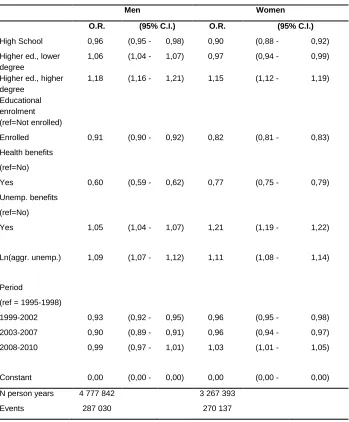
Parameter estimates from a discrete time hazard regression of the probability of a first birth, estimated for the full study sample (Model 1), are shown in Table 2 as odds ratios. For men (Model 1a), the coefficients show that the mean yearly first birth probability increases monotonously with earnings: the highest first birth probability is found in the fifth (highest) earnings quintile, and the lowest first birth probability is found in the first (lowest) earnings quintile (reference category). When moving from the first to the fifth earnings category, the odds of having a first birth increases with a factor of 2,7. For women, a similar pattern emerges (Model 1b): The odds of having a first child in a given year is 2,5 times higher in the highest earnings quintile than in the lowest. The coefficients for women are slightly – and significantly – smaller than the coefficients for men.
The directions of the parameter estimates of the control variables are largely as expected. It is noteworthy that the estimates change little, and rarely significantly, when the control variables are added consecutively (not shown). The estimates for reception of health benefits is negative across sexes, indicating that health problems leads to postponement of fertility for women as well as men. Reception of unemployment benefits the previous year is positively correlated with first birth probability across sex, though substantially and significantly more so for women. The positive correlation for women echoes findings from Denmark (Kreyenfeld and Andersson 2014) and Norway (Kravdal 2001, among women not enrolled in education). However, both these studies find negative correlations for men. The detailed controls for earnings included in this study likely to contribute to the diverging findings: While unemployment expectedly lowers male fertility through weakening the income effect, the estimates of this study capture the impact of unemployment net of income. Furthermore, the measure of unemployment is based on reception of any unemployment benefits in the given year, rather than begin economically inactive. Jalovaara and Miettinen (2013) finds weak effects of such periods of unemployment on the transition to parenthood, while being economically inactive is substantially more important.
5.2 Changes over time
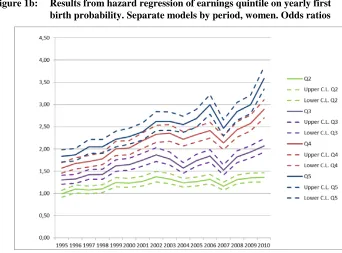
In Section 3, I argued that the correlation between earnings and fertility is expected to become increasingly similar across sex over period, because the correlation becomes more positive for women and/or because the correlation becomes less positive for men. In this section, I test the hypothesis of change over (period) time by estimating Model 1a and b separately by period, allowing the effect period and sex and all other independent variables to vary by year. Results from 16 separate period regressions are shown in Figure 1a (men) and 1b (women). A table with all year-specific estimates and 95 per cent confidence intervals is found in the Appendix (Table A2 and A3). To be sure that the estimates are not biased by differences in unobserved variance across models (Mood 2010), I also calculate average marginal effects (see section 5.3).16 Reassuringly, these display a similar pattern of change over time.17
16 As Average Marginal Effects are not defined for imputed samples (http://www.stata.com/manuals13/
mimiestimatepostestimation.pdf), the marginal effects are calculated for the non-imputed data set. As imputation gives virtually no change in the parameter estimates, indicating that there is very little bias from missingness in the original data set (Section 5.3), specification checks on the non-imputed data set should also be valid.
17 However, while the pattern of change over time within each sex is the same when estimated by marginal
effects, comparison of the level of the correlation across sex changes somewhat. As estimated by AME, the
correlation is comparable across sex at the beginning of the period. With a similar starting point, a stronger increase for women than for men (as seen with the odds ratios) leads to more positive estimates for women than for men at the end of the period. Omitted variables uncorrelated with the predictor will bias odds ratios towards zero (Mood 2010:71) Hence, a substantially larger proportion of unexplained variance in the female sample could in itself drive odds ratios closer to zero. The AME are unaffected by differences in unexplained variance across samples (Mood 2010). To avoid making substantive interpretations of statistical artefacts, I
comment on differences in the change in the correlation by sex (which are similar for OR and AME), rather
than on differences in the level of the correlation by sex (for which OR and AME give slightly different
Figure 1a: Results from hazard regressions of earnings quintile on yearly first birth probability. Separate models by period, men. Odds ratios
Note: For each year, the study sample consists of women born 1960-1988 and aged 22-45 years, who are childless at the start of the year. All models include controls for educational attainment and enrolment, reception of unemployment benefits in the previous year, reception of health benefits in the previous year, and dummies for region of births. All explanatory variables are lagged with two years. Missing values for earnings and educational attainment are imputed by multiple imputation.
Figure 1b: Results from hazard regression of earnings quintile on yearly first birth probability. Separate models by period, women. Odds ratios
Note: For each year, the study sample consists of men born 1960-1988 and aged 22-45 years, who are childless at the start of the year. All models include controls for educational attainment and enrolment, reception of unemployment benefits in the previous year, reception of health benefits in the previous year, and dummies for region of births. All explanatory variables are lagged with two years. Missing values for earnings and educational attainment are imputed using multiple imputation.
In the period of study, fathers have become increasingly involved in childrearing, and mothers have increased their efforts in paid work. Though these changes could be expected to lead to both a less positive earnings-fertility correlation for men and a more positive earnings-fertility relationship for women, the empirical results confirm the latter expectation only.
5.3 Specification checks
all age groups, and strikingly similar across age. Hence, the proportional hazard assumption does not seem to be violated.
As indicated in Section 2, partnership formation is an important mechanism linking earnings and fertility. As union status is a potentially endogenous covariate, it is omitted from the main results. To better understand the mechanisms driving the results, I also estimate Model 1 with a control for being married, lagged with two years (i.e. measured in the same year as the other predictors). As expected, the coefficient for being married is strong and positive (Appendix A, Table A4 Model A). However, relative to the Model 1 (Table 2), the coefficient for earnings quintile is only weakly reduced among men, and virtually unchanged for women. Hence, mechanisms other than partnership formation are important for the relationship between earnings and first birth risk. Note, however, that many of the unmarried individuals will be living with a partner, so that the covariate for being married captures only part of the partnership process.
Furthermore, Model 1 is estimated for the subsample of married men and women (Appendix A, Table A4 Model B).18 Though the earnings estimates are substantially reduced in magnitude in this subgroup, their direction is unchanged, and earnings remain an important predictor of fertility behaviour in the married subsample, as well. These results indicate that selection into partnership is among the mechanisms linking earnings level and first-birth rate, but not the only one.
The main results are estimated with imputed values for earnings and education when missing. I have also estimated models on a non-imputed data set, using a separate category for missing values on the earnings variable. These results are displayed as Average Marginal Effects in Appendix A (Figure A1). When displayed on odds scale (available upon request), the estimates are virtually identical to those obtained after multiple imputation. Across sex, results for the group with missing earnings are imprecisely estimated due to small sample size. For men only, there is a tendency of lower fertility among men with missing earnings, supporting the expectation that missing earnings is linked to lower earnings potential.
5.4 Study limitations
I have chosen to use actual, rather than predicted, earnings as a measure for earnings potential. Though using actual earnings has several advantages, it comes at the cost of underestimating the price of time for individuals who work less than full time. As women are more likely than men to work part time, this underestimation of the price of
18 As “unmarried” includes both cohabitors and single individuals, union status is not unambiguous for this
time may be more severe in the female sample than in the male. It should further be noted that the estimates do not have a causal interpretation, as unobservable characteristics may affect both earnings and fertility. However, the estimated coefficients give an unbiased estimate of the (conditional) correlation between annual earnings and first birth probability. Studying changes in this correlation over time and across sex casts light on how the interlinkages between earned income and fertility behaviour depend on context.
6. Discussion and conclusion
This study has assessed how the relationship between annual earnings and yearly first birth probability changes in a period when mothers increase their effort in paid work and fathers increase their efforts in childrearing. The results show that the positive correlation between annual earnings and first birth probability strengthens more over time for women than for men. The results for women corroborates the findings from cross-country comparisons, showing that the correlation between earnings and fertility is more positive for women in contexts where motherhood is compatible with pursuing a career (Andersson, Kreyenfeld, and Mika 2014; Berninger 2013, see also Matysiak 2011). No previous study has addressed how context shapes the relationship between earnings and first birth probability for men. The current study indicates that while the relationship between earnings and fertility is shaped by context among women, this is to a lesser extent the case among men.
In Section 2.1, I suggested that a negative correlation could emerge in the female sample if women enter parenthood at a time in the life course when earnings are relatively low, reducing the immediate opportunity cost of childrearing. As the correlation estimated for women is positive, data do not yield support for this explanation. I also suggested that a negative correlation would emerge if individuals on high earning trajectories were more likely to postpone childbearing than individual on low earning trajectories (heterogeneous postponement). Though it cannot be ruled out that such patterns of heterogeneous postponement exist, their impact, if any, on the correlation between earnings and fertility is cancelled out by mechanisms pulling in the opposite direction. Furthermore, heterogeneous postponement would be expected to lead to a negative relationship between earnings and first birth probability at low ages, for which there is again no evidence in data (Section 5.3).
Turning to change over time, the increasingly positive correlation between earnings and fertility for women over time is as expected. As outlined in Section 3, particularly the increased availability of public child care has made it easier to combine childrearing with full time employment for women – a development expected to weaken the substitution effect and make the correlation between female earnings and fertility more positive. Furthermore, if an increasing proportion of women intend to work full time also as mothers, fertility timing may be increasingly important in order to minimize the long-term negative effects of childbearing on earnings and career development. As outlined in Section 2.1, empirical evidence indicates that the wage penalty of childbearing is reduced when childbearing is postponed until earnings are relatively high, contributing to a positive correlation between earnings and first birth probability. Finally, the increasing monetary cost of childbearing may have contributed to the more positive correlation observed in the female sample, both through making women with relatively high earnings more attractive as partners and by making couples increasingly interested in having a first child at a point in time when her earnings are relatively high.
be in conflict with their future career development (Ellingsæter and Pedersen 2013). However, the increased monetary cost of childrearing and increased assortative mating on earnings was expected to give an increasingly positive correlation between men’s earnings and the transition to fatherhood. The results indicate that these mechanisms dominate.
When comparing these results to studies using cross-country variation, it should be kept in mind that compared to the wide range of factors that influencing childbearing that varies between countries; the amount of change that takes place within one country over two decades will be relatively minuscule. Hence, is it noteworthy that relatively small contextual changes seem to be linked to a change over time in the relationship between earnings and the transition to parenthood.
The positive correlation between earnings and fertility observed in Norway need not be driven solely by an income effect as such, but could also reflect preferences for ordering of life course transitions: establishing a solid foothold in the labour market before a first child is born may be perceived to ease the subsequent combination of career development and childrearing. If the estimated coefficients were to be driven by an income effect only, a shift from the lowest to the highest income quintile would increase the yearly odds of a first birth almost threefold across sex at the end of the observation period (Figure 1a and 1b). In a context where a large proportion of the monetary cost of childbearing is covered by the welfare state, income effects of this magnitude may come across as surprisingly large.
7. Acknowledgements
References
Andersson, G. (2000). The impact of labour-force participation on childbearing behaviour: pro-cyclical fertility in Sweden during the 1980s and the 1990s. European Journal of Population 16(4): 293–333. doi:10.1023/A:1006454 909642.
Andersson, G., Kreyenfeld, M., and Mika, T. (2014). Welfare state context, female labour-market attachment and childbearing in Germany and Denmark. Journal of Population Research 31(4): 287–316. doi:10.1007/s12546-014-9135-3. Becker, G. (1991). A Treatise on the Family. Enlarged Edition. Harvard: Harvard
University Press.
Berninger, I. (2013). Women’s income and childbearing in context: First births in Denmark and Finland. Acta Sociologica 56(2): 97–115. doi:10.1177/000169 9312444933.
Bracher, M. and Santow, G. (1998). Economic independence and union formation in Sweden. Population Studies 52(3): 275–294. doi:10.1080/003247203100 0150466.
Brines, J. and Joyner, K. (1999). The ties that bind: Principles of cohesion in cohabitation and marriage. American Sociological Review 64(3): 333–355.
doi:10.2307/2657490.
Buckles, K. (2008). Understanding the returns to delayed childbearing for working women. American Economic Review 98(2): 403–407. doi:10.1257/aer.98.2.403. Cools, S., Fiva, J.H., and Kirkebøen, L.J. (2015). Causal effects of paternity leave on
children and parents. The Scandinavian Journal of Economics 117(3): 801–828. Cools, S. and Strøm, M. (2014). Parenthood wage penalties in a double income society.
Review of Economics of the Household. doi:10.1007/s11150-014-9244-y. Dribe, M. and Stanfors, M. (2009). Does parenthood strengthen a traditional household
division of labour? Evidence from Sweden. Journal of Marriage and Family 71(1): 33–45. doi:10.1111/j.1741-3737.2008.00578.x.
Ellingsæter, A.L. and Pedersen, E. (2013). Economic risk, fertility and the welfare state: Understanding individual rationalities. In: Ellingsæter, A.L., Jensen, A.-M., and Lie, M. (eds.). The Social Meaning of Children and Fertility Change in Europe. Abingdon: Routledge: 33–47.
Even, W.E. (1987). Career interruptions following childbirth. Journal of Labor Economics 5: 255–277. doi:10.1086/298147.
Goldscheider, F.K. and Kaufman, G. (1996). Fertility and commitment: bringing men back in. Population and Development Review 22: 87–99. doi:10.2307/2808006. Gustavsson, S. (2001). Optimal timing of motherhood. Theoretical and empirical
considerations on postponement of maternity in Europe. Journal of Population Economics 14(2): 225–247. doi:10.1007/s001480000051.
Halrynjo, S. and Lyng, S.T. (2009). Preferences, constraints or schemas of devotion? Exploring Norwegian mothers’ withdrawals from high‐commitment careers. The British Journal of Sociology 60(2): 321–343. doi:10.1111/j.1468-4446.2009. 01233.x.
Happel, S.K., Hill, J.K., and Low, S.A. (1984). An economic analysis of the timing of childbirth. Population Studies 38(2): 299–311. doi:10.2307/2174078.
Heckman, J.J. and Walker. J.R. (1990). The relationship between wages and income and the timing and spacing of births – evidence from Swedish longitudinal data. Econometrica 58(6): 1411–1441. doi:10.2307/2938322.
Hook, J.L. (2006). Care in Context: Men’s Unpaid Work in 20 Countries. American Sociological Review 71(4): 639–660. doi:10.1177/000312240607100406.
Hotz, V.J., Klerman, J.A., and Willis, R.J. (1997). The economics of fertility in developed countries. Amsterdam: Elsevier.
Jalovaara, M. (2003.) The joint effects of marriage partners’ socioeconomic positions on the risk of divorce. Demography 40(1): 67–81. doi:10.1353/dem.2003.0004. Jalovaara, M. (2012). Socio-economic resources and first-union formation in Finland,
cohorts born 1969–81. Population Studies 66(1): 69–85. doi:10.1080/0032472 8.2011.641720.
Jalovaara, M. and Miettinen, A. (2013). Does his paycheck also matter? The socioeconomic resources of co-residential partners and entry into parenthood in Finland. Demographic Research 28(31): 881–916. doi:10.4054/DemRes.2013. 28.31.
Kalmijn, M., Loeve, A., and Manting. D. (2007). Income dynamics in couples and the dissolution of marriage and cohabitation. Demography 44(1): 159–179.
doi:10.1353/dem.2007.0005.
Kitterød, H. and Rønsen, M. (2013). Does parenthood imply less specialisation than before? Tales from the Norwegian time use surveys 1980–2010. Oslo: Statistics Norway, Research Department (Discussion Papers; No. 757).
Kornrich, S. and Furstenberg, F. (2013). Investing in children: changes in parental spending on children, 1972–2007. Demography 50(1): 1–23. doi:10.1007/ s13524-012-0146-4.
Kornstad, T. and Rønsen, M. (2014). Women’s wages and fertility revisited. Oslo: Statistics Norway, Research Department (Discussion Papers; No. 784).
Kravdal, Ø. (1994). The importance of economic activity, economic potential and economic resources for the timing of first births in Norway. Population Studies 48(2): 249–267. doi:10.1080/0032472031000147786.
Kravdal, Ø. (2001). The impact of individual and aggregate unemployment on fertility in Norway. Demographic Research 6(10): 263–294. doi:10.4054/DemRes. 2002.6.10.
Kravdal, Ø. and Rindfuss, R.R. (2008). Changing relationships between education and fertility: A study of women and men born 1940 to 1964. American Sociological Review 73(5): 854–873. doi:10.1177/000312240807300508.
Kreyenfeld, M. (2010). Uncertainties in female employment careers and the postponement of parenthood in Germany. European Sociological Review 26(3): 351–366. doi:10.1093/esr/jcp026.
Kreyenfeld, M. and Andersson, G. (2014). Socioeconomic differences in the unemployment fertility nexus: evidence from Denmark and Germany. Advances in Life Course Research 21: 59–73. doi:10.1016/j.alcr.2014.01.007.
Lappegård, T. and Rønsen, M. (2005). The multifaceted impact of education on entry into motherhood. European Journal of Population 21(1): 31–49. doi:10.1007/ s10680-004-6756-9.
Lappegård, T. and Rønsen, M. (2013). Socioeconomic differentials in multi-partner fertility among Norwegian men. Demography 50(3): 1135–1153. doi:10.1007/ s13524-012-0165-1.
Luci-Greulich, A. and Thévenon, O. (2014). Does economic advancement ‘cause’ a re-increase in fertility? An empirical analysis for OECD countries (1960–2007). European Journal of Population 30(2): 187–221. doi:10.1007/s10680-013-9309-2.
Lyngstad, T.H. (2004). The impact of parents’ and spouses’ education on divorce rates in Norway. Demographic Research 10: 122–142. doi:10.4054/DemRes. 2004.10.5.
Marsigilio, W. (2007). Qualitative insights in male fertility. In: Hoffert, S.L. and Casper, L.M. (eds.): Handbook of Measurement Issues in Qualitative Research. New Jersey: Lawrence Erlbaum Associates: 303–324.
Matysiak, A. (2011). Interdependencies between fertility and womens’ labour supply (European Studies of Population). Dordrecht: Springer. doi:10.1007/978-94-007-1284-3.
Miller, A.M. (2011). The effects of motherhood timing on career path. Journal of Population Economics 24(3): 1071–1100. doi:10.1007/s00148-009-0296-x. Ministry of Finance (2009). Fordelingsutvalget [The Government Comittee on
Redistribution] NOU 2009: 10. Oslo: Statens forvaltningstjeneste.
Ministry of Children and Family Affairs (1996). Offentlige overføringer til barnefamilier [Public Transfers to Families With Children] NOU 1996:13. Oslo: Statens forvaltningstjeneste.
Mood, C. (2010). Logistic regression: Why we cannot do what we think we can do, and what we can do about it. European Sociological Review 26(1): 67–82.
doi:10.1093/esr/jcp006.
Myrskylä, M., Kohler, H.P., and Billari, F.C. (2009). Advances in development reverse fertility declines. Nature 460(7256): 741–743. doi:10.1038/nature08230.
Noack, T. (2010). En stillle revolusjon: Det moderne samboerskapet i Norge [A silent revolution: Cohabitation in modern Norway]. [Thesis for the Dr Philos Degree]. Oslo: University of Oslo, Institute for Sociology and Human Geography.
Oppenheimer, V.K. (1997). Women's employment and the gain to marriage: The specialisation and trading model. Annual Review of Sociology 23: 431–453.
doi:10.1146/annurev.soc.23.1.431.
Oppenheimer, V.K. (2003). Cohabitating and marriage during young men’s career development process. Demography 40(1): 127–149. doi:10.1353/dem.2003. 0006.
Pedersen, E. (2014). Jakten på en foreldreskapskontrakt: betydningen av arbeidsvilkår for fruktbarhetsoverveielser [Obtaining a parenthood friendly contract: the importance of working conditions for fertility choice.]. Sosiologisk tidsskrift 22(2): 178–198.
Petersen, T., Penner, A., and Høgsnes, G. (2011). The male martial wage premium: Sorting versus differential pay. Industrial and Labor Relations Review 64(2): 283–304. doi:10.1177/001979391106400204.
Polacheck, S.W. (2008). Earnings over the lifecycle: The Mincer earnings functions and its applications. Foundations and Trends in Microeconomics 4(3): 165–272.
doi:10.1561/0700000018.
Rege, M. and Solli, I. (2013). The impact of paternity leave on father’s future earnings. Demography 50(6): 2255–2277. doi:10.1007/s13524-013-0233-1.
Rindfuss, R.R., Guilkey, D.K., Morgan, S.P., and Kravdal, Ø. (2010). Child-care availability and fertility in Norway. Population and Development Review 36(4): 725–748. doi:10.1111/j.1728-4457.2010.00355.x.
Rindfuss, R.R. and St. John, C. (1983). Social determinants of age at first birth. Journal of Marriage and the Family 45(3): 553–565. doi:10.2307/351660.
Rønsen, M. (2004). Fertility and public policies. Evidence from Norway and Finland. Demographic Research 10(6): 143–170. doi:10.4054/DemRes.2004.10.6. Rønsen, M. and Kitterød, R.H. (2014). Gender-equalizing family policies and mothers’
entry into paid work: Recent evidence from Norway. Feminist Economics 21(1): 59–89. doi:10.1080/13545701.2014.927584.
Schwartz, C.R. (2010). Earnings inequality and the changing association between spouses’ earnings. American Journal of Sociology 115(5): 1524–1557.
Steinkellner, A. (2003). Inntektsstatistikk for personer og familier 1999-2001. Dokumentasjon av datagrunnlag og produksjonsprosess. [Income statistics for persons and families 1999-2001. Documentation of indata and production.] Notater 2003/72. Oslo/Kongsvinger: Statistics Norway.
Sweeney, M. (2002). Two decades of family change: The shifting economic foundations of marriage. American Sociological Review 67(1): 132–147.
doi:10.2307/3088937.
Taniguchi, H. (1999). The timing of childbearing and women’s wages. Journal of Marriage and Family. 61(6): 1008–1019. doi:10.2307/354020.
Taşiran, A. (1995). Fertility dynamics: Spacing and timing of births in Sweden and the United States. (In Contribution to Economic Analysis Series No. 229). Amsterdam: Elsevier.
Van Buuren, S. (2012). Flexible imputation of missing data. Boca Raton: Taylor and Francis Group. doi:10.1201/b11826.
Vikat, A. (2004). Women’s labour force attachment and childbearing in Finland. Demographic Research S3(3): 177–212. doi:10.4054/DemRes.2004.S3.8. Vosko, L.F., MacDonald, M., and Campbell, I. (2009). Gender and the contours of
precarious employment. Oxon: Routledge.
Winship, C. and Elwert, F. (2014). Endogenous selection bias: The problem of
conditioning on a collider variable. Annual Review of Sociology: 40(2): 1–23.
Appendix A: Additional figures and tables
Figure A1: Results from hazard regression of earnings quintile on yearly first birth probability. Separate models by period, men (upper panel) and women (lower panel). Marginal effects. Missing earnings included as a separate category
Figure A2: Hazard regressions of earnings quintile on yearly first birth probability. Separate models by 4-year age groups. Men (upper panel) and women (lower panel). Odds ratios
Note: The study samples consists of men (upper panel) and women (lower panel) born 1960-1988, who were childless and in the age group 22-45 for at least one year in the period 1995-2010. The sample is split into six subsamples each covering a five year age bracket (six years for the interval 40-45). All models include controls for educational attainment and enrolment, reception of unemployment benefits in the previous year, reception of health benefits in the previous year, and dummies for region of birth and calendar year (4 year brackets). All explanatory variables are lagged with two years. Missing values for earnings and educational attainment are imputed using multiple imputation.
0 0.5 1 1.5 2 2.5 3 3.5
22-26 27-31 32-36 37-41 42-45
Q2
Upper C. L. Q2
Lower C.L. Q2
Q3
Upper C.L. Q3
Lower C. L. Q3
Q4
Upper C.L. Q4
Lower C. L. Q4
Q5
Table A1: Percent missing earnings by year, men and women
YEAR MEN WOMEN
1995 3,3 3,3
1996 3,4 3,4
1997 3,5 3,5
1998 3,6 3,6
1999 3,6 3,7
2000 3,7 3,8
2001 3,7 3,8
2002 3,8 3,9
2003 3,8 3,9
2004 3,8 3,9
2005 3,9 4,0
2006 3,9 4,1
2007 3,9 4,0
2008 3,7 3,9
2009 3,7 3,9
2010 3,6 3,8
Total 3,7 3,8
Table A2: Results from hazard regressions of earnings quintile on yearly first birth probability. Separate models by year, men. Odds ratios
Table A3: Results from hazard regressions of earnings quintile on yearly first birth probability. Separate models by year, women. Odds ratios
Table A4: Results from hazard regressions of earnings quintile on yearly first birth probability for married individuals. Separate models by sex. Odds ratios
All men Married men
Quintile (ref=Q1)
Q2 1,44 (1,42 - 1,47) 1,21 (1,14 - 1,27)
Q3 1,87 (1,84 - 1,90) 1,34 (1,27 - 1,41)
Q4 2,24 (2,21 - 2,28) 1,44 (1,37 - 1,52)
Q5 2,58 (2,54 - 2,62) 1,57 (1,49 - 1,66)
Married (ref= NO)
Yes 3,09 (3,05 - 3,13) .
N 4 777 842 160 675
All women Married women
Quintile (ref=Q1)
Q2 1,23 (1,21 - 1,26) 1,33 (1,25 - 1,42)
Q3 1,66 (1,63 - 1,69) 1,53 (1,44 - 1,62)
Q4 2,18 (2,14 - 2,22) 1,86 (1,75 - 1,97)
Q5 2,52 (2,48 - 2,57) 2,01 (1,89 - 2,13)
Married (ref= NO)
Yes 2,56 (2,53 - 2,60) .
N 3 267 393 1 672 62
Appendix B: Details on imputations
In the study sample, there is some missingness on educational attainment and earnings quintile. I handle this in the following way. First, an individual’s highest educational attainment cannot fall over time. If information on highest educational attainment is missing at t, but present at <t, education attainment (t) = educational attainment (<t), using the non-missing observation that is closest in time to t.
If the probability of having a missing value is related to both X and Y, incomplete handling of missing values could lead to biased estimates (Van Buuren 2012:48). Including missing as a separate variable value shows that individuals with missing information on education and earnings have comparatively low first birth risk, hence missingness is related to Y. Furthermore, missing is likely related to X, as missing values expectedly is linked to lower earnings and lower educational attainment. To avoid bias stemming from missing values, I impute missing values using chained imputation, a stochastic regression based imputation technique. This method is sufficient if missingness is random conditional on observable values (MNAR). Imputation based on a probability model of observed variables will not handle missingness that is related to unobservable characteristics (MCAR). For missingness up to 25%, assuming MNAR will be robust as long as the correlation between the omitted variable and the outcome does not exceed 0.4 (Van Buuren 2012). For parsimony, this assumption is made.
For each imputed variable, a prediction equation is estimated, which identifies probable values of the missing variable based on the observation’s values on other variables. Both educational attainment and earnings quintile are ordered categorical variables, and are imputed using ordered logistic regression. Predicting values directly from the regression results would underestimate the variance of the imputed variables. For correct estimation of variance, imputed values are drawn from a distribution constructed based on the results from estimating this prediction equation. Imputations are run in Stata 13, using the mi impute chained command.
Van Buuren (2012:128) suggests that 15-20 predictors are sufficient for accurate prediction. However, the need for a large set of predictors decreases with sample size. Attempting to minimize endogenous conditioning, I include only predictors that are measure at the time of – or before – the imputed variable. As lagged variables with be missing for individuals who were not observed in the previous year, all predictors are measured in the same year as the imputed variable. Hence, the imputation models include age splines, information on reception of unemployment, reception on health benefits, and educational attainment measured in the same year as the imputed variable. Finally, each of the imputed variables are used to predict values for the other.19 Because
calculation of quintiles is done separately by sex, imputations are run separately for men and women. Following standard practice, 20 imputed values were drawn per missing variable.