DEMOGRAPHIC RESEARCH
VOLUME 35, ARTICLE 17, PAGES 471
−
504
PUBLISHED 25 AUGUST 2016
http://www.demographic-research.org/Volumes/Vol35/17/ DOI: 10.4054/DemRes.2016.35.17
Research Article
Insight on ‘typical’ longevity: An analysis of the
modal lifespan by leading causes of death in
Canada
Viorela Diaconu
Nadine Ouellette
Carlo G. Camarda
Robert Bourbeau
©2016 Viorela Diaconu et al.
This open-access work is published under the terms of the Creative Commons Attribution NonCommercial License 2.0 Germany, which permits use, reproduction & distribution in any medium for non-commercial purposes, provided the original author(s) and source are given credit.
1 Introduction 472
2 Background: Leading causes of death in Canada 475
3 Data and methods 479
3.1 Sources of data 479
3.2 Cause-specific modal age-at-death derivation 480
4 Results 484
4.1 Cause-specific differentials and trends in 𝑀�𝑘 484 4.2 Exploratory analysis of the pace of increase in 𝑀�𝑘 486
5 Discussion and conclusion 488
6 Acknowledgements 492
References 493
Insight on ‘typical’ longevity: An analysis of the modal lifespan by
leading causes of death in Canada
Viorela Diaconu1
Nadine Ouellette2
Carlo G. Camarda3
Robert Bourbeau2
Abstract
BACKGROUND
The longevity gains recorded in high-income countries since the 1960s are mainly due to a reduction in mortality from chronic degenerative diseases, which particularly affect older individuals. In recent years the adult modal age at death (M) gained increasing recognition as a lifespan indicator for monitoring improvements in old-age survival. However, studies of M by cause of death are lacking.
OBJECTIVE
This work investigates trends in M by leading causes of death in Canada over the 1974– 2011 period and identifies the causes of death that have been more responsive to improvements in lifestyle behaviors and medical progress.
METHODS
We extend a recent method for estimating the all-cause M using a flexible P-spline approach to the context of cause-of-death analysis. Using data from the Canadian Vital Statistics Database for the 1974‒2011 period, we derive cause-specific modal age-at-death estimates and compare them in terms of levels and time-trends.
RESULTS
Although modal age-at-death estimates for heart diseases, cerebrovascular diseases, and the three types of cancers studied (breast/prostate, colorectal, and trachea, bronchus, and lung) differ greatly in terms of levels, they have all followed a steady upward trend since the mid-1970s in Canada. Moreover, the increase in cause-specific modal age estimates occurred at a strikingly similar pace for most causes, except for breast cancer
(females) and heart diseases (males), whose modal ages rose at a substantially faster pace.
CONTRIBUTION
Our study introduces an innovative method for estimating cause-specific modal ages at death and provides the first available estimates of time-trends in M by leading causes of death.
1. Introduction
The spectacular longevity gains achieved by low mortality countries in the last two centuries are the direct consequence of ongoing progress in fighting a wide variety of diseases. During the first half of the 1900s, advances in immunization, sanitation, and nutrition led to the near-eradication of major infectious and parasitic diseases, as well as maternal, perinatal, and nutritional disorders (Horiuchi 1999, Omran 1971, Preston 1976). Throughout this period, life expectancy at birth increased steadily and very rapidly, reaching a level of about 65‒70 years old for both sexes combined by the mid-20th century (Human Mortality Database). As fewer individuals succumbed to these diseases in the early years of life and increasingly survived to older ages, the risk of developing chronic degenerative diseases became more likely. By the early 1950s these age-associated conditions replaced infectious diseases as the most common cause of death in industrialized societies. After the fall of mortality at young and middle ages to historically low levels, gains in life expectancy at birth slowed down for about ten years, leading some demographers to argue that mortality improvements were no longer possible.
However, the late 1960s ushered in a new era of progress characterized by the decline of chronic degenerative diseases, particularly cardiovascular diseases. Kannisto (2001) referred to an “era of delayed aging,” as mortality at older ages dropped faster than at younger ages and deaths above age 80 started to decline considerably for the first time (Kannisto et al. 1994). Thereafter, advances in the extension of human life were mainly fuelled by improvements in old-age survival (Meslé and Vallin 2006, Wilmoth et al. 2000). Consequently, the upturn in life expectancy at birth resumed but the pace of increase was slower during this new era than in preceding years.
measures, however, is their dependence on an arbitrary selection of the age limit, and hence on an arbitrary definition of ‘old’ (Kannisto 2001). The conditionality upon survival to an age threshold constitutes another important disadvantage, as it reflects the average length of life still to be lived by the most robust individuals.
To make up for these shortcomings, Kannisto (2001), building on earlier work by Quetelet (1835) and Lexis (1877, 1878), proposed the late modal age at death (M) as a promising lifespan indicator in an era where the extension of human life is primarily due to the reduction of old-age mortality. Under a given mortality regime, this measure represents the most common (i.e., most frequent) or ‘typical’ length of life among adults. In the early years of its introduction to contemporary demography the attractiveness of M was its freedom from any arbitrary age limit. More recently, studies have also demonstrated that the late mode is solely determined by old-age survival and that the pattern of trends and differentials in M can differ greatly from those in life expectancy, at birth, or at some early old age (Canudas-Romo 2010, Cheung et al. 2009, Horiuchi et al. 2013, Office of National Statistics 2012). Therefore, a growing number of researchers have been monitoring longevity gains in low mortality countries through the lens of the late modal age at death (Brown et al. 2012, Canudas-Romo 2008, Cheung and Robine 2007, Cheung et al. 2005, 2009, Cheung, Robine, and Caselli 2008, Kannisto 2007, Ouellette and Bourbeau 2011, Ouellette, Bourbeau, and Camarda 2012, Robine 2001, Thatcher et al. 2010). Hence, M is becoming increasingly recognized as a key lifespan indicator in the era of delayed aging, also because of its usefulness in the parameterization of well-known mortality models (Horiuchi et al. 2013, Missov et al. 2015).
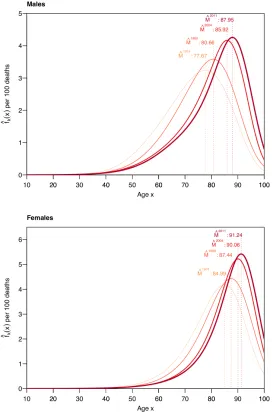
Pattern of trends in M reveal that in Canada the typical length of life of females and males increased substantially over the 1921‒2011 period (Figure 1). The onset of the upward trend is observed since the early 1930s and 1970s for females and males, respectively. To gain better understanding of the mechanisms that brought about these remarkable gains in the most common adult length of life in Canada, the analysis of M
needs to be disentangled by cause of death. Accordingly, the objective of this paper is to investigate changes in modal age-at-death values for six leading causes of death in Canada during the 1974‒2011 period: 1. heart diseases, 2. cerebrovascular diseases, 3. trachea, bronchus, and lung cancer,4 4. breast cancer (females only), 5. prostate cancer
results. To our knowledge, the present study provides the first available estimates of time-trends in cause-specific modal ages at death.
Figure 1: Modal age at death for all causes combined among Canadian males and females, 1921‒2011
Note: Modal age-at-death values are estimated using the method proposed by Ouellette and Bourbeau (2011)
Source: Authors’ calculations based on the Human Mortality Database
Our analysis allows identifying, firstly, the pattern of trends and differentials in M
countries (Ouellette, Barbieri, and Wilmoth 2014).It seems that during the 1970s and 1980s, when the cardiovascular revolution was in full force, progress against several types of cancer was modest at best. Medical advancement in this area perhaps required greater understanding of the cancer mechanisms at the cellular and molecular level, and hence its challenges were biologically more crucial than those of cardiovascular diseases (Horiuchi 1999). Whether or not our expectations are correct, the findings of the present study allow investigating if trends observed in all-cause M are an accurate representation of changes that occurred in mortality by leading cause or if it is the aggregate of various cause-specific death patterns. Moreover, an examination of changes in the shape of the trend as well as in the pace at which these changes occurred in recent years will provide further insight on future longevity trends. Accurate predictions of these trends are of great benefit to governments and policymakers when forecasting the cost of public pensions and health systems and when allocating their limited resources.
2. Background: Leading causes of death in Canada
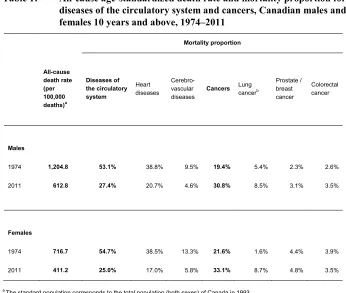
Chronic degenerative diseases have been the most common cause of death in Canada since the beginning of the 1940s. The proportion of deaths associated with these diseases followed a steady upward trend for about 30 years, reaching a maximum of around 70% in the late 20th century, and have been gradually declining ever since (Lussier, Bourbeau, and Choinière 2008). Table 1 illustrates the proportion of mortality due to the two main sub-categories of chronic degenerative diseases, namely disorders of the circulatory system5 and cancers, in 1974 and 2011 for ages 10 and above by sex.
In 1974, diseases of the circulatory system were responsible for about half of both male and female deaths, while cancers only accounted for about 20%. With the progress ushered in by the cardiovascular revolution an increasing number of individuals survived disorders of the circulatory system, and hence their relative importance in overall male and female mortality decreased to less than 30% by 2011 (Table 1). As fewer individuals succumbed to diseases of the circulatory system, in 2011 cancer mortality represented a larger proportion of all-cause mortality than in 1974 (30.8% vs. 19.4% for males and 33.1% vs. 21.6% for females), thus becoming the leading cause of death among Canadian males and females.
Table 1: All-cause age-standardized death rate and mortality proportion for diseases of the circulatory system and cancers, Canadian males and females 10 years and above, 1974‒2011
Mortality proportion
All-cause death rate (per 100,000 deaths)a
Diseases of the circulatory system
Heart diseases
Cerebro-vascular
diseases Cancers Lung cancerb
Prostate / breast cancer
Colorectal cancer
Males
1974 1,204.8 53.1% 38.8% 9.5% 19.4% 5.4% 2.3% 2.6%
2011 612.8 27.4% 20.7% 4.6% 30.8% 8.5% 3.1% 3.5%
Females
1974 716.7 54.7% 38.5% 13.3% 21.6% 1.6% 4.4% 3.9%
2011 411.2 25.0% 17.0% 5.8% 33.1% 8.7% 4.8% 3.5%
a The standard population corresponds to the total population (both sexes) of Canada in 1993.
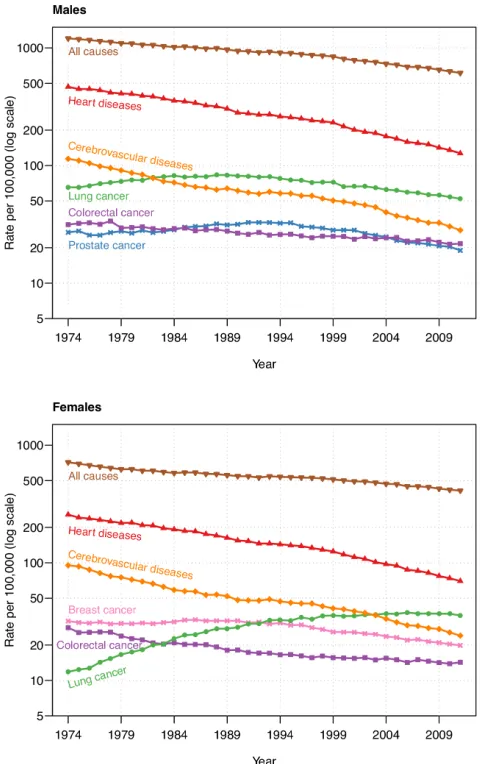
The majority of deaths from disorders of the circulatory system are the result of heart diseases and cerebrovascular diseases, accounting for more than 90% of all cardiovascular deaths above age 10 for both sexes (Table 1). The share attributable to disorders of the heart (about 75% for males and 70% for females) is considerably larger than that of cerebrovascular diseases (about 18% for males and 24% for females). About half of all male and female cancer deaths are attributed to the most diagnosed types of cancer in Canada: lung, breast (female), prostate (male), and colorectal cancer. Of these, in 1974, lung carcinoma was responsible for the highest proportion (29%) of all male deaths by malignant neoplasms. Females had an advantage, as a smaller percentage of their cancer mortality was due to this particular disease. However, by 2011 the proportion of female lung cancer mortality had almost reached that of males, as a growing number of females had taken up smoking over the previous decades. As for the remaining types of malignant neoplasms, the share of male and female mortality attributable to prostate/breast and colorectal cancer has increased slightly since 1974.
Figure 2: Age-standardized death rates for leading causes of death among Canadian males and females aged 10 years and above, 1974‒2011
Notes: The standard population corresponds to the total population (both sexes) of Canada in 1993. Lung cancer death rate includes all deaths from malignant neoplasms of trachea, bronchus, and lung as the underlying cause.
3. Data and methods
3.1 Sources of data
The data used in this paper consist of observed death counts by single years of age (10 and above), sex, and underlying cause of death, covering the period 1974‒2011 in Canada. These cause-specific mortality series are taken from the Canadian Vital Statistics Death Database (CVSDD), which gathers demographic and medical (i.e., cause of death) information from all provincial and territorial vital statistics registries on all deaths that occur in Canada. Each Canadian province and territory is bound by law to register all deaths that occur in their territory; thus under-coverage is considered to be minimal. The information collected is known to be of very good quality and it is widely accepted that it can be used to accurately portray cause-specific mortality dynamics. Because data are gathered at the individual level, various confidentiality rules are applied before any analytical report is released or published in order to prevent the disclosure of any information deemed confidential. We were granted access to this individual-level dataset through the Data Liberation Initiative, a program initiated by Statistics Canada to improve access to data resources for Canadian postsecondary institutions.
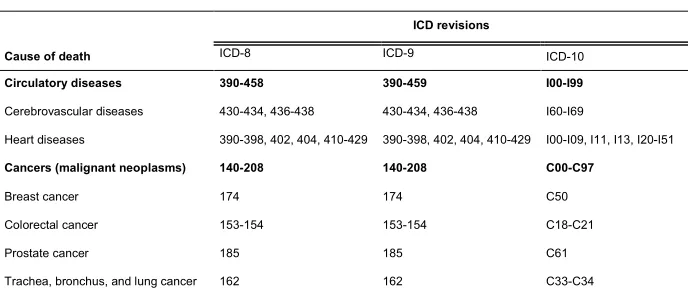
In this dataset, causes of death are classified according to the World Health Organization International Classification of Diseases (ICD). As our study period extends from 1974 to 2011 it covers three revisions of the international classification, ICD-8 (1969‒1978), ICD-9 (1979‒1999), and ICD-10 (since 2000). The adoption of ICD-10 led to a significant increase in the number of codes, as existing causes of death are classified in greater detail and newly recognized diseases were added. To ensure the consistency of categories throughout the three revisions of the ICD we restricted our analysis to large groups of causes (Table A-1, Appendix). In this way we minimize the impact of the successive revisions on our results. To make our sample consistent over time, we have excluded Canadian residents deceased in the United States. Indeed, as of 2010, such individuals are no longer accounted for in the CVSDD. Moreover, individuals for whom the age at death is unknown are also removed from the analysis. The number of individuals excluded from the analysis remains below 1% in each calendar year.
3.2 Cause-specific modal age-at-death derivation
Cause-specific analyses within a competing risks framework assume that an individual can die of any one of the 𝑚 types of death indexed by 𝑘 ∈(1, 2, 3, … ,𝑚). Let 𝐾 represent the whole set of possible types of failure (i.e., causes of death) and 𝑋denote the lifespan of an individual describing the time elapsed between their birth and their death. Since death can occur at any moment and from any cause, we treat the survival time 𝑋 and the type (cause) of death 𝐾 as random variables. The joint distribution of these random variables can be described by various continuous functions.
The specific hazard function, also known in demography as the cause-specific force of mortality, is defined as:
𝜇𝑘(𝑥) = lim∆𝑥→0Pr(𝑥<𝑋<𝑥+∆𝑥∆𝑥,𝐾=𝑘|𝑋>𝑥) (1)
and it represents the instantaneous risk of dying from cause 𝑘.
The cause-specific density function provides information on the unconditional risk of dying at age 𝑥 from cause 𝑘 and describes the distribution of deaths across ages. It can be written as follows:
𝑓𝑘(𝑥) =𝜇𝑘(𝑥)𝑆(𝑥), (2)
where
𝑆(𝑥) = exp�− ∫ 𝜇0𝑥 (𝑢)𝑑𝑢� (3)
describes the all-cause survival function. It shows that to be at risk of dying from any given cause at a given age 𝑥, an individual must survive all causes of death until that age.
Assuming that the causes of death are mutually exclusive and mutually exhaustive (Preston, Heuveline, and Guillot 2001), the all-cause force of mortality is derived from cause-specific forces of mortality through summation.
Finally, the cause-specific modal age at death, 𝑀𝑘, defined as the age at which the
highest proportion of deaths occur for a given cause 𝑘, is thus obtained by maximizing the corresponding density function:
𝑀𝑘= max𝑥𝑓𝑘(𝑥). (4)
calendar years. Assumptions are thus required to first estimate the cause-specific forces of mortality, 𝜇𝑘(𝑥), and hence 𝑀𝑘.
Specifically, for a given calendar year and sex, let 𝑑𝑖𝑘 represent observed death
counts by single years of age 𝑖 and cause of death 𝑘, and 𝑒𝑖 denote the population’s
amount of exposure to the risk of dying for each age 𝑖. Under the assumption of a constant cause-specific force of mortality over each one-year age interval, i.e., 𝜇𝑘(𝑥) =
𝜇𝑖𝑘 for all 𝑥𝜖 [𝑖,𝑖+ 1), death counts by single years of age and cause of death, 𝑑𝑖𝑘, are
assumed to be realizations from a Poisson distribution with mean 𝑒𝑖∙ 𝜇𝑖𝑘 (section 4.5 in
Alho and Spencer 2005, Brillinger 1986). Generally, 𝜇𝑖𝑘 can be estimated by the central death rate 𝑚𝑖𝑘=𝑑𝑖𝑘⁄𝑒𝑖. Although this straightforward approach is quite simple, it does
not allow deriving with great precision the cause-specific density functions and the associated modal ages at death. To overcome these limitations, we smooth age- and cause-specific death rates in order to retain the continuity of the age patterns of mortality presented above.
Among the various nonparametric smoothing techniques, we opted for the P-splines method (as illustrated in the Appendix of Ouellette and Bourbeau (2011) for the derivation of the all-cause modal age at death), which combines the concept of (fixed-knot) B-splines with a roughness penalty. Compared to the competing techniques available, P-splines is the smoother that features the most desirable properties simultaneously (see Table 1 in the Rejoinder section of Eilers and Marx (1996) on p.121, and Appendix A, notably, of Eilers, Marx, and Durban (2015) for a comparison with O-splines). Moreover, this method has been proven highly effective for smoothing mortality rates and hence for obtaining smooth forces of mortality (Camarda 2008, 2012, Currie, Durban, and Eilers 2004).
Algebraically, cause-specific forces of mortality can be described by a combination of B-splines basis and cause-specific penalized coefficients:
𝜇𝑖𝑘= exp(𝑩(𝑥𝑖)𝛼𝑘), (5)
where 𝑥𝑖 is such that 𝑥𝑖+1− 𝑥𝑖= 1 and coefficients 𝛼𝑘 are estimated by a penalized
likelihood approach. The compromise between smoothness and precision (fit to the observed data) is controlled in the model by a smoothing parameter included in the penalty. For the present study we rely on the Bayesian Information Criterion (Schwarz 1978) to select the smoothing parameter, as this criterion has been shown to be the most suitable in the context of mortality data (Currie, Durban, and Eilers 2004).
integration techniques (see equation (3)). Cause-specific density functions and corresponding modal ages at death are ultimately derived using equations (2) and (4).
In practice, to approximate the continuous forces of mortality we evaluate the B-splines basis at fine grids of age and multiply them by the estimated coefficients:
𝜇̂𝑘(𝑥)≈exp(𝑩(𝑥�)𝛼�𝑘), (6)
where 𝑥� is such that 𝑥�𝑗+1− 𝑥�𝑗=𝛿. In the present study, we set 𝛿= 10−2, which leads
to a precision up to the second decimal for the cause-specific modal age-at-death estimates.
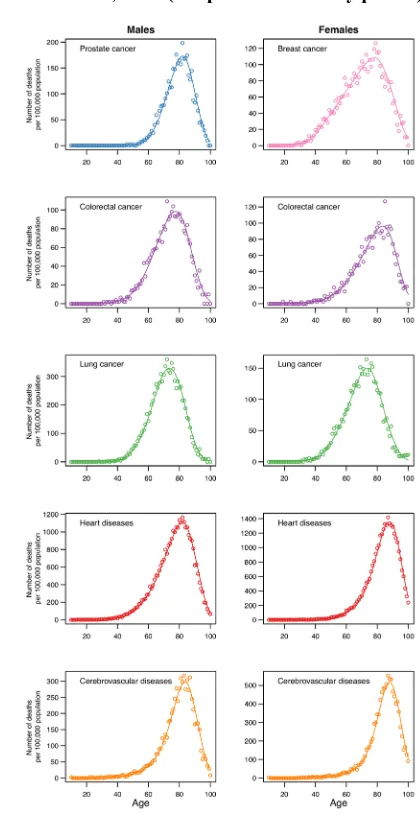
This method of deriving 𝑀𝑘 has several advantages. The smooth densities are standardized with respect to the population exposure estimates, thus allowing proper comparison between ages, calendar years, and sex. In fact, these curves can be seen as the smooth representation of cause-specific age-at-death distributions obtained from a multiple decrement life table (see Figure A-1, Appendix), with the following two additional advantages: (1) the smooth densities are free from any parametric assumption regarding the shape of the age distribution of deaths, and (2) they are estimated with a great numerical precision that facilitates the identification of 𝑀𝑘.
4. Results
4.1 Cause-specific differentials and trends in 𝑴�𝒌
Figure 4 depicts cause-specific changes in the most frequent age at death such as measured by 𝑀�𝑘 for Canadian males and females between 1974 and 2011. It reveals
important differences in levels between the various leading causes of death throughout the 38-year period studied. In general, the following ranking (from lowest to highest values) is observed: lung cancer, colorectal cancer, heart diseases, and cerebrovascular diseases.6 For males, prostate cancer ranked in between colorectal cancer and heart
diseases until the end of the 1990s and in between the two sub-categories of cardiovascular diseases after that. For females, 𝑀𝑘 estimates for lung and colorectal
cancer bound those for breast cancer.7
Therefore, from 1974 to 2011 the greatest gap in modal age-at-death estimates is observed between lung cancer and cardiovascular diseases. Indeed, the majority of male lung cancer deaths occurred around the age of 70 years old in 1974, which is about 10 years earlier than for male cerebrovascular deaths. Nearly four decades later the 10-year gap is maintained and now opposes lung cancer to both cerebrovascular and heart diseases. An even wider gap is seen among females for these conditions. At the beginning of the study period the majority of females died a few years prior to their 70th
birthday from lung cancer and about 15 years later from heart and cerebrovascular diseases. In 2011 the female modal age at death from lung cancer is postponed to age 77.8 and that from heart diseases to 91.2, yielding a 13.4-year gap.
Notable differences in 𝑀�𝑘 are also noticed between colorectal, prostate (males),
and breast cancer (females). The results for males reveal that in 1974 Canadians typically died of colorectal cancer at the age of 75, that is, about four years earlier than those who died of prostate cancer. The gap in modal age-at-death estimates for these two malignant neoplasms remained quite stable throughout the study period: hence in 2011 males with prostate cancer still outlived by 4.1 years, in terms of modal age at death, those battling colorectal cancer. Similarly, females with colorectal cancer had a significant advantage over those with a breast tumor, especially until the mid-1990s.
6 Note that while among males, 𝑀�
𝑘 values for heart diseases are distinctively lower than those for
cerebrovascular diseases until the late-1990s and then overlap, the two corresponding 𝑀�𝑘 series for females
were very similar after 1974.
7 For calendar years 1977 and 1978 the density function describing the age distribution of breast cancer deaths
Figure 4: Estimated modal age at death for leading causes among Canadian males and females, derived from cause-specific smooth density functions, 1974‒2011
Later on, the most frequent age at death for breast cancer became progressively closer to that of colorectal cancer, reaching about 85 years by 2011.
Looking more closely at the females’ results, we notice a clear separation between the estimated modal age at death for cancers and cardiovascular diseases. The gap between these two groups of causes barely narrowed, despite the sustained increase in 𝑀�𝑘 over the 1974‒2011 period. The separation is less obvious when analyzing the
males’ trends, as the relatively high level of 𝑀�𝑘 for prostate cancer mitigates it.
Despite important differences in terms of levels between the leading causes of death studied, trends in modal age at death for each cause are strikingly similar. Indeed, Figure 4 reveals quite linear and nearly parallel upward trends in 𝑀�𝑘 for most causes,
except for heart diseases (males) and breast cancer (females). Looking at the males’ results, we notice a slightly faster pace of increase for heart diseases than for any other cause of death. Until the mid-1990s heart diseases ranked third in terms of highest modal age at death, behind cerebrovascular diseases and prostate cancer. Thanks to an average growth rate of 3.2 months per year, the mode for heart diseases surpassed that of prostate cancer in 1997 at the level of 82.8 years and then gradually reached that of cerebrovascular diseases. For causes of death other than heart diseases, the average growth rate is contained between 2.1 (cerebrovascular diseases) and 2.6 (lung cancer) months per year. Among females, the fastest increase in the most frequent age at death is observed for breast cancer and to some extent for lung cancer also. Indeed, throughout our study period 𝑀𝑘 estimates for these diseases were postponed on average
by about 4.0 and 3.3 months per year, respectively. The modal age at death for heart diseases, cerebrovascular diseases, and colorectal cancer increased more moderately, as females with these pathogens gained, on average, 2 months per year or less in their typical length of life.
4.2 Exploratory analysis of the pace of increase in 𝑴�𝒌
In order to assess, beyond visual inspection, whether the various 𝑀�𝑘 trends shown in
Figure 4 are parallel, we conducted a simple statistical test. First, we modeled each 𝑀�𝑘
trend as a linear function of time.8 Second, we performed, for males and females
separately, an ANOVA test to determine whether the cause-specific slopes differ significantly from one another. Under the null hypothesis, increases in the estimated modal age at death occurred at the same pace for all causes over the 1974‒2011 period. We test this hypothesis under the alternative, stating that the modal age at death of at
8 Each linear regression model is a first approximation of the actual trend. For the various causes, these
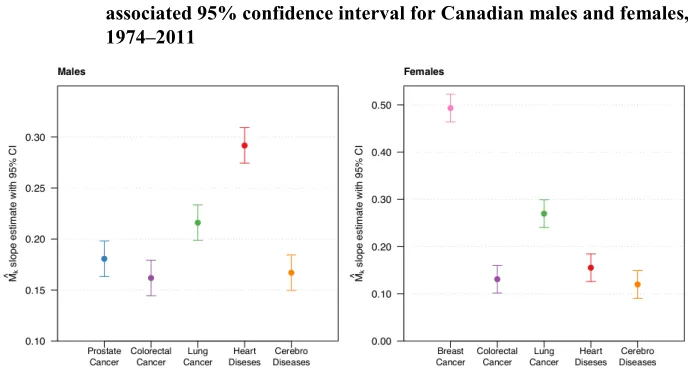
least one cause increased at a different pace. Results of the ANOVA test for each sex suggest that there is at least one cause of death for which the modal age rose at a different rhythm than all others (p-values < 0.0001). We singled out the cause(s) by comparing cause-specific 95% confidence intervals of estimated modal age-at-death linear slopes (see Figure 5).
The males’ results presented in Figure 5 indicate a significantly more rapid increase in the typical age at death for heart diseases since 1974 when compared to the remaining causes. This also holds for lung cancer, although to a limited extent.9 The
three remaining leading causes of death shared the same slope among males. By comparison, females experienced a more rapid increase in 𝑀�𝑘 for breast cancer and to a
lesser extent for lung cancer than for any other cause studied.
Figure 5: Estimated cause-specific modal age-at-death linear slope and associated 95% confidence interval for Canadian males and females, 1974‒2011
Note: The lung category includes malignant neoplasms of trachea, bronchus, and lung
Sources: Authors’ calculations based on the Canadian Vital Statistics Death Database and the Human Mortality Database
5. Discussion and conclusion
Since the early 2000s the modal age at death (M) has gained increasing scientific interest for monitoring reductions in all-cause mortality at older ages in economically advanced countries. Despite this, studies of M trends by cause of death remain very scarce. Improvements in old-age survival from specific causes of death are, to date, usually assessed through decomposition analyses of changes in life expectancy at birth or at some older age such as 50 or 65 (Beltrán-Sánchez, Preston, and Canudas-Romo 2008, Glei, Meslé, and Vallin 2010, van Raalte, Martikainen, and Myrskylä 2014). However, recent findings substantiate that changes in life expectancy, unlike M, tend to underestimate age shifts in old-age mortality (Horiuchi et al. 2013). Accordingly, this paper is the first to analyze cause-specific trends in modal ages at death. We extend a recently developed method for deriving all-cause M estimates from Poisson regressions with P-splines (Ouellette and Bourbeau 2011) to the context of cause-of-death analysis. P-splines have gained much recognition in the past decade for smoothing mortality curves and have proved to be very efficient when using erratic data – a problem often encountered when refining the analysis of mortality by cause due to a small number of deaths.
The present work exploits mortality data from the Canadian Vital Statistics Death Database (CVSDD), which provides detailed information about individuals who died from a particular cause – an important advantage for the study of M. Indeed, while most cause-of-death data for national populations are available by 5-year age groups, there is currently no method for determining M from these aggregated mortality data in broad age groupings. Very few countries other than Canada have detailed high-quality data on deaths by cause and single year of age over a long period of time (the United States is one rare example). A possible limitation of our data series is that information on causes of death by single year of age in Canada from the CVSDD is available only from 1974 onward. Because the cardiovascular revolution was already in full swing by the mid-1970s, we are unable to identify the year of the onset of the increase in M for heart diseases and cerebrovascular diseases, as well as for the other causes of death. Moreover, we cannot determine the cause(s) of death responsible for the upward all-cause M trend for Canadian females observed prior to 1974 (Ouellette and Bourbeau 2011).
cancer and colorectal cancer) increases faster in middle age, while chronic cardiovascular disease mortality rises steeply in old age.
Although cause-specific modal ages at death differ greatly in level, our results indicate that modal age values for leading causes among Canadian males and females increased steadily throughout the 1974‒2011 period. Moreover, the increase occurred at a strikingly similar pace for most causes, except for heart diseases (males), breast cancer (females), and to a lesser extent lung cancer (males and females). These findings suggest, on one hand, an extension of the ‘typical’ (i.e., modal) length of life attained by individuals battling any one of these diseases and, on the other hand, that this prolongation of life occurred at a similar cadence for all individuals regardless of the cause they were fighting.
The widespread and rapid decline of cardiovascular disease mortality, particularly for heart diseases and cerebrovascular diseases, was initiated in the 1960s by the cardiovascular revolution. The benefits brought about by this revolution in terms of technological advancement in preventive and curative medicine, as well as changes in behavioral patterns and lifestyles, ushered in a new era of progress in terms of adult and old-age survival. Evidence suggests that an important part of the decline in heart disease mortality since the late 1960s is due to the reduction in risk factors such as blood pressure, cholesterol, and smoking (Goldman and Cook 1984, Unal, Critchley, and Capewell 2004). Medical treatments, including secondary preventive therapies after myocardial infarction or revascularization, heart failure, and acute myocardial infraction treatments, would account for the rest of the decline (Ford et al. 2007, Unal, Critchley, and Capewell 2004).
The cardiovascular revolution set the stage for further technical advancement in preventive and curative medicine, particularly in regard to early diagnosis and treatment of cancers. Indeed, the reduction in colon cancer mortality in Canada between 1970 and 2007 was mainly attributable to early detection by means of testing for the presence of blood in stools and colonoscopy, and to the early removal of pre-cancerous polyps via adjuvant chemotherapy (Edwards et al. 2005, Schatzkin et al. 1994). Early diagnosis has also played an important part in reducing breast cancer mortality, especially since the implementation of the breast-screening program established in all Canadian provinces in 1998 (Shields and Wilkins 2009). Moreover, breast-conserving surgery, radiation, and hormonal therapy proved to be very efficient in increasing the survival of females that tested positive for cancerous polyps in the breast, especially when the malignant cells were caught in the early stages of their development (Harlan et al. 2002, Mariotto et al. 2002, NIH 1991). While no identifiable risk factor has been associated with prostate cancer, its mortality is highly responsive to early diagnosis and efficacy of treatment. Evidence shows that wide use of the PSA (the prostate-specific antigen) test has played a decisive role in reducing death rates from this disease (Nam and Klotz 2009, Schröder et al. 2009). Among the various treatment options available for prostate cancer, observational studies demonstrated that radiation therapy and radical prostatectomy have the most beneficial effects on survival (Trock et al. 2008, Wong et al. 2006). Hence, medical progress in past decades regarding cancer diagnosis and treatment played a considerable role in improving cancer survival.
delayed childbearing (Levi et al. 2005), as in many high-income countries a growing number of women have engaged in such behaviors in past years. In contrast to breast cancer, the fall in lung cancer mortality is for the most part linked to the declining trend in smoking prevalence observed in Canada since the mid-1900s (Corsi et al. 2014). However, further investigation is needed to identify the exact role played by improvements in health technologies and strategies in the extension of the typical length of life of each cause, and to what degree changes in lifestyle behaviors were more important than medical advances. In particular, it would be interesting to differentiate, for heart diseases as opposed to cerebrovascular diseases, the etiological characteristics that are susceptible to yielding a higher responsiveness to changes brought about by the cardiovascular revolution.
Also of interest is why the modal age at death for breast cancer increased more rapidly than any other type of cancer studied, and especially than prostate cancer. One possible explanation of the faster pace of increase in 𝑀� for breast cancer compared to prostate cancer (for example) may be the particular age domain over which each cause operates. Indeed, the risk of developing breast cancer increases rapidly during a woman’s reproductive period and slows down as she enters menopause (Lacey, Devesa, and Brinton 2002). Conversely, the risk of prostate cancer increases exponentially with age and develops more often in older than younger men (Crawford 2003). Consequently, from 1974 onward there was greater room for improvement in breast cancer survival than in prostate cancer survival, particularly at younger ages. The advancements made in screening and treatment since the mid-1970s were probably more effective in averting deaths from breast cancer occurring at younger old ages, thereby allowing its typical length of life to gradually converge towards that of prostate cancer. Future research should explore this avenue and determine whether improvements in the Canadian health care system's preventive and curative measures were indeed more successful in averting deaths from breast cancer than from prostate cancer.
old-age mortality compression accompany the continued rise in M by leading causes of death. Alongside the present analysis of trends in M by cause, a study of old-age cause-specific mortality dispersion would be highly desirable, to deepen our understanding of improvements in cause-specific survival.
6. Acknowledgements
References
Alho, J.M. and Spencer, B.D. (2005). Statistical demography and forecasting. New York: Springer.
Anderson, W.F. and Matsuno, R. (2006). Breast cancer heterogeneity: A mixture of at least two main types? Journal of the National Cancer Institute (98)14: 948‒951.
doi:10.1093/jnci/djj295.
Beltrán-Sánchez, H., Preston, S.H., and Canudas-Romo, V. (2008). An integrated approach to causes-of-death analysis: Cause-deleted life tables and decomposition of life expectancy. Demographic Research 19(35): 1323‒1350.
doi:10.4054/DemRes.2008.19.35.
Bots, M.L. and Grobbee, D.E. (1996). Decline of coronary heart disease mortality in the Netherlands from 1978 to 1985: Contribution of medical care and changes over time in presence of major cardiovascular risk factors. Journal of Cardiovascular Risk 3(3): 271‒276. doi:10.1097/00043798-199606000-00002.
Brillinger, D.R. (1986). The natural variability of vital rates and associated statistics.
Biometrics 42: 693‒734. doi:10.2307/2530689.
Brown,D.C., Hayward, M.D., Montez, J.K., Hummer, R.A., Chiu, C.T., and Hidajat, M.M. (2012). The significance of education for mortality compression in the United States. Demography 49(3): 819‒840. doi:10.1007/s13524-012-0104-1. Camarda, C.G. (2008). Smoothing methods for the analysis of mortality development.
[PhD thesis], Madrid: Universidad Carlos III de Madrid, Department of Statistics.
Camarda, C.G. (2012). MortalitySmooth: An R package for smoothing Poisson counts with P-Splines. Journal of Statistical Software 50(1). doi:10.18637/jss.v050.i01. Canudas-Romo, V. (2008). The modal age at death and the shifting mortality
hypothesis. Demographic Research 19(30): 1179‒1204. doi:10.4054/DemRes. 2008.19.30.
Canudas-Romo, V. (2010). Three measures of longevity: Time trends and record value.
Demography 47(2): 299‒312. doi:10.1353/dem.0.0098.
Cheung, S.L.K. and Robine, J.-M. (2007). Increase in common longevity and the compression of mortality: The case of Japan. Population Studies 61(1): 85‒97.
doi:10.1080/00324720601103833.
Cheung, S.L.K., Robine, J.-M., and Caselli, G. (2008). The use of cohort and period data to explore changes in adult longevity in low mortality countries. Genus
64(1–2): 101‒129.
Cheung, S.L.K., Robine, J.-M., Paccaud, F., and Marazzi, A. (2009). Dissecting the compression of mortality in Switzerland, 1876‒2005. Demographic Research
21(19): 569‒598. doi:10.4054/DemRes.2009.21.19.
Cheung, S.L.K., Robine, J.-M., Tu, E.J.-C., and Caselli, G. (2005). Three dimensions of the survival curve: Horizontalization, verticalization, and longevity extension.
Demography 42(2): 243‒258. doi:10.1353/dem.2005.0012.
Corsi, D.J., Boyle, M.H., Lear, S.A., Chow, C.K., Teo, K.K., and Subramanian, S.V. (2014). Trends in smoking in Canada from 1950 to 2011: Progression of the tobacco epidemic according to the socioeconomic status and geography. Cancer Causes Control 25: 45‒57. doi:10.1007/s10552-013-0307-9.
Crawford, D.E. (2003). Epidemiology of prostate cancer. Urology 62(6, Supplement 1):
3‒12. doi:10.1016/j.urology.2003.10.013.
Currie, I.D., Durban, M., and Eilers, P.H.C. (2004). Smoothing and forecasting mortality rates. Statistical Modelling 4(4): 279‒298. doi:10.1191/1471082X04st 080oa.
Diaconu, V., Bourbeau, R., Ouellette, N., and Camarda, C.G. (2015). The changing age distribution of deaths by cause in Canada and the U.S. Paper presented at the 16th Conference of the ASMDA International Society, Piraeus, Greece, 30th
June–4th July 2015.
Edwards, B.K., Brown, M.L., Wingo, P.A., Howe, H.L., Ward, E., Ries, L.A.G., Schrag, D., Jamison, P.M., Jemal, A., Wu, X.C., Friedman, C, Harlan, L., Warren, J, Anderson, R.N., and Pickle, L.W. (2005). Annual report to the nation on the status of cancer, 1975-2002, featuring population-based trends in cancer treatment. Journal of the National Cancer Institute 97(19): 1407‒1427.
doi:10.1093/jnci/dji289.
Eilers, P.H.C., Marx, B.D., and Durban, M. (2015). Twenty years of P-splines. SORT
39(2): 149‒186.
Ford, E.S., Ajani, U.A., Croft, J.B., Critchley, J.A., Labarthe, D.R., Kottke, T.E., Giles, W.H., and Capewell, S. (2007). Explaining the decrease in U.S. deaths from coronary disease, 1980–2000. New England Journal of Medicine 356: 2388‒ 2398. doi:10.1056/NEJMsa053935.
Glei, D.A., Meslé, F., and Vallin, J. (2010). Diverging trends in life expectancy at age 50: A look at causes of death. In: Crimmins, E. M., Preston, S. H., and Cohen, B. (eds.). International differences in mortality at older ages. Washington DC: The National Academy Press.
Goldman, L.E.E. and Cook, E.F. (1984). The decline in ischemic heart disease mortality rates. Annals of Internal Medicine 101: 825‒836. doi:10.7326/0003-4819-101-6-825.
Harlan, L.C., Abrams, J., Warren, J.L., Clegg, L., Stevens, J., and Ballard-Barbash, R. (2002). Adjuvant therapy for breast cancer: Practice patterns of community physicians. Journal of Clinical Oncology 20(7): 1809‒1817. doi:10.1200/JCO.2 002.07.052.
Horiuchi, S. (1999). Epidemiological transitions in human history. In: United Nations (ed.) Health and mortality issues of global concern: Proceedings of the Symposium on Health and Mortality, Brussels, 19‒22 November 1997. New York: United Nations: 54‒71.
Horiuchi. S., Finch, C.E., Meslé, F., and Vallin, J. (2003). Differential patterns of age-related mortality increase in middle age and old age. Journal of Gerentology:
Biological Sciences58A(6): 495‒507. doi:10.1093/gerona/58.6.b495.
Horiuchi, S., Ouellette, N., Cheung, S.L.K., and Robine, J.-M. (2013). Modal age at adult death: Lifespan indicator in the era of longevity extension. Vienna Yearbook of Population Research 11: 37‒69. doi:10.1553/populationyearbook 2013s37.
Human Mortality Database (2015). University of California, Berkeley (USA), and Max Planck Institute for Demographic Research, Rostock (Germany). Available at http://www.mortality.org or http://www.humanmortality.de (data downloaded on 1/1/2015).
and women. Annals of Epidemiology 6(5): 452‒457. doi:10.1016/S1047-2797 (96)00059-2.
Kannisto, V. (2001). Mode and dispersion of the length of life. Population 13(1): 159‒ 171.
Kannisto, V. (2007). Central and dispersion indicators of individual life duration: New methods. In: Robine, J.-M., Crimmins, E.M., Horiuchi, S., and Zeng, Y. (eds.).
Human longevity, individual life duration, and the growth of the oldest-old population. Dordrecht: Springer: 111‒129. doi:10.1007/978-1-4020-4848-7_5.
Kannisto, V., Lauritsen, J., Thatcher, A.R., and Vaupel, J.W. (1994). Reduction in mortality at advanced ages: Several decades of evidence from 27 countries.
Population and Development Review 20(4): 793‒810. doi:10.2307/2137662.
Lacey, J.V., Devesa, S.S., and Brinton, L.A. (2002). Recent trends in breast cancer incidence and mortality. Environmental and Molecular Mutagenesis 39(2‒3):
82‒88. doi:10.1002/em.10062.
Lee, I.M. (2003). Physical activity and cancer prevention: Data from epidemiologic studies. Medicine & Science in Sports & Exercise 35(11): 1823‒1827.
doi:10.1249/01.MSS.0000093620.27893.23.
Levi, F., Bosetti, C., Lucchini, F., Negri, E., and La Vecchia, C. (2005). Monitoring the decrease in breast cancer mortality in Europe. European Journal of Cancer Prevention 14(6): 497‒502. doi:10.1097/00008469-200512000-00002.
Lexis, W. (1877). Zur Theorie der Massenerscheinungen in der menschlichen Gesellschaft. Freiburg i.B.: Fr. Wagner’sche Buchhandlung.
Lexis, W. (1878). Sur la durée normale de la vie humaine et sur la théorie de la stabilité des rapports statistiques. Annales de Démographie Internationale 2(5): 447‒460. Lussier, M.-H., Bourbeau, R., and Choinière, R. (2008). Does the recent evolution of
Canadian mortality agree with the epidemiological transition theory?
Demographic Research 18(19): 531‒568. doi:10.4054/DemRes.2008.18.19.
Mariotto, A., Feuer, E.J., Harlan, L.C., Wun, L.M., Johnson, K.A., and Abrams, J. (2002). Trends in use of adjuvant multi-agent chemotherapy and tamoxifen for breast cancer in the United States: 1975–1999. Journal of National Cancer Institute. 94(21): 1626‒1634. doi:10.1093/jnci/94.21.1626.
Milan, A. (2011). Mortality: Causes of death, 2007. Statistics Canada publication no. 91-209-X.
Missov, T.I., Lenart, A., Németh, L., Canudas-Romo, V., and Vaupel, J.W. (2015). The Gompertz force of mortality in terms of the modal age at death. Demographic Research 32(36): 1031‒1048. doi:10.4054/DemRes.2015.32.36.
Nam, R.K. and Klotz, L.H. (2009). Trends in prostate cancer screening: Canada. In: Ankerst, D.P., Tangen, C.M., and Thompson, I.M. (eds.). Current clinical urology: Prostate cancer screening, New York: Humana Press: 23‒33.
NIH consensus conference (1991). Treatment of early-stage breast cancer. The Journal of American Medical Association 265(3): 391‒395.
Office of National Statistics (2012). Mortality in England and Wales: Average life span. London: Office of National Statistics.
Omran, A.R. (1971). The epidemiological transition: A theory of the epidemiology of population change. Millbank Memorial Fund Quarterly 49(4): 509‒538.
doi:10.2307/3349375.
Ouellette, N., Barbieri, M., and Wilmoth, J. (2014). Period-based mortality change: Turning points in trends since 1950. Population and Development Review 40(1): 77‒106. doi:10.1111/j.1728-4457.2014.00651.x.
Ouellette, N. and Bourbeau, R. (2011). Changes in the age-at-death distribution in four low mortality countries: A nonparametric approach. Demographic Research
25(19): 595‒628. doi:10.4054/DemRes.2011.25.19.
Ouellette, N., Bourbeau, R., and Camarda, C.G. (2012). Regional disparities in Canadian adult and old-age mortality: A comparative study based on smoothed mortality ratio surfaces and age-at-death distributions. Canadian Studies in Population 39(3‒4): 79‒106.
Paffenbarger, R.S. Jr., Lee, I.M., and Wing, A.L. (1992). The influence of physical activity on the incidence of site-specific cancers in college alumni. Advances in Experimental Medicine and Biology 322: 7‒15. doi:10.1007/978-1-4684-7953-9_2.
Preston, S.H. (1976). Mortality patterns in national population: With special reference to recorded causes of death. New York: Academic Press.
Quetelet, A. (1835). Sur l'homme et le développement de ses facultés ou essai de physique sociale. London: Bossange & Co.
Robine, J.-M. (2001). Redéfinir les phases de la transition épidémiologique à travers l’étude de la dispersion des durées de vie: Le cas de la France. Population 56(1‒ 2): 199‒222. doi:10.2307/1534822.
Schatzkin, A., Freedman, L.S., Dawsey, S.M., and Lanza, E. (1994). Interpreting precursor studies: What polyp trials tell us about large-bowel cancer. Journal of the National Cancer Institute 86(14): 1053‒1057. doi:10.1093/jnci/86.14.1053.
Schröder, F.H., Hugosson, J., Roobol, M.J., Tammela, T.L. J., Ciatto, S., Nelen, V., Kwiatkowski,M., Lujan, M., Lilja, H., Zappa, M., Denis, L.J., Recker, F., Berenguer, A., Määttänen, L., Bangma, C.H., Aus, G., Villers, A., Rebillard, X., van der Kwast, T., Blijenberg, B.G., Moss, S.M., de Koning, H.J., and Auvinen, A. (2009). Screening and prostate cancer mortality in a randomized European study. New England Journal of Medicine 360: 1320‒1328. doi:10.1056/NEJM oa0810084.
Schwarz, G. (1978). Estimating the dimension of a model. The Annals of Statistics 6(2): 461‒464. doi:10.1214/aos/1176344136.
Shields, M. and Wilkins, K. (2009). An update on mammography use in Canada.
Health Reports 20(3): 7‒19.
Stein, C.J. and Colditz, G.A. (2004). Modifiable risk factors for cancers. British Journal of Cancer 90: 299‒303. doi:10.1038/sj.bjc.6601509.
Thatcher, A.R., Cheung, S.L.K., Horiuchi, S., and Robine, J.-M. (2010). The compression of deaths above the mode. Demographic Research 22(17): 505‒ 538. doi:10.4054/DemRes.2010.22.17.
Thune, I. and Furberg, A.S. (2001). Physical activity and cancer risk: dose-response and cancer, all sites and site-specific. Medicine & Science in Sports & Exercise 33(6 Suppl): S530‒50. doi:10.1097/00005768-200106001-00025.
Unal, B., Critchley, J.A., and Capewell, S. (2004). Explaining the decline in coronary heart disease mortality in England and Wales between 1981 and 2000.
Circulation 109(9): 1101‒1107. doi:10.1161/01.CIR.0000118498.35499.B2.
van Raalte, A., Martikainen, P., and Myrskylä, M. (2014). Lifespan variation by occupational class: Compression or stagnation over time? Demography 51(1):
73‒95. doi:10.1007/s13524-013-0253-x.
Wilmoth, J., Deegan, J.L., Lundström, H., and Horiuchi, S. (2000). Increase of maximum lifespan in Sweden, 1861‒1999. Science 289: 2366‒2368.
doi:10.1126/science.289.5488.2366.
Appendix
A: International Classification of Diseases (ICD) codes for the leading causes of death under study
Table A-1: Concordance table for bridging revisions 8, 9, and 10 of the ICD for leading causes of death in Canada
ICD revisions
Cause of death ICD-8
ICD-9 ICD-10
Circulatory diseases 390-458 390-459 I00-I99
Cerebrovascular diseases 430-434, 436-438 430-434, 436-438 I60-I69
Heart diseases 390-398, 402, 404, 410-429 390-398, 402, 404, 410-429 I00-I09, I11, I13, I20-I51
Cancers (malignant neoplasms) 140-208 140-208 C00-C97
Breast cancer 174 174 C50
Colorectal cancer 153-154 153-154 C18-C21
Prostate cancer 185 185 C61
Trachea, bronchus, and lung cancer 162 162 C33-C34
Note: Items of ICD-8 are for years 1969–1978, ICD-9 for 1979–1999, and ICD-10 since 2000
B: Comparison between multiple decrement life table age-at-death distributions and P-spline-smooth cause-specific density functions
Estimated smooth cause-specific density functions obtained from the P-spline method are standardized with respect to estimates of population exposure to risk, thus allowing proper comparison between ages, calendar years, and sex. These curves are in fact the smooth representation of cause-specific age-at-death distributions obtained from a decrement life table. For illustration purposes, we constructed a multiple-decrement table using all-cause annual probabilities of dying at age 𝑥, 𝑞𝑥, for Canada
available in the Human Mortality Database and the proportion of observed deaths 𝜋𝑥𝑘=𝐷𝐷𝑘((𝑥𝑥,,𝑥+1𝑥+1)) , using data from the Canadian Vital Statistics Death Database.
Hence, for a given calendar year and sex, the probability of dying from cause 𝑘 is given by:
𝑞𝑥𝑘 =𝑞𝑥∗ 𝜋𝑥𝑘. (B.1)
Life table deaths from cause𝑘 were calculated by multiplying the cause-specific probability of dying by the number of individuals who survived all causes of death until age 𝑥:
𝑑𝑘(𝑥,𝑥+ 1) =𝑞𝑥𝑘∗ 𝑙𝑥.
(B.2)
Figure A-1: Comparison between age-at-death distributions resulting from the multiple decrement life (circles) and nonparametric (P-splines) estimations of Poisson regression models (solid lines), Canadian males and females, 1993 (midpoint of the study period)
Note: The lung category includes malignant neoplasms of trachea, bronchus, and lung