DEMOGRAPHIC RESEARCH
VOLUME 35, ARTICLE 50, PAGES 1489
−
1522
PUBLISHED 6 DECEMBER 2016
http://www.demographic-research.org/Volumes/Vol35/50/ DOI: 10.4054/DemRes.2016.35.50
Research Article
Impact of conjugal separation on women’s
income in Canada: Does the type of union
matter?
Céline Le Bourdais
Sung-Hee Jeon
Shelley Clark
Évelyne Lapierre-Adamcyk
This publication is part of the Special Collection on “Separation, Divorce, Repartnering, and Remarriage around the World,” organized by Guest Editors Benoît Laplante and Andrew Cherlin.
©2016 Céline Le Bourdais et al.
This open-access work is published under the terms of the Creative Commons Attribution NonCommercial License 2.0 Germany, which permits use, reproduction & distribution in any medium for non-commercial purposes, provided the original author(s) and source are given credit.
1 Introduction 1490
2 Background 1491
2.1 The economic effects of union dissolution 1491
2.2 The importance of context: The Canadian case 1495
2.3 Hypotheses 1497
3 Data and methods 1498
3.1 The data 1498
3.2 Adjusted family income 1500
3.3 Other variables and methods 1501
4 Results 1502
4.1 Descriptive analysis 1502
4.2 Multivariate analysis 1509
5 Summary and conclusion 1515
6 Acknowledgements 1517
Impact of conjugal separation on women’s income in Canada:
Does the type of union matter?
Céline Le Bourdais1
Sung-Hee Jeon2
Shelley Clark3
Évelyne Lapierre-Adamcyk4
Abstract
BACKGROUND
After conjugal unions end, women frequently experience sharp declines in their economic status. The severity of this decline may depend on whether they were in a marital or a cohabiting union and may change over time.
OBJECTIVE
We measure the economic situation of married and cohabiting women after union dissolution in Canada in two time periods and in two different contexts: Québec, where nearly 40% of couples cohabit, and the other provinces, where only 14% of couples are in cohabiting unions.
METHODS
Using data from the Longitudinal Administrative Databank, we employ both descriptive statistics and fixed effects models to compare adjusted family-based income prior to separation to income in the following five years for women aged 25−44 who separated in 1993−1994 and 2003−2004 in Québec and the rest of Canada.
RESULTS
All women experienced a major loss of income after separation. Previously cohabiting women tended to fare better than formerly married women, although after controlling for employment, number of children, and other factors married women did marginally better in the earlier cohort. Differences between married and cohabiting women tended to be smaller in Québec than in the rest of Canada for the later cohort.
1 McGill University, Canada. E-Mail: [email protected]. 2 Statistics Canada.
CONCLUSIONS
Both context and time period shape married and cohabiting women’s economic well-being following separation. As cohabitation becomes more common and more closely resembles marriage, as it does in Québec, long-term differences between marriage and cohabitation may diminish.
CONTRIBUTION
This paper extends the literature on the economic consequences of separation for women by examining the implications of rising levels of cohabitation.
1. Introduction
The redefinition of conjugal relationships is one of the major changes that have affected family life in recent decades. The adoption and liberalization of divorce laws in several Western countries during the 1970s and early 1980s led to a sharp increase in the proportion of marriages ending in divorce (Sobotka and Toulemon 2008; Le Bourdais and Lapierre-Adamcyk 2004). However, marriage became not only more unstable but also less popular as couples increasingly started living together without being married (Liefbroer and Dourleijn 2006; Sobotka and Toulemon 2008). Over the years, cohabiting unions have become widely accepted, first as a way for young adults to test conjugal compatibility and more recently as a setting within which to start and raise a family (Kiernan 2002). Although they have become more common, cohabiting unions still remain significantly more unstable than marriages, even after controlling for the presence of children (Bumpass and Lu 2000; Le Bourdais, Lapierre-Adamcyk, and Roy 2014).
Separations following either marriage or cohabitation may have significant financial repercussions for both partners, not least because they lose the economies of scale of partnership. Following the rise in divorce, a number of studies evaluated the economic consequences of marital dissolution. They unanimously found that one year after dissolution women experience a severe decline in household income (for a review, see Tach and Eads 2015), whereas the impact of divorce on men’s economic situation varied from small losses (Duncan and Hoffman 1985; Finnie 1993) to small gains (Jarvis and Jenkins 1999).
compared to their divorced counterparts (Avellar and Smock 2005), but that the gap separating the two groups has decreased over time (Tach and Eads 2015). Various explanations have been put forward to account for these findings, such as the different number of children that married and cohabiting women have, their differential level of participation in the labor market, their varying degree of access to government benefits and transfers, or the fact that cohabitation and marriage are becoming more alike with the diffusion and institutionalization of cohabiting unions over time.
So far few studies have compared the impact of union dissolution across different contexts or countries and those that do usually focus on one time period (e.g., Uunk 2004). In contrast, most studies that have examined changes in the economic consequences of separation over different time periods restrict their analyses to a single country or context (e.g., Tach and Eads 2015). Consequently, none of the existing studies assess differences in the economic divide separating previously married and cohabiting women both over different time periods and across different contexts where there have been changes in the prevalence and institutional treatment of marriages and cohabiting unions.
This paper aims to fill this gap. Drawing on a longitudinal administrative base of tax-file data spanning over fifteen years, we first compare the economic situation of previously married and cohabiting women who separated or divorced in two time periods, 1993−1994 and 2003−2004. Secondly, we examine to what extent the gap separating the two groups of women has changed over time and to what extent it is conditioned by the institutional context of society. Canada offers an excellent setting in which to address these questions. Québec and the other provinces differ radically with respect to the prevalence and meaning of cohabitation. Québec has widely adopted cohabitation as a basis for union and family formation, whereas levels of cohabitation remain much lower in English-speaking provinces (Le Bourdais and Lapierre-Adamcyk 2004). Hence in 2011 nearly 40% of Québec’s couples were cohabiting compared to 14% outside this province (Statistics Canada 2012a). The two regions also have distinct legal systems: Québec has a civil code, while the other provinces are governed by common law principles. As a result, married and cohabiting couples are treated differently at separation in Québec and other parts of Canada.
2. Background
2.1 The economic effects of union dissolution
These changes led to a significant increase in the number of divorces and prompted researchers to assess the economic outcomes of marital dissolutions using a variety of measures, such as family or household income, income-to-need ratios or adjusted household income, or poverty rates (Hoffman and Duncan 1988; Finnie 1993; Galarneau and Sturrock 1997). These studies unanimously found that women experience on average a decline of approximately 30% in their economic situation during the first year following marital separation.5 In contrast, research showed that
men experienced either relatively small losses of 10% or less (Duncan and Hoffman 1985; Finnie 1993; Galarneau and Sturrock 1997) or even a small improvement in their situation (Jarvis and Jenkins 1999) in the year after separation. Three to five years after the separation occurred, men had all surpassed their pre-divorce economic situation, whereas women had barely recovered (Duncan and Hoffman 1985; Finnie 1993) or were still lagging behind their pre-divorce income level (Galarneau and Sturrock 1997; Jarvis and Jenkins 1999). However, regardless of the recovery pattern observed for women, all studies concurred that women’s income still significantly lagged behind that of separated men (Gadalla 2009) and of women who had not separated (deVaus et al. 2010). In this paper we focus on women because of the substantially larger drop in income that separated women experience compared to their male counterparts.
The findings reported above were based on a variety of sources, including panel surveys, register data, court records, and administrative tax data. They concern different time periods, covering union break-ups that occurred in the early 1970s (Duncan and Hoffman 1985), during the 1980s (Finnie 1993), the 1990s (Jarvis and Jenkins 1999), and the first half of the 2000s (deVaus et al. 2010; Gadalla 2009). Among the very few researchers who adopted a comparative approach, Radenacker (2011) observed that German women with children experienced a higher pre-tax income loss than their US counterparts. However, because they benefitted from more substantial government allowances and transfers, they had almost recovered their pre-separation household income level four years after separation. Uunk (2004), who examined the consequences of divorce in 14 European Union countries, showed that divorced women living in liberal and conservative welfare regimes fared much worse than those living in social-democratic welfare states in terms of changes in the median adjusted household income in the years before and after divorce.6 Surprisingly, divorced women living in southern
countries were found to experience on average the smallest proportional decline in their median income, due to their much lower income level to start with.
5 The decline is much less severe than the loss of 73% estimated previously by Weitzman (1985). For a
detailed critique of Weitzman’s estimation, see Hoffman and Duncan (1988).
6 Uunk used Esping-Anderson’s (1990) typology of welfare states in which he distinguishes three types:
Although some recent studies have focussed exclusively on separations of previously married couples (deVaus et al. 2010; Uunk 2004), as cohabitation spreads researchers are increasingly incorporating cohabiting couples into their analysis of the economic consequences of separation. They first did so by merging both types of union separation into one category, in part because the small number of separated cohabiting couples prevented separate analysis or because of difficulties in distinguishing between types of union in survey data. The lack of theorization on the meaning of cohabitation as compared to marriage may also have contributed to this approach.
The significant increase in numbers of couples living together without being married during the 1990s and 2000s led researchers to investigate the similarities and differences between marriage and cohabitation in terms of stability and duration of unions and of birth of children within unions. Kiernan’s (2002) evolutionary perspective suggests that the diffusion of cohabitation proceeds in four stages, going from an avant-garde phenomenon, to a prelude to marriage (a temporary phase during which young couples test their compatibility before marrying), to an alternative to marriage (when couples no longer have to marry to have and raise children), before finally becoming indistinguishable from marriage. Heuveline and Timberlake (2004) suggest that this last stage is reached when unmarried couples become indifferent to marriage because of the widespread acceptance of cohabitation and the provision of institutional supports that discriminate little between married and cohabiting families. This converging process between marriages and cohabiting unions is likely to be reinforced by the deinstitutionalization of marriage. As Cherlin (2004) argued, the weakening of social norms related to spousal roles and the increased fluidity and diversity of conjugal unions contribute to making marriage increasingly resemble cohabitation. Given the growing centrality of cohabitation in the adult life course, researchers progressively started comparing the economic consequences of separation for previously married and cohabiting individuals, expecting that the gap separating the two types of union would be narrower as cohabitation becomes more widespread and in countries in which cohabitation and marriage are more alike.
2006).7 Furthermore, research showed that the difference in income between men and
women was less marked for separations from cohabitation than from marriage (Fisher and Low 2015). Over the years divorced women were found to recover more rapidly than formerly cohabiting women, but the gap separating the two groups still remained significant (de Regt, Mortelmans, and Marynissen 2013; Manting and Bouman 2006).
In a rare study assessing the relative economic costs of ending marriages and cohabitations over time, Tach and Eads (2015) observed that, as cohabitation became more common in the United States, the negative consequences of divorce for mothers declined from the mid-1980s to the mid-2000s, whereas those of formerly cohabiting mothers worsened. They found that part of the explanation is attributable to changes in policies in the United States that increased child support and government transfers to married mothers following separation, but had no effect on cohabiting mothers, who had previously been eligible to receive more generous benefits because they were considered to be single (Tach and Eads 2015). Another part of the explanation comes from the fact that the share of pre-dissolution income earned by married mothers had grown substantially as women increased their participation in the labor market, while the share of the income earned by cohabiting mothers did not increase as much. This result concurs with that observed in Belgium by De Regt, Mortelmans, and Marynissen (2013), who showed that an increase in labor market participation had more of an impact on divorced women than it did on previously cohabiting women.
The presence and number of children that women have are undoubtedly other important factors that account for part of the difference between previously married and cohabiting women with respect to the economic effects of separation (Fisher and Low 2015; Manting and Bouman 2006). In addition, the fact that mothers are much more likely than fathers to have custody of the children following union dissolution helps explain the worse economic situation of women compared to men (Galarneau and Sturrock 1997; Manting and Bouman 2006). Repartnering generally improves the economic situation of divorced and separated individuals through economies of scale. Cohabiting women are more likely than married women to repartner in the years following union dissolution (Tach and Eads 2015); however, repartnering appears to bring greater economic benefits to formerly married women than to formerly cohabiting women (Fisher and Low 2015; Manting and Bouman 2006). Living with adults others than partners may also help women to partially recover from financial loss following separation. The only study that examined this issue found that previously cohabiting women are more likely than married ones to live in a household with no partner but with other adults (Fisher and Low 2015).
7 Avellar and Smock (2006) found that married men experienced a larger proportional drop in income than
2.2 The importance of context: The Canadian case
The studies reviewed showed that the economic consequences of union dissolution for women are closely linked to the legal form of the union. Yet the magnitude of the differences appears to depend on the period and country considered. Contexts vary with respect to levels of acceptance and institutionalization of cohabitation and differential treatments of both marriages and cohabiting unions, as well as varied family policies and welfare state regimes. Unfortunately, due to differences in sampling methods, outcome indicators, and statistical methods, it is difficult to test whether the gap separating previously married and cohabiting women has changed over time and to what extent it is conditioned by different institutional contexts by comparing studies.
Canada provides an interesting case study to further explore contextual effects. To do so we contrast the province of Québec to the other provinces. Québec forms a distinct nation (“nation québécoise”) in Canada and is governed by a civil code rather than by common law principles. Québec also increasingly resembles Esping-Anderson’s (1990) social-democratic type of welfare state, with the introduction of a universal low cost childcare program in 1997 and of a more generous parental leave program in 2006, whereas the other provinces are typically characterized as liberal regimes (Proulx et al. 2011). Its largely French-speaking population holds more liberal attitudes toward family issues than other Canadians (Wu 2000) and exhibits different demographic patterns.
The distinctiveness of Québec demographic behaviors is particularly visible with respect to cohabitation. Before the 1980s cohabitation was quite rare all across Canada. Hence in 1981 7% of Québec couples cohabited, compared to 5% in the other provinces. From that point on both regions have taken divergent paths (Le Bourdais and Lapierre-Adamcyk 2004). Between 1981 and 2011 the percentage of cohabiting couples increased fivefold in Québec, from 7% to 19% in 1991, then to 30% in 2001, before reaching 38% in 2011. In the rest of Canada cohabitation spread at a much slower pace. The average percentage across the other provinces increased to 9% in 1991 to 12% in 2001 and 14% in 2011. Moreover, the heterogeneity across these provinces is relatively small compared to Québec: 15% in British Columbia and Prairies, 12% in Ontario, and 17% in the Atlantic Provinces in 2011 (Statistics Canada 2012a).
The proportion of young adults who opt for cohabitation as opposed to marriage when they start conjugal life is much higher in Québec than in the other provinces. Eighty percent of young Quebeckers who formed their first union during the 2000s took that route, compared to less than 60% in the other provinces of Canada (authors’ own calculations).8 Cohabitors living in Québec are also less likely than their counterparts
living elsewhere in Canada to marry their partner. Ten years after the beginning of the
union nearly 30% of the cohabiting unions formed in the 1980s and 1990s had been followed by marriage in Québec, compared to over half in the other provinces (Le Bourdais, Lapierre-Adamcyk, and Roy 2014). The legal form of the union is also a weaker predictor of union dissolution in Québec than elsewhere in Canada. Even though separation rates are higher for cohabitors across Canada, the difference between marriage and cohabitation is smaller in Québec. This result can be attributed to two tendencies: the relatively high instability of Québec marriages and the relatively longer duration of cohabitation in Québec than in the other provinces. On the one hand, the proportion of marriages expected to end in divorce according to the trends observed in 2008 was 49.9% in Québec, compared to 43.1% for Canada as a whole (Institut de la statistique du Québec 2011: 94).9 On the other hand, ten years after starting to live
together twice as many couples (33% vs 16%) formed in the 1990s were still cohabiting in Québec, as elsewhere in Canada (Le Bourdais, Lapierre-Adamcyk, and Roy 2014).
In addition, cohabitation has become the favored conjugal setting in which to give birth and raise a child in Québec. Since 2006 over 60% of all births occurred outside marriage, the large majority of these to cohabiting couples, whereas in Canada as a whole (including Québec) the percentage of nonmarital births was only 32% in 2010 (Girard 2012). Consequently, 38% of Québec children under the age of 15 lived with cohabiting parents in 2011, compared to 10% of those residing elsewhere in Canada (Statistics Canada 2012b). Not surprisingly, then, in Québec cohabitors are as likely as married couples to belong to families with biological children only, whereas the proportion of these families among cohabitors is only half of that observed among married couples (28% vs 55%) outside this province (Hamplová, Le Bourdais, and Lapierre-Adamcyk 2014). The fact that the Québec Civil Code requests both spouses to retain their respective names and exercise their rights under those names further contributes to making it difficult to differentiate between married and cohabiting families in daily interactions (Le Bourdais and Juby 2002). In Québec cohabitation thus appears to have successfully achieved the fourth stage of Kiernan’s (2002) model of partnership transition, where couples now seem indifferent to whether they have children in marital or cohabiting unions; in contrast, cohabitation does not appear to have attained the third stage of transition in other Canadian provinces, as cohabiting unions remain relatively short-lived and are a less commonly chosen environment in which to have children.
In Québec, as elsewhere in Canada, cohabiting couples are assimilated into married couples after a given duration or the birth of a child and, as long as they are together, they are entitled to the same rights and benefits when dealing with the state and with third parties (employers, insurance companies, etc.) (Laplante and Fostik forthcoming). However, important legal differences exist between regions at the time of
union dissolution. From the early 1970s common law provinces all successively adopted laws that imposed on cohabiting couples alimony obligations similar to those on married couples (Roy 2011). In the 2000s three provinces (British Columbia, Manitoba, and Saskatchewan) extended to cohabiting couples the obligation of sharing the family assets acquired through the course of the union (Comité consultatif sur le droit de la famille 2015). Interestingly, these changes were brought about while still giving all couples the chance to define these obligations by contract prior to separation (Le Bourdais, Lapierre-Adamcyk, and Roy 2014). In contrast, Québec has restricted the capacity of married couples to define their economic obligations at separation, while allowing cohabiting couples to freely define theirs. Hence since 1989 the Québec Civil Code has imposed at separation the sharing of the family patrimony (family residences, household furniture, family vehicles, and pension funds) acquired during the course of the relationship on married couples (Roy 2011); only other assets can be included in prenuptial agreements. On the other hand, in the absence of a signed contract or written agreement, cohabitors have no rights or obligations toward one another at separation (Le Bourdais, Lapierre-Adamcyk, and Roy 2014). However, it should be noted that, following parental separation, children have equal rights in all respects (including child support) across provinces, whether or not their parents were married.
2.3 Hypotheses
Based on the known differences in Québec and the other provinces in Canada and the empirical evidence reviewed above, we are led to formulate the following hypotheses:
Hypothesis 1: We expect married women will experience larger declines than
cohabiting women in family adjusted income following separation, because of their lower participation in the labor market and the fact that they are more likely to have children for whom they are the primary custodian. After controlling for labor force participation and number of children, we anticipate that these differences will diminish.
Hypothesis 2: We expect the income gap between previously married and
cohabiting women will be smaller in Québec than in the rest of Canada. In Québec cohabiting unions, on average, last longer, more often provide a family setting for childbearing and childrearing, and are less clearly distinguished from marriage in day-to-day interactions. This suggests that cohabitation is more a marriage-like institution in Québec than in other parts of Canada.
Hypothesis 3: In both regions we expect the gap in post-separation income
married women increased their participation in the labor market and thus their relative contribution to pre-dissolution household income.
3. Data and methods
3.1 The data
To test our hypotheses, we required longitudinal data that provides information on the economic situation of women prior to and in the years following union dissolution. We used Statistics Canada’s Longitudinal Administrative Databank (LAD) that spanned the years 1982 to 2011 at the time we conducted our analysis. The LAD is a subset of the T1 Family File (T1FF), which is a yearly cross-sectional file of all tax filers and their families created from Revenue Canada income tax returns. Both legally married and cohabiting couples are “attached by the spousal Social Insurance Number (SIN) listed on the tax file, or by matching based on name, address, age, sex, and marital status” (Statistics Canada 2014: 12). Children are identified using a similar approach.
The LAD is a random sample of 20% of the T1FF. Individuals selected for the LAD are linked across years to create a longitudinal profile and new tax filers are added each year in order to maintain a 20% sample of tax filers for every year. This sample has increased from 3,277,485 people in 1982 to 5,332,700 in 2012 (Statistics Canada 2014: 12). The LAD is a unique dataset that was constructed by Statistics Canada and can be analysed only at Statistics Canada.
We selected the LAD for our analyses because it is an excellent source of information on the relationship between income and union dissolution from a longitudinal perspective, although it was not constructed specifically to investigate such issues. Unlike many surveys in which income is measured retrospectively or only at the time of separation or of survey, the LAD provides detailed information on family income in the years preceding and following separation. Tax-file data is also believed to be more accurate than self-reported income data collected in surveys (Frenette, Green, and Picot 2006). Another advantage is the size of the database, which contains a sufficiently large number of individuals undergoing a union dissolution to allow for separate analysis of previously married and cohabiting couples across different regions and time periods. In addition, there is almost no missing data or panel attrition, except when individuals stop filing tax returns (Manting and Bouman 2006; Galarneau and Sturrock 1997).
Therefore separations can only be identified by comparing the conjugal situation of individuals who were part of a couple at the end of a given year but not at the end of the following year. This is likely to lead to an underestimation of the dissolution of short-lived unions: that is, unions starting and ending in a given year (Manting and Bouman 2006). Changes in family composition, as children can move between the households of their separated parents during the year, may also slightly distort the analysis (Galarneau and Sturrock 1997). Finally, the absence of variables, such as hours or weeks worked or wage rates, constitutes another limitation of this data (Finnie 1993).
The sample retained for our analysis consists of two cohorts of women, aged 25 to 44, who were married or cohabiting in 1992 and in 2002 and who separated in 1993 or 1994 and in 2003 or 2004.10 Cohabiting unions have only been identified separately as
such in the LAD since 1992.11 Prior to that cohabiting women could not be fully
identified in the LAD because both partners had to file their income tax returns to be identified as a cohabiting couple.12 The number of cohabiting women was thus likely to
be underestimated. In contrast, legally married women could be identified even if only one of the spouses filed his or her tax return.13 Ten years separate the second retained
cohort from the first; this gap is sufficiently large to allow us to observe changes over time and to follow up women several years after separation.14The lower age limit, set at
25, aims at restricting the inclusion in the sample of short-term unions, disproportionately cohabitations, for which the negative economic consequences of separation are probably modest, given that young cohabiting women are likely to be involved in the labor market and to still keep their money in separate bank accounts (Hamplová, Le Bourdais, and Lapierre-Adamcyk 2014). The upper age limit is set at 45 in order to avoid an over-representation in 1992 of women who had started cohabiting after the break-up of relatively long marriages. Indeed, women aged over 45 in 1992 belong to generations who typically directly married and thus experienced cohabitation late in their life after separation. In contrast, women in the following generations typically cohabited before their first marriage. The final sample comprises 25,660 married women and 25,260 cohabiting women in 1992 who separated in 1993 or 1994;
10 That is, women who were no longer living with their cohabiting or married partner, whether they divorced
or not.
11 Since 1992 cohabiting couples who have lived together for 12 months have to identify themselves as such
and to provide their partner’s social insurance number.
12 For example, if a cohabiting woman filed her tax return but her partner did not, she would be classified as a
lone mother, a nonfamily-member adult, or a child (if she lived with her parents). On the other hand, if a cohabiting woman did not file her tax return but her partner did, then she could not be observed in that year.
13 If only one spouse files a tax return, the other spouse is imputed in the LAD (he or she is not considered as
missing).
14 As mentioned previously, 2011 was the last year of data available at the time of analysis. Women who
the corresponding numbers for 2002 are 30,010 and 26,630 women respectively who separated in 2003 or 2004.
3.2 Adjusted family income
Family income includes the income of all individuals in the family. Pre-tax income comprises all sources of income, such as income from paid work or self-employment, investments and savings, social security, pensions, etc. Post-tax income is defined as the pre-tax family income minus federal and provincial taxes paid by all family members. From 1986 to 1996 payments of both spousal alimony and child support were included in the recipients’ income and taxed accordingly. In contrast, alimony and child support payments could be deducted from the payers’ income for tax purposes. However, since May 1997 only spousal alimony is included in the recipient’s income. Indeed, in 1996 the federal government launched the New Child Support Package, which amended the Income Tax Act so that there would be no tax deduction for child support and no taxation of these payments.15 Consequently, the post-dissolution income
of mothers who separated in 2003 or 2004 is likely to be slightly lower than it would have been in the absence of the tax law modification; we will return to this issue later. In addition, the package included measures aimed at improving the well-being of children after their parents’ divorce. For instance, the federal government produced child support guidelines to set fair, predictable, and consistent child support amounts in divorce cases and introduced new measures to help provincial agencies enforce payments in full and on time (Gadalla 2009).16
Incomes are reported in 2010 constant dollars and are adjusted in order to account for differences in family size, both among families at a given time and over time as the size of the family changes (Larochelle-Côté, Myles, and Picot 2012). Family income is divided by an equivalence factor that takes into account the number of adults and children present in the family and corrects for economies of scale, as the number of family members increases, and for the lower needs of children (under the age of 18). The factor we used is the following:17
15 This change followed the 1994 Supreme Court decision regarding the Thibaudeau case, which was
introduced on behalf of women who felt it was unfair to consider child support payments as part of their income given that it was intended to cover the needs of their children.
16 The federal government also included a special rule in the law allowing provinces to develop and use their
own guidelines instead of the federal ones. Three provinces (Manitoba, New Brunswick, and Québec) did so.
17 A variety of equivalence scales exist and have been used across studies. There is no single “correct”
Ω = (number of adults + number of children0.7)0.7
The adjusted family income makes it comparable to the economic situation of a woman living alone. To cope with the skewedness of income data, the samples were trimmed by 1% at the top and bottom of the pre-dissolution family income distributions. The analytic sample comprises 25,350 married women and 25,060 cohabiting women in 1992 who separated in 1993 or 1994 (hereafter the 1992 cohort), and 29,550 and 26,520 women respectively who did so in 2003 or 2004 (the 2002 cohort).
3.3 Other variables and methods
The other variables available in the LAD that are included in our analysis are: the age of women, coded into four categories (25−29, 30−34, 35−39, 40−44); the number of children (0, 1, 2, 3, 4+) under the age of 18 present in the family; the women’s work status (working or not working), defined by whether or not the woman reported work income; and women’s union status, which depends on whether or not the woman has repartnered through cohabitation or marriage in one of the years following separation. Except for the age of women, all variables are measured separately at each year of observation.
The first part of the analysis is descriptive. First, it presents the characteristics of women living in Québec and in the other Canadian provinces who were previously married or cohabiting and who separated in 1993−1994 and 2003−2004. Second, it compares the change in family adjusted income that married and cohabiting women experienced in the years following separation relative to their pre-dissolution income situation, according to the period and the region considered.
In a second step, we used fixed effects models to estimate the effects that time-varying characteristics of women (e.g., repartnering, number of children, work status) exert on their post-tax family adjusted income. This method inherently controls for any time-invariant characteristics of women, many of which we cannot observe (e.g., education, skills, motivation, other family relationships and support, etc.) but that may influence their income recovery over time (Allison 2009). In these models we add a dummy variable for each year after union dissolution to assess women’s post-tax family adjusted income relative to their income the year before separation. We include an interaction between the time period indicator variables and whether or not the woman had been in a marriage or cohabiting union. These interaction terms test whether
income recovery happens faster or slower for women following the dissolution of a cohabiting partnership versus a marriage. Models are run separately for each cohort (1992 and 2002) and in Québec and the rest of Canada, allowing us to compare trends over time and in different contexts.
4. Results
4.1 Descriptive analysis
Table 1 presents the characteristics of married and cohabiting women living in Québec and elsewhere in Canada in 1992 and 2002 and who separated in one of the two following years. First, it shows that cohabiting women are slightly younger than their married counterparts in both time periods and regions considered. Hence the proportion of cohabiting women aged between 25 and 29 is larger than that of married women, and the age gap separating the two groups has widened over time, due to the postponement of age at marriage. For example, in the other provinces of Canada, there is an 8 point difference in the percentage of previously married and cohabiting women in this age group in the 1992 cohort (26.6% vs 34.9%); the difference reached 13 points in the 2002 cohort (17.5% vs 30.9%). In both regions the mean age of separated women has slightly increased between periods, and this holds for both types of union.
Table 1 also gives the proportion of women who were working: That is, who reported employment income on their tax file in 1992 or 2002 (at t=–1), namely during the year prior to separation, and four years (t=4) after separation.18 First, it shows
clearly that the proportion of women working increased significantly between the 1992 and 2002 cohorts among cohabiting as well as married women: The percentages of working women vary between 75% and 79% in the 1992 cohort, but are all above 80% in the most recent one. During the year prior to separation, the percentage of women who reported employment income was slightly higher among cohabiting rather than married women in Québec, while the reverse was observed in the other Canadian provinces.19 Though surprising at first, the lower proportion of cohabiting women who
reported employment income outside Québec might be due to the fact that, past age 30, cohabitation has been shown to be more common among less educated women in these provinces than in Québec (Laplante and Fostik forthcoming). In both regions and for both periods the proportion of married women working four years after they separate is
18 In the 1992 cohort, either year 1993 or year 1994 is t=0, either year 1994 or year 1995 is t=1, and so on.
The same logic applies to the 2002 cohort.
19 For women who separated in 1994 and 2004, the data prior to separation technically refers to the situation
slightly higher than that observed in the pre-separation year, while that of cohabiting women remained at the same level.
Table 1: Characteristics of married and cohabiting women in 1992 and 2002
who separated in 1993−1994 and 2003−2004 in Québec and in the
other provinces
1992 Cohort 2002 Cohort
Variable Québec Other Canada Québec Other Canada
Married Cohabiting Married Cohabiting Married Cohabiting Married Cohabiting
Woman’s age (%)
25−29 20.8abc 32.6abc 26.6abc 34.9abc 14.2abc 28.6abc 17.5abc 30.9abc 30−34 28.2bc 8.8c 30.1bc 30.0c 23.7bc 25.0c 26.5bc 26.0c 35−39 28.6abc 23.0abc 25.0abc 21.3abc 30.7abc 24.9abc 29.1abc 23.1abc 40−44 22.5abc 15.6abc 18.2abc 13.9abc 31.4abc 21.5abc 26.9abc 19.9abc Mean (years) 34.6abc 33.0abc 33.7abc 32.6abc 36.0abc 34.0abc 35.3abc 33.6abc % Working(Percentage of women who reported employment income)
At time = –1 75.0abc 77.0abc 77.8abc 75.0abc 82.7ac 84.4abc 82.1ac 81.3abc At time = 4 78.4c 77.3bc 79.1c 74.6bc 86.1bc 85.9bc 84.1abc 81.9ac Number of children under 18 (%)
At time = –1
0 21.0abc 44.2ac 22.4abc 44.0ac 18.2ac 36.9abc 18.4ac 39.3abc 1 26.8a 26.9a 23.5bc 23.3bc 26.8 27.6b 27.8ac 25.8abc 2 36.7ab 20.5abc 34.8ab 19.2abc 37.6ab 24.7abc 35.3ab 21.1abc 3 11.6abc 5.7abc 13.7ab 8.6ab 12.9ac 7.8abc 13.2a 8.8ab
4+ 4.0ab 2.7ab 5.6ab 4.9ab 4.5ab 3.0ab 5.2b 5.0b
Mean (number) 1.52abc 0.97abc 1.59abc 1.09abc 1.60ac 1.14ac 1.61ac 1.17ac At time = 4
0 30.1abc 44.0ac 27.2ab 43.0ac 32.1abc 41.9abc 26.9ab 40.6abc 1 29.4b 29.0bc 26.1bc 26.1bc 30.5 30.8c 30.1c 29.7c 2 28.2abc 19.7a 30.4ab 19.5a 26.3abc 19.3a 29.6ab 19.7a 3 9.2abc 5.5ab 11.8abc 7.5abc 7.9abc 6.0ab 9.8abc 6.8abc 4+ 3.2ab 1.9ab 4.4abc 3.9abc 3.2a 2.0ab 3.6ac 3.2abc Mean (number) 1.27abc 0.93ab 1.42abc 1.05ab 1.21abc 0.96ab 1.34abc 1.04ab % Repartnered 49.4ab 58.5abc 51.0ab 61.2abc 48.1ab 51.8abc 50.8ab 54.0abc
Married women have significantly more children under age 18 than cohabitors, no matter the period or region considered. Cohabiting women are approximately twice as likely as their married counterparts to not have any children under 18 living with them in the year prior to separation: For example, 44% of cohabiting women residing in Québec or in the other provinces were childless compared to 21−22% of married women among the 1992 cohort. In contrast, the latter were more likely to report living with three or more children. The average number of children was approximately 1.6 children per married woman, compared to 1.0 to 1.2 children per cohabitor. Four years after the separation occurred, the number of children under 18 living with women had diminished, due to the aging of children and to the fact that some might have been living with their other parent. The decrease is most noticeable among married women, whose children were slightly older prior to separation.
The last variable provides the percentage of women who repartnered in the four years after the union dissolution occurred. Cohabiting women are significantly more likely to have done so than their married counterparts, but the gap separating the two groups narrowed between 1992 and 2002. In the 1992 cohort approximately 60% of cohabiting women had started living with a partner four years after separation, compared to around half of married women; in the 2002 cohort only four percentage points separate the two groups, mostly due to a decline in the proportion of cohabitors who had repartnered.
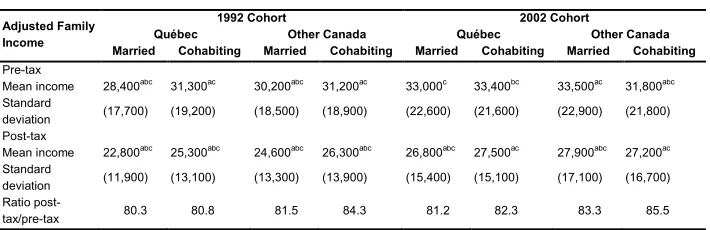
Table 2: Pre-tax and post-tax adjusted family income prior to separation and post-tax/pre-tax income ratio among married and cohabiting women
in 1992 and 2002 who separated in 1993−1994 and 2003−2004 in
Québec and in the other provinces
Adjusted Family Income
1992 Cohort 2002 Cohort
Québec Other Canada Québec Other Canada
Married Cohabiting Married Cohabiting Married Cohabiting Married Cohabiting
Pre-tax
Mean income 28,400abc 31,300ac 30,200abc 31,200ac 33,000c 33,400bc 33,500ac 31,800abc Standard
deviation (17,700) (19,200) (18,500) (18,900) (22,600) (21,600) (22,900) (21,800) Post-tax
Mean income 22,800abc 25,300abc 24,600abc 26,300abc 26,800abc 27,500ac 27,900abc 27,200ac Standard
deviation (11,900) (13,100) (13,300) (13,900) (15,400) (15,100) (17,100) (16,700) Ratio
post-tax/pre-tax 80.3 80.8 81.5 84.3 81.2 82.3 83.3 85.5
Source: Statistics Canada, Longitudinal Administrative Database (LAD). Income rounded at the nearest hundred. Statistically significant difference at the 0.05 level when comparing:
a married vs cohabiting, for a given year and geographic unit. b Québec vs Other Canada, for a given type of union and year. c 1992 vs 2002 cohort, for a given type of union and geographic unit.
As expected, the average post-tax family adjusted income of all groups is lower than the pre-tax income. In the 1992 cohort, cohabitors benefit from a significantly higher level of income than married women. In the 2002 cohort cohabitors continue to fare better in Québec ($700 more than married women), whereas married women do better in the other provinces ($700 more than cohabitors). Women living outside Québec exhibit a slightly higher post-tax/pre-tax income ratio than Quebeckers, reflecting the higher levels of taxation prevailing in Québec. Among all groups of women cohabiting women living outside Québec have the largest post-tax/pre-tax income ratio, their post-tax adjusted income representing approximately 85% of their pre-tax income.
among cohabitors.20 In the 1992 cohort a slightly higher percentage of cohabitors
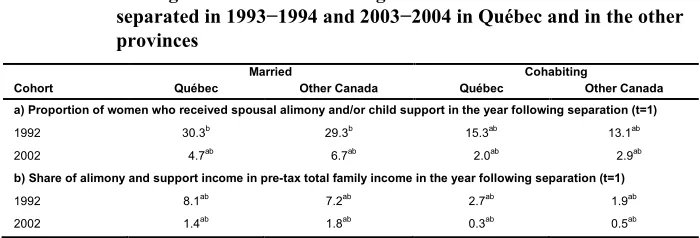
received support payments in Québec compared to elsewhere in Canada (15.3% vs 13.1%), while a larger proportion of married women did so outside Québec in 2002 (6.7% vs 4.7%). The former gap is probably attributable to the higher percentage of cohabiting women who were living with the father of their children prior to separation – and thus more likely to receive child support – as shown in a previous study (Hamplová, Le Bourdais, and Lapierre-Adamcyk 2014). The second might be related to the relatively shorter duration of marriage associated with higher divorce rates in Québec.
Table 3: Among married and cohabiting women in 1992 and 2002 who
separated in 1993−1994 and 2003−2004 in Québec and in the other
provinces
Cohort Québec Married Other Canada Québec Cohabiting Other Canada
a) Proportion of women who received spousal alimony and/or child support in the year following separation (t=1)
1992 30.3b 29.3b 15.3ab 13.1ab
2002 4.7ab 6.7ab 2.0ab 2.9ab
b) Share of alimony and support income in pre-tax total family income in the year following separation (t=1)
1992 8.1ab 7.2ab 2.7ab 1.9ab
2002 1.4ab 1.8ab 0.3ab 0.5ab
Source: Statistics Canada, Longitudinal Administrative Database (LAD). Statistically significant difference at the 0.05 level when comparing: a Québec vs Other Canada, for a given type of union and year. b married vs cohabiting, for a given year and geographic unit.
Among the 1992 cohort the percentage of women who received any kind of support payments compared to the larger proportions of those who reported living with children under age 18 during the year prior to separation (see Table 1) may seem relatively low. Part of the difference is probably linked to the number of fathers who have either full or shared custody of their children and are thus not required to pay child support. But other factors are also at play. To be recognized by Revenue Canada, “support payments have to be a fixed amount paid regularly. Couples who have opted for lump-sum or irregular payments would thus not appear in the LAD” (Galarneau and Sturrock 1997: 22). To these must be added the large number of separated mothers who received no payments. This number is hard to estimate but appears to be relatively high. For example, according to the General Social Survey on Family conducted in 2011 by
20 The percentages observed in 2002 include a number of women receiving spousal alimony as well as a very
Statistics Canada, 21% of separated or divorced parents mentioned that they were paying some form of financial support for their children, while 26% reported receiving child support (Sinha 2014). For women who reported receiving spousal and/or child support payments, these represent a relatively low proportion of their income. As can be seen in the lower panel of Table 3, both types of payments account for 7−8% of pre-tax family income among married women in the 1992 cohort, compared to approximately 1.5% in the 2002 cohort. For cohabiting women the comparable figures are respectively 2−3% and less than 1% (see lower panel of Table 3). The gap separating the two cohorts is likely to become even smaller when considering post-tax family income, given that child support payments were taxed in the 1992 cohort but not in that of 2002.21 This result supports prior studies that aimed to estimate the impact of the
noninclusion of child support in separated mothers’ income and concluded that it is modest, given the low percentage of women who receive child support and the relatively small amounts that they get (Galarneau and Sturrock 1997; Manting and Bouman 2006).
We will now examine the decline in income that women face once they separate and the relative recovery that they experience through the following years. To this end Figure 1 presents the adjusted income replacement rate of married and cohabiting women: that is, the fraction of the pre-dissolution adjusted family income that women reported for the year in which they separated and in the four successive years. We use median incomes, which are not as sensitive as other indicators (e.g., means) to extreme high and low values. The upper part of the figure shows pre-tax income replacement rates and the lower part shows post-tax replacement rates.
Figure 1 shows that all women, previously married and cohabiting, face a significant decline in their economic situation following separation. In the year the union dissolved women experienced a drop in income that varied between 29% and 40%, depending upon the type of union, the region, and the period considered. Married women appear to be the most negatively impacted by separation, with a loss in their pre-tax income between 35% and 40%, and the magnitude is relatively consistent across both periods. In contrast, cohabitors lose about 30% of their pre-tax income. Four years after separation married women have, however, caught up with cohabiting women in the 1992 cohort, where the adjusted family income of both groups of women is then approximately 15% lower than their pre-separation income. The situation is quite different in 2002. Four years after separation, not only are income replacement rates higher than they were in the previous cohort, but also the gap separating cohabiting and married women differs in the two regions considered. In Québec both groups of women have regained nearly 95% of their pre-separation economic situation. In contrast,
21 It is impossible to estimate precisely the share of spousal and child support payments in post-tax income
0.55 0.60 0.65 0.70 0.75 0.80 0.85 0.90 0.95 1.00
-1 0 1 2 3 4 -1 0 1 2 3 4
Married-Québec_ Cohabiting-Québec Married-Other Canada Cohabiting-Other Canada
1992 Cohort 2002 Cohort
Time Time
0.55 0.60 0.65 0.70 0.75 0.80 0.85 0.90 0.95 1.00
-1 0 1 2 3 4 -1 0 1 2 3 4
Married-Québec_ Cohabiting-Québec Married-Other Canada Cohabiting-Other Canada
1992 Cohort 2002 Cohort
Time Time
cohabiting women living outside Québec have totally recovered their pre-separation income, while married women still suffer a 6% loss.
Figure 1: Adjusted family income replacement rate of previously married and
cohabiting women who separated in 1993−1994 and 2003−2004 in
Québec and in the other provinces (changes in median income)
A) Pre-tax
The post-tax data shows similar trends, except for two differences. First, the gap separating cohabiting and married women in the first years following separation is slightly narrower than that observed with pre-tax data. Second, in the 1992 cohort married women end up with a slightly higher recovery rate than cohabitors four years later. These results are due to the progressive nature of the income tax system in Canada: that is, to the fact that married women paid less tax given that their income was lower than that of cohabiting women. The descriptive analysis thus appears to support our first hypothesis, namely that married women experience larger declines in family adjusted income than cohabiting women, at least in the first years following separation.
4.2 Multivariate analysis
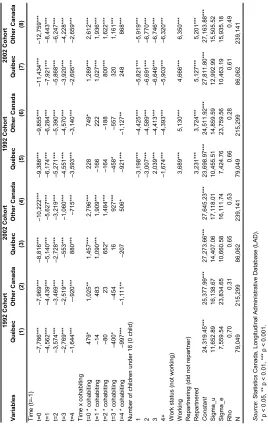
We will now use fixed effects models to estimate the changes in post-tax adjusted family income that married and cohabiting women experienced after controlling for both some important time-varying characteristics (number of children, work status, and repartnering) and all time-constant characteristics. Table 4 presents the coefficients of the regressions run separately for the two regions and the two periods considered. The first four columns (Models 1−4) show the changes in income that married and cohabiting women experience during the year of separation and in the following four years, without controlling for other characteristics; Models 5−8 include the time-varying characteristics in the regression.
Table 4: Fixed-effects coefficients of changes in post-tax adjusted family income among married and cohabiting women in 1992 and 2002 who
separated in 1993−1994 and 2003−2004 in Québec and in the other
provinces Var iab les 1992 C oh or t 2002 C oh or t 1992 C oh or t 2002 C oh or t Q uéb ec O th er C an ad a Q uéb ec O th er C an ad a Q uéb ec O th er C an ad a Q uéb ec O th er C an ad a (1) (2) (3) (4) (5) (6) (7) (8) Ti me (t =-1) t=0 ‒7, 786* ** ‒7, 969* ** ‒8, 816 *** ‒10, 222* ** ‒9, 388 *** ‒9, 855* ** ‒11, 434 *** ‒12, 759* ** t=1 ‒4, 562* ** ‒4, 439* ** ‒5, 140* ** ‒5, 627* ** ‒6, 174* ** ‒6, 284 *** ‒7, 921* ** ‒8, 443 *** t=2 ‒3, 574* ** ‒3, 469* ** ‒2, 728* ** ‒3, 219* ** ‒5, 271* ** ‒5, 390* ** ‒5, 868* ** ‒6, 247 *** t=3 ‒2, 769* ** ‒2, 519* ** ‒553 *** ‒1, 060* ** ‒4, 551* ** ‒4, 570* ** ‒3, 920* ** ‒4, 228 *** t=4 ‒1, 644* ** ‒-920* ** 880* ** ‒715 *** ‒3, 593* ** ‒3, 140* ** ‒2, 695* ** ‒2, 659 *** Ti me x c ohabi ting t= 0 * c ohab iti ng 479 * 1, 025* * 1, 457* ** 2, 796* ** 228 749 * 1, 289 *** 2, 612 *** t= 1 * c ohab iti ng ‒14 483 1, 090 *** 1, 909* ** ‒166 222 1, 027 *** 1, 936* ** t= 2 * c ohab iti ng ‒80 23 652 * 1, 484* ** ‒164 ‒188 800 *** 1, 622 *** t= 3 * c ohab iti ng ‒400* ‒454 16 927 *** ‒458 * ‒557 320 1, 161 *** t= 4 * c ohab iti ng ‒997* ** ‒1, 111 ** ‒207 506 * ‒921 *** ‒1, 127 ** 248 868 *** N um ber of c hi ldr en unde r 18 (0 c hi ld ) 1 ‒3, 198* ** ‒4, 425* ** ‒5, 821* ** ‒5, 919 *** 2 ‒3, 007* ** ‒4, 589* ** ‒6, 691* ** ‒6, 770 *** 3 2, 039* ** ‒4, 413* ** ‒6, 646* ** ‒6, 746 *** 4+ ‒1, 674* ** ‒4, 393* ** ‒5, 903* ** ‒6, 320 *** W or k s tat us (not w or ki ng) W or ki ng 3, 689* ** 5, 130 *** 4, 666* ** 6, 350 *** R epar tne ring ( di d not repa rtner ) R epar tne red 3, 231* ** 3, 724 *** 5, 127* ** 5, 201 *** C ons tant 24, 319. 45* ** 25, 377. 99* ** 27, 273. 66* ** 27, 645. 23 *** 23, 698. 97* ** 24, 511. 92* ** 27, 811. 80* ** 27, 163. 88* ** Si gm a_u 11, 652. 89 16, 138. 67 14, 407. 06 17, 118. 01 10, 455. 51 14, 859. 59 12, 992. 99 15, 505. 52 Si gm a_e 7, 559. 54 23, 834. 65 10, 660. 58 16, 111. 74 7, 424. 76 23, 759. 56 10, 463. 19 15, 935. 18 Rh o 0. 70 0. 31 0. 65 0. 53 0. 66 0. 28 0. 61 0. 49 N 79, 049 215, 299 86, 062 239, 141 79, 049 215, 299 86, 062 239, 141 Sour ce : S tat is tic s C anad a, Lon gi tud ina l A dm ini st rat iv e D at abas e ( LA D ).
* p <
0. 05, ** p < 0. 01, **
* p <
0.
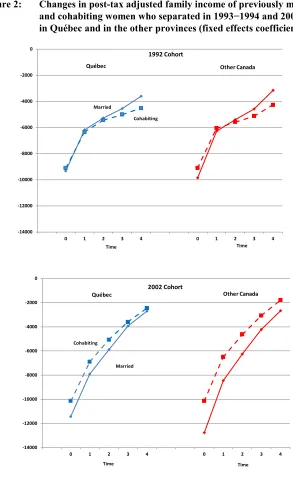
The inclusion of the time-varying covariates in the regression results in an increase of the financial loss that both married and cohabiting women faced when separating. For example, the amount of income lost by Québec married women increased from $7,786 to $9,388 (cf. Models 1 and 5) at the time of separation, and the loss experienced by cohabiting women rose from $7,307 to $9,160. Thus the gap between married and cohabiting women decreased slightly (by about $251) at the time of separation. However, this gap did not uniformly decrease across all years following separation. It diminished through the years in which cohabiting women experienced a smaller drop in income than their married counterparts (i.e., when the time x cohabiting coefficient was positive), but it increased when married women were financially doing better than cohabitors (i.e., when the time x cohabiting coefficient was negative). For example, in the 1992 cohort in Québec the gap separating married and cohabiting women decreased by $251 in the year of separation, but it increased from $14 to $166 in the first year following separation. Contrary to our expectation, controlling for work status and number of children in the equation did not lead to a constant decline in the post-separation income gap between previously married and cohabiting women.
Figure 2: Changes in post-tax adjusted family income of previously married
and cohabiting women who separated in 1993−1994 and 2003−2004
in Québec and in the other provinces (fixed effects coefficients)
-14000 -12000 -10000 -8000 -6000 -4000 -2000 0
0 1 2 3 4 0 1 2 3 4
Québec Other Canada
Married
Cohabiting 1992 Cohort
Time Time
-14000 -12000 -10000 -8000 -6000 -4000 -2000 0
0 1 2 3 4 0 1 2 3 4
Cohabiting
Married
2002 Cohort
Québec Other Canada
The situation is drastically different for women who separated in 2003 or 2004. No matter the region or the time elapsed since separation, cohabiting women exhibit a lower decline in income than their married counterparts. The year they separated cohabitors living in Québec faced a $10,145 drop in income that was significantly lower than that ($11,434) observed among married women. Four years later the absolute loss in income experienced by the two groups of women in Québec was no longer statistically different: They both earned approximately $2,500 less than they did in the year prior to separation. Outside Québec the gap separating cohabiting and married women did not appear to narrow significantly over time. Hence four years after they separated the former earned only $1,800 less than they did before separation, compared to $2,660 for the latter. One should note that, in both regions, the initial dip in adjusted income was larger in the 2002 rather than in the 1992 cohort, but that women had recovered more of their loss four years later.
To test our second hypothesis that the income gap between previously married and cohabiting women will be smaller in Québec than in the rest of Canada, we ran fixed effects regressions on the pooled sample of regions, for 1992 and 2002 separately, and tested for interactions between union status and region over time (results available upon request). As reflected in the upper panel of Figure 2, these interactions revealed no significant differences between the gap separating married and cohabiting women by region in the 1992 cohort. However, in the more recent cohort these differences turned out to be statistically significant in all years following of separation except for the last (t=4). Our second hypothesis is thus confirmed, but only in the 2002 cohort.
Our third hypothesis posited that the gap in post-separation income between married and cohabiting women would decrease over time: That is, it would be smaller in the 2002 than in the 1992 cohort. To test this hypothesis we ran fixed effects regressions on cohort pooled samples, separately for Québec and the other provinces (results available upon request). In Québec the differences between cohorts turned out to be statistically significant. However, we did not find a constant decrease of the gap observed between the 1992 and 2002 cohorts, but rather the gap widened during the year of separation and the two subsequent years. Only in the fourth year after separation did the difference separating married and cohabiting women significantly decrease across cohorts. Outside Québec, contrary to our hypothesis, the analysis showed that the gap between married and cohabiting women increased, rather than decreased, from the 1992 cohort to the 2002 cohort.
1992 cohort, and between $6,000 and $6,750 less in the 2002 cohort. The last numbers parallel those observed in Québec for the most recent cohort. Among women living in Québec who separated in 1993 or 1994 the income loss dropped from about $3,000 among women with one or two children, to $2,000 among those with three children, and to $1,675 among those with four children or more. The baby-bonus policy introduced by the Québec government in 1988, which provided a nontaxable allowance of $8,000 paid in four installments per year over five years to mothers for the birth of third and higher-rank children, perhaps accounts for the variation observed. This program was stopped in 1997 and thus did not affect mothers who separated in 2003 or 2004. The larger decline in income per number of children that we observe in the 2002 cohort compared to the 1992 cohort is perhaps slightly overestimated, due to the fact that child support payments have not been included in women’s tax returns since 1997. However, this effect is likely to be relatively modest given, as mentioned earlier, the low percentage of mothers who receive regular child support payments and the small size of these payments.
As expected, women who were employed experienced less economic loss after separation. Compared to their counterparts who did not work, separated women who worked – that is, who reported employment income on their tax returns – earned approximately $4,000 and $4,650 more respectively in the 1992 and 2002 cohorts in Québec, and $5,100 and $6,350 respectively in the other provinces. The impact of working in reducing the economic consequences attached to separation thus appears to be smaller in Québec than it is in the other provinces. This can perhaps be attributable to lower numbers of hours worked and to lower salaries and wages in Québec. Unfortunately, information on full- or part-time work is not available in the LAD.
Separated women who repartnered saw their adjusted family income increase compared to their single counterparts. The increase in the adjusted income of women linked to repartnering does not appear to vary much according to the region considered, but it does so between cohorts. Separated women who repartnered enjoyed higher adjusted incomes than those who remained single; on average, they received $3,500 more in the 1992 cohort and $5,000 more in the most recent cohort.
5. Summary and conclusion
This paper aimed to estimate the economic consequences of separation among previously married and cohabiting women and, more specifically, to investigate whether the gap between the two groups of women varied across the two regions of Canada and over time. To do so we used the Longitudinal Administrative Databank, which contains a 20% sample of Canadian tax filers, and examined the financial situation of women aged 25−44 who were living with a married or cohabiting partner in 1992 or 2002 and who separated in one of the two following years.
First, we expected married women to suffer a larger decline in income than cohabiting women, because they are less likely to participate in the labor market and more likely to have children. After controlling for labor force participation, number of children, and other factors, we predicted that these differences would diminish. The analysis, based on post-tax incomes, only partly corroborated our first hypothesis. The year they separated, married women experienced a larger decline in income than their unmarried counterparts, but the gap separating the two groups narrowed over the following years. Hence four years after separation married women had recovered a similar or larger proportion of their pre-separation income than cohabiting women in both regions in the 1992 cohort and in Québec in the 2002 cohort. Only in the most recent cohort did married women living outside Québec fare worse than the latter throughout all the years observed after separation, although the difference between married and cohabiting women decreased over time. Furthermore, the introduction of work status and number of children into the regression did not uniformly reduce the gap observed between married and cohabiting women as predicted, but rather only during the years in which cohabiting women were faring better than their married counterparts. Second, we hypothesized that the gap between the two groups of women would be narrower in Québec than elsewhere in Canada, given that cohabitation appears to be more marriage-like in the former than in the latter. The use of interactions in the pooled samples of regions confirmed this hypothesis, but only for the 2002 cohort. Hence in the 1992 cohort the analysis revealed no significant differences between Québec and the other provinces in the gap separating married and cohabiting women.
slightly (although not significantly) better position than the latter. In the other provinces the gap between the two groups of women actually increased from the 1992 to the 2002 cohort.
The deterioration of the economic situation of married women relative to cohabitors that we observed in the 2002 cohort as compared to the 1992 cohort runs counter to our expectation and stands in contrast with the situation that was observed in the United States by Tach and Eads (2015). In the US case one of the explanations advanced to account for the relative improvement of married women’s income was the change in policies that increased the eligibility of married mothers to government transfers and programs. In Canada the deterioration of married women’s economic situation is perhaps partly attributable to the fact that child support is no longer included in women’s income tax returns. Indeed, the noninclusion of child support payments is more likely to affect the income of married women, who have more children and are more likely to receive child support payments from their ex-partners than formerly cohabiting women, as previous studies have shown (Marcil-Gratton and Le Bourdais 1999). However, as discussed previously, this is unlikely to account for most of the difference observed given the relatively small amounts involved. Another factor could be the changing composition of cohabitors, with cohabitation becoming more common among more educated women.
It is important to note that, four years after union dissolution, both previously married and cohabiting women who separated in 2003 or 2004 had recovered a higher proportion of their pre-dissolution income than those from the 1992 cohort. This improvement could be attributable to a variety of factors, such as an increase in women’s work hours and earnings or salaries among the 2002 cohort, or the development of policy and fiscal measures that are favorable to single-parent families. Unfortunately, the LAD data does not include data that would allow us to estimate the impact of these factors.
information on the rank and duration of the woman’s union prior to separation. Yet cohabiting unions have been shown to be of shorter durations than marriages and, the second time around, separated individuals are more likely to opt for cohabitation over marriage. In both cohabiting unions and stepfamilies formed after a union dissolution, women have been shown to be more likely to participate in the labor market (Lapierre-Adamcyk and Le Bourdais 2008) and to manage their money separately (Hamplová, Le Bourdais, and Lapierre-Adamcyk 2014). The fact that cohabiting women tend to earn a larger proportion of the family income and to keep greater control over their finances than married women perhaps partly accounts for our result indicating that they experience a smaller decline in income. Clearly, further analyses using alternative sources of data are required to document the factors that lay behind the differences observed in the economic situation of previously married and cohabiting women living in Québec and the rest of Canada.
Comparisons to other countries will further illuminate how the economic well-being of married and cohabiting women may differ according to the level of cohabitation and across different policy contexts. Our results indicate that although the changing composition of married and cohabiting women is likely to influence their relative long-term wellfare, the legal and policy context can also shape whether their trajectories converge or diverge over time.