World Maritime University
The Maritime Commons: Digital Repository of the World
Maritime University
World Maritime University Dissertations Dissertations
1999
The impact of the STCW 95 on the onboard
training programs of shipping companies in China :
meeting the challenge of change
Guohua Shen
World Maritime University
Follow this and additional works at:http://commons.wmu.se/all_dissertations Part of theEducational Methods Commons
This Dissertation is brought to you courtesy of Maritime Commons. Open Access items may be downloaded for non-commercial, fair use academic purposes. No items may be hosted on another server or web site without express written permission from the World Maritime University. For more information, please [email protected].
Recommended Citation
Shen, Guohua, "The impact of the STCW 95 on the onboard training programs of shipping companies in China : meeting the challenge of change" (1999).World Maritime University Dissertations. 429.
WORLD MARITIME UNIVERSITY
Malmö, Sweden
THE IMPACT OF THE STCW 95
ON THE ONBOARD TRAINING PROGRAMS
OF SHIPPING COMPANIES IN CHINA
- Meeting the challenge of change
By
SHEN GUOHUA
The People’s Republic of China
A dissertation submitted to the World Maritime University in partial fulfilment of the requirements for the award of the degree of
MASTER OF SCIENCE
in
MARITIME EDUCATION AND TRAINING (Nautical)
1999
DECLARATION
I certify that all the material in this dissertation that is not my own work has been identified, and that no material is included for which a degree has previously been conferred on me.
The contents of this dissertation reflect my own personal views, and are not necessarily endorsed by the University.
... SHEN Guohua
2 August 1999
Supervised by: Professor Peter Muirhead
Course Professor, Maritime Education and Training World Maritime University
Assessor: Captain Jan Horck
Lecturer, Maritime Education and Training World Maritime University
Co-assessor: Captain George Angas
Dean, Warsash Maritime Centre,
ACKNOWLEDGEMENTS
Having finished the dissertation, I feel deeply that my achievement could not be
made without much help and support from professors and other staff such as
librarians at WMU, friends in China as well as some visiting professors.
I hereby would especially like to express my deepest thanks to my Course Professor
and Supervisor Peter Muirhead, who gave me great assistance and instruction in my
study and research.
In addition, Associate Professor Hikima at WMU, Captain Yan Weiping, Deputy
General Manager in COSCO Dalian, Captain Liu Shi, Deputy General Manager in
Magagement Division of COSCO Headquarter and Senior Engineer He Dalu, Vice
General Manager in COSCO Human Resource Training and Development Co. as
well as Mr. Cao Chunjing, Manager of Seaman Division of COSCO Human
Resource Training and Development Co. gave me great assistance in my collection
of information. My acknowledgement also goes to them.
Finally, I must thank my wife Zhao Min and my beloved daughter Shen Tong
ABSTRACT
The dissertation is a study of Maritime Education and Training in shipping
companies. It describes new requirements imposed on shipping companies by the
STCW 95 and the national regulations related to the training of seafarers, and
discusses at some length that more attention needs to be given to onboard training by
Chinese shipowners. The assurance of seafarers’ competency, especially operational
skills and the English language skill, is not only the task of maritime institutes. On
the contrary, shipping companies should carry out their obligations without any
doubt.
The development of new technology such as computer technology, satellite
communication technology and network (Internet) technology, and their applications
in the shipping industry with the focus on the approach to onboard training are
examined briefly.
An analysis of the current situation in Chinese shipping companies is made. Some
weaknesses and shortcomings, both in training systems and in seafarers’
competency, are identified.
On the basis of this study of the internal and external environment of Chinese
shipping companies as well as reference to others, the principles and main aspects of
onboard training in the improved training system for Chinese shipping companies are
highlighted in order to meet the challenge of change. Finally, some recommendations
are put forward to Chinese shipping companies.
TABLE OF CONTENTS
Declaration
Acknowledgements
Abstract
Table of Contents
List of Tables
List of Figures
List of Abbreviations
1 Introduction
1.1 Background
1.1.1 Enforcement of the STCW 95 and the ISM Code
1.1.2 The development of new technology in the shipping industry 1.1.3 Demand of the industry
1.2 Objectives 1.3 Methodology 1.4 Limitations
2 Maritime training in shipping companies
2.1 Company and Institutional Training – a comparison 2.1.1 Differences
2.1.2 Linkage to maritime institutes
2.2 Shore-based training in large shipping companies 2.2.1 Its necessity and basic approaches
2.2.2 General training aspects 2.2.3 Training needs
2.3 Onboard training
2.3.1 Advantages of onboard training 2.3.2 Objectives with different levels 2.3.3 Equipment and facilities
2.3.4 Training methods
3 Impact of conventions and regulations (related to seafarers’ training) on shipping companies
3.1 International requirements
3.1.1 STCW 95
3.1.2 ISM Code
3.1.3 International Memorandums of PSC related to training 3.1.4 Others
3.2 Chinese National requirements
4 A review of current situation of the companies in China
4.1 The role of the major shipping companies
4.2 An analysis of current training systems 4.2.1 Structure of training system 4.2.2 Regulations related to training 4.2.3 Organisation of training
4.3 An analysis of current seafarers’ competence 4.3.1 Professional knowledge and understanding 4.3.2 Practical (Operational) skills
4.3.3 English language
4.3.4 Management ability for senior officers
4.4 Measures for implementation of STCW 95 in shipping companies 4.4.1 Preparation for implementation of STCW 95
4.4.2 Training practice
5 Change to training, new approach for Chinese shipowners
5.1 Impact of new technology on operation practices
5.1.1 Brief introduction to new technology in shipping industry 5.1.2 Applications of new technology in MET
5.2 Factors influencing a training system 5.2.1 Internal environment and situation 5.2.2 External environment
5.3 The use of experience of others 5.3.1 The Norwegian approach 5.3.2 The Japanese approach 5.3.3 Others
5.4 Improved training system for Chinese shipowners 5.4.1 The principles and organisation
5.4.2 Identification of essential aspects for onboard training 5.4.3 Onboard training resources
5.4.4 Methodology and effective implementation
5.4.5 Assessment, evaluation and recording for onboard training 5.5 Limitations and constraints
6 Conclusions and Recommendations
6.1 Conclusions 6.2 Recommendations
Bibliography Appendices
Appendix 1 Evolution of Intel Microprocessors
Appendix 2 Norwegian Onboard Training Programmes Appendix 3 Japanese “K” Line Training Programmes Appendix 4 Seagull AS: CBT Training Programmes Appendix 5 Videotel Training Packages
79
79 81
82 88
LIST OF TABLES
Table 2.1 Training Comparisons
Table 4.1 Assessment Results (deck department) Table 5.1 Three-month Onboard Training Program Table 5.2 Training Items for Each Group
7 39 60 71
LIST OF FIGURES
Figure 2.1 Shipowners and Reliability
Figure 2.2 Linkage Between a Institute and a Company Figure 2.3 The Concept of Experience
Figure 4.1 1991-1997 Seaborne Cargo Transport Turnover in China Figure 4.2 Basic Structure Relating to Seafarers' Training
Figure 4.3 Statistics of Incidents in a Shipping Company Figure 4.4 A Breakdown of Human Factors
Figure 5.1 Internal and External Factors
Figure 5.2 Baseline for an Improved Training System Figure 5.3 Sectors Affecting a Seafarers’ Training Figure 5.4 A Flowchart of Training Procedures Figure 5.5 Hierarchy of Training Standards
LIST OF ABBREVIATIONS
APRO Ability Profile
ARPA Automatic Radar Plotting Aid
BRM Bridge Resource Management
CAL Computer Assisted Learning
CBA Computer-Based Assessment
CBT Computer-Based Training
CD-ROM Compact Disk - Read Only Memory
CFR Code of Federal Regulations
COLREG Collision Regulations
COSCO China Ocean Shipping Company
DGPS Differential Global Positioning System
DTV Digital TV
ECDIS Electronic Chart Display and Information System
ECS Electronic Chart System
EC European Commission
ENIAC Electronic Numerical Integrator and Computer
FSA Formal Safety Assessment
GB Gigabyte
GEO Geo-stationary orbit satellite
GLONSS Global Navigation Satellite System
GMDSS Global Maritime Distress and Safety System
GNSS Global Navigation Satellite System
GPS Global Positioning System
GPS-SPS Global Positioning System Standard Positioning Service
IBS Integrated Bridge System
ICO Intermediate Circular Orbit (here it is the name of a company)
ICS International Chamber of Shipping
ICT Information and Communication Technology
IGS Inert Gas System
ILO International Labour Organization
INS Integrated Navigation System
IMO International Maritime Organization
INMARSAT International Mobile Satellite Communications
Global Mobile Satellite Communications
ISDN Integrated Service Data Network
ISF International Shipping Federation
ISI Information Society Initiative
ISMA International Ship Managers’ Association
IT Information Technology
LAN Local Area Network
LEOS Low Earth Orbit Satellite
LESO Land Earth Station Operator
MARCOM Maritime Communication
MARPOL International Convention for the Prevention of Pullotion from
ships 73/78
MET Maritime Education and Training
MIS Management Information System
MOU Memorandum Of Understanding
MPP Most Probable Position
OMBO One Man Bridge Operation
OOW Officer of the Watch
OS Ordinary Sailor
OSM Oil Spill Management
PPRO Performance Profile
PSC Port State Control
PSCO Port State Control Officer
RPM Revolutions Per Minute
SAR Search And Rescue
SATCOM Satellite Communication
SCC Ship Control Centre
SETS Seafarers Evaluation and Training Systems
SIRC Seafarers International Research Centre (Cardiff University)
SMCP Standard Marine Communications Phrases
SMS Safety Management System
SOLAS International Convention for the Safety of Life at Sea 1974
STCW International Convention on Standards of Training, Certification
and Watchkeeping for Seafarers, 78/95
SWOT Strength, Weakness, Opportunity and Threat
TEU Twenty Equivalent Unit
UNCTAD United Nations Conference on Trade and Development
USCG United States Coast Guard
VDR Voyage Data Recording
VHF Very High Frequency
VR Virtual Reality
VTMIS Vessel Traffic Management and Information Service
VTS Vessel Traffic Service
WWRNS World Wide Radionavigation System
CHAPTER 1
Introduction
1.1 Background
1.1.1 Enforcement of the STCW 95 and the ISM Code
The revised STCW 78 (STCW 95) entered into force in February 1997, and
the transitional arrangement of enforcement has already passed the first date of
August 1st 1998. Final compliance date is set for February 1st 2002. The statutory
requirements imposed by the Convention have had a strong impact on the whole
maritime education and training (MET) system across the world. The obligations and
responsibilities of shipping companies have been identified in the Convention,
relating to recruiting and training seafarers. To enforce the seafarers’ training,
especially onboard training, shipping companies need to review and improve their
training systems.
On August 1st 1998, the ISM Code, which directly addresses the company,
fully entered into force. Bulk carriers, oil tankers, chemical tankers, gas carriers,
passenger ships and high-speed craft (including both passenger and cargo) of 500
gross tonnage and upwards are bound legally. In three years’ time, namely 2002,
other types of vessels will also be bound by the Code. Shipowners and operators
cannot avoid operating their fleet and manning ships carefully and properly. Safe
management of fleet needs not only the necessary procedures but also even more
competent personnel both ashore and on board. Therefore, recruiting and training
seafarers in shipping companies requires more attention than before.
The GMDSS has been just fully implemented from February 1st 1999.
Correct operation of the system needs seafarers’ practical skills. Other new
In Chapter 3, the above-mentioned requirements on shipping companies as
well as others including national requirements that are related to seafarers’ training
are identified.
1.1.2 The development of new technology in the shipping industry
New technology, especially information technology (IT) in the shipping
industry, has developed so fast that ship operation and management, based on the
new technology, are changing the face of the industry, while changes in maritime
education and training are concerned with people’s perspectives, methods and tools.
The opportunities and challenge brought about by the new technology are facing all
shipping companies. The traditional Chinese shipping industry needs to think about
rising rapidly with the aid of new technology. The first part of Chapter 5 states
briefly the applications of new technology.
1.1.3 Demand of the industry
MET system consists of two major stages: one is in maritime institutions, the
other is in shipping companies. One cannot educate and train competent seafarers
totally in an institution. On the contrary, the skills they have gained in an institute
need to be assessed at the workplace, on board ships. On the other hand, the trend of
reduction of manning ships demands more knowledgeable and skilful seafarers. The
further training during their in-service on board therefore has to be conducted
systematically.
The competitiveness in the shipping industry today has been increasingly
intense. In essence, this is the competitiveness of people of talent, level of
management and the use of new technology.
According to research by SIRC that is under the EC project ‘Maritime
Communication’ (MARCOM), the most frequently applied criteria for recruitment of
officers in the majority of shipping companies are ‘abilities/training’, followed by
‘tradition’ and then ‘language skills’. This indicates that seafarers’ training is now
seafarers more and more seriously. Many research results show that about 80% of
marine accidents were attributed to human factors. Highly qualified seafarers mean
safer ships, and a safer ship is an essential element for lower cost. So there are no
reasons for shipping companies not to pay attention to seafarers’ training. Chapter 2
describes general aspects of MET in a shipping company.
China is a developing country. The supply of seafarers for developed and
industrialised countries is one of the practical issues. However, many seafarers are
not at higher level of standards in operation of modern ships, nor skilled in English
language. Their competency needs to be developed and improved so as to meet the
requirements of the labour supply and safe operation on board ships. To improve this
situation is a very important and urgent task for Chinese shipping companies.
Chapter 4 reviews and analyses the current situation in Chinese shipping companies,
including training system and seafarers’ competency.
In summary, the main reasons for the author to choose the topic are the legal
aspect, development of new technology, demand of the industry, and a gap between
the industry requirements and the current situation in China.
1.2 Objectives
Training in shipping companies, mainly on board training, is a hot issue that
should be considered carefully in order to fully implement STCW 95. The objectives
of this dissertation are to try to answer those questions: What situations are shipping
companies facing? How can shipowners be encouraged to embrace improved
onboard training regimes? What are the main factors that have an impact on the
training? How to conduct training on board in order to acquire better results? The last
part of Chapter 5 gives an outline to improve training system based on the following
specific objectives:
1. To clarify responsibilities of shipowners in seafarer training, according to
the international conventions and codes, as well as national regulations.
2. To identify impact of new technology on seafarers’ training.
conventions and codes.
4. To identify the major training requirements for Chinese seafarers.
5. To develop solutions to achieve high standards of onboard training.
6. To make proposals and recommendations to improve training and
assessment in shipping companies, especially onboard training.
1.3 Methodology
The author made a literature search of the topic with the focus on
identification of the development of new technology in the shipping industry, current
MET methods for onboard training and assessment, and responsibilities of the
company. He examined some relevant books, journals, conference-proceedings,
handouts and lecture-notes, newspapers etc. as well as the Internet sources. The
investigation was carried out by asking for some first hand materials and
information, and interviewing professors, visiting professors and some staff in
shipping companies to get their opinions on the seafarers’ training. Reference of
some training systems of shipping companies in other countries was taken for
improvement of the Chinese training system. The handouts and lecture-notes related
to the topic were used. E-mail and fax communication was a supplementary way to
get some ideas from some world leading shipping companies. In addition,
observation of others during the field study trips and the author’s own experience
were also used in creation of the new training system. In order to make some points
clear, some references selected as support information are listed in appendixes.
Based on the study of information, the conclusion and suggestions are drawn.
1.4 Limitations
From the author’s own background, the details in the dissertation are related
to the deck department on board ships and the engine department is little discussed.
Other limitations included the each of availability of useful information, and the
restricted scope and time. As well, the author’s mother-language is not English.
There may be some unclear statements in the dissertation. So it is difficult to avoid
CHAPTER 2
Maritime Training in Shipping Companies
When people mention maritime education and training, they always think of
something in maritime academies or institutes. Of course what they think of is not
wrong. However, maritime training has been conducted in shipping companies for a
long time. Maybe, it started at the very beginning of marine transportation with
onboard training, but there were few people who realised this at the time. It was the
onboard training that allowed seafarers in the ancient times to have the skills or
techniques of navigation at sea in their hand. The master of a ship at that time was
equal to a manager in a shipping company of today. And this kind of training still
happens on board.
Looking back at maritime accidents in the past, one may find that many of
them were caused by incompetent seafarers or human errors, not cadets who had just
graduated from maritime institutes. The cadets need to be more fully trained on
board, and then they could become competent seafarers. If the environment changes,
such as new ships or new technology used in modern equipment, on being promoted
to a higher position onboard, they still need further training. Otherwise, they could
encounter difficulties in dealing with some problems that affect the safety at sea,
prevention of pollution or safety of life. So maritime training in companies is a very
important issue. It should be met face on, so as to take it from possible chaos to
structured operation.
Furthermore, from the whole society point of view, safety and environment
protection in the shipping industry are addressed directly to shipowners or ship
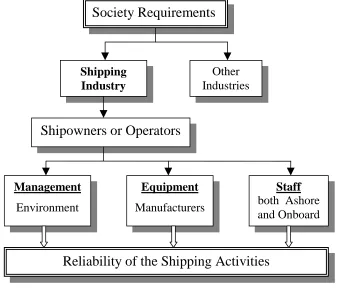
operators such as by the ISM and the STCW. This should ensure reliability of
better management, and in such a way give the society a satisfactory answer. See
Figure 2.1. Of the above three elements, staff, including seafarers, is crucial one.
Figure 2.1: Shipowners and Reliability
But what differences are there between training in shipping companies and
training in maritime institutes? Can these be harmonised? What is the focal point of
maritime training in companies, particular for on-board training? This chapter
discusses these issues.
2.1 Company and Institutional Training - a comparison 2.1.1 Differences
Maritime training in shipping companies may be broken down into two
categories: one is shore-based training, the other is on-board training. They have
their own characteristics, which are as follows:
Society Requirements
Shipping Industry
Other Industries
Shipowners or Operators
Management
Environment
Equipment
Manufacturers
Staff
both Ashore and Onboard
a. The focus is on the task. It can be explained that training items or courses
are specially designed to meet the requirements of the fleet and seafarers'
needs.
b. Course programs are short but effective. For example, when the company
buys newly built ships, seafarers who will be assigned to work on board
the ships need to be trained in ship-handling or equipment operation.
c. Training is flexible. Training may take place on shore or on board a ship,
depending on a specific course. Trainees can select the time set aside for
training in certain period.
d. Instructors may be selected from senior officers on board, staff in the
company or professional persons in the maritime field.
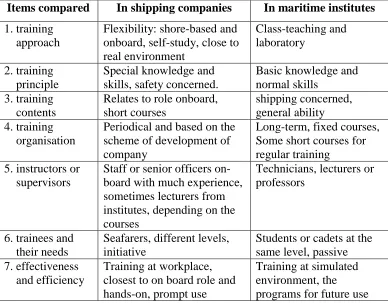
The differences compared with maritime institutes are identified in following
table.
Table 2.1: Training Comparisons
Items compared In shipping companies In maritime institutes
1. training approach
Flexibility: shore-based and onboard, self-study, close to real environment
Class-teaching and laboratory
2. training principle
Special knowledge and skills, safety concerned.
Basic knowledge and normal skills
3. training contents
Relates to role onboard, short courses
shipping concerned, general ability 4. training
organisation
Periodical and based on the scheme of development of company
Long-term, fixed courses, Some short courses for regular training
5. instructors or supervisors
Staff or senior officers on-board with much experience, sometimes lecturers from institutes, depending on the courses
Technicians, lecturers or professors
6. trainees and their needs
Seafarers, different levels, initiative
Students or cadets at the same level, passive 7. effectiveness
and efficiency
Training at workplace, closest to on board role and hands-on, prompt use
Obviously, many advantages of training in shipping companies can be found
from the above table.
2.1.2 Linkage to maritime institutes
As the author mentioned in Chapter 1, a MET system has two major parts:
one is in maritime institutes and another is in shipping companies. These two parts
can form an integral system. Eliminating either of them will cause the MET system
not to be integral. Being a seafarer, he/she does not only learn something in a
college, but must also learn something on the job. As a result, he/she could become a
competent seafarer. So the linkage between two kinds of training shows its
importance to trainees.
A good linkage should be made from trainees' needs or in considering
trainees' level. It means that the body of trainees is the central part of the training
system, thus either an institute or a shipping company should take trainees as a basic
element to develop training programs.
Figure 2.1 indicates that an institute gives a trainee (here a student) a
professional training and then awards him/her a diploma or degree. A student's needs
are the basic knowledge and skills, and a certificate of competency. After graduation,
the student is recruited to work on board a ship in a shipping company. The shipping
company assigns him/her a post on board, either as an officer or a rating. But he is
not competent for the job during the beginning period of time in general. So further
training needs to continue.
From an institute's point of view, the program should be capable of meeting
the requirements of the position on board. The institute needs to understand more
about shipping companies, ship-operation practice and seamanship, etc. while a
shipping company can design training programs according to a trainee's level
(knowledge basis and skills mastered) and requirements of the job. In this case,
refreshment should be brought into line to avoid unnecessary overlap. So these two
with each other, and supplement or modify their training programs. Trainees will
become competent, and the aim of safer ships and cleaner oceans will be realised.
Figure 2.2: Linkage Between a Institute and a Company
2.2 Shore-based training in large shipping companies
A large shipping company may be defined as a company that usually owns
more than 10 vessels and employs over several hundred seafarers. In that case, the
number of seafarers is the basis for discussing training.
2.2.1 Its necessity and basic approaches
Shore-based training in a shipping company, like a maritime institute, is to
gather seafarers by groups and then teach them certain skills or knowledge that will
be used when they go back to work on ships.
Years ago, the hierarchy of the organisational structure on board was
experience based. Now the hierarchy on board is mainly technical based. Senior
officers should update their knowledge so as to keep abreast of modern ships.
With the development of new technology, the level of ships’ automation is
higher and higher, and the equipment onboard ships is more advanced. The
integrated Navigation System (INS), for instance, has become a popular
configuration on modern vessels. The techniques and knowledge for seafarers to
operate such a ship consequently become more and more complicated. One-man-Trainee
Maritime Institute
Shipping Company Connection
Co-operation Supplementary
Task
Training needs Professional training
bridge-operation (OMBO) is not strange to seafarers, though it is still in hot
argument. Therefore, seafarers have to learn some new things so as to work on board
better to improve their ability for safe navigation.
On the other hand, managers in shipping companies do not have the safety of
ship as their final goal. What they really want to gain is high revenue. From the
board of directors to ordinary staff, a “sound circle” has been formed. Maybe, this is
the driving force for shipping companies behind the training. Seafarers, particularly
senior officers, are just a link of the circle. But how can they manage to assist a
company to achieve its goal? The answer should be that they need to understand the
company’s policy, follow the instructions, organise other seafarers on board and use
all resources on board as well as they can.
Thirdly, some international conventions or codes as well as national
regulations require shipping companies to make sure all seafarers working in their
companies are trained properly and qualified. (See Chapter 3)
Lastly, cost-derived forces make shipping companies man ships with
multinational crews. However, seafarers from different counties have different
cultures that influence their behaviour in working and daily life, including language
communication. With regard to the special environment on board ships, their
behaviour may affect the safety aspect by misunderstanding each other. On the other
hand, although the standards in the STCW Convention are required to be achieved,
their operational practice, in fact, is still different or at different levels. The shipping
companies, consequently, cannot avoid training crew in safety, even behaviour
standards if necessary. Not only should they be trained before seagoing, but they
should be continuously trained on board also.
Shore-based training may be conducted in several ways. Self-study and
studying in a training centre of a shipping company are often used, which apply to
different situations and programmes respectively, theoretical and simulations are
main subjects. But these two ways have their own advantages and disadvantages. For
example, self-study can save costs, but the result is not so good as hands-on training,
teaching, accommodation and travelling but the result will be better than that of
self-study, and easier to get better management and no limitations whenever companies
want to conduct training.
With large shipping companies, the number of crew is larger, and seafarers’
training often happens. The better way to conduct training is to set up a specific
division to manage it and train seafarers in turn by stages, but in proper groups.
So the shore-based training method in shipping companies is no different
from that in maritime institutes. The important thing for shipping companies is to
make a course plan for instructors or lecturers, whether in a training centre or not.
2.2.2 General training aspects
What seafarers need to be trained in depends on their posts on board ship and
the strategy of the company’s training policy as well. So the training should reflect
the future’s vision and requirements of the shipping industry. Precious (1997) holds
that tomorrow’s skills required for seafarers are identified by four aspects:
technology which will of course impact on ship design that gives crew the benefit of a safer operating system, and more sophisticated equipment, manning on board that needs higher skill-level but less complements,
industry regulations that impose on seafarers such as STCW and ISM
Code,
and a role of the individual that makes up our industry.
In general, training items can be divided into the following groups:
a. Technical group
New technology used in navigation and machinery equipment,
Operational requirements related to safety and pollution prevention,
Familiarisation, variable types of ships run by the company,
Basic safety,
Professional development.
Teamwork skills of mixed manned ships and human resource management,
Company’s policy, procedures in Safety Management System (SMS),
Maritime IT,
Cost management,
Note: in each group, there are different requirements for different levels.
2.2.3 Training needs
Identification of training needs is prerequisite for training arrangements. But
one should give a clear description of a job before assessing seafarers. Training
needs for seafarers, therefore, as mentioned in Section 2.2.1 of this paper, come from
the job requirement on board ships. In other words, training is needed when a
seafarer’s knowledge and skills are lower than what are required by the job, and they
will be improved to the required level through normal training. Both knowledge and
skills can be acquired either on shore or on board. But experience is a special training
need, which one can only achieve by on-the-job training, especially for the seafaring
profession. From this point of view, training is an eternal topic in the shipping
industry.
2.3 Onboard training
There is no doubt that on-board training is apparently tailored training in
shipping companies and it is the most practical and effective. It can enable seafarers'
knowledge to be transformed into effective skills besides learning by practice. In the
broad sense, on-board training is currently not necessarily concerned with specific
tasks on board. It may be any training related to professional development that takes
place on board, such as training in computer operations and new technology learning.
There are many factors that affect onboard training. Among them, trainer and
trainee’ attitude, training methods, equipment and an assessment system are
essential. Besides these, shore-based training, no matter where it occurs, is the basis
of on-board training. That is to say, one, who will work on board ships, must have
skills. Without this basis, on-board training is impossible to be undertaken efficiently
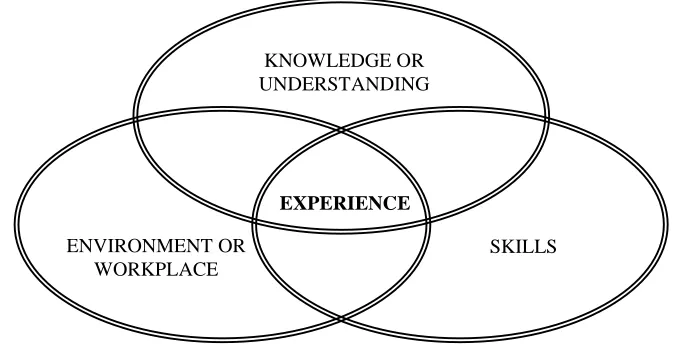
at present. Figure 2.3 shows that experience for modern seafarers means the
combination of their knowledge or understanding, skills and feeling in the working
environment. One’s experience is gained at the workplace, based on the knowledge
and skills he/she learned, only when tasks (including training programmes) are done
in a real environment. Onboard training is to incorporate knowledge and skills with
feeling at the workplace, and accumulate experience in order to make one competent
at their job.
Figure 2.3: The Concept of Experience
2.3.1 Advantages of onboard training
Training taking place at workplace. A real environment can ensure that
trainees are serious about learning. The implementation of their tasks also
depends on a good interaction with the environment. Any risk on board a
ship affects safety of life, so no one can doubt that he is fighting against
danger. It is easier to motivate trainees to perform well.
Highly effective in comparison with shore-based training. In regard to
most programs, trainees hope to apply to their job what they have just
learned. In other words, training is combined with real tasks. After
practising several times, they can master relevant skills. "Learning by
KNOWLEDGE OR UNDERSTANDING
ENVIRONMENT OR WORKPLACE
doing " is the seafarers' traditional way of learning. It is still effective
today.
High efficiency. Operation of equipment or instruments may be just
normal performance for seafarers. This is particularly so when on
duty. Usually the same program run on shore gives trainees a general
procedure of operation, not a specific one. Therefore, trainees maybe
can operate equipment at the time, but will not be proficient when
they go back to ships, or they may face different types of equipment
from that they were trained on. On the other hand, one can not put all
equipment or instruments in shore-based training centres. The level of
efficiency resulting from trainers delivering a program without
equipment is that much lower. Conversely, efficiency of on-board
training is higher, relating to the hands-on practice. "We remember
90% of what we say and do", describes ‘Training Course for
Instructors’ (IMO Model Course 6.09).
Tailored-made programs for specific vessels. Common courses, such
as emergency procedures and basic safety, give trainees a general idea
or knowledge. When they are assigned to a particular vessel, they
have to familiarise themselves with the operation or execution of the
safety arrangement on the vessel. With a tailored-made program,
training can be conducted successfully.
Indispensable linkage on modern ships. Generally speaking, graduates
from maritime institutes are not proficient at their jobs when they go
to work on board at first. They need to be conversant with the
environment. The more important thing is that they have to fill the gap
between nautical theory they have learned in the institutes and
practical operation on the vessel though they have had some hands-on
practice on simulators or on-board training as cadets. Perhaps this is
Time-flexible. To enhance competition and cut down costs, the total crew numbers in a shipping company and on board ships is slowly
reducing eventually. Seafarers have no more time to be trained when
they are on vacation ashore. Therefore a possible way for them to
update their knowledge and skill is through on-board training and
education, by means of new technology. They may learn something
under supervision from senior officers or by use of computer-based
training facility for self-study provided they are not under time
pressure. On the other hand, contract seafarers (short term) have no
more chances to be trained ashore, but they are allowed to use training
facilities on board and to partake in any training programs on board.
Good combination of training and assessment. A way to assess
seafarers’ outcome of training is at the workplace, and this is the most
effective way. Without an assessment the training is invalid. Holder
(1997) believes that “the essential skills in the future will be measured
by performance in the workplace.”
Some difficulties may be encountered, such as:
Time-threat
Qualification of instructors
More preparation of work
More jobs for senior officers
Limitation of ships' conditions
Shipping companies should consider them adequately.
2.3.2 Objectives with different groups
Whatever training is, objectives should first be established, which are derived
from training needs. On the basis of the objectives, relevant contents and methods
Trainees of on-board training are, obviously, seafarers on board ships, but
there is also a hierarchy among seafarers on board. One should identify different
groups before training.
It is known that there are three levels of seafarers stated in the STCW 95,
namely management, operational and support. So goals and contents of training can
be made as follows:
Management level: means the group serving as senior officers,
including master, chief mate, chief engineer officer and second
engineer officer. Their positions determine that the structure of
their knowledge and skill consists of two types: technical and
management. The latter is more essential for masters.
Operational level: means the group serving as officer in charge of a navigational or engineering watch or as designated duty engineer
for periodically unmanned machinery spaces or as radio operator.
Officers in this group, besides normal tasks, will be encouraged to
upgrade or proceed to management level by companies or by
themselves. So training needs to concentrate on technical aspects,
and some management knowledge.
There is a specific part of operational level, i.e. cadets or prospective
officers. Their training needs to focus on familiarisation of the ship and
equipment, practical operational procedures and practice relevant to their
duties and responsibilities to be undertaken. The period of probation
depends on their position to be assigned. In the STCW 95, it states that
‘every candidate for certification (OOW) shall have approved seagoing
service of not less than one year’ before they accept new positions. For
officers who are to be promoted to higher positions, their training needs to
concentrate on familiarisation with the equipment in a new spectrum,
procedures concerning new responsibility, regulations and teamwork
skills, especially for those who are to be promoted from operational level
Support level: means the group serving as ratings. Two things should be covered. One is their skill when they work alone, and
other is an additional task when they assist the OOW forming part
of a navigational watch. Training emphasis should be on basic
safety, procedures in watch-keeping and teamwork concept.
2.3.3 Equipment and facilities
For general purpose, on-board training is based on the ship's environment and
sea environment. These are the most important facilities. Therefore sometimes
people take it as on-the-job training or in-service training.
However on-board training needs some basic equipment that can be used to
get a better outcome. Thanks to the development of new technology, many advanced
tools and equipment can be available on board ships for training. The Anglo Eastern
Company in Hong Kong for example has supplied every ship with a PC – based
simulator for ship handling and engine operation. Some shipping companies have
introduced new technology to create the office on board for the purpose of
management, including on-board training. (Hapag-Lloyds) Such equipment consists
of computers, satellite communication system, TV set, video-player,
overhead-transparency projector and so on.
On the other hand, some world leading navigation aids suppliers now add
recording functions in their products. The functions may be used by the masters and
officers to replay critical parts of a voyage for training purposes though they may
also be used in case of collision or grounding at sea. The versatile ECDIS – based
Electronic Chart Navigation System, CHARTPILOT, made by the STN ATLAS
Marine Electronics, for example, has two functions in term of onboard training:
voyage recording and consulting and service. The former can store and replay
voyage data for 8 weeks with each minute or 24 hours with each second. The latter
can act as an internal ship motion simulator for test and training purposes. Effective
use of these functions may bring about unexpected achievement for onboard training.
training more effective by linking the computers used for training with a real
integrated navigation system that trainees can retrieve data and graphics from the
INS for training purposes.
There are other resources: a variety of software, books, materials and posters
relating to on-board tasks.
The above mentioned equipment will be discussed further in Chapter 5.
2.3.4 Training methods
In earlier days, seafarers learned skills and basic knowledge of navigation by
two ways: new navigators by knowledge and skills passed on by experienced
navigators while experienced navigators by survey and summing up. Eventually they
had learned to use basic mathematical and instrumental techniques of what was still
the new navigation. Observation and practice were effective methods. Captain James
Cook (1728 - 1779), for example, that most exceptional of seamen, acquired great
skill with lunar distances during his first voyage (1768 - 1771) and he was described
as the first 'complete seaman', and 'grand navigator'. Douglas Phillips-Birt wrote in
“A History of Seamanship” that 'he had trained himself by survey and became,
thanks to unrivalled opportunities which he grasped so competently, the greatest
cartographer of any time.' So to be a good navigator in the past, one must have not
only learnt from others, but also improved oneself with practice. There were few
written 'operational manuals' or information to study or for reference.
Today, all seafarers have been given certain knowledge and skills before they
work on board, and navigational equipment is more complicated than that of
hundreds of years ago. Seafarers need to consider how to use the equipment correctly
which is available on board ships. This means that skills for navigation today are
different from those in the past. But learning by practice under supervision of
experienced seafarers is still an effective method for the time being. Thanks to the
development of new technology, computer-based training (CBT), distance learning
via satellite communication at sea, video-based training, on-the-job training and so
on are all effective methods. A great benefit can be achieved from those approaches
CHAPTER 3
Impact of conventions and regulations
(related to seafarers’ training) on shipping companies
An organisation in our society cannot isolate itself from the influence of its
external environment. In the maritime community, a shipping company engaging in
international transport has to meet all requirements made by both national
government and international organisations.
In recent years, IMO, a special agency under the United Nations, has changed
many aspects of its conventions and codes, rather than adopting new conventions, for
the purpose of safety and pollution prevention at sea. These changes have made a
great impact on shipping companies, in their operation and management. Of the main
conventions, the STCW 95 and SOLAS are the most influential with regard to
seafarers' training. Being a contracting party, each country should make national
level regulations based on the requirements imposed by the conventions. The
Chinese government does this by keeping up international standards.
3.1 International requirements 3.1.1 STCW 95
With its enforcement on 1st February 1997, the STCW 95 gives more details
about seafarers’ training, assessment and certification. It identifies first the
responsibilities of a shipping company in training seafarers and makes
administrations, maritime institutes and shipping companies in a country jointly
responsible to ensure seafarers' quality. This philosophy brings all aspects concerned
A shipping company (or a company), according to its definition in STCW 95,
means the owner of the ship or any other organization or person such as the manager,
or the bareboat charterer, who has assumed the responsibility for operation of the
ship from the shipowner and who, on assuming such responsibility, has agreed to
take over all duties and responsibility imposed by these regulations. No matter
whether a ship-management corporation or ship operator or ship-owner itself, each
must take responsibility for manning with qualified seafarers and training them
accordingly provided he operates the ships. All convention requirements on the
company can be fully complied with as a result.
In Regulation I/14 of STCW Convention, companies are required by each
Administration (Flag State) to ensure that the five aspects in connection to the
assignment of seafarers for service in their ships are followed.
- Each seafarer holds an appropriate certificate,
- Every ship is manned in compliance with the applicable safe manning
requirements of the Administration.
- Documentation and data on seafarer's experience, training, medical fitness
and competency in assigned duties are maintained and readily accessible,
- Seafarers are familiarised with their duties and ships,
- All seafarers on board can effectively co-ordinate their activities in an
emergency situation and in performing functions.
Morrison (1998, p98) explains the above-mentioned requirements that
“In assigning seafarers to their ships, companies need to be
fully aware of the certificates held and training completed by each
seafarer to be assigned, the capacity they are to fill and the functions
and duties they are to perform. Companies must also be aware of the
current on-board training and instruction capabilities of the crew
being relieved and those of the crew being assigned to the ship. This
is necessary to ensure that the qualifications of those who are to
provide the on-board familiarisation training and instruction required
training, meet the in-service training qualification requirements of
regulation I/6.”
The provisions of Section A-I/14 of the STCW Code gives more clear
emphasis on the responsibilities of companies, masters and crew members. Its first
paragraph states that
“Companies, masters and crew members each have
responsibility for ensuring that the obligations set out in this section
are given full and complete effect and that such other measures as
may be necessary are taken to ensure that each crew member can
make a knowledgeable and informed contribution to the safe
operation of the ship.”
The second requires the company to
“provide written instructions to the master of each ship to
which the Convention applies, setting forth the policies and
procedures to be followed to ensure that all seafarers who are newly
employed on board the ship are given a reasonable opportunity to
become familiar with the shipboard equipment, operating procedures
and other arrangements needed for the proper performance of their
duties, before being assigned to those duties.”
Although Code B in the STCW Code is not compulsory, it still provides
guidelines for maritime training. One should not neglect it when considering how to
keep a high level of compliance with the requirements of the STCW 95. The
provisions of Section B-I/14 state that companies should provide ship specific
introductory programs aimed at assisting newly employed seafarers to familiarise
themselves with all procedures and equipment relating to their areas of
responsibility. It is noted that providing programs is not enough for companies to
take their responsibility. They should ensure that newly employed seafarers are
trained to be familiar with all procedures and equipment relating to their areas of
3.1.2 ISM Code
From the management point of view, not the technology one, The
International Safety Management Code (ISM Code) has been put into the SOLAS
Convention. This, maybe, is a significant change of the Convention in recent years.
As one knows, management always relates to human resource and the use of
human resources always relates to personnel training. So in the ISM Code there are
several points concerned with training.
One safety-management objective of the company is "to continuously
improve safety-management skills of personnel ashore and aboard ships,
including preparing for emergencies related both to safety and
environmental protection." (1.2 Objectives). Here "continuously improve
skills" means training for personnel in the company should never stop,
whether they are on board or not, in order to keep pace with changes in
the maritime industry.
Part 6 of the ISM Code deals with resources and personnel. Of 7 points,
the following 4 are mostly correlated.
- “The Company should ensure that each ship is manned with
qualified, certificated and medically fit seafarers in
accordance with national and international requirements.
- The Company should establish procedures to ensure that
new personnel and personnel transferred to new assignments
related to safety and protection of the environment are given
proper familiarization with their duties.
- The Company should ensure that all personnel involved in
the Company's SMS have an adequate understanding of
relevant rules, regulations, codes and guidelines.
- The Company should ensure that the ship's personnel are
able to communicate effectively in the execution of their
The first paragraph makes clear that the company should always maintain
qualified seafarers not only certificated but also in practice, through continuous
training both ashore and on-board. So the company should establish a training policy
and procedures to undertake seafarers training.
The second paragraph states that new seafarers and those transferred to new
assignments are given proper familiarisation with their duties. How to conduct the
familiarisation? How to know they have been familiar with the duties? These
questions still need to be answered in accordance with the training policy and
procedures in the company.
The third paragraph tells that adequate understanding of relevant rules and
regulations by seafarers who are certainly involved in the SMS is required.
"Adequate" can not be got through once training. While many new rules or
regulations and their amendments are coming up every year, crew need to be familiar
with them in time. The effective way is still training.
The fourth paragraph emphasises the working language on board in order to
communicate both with the company and between seafarers. This issue is very
important under multinational manning circumstances. Any seafarer who joins an
international group must speak a common language used in the group. One thus
needs to be trained.
Part 8 of the Code requires that “The Company should establish
programmes for drills and exercises to prepare for emergency actions.”
Though this is not explicit, there is no doubt that ‘drills and exercise’ here
indicate what should be done on board.
3.1.3 International Memorandums of PSC related to training
One of the memorandums of understanding (MOU) on port state control
(PSC) is The Paris MOU signed by 14 European countries in 1982, which is the
earliest and most influential in the world shipping industry. In regard to seafarers’
training, its scope of inspection covers the STCW Convention and others related to
those aspects, not only to avoid detention of ships but also to enhance safe
navigation.
In Section 3 of the Memorandum if there are clear grounds for believing that
its crew does not substantially meet the requirements of a relevant instrument, such
as STCW Convention, a more detailed inspection will be carried out and that may
lead to detention of the ship.
More detailed aspects of ‘clear grounds’ are listed in its Annex 1. However,
these aspects in the list those warrant a more detailed or expanded inspection, which
includes verbal questions and showing their qualifications, should be borne in mind:
• “Information or evidence that the master or crew is not
familiar with essential ship-board operations relating to
the safety of ships or the prevention of pollution, or that
such operations have not been carried out;
• Indications that the relevant crew members are unable to communicate appropriately with each other, or with
other persons on board, or that the ship is unable to
communicate with the shore-based authorities either in a
common language or in the language of those authorities;
• Evidence of cargo and other operations not being
conducted safely or in accordance with IMO guidelines.
Under the provisions of the STCW 95, it states that control exercised by the
port state control officer (PSCO) will be limited to
‘assessment of the ability of the seafarers of the ship to maintain
watch keeping standards as required by the Convention if there are
clear grounds for believing that such standards are not being
maintained because any of the following have occurred:
.1 the ship has been involved in a collision, grounding
.2 there has been a discharge of substances from the ship
when underway, at anchor or at berth which is illegal
under any international convention, or
.3 the ship has been manoeuvred in an erratic or unsafe
manner whereby routeing measures adopted by the
IMO or safe navigation practices and procedures
have not been followed, or
.4 the ship is otherwise being operated in such a manner
as to pose a danger to persons, property or the
environment.”
Furthermore, if deficiencies are found during the course of a ship inspection
the PSCO will further assess whether crew is able to safely handle or operate the ship
throughout the forthcoming voyage as well as to perform their duties in case of
emergency situations such as fire-fighting, ship-abandoning and
pollution-preventing. The ship will be strongly considered for detention if the result of any of
these assessments is negative.
Almost the same points have been stipulated in the Tokyo Memorandum.
They all demand that the crew do substantially meet the requirements of a relevant
instrument, or the master or crew are familiar with essential shipboard procedure
relating to the safety of ships or the prevention of pollution.
3.1.4 Others
SOLAS
Besides the ISM Code, the SOLAS Convention and later amendments have
imposed other requirements for the training of seafarers. But they are not in clear
order. For example,
Regulation 19 of Chapter III states that on-board training in the use of the
ship's life-saving appliances, including survival craft equipment, and in the use of the
than 2 weeks after a crew member joins the ship. On-board training shall be recorded
in the log-book.
Regulation 3 of Chapter VI states that the Administration shall take steps to
ensure that crews of ships are trained in the use of such instruments (oxygen analysis
and gas detection equipment).
Regulation 4 of Chapter XI states when there are clear grounds for believing
that the master or crew are not familiar with essential shipboard procedures relating
to the safety of ships, PSC officers will control the ships. This hints at training in
familiarisation.
IMO: Inert Gas Systems (1990)
Many IMO publications deal with training. One of them is Inert Gas Systems
which was published in 1990. Section 10 titled with Training states that training in
use of IGS for the tanker safety is essential and the requirements for training depend
on the policies of the shipping company concerned as well as the Administration.
It is recommended that the training of both deck and engine-room personnel
be co-ordinated to ensure a common understanding of the procedures
Because of the importance of operation of IGS, the Guidelines give an
alternative location of training: aboard or ashore. “If shore training in basic design
and operation is given, personnel should be made familiar with the equipment on
board ship.” So no matter wherever the training takes place the theoretical and the
practical aspects should be dealt with.
The training methods are also mentioned in the Guidelines in that there are
currently three methods used in training: On board by shipping company staff,
Specialist shore-based training (This may be undertaken by nautical colleges, either
in consultation with shipping companies or with manufactures.) and shore-based by
ILO: C147 Convention and R37 Recommendation
Merchant Shipping (Minimum Standards) Convention, 1976, namely C147,
entered into force in 1981. The objective is to promote each member to undertake
legislation and jurisdiction over ships flying its flag and ships in its territory. Each
member should ‘ensure that seafarers employed on ships registered in its territory are
properly qualified or trained for the duties for which they are engaged, due regard
being had to the Vocational Training (Seafarers) Recommendation, 1970’.
R37 Recommendation is Vocational Training (Seafarers) Recommendation,
1970 for short. It makes clear objectives of training, organisation, training
programmes, training methods and training schemes for seafarers. Though the
Recommendation addresses the member states, it still needs to be implemented
through maritime schools or shipowners. Part VI is concerned with ‘advance
training’ which is obviously the requirement to the shipowners. It states that
(1) Retraining, refresher, familiarisation and upgrading courses
should be available as required for suitable officers and ratings
to enable them to increase and widen their technical skills and
knowledge, to keep abreast of technological changes, in
particular in the development of automated ships, and to meet
the requirements of new methods of operations on board ship.
(2) Such courses may be used, for instance, to complement general
courses and provide advanced specialised training opening the
way to promotion, as well as to provide advanced electronics
courses for appropriate personnel.
(3) Special attention should be given to the ability of masters, other
officers and ratings to navigate and handle new types of ships
safely.
(4) Where training would be facilitated thereby, shipowner should
release suitable seafarers employed on board their ships for
training periods ashore, at appropriate schools, to enable them to
and qualify for promotion. Persons in a supervisory position on
board ship should take an active part in encouraging such
training.
The responsibility of a shipping company is, therefore, to set up a training
system, to well organise seafarers for post-graduate training and to make decisions
whether training is to be undertaken on shore or on board.
3.2 Chinese National requirements
In implementation of international conventions ratified by the Chinese
Government, the Administration has promulgated a series of regulations relating to
seafarers’ training, examination and certification. Among those, Regulations on
Examination, Assessment and Certification of Competence for Seafarers of the
People's Republic of China is the most essential one. Of fourteen Chapters, Chapter
XI is concerned with responsibilities of companies.
There are six articles in the chapter. They require the company to establish
the archives for seafarers so as to ensure that their employment, training, safety and
technical competence check, application for examination, assessment and
certification shall be controlled in a continuous and effective way.
"When assigning a seafarer to serve on its ships, the company
shall ensure that:
1. The seafarer holds an appropriate Certificate of Competency in
accordance with the provisions of these Regulations and the
applicable safe manning requirements of the Administration;
2. The seafarer is familiarised with the specific duties and all ship
arrangement, installation, equipment, procedures, characteristics
and limitations in relation to their routine or emergency duties;
and
3. The seafarer can effectively co-ordinate his/her activities in an
emergency situation and in performing functions vital to safety
Other provisions in the Chapter state that the company shall provide masters
with written instructions to stipulate the relevant policies and procedures to be
followed so as to ensure that each new seafarer shall be familiarised with the
shipboard equipment, operational procedures and other arrangements for correct
implementation of his/her duties before actually performing the duties. Designation
of a knowledgeable seafarer who shall be in charge of others and ensure that an
opportunity is provided for each newly employed seafarer to receive essential
information in a language he/she understands should be made.
From the above international and national requirements, one can expressly
see that shipping companies today have a lot of work to do in meeting the challenge
of change. But do they understand themselves? How to deal with the concrete issues?
How to deal with the relationship between safety and cost? These questions are
CHAPTER 4
A review of current situation of shipping companies in China
4.1 The role of the major shipping companies
Shipping in China has a long history and has brought much benefit to the
country. In the last two decades the economy in China has increased rapidly and the
globalisation of economy has brought China into the trading circle of the world. The
volume of goods imported/exported has gone up dramatically. The industrial
expansion has increasingly created the maritime transport requirements. By the end
of last year, there were about 220 shipping companies registered in China, more than
10% of which operate 10 or more vessels. Now China is the fifth maritime country in
the world, according to the report made by UNCTAD.
According to the statistics made by the Ministry of Communications, the
annual turnover of sea-borne cargo transport from 1991 to 1997 is shown in Figure
4.1. Ocean-going cargo transport in 1997 increased more than 40% in volume, the
average distance was about 3,959 miles.
Figure 4.1: 1991-1997 Seaborne Cargo Transport Turnover in China
0 500 1000 1500 2000
91 92 93 94 95 96 97
Year
Currently, COSCO Group and China Shipping (Group) Company are two top
leading companies. Each of them has several branch companies or specialised
companies. About 1,000 vessels are owned and operated by them. The carrying
capacity of their fleets is more than 25 millions dwt, about 67% of the total Chinese
fleet. These two shipping (group) companies in sea-borne cargo transport have
played, and are still playing, very important roles. They undertake over 80% of the
total ocean cargo transport and coastal cargo transport.
COSCO Group now has become one of the top ten shipping companies in the
world. The container fleet and bulk carrier fleet is the fifth and the first place in the
world respectively in the last year.
To supply a speedy, high grade and reliable service to the national foreign
trade, and to make themselves competitive in the world, the shipping companies like
COSCO Group need to retain, train and attract competent seafarers.
4.2 An analysis of current training systems 4.2.1 Structure of training system
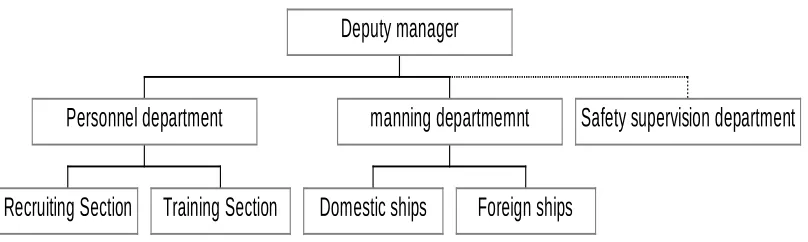
Generally speaking, a structure that relates to seafarers’ recruiting and
training is no different in most shipping companies in China. A deputy manager (or
vice president) is in charge of training for both shore-staff and seafarers (See Figure
4.2). But two departments, namely personnel department and manning department
(sometimes called manning corporation), usually deal with training and recruiting of
seafarers. So good co-operation between them is well needed. The Safety
Supervision Department is not in the subsystem, but it is also involved in the training
of seafarers. The personnel in this department know safety issues on board and deal
with the safety management. In large companies such as COSCO Group, there is an
Education and Training Committee that consists of deputy managers in subordinates
and heads of maritime institutes. They meet once a year to review the last year's
Figure 4.2: Basic Structure Relating to Seafarers' Training
4.2.2 Regulations related to training
Training policy is a basic element that is written in the company's strategic
plan. Most shipping companies in China, which are impacted on by the ISM Code,
have had established training systems, some of which are incorporated in SMS.
These training systems include the training procedures, organisations, responsibilities
and recording methods. All training activities should be conducted in accordance
with the documents. Each company has also stand-alone documented training
regulations that state who should be trained, what sort of training should be
undertaken and how training should be conducted, that are supplementary to the
SMS. One company for example, besides formal regulations, has a
One-Thousand-Item Inspection Checklist that contains training aspects. These regulations and
checklist have played important roles in training of seafarers in China.
However, training items in the document or training policies are, in most
companies, related to the certification of seafarers. A few companies have tailored
training programs for seafarers’ professional development, including updating of
knowledge programs and familiarisation of new equipment programs. Assessment
however is always done by the Administration and trainees must pass the
examinations to qualify for certification. Onboard training is mentioned less in those
documents.
Recruiting Section Training Section Personnel department
Domestic ships Foreign ships