https://doi.org/10.5194/gmd-12-5197-2019 © Author(s) 2019. This work is distributed under the Creative Commons Attribution 4.0 License.
Algorithmic differentiation for cloud schemes (IFS Cy43r3)
using CoDiPack (v1.8.1)
Manuel Baumgartner1, Max Sagebaum2, Nicolas R. Gauger2, Peter Spichtinger3, and André Brinkmann1 1Zentrum für Datenverarbeitung, Johannes Gutenberg University Mainz, Mainz, Germany
2Chair for Scientific Computing, Technische Universität Kaiserslautern, Kaiserslautern, Germany 3Institute for Atmospheric Physics, Johannes Gutenberg University Mainz, Mainz, Germany Correspondence:Manuel Baumgartner ([email protected])
Received: 16 May 2019 – Discussion started: 3 June 2019
Revised: 24 October 2019 – Accepted: 12 November 2019 – Published: 11 December 2019
Abstract. Numerical models in atmospheric sciences not only need to approximate the flow equations on a suitable computational grid, they also need to include subgrid effects of many non-resolved physical processes. Among others, the formation and evolution of cloud particles is an example of such subgrid processes. Moreover, to date there is no univer-sal mathematical description of a cloud, hence many cloud schemes have been proposed and these schemes typically contain several uncertain parameters. In this study, we pro-pose the use of algorithmic differentiation (AD) as a method to identify parameters within the cloud scheme, to which the output of the cloud scheme is most sensitive. We illustrate the methodology by analyzing a scheme for liquid clouds, incor-porated into a parcel model framework. Since the occurrence of uncertain parameters is not limited to cloud schemes, the AD methodology may help to identify the most sensitive un-certain parameters in any subgrid scheme and therefore help limiting the application of uncertainty quantification to the most crucial parameters.
1 Introduction
Modeling the atmosphere is a highly non-trivial task due to the multiscale and multicomponent nature of the atmospheric flow, where multiple physical processes on different length and timescales interact simultaneously (Orlanski, 1975). One particular result of the interaction of such processes is regu-larly observed in the sky: clouds appear and disappear. The evolution of a cloud (see, e.g., Lamb and Verlinde, 2011, for an in-depth treatment of cloud evolution) starts on the length
scale of a few nanometers, where aerosol particles get wet-ted by ambient water vapor leading to the formation of haze particles. If thermodynamic conditions are fulfilled, i.e., the (relative) humidity is large enough, the haze particles grow further to become cloud droplets with typical diameters of about 10–30 µm. This growth process is described by com-bining Maxwell and Köhler theories (Rogers and Yau, 1989; Devenish et al., 2012; Köhler, 1936; Maxwell, 1877). Col-lisions of the cloud droplets eventually lead to rain drops with sizes up to larger than 100 µm (see, e.g., Devenish et al., 2012; Grabowski and Wang, 2013, for a discussion including turbulence effects). Due to their weight, rain drops fall out of the cloud and form precipitation. Since all phase transitions are connected with the release or consumption of latent heat, the formation and evaporation of a cloud can affect the ambi-ent atmospheric flow by modifying local buoyancy (see, e.g., Cotton et al., 2010). However, all aforementioned cloud pro-cesses are microphysical propro-cesses and not resolved in nu-merical models, in particular not in the operational models used for weather forecasts. In these models, the cloud itself is not resolved and instead considered as a subgrid process, calling for a representation of the impact of the cloud by us-ing so-called “parameterizations” or “cloud schemes” (see, e.g., Khain et al., 2000). These schemes take the values of the resolved fields as input and compute the feedback of the unresolved process as an output.
unit mass of dry air. However, at the moment no universal governing equation is available to describe the evolution of a cloud across all involved scales, explaining the existence of different formulations of the cloud processes. In addition, cloud schemes typically contain parameters with uncertain values, which may be introduced by artificial parameters or limited observational evidence of the precise value. A typi-cal example for an uncertain parameter is the autoconversion rate, encoding the efficiency of colliding cloud droplets to form large and falling rain drops (Khain et al., 2015). His-torically, the autoconversion rate was introduced by Kessler, who advocated the partitioning of the whole size spectrum of droplets into small cloud droplets, with negligible sedimen-tation velocity, and falling rain drops (Kessler, 1969). Most cloud schemes adopt the partitioning of the size spectrum, especially all schemes of the Kessler type. The cloud scheme to be described in Sect. 3 below is also of the Kessler type. More examples of processes with uncertainties in their de-scription and of how uncertainties enter the dede-scription of clouds are discussed in Khain et al. (2015).
In any case, uncertain parameters introduce uncertainty in the cloud scheme at hand, and ultimately into the numerical model as a whole. To assess the uncertainty of the param-eters, one usually performs sensitivity studies, e.g., by run-ning ensemble simulations, where each ensemble member employs slightly different values for the parameters. How-ever, usually the number of ensemble members is limited to small values posing an additional challenge to extract the de-sired signal from the simulations.
In this study, we propose the use of “algorithmic differen-tiation” (AD) as another way of identifying the parameters with largest sensitivity. Although this method is well known in computer science and engineering, its potential in mete-orological contexts, and cloud physics in particular, has not yet been fully exploited. Most applications of AD in meteo-rology are limited to individual studies investigating model sensitivities (usually with respect to initial values) by using adjoint models (e.g., Bischof et al., 1996b; van Oldenborgh et al., 1999; Kaminski et al., 1999; Xiao et al., 2008; Rauser et al., 2010; Zhang et al., 2013; Belikov et al., 2016) or stud-ies targeting applications in data assimilation (e.g., Le Dimet et al., 2002; Blessing et al., 2014). We will introduce the tech-nique in Sect. 2, but, in a nutshell, it provides the derivative of a given computer code with respect to selected parameters. A cloud scheme may be described as a functionf, taking the flow characteristicsy from the given grid box together with parametersηas an input, and computing the feedbackzof the cloud, i.e.,z=f (y, η), as an output. Assessing the sensitiv-ity of the outputzwith respect to the parametersηamounts to computing the derivative dηdz. AD helps in evaluating this derivative by computing the derivative of the functionfbwith respect to the parameters, where the hat notation indicates the implemented version of the mathematical functionf in some computer code. Using this technique can help in the
development of cloud schemes by providing the respective derivatives to machine accuracy in an automated fashion, i.e., without implementing finite difference approximations offb. Recently, a field called uncertainty quantification has emerged in mathematics as a more systematic combination of (numerical) analysis and statistics in order to study the propagation of uncertainties (e.g., Sullivan, 2015; Le Maître and Knio, 2010). Although powerful methods for the investi-gation of uncertainties already exist, their practical use often limits the number of the considered uncertain parameters due to the curse of dimensionality; see Chertock et al. (2019) for an application in the context of cloud physics. Therefore, it is valuable to first identify the parameters with the highest sen-sitivity using AD in order to limit more rigorous or extensive investigation to these parameters.
We emphasize that AD is not related to a specific appli-cation (as a cloud scheme) nor to a specific programming language. Although we use an implementation in C++ to-gether with an AD tool suited for this language, AD tools for other languages like Fortran are available (e.g., Bischof et al., 1996a). A list can be found on http://www.autodiff.org (last access: 23 October 2019).
In this study, we will first explain the concept of algo-rithmic differentiation in Sect. 2, introduce the warm cloud scheme used for illustration purposes within an air parcel framework in Sect. 3, and show results in Sect. 4. Some con-cluding remarks are given in Sect. 5.
2 What is algorithmic differentiation?
Algorithmic differentiation (AD) is a mathematical theory that describes how the computation of derivatives in a com-puter program can be automatized. It was developed in the early 1980s and rediscovered several times since then. The most well-known resource is the book of Griewank and Walther (2008). A useful first introduction is given by Nei-dinger (2010).
For the purpose of computing the derivative of a program, it is considered as a sequence of simple elemental (or in-trinsic) functions including the sine, cosine, multiplication, division, and addition. The approach of AD considers the given program as a composition of elemental functions and, by applying the chain rule, computes its directional deriva-tive by accumulating the derivaderiva-tives of each elemental func-tion within the program code. It is important to stress that AD does not generate a generalized representation of the derivative of the computer program. Instead, AD computes the derivatives alongside the execution path. The path might change due to conditional instructions within the code.
As an example, assume the computer program to be differ-entiated is given by
where a, b, c, d are the input variables and w is the out-put. This program can now be split into elemental functions which yield the intermediate stepst1, t2 required by AD as follows:
t1=a+b,
t2=c−d,
w=t1·t2. (2)
For the application of the chain rule the Jacobian matrix has to be computed for each of these intermediate steps with respect to all input variables, which is quite simple; e.g., fort1=t1(a, b, c, d)=a+bthe matrix is(1,1,0,0) since ∂t1
∂a = ∂t1
∂b =1 and ∂t1 ∂c =
∂t1
∂d =0. However, for nota-tional convenience it is common to drop the indication of the formal dependence of the elemental function t1 and its derivatives on the input parameters c, d since they are un-changed int1. In order to compute the directional derivative, the Jacobian matrix is multiplied with the desired direction
(a,˙ b,˙ c,˙ d)˙ T, where the dot notation is used in the AD the-ory to describe the corresponding derivative direction of a variable. Applying this process to the full procedure Eq. (2), the result is
˙
t1= ˙a+ ˙b,
˙
t2= ˙c− ˙d,
˙
w=t2· ˙t1+t1· ˙t2, (3)
since, e.g.,
˙ t1=
∂t 1
∂a, ∂t1
∂b
· ˙a,b˙T =(1,1)· ˙a,b˙T = ˙a+ ˙b, (4) where we again neglected the formal dependency oft1onc andd. By computing the corresponding directional deriva-tive statements in procedure Eq. (3) alongside the original statements in procedure Eq. (2), the directional derivative is computed for the whole computer program Eq. (1). Note that the choices(˙a,b,˙ c,˙ d)˙ =(1,0,0,0)and(˙a,b,˙ c,˙ d)˙ = (0,1,0,0)for the input directions for the AD computation results in the computation of the partial derivatives ∂w∂a and
∂w ∂b.
The example shows the application of the forward AD mode on a simple computer program. The general the-ory of AD assumes that the elemental functions are eval-uated at argument values where they are differentiable in a neighborhood of the argument value. Actually, many common elemental functions are differentiable everywhere as, e.g., addition or multiplication, but there are elemen-tal functions which are differentiable except at some criti-cal points. Examples for elemental functions with a criticriti-cal point are square root, absolute value, and division, which are not differentiable at the origin. How these difficulties are treated mainly depends on the AD tool. The AD tool CoDiPack used in this study provides the preprocessor op-tionCODI_CheckExpressionArgumentsto throw an
exception if such a critical point is encountered. In any case, the exact derivative of each elemental function, at least apart from the critical points, may be written down explicitly. Note that conditional instructions (e.g., if-else switches) do not pose problems, since they only alter the program path, i.e., the specific sequence of the elemental instructions that are executed. Since the whole computer program is a compo-sition of the differentiable elemental operations, the chain rule states that also the whole program is differentiable (apart from the critical points). Moreover, if the program is repre-sented by the functionfb:Rn→Rm, the so-called forward mode of AD computes
˙ z=dfb
dx (x)x.˙ (5)
In Eq. (5),dfb
dx(x)is the Jacobian of the full program at state
x, vectorx˙is the direction for which the program derivative is desired along the computational path and the variablex sub-sumes all input variables. In the notation of Sect. 1, we have
x=(y, η), i.e., x contains the cloud model and thermody-namic variablesytogether with the inherent parametersη. In this terminology, an inherent parameter of the (cloud) model is also now considered as a parameter if this parameter is to be investigated.
Equation (5) just states which result is computed by the forward mode of AD and not how it is computed. The evalu-ation of the derivative is done alongside the primal computa-tion off (x)b by applying Eq. (5) to each elemental operation as in the above example, i.e., the full Jacobian is never com-puted explicitly but accumulated by considering each code statement individually.
The second operation mode of AD is called the reverse AD mode. As will become clear, the reverse mode can be introduced by multiplying an adjoint direction from the left side to the derivative representation of the computer program, instead of multiplying a derivative direction from the right as in Eq. (5). This yields the general equationxT =zTdfb
dx(x). The standard AD notation for the adjoint of a variablev is the bar notationvand may be thought of as containing the immediate derivative of the current statement with respect to the particular variable.
As an example, for the statementw=t1·t2, the AD reverse mode evaluation is
t1, t2 =w·
∂w ∂t1,
∂w ∂t2
=w·(t2, t1)=(w·t2, w·t1) . (6)
Eq. (2) is then
t1=t2·w,
t2=t1·w,
c=t2,
d= −t2,
a=t1,
b=t1. (7)
As discussed above, the statements from procedure Eq. (2) are now handled in reverse order. The values a,b, c, and
d contain the derivatives of w with respect to themselves. Takingd as an example, according to the chain rule this is
dw
dd =w
dw
dt2 dt2
dd =w·t1·(−1)= −t1·w, (8)
and the value of t1 is taken from the primal evaluation of the program. By choosingw=1 as input for the reverse AD mode, the adjoint variabledcontains the derivative of proce-dure Eq. (2) with respect to the inputd.
The example, Eq. (7), shows the application of the reverse AD mode on a simple computer program. According to the general theory of AD, given a computer program which can be represented by the functionfb:Rn→Rm, the reverse AD mode computes
x= "
dfb dx (x)
#T
z (9)
where, again, dfb
dx(x) denotes the Jacobian of fb and h
dfb
dx(x) iT
its transpose, while z represents the desired di-rection for the derivative. Eq. (9) again just states the result that is computed by the reverse mode of AD and not how it is computed. The actual evaluation of the derivative is done without forming the Jacobian and instead by storing infor-mation during the primal computation off (x)b . Afterwards, a reverse sweep over the stored information is performed. This reverse sweep applies a slightly modified version of Eq. (9) to each elemental function as in the above example.
Both operation modes of AD are connected via the discrete adjoint operator. Leth·,·inandh·,·imdenote the Euclidian scalar products in Rn andRm, respectively. We now select
an arbitrary directionz∈Rm, which we apply to the result of the forward mode. This yields the equality
hz,z˙im= *
z,dfb
dx (x)x˙ +
m
= *"
dfb dx(x)
#T z,x˙
+
n
= hx,x˙in (10)
by shifting the Jacobian matrix of fbto the left side of the scalar product. This shows that the reverse mode is the dis-crete adjoint of the forward mode (see, e.g., Kalnay, 2003,
for the use of adjoint models in atmospheric data assimila-tion).
The advantage of the reverse mode becomes clear if we as-sume that we want to compute the full gradient of a function
b
f :Rn→Rm. In the case ofm=1, i.e., a computer program withninput and a single output variable, the full gradient dfb
dx(x)is a matrix with n columns and one row; hence its transpose is a matrix withnrows and a single column. Since
m=1, the directionzis a vector with a single entry. Conse-quently, we obtain the resultx by computing Eq. (9) exactly once with the single inputz=(1)∈R1. Using the forward mode of AD, we infer from Eq. (5) that the computation of the full gradient requiresnsubsequent computations with the choicesx˙=e1,x˙=e2, . . .,x˙=en, andei∈Rn denotes the
ith unit vector. Ifnis large, thesensubsequent computations require much more computational effort than a single (but slightly more costly) computation using the reverse mode of AD.
In contrast, if n=1, i.e., the computer program has a single input and m output variables, the forward mode of AD computes the full derivative with a single computation by choosing the 1×1 matrix x˙=(1) as the input direc-tion, whereas the reverse mode needsmcomputations, being costly for large values ofm.
An alternative approach to compute the derivative offb:
Rn→Rmin the directiond∈Rnis to apply the finite
differ-ence approach dfb
dx (x)·d≈ b
f (x+t d)−f (x)b
t (11)
with a (small) step sizet >0, requiring two evaluations of the programfb. Instead of the approximation Eq. (11), one could alternatively choose a finite difference approximation of a higher order (e.g., Grossmann and Roos, 2007), but these typically need even more program evaluations. In contrast to AD, the finite difference approach requires the choice and tuning of the step sizet >0 to achieve the desired accuracy of the derivative. Moreover, the optimal value of the step size will in general depend on the selected directiond and the statex(see Elizondo et al., 2002, for a comparison with AD). These issues render the finite difference approach as quite unattractive but due to its simplicity it is often used, accept-ing all drawbacks of the method.
Iffbis a linear function, then an arbitrary step sizetcan be chosen for all directions. For non-linear functions,t should be as small as possible to achieve the desired accuracy but large enough to avoid cancellation errors due to the differ-ence in Eq. (11). AD has the advantage of not having to choose and tune a step size. Since the derivative of each el-emental function is known exactly and AD applies the chain rule, the computed derivatives are accurate up to machine precision (Griewank et al., 2012).
vari-ables, AD has the potential of being several times faster com-pared to using finite difference approximations.
AD is introduced into computer programs mostly in two ways: either through operator overloading or through source transformation. For C++, the majority of tools (as listed at http://www.autodiff.org, last access: 23 October 2019) use the operator overloading approach which is also used by the AD tool CoDiPack (Sagebaum et al., 2017a) developed by the authors from the Scientific Computing group in Kaiser-slautern and employed in this study. CoDiPack uses expres-sion templates to reduce the amount of required informa-tion for the reverse AD mode. The data layout of the infor-mation is such that a minimal memory footprint is required and caching strategies of the processors can be applied. The general focus of CoDiPack is its application in high per-formance computing environments which was successfully demonstrated in Sagebaum et al. (2017b) and Albring et al. (2016).
The source transformation approach is mostly used in For-tran source codes. Here, the code is parsed and new code is generated which adds the additional statements for the for-ward or reverse AD mode. Tapenade (e.g., Hascoët and Pas-cual, 2013) is the most widespread tool for source transfor-mations in Fortran. It is written in Java and supports nearly all features of older Fortran standards. Support for more mod-ern features in newer Fortran versions is an ongoing devel-opment.
In general AD can be applied to any computer program. After an initial effort, the derivative computations can be au-tomatized in the sense that every change in the code will im-mediately affect the primal computation and also the deriva-tive evaluation. How much time the initial effort requires de-pends strongly on the code and which AD tool is applied. A general effort at analyzing software and detecting problem-atic code constructs is done in Hück et al. (2015). In gen-eral, operator overloading tools are usually quite easy to in-troduce into a code if it is well written and there is a distinct place where the computation type of the program can be de-fined. Source transformation usually requires much greater effort. In both cases an early introduction of AD into the code reveals incorrect implementation assumptions and yields a cleaner code.
3 The warm cloud scheme
As an application for AD, we consider a slightly general-ized one-moment scheme for warm cloud microphysics, i.e., liquid clouds without ice, within a zero-dimensional air par-cel framework. One-moment schemes are designed to predict the temporal evolution of the mass of non-sedimenting cloud droplets, rain drops, and water vapor, i.e., the mixing ratios
qc=MMca, qr=MMra, and qv=MMva whereMc is the mass of cloud droplets,Mrthe mass of rain drops,Mvthe mass of wa-ter vapor, andMathe mass of dry air. One-moment schemes
have a long history and are governed by the classical parti-tioning of the droplet spectrum into non-sedimenting cloud droplets and larger rain drops, which fall due to the gravita-tional acceleration (Kessler, 1969). Although these schemes remain the default choice in many computational models, for example, the operational numerical weather forecast mod-els IFS (ECMWF, 2017), run by the European Center for Medium Range Weather Forecast (ECMWF), and COSMO (Doms et al., 2011), run by the German Weather Service (DWD), much consensus exists that two-moment schemes are in general more accurate (Igel et al., 2015). The differ-ence between a one-moment and a two-moment scheme is that the two-moment scheme not only predicts the evolution of the mass mixing ratios but also the corresponding number concentrations.
The one-moment warm cloud schemes of the IFS and the COSMO model may be written in generic form as (see Rose-meier et al., 2018; Porz et al., 2018)
dqc
dt =c·(S−1) q 1 3 c
| {z }
Condensation
− a1qcγ | {z } Autoconversion
−a2qcβcqrβr | {z } Accretion
, (12a)
dqr
dt = a1q
γ c | {z } Autoconversion
+a2qcβcqrβr | {z } Accretion
(12b)
+ e1qrδ1+e2qrδ2
min(S−1,0)
| {z }
Evaporation
(12c)
+B− dqrζ |{z} Sedimentation
, (12d)
dqv
dt = −c·(S−1) q 1 3
c (12e)
− e1qrδ1+e2qrδ2
min(S−1,0) , (12f) with the coefficients c, a1, a2, e1, e2, d, the exponents
γ , βc, βr, δ1, δ2, ζand the saturation ratioS=ppsatv, compar-ing the partial pressurepv of water vapor to the saturation vapor pressurepsatover a flat surface of water. The scheme includes the following processes:
i. condensational growth of cloud droplets;
ii. autoconversion, describing the formation of rain drops by colliding cloud droplets;
iii. accretion, describing the collection of cloud droplets by falling rain drops;
iv. evaporation of rain drops;
The major differences of Eq. (12) from the actual scheme in the operational model are the formulations of the sedi-mentation process as a sum of the incoming and outgoing fluxes B anddqrζ, and the use of an explicit condensation term, which is usually circumvented by employing a sat-uration adjustment scheme (Asai, 1965; McDonald, 1963; Langlois, 1973; Soong and Ogura, 1973; Kogan and Mar-tin, 1994). Note that the values of the coefficients may also depend on the environmental conditions. Also note that the formulation in Eq. (12) does not contain a term for the acti-vation of new cloud droplets. Within the operational models, the activation of cloud droplets is done with the help of the saturation adjustment, where the excess water vapor is con-verted into mass of cloud droplets, thus always activating the maximal number if not restricted otherwise.
After choosing an appropriate set of coefficients and expo-nents, Eq. (12) represent a cloud scheme for a warm cloud in the spirit of Kessler, although not every choice of parameters yields a physically meaningful scheme. Apart from the con-densation term, the parameterizations of the other processes are not based on purely physical reasoning. Rather the struc-ture of the terms represent in some sense ad hoc formulations and approximations, but may also be motivated in the sense of population dynamics. The values of the coefficients and the exponents are usually obtained by fitting to observational data or results of detailed models (e.g., Khairoutdinov and Kogan, 2000). In any case, the precise values of the coeffi-cients and the exponents are uncertain to some degree.
For simplicity, we consider the cloud scheme Eq. (12) within an adiabatic air parcel, providing a natural framework to start with in the development of cloud schemes. The clo-sure of Eq. (12) is given by the evolution equations for pres-surepand temperatureT:
dp
dt = − g
RTwp, (13a)
cpa+cpvqv+cpl(qc+qr) dT
dt = −gw−L
dqv
dt , (13b)
where g denotes the gravitational acceleration, R= Ra
1+1−ε
ε qv 1+qv
the gas constant for moist air,Ra the gas constant for dry air,Rvthe gas constant for water vapor, and
ε=Ra
Rv the quotient of the gas constants of dry air and water vapor,wthe vertical velocity andLthe latent heat of vapor-ization. The coefficientcof the condensation is given by
c=4π
3
4π ρl 13
H N 2 3
c, (14)
withρlthe density of water,Ncan assumed constant number concentration of the cloud droplets, and the thermodynamic correction (Howell factor)
H=
L
RvT
−1
L
KT +
RvT
Dpsat −1
(15)
for the condensational growth of a cloud droplet. In Eq. (15),
Kdenotes the thermal conductivity of dry air andDthe dif-fusivity of water vapor in air. Note that the choice of a fixed constant cloud droplet numberNc in Eq. (14) is motivated by the default Kessler-type warm cloud scheme of the IFS model (ECMWF, 2017).
Using the notation introduced in Sect. 1, the combined dis-cretization of the governing Eqs. (12) and (13) represents the (mathematical) functionf =f (y, η), taking the values of the foregoing time step
y=pold, Told, qcold, qrold, qvold (16) together with the parameters
η=(a1, a2, e1, e2, d, γ , βc, βr, δ1, δ2, ζ ) (17) to compute the state of the system at the new time level, i.e., computingz=f (y, η). Implementingf yields the function
b
f, from which AD can compute the derivatives with respect to the parametersη.
4 Application of algorithmic differentiation
We implemented the air parcel model in C++ and discretized the ordinary differential equations using the classical explicit Runge–Kutta method of order 4 (Hairer et al., 1993), al-though any other method could be used as well. We chose the values of the parameters according to the warm rain scheme used in the operational forecast model IFS (ECMWF, 2017). In this case, all exponents are independent of the environ-mental conditions and only the coefficientse1, e2of the evap-oration depend on the environmental conditions. Table 1 col-lects the values of the constant coefficients and exponents together with the values ofe1, e2 at pressure 850 hPa and temperature 270 K. Note thate1, e2 vary only weakly with pressure and temperature. Prior to each time step, we com-pute the values of the parameterse1, e2for the cloud model using the environmental values of pressure and temperature from the old time step. This fixes the values of the parameters for the call to the functionfb, computing numerically a sin-gle time step of the governing Eqs. (12) and (13). Using AD, we compute the derivative of the implemented codefbwith respect to the parameters Eq. (17) at the current time step.
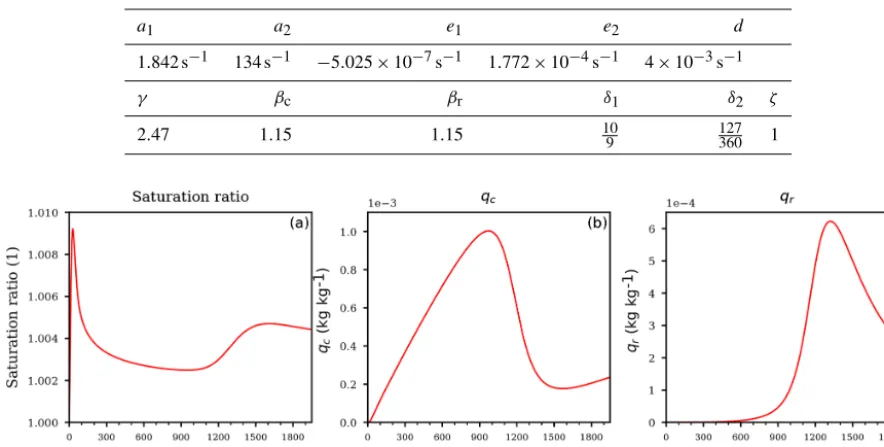
Table 1.Values of the coefficients and exponents used for the cloud scheme. All coefficients except fore1, e2are independent of
environ-mental pressure and temperature. The values for the exponents are exact; the values for the coefficients are rounded to three digits. The coefficient values displayed fore1, e2are for environmental pressure 850 hPa and temperature 270 K.
a1 a2 e1 e2 d
1.842 s−1 134 s−1 −5.025×10⁻⁷s−1 1.772×10⁻⁴s−1 4×10⁻³s−1
γ βc βr δ1 δ2 ζ
2.47 1.15 1.15 109 127360 1
Figure 1.Temporal evolution of the saturation ratioS(a), the cloud droplet mixing ratioqc(b), and the rain drop mixing ratioqr(c)for the
ascending air parcel with no pre-existing clouds.
4.1 Cloud formation in updraft
As the first example we consider an updraft velocity w=
1 m s−1, the initial conditions
(qc(0), qr(0))=
10−10kg kg−1,0 kg kg−1 (18) for the mixing ratios, and S(0)=1 for the saturation ratio and integrate the governing equations for 1950 s. The reason of not choosing qc(0)=0 kg kg−1 is that Eq. (12a) needs a zero initial value to allow for a constant and non-zero solution. Physically, this reflects the fact that the cloud scheme Eq. (12) does not include a precise activation mech-anism which predicts the number of activated cloud droplets as a function of saturation ratio. Such a mechanism is not included in the operational model due to its usage of a satu-ration adjustment scheme (e.g., Kogan and Martin, 1994).
Figure 1a, b, and c show, respectively, the temporal evolu-tion of the saturaevolu-tion ratioS, the cloud droplet mixing ratio
qc, and the rain drop mixing ratioqr. Apparently, the satu-ration ratio increases initially due to adiabatic cooling, until cloud droplet mass increased enough to balance the source for the saturation ratio from the adiabatic cooling by the diffusional growth of the cloud droplets. Since autoconver-sion is the only process for forming rain, its formation starts after enough cloud droplet mass is available. The time in-terval between 900 and 1200 s is a transition region, where the influence of autoconversion decreases while the influ-ence of accretion increases, i.e., falling rain drops start to
effectively collect cloud droplets and consequently increase the rain drop mass mixing ratioqr. This may also be seen directly from the model Eq. (12): accretion is modeled as
a2qcβcqrβr, hence an increase of rain drop mass directly in-creases the influence of this process and the further decrease in cloud droplet mass may be attributed to accretion. At about 1200 s the saturation ratio starts to increase again, since the decreasing cloud droplet mass diminishes the sink for water vapor due to its condensational growth. Note that, according to Eq. (12c), the evaporation term is inactive for supersatu-rated conditions withS≥1.
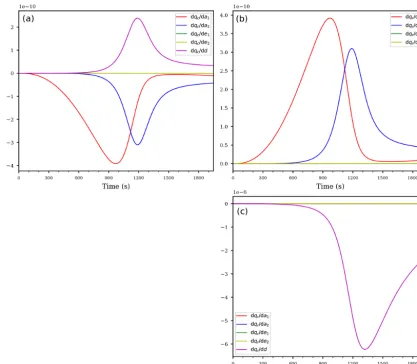
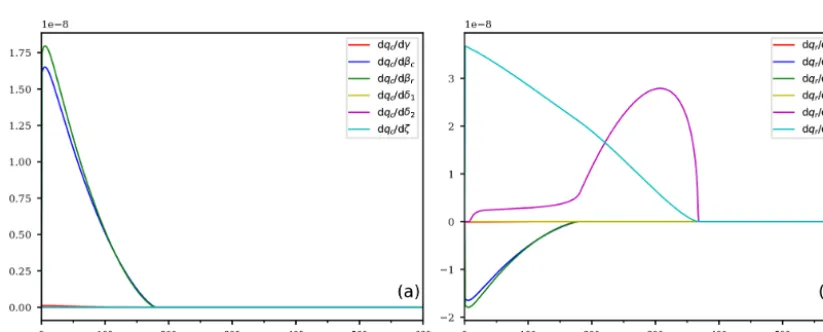
The derivatives of the mixing ratios with respect to the coefficients are shown in Fig. 2, whereas Fig. 3 shows the derivatives with respect to the exponents. As Fig. 2a shows, the coefficient with the largest sensitivity to the cloud droplet massqcup to about 1000 s is the coefficienta1for autocon-version (red curve). The large sensitivity during the initial stage of the cloud evolution implies that the main loss of cloud droplet mass can be attributed to the autoconversion process, rendering the autoconversion rate a critical param-eter. Given that autoconversion is the only process for pro-ducing rain drops out of the cloud droplets, this result may be anticipated. The negative value of the derivative∂qc
Figure 2.Temporal evolution of the derivatives of the cloud droplet mixing ratioqc(a)and the derivatives of the rain drop mixing ratioqr(b)
and(c)with respect to the coefficients. Panel(b)shows the derivatives of the rain drop mixing ratioqrwith respect to the coefficients but
without the derivative ∂qr
∂d with respect to the sedimentation coefficient; the panel(c)shows the derivatives ofqrincluding the derivative with
respect to the sedimentation coefficientd(purple curve). All panels correspond to the first case of an ascending air parcel with no pre-existing clouds.
a decreasing magnitude of ∂qc
∂a1 and an increasing magnitude of the derivative ∂qc
∂a2 of cloud droplet mass mixing ratio with respect to the accretion parametera2(blue curve).
Inspecting Fig. 2b, we observe a positive derivative ∂qr ∂a1 of the rain mixing ratio with respect to the autoconversion coefficient with the same magnitude as ∂qc
∂a1. This simply re-sembles the mass continuity, since a faster autoconversion implies a faster decrease in the cloud droplet mass qc and an equally fast increase in the rain drop mass qr. The same is true for the accretion, i.e., the derivatives ∂qc
∂a2, ∂qr ∂a2 (blue curves in Fig. 2a and b).
The derivatives ∂qc ∂e1,
∂qc
∂e2 of the cloud droplet mixing ratio with respect to the rain evaporation rate coefficients e1, e2 and the derivatives ∂qr
∂e1, ∂qr
∂e2 of the rain mixing ratio with re-spect to the same coefficients are identically zero, consistent with the fact that the evaporation term is inactive within a supersaturated cloud parcel; see Eq. (12c). However, the
pur-ple curve Fig. 2a, representing the derivative∂qc
∂d of the cloud droplet mixing ratio with respect to the sedimentation co-efficient, is not identically zero although the sedimentation term is absent in Eq. (12a) for the cloud droplet mixing ra-tioqc. This is an example of an indirect sensitivity ofqcto this coefficient: altering the sedimentation coefficient modi-fies the sedimentation rate which obviously directly affects the rain mixing ratioqr. This in turn feeds back to the cloud droplet mixing ratio qc since the rain mixing ratio qr en-ters Eq. (12a) through the accretion term. We conclude that the AD methodology is able to detect such indirect effects. Moreover, as may be concluded from Fig. 2a, this indirect sensitivity could easily be masked due to the comparable magnitude of the positive sensitivity ∂qc
∂d (purple curve) and the negative sensitivity∂qc
∂a2 (blue curve).
parameter d (purple curve; this curve was not included in Fig. 2b). From this figure it is evident thatqris most sensi-tive to the sedimentation coefficient. Comparing the differ-ent scalings of the ordinate in Figs. 2b and c corroborates this result. To summarize, at the beginning of this simula-tion, the most sensitive parameter is the autoconversion rate at creating rain drop mass. Towards the end of the simula-tion, enough rain drop mass is formed and the sedimenta-tion becomes more important, actually much more important than the autoconversion or the accretion since the derivatives
∂qr ∂a1,
∂qr ∂a2, and
∂qr
∂d differ by almost 4 orders of magnitude. Figure 3 shows the derivatives of the mixing ratiosqc, qr with respect to the exponents. For both mixing ratios, ob-viously the exponentsβc, βr from the accretion process are most sensitive (blue and green curves).
Note that the sign of the curves is counter intuitive, be-cause, e.g., positive values of the blue and green curves imply slower accretion after increasing the values of those expo-nents by a small amount. This behavior is easily explained with the values of both mixing ratios being smaller than unity: increasing the exponent in the expression a2qcβcqrβr with 0≤qc, qr<1 leads to decreased values of the expres-sion a2qcβcqrβr and consequently to a slower accretion pro-cess. It is important to keep such a behavior in mind in inter-preting the derivatives.
The second most sensitive exponent for the rain mixing ratio is given by exponentζ from the sedimentation process, but only after enough rain drop mass has formed after about 1000 s. The magnitude of the derivatives with respect to ζ
and the accretion exponentsβc, βrare comparable and of op-posite sign. Therefore, the influence of increasing these ex-ponents simultaneously may cancel out.
Observe that the derivatives of both mixing ratios with respect to the exponents δ1, δ2 in Fig. 3 are exactly zero, again resembling the in-activeness of the evaporation term in Eq. (12c) within the supersaturated cloud parcel.
As indicated, AD computes the derivatives of the imple-mentedcode, which in our case involves a numerical method, rather than derivatives of the (unknown) continuous solu-tion of the governing differential equasolu-tion. This distincsolu-tion is important for the interpretation of the computed sensitivi-ties and we are now going to discuss the subtlesensitivi-ties connected with them.
First of all, we outline the fact that since the numerical dis-cretization of the governing differential equation depends on the time step1t, the magnitude of all computed derivatives also depend on the time step. Figure 4 illustrates this fact by showing the derivative ∂qc
∂a1 of the cloud droplet mass on the parametera1for autoconversion for several time steps. In this figure, the dependency on1tbecomes obvious, however, the shape of the curve does actually not change. Rescaling the curves in Fig. 4 by multiplying the values of the blue curve by
0.1
0.01 =10, the values of the green curve by 0.1
0.001=100, and the values of the yellow curve by 0.00010.1 =1000, all rescaled
curves coincide with the red curve (not shown), representing the derivative computed with time step1t=0.1. Although this scaling with the time step is quite intuitive due to the fact that if the time step is larger, the simulation is done for a larger time interval and the sensitivities are expected to in-crease, one should be aware of this scaling when trying to interpret the magnitudes of the derivatives.
A second issue regarding the meaning of the computed sensitivities is addressed in Bischof and Eberhard (1999). There are two possibilities of computing sensitivities:
1. apply AD on the implemented code, which numerically approximates the unknown solution of the governing differential equation, or
2. derive an analytical differential equation (called the sen-sitivity or variational equation as an analogue of the for-ward AD mode or the adjoint equation as an analogue of the reverse AD mode), describing how the sensitiv-ities evolve with time (see, e.g., Sandu et al., 2003, or Walther, 2007, for details). In this approach, AD may enter the computation of the derivatives of the right-hand side of the governing equation.
The essential difference between the possibilities is that the first approach explicitly includes the numerical method in the computation of the sensitivities, while the second approach excludes any numerical method in the first place and instead creates an analytical differential equation, e.g., the sensitivity equation, for the description of the sensitivities and only in a second step approximates the exact solution of this equation using a numerical method.
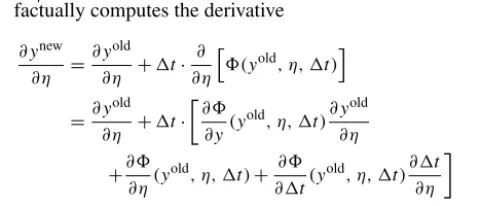
In our study we choose the first option and include the numerical method in the differentiation, since this seems more appropriate if one is interested in how the sensitivities propagate through a given, already implemented, numerical model. We use a one-step numerical method with constant time step1t to approximate the ordinary differential equa-tion, hence the numerical solutionynewat the new time level is connected to the old solutionyoldat the old time level by
ynew=yold+1t·8(yold, η, 1t ), whereηrepresents the pa-rameter vector as in Eq. (17) and8is the numerical method. Moreover, we compute the derivatives at each time step sep-arately, i.e., the approximation yold is considered as inde-pendent of the parameters at the current time level, hence ∂yold
∂η =0. Consequently, in our case the AD methodology factually computes the derivative
∂ynew ∂η =
∂yold ∂η +1t·
∂ ∂η
h
8(yold, η, 1t ) i
=∂y old
∂η +1t·
∂8 ∂y(y
old
, η, 1t )∂y
old
∂η
+∂8
∂η(y
old
, η, 1t )+ ∂8
∂1t(y
old
, η, 1t )∂1t ∂η
=1t·∂8
∂η(y
old
Figure 3.As in Fig. 2, but for the derivatives ofqc(a)andqr(b)with respect to the exponents.
Figure 4.Temporal evolution of the derivative ∂qc
∂a1 using the time
steps1t∈ {0.1,0.01,0.001,0.0001 s}for the computation of the same case as in Fig. 2.
showing once again the observed dependency of the com-puted sensitivities on the time step. In addition, Eq. (19) shows explicitly that the numerical method8is included in the differentiation, and thus the computed sensitivities de-pend on the numerical method. Note that we employed a con-stant time step that, according to the results in Bischof and Eberhard (1999), ensures that the computed sensitivities are indeed approximations of the sensitivities of the unknown, exact solution. If we had used a numerical method with adap-tive time-stepping, this would not necessarily be true, since in this case the current time step depends on the solution which in turn depends on the parameters η, implying ∂1t∂η 6=0 in general. Again, if one is interested in an approximate com-putation of the sensitivities of the exact solution, a correc-tion is needed for this non-zero contribucorrec-tion of ∂1t∂η 6=0; see Bischof and Eberhard (1999). However, if one is interested
in the sensitivities of theimplementedcode, no correction is needed.
Finally, it is not obvious that the computed sensitivities, which depend on the time step, converge to the sensitivities of the exact but unknown solution in the limit1t→0. In our case, since we rely on an explicit Runge–Kutta method of order 4, the desired convergence is established in Walther (2007). An extension to a more general Runge–Kutta method for the adjoint equation is presented in Sandu (2006).
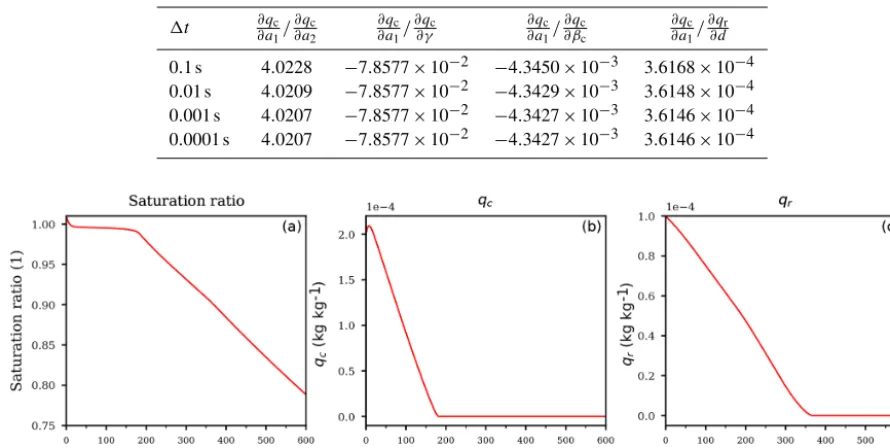
Although the magnitude of the computed derivatives de-pend on the time step of the numerical method, therelative magnitudes of the individual derivatives are independent of the time step. Table 2 highlights this observation by com-paring the ratios of some derivatives of the mixing ratios at
t=1000 s, computed with several time steps1t. The ratios of the derivatives shown in Table 2 are indeed approximately constant (except for the effects of a coarse time resolution), implying that these ratios are indeed independent of the time step. Therefore, the derivative with respect to the most sen-sitive parameter will show the largest magnitude compared to the derivatives with respect to the other parameters, re-gardless of the chosen time step of the numerical method involved. This allows the possibility of using the computed derivatives to identify the most sensitive parameters of the cloud scheme.
4.2 Cloud evaporation in a downdraft
As the second example, we consider a downdraft with veloc-ityw= −1 m s−1, the initial conditions
(qc(0), qr(0))=
2×10⁻⁴kg kg−1,10−4kg kg−1 (20) for the mixing ratios andS(0)=1.01 for the saturation ratio, representing an initial supersaturation of 1 %.
Table 2.Ratios of the derivatives of the mixing ratios with respect to different parameters att=1000 s, computed for several time steps1t. All numbers are taken from the computations of the first case of an ascending air parcel with no pre-existing cloud. The numbers are rounded to four digits.
1t ∂qc ∂a1/
∂qc ∂a2
∂qc ∂a1/
∂qc ∂γ
∂qc ∂a1/
∂qc ∂βc
∂qc ∂a1/
∂qr ∂d
0.1 s 4.0228 −7.8577×10⁻² −4.3450×10⁻³ 3.6168×10⁻⁴ 0.01 s 4.0209 −7.8577×10⁻² −4.3429×10⁻³ 3.6148×10⁻⁴ 0.001 s 4.0207 −7.8577×10⁻² −4.3427×10⁻³ 3.6146×10⁻⁴ 0.0001 s 4.0207 −7.8577×10⁻² −4.3427×10⁻³ 3.6146×10⁻⁴
Figure 5.Temporal evolution of the saturation ratioS(a), the cloud droplet mixing ratioqc(b), and the rain drop mixing ratioqr(c)for the
descending air parcel with evaporating cloud.
adiabatic heating. However, until the complete evaporation of the cloud droplets at about 175 s (see Fig. 5b), the release of water vapor of the evaporating cloud droplets counteracts the decrease of the saturation ratio and keeps the air parcel only slightly subsaturated (Fig. 5a). After roughly 175 s, the sat-uration ratio decreases continuously, resulting in a substan-tially subsaturated air parcel. Consequently, the available rain drops not only sediment out of the air parcel but also evapo-rate due to the subsaturation (Fig. 5c). However, the release of water vapor of the evaporating rain drops is seemingly not able to counteract the decrease of the saturation ratio as was the case for the evaporating cloud droplets at the beginning of the simulation, but the precise sensitivities of rain drop evaporation and sedimentation cannot be deduced from the temporal evolution of the mass mixing ratioqr.
The temporal evolutions of the derivatives of the mixing ratios with respect to the coefficients are shown in Fig. 6. Contrary to the first case from Sect. 4.1, the air parcel rapidly becomes subsaturated with S≤1 and the evaporation pro-cess in Eq. (12c) is now active, hence no derivative is iden-tically zero. Inspecting Fig. 6, the most sensitive coefficient for both mixing ratios ise2(yellow curve), corresponding to the ventilation coefficient within the formulation of the evap-oration process of the rain drops; see Eq. (12c). This result may be anticipated regarding the rain drop mass mixing ratio
qr, because the air parcel is subsaturated and the evaporation process directly affects the rain drop mixing ratio. However, we also observe a large sensitivity of the cloud droplet
mix-ing ratioqcon the same parameter. This feedback is, again, an indirect sensitivity originating from the accretion process: if the rain drop mass decreases faster due to a slight increase of the coefficiente2, the accretion gets slower and therefore less cloud droplets get collected by the falling rain drops. Consequently, the decrease of cloud droplet mixing ratio is diminished.
Figure 6b also shows that the second most sensitive coef-ficient forqr is given by the sedimentation rate coefficient. This observation also answers the question which process is more sensitive to changes in its rate coefficient for the de-crease of rain drop mass, seen in Fig. 5b. Due to the larger absolute values of ∂qr
∂e2 compared to ∂qr
∂d (yellow and purple curves in Fig. 6b), a slight change in the evaporation rate co-efficiente2will result in larger responses than a change in the sedimentation rate.
Although not visible in Fig. 6a, the derivatives with re-spect to the coefficientsa1, a2, d are all of about the same magnitude, while the sensitivity to the second evaporation coefficiente1is significantly smaller.
Inspecting Fig. 7, illustrating the derivatives of both mix-ing ratios to the exponents, the most sensitive exponents for the cloud droplet mixing ratio qc are again the exponents
Figure 6.Temporal evolution of the derivatives of the cloud droplet mixing ratioqc(a)and the rain drop mixing ratioqr(b)with respect to
the coefficients for the descending air parcel with evaporating cloud.
Figure 7.As in Fig. 6, but for the derivatives ofqc(a)andqr(b)with respect to the exponents.
consistent with the large sensitivity of the corresponding rate coefficiente2; see the yellow curve in Fig. 6a.
To summarize the second example: the AD methodology pinpoints the second summande2qrδ2 of the evaporation term together with the exponentsβc, βr of the accretion process in introducing the largest sensitivity in the model results. Al-though one could find the same sensitivities using classical sensitivity studies instead of AD, the AD methodology pro-vides an immediate suggestion on the large sensitivity of the coefficiente2for both mixing ratios (see Fig. 6), without hav-ing to carry out multiple model runs, where one perturbs each coefficient of the cloud scheme separately, one after the other. Moreover, the sensitivity of the cloud droplet mixing ratio
qctoe2is indirect, rendering it difficult to identify this sen-sitivity directly using the ensemble approach, in particular because the governing Eq. (12a) provides no indication due to the absence of coefficiente2. Given that even the simple cloud scheme Eq. (12) already contains five rate coefficients,
perturbing each coefficient within a separate model run re-sults in a significant total number of runs.
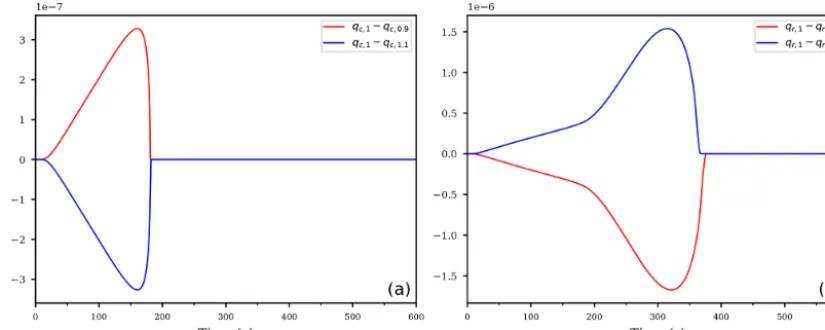
After the identification of the most sensitive parameters using AD, one can carry out further model runs, targeted at the parameters which were identified beforehand. Figure 8 illustrates a possible further analysis step. It shows the dif-ference between an unperturbed run, denoted byqx,1 with
x∈ {c, r}, and two further runs with perturbed rate coeffi-cients·e2instead ofe2, wheres∈ {0.9,1.1}is a scaling pa-rameter. Observe that the signal is consistent with the deriva-tive, computed by AD, in Fig. 6: the derivative ∂qr
∂e2 is nega-tive, hence a slight increase of the coefficient should result in a smaller rain mixing ratioqrand, consequently, the differ-ence ofqr,1−qr,1.1should be positive. Similarly, the deriva-tive ∂qc
∂e2 is positive, and hence a slight increase of the co-efficient should result in negative values for the difference
Figure 8.Difference between the reference run with unperturbed coefficiente2, denoted asqx,1forx∈ {c, r}and using the perturbed second
evaporation coefficients·e2withs∈ {0.9,1.1}, denoted asqx,0.9orqx,1.1, for the cloud droplet mixing ratio(a)and the rain mixing ratio(b),
respectively.
the scaling parameters=0.9; note that the curves are asym-metric to each other.
4.3 Dependency on the model trajectory
After having discussed both exemplary cases individually, we now point to another important aspect of the AD method-ology. Given that AD was applied to the exactly same com-putational code, a comparison between, e.g., the derivatives of the cloud droplet mixing ratioqcwith respect to the rate coefficients (see Figs. 2a and 6a) reveals that the correspond-ing curves are not equal to each other, but show significantly different behavior. The only difference between the exam-ples were the values of the initial conditions. Consequently, the model trajectories between the runs evolved differently despite the fact that the computational code was unchanged. This observation is a crucial aspect of the AD methodol-ogy since it underlines that AD computes the derivative of the model, i.e., the computational code, along the particu-lar model trajectory, rather than providing the derivatives for each possible state of the model. Therefore, the AD approach can provide the desired sensitivities for the particular evolu-tion of the model state, posing the same limitaevolu-tions as the computation of the derivatives using the aforementioned fi-nite difference approach.
5 Conclusions
In this study, we presented and applied the technique of algo-rithmic differentiation (AD) in the context of cloud schemes, representing an important example of a subgrid parameteri-zation of numerical models within the atmospheric sciences. In the literature, many different cloud schemes are suggested since at the moment, a universal governing equation for the full description of a cloud is not available (in contrast to the
Navier–Stokes equation for the description of a non-reacting flow), making it impossible to derive cloud schemes from a common universal basis. As a consequence, many ad hoc assumptions are made within the formulations of the cloud processes typically leading to the introduction of uncertain parameters.
We propose the use of algorithmic differentiation in the de-velopment of cloud schemes in order to identify the most sen-sitive parameters in the adopted formulation along the sim-ulated solution trajectory. The AD methodology is based on the observation that each computer code is a large composi-tion of only a few differentiable elemental operacomposi-tions; hence, by the chain rule, the code itself is differentiable apart from critical points, where the elemental functions are not differ-entiable. Since the derivatives of the elemental operations are known, the full computational code can be differentiated in a (semi-)automatic fashion. Moreover, the resulting derivatives are accurate to machine precision because the AD approach merely evaluates the exact derivative.
run, but the amount is independent of the number of input variables, among which are also the parameters to be inves-tigated. Therefore, the reverse AD mode has the ability to outperform the forward mode in the case of many input vari-ables but only a small number of output varivari-ables because only a single run of the reverse mode is required to establish the derivatives with respect to each input variable, whereas the forward mode requires as many runs as the number of input variables. The fact that AD introduces only a constant computational overhead is especially useful if the number of parameters is comparably high, since establishing an ensem-ble to investigate the sensitivity of the parameters quickly results in a high number of model runs. Moreover, using an ensemble of model runs to study parameter sensitivities ad-ditionally involves a thorough post-processing of all model output. In contrast, the AD approach clearly identifies the parameters with high sensitivity, regardless of whether the sensitivity is direct or indirect, and allows one to focus fur-ther post-processing on only the relevant parameters.
AD helps in computing the derivatives, but one has to keep in mind the subtleties: using AD as advocated in this study implies that the computed derivatives involve the differenti-ation of the numerical method used to approximate the so-lution of the differential Eqs. (12), (13). Consequently, the derivatives depend on the time step and may change if the numerical method is replaced by another method. Neverthe-less, the computed sensitivities resemble the actual sensitivi-ties of theimplementedcode and comprise the correct result to tackle the question how uncertainties propagate through a given numerical model as, e.g., a weather forecasting model. We emphasize that the technique of AD is not restricted to a specific programming language nor to the analysis of cloud schemes. It is a generic technique which may help in the development of any (subgrid) scheme for a (geophysical) numerical model by providing information about the sensi-tivities of the involved parameters.
In adopting a cloud scheme or any subgrid scheme, the question of how the inherent uncertainties of the scheme in-fluence the (numerical) solution of the model arises. In the context of the topic of this study, an example of the influ-ences of a single parameter within a typical cloud scheme on the overall cloud development is discussed in Igel and van den Heever (2017a, b, c). Answering the question of how uncertainties propagate within a given model is a highly non-trivial task. As indicated in Sect. 1, methods from uncertainty quantification allow to assess this propagation (e.g., Sullivan, 2015; Le Maître and Knio, 2010), but taking many parame-ters simultaneously into account is challenging and compu-tationally expensive. Algorithmic differentiation allows one to first identify the parameters which influence the result of a given parameterization at most, e.g., a cloud scheme, and limit the more extensive investigation to only these parame-ters; see Chertock et al. (2019) for an example of such an in-vestigation. However, as AD by design computes the deriva-tives along the numerical solution trajectory, one might not
detect all possible sensitivities, but at least the most sensitive parameters in “typical” situations.
Code availability. The code for the cloud model together with all scripts needed to reproduce the results in this study are available at https://doi.org/10.5281/zenodo.3461483 (Baumgartner, 2019). The algorithmic differentiation tool CoDiPack may be found online at https://github.com/scicompkl/codipack (last access: 6 Decem-ber 2019) and the version 1.8.1, which is used in this study, is avail-able at https://doi.org/10.5281/zenodo.3460682 (Sagebaum et al., 2019).
Author contributions. MB developed the cloud model code and carried out the numerical experiments under the supervision of AB and PS. MS developed the algorithmic differentiation tool CoDi-Pack under the supervision of NRG. MB and MS prepared the manuscript with reviews from NRG, AB, and PS.
Competing interests. The authors declare that they have no conflict of interest.
Acknowledgements. The authors thank the anonymous referees for their valuable comments and suggestions, which considerably helped in improving the manuscript. The authors acknowledge sup-port of the Deutsche Forschungsgemeinschaft (DFG) within the project Enabling Performance Engineering in Hesse and Rhineland-Palatinate (grant number 320898076). Manuel Baumgartner, Pe-ter Spichtinger and André Brinkmann acknowledge support by the DFG within the Transregional Collaborative Research Centre TRR165 Waves to Weather (http://www.wavestoweather.de, 6 De-cember 2019), projects B7 and Z2.
Financial support. This research has been supported by the Deutsche Forschungsgemeinschaft (grant nos. 320898076 and 257899354).
Review statement. This paper was edited by David Topping and re-viewed by two anonymous referees.
References
Albring, T., Sagebaum, M., and Gauger, N. R.: Efficient Aerody-namic Design using the Discrete Adjoint Method in SU2, AIAA 2016-3518, 2016.
Asai, T.: A Numerical Study of the Air-Mass Transformation over the Japan Sea in Winter, J. Meteorol. Soc. Jpn. Ser. II, 43, 1–15, 1965.
Baumgartner, M.: Algorithmic Differentiation for
Cloud Schemes using CoDiPack (v1.8.1), Zenodo,
Belikov, D. A., Maksyutov, S., Yaremchuk, A., Ganshin, A., Kaminski, T., Blessing, S., Sasakawa, M., Gomez-Pelaez, A. J., and Starchenko, A.: Adjoint of the global Eulerian–Lagrangian coupled atmospheric transport model (A-GELCA v1.0): de-velopment and validation, Geosci. Model Dev., 9, 749–764, https://doi.org/10.5194/gmd-9-749-2016, 2016.
Bischof, C. H. and Eberhard, P.: Automatic differentiation of numerical integration algorithms, Math. Comp., 68, 717–731, https://doi.org/10.1090/S0025-5718-99-01027-3, 1999. Bischof, C. H., Khademi, P., Mauer, A., and Carle, A.: Adifor 2.0:
automatic differentiation of Fortran 77 programs, IEEE Comput. Sci. Eng., 3, 18–32, https://doi.org/10.1109/99.537089, 1996a. Bischof, C. H., Pusch, G. D., and Knoesel, R.: Sensitivity
analy-sis of the MM5 weather model using automatic differentiation, Comput. Phys., 10, 605–612, https://doi.org/10.1063/1.168585, 1996b.
Blessing, S., Kaminski, T., Lunkeit, F., Matei, I., Giering, R., Köhl, A., Scholze, M., Herrmann, P., Fraedrich, K., and Stammer, D.: Testing variational estimation of process parameters and ini-tial conditions of an earth system model, Tellus A, 66, 22606, https://doi.org/10.3402/tellusa.v66.22606, 2014.
Chertock, A., Kurganov, A., Lukáˇcová-Medvid’ová, M., Spichtinger, P., and Wiebe, B.: Stochastic Galerkin Method for Cloud Simulation, Mathematics of Climate and Weather Forecasting, 5, 65–106, https://doi.org/10.1515/mcwf-2019-0005, 2019.
Cotton, W. R., Bryan, G. H., and van den Heever, S. C.: Storm and Cloud Dynamics, Academic Press, 2nd Edn., 2010.
Devenish, B. J., Bartello, P., Brenguier, J.-L., Collins, L. R., Grabowski, W. W., IJzermans, R. H. A., Malinowski, S. P., Reeks, M. W., Vassilicos, J. C., Wang, L.-P., and Warhaft, Z.: Droplet growth in warm turbulent clouds, Q. J. Roy. Meteor. Soc., 138, 1401–1429, https://doi.org/10.1002/qj.1897, 2012. Doms, G., Förstner, J., Heise, E., Herzog, H.-J., Mironow, D.,
Raschendorfer, M., Reinhardt, T., Ritter, B., Schrodin, R., Schulz, J.-P., and Vogel, G.: A Description of the Nonhydro-static Regional COSMO Model, Part II: Physical Parameteriza-tion, available at: http://www.cosmo-model.org/content/model/ documentation/core/default.htm (last access: 23 October 2019), 2011.
ECMWF: IFS DOCUMENTATION – Cy43r3, Part IV: Physical Processes, available at: https://www.ecmwf.int/en/elibrary/ 16648-part-iv-physical-processes (last access: 23 Octo-ber 2019), 2017.
Elizondo, D., Cappelaere, B., and Faure, C.: Automatic versus manual model differentiation to compute sensitivities and solve non-linear inverse problems, Comput. Geosci., 28, 309–326, https://doi.org/10.1016/S0098-3004(01)00048-6, 2002. Grabowski, W. W. and Wang, L.-P.: Growth of Cloud Droplets in a
Turbulent Environment, Annu. Rev. Fluid Mech., 45, 293–324, https://doi.org/10.1146/annurev-fluid-011212-140750, 2013. Griewank, A. and Walther, A.: Evaluating Derivatives, 2nd Edn.,
ISBN 978-0-898716-59-7, SIAM, 2008.
Griewank, A., Kulshreshtha, K., and Walther, A.: On the numerical stability of algorithmic differentiation, Computing, 94, 125–149, https://doi.org/10.1007/s00607-011-0162-z, 2012.
Grossmann, C. and Roos, H.-G.: Numerical Treatment of Par-tial DifferenPar-tial Equations, Universitext, Springer-Verlag, Berlin Heidelberg, 2007.
Hairer, E., Nørsett, S. P., and Wanner, G.: Solving Ordinary Differ-ential Equations I, vol. 8 of Springer Series in Computational Mathematics, Springer-Verlag, Berlin Heidelberg, 2nd revised Edn., https://doi.org/10.1007/978-3-540-78862-1, 1993. Hascoët, L. and Pascual, V.: The Tapenade Automatic
Differentiation tool: Principles, model, and
speci-fication, ACM T. Math. Software, 39, 20:1–20:43,
https://doi.org/10.1145/2450153.2450158, 2013.
Hück, A., Bischof, C. H., and Utke, J.: Checking C++ codes for compatibility with operator overloading, in: 2015 IEEE 15th International Working Conference on Source Code Analysis and Manipulation (SCAM), 91–100, https://doi.org/10.1109/SCAM.2015.7335405, 2015.
Igel, A. L. and van den Heever, S. C.: The Importance of the Shape of Cloud Droplet Size Distributions in Shallow Cumulus Clouds. Part I: Bin Microphysics Simulations, J. Atmos. Sci., 74, 249– 258, https://doi.org/10.1175/JAS-D-15-0382.1, 2017a.
Igel, A. L. and van den Heever, S. C.: The Importance of the Shape of Cloud Droplet Size Distributions in Shallow Cumulus Clouds. Part II: Bulk Microphysics Simulations, J. Atmos. Sci., 74, 259– 273, https://doi.org/10.1175/JAS-D-15-0383.1, 2017b.
Igel, A. L. and van den Heever, S. C.: The role of the gamma function shape parameter in determining differences between condensation rates in bin and bulk microphysics schemes, At-mos. Chem. Phys., 17, 4599–4609, https://doi.org/10.5194/acp-17-4599-2017, 2017c.
Igel, A. L., Igel, M. R., and van den Heever, S. C.: Make It a Double? Sobering Results from Simulations Using Single-Moment Microphysics Schemes, J. Atmos. Sci., 72, 910–925, https://doi.org/10.1175/JAS-D-14-0107.1, 2015.
Kalnay, E.: Atmospheric modeling, data assimilation and pre-dictability, Cambridge University Press, 2003.
Kaminski, T., Heimann, M., and Giering, R.: A coarse grid three-dimensional global inverse model of the atmospheric transport: 1. Adjoint model and Jacobian matrix, J. Geophys. Res.-Atmos., 104, 18535–18553, https://doi.org/10.1029/1999JD900147, 1999.
Kessler, E.: On the Distribution and Continuity of Water Substance in Atmospheric Circulations, American Meteorological Soci-ety, Boston, MA, 1–84, https://doi.org/10.1007/978-1-935704-36-2_1, 1969.
Khain, A. P., Ovtchinnikov, M., Pinsky, M., Pokrovsky, A., and Krugliak, H.: Notes on the state-of-the-art numerical modeling of cloud microphysics, Atmos. Res., 55, 159–224, https://doi.org/10.1016/S0169-8095(00)00064-8, 2000. Khain, A. P., Beheng, K. D., Heymsfield, A. J., Korolev, A. V.,
Krichak, S. O., Levin, Z., Pinsky, M., Phillips, V., Prabhakaran, T., Teller, A., van den Heever, S. C., and Yano, J.-I.: Repre-sentation of microphysical processes in cloud-resolving models: Spectral (bin) microphysics versus bulk parameterization, Rev. Geophys., 53, 247–322, https://doi.org/10.1002/2014RG000468, 2015.
Khairoutdinov, M. and Kogan, Y.: A New Cloud
Physics Parameterization in a Large-Eddy
Simula-tion Model of Marine Stratocumulus, Mon. Weather
Rev., 128, 229–243, https://doi.org/10.1175/1520-0493(2000)128<0229:ANCPPI>2.0.CO;2, 2000.
At-mos. Sci., 51, 1728–1739, https://doi.org/10.1175/1520-0469(1994)051<1728:POBCIN>2.0.CO;2, 1994.
Köhler, H.: The nucleus in and the growth of
hygro-scopic droplets, T. Faraday Soc., 32, 1152–1161,
https://doi.org/10.1039/TF9363201152, 1936.
Lamb, D. and Verlinde, J.: Physics and Chemistry of Clouds, Cam-bridge University Press, CamCam-bridge, 2011.
Langlois, W. E.: A rapidly convergent procedure for computing large-scale condensation in a dynamical weather model, Tellus, 25, 86–87, https://doi.org/10.1111/j.2153-3490.1973.tb01598.x, 1973.
Le Dimet, F.-X., Navon, I. M., and Daescu, D. N.:
Second-Order Information in Data Assimilation, Mon. Weather Rev., 130, 629–648, https://doi.org/10.1175/1520-0493(2002)130<0629:SOIIDA>2.0.CO;2, 2002.
Le Maître, O. and Knio, O. M.: Spectral Methods for Uncertainty Quantification: With Applications to Computational Fluid Dy-namics, Scientific Computation, Springer Science & Business Media, https://doi.org/10.1007/978-90-481-3520-2, 2010. Maxwell, J. C.: Diffusion, reprinted in: The Scientific Papers of
James Clerk Maxwell, edited by: Niven, W. D., 2, 625–645, 1877.
McDonald, J. E.: The saturation adjustment in numerical modelling of fog, J. Atmos. Sci., 20, 476–478, 1963.
Neidinger, R. D.: Introduction to Automatic Differentiation and MATLAB Object-Oriented Programming, SIAM Rev., 52, 545– 563, https://doi.org/10.1137/080743627, 2010.
Orlanski, I.: A Rational Subdivision of Scales for Atmospheric Pro-cesses, B. Am. Meteorol. Soc., 56, 527–530, 1975.
Porz, N., Hanke, M., Baumgartner, M., and Spichtinger, P.: A model for warm clouds with implicit droplet activation, avoiding satura-tion adjustment, Mathematics of Climate and Weather Forecast-ing, 4, 50–78, https://doi.org/10.1515/mcwf-2018-0003, 2018. Rauser, F., Riehme, J., Leppkes, K., Korn, P., and Naumann, U.:
On the use of discrete adjoints in goal error estimation for shallow water equations, Procedia Comput. Sci., 1, 107–115, https://doi.org/10.1016/j.procs.2010.04.013, 2010.
Rogers, R. and Yau, M.: A Short Course in Cloud Physics, Inter-national Series in Natural Philosophy, Butterworth-Heinemann, 3rd Edn., 1989.
Rosemeier, J., Baumgartner, M., and Spichtinger, P.: Intercompar-ison of Warm-Rain Bulk Microphysics Schemes using Asymp-totics, Mathematics of Climate and Weather Forecasting, 4, 104– 124, https://doi.org/10.1515/mcwf-2018-0005, 2018.
Sagebaum, M., Albring, T., and Gauger, N. R.: High-Performance Derivative Computations using CoDiPack, arXiv preprint arXiv:1709.07229, 2017a.
Sagebaum, M., Özkaya, E., Gauger, N. R., Backhaus, J., Frey, C., Mann, S., and Nagel, M.: Efficient Algorithmic Differentia-tion Techniques for Turbo-machinery Design, AIAA 2017-3998, https://doi.org/10.2514/6.2017-3998, 2017b.
Sagebaum, M., Albring, T., Demidov, D., Möller,
M., van der Weide, E., and Lam, M.:
Sci-CompKL/CoDiPack: Version 1.8.1 (Version v1.8.1), Zenodo, https://doi.org/10.5281/zenodo.3460682, 2019.
Sandu, A.: On the Properties of Runge-Kutta Discrete Adjoints, in: Computational Science – ICCS 2006, edited by: Alexandrov, V. N., van Albada, G. D., Sloot, P. M. A., and Dongarra, J., Springer Berlin Heidelberg, Berlin, Heidelberg, 550–557, 2006. Sandu, A., Daescu, D. N., and Carmichael, G. R.: Direct and adjoint sensitivity analysis of chemical kinetic systems with KPP: Part I – theory and software tools, Atmos. Environ., 37, 5083–5096, https://doi.org/10.1016/j.atmosenv.2003.08.019, 2003.
Soong, S.-T. and Ogura, Y.: A Comparison Between Ax-isymmetric and Slab-Symmetric Cumulus Cloud Models, J. Atmos. Sci., 30, 879–893, https://doi.org/10.1175/1520-0469(1973)030<0879:ACBAAS>2.0.CO;2, 1973.
Sullivan, T. J.: Introduction to Uncertainty Quantification, vol. 63 of Texts in Applied Mathematics, Springer-Verlag, Cham Heidel-berg New York Dordrecht London, https://doi.org/10.1007/978-3-319-23395-6, 2015.
van Oldenborgh, G. J., Burgers, G., Venzke, S., Eckert,
C., and Giering, R.: Tracking Down the ENSO
De-layed Oscillator with an Adjoint OGCM, Mon. Weather Rev., 127, 1477–1496, https://doi.org/10.1175/1520-0493(1999)127<1477:TDTEDO>2.0.CO;2, 1999.
Walther, A.: Automatic differentiation of explicit Runge-Kutta methods for optimal control, Comput. Optim. Appl., 36, 83–108, https://doi.org/10.1007/s10589-006-0397-3, 2007.
Xiao, Q., Kuo, Y.-H., Ma, Z., Huang, W., Huang, X.-Y., Zhang, X., Barker, D. M., Michalakes, J., and Dudhia, J.: Application of an Adiabatic WRF Adjoint to the Investigation of the May 2004 Mc-Murdo, Antarctica, Severe Wind Event, Mon. Weather Rev., 136, 3696–3713, https://doi.org/10.1175/2008MWR2235.1, 2008. Zhang, X., Huang, X.-Y., and Pan, N.: Development of the