Journal of Humanities Insights 2(4): 179-183, 2017
Research Paper
Different Approaches to Contextualization
Seyyed Hassan Seyyedrezaie*,Ghasem BaraniDepartment of ELT, Aliabad Katoul Branch, Islamic Azad University, Aliabad Katoul, Iran
Received: 14 September 2018 Accepted: 23 October 2018 Published: 01 December 2018
Abstract
The present study tries to investigate the growing need to learn how to use language appropriately in context. Effective English language teachers treat language as a whole, using it as a "context" to facilitate their students' learning. Today, contextualization is of crucial importance since it helps learners to understand the functions of language, assists them in developing appropriate use of language, activates their own background knowledge to make the language learning more meaningful and etc, [1]. We need to reconsider our attitude towards contextualization due to its vital role in language learning and teaching.
Keywords: Contextualization; Decontextualization; Gumperz’ Approach; Sociocultural Approach; Contextualizing Through Content
How to cite the article:
S. H. Seyyedrezaie, G. Barani, Evaluation of Cost-benefit Disparity of Butter Production in Nigeria, J. Hum. Ins. 2018; 2(4): 179-183, DOI: 10.22034/jhi.2018.86950
©2018 The Authors. This is an open access article under the CC By license
1. Introduction
According to Auer and Di Luzio (1992) [2], contextualization refers to meaningful language use for communicative purposes within a given situation or context. The rationale for this kind of approach is to demonstrate "real" world language use, how language is used by speakers of that language, and to help learners construct language in their learning environments, depending on (1) their purpose and, (2) the needs of a given situational context. Johnson (2002) defines contextualization as “A diverse family of instructional strategies designed to more seamlessly link the learning of foundational skills and academic or occupational content by focusing teaching and learning squarely on concrete applications in a specific context that is of interest to the student [3]. Auer & Di Luzio (1992) go on to say that in most general terms, contextualization therefore comprises all activities by participants which make relevant, maintain, revise, cancel … any aspect of context which, in turn, is responsible for the interpretation of an utterance in its particular locus of occurrence [2]. Such an aspect of context may be the larger activity participants are engaged
* Corresponding Author email: [email protected]
in (the "speech genre"), the small-scale activity (or "speech act"), the mood (or "key") in which this activity is performed, the topic, but also the participants' roles (the participant constellation, comprising "speaker", "recipient", "bystander", etc.), the social relationship between participants, the relationship between a speaker and the information he conveys via language ("modality"), even the status of "focused interaction" itself.
2. Reasons for contextualization
According to Walz (1989) [1], reasons for contextualizing language are as follows: •It can help learners to understand the functions of language.
•It can assist learners in developing appropriate use of language. •Learners can activate their own background knowledge to make the language learning more meaningful.
•It adds the cultural element, combining language
and culture.
•The combination of all of the above can be motivating for both learners and teachers.
development of expertise requires that a learner develop not only content but also procedural knowledge, such as the metacognitive awareness of
when and how to apply what has been learned. In Hartman`s (2001) words, this kind of knowledge can be acquired only through practice [5].
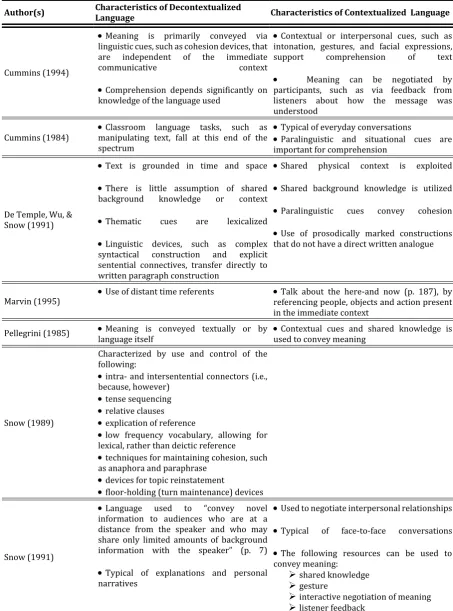
Table 1. Definitions of "decontextualized" and "contextualized" language.
Author(s) Characteristics of Decontextualized Language Characteristics of Contextualized Language
Cummins (1994)
Meaning is primarily conveyed via linguistic cues, such as cohesion devices, that are independent of the immediate
communicative context
Comprehension depends significantly on knowledge of the language used
Contextual or interpersonal cues, such as intonation, gestures, and facial expressions, support comprehension of text
Meaning can be negotiated by participants, such as via feedback from listeners about how the message was understood
Cummins (1984) manipulating text, fall at this end of the Classroom language tasks, such as spectrum
Typical of everyday conversations
Paralinguistic and situational cues are important for comprehension
De Temple, Wu, & Snow (1991)
Text is grounded in time and space
There is little assumption of shared background knowledge or context
Thematic cues are lexicalized
Linguistic devices, such as complex syntactical construction and explicit sentential connectives, transfer directly to written paragraph construction
Shared physical context is exploited
Shared background knowledge is utilized
Paralinguistic cues convey cohesion
Use of prosodically marked constructions that do not have a direct written analogue
Marvin (1995) Use of distant time referents referencing people, objects and action present Talk about the here-and now (p. 187), by in the immediate context
Pellegrini (1985) Meaning is conveyed textually or by
language itself used to convey meaning Contextual cues and shared knowledge is
Snow (1989)
Characterized by use and control of the following:
intra- and intersentential connectors (i.e., because, however)
tense sequencing
relative clauses
explication of reference
low frequency vocabulary, allowing for lexical, rather than deictic reference
techniques for maintaining cohesion, such as anaphora and paraphrase
devices for topic reinstatement
floor-holding (turn maintenance) devices
Snow (1991)
Language used to “convey novel information to audiences who are at a distance from the speaker and who may share only limited amounts of background information with the speaker” (p. 7)
Typical of explanations and personal narratives
Used to negotiate interpersonal relationships
Typical of face-to-face conversations
The following resources can be used to convey meaning:
shared knowledge
gesture
interactive negotiation of meaning
Snow, Cancino, De Temple & Schley (1991)
“Language used in ways that eschew reliance on shared social and physical context in favor of reliance created through the language itself” (p. 90)
Formal definitions, that identify a superordinate class and add relevant information about restrictions on class membership, including crucial information and excluding irrelevant information
Westby (1995) Language that is “comprehensible to an unknown audience without support from others” (p. 56)
3.Approaches to contextualization
3.1 Gumperz’ approach to contextualization
Gumperz (1991) states that the notion of contextualization suggests a flexible notion, a context that is continually reshaped in time [6]. But the relationship between context and text must also be a reflex iveone i.e. one in which language is not determined by context, but contributes itself in essential ways to the construction of context. Gumperz (1991) insists on the necessity to construct context in order to communicate [6]. This means: language is not only a semiotic system the actual usage of which is determined by the context; this semiotic system (or, as we should better say, this system of semiotic systems) is in itself also responsible for the availability of the very context which is necessary in order to interpret the structures encoded in it. Context, therefore, is not just given as such in an interaction, but is the outcome of participants' joint efforts to make it available. It is not a collection of material or social 'facts' (such as the interaction taking place in such-and-such locality, between such-such-and-such roles-bearers, etc.), but a (number of) cognitive schema(ta) (or model(s)) about what is relevant for the interaction at any given point in time. What is relevant in this sense may exclude or include certain facts of the material and social surroundings of the interaction as they might be stated by an 'objective' on-looker who tries to describe context without looking at what takes place in it (as, for instance, the social scientist of some former theoretical and methodological conviction), but it may also include information not statable before the interaction begins, or independently of it. These emergent context parameters refer, e.g., to types of linguistic activities not predictable from the 'materially' or socially' environment of the interaction at all, but also to facets of knowledge which may 'in fact' be shared by co-participants from the very beginning, but have to be turned from 'unvisible' (and interactionally irrelevant) cognitive dispositions of
the participants into commonly available grounds on which to conduct the interaction.
The two most important characteristics of this more specific approach to contextualization are the following:
a) Focus on particular classes of contextualization cues.
established by Gumperz from most of conversation analysis, but also certain parts of pragmatics.
b) Naturally occurring interaction as data.
Contrary to most research on information structuring, contextualization research is unthinkable without work on naturally occurring data. Gumperz (1989) deals with fine-grained contextualization cues which cannot be reconstructed from the analyst's memory or competence as a member of a speech community but have to be observed in mechanically recorded data [6].
3.2 Contextualizing through Content
According Walz (1989), contextualizing is a process that is best, or at least most easily, organized around content, especially in an EFL environment [1]. This can be done through a content-based curriculum, in which a subject is taught through the medium of English, or through a topic or theme-based curriculum. Using content is a good way to utilize what learners already know about a topic. The teacher presents new information in the context of known information, utilizing both linguistic and world knowledge. This creates a natural spiraling or reusing of language and information used in previous lessons, as previous material is reviewed and activated in presenting new material. The content itself sets the language context, or provides information from which the teacher can set a language context. The next step is for teachers to choose authentic materials natural to that context, which would also be accessible to themselves and to their students. The materials, in turn, suggest authentic activities, meaning activities that require "real" communication. One of the most frequently used examples of this process is content related to travel, or the tourist industry, partly because content for this topic is accessible for both teachers and students.
According to Darling-Hammond and Snyder (2000) [7], some examples of authentic materials and situations are as follows:
Brochures written in English for tourists who visit the learners' country or city; tourism web sites (written in English) about the country or city in English; several local hotels or restaurants who would be willing to take calls in English from students.
Activities that activate real world knowledge: In groups, learners make a list of all the businesses in their town that either depend on or are related in some way to tourism and /or a list of as many different jobs as they can think of in the local tourism industry. Learners can make a list of different communication events that a tourist visiting the city might have (checking into a hotel, going to a restaurant, etc.). Learners can prepare for the unit by visiting establishments that deal with
visitors (any visitors, not just English-speaking ones) and make notes about language used, eye contact, body language, and other appropriate behaviors.
Spiraling (re-use or recycling of lesson content): The teacher can do a review of previously learned politeness language and language chunks, which might be used for dialogues in this new unit. Linguistic focus: Introduction of more polite language structures using modals; travel-related vocabulary; perhaps appropriate telephone formulas, etc. Communication events (tasks): Reading information on the Internet, making hotel / restaurant reservations, buying bus/plane/train tickets; asking for information, etc. Watching an English movie /video that includes some of these communication events and comparing appropriate behaviors in the target culture to notes about local behaviors (depending on the proficiency level of the students).
3.3 Constructing approach to contextualization
According to Walz (1989), part of contextualizing language is helping students learn how to construct language for a given situation [1]. An effective process for constructing language in a classroom has both cognitive and social aspects. In the cognitive process learners construct their own meaning or knowledge from the input they receive, input which will include information about the context or situation. The social aspect includes the idea of learners helping other learners to understand ideas and concepts, opportunities for which can be facilitated through group and pair work. Both aspects are important in setting up a constructive learning environment contextualizing language. And for both aspects, the learner is the center of the learning process, the one who constructs language based on situation, input, and purpose. One of the decisions a teacher must make concerns how much situational and cultural information to provide about the various factors in a given context beyond the linguistic information, i.e. Information about participant roles, appropriate body language, register, expected behaviors and so forth. How much is needed for appropriate language use and how much can the learners handle at their level of proficiency? As learners work on constructing language appropriate to a given context, Goode (2000) provides a list of some of the variables that need to be considered as follows [4]:
•Communicators' purpose,
• Roles and status of the participants in the communication event, which will include attention to register and tone, and
communication, the medium, and the genre. According to Nikitina (2006), in the kind of learning environment described above, the teacher's responsibility is 1) to provide useful, accurate, and comprehensible input, 2) to design language learning activities that facilitate language construction, and 3) to provide support for learners' efforts whenever needed [8]. How, then, can the teacher design this kind of learning environment? Contextualizing language in an active learning environment can be particularly difficult for the English teacher in a non-English setting, an EFL environment. In that environment, textbook language is often felt to be more accessible to both learners and teachers than contextualized language. However, there are teaching strategies that can be used quite well in an EFL situation. The teacher can adjust the amount of contextual information in the input based on his or her own comfort level.
3.4 Sociocultural approach to contextualization
According to Wenger (1998), contextualized approach to instruction stresses the social nature of real world activities, the value of building a learning community within the classroom, and the importance of incidental learning that takes place when knowledge and skills are acquired within a social context [9]. For example, when the skill of “filling out forms” grows out of an immediate real-world need of immigrant learners and is addressed in a community of learners, issues such as understanding the conditions under which filling out forms is necessary, when and how to call in an “expert” such as a lawyer, and the benefits and draw backs of asking family members for assistance become part of the curriculum. This Research to Practice Note focuses on the following key assumptions:
• Effective learning requires not only the acquisition but also the active application
of knowledge, skills, and processes.
• To encourage transfer to other contexts, effective learning requires the acquisition
of a complex knowledge base including content knowledge, skills, and cognitive
and metacognitive strategies.
• Learning is a function not only of the activity itself but also of the context and
culture in which it takes place.
4. Conclusion
In today's world, there is a growing need to learn how to use language appropriately in context. Effective English language teachers treat language as a whole, integrated communication system and use that system as a "context" to facilitate their
students' learning. Contextualization has been defined as using any information that can be used to characterize the situation of anentity [10]. Helping learners to understand the functions of language, assisting learners in developing appropriate use of language, activating their own background knowledge to make the language learning more meaningful and adding the cultural element, combining language and culture are among the main reason of contextualization [1].
There are different approaches to contextualization: Gumperz’ approach to contextualization, Contextualizing through Content, Constructing approach to contextualization and Sociocultural approach to contextualization. It seems that considering these approaches altogether in language teaching and materials development provides a more comprehensive picture of contextualized language.
References
1.Walz, J. 1989. Context and contextualized language practice in foreign language teaching.
The Modern Language Journal 73(2): 160-168. 2.Auer, P., A. Di Luzio. 1992. The contextualization
of language. Amsterdam; Philadelphi: J. Benjamins.
3.Johnson, E. B. 2002. Contextual teaching and learning: What it is and why it’s here to stay. Thousand Oaks, CA: Corwin Press.
4.Goode, D. 2000. Creating a context for developmental English. Teaching English in the Two-Year College. 27(3): 270-277.
5.Hartman, H. J. 2001. Metacognition in learning and instruction: Theory, research and practice. Boston: Kluwer Academic Publishers.
6.Gumperz, J. 1991. Contextualization and understanding. In A. Durand & C. Goodwin (Eds.), Rethinking context (pp.123-165). Cambridge: CUP.
7.Darling-Hammond, L., J. Snyder. 2000. Authentic assessment of teaching in context. Teaching and Teacher Education 16(5): 523-545.
8.Nikitina, S. 2006. Three strategies for interdisciplinary teaching: Contextualizing, conceptualizing, and problem-centring. Journal of Curriculum Studies 38(3): 251-271.
9.Wenger, E. 1998. Communities of practice: Learning, meaning, and identity. New York: Cambridge University Press.
10.Dey, A. K. 2001. Understanding and using context. Personal and Ubiquitous Computing Journal 5(1): 4-7.