Progress in Biological Sciences
Vol. 4, Number 2, Summer / Autumn 2014/235-243A quantitative competitor PCR assay to detect
genetically modified roundup-ready soybeans in
commercially sold foods in Iran
Received: 24 March, 2014; Accepted: 29 July, 2014
Elham Ghazizadeh1,2, Amir Mousavi1*, Faranak Hadi2
1. Department of Plant Biotechnology, National Institute of Genetic Engineering and Biotechnology (NIGEB), Tehran, Iran
2. Department of Biology, Faculty of Science, Lorestan University, Khoramabad, Iran
Due to ever-increasing global diffusion and related socio-economic implications, the detection of genetically modified organisms (GMOs) is very important. In this study, we design a plasmid containing two genes in mutated form as construct-specific (cp4 epsps) and event-specific
(pd35S). It is applied for quantitative-competitor (QC) PCR as a simple and reliable method for
the detection of GM food. This plasmid is calibrated with the external standard of the IRMM (The Institute for Reference Materials and Measurements), and then used to detect the presence of cp4 epsps and pd35S sequences in five foods derived from GM round-ready (RR) soya sold
commercially in Iran. The results indicate the presence of GM RR soya in these products, quantitatively. In order to detect whether they contain more or less than 1% RR soya DNA, QC-PCR with various amounts of DNA plasmids as a standard was performed. The results show that this plasmid can be used as a calibrator for 1% cp4 epsps and pd35S, and that it can also be
applied instead of 1% IRMM genomics.
Introduction
Genetically modified foods are becoming increasingly used worldwide
.
Currently, more than 50 GM crops have been approved for commercial production in the US. Among them, soybean, maize, cotton and rapeseed are the most common (http://www.transgen.de). Along with the increasing
market for transgenic crops, consumers increasingly demand the testing of food products to certify non-GMO food products. The labelling of food products containing more than 0.9% GM material is required by the EU. Hence, a reliable method for GMO detection is necessary (1, 2). The preferred technique for GM food detection is the polymerase chain reaction (PCR) or its derivative, real-time PCR (3, 4). The GM product analysis primers are designed based on sequences of regulatory and structural genes on transgenes (5, 6). Because of the importance of the bioethics and biosafety aspects of GM crops in relation to human health, labelling of GMOs is required in food laws (7, 8). The major brand among the GM soybeans cultivated in the US is Roundup® Ready (RR) (9). The RR soybean was introduced into agricultural production in 1996
.
It was genetically modified to increase its tolerance to the Roundup® herbicide (10). The structure of the gene of the inserted recombination gene in the RR soybean is cp4 epsps (5-enolpyruvylshikimate-3-phosphate synthase from the Agrobacterium tumefaciens strain CP4). This foreign gene is regulated by a constitutive cauliflower mosaic virus (CaMV) 35S promoter and the A. tumefaciens nopaline synthase (NOS) terminator (11). Here, we describe our attempts to identify an efficient approach to qualify and quantify the RR soybean using a QC-PCR-based protocol (12, 13). In this study, we designed a novelplasmid that has a part of cp4 epsps as a gene–specific and pd35S as an event-specific of RR soyabean. Both genes are mutated by adding a 35 bp fragment
Materials and Methods
0%, 1%, 5% or 2% GM-soya standard obtained from Fluka Co. (Buchs SG, Switzerland). Other commercially available soya products (soy sausage, soya flour, soya sweet and bean soy) were purchased on the open market in Iran.
DNA Extraction
DNA was extracted according to the Swiss food manual (14, 15). Approximately 100 mg of homogenized sausage samples were mixed with 500 µL CTAB buffer [50 mM CTAB, 1.4 M NaCl, 100 mM Tris-HCl (pH= 8), and 20 mM EDTA] and incubated at 65 °C for 20 min. Next, 20 μl Proteinase K (20 mg/ ml) was added, mixed and incubated at 65 °C for 90 min. Samples were deproteinized by 520 µl chloroform/isoamylic alcohol (24:1), vortexed and centrifuged for 10 min at 16.000 g. The supernatant was transferred into a new 1.5 ml tube. Nucleic acids were precipitated with one volume of isopropanol and 0.5 volume of 7.5 M ammonium acetate, and centrifuged for 10 minutes at 16.000 g. The supernatant was discarded and the pellet washed once with 500 µL 70% ethanol. The pellet was then dried at room temperature for approximately 10 minutes, and then re-suspended in 50 µl water and stored at –20 °C until use. The extracted DNA was quantitatively standardized to 100μg/ml and monitored by O.D. 260/280 nm prior to proceeding withthe necessary testing for this study.
Construction of the Standard
Plasmid
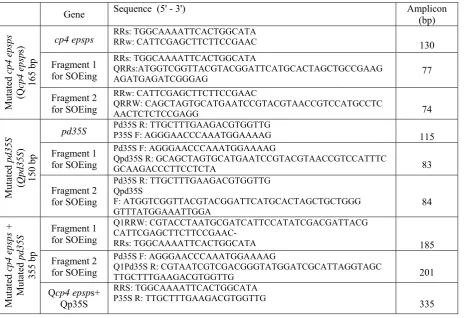
Table 1 lists five sets of primers designed for
.
this study. For amplification of the mutated form of cp4 epsps, PCR was carried out in a 25 μl volume containing a 1X PCR buffer, 1.5 mM MgCl2, a 2 mM dNTP mixture, a 0.5
unit Taq DNA polymerase, 20 ng template DNA, and 1 pmol of each primer (RRS/QRRS and RRw/QRRw), which were used individually in PCR I and II. Thermocycling conditions started with an initial denaturation step at 95 ºC for 5 min, followed by 35 additional cycles at 95 ºC for 1 min, an annealing temperature of 70 ºC for 1 min, and an extension at 72 ºC for 1 min. The PCR products were electrophoresed on a 1.5% agarose gel, and the DNA was purified using the DNA Extraction Kit (Bioneer). Two intermediate fragments of Qcp4 epsps for the mutated form of cp4 epsps were fused together by two-step SOE-PCR; in the first step, 56 ºC was established as the annealing
temperature for 15 cycles; in step two, SOE-PCR was continued by adding 1.5 pmol of RRs/RRw primers, which annealed at 62 ºC for another 30 cycles. The reaction was set up with 0.2 mM dNTP, 1 mM MgCl2, a 1X PCR
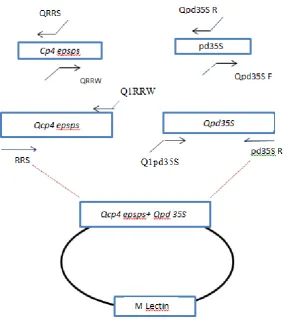
buffer, and a 1 unit Taq DNA polymerase. For the production of mutated pd35S, a polymerase chain reaction with pd35S F/Qpd35S R and pd35SR /Qpd35SF primers was performed. Two intermediates of Qpd35S were fused by SOE-PCR using pd35S F/pd35S R, as previously mentioned. After the separation of Qcp4 epsps and Qpd35S, inserting additional fragments at 5' cp4 epsps and Qpd35S, PCR was performed using Q1RRW-RRS and p35S F/Q1pd35S R primers, respectively. Finally, two fragments were amplified by RRS/Pd35S F primers (Fig. 1).
Table 1. Information of primers used in this study
Amplicon (bp) Sequence (5' - 3')
Gene 130 RRs: TGGCAAAATTCACTGGCATA RRw: CATTCGAGCTTCTTCCGAAC cp4 epsps M utate d cp4 eps ps (Q cp4 e ps p s) 165 b p 77 RRs: TGGCAAAATTCACTGGCATA QRRs:ATGGTCGGTTACGTACGGATTCATGCACTAGCTGCCGAAG AGATGAGATCGGGAG Fragment 1 for SOEing 74 RRw: CATTCGAGCTTCTTCCGAAC QRRW: CAGCTAGTGCATGAATCCGTACGTAACCGTCCATGCCTC AACTCTCTCCGAGG Fragment 2 for SOEing 115 Pd35S R: TTGCTTTGAAGACGTGGTTG
P35S F: AGGGAACCCAAATGGAAAAG pd35S M utate d pd35S ( Q pd35S ) 150 b p 83 Pd35S F: AGGGAACCCAAATGGAAAAG
Qpd35S R: GCAGCTAGTGCATGAATCCGTACGTAACCGTCCATTTC GCAAGACCCTTCCTCTA
Fragment 1 for SOEing
84 Pd35S R: TTGCTTTGAAGACGTGGTTG
Qpd35S F: ATGGTCGGTTACGTACGGATTCATGCACTAGCTGCTGGG GTTTATGGAAATTGGA Fragment 2 for SOEing 185 Q1RRW: CGTACCTAATGCGATCATTCCATATCGACGATTACG CATTCGAGCTTCTTCCGAAC- RRs: TGGCAAAATTCACTGGCATA Fragment 1 for SOEing M utate d cp4 e ps p s + M utate d pd35S 355 b p 201 Pd35S F: AGGGAACCCAAATGGAAAAG
Q1Pd35S R: CGTAATCGTCGACGGGTATGGATCGCATTAGGTAGC TTGCTTTGAAGACGTGGTTG
Fragment 2 for SOEing
335 RRS: TGGCAAAATTCACTGGCATA
P35S R: TTGCTTTGAAGACGTGGTTG Qcp4 epsps+
Figure 1. Schematic representation of the pGEM-Qcp4 epsps+ Qpd 35S. The construct contains the mutated cp4 epsps (Qcp4 epsps) and mutated pd 35S (Qpd 35S)
The PCR products were purified and inserted into the pGEM-T easy vector (Promega). The resulting plasmid with the two targets of RR soya was named PGEM-002, and after sequencing was used as an internal standard in QC-PCR. The copy number of the mutant plasmid was calculated based on the concentration of the plasmid using the DS Copy Number Analyzer online software found at www.uri.edu/research/gsc/ resources/ cndna.html and the plasmid was linearized by the scaI enzyme.
Calibration of QC-PCR for Two
Targets (
cp4 epsps
and
pd35S
)
It is important to calibrate the sensitive and
products were directly measured using an image program (http://rsb.info.nih.gov/ij) and the total lab and SAS (Statistical Analysis System, version 7.12; SAS, Cary, N.C.) software. The amplification products were separated by electrophoresis on 2% agarose gels and visualized by ethidium bromide staining.
Quantification of 1% GM Content
in a Food Sample for
cp4 epsps
and
pd35S
DNA extraction was performed for the five commercial food products. Next, QC-PCR for cp4 epsps using a calibrated plasmid of 1% RR soybean (68 pg) was applied. To accomplish the best optimization of this plasmid around the RR soybean food at the event level (GTS 40-3-2), the commercial samples were also checked with pd35S primers using the QC-PCR method.
Results
Construction of the Standard
Plasmid for QC-PCR
After amplification of the mutated forms of both target DNAs (cp4 epsps and pd35S), two large fragments were fused together. Standard DNA which was 355 bp in length - was made and inserted into the pGEM-T easy vector (Promega). The copy number of this standard plasmid was calculated based on the concentration of the plasmid as 5.4 x 10⁴
copies/µl.
Standardization of the Novel
Plasmid
Wecalibrated the plasmid for cp4 epsps relative to the DNA (500 ng) containing different proportions of GMO DNA (100, 50,
Progress in Biological Sciences
Figure 2. QC-PCR of cp4 epsps in target DNA in the presence of a competitor. Right: The QC-PCR products of different proportions of IRMM DNA (130 bp) and the fixed amount of the competitor (165 bp) separated on the 2% agarose gel. Lane M, 100 bp molecular ladder (Fermentas); lanes 1-7, in the same order: 100%, 50%, 25%, 5%, 5, 1%, 0.1%, and 0.5% GMO DNA; lane 8: pGEM TA easy vector as a positive control. Left: Calibration curve of cp4 epsps for 0.1% RR soya DNA based on the intensities of the DNA bands in the gel on the right.
Figure 3. QC-PCR of Pd35S in the target DNA in the presence of a competitor. Right: The QC-PCR products of the co-amplified different proportions of IRMM DNA (115 bp) and the fixed amount of the competitor (150 bp) separated on the 2% agarose gel. Lane M, 100 bp molecular ladder (Fermentas); lanes 1-7, in the same order: 0%, 0.1%, 1%, 5%, 25%, 50%, and 100% GMO DNA; lane 8: pGEM TA easy vector as a positive control. Left: Calibration curve of
Pd35S for 0.1% RR soya DNA based on intensities of DNA bands in the gel to the right.
Figure 4. Five commercial food samples were tested for the detection of cp4 epsps (A) and Pd35S (B) using a plasmid calibrated to 1% RR soy. A: Lane M, 100 bp molecular ladder (Fermentas); lane 1, 68 pg of pGEM-002 as a positive control (equal to 1% RR soya DNA); lane 2, souse soya sausage; lane 3, soya sausage; lane 4, soya flour; lane 5, soya sweet; lane 6, bean soy; lane 7, 1% IRMM. B: Lane M, 100 bp ladder (Fermentas); lane 1, 1% RR soya DNA (99 fg); lane 2, 1% RR soya DNA and internal standard (99 fg); lane 3, bean soy; lane 4, soya sweet; lane 5, soya flour; lane 6, soya sausage; lane 7, positive control.
Discussion
The aim of this study was the detection of RR soybean at the construct–specific and event-level in soybean-derived samples obtained in Iran. Although Iran is not currently a member
of the EU, it has adopted their biosafety and bioethics standards. We performed qualitative and quantitative testing of GMOs using detection methods with the assistance of a community reference laboratory.
165bp 130bp
165bp 130bp
150bp 115bp
The bulk of soybean foodstuffs in Iran are transgenic, so the labelling of seeds and RR foods is necessary. We performed RR soybean analysis in this study for five commercial Iranian foods. For the detection of specific GMOs, PCR methods are accepted as being reliable and the most sensitive (16). In this study, we used QC-PCR systems by designing a new plasmid for two targets of cp4 epsps (gene-specific) and pd35S (event-specific).
QC-PCR was first described in 1990
(18). Studer et al. (1998) used QC-PCR for
the detection and quantification of GMOs first (19), but we constructed the internal DNA standard with different primer sequences. These primers were designed for a part of cp4 epsps as a gene–specific and
pd35S as an event-specific of RR soybeans. Our protocol and plasmid can be used for labelling GMO in maize and soybean. The greatest advantage of designing this plasmid is that it can be used as a calibrator plasmid instead of as an IRMM genomic standard. Because this plasmid contains two transgenes that are most common in commercial transgenic foods, it can easily be used for the detection of multiplex transgenic foods.
Acknowledgement
1. Rodriguez –Lazaro, D., Lombard, B., Smith, B., Rzezutka, B., D'Agostino, M., Helmuth, R., Schroeter, A., Malorny, B., Miko, A., Guerra, B., Davison, J., Kobilinsky, A., Hernandez, M., Bertheau, Y. and Cook, Y. (2007) Trends in analytical methodology in food safety and quality: monitoring microorganisms and genetically modified. Trends. Food. Sci. Tech., 18, 306-319.
2. Dohare, A. and Tank. S K. (2014) Identification of Cry1Ac and Cry2Ab proteins in transgenic cotton seeds available in Gujarat (India) by ELISA method, J.E.B.A.S., 2, 43-48.
3. Holst-Jensen, A. (2009) Testing for genetically modified organisms (GMOs): Past, present and future perspectives. Biotechnol. Adv., 27:1071–1082.
4. Zel, J., Milavec, M., Morisset, D., Plan, D., Van den Eede, G., Gruden, K. (2012) How to Reliably Test for GMOs. 1st edition. New York: Springer.
5. Querci, M., Kleter, G., Malingreau, J.P. Broll, H., Van den Eede, G. (2008) Scientific and technical contribution to the development of an overall health strategy in the area of GMOs. Luxembourg: Office for Official Publications of the European Communities; EUR 23542 EN. 6. Holst-Jensen, A., Ronning, S.B., Lovseth, A., and Berdal, K.G. (2003) PCR technology for
screening and quantification of genetically modified organisms (GMOs). Anal. Bioanal. Chem.,
375: 985–993.
7. Mousavi, A. and Shakourinia, M.R. (2005) Global evaluation of commercialized transgenic crops. Modern. Genet., 3, 20-25.
8. Rabiei, M., Mehdizadeh, M., Rastegar, H., Vahidi, H. and Alebouyeh, M. (2013) Detection of Genetically Modified Maize in Processed Foods Sold Commercially in Iran by Qualitative PCR.
I.J.P.R., 12, 25-30
9. US Department of Agriculture, Economic Research Service (USDA ERS). (2009) Adoption of genetically engineered crops in the US [dataset], http://www.ers.usda.gov/Data/BiotechCrops/. 10. Duke, S.O. and Powles, S.B. (2009) Glyphosate-Resistant Crops and Weeds: Now and in the
Future. Ag.Bio.Forum., 2, 346-357.
11. Pietsch, K., Waiblinger H.U., Brodmann, P. and Wurz, A. (1997) Deutsche Lebensm Rundsch 93, Screaning methods for identification of genetically-modified food of plant origin, Deut. Lebensm-Rundsch., 93, 35-38.
12. Taverniers, I., Windels, P., Van Bockstaele, E. and De Loose, M. (2001) Use of cloned DNA fragments for event-specific quantification of genetically modified organisms in pure and mixed food products. Eur. Food. Res.Technol., 213, 417-424.
13. KELDA, Kernel Lot Distribution Assessment Project (2003). Joint Research Centre, European Commission, Ispra, Italy; http://biotech.jrc.it/kelda/login.asp.
14. Murray, H.G. and Thompson, W.F. (1980) Rapid isolation of high molecular weight DNA
.
Nucleic. Acids. Res., 8, 4321–4325.
16. Raeymaekers, L. (2000) Basic principles of quantitative PCR. Mol. Biotech., 15, 115-22.
17. Hadi, F., Salmanian, A.H., Mousavi, A., Ghazizadeh, E., Amani, J. and Akbari Noghani, K. (2012) Development of quantitative competitive PCR assay for determination both the copy number and expression level of synthetic glyphosate oxidoreductase gene in transgenic canola plants. E.J.B., 15(4), full text 5.
18. Gilliland, G., Perrin, S., Blanchard, K. and Bunn, H.F. (1990) Analysis of cytokine mRNA and DNA: detection and quantitation by competitive polymerase chain reaction. Proc. Nat. Acad. Sci., 87, 2725-2729.