IJE Transactions B: Applications Vol. 22, No. 2, August 2009 -
197
REDISTRIBUTION OF FIBERS IN THE STRUCTURE OF
HOLLOW RING SPUN YARN
A.R. Moghassem* and A.A. Gharehaghaji
Department of Textile Engineering, Isfahan University of Technology (IUT) P.O. Box 8415683111, Isfahan, Iran
[email protected] – [email protected]
*Corresponding Author
(Received: January 27, 2008 – Accepted in Revised Form: December 11, 2008)
Abstract Core yarn was spun by introducing a PVA multifilament as the core through the yarn forming zone of a ring spinning frame and viscose fibers as the sheath containing tracer fibers. The water soluble PVA multifilament was extracted from the yarn structure. Then internal structure and properties of the hollow ring yarn was assessed and compared with those of typical ring yarns. Also, two plain fabric samples with hollow and typical weft ring yarns were produced to investigate the effect of hollowness and fibers collapse on the structural parameters of the fabrics. Bending behavior and air permeability of these fabrics were consequently studied. The results showed the mean value of fiber spinning-in-coefficient (Kf) and strength of hollow and typical ring yarns were very close, but
elongation at break, unevenness and hairiness of hollow ring yarn is more than those of typical ring yarn. Results indicated that the bending rigidity and air permeability of the fabrics constructed from hollow ring weft yarn were improved due to the collapse of the fibers in the center of yarn and better flattening.
Keywords Hollow Ring Yarn, Spinning-in-Coefficient, Tracer Fiber Technique, Fiber Collapse, Bending Rigidity, Air Permeability
ﻜﭼ
ﻴ
ﻩﺪ
ﺰﻐﻣ ﺦﻧ ﻱﺬﻐﺗﺎﺑﺭﺍﺩ
ﻳﺔ ﺘﻟﻮﻣ ﻲ ﻓ ﻴ ﻠﭘﺖﻨﻣﻼ ﻲ ﻭﻳ ﻨﻴ ﻞ ﻞﻜﻟﺍ ﯼﺍﺮﺑ ﺰﻐﻣﺶﺨﺑ ﻱ ﻟﺍﻭ ﻴ
ﻭﻩﺎﺗﻮﻛ ﻑﺎ
ﻳ ﻞﻣﺎﺷ ﺯﻮﻜﺴ ﻟﺍﻴ ﺩﺭﻑﺎ ﻳﺑﺎ ﻲ ﻩﺪﻧﻮﺷ ﯼﺍﺮﺑ ﻭﺭﺶﺨﺑ ﻳ
ﺷﺎﻣﺭﺩﻪ
ﻴ ﺭﻦ ﻳ ﮔﺪﻨﺴ ﻲ ﺭ ﻳ ﺭﮓﻨ ﻳ ﺴ ﻴ ﺪﺷﻩﺪ . ﻠﭘ ﻲ ﻭﻳ ﻨﻴ ﻞ
ﺭﺍﺮﻗﺎﺑﻞﻜﻟﺍ
ﺘﺴﺑﻥﺩﺍﺩ
ﺔ ﺦﻧ
ﺰﻐﻣ ﺦﻧﺭﺎﺘﺧﺎﺳ ﺯﺍﻡﺮﮔ ﺏﺁ ﺭﺩ
ﻱ
ﺩﺮﮔﺝﺍﺮﺨﺘﺳﺍ ﺭﺍﺩ
ﻳﺪ
.
ﻠﺧﺍﺩ ﺭﺎﺘﺧﺎﺳ ﺲﭙﺳ
ﻲ
ﺻﻮﺼﺧﻭ
ﻴ
ﻟﺎﺧﻮﺗﺦﻧ ﺕﺎ
ﻲ ﺭ ﻳ ﮓﻨ
ﺻﻮﺼﺧﺎﺑﻭﻪﻌﻟﺎﻄﻣ
ﻴ
ﻠﺧﺍﺩﻥﺎﻤﺘﺧﺎﺳﻭﺕﺎ
ﻲ ﻟﻮﻤﻌﻣﺦﻧ ﻲ ﺭ ﻳ ﺎﻘﻣﮓﻨ ﻳ ﺪﺷﻪﺴ . ﺯﺍ ﻮﺳ ﻱ ﺩ ﻳ ﺮﮕ ﯼﺍﺮﺑ ﻌﻟﺎﻄﻣ ﺄﺗﺔ ﺛﻴ ﺩﻮﺟﻭﺮ
ﺧﺎﺳﺭﺩﻩﺮﻔﺣ
ﺭﻭﺦﻧﺭﺎﺘ
ﻳ
ﻟﺍﺵﺰ
ﻴ
ﻩﺭﺎﭘﺮﺑﻑﺎ
ﺍ ﻱ ﺮﺘﻣﺍﺭﺎﭘﺯﺍ ﺎﻫ ﻱ ﺭﺎﺘﺧﺎﺳ ﻱ ﭼﺭﺎﭘ ﺔ
ﺎﺑﻪﺘﻓﺎﺗﻪﭼﺭﺎﭘﻪﻧﻮﻤﻧﻭﺩ
ﻩﺩﺎﻔﺘﺳﺍ ﺦﻧﺯﺍ ﻟﻮﻤﻌﻣ ﻲ ﻟﺎﺧﻮﺗﻭ ﻲ ﺭ ﻳ ﻪﺑﮓﻨ
ﺪﺷﻪﺘﻓﺎﺑﺩﻮﭘﺦﻧﻥﺍﻮﻨﻋ
. ﺎﻬﻧ ﻳ ﺖ ﻪﻜﻧﺁ ﺸﻤﺧﺹﺍﻮﺧ ﻲ ﺬﭘﺫﻮﻔﻧﻭ ﻳﺮ ﻱ
ﻪﻧﻮﻤﻧﺭﺩﺍﻮﻫ
ﺎﻫ ﻱ
ﺪﺷ ﻪﻌﻟﺎﻄﻣﻪﭼﺭﺎﭘ
. ﺎﺘﻧ ﻳ ﻘﺤﺗﺞ ﻴ ﻳﺆﻣ ﻖ
ﺮﺿ ﻪﻛﺖﺳﺍﻥﺁﺪ
ﻳ
ﻟﺍﺖﻛﺭﺎﺸﻣﺐ
ﻴ ﻑﺎ
ﺦﻧﻥﺎﻤﺘﺧﺎﺳﺭﺩ
(Kf)
ﻭﺩﻡﺎﻜﺤﺘﺳﺍﻭ
ﺴﺑﺦﻧﻪﻧﻮﻤﻧ
ﻴ ﻪﺑﺭﺎ ﻳ ﺪﻜ ﻳ ﺩﺰﻧﺮﮕ ﻳ ﻚ ؛ﺖﺳﺍ ﻟ ﻴ ﺩﺯﺍﻦﻜ ﻳ
ﮔﺭﺎﭘﺪﺣﺎﺗﻝﻮﻃﺩﺎ
ﻲ ، ﺎﻧ ﻳ ﺘﺧﺍﻮﻨﻜ ﻲ ﮔﺩﻮﻟﺁﺯﺮﭘﻭ ﻲ ﻟﺎﺧﻮﺗﺦﻧ ﻲ ﺭﻳ ﺑﮓﻨ ﻴ ﺶ
ﻟﻮﻤﻌﻣ ﺦﻧﺭﺩﺮﺘﻣﺍﺭﺎﭘ ﻥﺎﻤﻫﺭﺍﺪﻘﻣﺯﺍ
ﻲ ﺭ ﻳ ﺖﺳﺍﮓﻨ . ﺯﺍ ﻮﺳ ﻱ ﺩ ﻳ ﺻﻮﺼﺧﺮﮕ ﻴ ﺸﻤﺧﺕﺎ ﻲ ﺬﭘﺫﻮﻔﻧ ﻭ ﻳﺮ ﻱ
ﭼﺭﺎﭘﺭﺩﺍﻮﻫ
ﺔ ﻪﺘﻓﺎﺑ
ﺗﺩﻮﭘﺦﻧﺯﺍﻩﺪﺷ
ﻟﺎﺧﻮ ﻲ ﻪﺑ ﻟﺩ ﻴ ﺭﻞ ﻳ ﻟﺍﺵﺰ ﻴ
ﺰﻛﺮﻣﺶﺨﺑﺭﺩﻑﺎ
ﻱ
ﻐﺗﻭﺦﻧ
ﻴﻴ
ﺿﺮﻋﻊﻄﻘﻣﺮ
ﻲ ﺩﺦﻧ ﺭ ﺎﻘﻣ ﻳ ﻪﺴ ﭼﺭﺎﭘﺎﺑ ﺔ ﻪﺘﻓﺎﺑ
ﻟﻮﻤﻌﻣﺩﻮﭘﺦﻧﺯﺍﻩﺪﺷ
ﻲ ﺭ ﻳ ﺩﻮﺒﻬﺑﮓﻨ ﻳ ﺖﺳﺍﻪﺘﻓﺎ . 1. INTRODUCTION
Core yarn production and study of the relationship between influencing parameters and yarn properties have been an issue of interest to researchers in recent years. In the production of core spun yarns, staple fibers and filament yarns are introduced together into the yarn forming zone. Sheath fibers and core component are selected individually and according to the desired properties or functions [1,2]. Core spun yarn combines positive
properties and pilling resistance. However this kind of fabric has disadvantages such as unevenness in dye absorption [5].
Core spun yarn was a suitable idea for producing the hollow yarn. In spinning of hollow yarn, a water soluble filament i.e. PVA (Poly Vinyl Alcohol) is used as core in the yarn central zone and staple fibers are wrapped around it. After dissolving the PVA core, a hollow space forms in the yarn center [6]. Research carried out by Merati, et al [6] shows that, although strength at break of hollow and typical friction yarn is the same, but elongation at break and diameter of hollow friction yarn is greater than those of typical friction yarns. It was reported that, the ellipticity ratio of cross section of hollow and typical friction yarn are 1.6 and 1.3 respectively. In addition, elastic recovery of hollow yarn after removing the lateral compressive force was higher than elastic recovery of typical friction yarn with the same count [7]. Hollow yarn production aims at decreasing fiber packing density, improving yarn thermal comfort, cover factor, smoothness, bulkiness and efficiency in weaving [6,7].
This research had a closer look at the effect of hollowness and fiber collapse in the central zone of the yarn, on the hollow yarn properties and structural properties of fabrics made from hollow yarns, such as bending behavior and air permeability. Since the majority of fabric properties depend on the volumetric density of the yarn in its construction, fiber orientation in the yarn structure and fiber compactness (packing density) in the yarn [8]; in this work the internal structure of hollow and typical ring yarn was studied by tracer fiber technique. The interactions between the yarn structure and fabric properties are discussed as well.
2. MATERIALS AND METHODS
In this study a viscose roving (staple length=38 mm, fiber fineness=1.5 den) was used as the sheath and PVA multifilament (60/18 den) was used as the core to produce a 29.5 (tex) hollow yarn on a ring spinning frame. Relevant modifications were applied for positive feeding of the filaments. In order to study the yarn internal structure by tracer fiber technique, dyed viscose fibers (0.4 %) were
blended with white ones before blowing machines. Spinning was carried out at a speed of 18.2 m/min to produce a 29.5 tex hollow and typical ring yarns while the twist was 680 tpm. The spindle speed was 12500 (rpm). The filament was fed under a constant and uniform tension into the yarn forming zone to form the core spun yarn with full coverage of the sheath fibers around the core. The core spun yarn was wound on a perforated bobbin in the loose form and then dipped in boiling water to extract the PVA filament. The samples were shaken in hot water for more efficient dissolution of the PVA component. Then the yarn bobbin was rinsed under running water and dried.
In this study two plain woven fabrics with 26 warp/cm and 22 weft/cm were woven on a Sulzer Ruti weaving machine. In the construction of these fabrics, warp yarns were single polyester-viscose (20 Ne) and weft yarns were from hollow ring yarn and typical ring yarn.
The structure of produced yarns was studied by the tracer fiber technique. The load-elongation characteristics of the yarns were examined with a Zwick tensile tester (CRE) according to ASTM D2256. The hairiness of the yarns was measured with Zweigle G565 hairiness tester. In this test 10 samples with 150 m length were examined. The yarn evenness was measured with Uster tester 4 with a test speed of 400 m/min for 2.5 min. The thickness and weight per unit area of 10 random samples of each fabric type were measured. Bending behavior of fabrics in warp and weft direction was tested by the cantilever test method according to ASTM D1388 (the dimensions of fabric samples were 200±1mm×25±1mm). The air permeability of samples was also examined by ASTM D737-96 test method. Cross section of spun yarns was prepared using a Microtome method and photos were taken by a CCD camera mounted on a Nikon microscope. Ellipticity of samples was calculated by measuring major and minor axis. Statistical analysis (paired t-test) was carried out to analyze the differences between the test results.
3. RESULTS AND DISCUSSION
IJE Transactions B: Applications Vol. 22, No. 2, August 2009 -
199
the study of the yarn internal structure. This table demonstrates the number of fibers observed in each of the mean fiber spinning-in-coefficient classes and the spinning-in-coefficient of yarn samples.
The first study on the yarn internal structure was carried out by Belicin and Paysakhov in 1942. Morton introduced the tracer fiber technique for the first time to study the fiber migration in the ring yarn [8]. Later Kasparek and Rinding used this technique for studying the internal structure of rotor spun yarns [9]. Kasparek classified fiber shape and shape factor in yarn structure into 10 different classes and calculated the spinning-in-coefficient [9]. According to kasparek method, the spinning-in-coefficient (Kf) of yarns are different.
This coefficient was determined to be 0.76, 0.67 and 0.51 for combed cotton, carded cotton and rotor spun yarns respectively [9].
The best form of fiber arrangement in the yarn structure results when the fibers lay parallel along the yarn axis and contribute to the yarn strength by their full length. Therefore fibers must be straight, without folds and parallel to each other. In such a yarn, fiber extent in yarn structure is very high. In practice, this arrangement of fibers is difficult to achieve. Few fibers are near straight and parallel to the yarn axis while others have distorted forms (such as folded, wrapped and hooked shapes) [10-11]. In the ring yarn structure, the fiber helix angle decreases from surface towards the inner layers. On the other hand, fiber helical path is different and is longer for outer layers; therefore, fiber tension varies from surface to central zone [11]. As Table 1 shows, the typical ring yarn has the most straight and parallel fibers in its structure with respect to the yarn axis. The results of the study on the internal structure of both yarns show that the number of fibers with high kf is more than that in
low kf classes. Despite the difference in the
number of fibers in each fiber spinning-in coefficient class in both yarns, the calculated mean fiber spinning-in coefficient of yarns are very close together.
As already mentioned, after dissolving the PVA filament from the core, a hollow space is created in the central zone of the yarn. As a consequence, yarn structure may collapse and fiber arrangement and configuration may be affected if the yarn experiences mechanical forces. Since the fibers
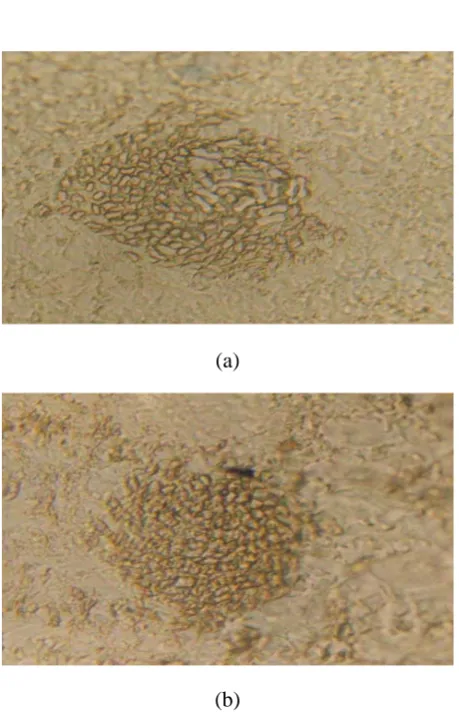
tend to migrate towards the central zone of yarn layers with minimum latent energy, this hollow space provides a chance for the fibers in the vicinity of the hollow space to migrate and stress relaxation occurs after collapse of the fibers. Tension in the yarn core decreases when PVA is extracted. In the loose structure of hollow ring yarn (Figure 1), fiber movement in the yarn layers is easier and fiber shape undergoes deformation after this movement.
The PVA extraction from the core yarn structure was determined by the following Equation 1 to assess the efficiency of treatment:
Em = TC.Y–TH.Y (1)
Where Em is the material extracted from the yarn
core in boiling water, TC.Y is the tex of the core
yarn (before extracting) and TH.Y is the tex of the
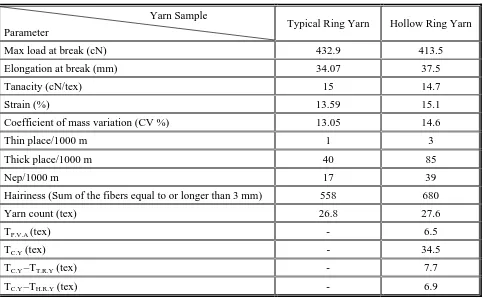
hollow yarn (after extracting) [6]. It was found that the extraction of PVA filament from the yarn core was nearly complete (Table 2). A paired t-test showed that, there was no significant difference between typical and hollow ring yarn counts in the 95% level of significance.
The result of various tests on the hollow and typical ring yarn is shown in Table 2. The findings indicate that, while the breaking elongation of hollow ring yarn is greater than that of typical ring yarn, the tenacity remains almost the same. Statistical study on the results confirms a significant difference between breaking elongation of typical and hollow ring yarns, but there is no significant difference between the strength of hollow and typical ring yarns. Although, there are more straight fibers (class 1,2) in the structure of typical ring yarn, the overall kf value was nearly
under tensile loading. Higher compaction and contraction of hollow ring yarn under tensile load, is accompanied by higher fiber entangling and hence higher breaking elongation. It should be noted that a typical ring yarn has more straight fibers that are parallel to the yarn axis and fewer folded or hooked fibers. In other words, the fiber orientation in typical yarn is better than that of hollow ring yarn which makes the yarn less extensible under tensile loading. The coefficient of mass variation of yarn samples was examined in order to investigate the effect of hollowness and fiber collapse on the yarn evenness. While the uniformity of these yarns differs, thin place and nep remains the same for both yarns. Also, thick place of hollow ring yarn is more than that of typical ring yarn. Statistical tests in 95% level of significance show no meaningful differences in the thin place and nep of these yarns. Spinning processes and fiber characteristics affect yarn evenness. Processes required for preparing hollow ring yarn, such as winding and filament extraction, can affect the regularity of the yarn. Another reason would be the presence of un-dissolved PVA component (very low) in hollow yarn which in return caused lower uniformity. Un-dissolved PVA is probably distributed along the yarn length and in the Uster tester these spots may be recorded as thick places so the coefficient of variation and yarn faults shows an increase in the hollow ring yarn. However, the first reason is more dominant than the later.
Table 2 shows the number of protruding fibers having a length of 3mm or more (S3). According to
this table, the typical ring yarn has less protruding fibers. Fiber orientation along the yarn axis and fiber migration towards the inner layers have a controlling effect on hairiness. Fiber characteristics and machine parameters also affect the hairiness of yarn. Increasing fiber cohesion and friction increases the likelihood of fibers staying in the inner layers of the yarn structure. Differences in the yarn hairiness may be due to differences in fibers migration behavior and the loose structure of hollow ring yarn (fiber movement is easier in the central yarn layers after dissolving the PVA). As stated earlier, typical ring yarns have lower hairiness value in comparison with the hollow ring yarns. These yarns posses the most number of straight fibers parallel to the yarn axis in the inner
TABLE 1. The Results of Tracer Fiber Technique Tests on the Hollow and Typical Ring Yarn.
No. of Fibers in
Hollow Ring Yarn No. of Fibers
in Typical Ring Yarn Mean Fiber
Spinning-in Coefficient in the
Given Class (kfi)
5 70 367 268 68 39 1 23 28 45
188 273 200 63 55 19 16 10 0.95
0.9 0.8 0.63
0.4 0.2 0.08 0.02 0
0.653 0.683
Fiber Spinning-in Coefficient of
Yarn (KF)
(a)
(b)
IJE Transactions B: Applications Vol. 22, No. 2, August 2009 -
201
layers and rarely protrude from the yarn surface. In the hollow yarn, fibers collapse when PVA is extracted from the yarn center which leads to the changes in fiber arrangement and orientation. So, the amount of straight fibers decreases and the number of folded and hooked fibers increases. Such fibers may protrude from the yarn surface due to the loose structure of the yarn and result in yarn hairiness. In typical ring yarns, fiber movement and migration happens in the spinning triangle but could continue after yarn production due to the strain energy in fibers, when the fibers pass through the convergence point. In these yarns, fibers migrate from the surface to the core and return to the surface. Therefore, fiber migration behavior in typical ring yarn is different from hollow ring yarn. Better fiber orientation and enhanced structure of the typical ring yarn resulted in a lower hairiness in comparison with hollow ring yarn. The production process may also affect the yarn hairiness. Yarn winding on a perforated
bobbin and yarn abrasion due to the movement on the metal surface may be other causes of increased hairiness in hollow yarns.
3.2. Study of Fabric Properties
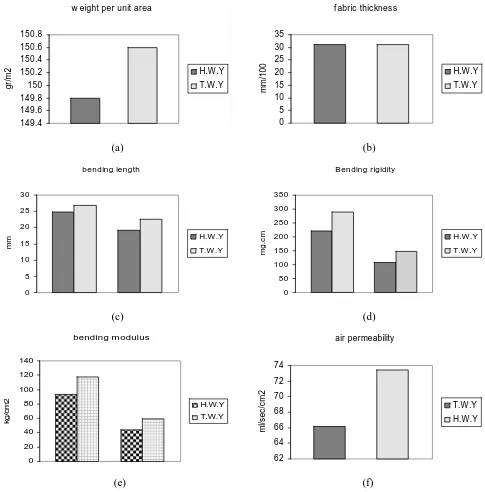
3.2.1. Bending behavior of woven fabrics Fabric samples were cut along the warp and weft direction from the fabrics manufactured with hollow and typical ring yarns as mentioned in the experimental part. Figures 2a-2f shows the weight per unit area, thickness, bending parameters and air permeability of woven fabric samples. The abbreviations (T.W.Y) and (H.W.Y) are used throughout the text to stand for woven fabric with typical weft yarn and woven fabric with hollow weft yarn respectively. The difference between the weight per unit area and thickness of fabrics made from typical and hollow ring weft yarns was not statistically significant, which again confirms the nearly complete extraction of PVA. According to
TABLE 2. Results of the Study on the Properties of Yarn Samples.
Yarn Sample
Parameter Typical Ring Yarn Hollow Ring Yarn
Max load at break (cN) 432.9 413.5
Elongation at break (mm) 34.07 37.5
Tanacity (cN/tex) 15 14.7
Strain (%) 13.59 15.1
Coefficient of mass variation (CV %) 13.05 14.6
Thin place/1000 m 1 3
Thick place/1000 m 40 85
Nep/1000 m 17 39
Hairiness (Sum of the fibers equal to or longer than 3 mm) 558 680
Yarn count (tex) 26.8 27.6
TP.V.A (tex) - 6.5
TC.Y (tex) - 34.5
TC.Y–TT.R.Y (tex) - 7.7
Figures 2d-2e bending rigidity and bending modulus of samples made from hollow weft yarn are minimum in both warp and weft directions.
The statistical tests on bending length in warp
and weft directions show that there is no significant difference between bending length of fabrics in warp direction, but the difference between bending length of fabrics is meaningful in the weft direction.
w eight per unit area
149.4 149.6 149.8 150 150.2 150.4 150.6 150.8
gr
/m
2 H.W.Y
T.W.Y
f abric thic knes s
0 5 10 15 20 25 30 35
mm
/1
0
0
H.W.Y
T.W.Y
(a) (b)
bending length
0 5 10 15 20 25 30
mm
H.W.Y
T.W .Y
Bending rigidity
0 50 100 150 200 250 300 350
mg
.c
m H.W.Y
T.W .Y
(c) (d)
bending m odulus
0 20 40 60 80 100 120 140
k
g
/c
m
2 H.W.Y
T.W.Y
air permeability
62 64 66 68 70 72 74
m
l/s
ec
/c
m2
T.W.Y
H.W.Y
(e) (f)
Figure 2. parameters of the fabric samples related to their bending behaviour and air-permeability (a) weight per unit area, (b) fabric thickness, (c) bending length, (d) bending rigidity,
IJE Transactions B: Applications Vol. 22, No. 2, August 2009 -
203
Analysis of mean bending length shows, with 95 % confidence, that the difference between bending rigidity and bending modulus of these fabrics are meaningful in both warp and weft directions. Many factors that affect comfort in fabrics depend on the ability of the constituent yarns to withstand compressive deformation. Regardless of fiber type, spun yarn structure appears to provide superior resistance to compression in apparel fabrics. One of the most important features in the bending of woven fabrics is the bending resistance of the thread lying in the direction of bending. Another factor is the frictional resistance. In bending of fabrics, the fibers in a yarn pass through under pressure and intersection regions [8]. Hence for bending, fibers must slip individually through each other. The relationship between fabric bending rigidity and yarn bending rigidity is highly complex. Yarn bending behavior is determined by the mechanical properties of constituent fibers and the structure of the yarn. The warp yarns used in 10 samples had the same characteristics and weave pattern. The same pattern was used in all fabrics, so the difference in bending parameters is due to weft yarn structure which affects the fabric structure and properties. In the sample fabric made from hollow weft yarn, weft yarns have an empty space in the center. This empty space together with loose structure of the yarn could increase the fiber movement and slippage during bending. This leads to the freedom of movement of fibers in the internal structure of yarns. The diameter of hollow yarn is more than that of typical yarn but yarn contraction and deformation is higher under compressive stresses in a lateral direction due to the hollow structure. This means that, the collapse of fibers affects the bending behavior and has a dominant effect. Finally, in hollow yarn, the cross sectional shape is elliptical (Figure 1) and study on the distribution of fibers in the cross section of the yarn by microtomy shows that in hollow yarn the rate of ellipticity was 1.2-1.3. So, in hollow yarn the difference between minor and major axis of cross section is considerably higher. Ellipticity was calculated by measuring and dividing major axis of the hollow yarn cross section by its minor axis after taking a photo. This can explain why the bending rigidity of fabric made from hollow weft yarn is less than that of fabric made from typical
weft yarn. In typical ring yarns, most of the fibers are straight and parallel to the yarn axis and the free space between the fibers is low which leads to a dense structure of yarn and a higher fiber packing density. All of the said parameters increase the bending rigidity of typical ring yarns.
3.2.2. Air permeability Air permeability is an important factor for textiles that are used as filter and air bag. Finishing treatment applied on the fabric, yarn twist, yarn structure, fibers packing density and fabric thickness are some of the factors that affect the air permeability in fabrics. Figure 2f shows the results of study on the air permeability of two fabric samples. According to this figure, air permeability increases from fabric made of typical ring weft yarn to the fabric made from hollow weft yarn. Statistical tests confirm the difference between air permeability of fabrics with a 95% confidence level.
In this study, hollow yarn was found to have a loose structure and low fiber packing density, so there are more empty spaces between the fibers. The loose structure of yarn and empty space between fibers are suitable passage for air streams. Air passes through these voids quickly and air permeability was found to increase in this fabric. In typical ring yarn, fibers have dense packing, therefore air streams cannot pass through the fabric easily.
4. CONCLUSION
After creating a hollow space in the central zone of ring yarn, fiber collapse was observed and the internal structure of ring spun yarn was studied. Study on the efficiency of extraction of PVA filament from core yarn structure indicated that, PVA filament had been almost completely extracted from the yarn body. The spinning-in-coefficient (Kf)
hollow yarn than with typical ring yarn. There was no significant difference between thin places and nep of these yarns. Typical ring yarn had lower hairiness. Ellipticity ratio of hollow yarn cross section was higher than typical ring yarn. Study on the properties of fabrics made from these yarns showed that woven fabric with hollow weft yarn had lower bending length, lower rigidity and lower bending modulus in both warp and weft directions. In hollow yarn fabric, air permeability was higher than air permeability of typical ring yarn fabric due to the loose structure and lower fiber packing density of hollow ring yarn.
5. ACKNOWLEDGEMENTS
The authors wish to thank Isfahan University of Technology for their financial support and for providing experimental facilities.
6. REFERENCES
1. Jeddi, A.A., Johari, M.S. and Merati, A.A., “A Study on the Structural and Physical Properties of Cotton-Covered Nylon Filament Core Spun Yarns”, J. Text. Inst., Vol. 88, No. 1, (1997), 12-20.
2. Merati, A., Konda, A., Okamura, M. and Marui, E., “Filament Pre-Tension in Core Yarn Friction Spinning”,
Text. Res. J., Vol. 68, No. 4, (1998), 254-264.
3. Robert, J., Harper, J. R., George, F. and Ruppenicker, J. R., “Woven Fabrics Prepared from High Tenacity Cotton/Polyester Core Yarn”, Text. Res. J., Vol. 57, No. 3, (1987), 147-154.
4. Ruppernicker, G.F., Harper, R.J., Sawhney, A.P. and Robert, K.Q., “Comparison of Cotton/Polyester Core and Staple Blend Yarns and Fabrics”, Text. Res. J., Vol. 59, No. 1, (1989), 12-16.
5. Sawhney, A.P.S., Ruppernicker, G.F. and Robert, K.Q., “Cotton Covered Nylon-Core Yarn and Greige Fabrics”,
Text. Res. J., Vol. 59, No. 4, (1989), 185-190.
6. Merati, A.A. and Okamura, M., “Hollow Yarn in Friction Spinning, Part 1: Tensile Properties of Hollow Yarn”,
Text. Res. J., Vol. 70, No. 12, (2000), 1070-1076.
7. Merati, A.A. and Okamura, M., “Hollow Yarn in Friction Spinning, Part 2: Yarn Structure and Deformation under Axial Tension and Lateral Forces”, Text. Res. J., Vol. 71, No. 5, (2001), 454-458.
8. Grosberg, P., “The Mechnical Properties of Woven Fabrics, Part II: The Bending of Woven Fabrics”, Text.
Res. J., Vol. 36, No. 3, (1966), 205-211.
9. Rohlena, V., “Open-End Spinning”, Elsevier Scientific
Publishing Company, Oxford, (1975), 214-244.
10. Morton, W.E., “The Arangement of Fibers in Single Yarn”, Text. Res. J., Vol. XXVI, No. 5, (1956), 325-331.
11. Hearle, J.W.S., Gupta, B.S. and Merchant, V.B., “Migration of Fibers in Yarns, Part 1: Charactetization and Idealization of Migration Behavior”, Text. Res. J., April, (1965), 329-334.
12. Peak, S.L., “Effect of Yarn Type and Twist Factor on Air Permeability, Absorbency and Hand Properties of Open-End and Ring Spun Yarn Fabrics”, J. Text. Inst., Vol. 86, No. 4, (1995), 581-589.