Original Article
Evaluation of Bond Strength of Pressed and Layered Veneering Ceramics to
Nickel-Chromium Alloy
Mitra Farzin a, Amir Alireza Khaledi b, Behnam Malekpour c, Mohammad Hassan Naseri d
a
Dept.of Prosthodontic, School of Dentistry, Shiraz University of Medical Sciences, Shiraz, Iran.
b Biomaterial Research Center, Dept. of Prosthodontic, School of Dentistry, Shiraz University of Medical Sciences, Shiraz, Iran. c
Postgraduate Student, Dept. of Orthodontic, School of Dentistry, Shiraz University of Medical Sciences, Shiraz, Iran.
dDental Student, Student Research Committee, Dept. of Prosthodontic, School of Dentistry, Shiraz University of Medical Sciences,
Shiraz, Iran.
KEY WORDS
Metal;
Bond;
Pressable porcelain;
Layering porcelain
Received June 2014;
Received in revised form July 2014; Accepted September 2014;
ABSTRACT
Statement of the Problem: The success of metal- ceramic- restorations (MCR) de-pends on the presence of strong bond between porcelain and metal substructure.
Purpose: The purpose of this study was to evaluate the effect of hot pressing tech-nique on the bond strength of a metal-porcelain composite in comparison to layering technique.
Materials and Method: Thirty Nickel-Chromium specimens were produced by two methods; conventional porcelain layering on metal and hot pressing (n=15). Bond
strengths of all specimens were assessed by the means of three–point bending test according to ISO 9693: 1999 (E) instructions. The data were analyzed using Students
t-test (p< 0.001).
Results: The mean ± SD bond strength of conventional and hot pressing technique was 48.29 ± 6.02 and 56.52 ± 4.97, respectively. Therefore, the conventional layer-ing technique yielded significantly lower mean bond strength values than hot
press-ing technique (p< 0.001).
Conclusion: This study showed that it is possible to improve metal–porcelain bond strength significantly by applying an overpressure during porcelain firing.
Corresponding Author: Khaledi AAR., Biomaterial Research Center, Dept. of Prosthodontic, Shiraz University of Medical Sciences, School of Dentistry, Shiraz, Iran. Tel: +98-71-36263193-4
Email: [email protected]
Cite this article as: Farzin M., Khaledi AAR., Malekpour B., Naseri MH. Evaluation of Bond Strength of Pressed and Layered Veneering Ceramics to Nickel-Chromium Alloy. J Dent Shiraz Univ Med Sci., 2015 September; 16(3 Suppl): 230-236.
Introduction
Metal ceramic restorations are used extensively in
den-tal prosthetics. [1-2] In these restorations, aesthetic qual-ities of the ceramic materials can be used in
combina-tion with the strength and toughness of metal alloys to produce restorations that have both aesthetic and proper
mechanical features. [3-7] Various types of alloys have been introduced for the metal ceramic restorations.
No-bel alloys containing primarily gold palladium and a small percentage of indium have proven to be the most
reliable ones. However, the major shortcoming of these alloys is their high cost and their lack of adaptability
with various systems of ceramic. The alloys that are
used as the base metal, enjoy certain desirable features such as low cost, increased strength, toughness, and
greater resistance to distortion.However, they some-times reveal additional oxide formations, prove difficult
to finish and polish since they have a low ductility and exhibit a greater casting shrinkage. [8]
The presence of a strong bond between porcelain and metal substructure determines the success of the
metal-ceramic restoration (M-CR). [9] It is also believed that the adhesion mechanism which exists between
met-al and porcelain is a micromechanicmet-al bond, which is compatible with the coefficient of thermal expansion
Table 1: The features and manufacturers of the used metal alloy
Brand name Composition Manufacturer 0.2 yield point (N/mm2)
Melting interval
Coefficient of thermal expansion (CTE)
N E-Bond Ni,Cr,Mo Si,Fe Schutz Rosbach/Germany 550 1260-1350°C 14.1×10 k-1
dation and ion interdiffusion between metal and
porce-lain. [10-13]
Extensive studies have been carried out on the
metal-porcelain bond. [14] Some effects were studied including firing cycle and temperature, [15-16] thermal
and/or mechanical cycling, [17-18] cooling rate, [19] opaque layer thickness, [20] metal conditioners,
adhe-sives. [21-22] However, the existence of various testing methods has limited the investigators’ ability in
compar-ing the results of various M-C bond strengths. There-fore, although multiple mechanical tests have been
car-ried out over the last two and a half decades, the more recent Schickerath three-point flexure test that has been
standardized by the ISO FDIS 9693: 1999 (E) is now considered the gold standard for testing metal ceramic
bond strength. [23]
Two methods are available for the application of
porcelain on the metal core. The first method is the technique of layering. According to this traditional
technique, first, opaque porcelain is applied on the core then dentin and enamel porcelains are used. [24] The
second method is the technique of pressing. Following this technique, a complete contour wax up is applied on
a core and a sprue is attached to it. The wax is eliminat-ed in an oven and ceramics are presseliminat-ed to the core under
high temperatures. [25-26]
Comparative studies have been carried out on the
bond strength of pressed ceramic to metal versus fusing feldspthic porcelain to metal by Venkatachalam et al.
[26] and Schweitzer et al. [27] Although the pressable ceramic they used was indicated for all- ceramic
restora-tions and not for metal- ceramic ones, they found no differences between the two techniques for the tested
alloys. Unlike the mentioned studies, however, signifi-cant differences in metal-ceramic bond strength were
experienced by some researchers [28-29] between hot
pressing and traditional porcelain fusing to studied
al-loys.
According to the author´s knowledge, there was
no published research regarding the comparison of porcelain application methods on bond strength of
porcelains to nickel– chromium (Ni-Cr) alloys. There-fore, the current study aimed at measuring and
compar-ing the bond strength of ceramics which were pressed or layered to a Ni-Cr alloy. The null hypothesis of the
study was that the two mentioned techniques are equiva-lent in the bond strength.
Materials and Method
In this experimental study, pressed ceramic to core ma-terials was selected as the experimental groups, and
layer ceramics to the core materials was defined as the control groups (n = 15 per each group).
The features, composition, and the manufacturer of the materials which were used in this study are summarized
in Table 1 and 2.
The preparation of specimen was performed
with-in two stages; metal strip fabrication and ceramic ve-neering. In order to obtain Ni-Cr strips, stainless dies
(25±1mm×3±0.1mm×0.5±0.05mm) were embedded in hard silicon rubber in accordance with ANSI/ADA
specification NO.38 and ISO NO. 9693: 1999 (E) Uniform thickness of molds was obtained as the result
of pressing glass slide over the silicone material and die. The molds were filled with duralay acrylic resin (Pattern
Resin; GC America, Alsip, IL) after removing the dies. Afterwards, rectangular acrylic templates were sprued
and invested into phosphate bonded investment (Fu-jivest II; GC America, Alsip, IL) and then preheated
according to the manufacturer's recommendation. Each alloy was casted by using natural gas and oxygen torch
in a centrifugal casting machine (Multicast; DeguDent
Table 2: The features and manufacturers of the used porcelains
Brand name Composition Manufacturer Flexural strength (biaxial) [MPa]
Firing or Press tem-perature [°C]
CTE (100-500°C) [10-6/K] IPS InLine (conventional
metal-ceramic) Feldspatic
porcelain Ivoclar Vivadent
80 900-930 13.2
IPS InLine (press-on-metal
Hanau, Germany). After casting process, all molds were
bench cooled. Carbide discs were used at low speed to remove sprues and separate metallic strips. Then, the
metal strips were divested and cleaned by using air-borne-particle abrasion. The surface of the specimens
which would receive the ceramic was air borne-particle abraded once more by using 150-µm aluminum oxide
particles at an angle of 45◦ for 10 seconds from nearly 2 centimeter distant and under pressure of 2 bars. The
metal strips were cleaned by using a steam cleaner de-vice, and were dried at the temperature of the room.
Finally, the oxidation process was performed according to the instructions of the manufacturer. By using a
graphite pencil, an area of 8×3 mm was marked on the metal strips and then the veneering ceramics were fired
on the metal frames (Figure 1).
Figure 1: Final shape and dimensions of the Ceramic-Alloy specimen
Proceeding to the process of veneering ceramics, the first and second opaque firings were performed for
each group by applying the respective opaque following the manufacturer’s instruction.
Rectangular wax patterns (Prowax; Ivoclar, Viva-dent, Liechtenstein) with approximately height of 1mm
were fabricated on the opaque surface for the hot-pressed group. The sprues were attached to the top of
the wax patterns and then the specimens were invested within the pressing ring and the lost wax technique was
performed and ceramic ingots (Ivoclar, Vivadent, Liech-tenstein) were pressed into the mold in the furnace
(EP5000; Ivoclar, Vivadent, Liechtenstein) according to the manufacturer's instructions. For the layering group,
a thin layer of the dentin porcelain was used in order to cover the opaque surface and was fired in the furnace in
an oven (Vacumat 40; Vita Zahnfabrik, Bad Säckingen, Germany). Subsequently, the dentin porcelain was
ap-plied and fired twice. To maintain a uniform rectangular form for metal and veneer, excess ceramic was adjusted
using a sintered diamond rotary instrument (Brasseler USA; Savannah, USA) and then the thickness was
checked by digital dental caliper. After finishing the specimens, glaze firing was performed for all
speci-mens. Afterward, three-point bending test was
conduct-ed on the specimens in a universal testing machine (model SS81, Instron) at a cross head speed of 1
mm/min. The bond strength ( ) in MPa was deter-mined by the following equation: δ = k × F(fail)
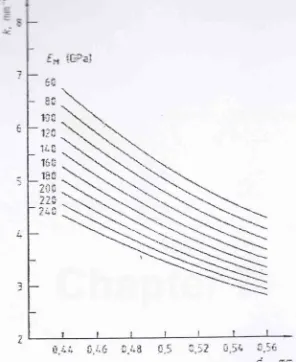
The coefficient K is a function of the thickness of the metal strip and the value of Young's modulus of the
alloy which was derived from the diagram shown in the ISO 9693: 1999(E) (Figure 2). Statistical analysis was
performed using SPSS 17. Students t- test was used to compare the mean tensile bond strength of the two
groups.
Figure 2: Diagram to determine the coefficient K as a func-tion of metal substrate thickness dm and young's modulus EM
of the metallic materiel.
Results
Table 3 summarizes the tensile bond strength records for the two groups as mean±SD, minimum and
maxi-mum. The result (P-Value) of student´s t-test is also reported is this table. The result indicated that the
con-ventional layering technique produced significantly lower mean bond strength measures (48.29 ± 6.02) than
hot pressing technique (56.52 ± 4.97) (p< 0.001).
Table 3: The results of tensile bond strength measurement by three- point bending
Mean ± SD Minimum Maximum p-value Layered 48.29±6.02 35.70 60.26
<0.001 Pressed 56.52±4.97 48.76 68.54
Total 52.41±6.85 35.70 68.54
Discussion
The current study measured the effectiveness of the
basis of the findings of this study, the null hypothesis is
rejected and the results indicated that metal ceramic bond strength is affected by veneering technique.
How-ever, the bond strength of the control and the experi-mental specimens ranged above 25 MPa, which is the
minimum value determined in ISO 9693. [23]
Mechanical tests such as three- or four-point
bending tests, biaxial flexural test, and shear test could be applied to compare or measure the bond strength
between the ceramic and metal. [29-33] Studies which applied the shear test with different methods and various
types of alloys revealed results ranging from 15 to 97 MPa. [3, 31-34] Since there is the lack of a universal
methodology for measuring of the bond strength of metal porcelain systems, this range of variation is
enor-mous. Therefore, the three-point flexure bond test sug-gested by the ISO guidelines as an international
stand-ard was employed for this study. If at least four out of six specimens have a debonding strength of more than
25 MPa, metal-ceramic systems enjoy enough qualifica-tion to pass ISO 9693. [23]
For complete fixed dental prostheses, metal-ceramic restorations have been a preferred restoration
because of their long-term clinical use. [1-2, 35] In or-der to establish an optimum esthetic outcome, veneering
ceramics are classically layered on metal or zirconia core materials. [36-37] One possible technique is to
press veneering ceramics to the core materials. Alt-hough the pressing technique itself is not considered as
a recent technology, a process for pressing ceramics to metal and zirconia cores using the lost-wax technique
and glass-ceramic ingots has been recently developed. [38]
The layering technique has been the principle method of the application of the veneering ceramics to
the core materials. The layer is usually over built as a compensatory strategy to deal with condensation and
firing shrinkage. In general, this technique requires good dexterity and multiple applications and firings. The
fail-ure rate caused by fractfail-ure and exfoliation of porcelain is 59.1% of the whole clinical failures despite the
great-er longevity of PFM restorations compared to all-ceramic restorations. [1-2, 5] Therefore, there still is
some work to do in the increasing of metal–porcelain bond. The pressing technique, suggests that a complete
contour anatomical waxing is performed on a core, and
subsequently, a sprue is attached to the wax and the
wax-core complex invested. The wax is cleaned up in an oven and ceramics are heat-pressed into the mold and
to the core; thereby, reproducing the anatomy created in the wax and allowing for the creation of the desired
tooth anatomy. Moreover, the firing shrinkage experi-enced with the layering technique is minimized,
result-ing in a better fit of the porcelain margins to the abut-ments. Since there is a support from the investment,
distortion of the metal may be reduced during veneer-ing. [24-25, 38] Also hot pressing encourages a full
contact between metal and porcelain, enhancing the diffusion of the elements in the metal–porcelain
interac-tion zone and resulting in an extremely good chemical bonding without any residual porosity and cracks. [39]
In this study, pairs of pressable and layering ce-ramics from the same manufacturer were selected to
reduce the variables. Hence, the metal ceramic speci-mens in both groups had similar procedures performed
in terms of the process of opaque application. However, application of veneering ceramics was done either by
pressing or layering.
Similar to our research and due to an increased
presence of uniformly distributed leucite phase, some studies have employed low-fusing, leucite-based
press-able ceramics to metals. [26-27] These ceramics provide some advantages such as high compressive strengths
and high flexural strength over traditional porcelains, due to an increased presence of uniformly distributed
leucite phase. [39] The desired shape of the specimens for pressed ones was obtained with a single pressing
procedure. However, in the process of layering speci-mens three applications and firings were used and
sub-sequently adjustments were needed to achieve the defin-itive shape for bond strength testing. This was due to the
firing shrinkage of the layering procedure, but this is adequately representative of the clinical practice for
generating the restorations. A set of different factors, such as material composition and properties, firing
tem-peratures, cooling rates, operator’s skill, porosities, and fabrication process might have an effect on the quality
and strength of the bond between the core and the ve-neering materials.
The result of current study is consistent with the findings of the investigations carried out by Henriques
the bond strength of pressed and layered ceramics to
noble alloys. In contrast to our study, Venkatachalam et al. [26] and Schweitzer et al. [27] found no significant
differences between the two techniques. This disagree-ment could be attributed to the difference between the
metal and also the porcelain materials that have been used in their study and our research. In our study, the
veneering porcelains were selected from the same man-ufacturer in order to reduce the study variables as much
as possible. Therefore, not only CTEs of both porcelains were compatible with metal substructure(less than
1×10 ) but also opaque material and also its applica-tion method was the same for both groups. Moreover,
they could not ascertain the effect that additional steps of divestment and sprue removal had on the debond
strength values of pressed ceramic samples character-ized by larger standard deviations (SD). Another
signif-icant aspect to consider in their studies was the CTE mismatch between pressed ceramic and metal, which
was greater than 3×10 ◦C. It is recognized that CTEs differences of 1.7×10 ◦C or greater between metal and
porcelain could cause shear stresses at the interface which could result in a weak metal–ceramic bond or to
its ultimate failure. To assure that porcelain is under compression at the interface, the metal’s CTE should be
slightly higher than of the porcelain, but, perfectly their mismatch should not be greater than 1×10 ◦C. [5, 7,
13] However in our study the tested metal and porcelain materials were compatible in regard to CTE. [39]
In the future, studies evaluating the bond strength with different combinations of metals and veneering
materials, and also the effect of mechanical and thermal cycling protocols are suggested. Furthermore, various
types of methodologies to assess the bond strength might be deliberated.
Conclusion
Within the limitation of this in vitro study, it may be concluded that the tested metal-ceramic composites
reveal sufficient bond strength for optimum clinical performance of the restorations. The bond strength of
metals to porcelains could be improved by hot pressing technique.
Acknowledgement
The authors would like to thank the Biomaterial Resear-
ch Center at Shiraz University of Medical Sciences for
providing financial support (grants: 6287).This manu-script relevant thesis of Dr. Mohammad Hasan Naseri
and Dr. Behnam Malekpour.
The authors also thank Dr. Vossoughi of the
tal Research Development Center, of the School of Den-tistry for the statistical analysis.
Conflict of Interest
No conflict of interest.
References
[1] De Backer H, Van Maele G, De Moor N, Van den Berghe L. Long-term results of short-span versus
long-span fixed dental prostheses: an up to 20-year retrospec-tive study. Int J Prosthodont. 2008; 21: 75-85.
[2] Walton TR. An up to 15-year longitudinal study of 515 metal-ceramic FPDs: Part 1. Outcome. Int J Prosthodont.
2002; 15: 439-445.
[3] Joias RM, Tango RN, Junho de Araujo JE, Junho de
Araujo MA, Ferreira Anzaloni Saavedra Gde S, Paes-Junior TJ, et al. Shear bond strength of a ceramic to
Co-Cr alloys. J Prosthet Dent. 2008; 99: 54-59.
[4] Fischer J, Zbären C, Stawarczyk B, Hämmerle CH. The
effect of thermal cycling on metal-ceramic bond strength. J Dent. 2009; 37: 549-553.
[5] Bagby M, Marshall SJ, Marshall GW Jr. Metal ceramic compatibility: a review of the literature. J Prosthet Dent.
1990; 63: 21-25.
[6] Pretti M, Hilgert E, Bottino MA, Avelar RP. Evaluation
of the shear bond strength of the union between two CoCr-alloys and a dental ceramic. J Appl Oral Sci. 2004;
12: 280-284.
[7] Raigrodski AJ. Contemporary materials and technologies
for all-ceramic fixed partial dentures: a review of the lit-erature. J Prosthet Dent. 2004; 92: 557-562.
[8] Phillips RW. Skinner's science of dental materials. 9th ed. Philadelphia: WB Saunders Co; 1991. p. 72.
[9] Giordano RA. Dental ceramic restorative systems. Com-pend Contin Educ Dent. 1996; 17: 779-782.
[10]Jacobson TE, Chang JC, Keri PP, Watanabe LG. Bond strength of 4-META acrylic resin denture base to cobalt
chromium alloy. J Prosthet Dent. 1988; 60: 570-576. [11]Almog DM, Ganddini MR. Maxillary and mandibular
2006; 72: 32-35.
[12]DeHoff PH, Anusavice KJ, Hojjatie B. Thermal
incom-patibility analysis of metal-ceramic systems based on flexural displacement data. J Biomed Mater Res. 1998;
41: 614-623.
[13]American Dental Association. Porcelain-metal alloy
compatibility: criteria and test methods. Council on Den-tal Materials, Instruments, and Equipment. J Am Dent
Assoc. 1981; 102: 71-72.
[14]Al Amri MD, Hammad IA. Shear bond strength of two
forms of opaque porcelain to the metal substructure. King Saud Univ J Dent Scien. 2012; 3: 41-48.
[15]de Vasconcellos LG, Buso L, Lombardo GH, Souza RO, Nogueira L Jr, Bottino MA, et al. Opaque layer firing
temperature and aging effect on the flexural strength of ceramic fused to cobalt-chromium alloy. J Prosthodont.
2010; 19: 471-477.
[16]Tróia MG Jr, Henriques GE, Nóbilo MA, Mesquita MF.
The effect of thermal cycling on the bond strength of low-fusing porcelain to commercially pure titanium and
titanium-aluminium-vanadium alloy. Dent Mater. 2003; 19: 790-796.
[17]Shimoe S, Tanoue N, Yanagida H, Atsuta M, Koizumi H, Matsumura H. Comparative strength of metal-ceramic
and metal-composite bonds after extended thermocy-cling. J Oral Rehabil. 2004; 31: 689-694.
[18]Vásquez VZ, Ozcan M, Kimpara ET. Evaluation of inter-face characterization and adhesion of glass ceramics to
commercially pure titanium and gold alloy after thermal- and mechanical-loading. Dent Mater 2009; 25: 221-31.
[19]Guinn JW 3rd, Griswold WH, Vermilyea SG. The effect of cooling rate on the apparent bond strength of
porce-lain-metal couples. J Prosthet Dent. 1982; 48: 551-554. [20]Barghi N, Lorenzana RE. Optimum thickness of opaque
and body porcelain. J Prosthet Dent. 1982; 48: 429-431. [21]Goharian R, Maleknejad F, Salari T, Ghavamnasiri M,
Derhami M. Effect of adhesives on bond strength of porcelain veneer to base metal alloy. Quintessence Int.
2002; 33: 595-599.
[22]Ozcan M, Valandro L. Effect of silane coupling agents
and alloy primers on adhesion to titanium. Minerva Sto-matol. 2011; 60: 427-434.
[23]ISO 9693:1999(en): Metal-ceramic dental restorative systems. Available at: https://www.iso.org/obp/ui/#iso:
std:iso :9693:ed-2:v1:en
[24]Goldin EB, Boyd NW 3rd, Goldstein GR, Hittelman EL,
Thompson VP. Marginal fit of leucite-glass pressable ce-ramic restorations and cece-ramic-pressed-to-metal
restora-tions. J Prosthet Dent. 2005; 93: 143-147.
[25]Holden JE, Goldstein GR, Hittelman EL, Clark EA.
Co-mparison of the marginal fit of pressable ceramic to metal ceramic restorations. J Prosthodont. 2009; 18: 645-648.
[26]Venkatachalam B, Goldstein GR, Pines MS, Hittelman EL. Ceramic pressed to metal versus feldspathic
porce-lain fused to metal: a comparative study of bond strength. Int J Prosthodont. 2009; 22: 94-100.
[27]Schweitzer DM, Goldstein GR, Ricci JL, Silva NR, Hit-telman EL. Comparison of bond strength of a pressed
ce-ramic fused to metal versus feldspathic porcelain fused to metal. J Prosthodont. 2005; 14: 239-247.
[28]Henriques B, Faria S, Soares D, Silva FS. Hot pressing effect on the shear bond strength of dental porcelain to
CoCrMoSi alloy substrates with different surface treat-ments. Materials Science & Engineering C. 2013; 33: 557–563.
[29]Henriques B, Gonçalves S, Soares D, Silva FS. Shear
bond strength comparison between conventional porce-lain fused to metal and new functionally graded dental
restorations after thermal-mechanical cycling. J Mech Behav Biomed Mater. 2012; 13: 194-205.
[30]Vojdani M, Shaghaghian S, Khaledi A, Adibi S. The effect of thermal and mechanical cycling on bond
strength of a ceramic to nickel-chromium (Ni-Cr) and cobalt-chromium (Co-Cr) alloys. Indian J Dent Res.
2012; 23: 509-513.
[31]Carter JM, Al-Mudafar J, Sorensen SE. Adherence of a
nickel-chromium alloy and porcelain. J Prosthet Dent. 1979; 41: 167-172.
[32]Suansuwan N, Swain MV. New approach for evaluating metal-porcelain interfacial bonding. Int J Prosthodont.
1999; 12: 547-552.
[33]de Melo RM, Travassos AC, Neisser MP. Shear bond
strengths of a ceramic system to alternative metal alloys. J Prosthet Dent. 2005; 93: 64-69.
[34]do Prado RA, Panzeri H, Fernandes Neto AJ, das Neves FD, da Silva MR, Mendonça G. Shear bond strength of
dental porcelains to nickel-chromium alloys. Braz Dent J. 2005; 16: 202-206 .
[35]Coornaert J, Adriaens P, De Boever J. Long-term clinical study of porcelain-fused-to-gold restorations. J Prosthet
Dent. 1984; 51: 338-342.
Dent. 1972; 28: 209-214.
[37]McPhee ER. Hot-pressed porcelain process for
porcelain-fused-to-metal restorations. J Prosthet Dent. 1975; 33: 577-581.
[38]Ishibe M, Raigrodski AJ, Flinn BD, Chung KH, Spiek-erman C, Winter RR. Shear bond strengths of pressed
and layered veneering ceramics to high-noble alloy and zirconia cores. J Prosthet Dent. 2011; 106: 29-37.
[39]Henriques B, Soares D, Silva FS. Shear bond strength of a hot pressed Au-Pd-Pt alloy-porcelain dental composite.
J Mech Behav Biomed Mater. 2011; 4: 1718-1726. [40]Optimization of bond strength between gold alloy and
porcelain through a composite interlayer obtained by powder metallurgy. Available at: http://www.dem.
umi-nho.pt/People/fsamuel/project2010/pastpub_Fatih/%5BA %5D.pdf