
13.4 Petrochemicals
5
0
0
Full text
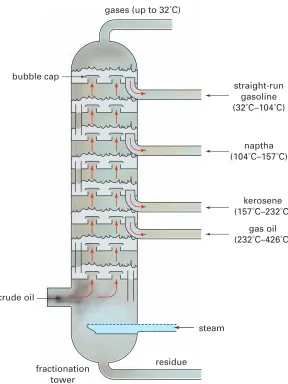
(2) Using Properties to Separate Petroleum Components Fractional distillation is a process for separating petroleum into its hydrocarbon components. This process relies on a physical property— boiling point. Each of the hydrocarbon components, called fractions, has its own range of boiling points. At an oil refinery, the separating (refining) of petroleum begins in a large furnace. The furnace vaporizes the liquid components. The fluid mixture then enters a large fractionation tower. Figure 13.35 outlines how the various hydrocarbon fractions are separated in the tower. (Note: The temperatures shown are approximate boiling points for the hydrocarbon fractions.) gases (up to 32˚C). bubble cap straight-run gasoline (32˚C–104˚C). naptha (104˚C–157˚C). Web. LINK. www.school.mcgrawhill.ca/ resources/ Canada’s land mass has experienced dynamic changes over tens of millions of years. Climatic conditions, along with the deposition of countless remains of organisms, created the areas in which petroleum is found today. These areas are called sedimentary basins. Where are the sedimentary basins? Are they all active sites for oil and gas extraction? How much oil and gas do scientists estimate there is? How do Canada’s reserves compare with those of other petroleumproducing nations? Go to the web site above to “tap” into Canada’s and the world’s petroleum resources. Go to Science Resources, then to Chemistry 11 to find out where to go next. Decide on a suitable format in which to record your findings.. kerosene (157˚C–232˚C) gas oil (232˚C–426˚C). Figure 13.35 This diagram shows how petroleum is separated into its hydrocarbon fractions. Each fraction has a different range of boiling points. The tower separates the fractions by a repeated process of heating, evaporating, cooling, and condensing.. crude oil steam. fractionation tower. residue. Perforated plates, which are fitted with bubble caps, are placed at various levels in the tower. As each fraction reaches a plate where the temperature is just below its boiling point, it condenses and liquefies. The liquid fractions are taken from the tower by pipes. Other fractions that are still vapours continue to pass up through the plates to higher levels. Several plates are needed to collect each fraction. Heavier hydrocarbons (larger molecules) have higher boiling points. They condense first and are removed in the lower sections of the tower. The lighter hydrocarbons, with lower boiling points, reach the higher levels of the tower before they are separated.. Chapter 13 The Chemistry of Hydrocarbons • MHR. 569.
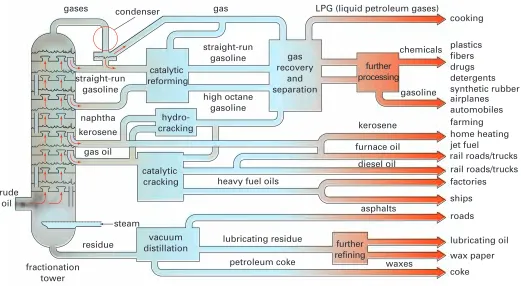
(3) Cracking and Reforming Once the fractions are removed from the distillation tower, they may be chemically processed or purified further to make them marketable. (See Figure 13.36.) There has been a tremendous increase in the demand for a variety of petroleum products in the early twentieth century. This demand has forced the oil industry to develop new techniques to increase the yield from each barrel of oil. These techniques are called cracking and reforming. Petroleum Fractionation Products gases. gas. condenser. LPG (liquid petroleum gases) cooking. straight-run gasoline straight-run gasoline naphtha kerosene. catalytic reforming high octane gasoline. chemicals. gas recovery and separation. further processing gasoline. hydrocracking. kerosene furnace oil. gas oil catalytic cracking. diesel oil heavy fuel oils. crude oil. plastics fibers drugs detergents synthetic rubber airplanes automobiles farming home heating jet fuel rail roads/trucks rail roads/trucks factories ships. asphalts steam residue. vacuum distillation. lubricating residue. Figure 13.36. lubricating oil. further refining. petroleum coke. fractionation tower. roads. waxes. wax paper coke. Selected uses of petroleum fractions. Cracking was first introduced in Sarnia, Ontario. This process uses heat to break larger hydrocarbon molecules into smaller gasoline molecules. Cracking is done in the absence of air and can produce different types of hydrocarbons. For example, the cracking of propane can produce methane and ethene, as well as propene and hydrogen. (See Figure 13.37.) Electronic Learning Partner. The Chemistry 11 Electronic Learning Partner has an animation that illustrates how a fractionation tower works.. 500˚C–700˚C. +. 2 CH3CH2CH3. CH4. propane. methane. Figure 13.37. 570 MHR • Unit 5 Hydrocarbons and Energy. CH2 ethene. CH2 + CH3CH propene. CH2 + H2 hydrogen. This chemical equation summarizes the cracking of propane..
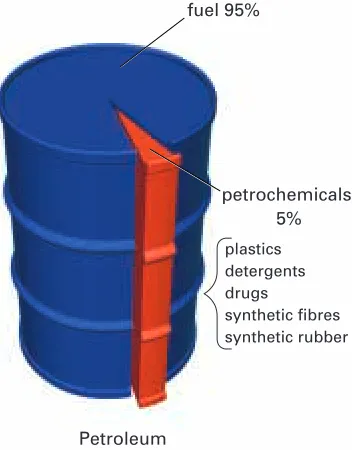
(4) Reforming is another technique that uses heat, pressure, and catalysts to convert large hydrocarbons into other compounds. Reforming can produce larger hydrocarbons or a different type of hydrocarbon, called aromatic compounds. (See Figure 13.38.) Aromatic compounds contain special ring structures. You will learn about them in a later chemistry course.. Language. LINK. What is a catalyst? Use reference books to find out.. Cracking Larger Hydrocarbon. Heat Smaller Hydrocarbon. + Smaller Hydrocarbon. Catalyst. Reforming Heat, Pressure Smaller Hydrocarbon. + Smaller Hydrocarbon Catalyst. Figure 13.38. Larger Hydrocarbon. Comparing cracking and reforming. Some of the products of the refining process are transported to petrochemical plants. These plants convert complex hydrocarbons, such as naphtha, into simple chemical compounds, or a small number of compounds, for further processing by other industries. Canadian petrochemical plants produce chemicals such as methanol, ethylene, propylene, styrene, butadiene, butylene, toluene, and xylene. These chemicals are used as building blocks in the production of other finished products. Nearly every room in your school, your home, and your favourite shopping centre contains, or is made from, at least one petrochemical product. Yet, as you can see in Figure 13.39, petrochemicals represent only a small fraction of society’s uses of petroleum. In the next chapter, you will discover why hydrocarbons are so highly valued as fuels. As well, you will unravel the mystery of how so much energy can be locked up inside a hydrocarbon molecule.. fuel 95%. petrochemicals 5% plastics detergents drugs synthetic fibres synthetic rubber. Petroleum. Section Wrap-up In this section, you learned that petrochemicals, an essential part of our society and technology, are obtained from petroleum. You discovered how petroleum is separated into its components by fractional distillation, cracking, and reforming. In this chapter, you learned a great deal about hydrocarbons. You learned how hydrocarbons are formed in section 13.1. In sections 13.2 and 13.3, you learned to draw, classify, and name different hydrocarbons. Finally, you learned about the practical side of hydrocarbons — how they are produced and used in everyday life.. A tremendous number of petrochemical products enrich your life. Yet they still make up only about 5% of what is produced from a barrel of crude oil. A staggering 95% of all petroleum is used as fuel. Figure 13.39. Chapter 13 The Chemistry of Hydrocarbons • MHR. 571.
(5) Careers. in Chemistry manipulate these polymers in various ways. Polymer chemists have invented an amazing array of materials. These include polyvinyl chloride (used to make garden hose and duct tape), polyurethane (used to stuff teddy bears and make spandex bicycle pants), and acrylonitrilebutadiene-styrene, or ABS (used to make brakes and other auto body parts).. Polymer Chemist. Bulletproof vests used to be heavy, bulky, and uncomfortable. Stephanie Kwolek changed that. Now police officers, police dogs, and soldiers, can wear light, strong bulletproof vests made of a synthetic fibre called Kevlar™. Kwolek (shown above) developed Kevlar™ while working for the DuPont chemical company. Kevlar™ first came into general use in 1971. It is five times stronger than steel, gram for gram, but almost as light as nylon. It is flame resistant, resists wear and tear, and does not conduct electricity. This versatile material is used not only in bulletproof vests, but also in other manufactured items, including hockey helmets, firefighters’ suits, spacecraft shells, and surgeons’ gloves. Kwoluk’s branch of organic chemistry—polymer chemistry—specializes in creating synthetic materials that are cheaper, faster, and stronger than natural materials. Polymer chemists often work by stringing together thousands of atoms to form long molecules called polymers. Then they. Make Career Connections What kind of education do polymer chemists need for their jobs? • Find out about polymer chemistry programs that are offered by a university near you. • Research different companies that employ polymer chemists. If possible, interview a polymer chemist who is employed by one of these companies.. Section Review Unit Project Prep. Before you choose a product to investigate for the end-ofunit Project, consider what you have learned about petrochemical products. What compound is used to produce most plastics, and thus almost all products’ packaging?. 1 (a). (b). K/U What physical property allows various fractions of crude oil to be separated in a fractionation tower?. What is this process of separation called? Briefly describe it. Include a diagram in your answer if you wish. C. 2. Our society’s demand for petroleum products has increased dramatically over the last century. Describe two techniques that can be used to transform the petroleum fractions from a fractionation tower, in order to meet this demand.. 3. MC List five types of petrochemicals that can be produced from refined hydrocarbons. Describe briefly how each type has affected your life.. 4. MC Petrochemicals are not always helpful. Do research and prepare a presentation illustrating the effects of petrochemicals on the environment.. MC. 572 MHR • Unit 5 Hydrocarbons and Energy.
(6)
Figure
Related documents
Nada hay más extraño que aplicar un dispositivo analítico a un fenómeno sintético: por ejemplo, escribir en inglés sobre un poeta ruso. Sin embargo, en el caso de
A simple, rugged, and reliable method using solid-liquid extraction followed by Captiva EMR—Lipid cartridge cleanup was developed and validated for the multiresidue analysis of
Teoria geopolitică a lui Haushofer este axată pe relaţia "organică" ce ar exista între teritoriu şi populaţia care îl locuieşte, teorie aplicată mai întâi la
In actual fact, if the thinking matter of the brain is the same matter, then thought (observed not in its narrow gnoseological aspect but in terms of its place and role among
In this work, we studied how the Artificial Neural Network model IGMN, based on incremental Gaussian Mixture Models, could be adapted and improved to solve spatial
A pivot point is a price level of significance in technical analysis of a financial market that is used by traders as a predictive indicator of market movement.. A pivot point
• Aromatic compounds in which the hydroxyl group is attached directly to the carbon atom of the aromatic ring.. • Compounds are named as derivatives of benzenol in presence of
We examined whether women responded more strongly than men to images of women and/ or babies relative to their responses to other images on 4 measures assessing commonly
