Volume 5, Issue 4, 2018, pp. 151-162 Available online at www.jallr.com ISSN: 2376-760X
* Correspondence: Samer Mahmoud Al-Zoubi, Email: samerlzb yahoo.com © 2018 Journal of Applied Linguistics and Language Research
The Impact of Exposure to English Language on Language
Acquisition
Samer Mahmoud Al-Zoubi *
Assistant Professor, Ajloun National University, Jordan
Abstract
The main purpose of this study is to investigate the impact of exposure to English language on language acquisition. The participants of this study were 42 EFL students chosen randomly from the Department of English Language and Literature at Ajloun National University, Jordan. The students were given five sets of Likert scale type of questionnaire as the instrument of this study that consisted of 22 items. The results yielded the following results: Firstly, there was a strong impact of exposure to English language on language acquisition as the overall means was high reached (3.72). Secondly, there is a statistically significant correlation between exposure to language and developing the four language skills since the p value is (0.228), which is greater than the significant level (p>0.05). Finally, the researcher recommended that students should be continually exposed to the English language through watching English movies and program, surfing the internet, listening to radio, reading English books ,magazines ,newspapers, and practicing English language with native speakers on a daily basis to encourage them overcoming their weaknesses and improving their fluency as well as proficiency in acquiring English language. Moreover, teachers and parents should raise learners’ awareness towards the importance of learning English language through exposure to the language daily using different techniques that can enhance second language acquisition.
Keywords: language acquisition, language exposure, language skills
INTRODUCTION
particularly for those who learn a language as their second or foreign language. Considering the importance of English language, the Ministry of Education in Jordan has outlined English as a foreign language that should be acquired by the students. It has received more attentiveness in Jordan especially in the educational field. Generally, basic education at the elementary level in Jordan consists of a series of ten years of continuous teaching. Secondary education comes after this ten-year period for two years. Although secondary education, which typically starts at age 16, is not compulsory, it includes a two-year track of sequential study in which students can join either academic or vocational programs. When this two-year educational program ends, students can take a general secondary certificate examination, also known as the Tawjihi, according to their track of specialty .The students who complete the test with a passing score are granted a special certificate .As soon as students complete this full educational system, they are qualified to obtain admission to universities. (English General Guides and curricula for Secondary Stage, MOE, 1993)
However, exposure to language can be defined as the contact that the learners have with the target language that they are attempting to learn .Inside the classroom, one of the most central roles of the teacher is to provide learners with sufficient exposure to practice the target language in a variety of contexts, and from different speakers. As a qualified speaker of the language, the teachers can give practical examples of language, moreover they can apply natural input from television, cassettes,, video, web sites, books, and magazines. Mainly, language exposure in general, refers to contact outside the classroom. Benson (2001) defined outside-of-class language exposure term as, “any kind of learning that takes place outside the classroom and involves self-instruction, naturalistic learning or self-directed naturalistic learning. ” The forms of outside classroom language exposure can include: listening to English programme on the radio, watching English programme and movies on the television, traveling to English speaking countries, talking face to face with English native speakers (L2 interaction), using English language in real life situations, surfing the internet using English language as well as, reading English books, magazines, and newspapers.
It is believed that learning English language needs to be encouraged and developed in the classroom and out the classroom through appropriate techniques. Such techniques help students become better able to improve their English language and to express themselves in the target language. Nevertheless, in teaching English language to learners, the researcher is not talking about writing stories or plays, which require creative gifts and powers of imagination, to judge that the learners are really weak in English language. Educators simply look forward to enabling their students to express themselves in simple correct and acceptable level of English through exposure to English language.
inside the classroom but if they do not get the chance to practice it outside the classroom they will not learn it appropriately. It should be emphasized that exposure can directly improve a target language so that language proficiency may be a result of social interaction with speakers of the target language. (Peregoy & Boyle, 2005). Nevertheless, an insufficient exposure to the target language can be influenced by the learner's anxiety and self-efficacy, mainly in speaking and writing. For instance, a learner studying in a country where English is spoken as a first language has a lot of exposure consequently, more chances to acquire the language. As an experienced speaker of the language, the teacher can supply learners with practical models of language, and can also use natural input from CDs, television, video, web sites, magazines, and books.
Exposure to English language is something learners run into in their everyday life. Interest and motivation are essential factors when it comes to language learning, but one should distinguish between reward and work when bringing different types of media in the classroom. Learners recognize when they are being taught when they are at school, and they may concentrate on what the teacher is presenting. But when they sit on their computers at home, watching a film or playing a game, they might learn words and phrases and use them in real life situations. This is called incidental learning (d’Ydewalle, G., & De Bruycker, W., 2007). Thus, formal classroom learning is one way to perform and learn a new language skills, although multitudes of opportunities for learning a new language can be presented outside of the classroom. Multimedia (Internet, social media, television, radio, Video games), group work and projects may assist learners to develop the target language appropriately.
Generally speaking, students’ weakness in learning English language has its roots in the method of teaching, lack of motivation, the teacher, practice and interest and in the curriculum design. Though, in spite of Jordan’s high profile global image and continual appearance in national and international contexts, little research has been conducted or published on exposure to English language and language acquisition.
For most Jordanian students who do not get enough exposure to authentic English speaking environment or chances to interact using English, they could only learn to improve in classes through intensive training. Many learners have studied English at schools but they did not use it outside the classroom. They have many problems in learning English language because they do not have the courage to speak in English confidently.
THIS STUDY
The present study is significant because it aims to provide evidence on the positive relationship between exposure to English language and language acquisition and its relationship to language skills. Moreover, it intends to concentrate on other studies where outside classroom activities are assessed with reference to their possible relationship with in-class performance. Additionally, it provides information for further research on exposure to English language and language acquisition.
To what extent does exposure to English language affect language acquisition? What is the relationship between exposure to English language and developing the
four language skills? LITERATURE REVIEW
To assess the relationship between exposure to English language and language acquisition, the current review begins with examining the studies focused on exposure to English language and language acquisition. Thus, exposure to L1 plays a major role in second or foreign language (L2) learning. Politzer (1965) revealed that all immigrants arriving the United States learn to speak English language since they continue exposing themselves to English language environment. If learners are exposed to the L2 in the same way as they are exposed to the L1, better accomplishment will be attained. This happens due to the natural L2 learning situation, the difficulty is to acquire the IL to manage the environment is certainly remarkable.
development more rapidly than children .Secondly, older children acquire second language quicker than younger children .Thirdly, learners who start natural exposure to second language throughout their childhood normally accomplish higher second language proficiency than those who beginning as adults.
Briere (1978) carried out a study among Native Mexican children learning Spanish as second language. It was concluded that the children who got the highest marks on the test of Spanish were those whose community was the contiguous to a Spanish-speaking community. Apparently, this study showed that boys who usually spent most of the time with their parents are likely to be more fluent in speaking Spanish. Therefore, the finding shows that the function of language contact in determining the success of second language learning. Basically, second language learners learning the target language in the target language community are at the benefits of being significantly exposed to the language while a large number of second language learners learning the target language outside the target language community are not.
Chandrasegaran (1979), conducted a study among Malay learners who learn English as second language. She found a strong relationship between the extent of exposure to English and proficiency in acquiring English language. The assumption was that urban learners, by living in an environment where the chance for practicing English was more available, experienced wider contact with English accordingly became more proficient in the target language. Moreover, she concluded that urban learners were better at English than rural learners. She eliminated the factor of quality of teaching in rural schools as being lower because government schools followed the same curriculum and the teachers have similar qualifications. As well as, urban learners were more motivated towards learning English language than rural learners. In conclusion, the principal hypothesis here is that learners' relative proficiency in their two languages is in some sense a function of the amount of language to which they are exposed in those languages. Moreover, the acquisition of the first language occurs in the long period of cognitive and physical development and of socialization.
The language is acquired in the context of the community of the speakers. In highlighting the significance of exposure in the first language acquisition, Steinberg (1982) claimed that learners who are exposed to language generally through overhearing adults, watching television or by conversation do not attain enough language knowledge due to the nature of the environment and speech input which learners receive to assist target language learning. However, additional exposure to the language, particularly at levels in which the speech has to be mainly modified to the learners' level of understanding, will essentially lead to more regular usages of definite words and language structure.
language is composed. Considerably, he does not argue that L2 learners should learn TL by hearing the language only. Nevertheless, the two methods should be united, as pedagogical rules were appropriately successful when applied in process with a number of helpful exemplars of their application.
In her article, Lambine's (2008) entitled with “English just isn't a foreign language anymore”, she clarified that the more exposure to the language the children can get outside the school the more they learn the target language. Generally, learners in their last three years in school (at ages 16-19) were asked to respond to the statement “I consider English to be more like my second mother tongue than my first foreign language”. The learners generally agreed to this, distinguishing it from other foreign languages they had begun to learn afterward stage.
To find out learner’s exposure to low frequency words through watching movies, Webb (2010) investigated the scripts of 143 movies. The results showed that there is not adequate exposure to make certain learning unless learners keep a normal habit of watching movies for a long time. In the course of long exposure to movies, it is probable for learners to acquire the low frequency words under the condition that they recognize the most frequent 3,000 word families.
Simultaneously, Ghaderpanahi 's (2012) study regarding using films alone as a form of language exposure to facilitate English language learning. He considered that the impact of movie watching couldn't be more effective than communicative activities, which involves more learner participation and interaction.
To sum up, the previous studies have provided evidence on how exposure to English language has positive effects on language acquisition. However, language acquisition is crucial to fluency in a second / foreign language acquisition that can be useful and helpful learning environment through exposure to target language. These studies have confirmed that a variety of forms of media can be constructive for the ESL/EFL students´ language development. Many researchers have discovered how media may work as a tool for second language acquisition learning. However, the results of many studies showed that language acquisition could be speeded by explicit teaching such as that typically practiced in school. Therefore, chatting with native speakers, watching English programs, listening to English programmes and songs, practicing English through using social media and surfing information on the internet can all contribute to expose learners to English language because a massive amount is communicated in English.
METHOD
Participants
Instrument
To investigate the impact of exposure to English language on language acquisition at Ajloun National University, a questionnaire was developed. To validate the questionnaire, a jury of specialists in EFL, applied linguistics, from the Department of English Language and Literature at Ajloun National University were asked to examine it, and provided their comments and suggestions. All their suggestions were taken into consideration when producing the final form of the questionnaire. The students were given five sets of Likert scale type of questionnaire. These included ‘Strongly Agree’, ‘agree’, ‘I don’t know, ‘disagree’, and ‘strongly disagree’. This questionnaire was divided into two parts: The first part concerned with the impact of exposure to English language on language acquisition included 13 items. While the second part focused on the impact of exposure to English language on developing the four language skills contained 9 items. The questionnaires were distributed to the students in class. The researcher stayed in the classroom, while the subjects respond to the questionnaires, to answer to any questions that the students may have regarding the questionnaire. After the students had completed the questionnaires, the researcher collected all answered questionnaires to be analyzed.
RESULTS
For data analysis of the questionnaire, the researcher used the following scale: The item with the means of between (1 - 2.33) is rated Low. The item with the means of between (2.34 - 3.67) is rated Moderate. The item with the means of between (3.68-5) is rated High.
Results Related to the First Question
To what extent does exposure to English language affect language acquisition?
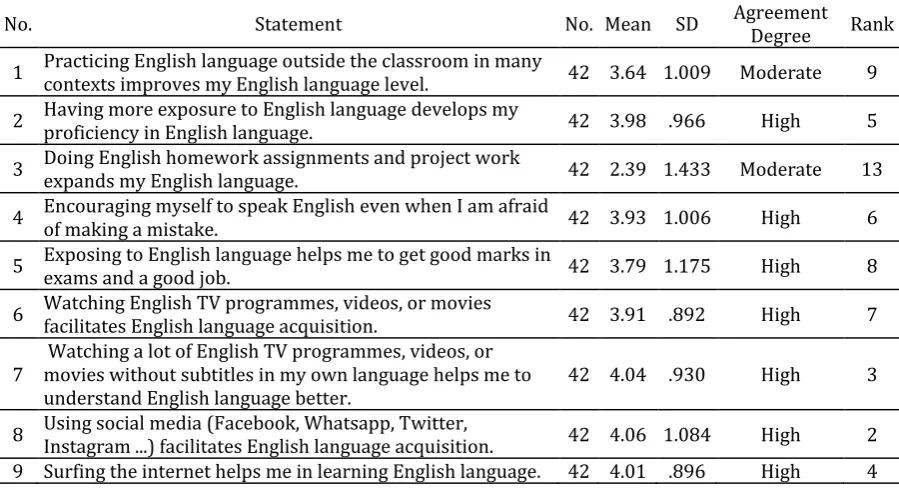
Table 1. Means, standard deviation, agreement degree and rank of exposure to English language and language acquisition
No. Statement No. Mean SD Agreement Degree Rank
1 Practicing English language outside the classroom in many contexts improves my English language level. 42 3.64 1.009 Moderate 9 2 Having more exposure to English language develops my proficiency in English language. 42 3.98 .966 High 5 3 Doing English homework assignments and project work expands my English language. 42 2.39 1.433 Moderate 13 4 Encouraging myself to speak English even when I am afraid of making a mistake. 42 3.93 1.006 High 6 5 Exposing to English language helps me to get good marks in exams and a good job. 42 3.79 1.175 High 8 6 Watching English TV programmes, videos, or movies facilitates English language acquisition. 42 3.91 .892 High 7
7 Watching a lot of English TV programmes, videos, or movies without subtitles in my own language helps me to
understand English language better. 42 4.04 .930 High 3
10 Communicating in English outside the classroom makes English language acquisition easy. 42 3.38 1.121 Moderate 12 11 Using English in real life situations increases my English fluency. 42 3.59 1.220 Moderate 10 12 Travelling to English speaking countries develops English language acquisition. 42 4.11 .942 High 1 13 Applying variety of techniques in the classroom by the teacher increases language acquisition. 42 3.58 .984 Moderate 11
Total 42 3.72 .278 High
Table (1) showed the results of the effect of exposure to English language on language acquisition .It illustrated that item no. 12 "Traveling to English speaking countries develops English language acquisition" reached the highest means (4.11) by standard deviation (.942) and classified in the first rank. In the second rank was item no. (8) "Using social media (Facebook, Whatsapp, Twitter, Instagram ...) facilitates English language acquisition." The means reached (4.04) by standard deviation (1.084). Items (2,4,5,6,7 ,8 ,9 and 12) means were high .The rest of the items means were moderate. Finally, the overall means was high reached (3.72). Thus, the results presented a strong effect of exposure to English language and language acquisition.
Results Related to the Second Question
What is the relationship between exposure to English language and developing the four language skills?
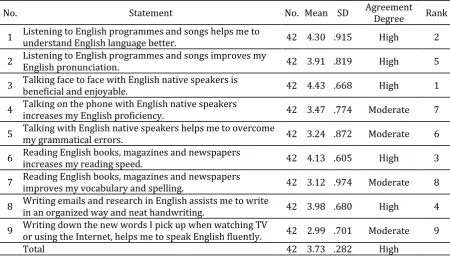
Table 2. Means, Standard of Deviation, Agreement Degree and Rank of Exposure to English Language and Developing the Four Language Skills
No. Statement No. Mean SD Agreement Degree Rank
1 Listening to English programmes and songs helps me to understand English language better. 42 4.30 .915 High 2 2 Listening to English programmes and songs improves my English pronunciation. 42 3.91 .819 High 5 3 Talking face to face with English native speakers is beneficial and enjoyable. 42 4.43 .668 High 1 4 Talking on the phone with English native speakers increases my English proficiency. 42 3.47 .774 Moderate 7 5 Talking with English native speakers helps me to overcome my grammatical errors. 42 3.24 .872 Moderate 6 6 Reading English books, magazines and newspapers increases my reading speed. 42 4.13 .605 High 3 7 Reading English books, magazines and newspapers improves my vocabulary and spelling. 42 3.12 .974 Moderate 8 8 Writing emails and research in English assists me to write in an organized way and neat handwriting. 42 3.98 .680 High 4 9 Writing down the new words I pick up when watching TV or using the Internet, helps me to speak English fluently. 42 2.99 .701 Moderate 9
Total 42 3.73 .282 High
classified in the first rank (speaking skill). In the second rank was item no. (1) " Listening to English programmes and songs helps me to understand English language better." Means reached (4.30) by standard deviation (.915) (Listening skill). In the third rank is item no. (6) " Reading English books, magazines and newspapers increases my reading speed." Means was (4.13) by standard deviation (.605) (Reading skill). In the fourth rank item no.(8) " Writing down the new words I pick up when watching TV or using the Internet, helps me to speak English fluently." Means was (3.98) by standard deviation (.915) (writing skill). Items (2, 4, 5, 6, 7 , 8 ,9 and 12) were high .The rest of the items were moderate. Finally, the overall means was high (3.73).
Table 3. Correlation between Language Exposure and Developing the Four Language Skills
Exposure Language Skills Exposure
Pearson Correlation 1 .228*
Sig. (1-tailed) .037
N 62 62
Language Skills Pearson Correlation Sig. (1-tailed) .228* .037 1
N 42 42
*. Correlation is significant at the 0.05 level
Table (3) examined the relationship between language exposure and developing the four language skills. As can be seen in table (3), the coefficient correlation between language exposure and the four language skills was (.228), and the significance level (.37). Therefore, there is a statistically significant at the level of significance (P <0.05) between the two variables. This indicates a statistically significant correlation between exposure to language and developing the four language skills since the p value is (.228), which is greater than the significant level (p>0.05) which signifies a strong significant relationship between language exposure and developing the four language skills. Therefore, the results related to the second question proved a positive relationship between language exposure and developing the four language skills.
DISCUSSION
Accordingly, thorough exposure to the TL, the learner can improve the second / foreign language acquisition. Same result was garnered by Ellis (2002) stressing that learners may apprehend the target language by regular exposure to it. Throughout this exposure, the learner normally come across the linguistic features that composed language. He emphasized the results of several studies showed that language acquisition can be speeded by explicit instruction, such as that normally used by teachers in schools. Lambine's (2008) explained that the increased exposure the children get outside the school environment, it can change the way they think about the language.
Regarding to the second question of this study, the results related to the relationship between exposure to English language and developing the four language skills (listening, speaking, reading and writing) proved a positive relationship. Language learners acquire skills and knowledge by using the language, by writing and speaking, and by listening and reading. It confirmed that item no. 3 " Talking face to face with English native speakers is beneficial and enjoyable." got the highest means (4.43) by standard deviation (.668) and classified in the first (speaking skill). In the second rank was item no. (1) " Listening to English programmes and songs helps me to understand English language better." Means reached (4.30) by standard deviation (.915) (Listening skill). Drew & Sørheim (2009) amongst others argue that by listening to a CD or an audio books, the pronunciation of the learners will improve, and their vocabulary will increase. Students may even acquire native-like accents by listening to previously recorded material.
In conclusion, the results showed a significant impact of exposure to English language on language acquisitionand learners who are exposed to the English language at numerous levels are more open when it comes to language learning as well as there is a strong relationship between exposure to English language and developing the four language skills.
CONCLUSIONS AND RECOMMENDATIONS
Based on the results and analysis of this study, the statistical analysis approved that there are some positive relationships between exposure to English language and language acquisition as well as in developing the four language skills.
The researcher recommended that students should be continually exposed to the English language through many types of media, such as movies, songs and the internet on a daily basis to help them get rid of their points of weakness and improve their fluency as well as proficiency in English. Moreover, provide quality English exposure through a variety of pleasurable and developmentally appropriate language activities /materials related to their everyday life. Besides, teachers and parents should raise learners’ awareness towards the importance of learning English language through exposure to the language daily using different techniques that can enhance second language acquisition. Finally, the present study is only a small step towards doing justice to this topic. This study may help future researchers investigate this issue with a larger group in more depth and with more connection to exposure to English language and language acquisition.
REFERENCES
Benson, P. (2001). Teaching and researching autonomy in language learning. Harlow: Pearson Education.
Briere, Eugene J. (1978). Variables affecting Native Mexican children's learning Spanish as a second language. Language Learning, 28, 159-174, 1978.
Chandrasegaran, A. (1979), Problems of learning English in national schools in Johor, Malaysia: an investigation of attitudinal-motivational variables, learning strategies and exposure to English. Unpublished MA dissertation, University of Singapore. d.Ydewalle,G,& De Bruycker,w(2007).Eye movements of children and adults while
reading television subtitles. European psychologist, 12, 196-205
Drew, I., Sørheim, B. (2009). English Teaching Strategies. Det Norske Samlaget: Oslo
English Subject Curriculum. (2013). Udir. Retrieved from
http://www.udir.no/kl06/ENG1- 03/Hele?lplang=eng
Ellis, Rod. (2002). Second Language Acquisition. Oxford: Oxford University Press. Faigley, L., Daly, J. A., & Witte, S. P. (1981). The role of writing apprehension in writing
performance. Journal of Educational Research, 75(1), 16-21
Ghaderpanahi, L (2012). Using Authentic Aural Materials to Develop ListeningComprehension in the EFL Classroom. English Language Teaching Journal Vol. 5, No. 6
Grosjean, F. & Miller, J. (1994). Going in and out of languages: an example of bilingual flexibility. Psychological Sciences 5, 201–206.
Kennedy, G (1973). Conditions for language learning. Rowey,MA. Newbury House.
Krashen, S.D., Long, MA, and Scarcella, R.C. (1979). Age, rate, and eventual attainment in second language acquisition. TESOL Quarterly, 13, 573-582.
Lambine, Camilla. (2008). English just isn't a foreign language anymore. Språk og språkundervisning, 2, 5-7.
Lightbrown, P. M., & Spada, N. (2006). How languages are learned (3rd ed.). USA: Oxford University Press.
Oxford, Rebecca. (2001) Integrated Skills in the ESL/EFL Classroom. ESL Magazine, Vol. 6, nº 1, January/February 2001.
Peregoy, S. F., & Boyle, O. F. (2005). Reading, writing, and learning in ESL: A resource book for K12 teachers. Pearson/Ally & Bacon.
Politzer, Robert L. (1965). Foreign language learning: A linguistic introduction. Englewood Cliffs, New Jersey: Prentice Hall, Inc.