Research Article
February
2018
Computer Science and Software Engineering
ISSN: 2277-128X (Volume-8, Issue-2)
Early Stage Commercialization Strategies:
How Did Prius Family Affect Toyota Electric Vehicle
Development?
Majid A. Dehkordi Starlight Group, Tokyo, Japan
Graduate School of Commerce and Management, Hitotsubashi University, Tokyo, Japan
Seiichiro Yonekura
Graduate School of Commerce and Management, Hitotsubashi University, Tokyo,
Japan
Abstract - Although researches in the eco-friendly innovation studies have contributed much to technological development, a limited contribution has been made to the importance of structural concepts, strategic decisions and early stage marketing in the diffusion of innovation. The uniqueness of this research lies in its effort of exploring Toyota’s commercialization strategies for the first generation of its green vehicles, Prius Hybrid and RAV4 EV. Literature is reviewed from both historical and technological perspectives. The Roger’s Diffusion model was used and on the basis on this review, it has been argued that Toyota’s hybrid vehicle commercialization strategy affected this company’s electric vehicle development at least for a decade. The results fill a gap in the literature, particularly in Green vehicles research, development, and marketing.
Keywords - Toyota Prius, Toyota RAV4 EV, Rebound effect, Cannibalism, Marketing strategy
I. INTRODUCTION
The population in the world as well as the number of people that can afford a car is growing. One of the major environmental problems is to avoid a huge increase in environmental pollutions and the greenhouse effect. Because cars driven by fossil fuel are one of the largest contributors to air pollution, and the oil won‟t be enough for our needs in the future, many novel ideas for solving these important problems have been developed. We had to develop new mechanical solutions and also to find another main energy source. These problems have motivated car manufacturers to introduce new generations of cars in order to cope with fuel consumption and emission issues. Electric vehicles and Hybrid Electric Vehicles are considered, by some, to be the solution to those problems.
Conventional vehicles are propelled by only igniting fossil fuel [LNG or Gasoline] in a combustion chamber inside and integral to the engine and converting the ignition energy into mechanical rotation and translation [1]. It is correct that the 2010 cars are about 20 times cleaner than cars 20 years ago, but still cars put millions of tons of toxic chemicals into the air and water. This had been led by market demand followed by car manufacturers, oil companies and governments. The emission from motor vehicle exhaust is very harmful to human health and to the environment especially in large quantities. The air pollutant causes breathing and heart problems as well as increasing the risk of cancer [2]. Also, the increase of greenhouse gas concentration in the atmosphere is responsible for global warming and climate change that is happening around the world. As a result, the combination of the worlds need for lower emissions, non-fossil energy sources and the development of battery technologies has opened up new possibilities for the future of automotives. The automotive industry is looking at pure electric vehicles as well as Hybrid Electric Vehicles to meet these global demands.
Toyota Motor Corporation group has always known for its considerable influence on the world class car manufacturing. Among Toyota cars and as a Hybrid Electric Vehicle, Toyota Prius is the World‟s first mass produced hybrid vehicle. Before the Prius production, Toyota had never been much of a pioneer. It was known as a fast follower company. Prius went on sale on 1997 and brought an incremental success for the company. Meanwhile, the first version of the Toyota electric vehicle (RAV4 EV) became available on a limited basis from 1997 to 2003, but many consider this car as a failure for the company.
ISSN(E): 2277-128X, ISSN(P): 2277-6451, pp. 51-63
II. TOYOTA’S GREEN TRANSFORMATION AND TECHNOLOGICAL BACKGROUND
It is important to ask how the structural location of Toyota positioned its response to environmental movements. We might be concerned as well with how advertising affected the sales of the green vehicles and with how the non-availability of cheaper electric cars affected its promotion in the society. To understand the success and failures of first generation green vehicles, we need to be concerned about the socio-organizational structure of Toyota between 1996 and 2003.
In 1993, Toyota company‟s chairman, Eiji Toyoda expressed the company‟s concern about the future of the automobiles. A project known as G21 initiated to develop a future-oriented new car technology. By 1994, the G21 team had concluded that the increasing oil price would require the new car to be fuel-efficient. As the result, engineers were ordered to develop a concept car with a hybrid power train for the 1995 Tokyo Motor Show [e.g. 3]. The first Toyota Prius was the brainchild of Takeshi Uchiyamada, an engineer and expert in noise and vibration control. In 1995, with a change in company‟s president, Toyota got serious about putting Prius into production. One year later, competition for Prius body design started and Erwin Lui from Toyota's design studio in Newport Beach CA, got three weeks to prepare models for four-door sedan Prius.
The first Prius (model NHW10) went on sale on 1997 and it was available only in Japan [3], doubling the fuel efficiency to 28km per liter compared with a conventional Corolla. By mid-2000, Prius was subsequently introduced in US. Until 2012, Toyota introduced 4 generations of Prius in more than 70 countries. Prius I (first generation) largest markets being those of Japan and US, and from the introduction of Prius II, Europe also came to the picture.
In US, Honda introduced its hybrid car Insight I (first generation) seven months ahead of Prius. This helped Toyota to modify the Prius for US needs. In other words, Toyota used the Fast follower strategy to introduce the Prius right after the Insight (in this strategy, the follower company learns quickly from those companies who enter first). For example, An Insight buyer in the US posted his cars manual on his Web site, and TMS used the information to modify its warranties (ibid.). In contrast to Prius, Honda Insight looked like something out of a science fiction movie. The Insight was small and impractical, demanding that its buyers sacrifice space, comfort, and appearance in exchange for high gas mileage. Customers were unwilling to do so, and Honda Insight I was discontinued in 2006 [4]. Again In 2009, Honda introduced Insight II to make hybrid technology more affordable to a wide range of buyers.
On Prius I, Toyota was losing over $20,000 per vehicle, selling it for $20,000 while it cost $41,000 to build. Toyota executives stated that the company broke even financially on sales of Prius first-generation. But gradually, Prius retained 57% of its value after three years. Pride of ownership was so high that only 2% of buyers opted to lease [3]. This success increased more with the introduction of the second and the third generations of Prius. Table 1 shows the annual worldwide sales of Toyota Prius I by region.
Table 1. Prius I annual worldwide sales by region - in thousands [5 – 6, TMC]
As you can see in Table 1, Prius I largest markets have been US and Japan. Toyota‟s initial strategy for the Prius I targeted innovators and early adopters of new technologies. In this sense, a special website about Prius I developed as early as two years before the introduction of the product. Also, Toyota used Internet-based advertisement, such as online e-brochures with a 17-second video clip that were sent to the almost 44,000 people. Coordinating 900 dealers to execute a „rental‟ program was another way to let the customers deal more with the new hybrid technology of the company.
ISSN(E): 2277-128X, ISSN(P): 2277-6451, pp. 51-63
Fig 1. US hybrid sales – Honda Insight I and II and Honda Civic Hybrid are shown (Alternative Fuels Data Center)
In four years and right before Toyota introduced its second generation of Prius in 2004, Toyota Prius I had 39 percent and Honda Civic had 55 percent of the US hybrid market share (Figure 2).
Figure 2. US hybrid market share in 2003 [7]
Toyota introduced the second generation of Prius (model NHW20) in 2004, targeting the early majority of customers (refer to Figure 1). Toyota used television and newspaper advertisements to aim at the mass market using the mass media. Compared to previous generation, Prius II was more environmentally friendly, longer in size and it had more aerodynamic body balance. Figure 2 shows the annual worldwide sales of Toyota Prius II by region.
Table 2. Prius II annual worldwide sales by region - in thousands [5 - 6, TMC]
ISSN(E): 2277-128X, ISSN(P): 2277-6451, pp. 51-63 European sales of Prius began in September 2000. But from 2005 and after the introduction of Toyota Prius II, European sales increased dramatically. In other words, Europe became the third largest market for Prius. In 2006, Toyota came with the idea of Camry Hybrid (model XV40), although this vehicle has never been available for purchase in its home market, Japan [8]. Figure 3 shows the US hybrid market share in 2007, before the introduction of Toyota Prius III and Honda Insight II. It should be noted that Altima hybrid, Nissan‟s first hybrid car started its sales from 2007.
Figure 3. US hybrid market share in 2007 (hybridcars.com)
Indeed, after the introduction of Prius II, the golden ages of hybrid vehicles started for Toyota. Just between 2004 and 2008, Total hybrid vehicle sales in US became quintuple and of this huge increase in sales (Figure 4), Toyota had the greatest bite of the fruit. Between all of the known automakers, Toyota had the most hybrid vehicle sales as a percentage of total light vehicle sales (Figure 5). By 2008, Toyota had more than 10 percent reported hybrid vehicle sales as a percentage of total light vehicles sales, while for Honda, the closest competitor of Toyota in hybrid vehicles, this share remained hardly at 2 percent.
ISSN(E): 2277-128X, ISSN(P): 2277-6451, pp. 51-63
Figure 5. Reported hybrid sales as a percentage of total new light vehicle sales in 2008 [5 - 6]
In 2009, Honda introduced the second generation of Insight. Compared with 2-seat Insight 1999, Insight 2009 was a 5-passenger hatchback, designed to compete with Toyota Prius. Toyota also debuted the new third generation of Prius (model NHW30) in the same year, but as far as the mass production is concerned, Toyota Prius III started one month later than Insight II. Toyota cut the price of the Prius from 2.33 to 2.05 m¥ to better compete with the Insight II (price between 1.89 and 2.21 m¥). Table 3 shows the annual worldwide sales of Toyota Prius III by region.
Table 3. Prius III worldwide sales by region – in thousands [5 – 6, TMC].
ISSN(E): 2277-128X, ISSN(P): 2277-6451, pp. 51-63
Figure 6. annual worldwide sales of Toyota Prius [5 - 6]
Figure 7. Worldwide annual sales of Prius by region [5 - 6]
ISSN(E): 2277-128X, ISSN(P): 2277-6451, pp. 51-63 As far as the latest generations of Prius are concerned, Toyota debuted the Prius C hatchback on 2011 (Tokyo Motor Show as Prius Aqua, North American International Auto Show in Detroit as Prius C). It was launched in Japan in December 2011 and in US in March 2012. Schmitt [10] stated that initial demand has been high in both countries. Toyota cut the price of this car to 1.69 m¥. Toyota introduced Prius V minivan in 2011 (North American International Auto Show in Detroit as V). It was launched in Japan in May 2011 as Prius α, in US in October 2011 as Prius V, and the European version will be out in mid-2012 as Prius + (plus). This car uses NiMH battery pack and the sales price is 2.35 m¥. Also, Toyota produced Prius plug-in hybrid in 2011 (unveiled in 2011 in Frankfurt Motor Show). Sales began in Japan, US and Europe by early 2012 and the US retail sales price starts at US$32,000. In spite of Tohoku earthquake and tsunami in 2011, again Toyota Prius brand became the best selling vehicle in Japan in 2011.
III. THEORETICAL BACKGROUND
For better understanding of Toyota‟s strategy, we have used Rogers Diffusion of Innovations to describe the marketing strategy for Toyota Prius. According to Rogers [11] definition, with successive groups of consumers adopting the new technology (shown in blue in Figure 2), its market share (yellow) will eventually reach the saturation level. Moore [12] suggests that early stage of new product development should focus on innovators and early adopters (both are customer initiators) as their reaction to the innovation will determine the product success or failure. This is because information diffusion creates product awareness [13] and customer education increases product acceptance. In uncertain environments, new product acceptance is related to trust between the company and its customers [e.g., 14 – 15], which suggests that targeting existing customers and positioning the product according to customers technological superiority may increase new product success [e.g., 16]. Rogers' [11] innovation diffusion model has an S-shaped rate of adoption and thus new product adoption success depends mainly on innovators and early adopters. Rosen et al. [17] note that customer initiators (innovators and early adopters) affect how a new product is perceived in the market in terms of customer satisfaction. As far as the importance of advertisement is concerned, Rosen et al. [17] rightly states the role of advertising and the importance of companies in developing markets for the shape and success of new technologies. Advertising can play a crucial role in “pushing stabilization in a particular direction” (p. 492). Strasser [18] shows that it is often not the market through price that shapes consumer demand but the dedicated efforts of advertisers who seek “to meet the needs of production and company growth”. “The most effective campaigns encouraged new needs and new habits, not by creating them out of whole cloth, but by linking the rapid appearance of new products with the rapid changes in all areas of social and cultural life” (Ibid). In this sense, for commercializing green fleet technologies, an innovative approach toward the active advertisement and the effective use of channels must be considered.
This study also tries to bind Electric Vehicles (EVs) success in the market to another innovation, Hybrid Electric Vehicles (HEVs). As Williams and Edge [19] mentioned, “earlier technological choices pattern subsequent development” (see also Rip 1995). The idea here is that groups looking to promote development of an artifact with a particular configuration might have an advantage if it links a popular existing technology to the new one [20]. While product line extension or repositioning strategies pose minimal risk of failure for the product being introduced, potential negative effects on existing products serving existing markets must be considered. These effects can be called product cannibalism [21]. Product cannibalism is gaining sales for a new product by diverting them from an existing product or sacrificing an existing product. Product cannibalism should not be considered only negatively. It may be better to have customers switching brands within the company's product line rather than to have them switching out and buying from a competitive rival company.
Figure 8 shows the Prius I and II marketing strategies. It will be intriguing to note that Toyota focused on innovators and early adopters of innovation as the main marketing strategy for Prius I, while for Prius II, the focus was mostly on the early majority group of customers.
ISSN(E): 2277-128X, ISSN(P): 2277-6451, pp. 51-63 Coming back to 1997, while Toyota started its sweet experience with hybrid vehicles, it devoted 2% of its sales to zero emission vehicles. In 1997, Toyota launched RAV EV I (first generation) on a limited lease basis in California and then, due to shift in corporate policy, it sold them to general public. During production years, 328 were sold with final price of 29,000$. After six years and in spite of waiting lists of forthcoming customers, in 2003 RAV EV production was terminated by Toyota.
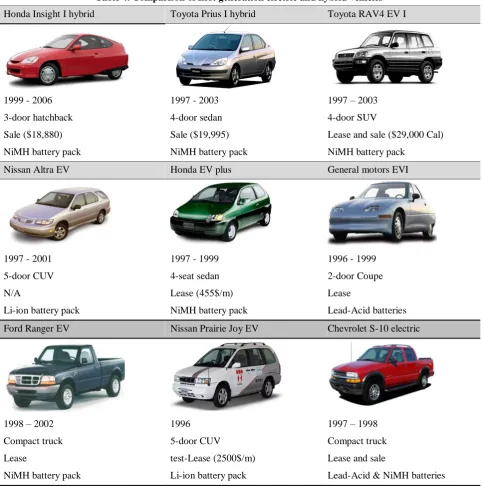
Between 1997 and 2003, major Japanese car companies wanted a piece of the Electric Vehicle market share. Toyota RAV4 EV was the first commercial electric vehicle to be powered by nickel-metal hydride batteries and only offered for public sale for about seven months from 2002 to 2003 in very small quantities and just in California. Nissan Motor's Prairie Joy EV, introduced in 1995, was the world's first production electric vehicle powered by lithium-ion batteries. Nissan Prairie was a test model and only 30 vehicles were produced and mainly sold to labs. Nissan later introduced Altra EV in 1997, while only about 200 vehicles were sold. Honda EV Plus, unveiled in April 1997, was an electric vehicle of totally original design. Again only 340 vehicles were designed and produced. All of these vehicles productions stopped due to lack of demand or change in the company‟s strategy. Table 4 shows the comparison between the first mass produced hybrid and electric cars, Honda Insight I, Toyota Prius I, RAV4 EV I (Toyota‟s first experience with electric vehicles), Honda EV plus, General Motors first generation‟s EV1, Nissan Altra EV, Ford Ranger EV, Chevrolet S-10 EV, Nissan Prairie Joy EV, Nissan Tino Hybrid, Nissan FCX EV, and Honda Civic hybrid I.
Table 4. Comparison of first generation electric and hybrid vehicles
Honda Insight I hybrid Toyota Prius I hybrid Toyota RAV4 EV I
1999 - 2006 1997 - 2003 1997 – 2003
3-door hatchback 4-door sedan 4-door SUV
Sale ($18,880) Sale ($19,995) Lease and sale ($29,000 Cal)
NiMH battery pack NiMH battery pack NiMH battery pack
Nissan Altra EV Honda EV plus General motors EVI
1997 - 2001 1997 - 1999 1996 - 1999
5-door CUV 4-seat sedan 2-door Coupe
N/A Lease (455$/m) Lease
Li-ion battery pack NiMH battery pack Lead-Acid batteries
Ford Ranger EV Nissan Prairie Joy EV Chevrolet S-10 electric
1998 – 2002 1996 1997 – 1998
Compact truck 5-door CUV Compact truck
Lease test-Lease (2500$/m) Lease and sale
ISSN(E): 2277-128X, ISSN(P): 2277-6451, pp. 51-63
Honda Civic Hybrid I Nissan Tino Hybrid Honda FCX EV
2001 - 2005 2000 2002
4-door sedan 4-door sedan 2-door hatchback
Sale ($20,000) N/A test-Lease
NiMH battery pack Li-ion battery pack Fuel Cell battery pack
Aside from hybrid vehicles, the destination of all mentioned electric vehicles was the same. In spite of the growing demand and positive feedback for some of the EVs in the market, their production stopped and the vehicles were crushed by their companies (Toyota RAV4 EV and General Motors EV1), while the production of some of them stopped due to lack of demand (Nissan Altra EV and Honda EV plus). In other words, from 1999 to 2004, all of a sudden auto manufacturers pulled all their leased electric vehicles from the market or decided to stop producing more EVs. For almost a decade, the market didn‟t hear about any mass produced electric car. The most important EV development in this blank timeline was Tesla Roadster, developed by Tesla Motors in 2006 and mass produced from 2008 with the price of 109,000 US$. Of course because of the expensive price, this car wasn‟t something that everyone could afford.
It should be noted that between 2002 and 2008, world economy dealt with a major oil crisis. Due to tensions in Middle-east and worries over oil speculations, price of crude oil increased from 30$ in 2002 to 147$ in 2008. From 2008, major automakers in the world, turned they attention again to electric cars. For example, Honda FCX Clarity manufactured by Honda from 2008 (production cost between 120,000$ and 140,000$), Th!nk City manufactured by Think Global from 2008 to 2011 (sold 1045 units worldwide), i-MiEV manufactured by Mitsubishi from 2009 (price from 29,000$ in US to 63,000$ in Australia), Leaf manufactured by Nissan from 2010 (world best selling EV), Ford Focus Electric by Ford Motors Company from 2011 (price of 40,000$), RAV4 second generation manufactured by Toyota from 2012, and Smart ED third generation manufactured by Smart from 2012 (price of 22,400$ plus monthly battery rental fee) are said to be or will be the most successful EVs. Of course because of the research limitations, it is not possible to deeply explore all of the mentioned electric vehicles.
From May 2010, Toyota Motor Company and Tesla Motors started their cooperation to develop the second generation of RAV4 EV. Tesla is providing the Lithium Metal-oxide battery pack and Toyota has come with the platform and body. The US market launch will be in late-2012. From the first generation of RAV4 (1997) until the second generation (2010), Toyota‟s mainly eco-cars have been hybrid vehicles (such as Prius and Camry) and there wasn‟t any pure electric vehicle from this company in the market. In spite of oil price increase in 2000s, why Toyota stopped its investment on electric cars? It is very interesting, because the same thing happened for almost all automakers; they all stopped electric car production and they all had their own strategic reasons for giving up on electric vehicles. In the next section Toyota reasons for stalling the production of electric car will be discussed.
IV. TOYOTA PRIUS AND RAV4 EV CO-RELATION
This study was undertaken to explore why Toyota did not continue its electric vehicle production until 2012 (mass production time of RAV4 EV II). Figure 12 presents the timeline of Toyota‟s green car productions from 1997 to 2012 (electric and hybrid cars; eco-cars with ICE and low emission are excluded). Toyota introduced its RAV4 EV and Prius I hybrid in the same year, but RAV4 EV was available in the American market and only for lease. In 2002 and 2003, it was sold to the general public with the price of 29,000 $ on a limited basis and only 328 units were sold. Toyota suddenly stopped RAV4 EV production, removed its EV program website and called all of the leased vehicles.
ISSN(E): 2277-128X, ISSN(P): 2277-6451, pp. 51-63
Figure 9. Toyota Hybrid (blue) and Electric vehicle (pink) introduction in US market along with oil price increase
One of the reasons that Toyota decided not to continue commercializing the next generation of EV or not to produce RAV4 EV after 2003, is that based on the previous Marketing researches findings, “for all of us, environmental advantages were able to arouse a certain conceptual interest but ultimately it was not the driving choice” [22]. It means that in the time of introduction of green vehicles, insisting just on environmental friendliness as the main message of the campaigns wasn‟t a good strategy for both RAV4 EV and Prius I. Toyota noticed this subject very early and it helped them to gain a huge profit out of their hybrid vehicle. In case of Prius, researchers recommended that as hybrid technology of Prius (or engine size and fuel type) is not a key selling point, the Prius should be positioned as a stylish, innovative vehicle offering fun to drive. Later and especially from Prius II, Toyota changed this strategy and focused mainly on technology and Innovation. For example, take a look at Figure 10, where it compares two generations of Toyota Prius campaign advertisements.
ISSN(E): 2277-128X, ISSN(P): 2277-6451, pp. 51-63 It should be emphasized that Toyota‟s first campaigns didn‟t add enough perception of the technology and drive distinction. However, later they have been replaced by advertisements that give customers enough details about innovation dominance, remarkable idea and technological advancement.
In addition to above finding and argument, in 2004, a survey conducted by Thun (Basis-Kontakt and Maritz Research Deutschland) that commissioned by the Strategic Research Division of Toyota Motor Marketing in Europe, on the positioning of a green technology in consumers consciousness ended up with an interesting result. This research found notably that fuel type is not a decision making motivation in the early stages of green vehicle sales. Unlike the aforementioned attribute, price, brand, segment, body type, design, better say innovation and technology, were far more relevant. The research further concluded that awareness of Green technology and knowledge of the hybrid system was low.
Therefore, our study brings to the attention of specialists the importance of first marketing orientation. In spite of the rising oil price between 1999 and 2008, an opportunity that opens market doors for green technologies, one of the reasons that Toyota RAV4 EV couldn‟t find its right position in the market was the wrong sale and marketing strategies.
Another reason that Toyota decided not to continue the production of RAV4 EV after 2003, is that in marketing campaign of Toyota Prius, the company found that the other brands within Toyota‟s portfolio will benefit from the extra Toyota exposure and from Toyota being portrayed as a technologically advanced brand. In other words, Toyota sacrificed RAV4 EV in favor of Prius I and this practice helped Toyota to increase its sale not just only for Prius, but also other brands in its portfolio. In marketing literature, this is called Cannibalism [e.g. 23]. If a company has two brands offering similar or close characteristics that are competing for the same customers, one will get eaten by the other or one will be removed from the market by its own company: the brand cannibalism. Toyota stopped RAV4 EV production to help Prius sales and as a result, Prius sales increased and benefit other brands within company‟s portfolio. Figure 11 describes the battle between Toyota and General Motors in the car market. In 2000, General Motors was the world top car manufacturer and in the list, Toyota was number 3 after Ford. It is clear that after the introduction of Prius family, Toyota vehicle sales increased significantly and in 10 years, Toyota Company became the world top car manufacturer and General Motors became number 2 in the list.
Figure 11. Toyota vehicle sales after the introduction of Prius (Global Insight: General Motors, Toyota)
The final argument is the Toyota RAV4 EV‟s Rebound Effect. Rebound effect or Take-back effect is a behavioral response to the introduction of a novel innovation. Rebound phenomenon is a tendency in the market that happens with the introduction and discontinuation of new technologies. In other words, if a sudden stall or stop in the production of an especial innovation happens, the market gets hungry and thirsty and the signs of this enthusiasm will get even more than the time that the introduction first began [e.g. 24]. Rebound effects are very difficult to quantify, and their size and importance under different circumstances is hotly disputed [25].
ISSN(E): 2277-128X, ISSN(P): 2277-6451, pp. 51-63 vehicle. It should be noted that RAV4 EV owners showed a great loyalty and most of them didn‟t want to replace their own cars. In the Internet, they even made owners group and supported each other (ex, evnut.com RAV4 EV group), In contrast, researches didn‟t find any Rebound effect in case of Prius [26], that means any stall in Prius production won‟t necessarily cause any boost in other green vehicles sales.
In addition to above findings, we shall not forget that Toyota RAV4 EV was a few years ahead of its time as far as market acceptance, but mainly because of the prohibitive cost of the battery pack (NiMH or nickel metal hydride) and self discharge disadvantage. The battery would have cost more than the car was worth at the time of replacement, so most of them were retired once the battery would no longer hold a charge. On the other hand, with the absence of electric vehicles in the market and along with the rising price of oil, Toyota introduced Prius II, Camry hybrid and later Prius III that all of them had a great sale success.
Finally, the role of EV infrastructure must be considered either. Compared to the current time, a decade ago, EV charging points and battery swap stations weren‟t that available. For example in US, from 1996 to 2008, only available charging station was General Motors EV1 with 500 charging points in California; A project that started in 1996 and was cancelled in 2001. But from 2008 to 2012, more than fifteen different companies have their own charging points in most of the important cities in US. Right now, with too many charging points and battery swap stations in most of the advanced countries, it has made possible for EV owners to travel long distances and not to have range anxiety.
V. SUMMARY
Since electric cars are at least four times more energy efficient compared to ICEVs, they are sustainable innovations. However, in this great transition from ICE to EV, hybrid vehicles played an important role. When the first generations of HEVs and EVs were introduced in Japan and US, there was an unavoidable skepticism in the mind of customers; especially not only the battery pack was concerned, but also the vehicle general reliability was highly in doubt. Many stated that hybrids were too risky, because it has two power sources and one of them is a new technology. As far as EV is concerned, for a long time, it is viewed as a particular technology for the short distance travels. The fact is that hybrid technology functioned as a transitional technology that prepared minds of customers for the current generations of electric vehicles. In consistent, Franken et al. [27] stated that HEV can function as a transitional technology that enables car manufacturers to experiment with innovations in various subsystems within the constraints of the current internal combustion engine regime. Currently, there are more than seventy electric vehicles from different companies subjected for production, and out of them twenty eight EVs are produced and are selling in the market. Also, there are more than forty vehicles planned for future production.
It is rather interesting that green car technologies have shown a considerably growing variety in electric vehicle development. In the current state, neither electric vehicles can fade the importance of hybrid vehicles, nor hybrid vehicles can become the dominant technology in the market and both are developing along with each other. During the period 1996 – 2008, major policy shift caused manufacturers to become heavily involved in R&D and as a result, a sudden rise in patent listing of major car companies. The children of this R&D involvement were EVs, FCVs and HEVs. The previous stage in the transition from traditional gasoline cars to green cars mainly started by Toyota and its successful product Prius. The growing competition between automakers was considered as a positive factor of this transition between 1996 and 2003. However, of all the green vehicles developed in that period, Prius success didn‟t happen out of the blue and indeed, Toyota had to sacrifice its own electric vehicle project. At production time, Toyota managed to communicate Prius similarly to the end values of the customers. Marketing and sales strategies surely have been the biggest influence in the success of Prius and failure of RAV4 EV. Toyota used its electric vehicle‟s market failure as an opportunity to feed the hungry market with another innovation. This is what Toyota does: Toyota‟s way of production and Toyota sales strategy.
REFERENCES
[1] Irani, F. (2009). On Dynamic Programming Technique Applied to a Parallel Hybrid Electric Vehicle. Chalmers University of Technology.
[2] Minnesota Pollution Control Agency (2009). Motor Vehicle Pollution. Retrieved April 17, 2012. from: http://pca.state.mn.us
[3] Taylor, A. (2006). Birth of the Prius. Fortune.
[4] Rego, J., Stempel, J., & Mintz, R. (2007). The Prius Effect: Learning from Toyota. Brand Neutral.
[5] Greencarcongress (2005). DontCrush.com Saves the RAV4, Launches Plug In America. Greencarcongress.com. Retrieved May 13, 2012. from http://www.greencarcongress.com
[6] Greencarcongress (2010). Worldwide Prius Cumulative Sales Top 2M Mark; Toyota Reportedly Plans Two New
ISSN(E): 2277-128X, ISSN(P): 2277-6451, pp. 51-63 [7] Rodriguez, A., & Page, C. (2004). A comparison of Toyota and Honda hybrid vehicle marketing strategies.
Rocky Mountain Institute.
[8] Abuelsamid, S. (2009). Toyota tops 2 million hybrid sales worldwide. Retrieved May 8, 2012. from http://green.autoblog.com
[9] Jones, B. (2010). Prius No.1 in Japan sales as green interest grows. Associated Press. Retrieved May 20, 2012. from http://usatoday30.usatoday.com
[10] Schmitt, B. (2012). Toyota Drowns In Orders For Game Changing Prius C. Retrieved June 3, 2012. from http://www.hybridcars.com
[11] Rogers, E. (1962). Diffusion of innovations. Free Press, London, NY, USA. [12] Moore, G. A. (1998). Crossing the Chasm. Oxford: Capstone Publishing Ltd.
[13] Easingwood, C., & Harrington, S. (2002). Launching and re-launching high technology products. Technovation, 22, 657−666.
[14] Athaide, G. A., Meyers, P. W., & Wilemon, D. L. (1996). Seller–buyer interactions during the commercialization of technological process innovations. Journal of Product Innovation Management, 13, 406−421.
[15] Atuahene-Gima, K. (1995). An exploratory analysis of the impact of market orientation on new product performance. A contingency approach. Journal of Product Innovation Management, 12, 275−293.
[16] Hultink, E. J., & Schoormans, J. P. L. (1995). How to launch a high-tech product successfully: An analysis of marketing managers' strategic choices. Journal of High Technology Management Research, 6(2), 229−242.
[17] Rosen, D. E., Schroeder, J. E., & Purinton, E. F. (1998). Marketing high tech products: Lessons in customer focus from the marketplace. Academy of Marketing Science Review, 6.
[18] Strasser, S. (1989). Satisfaction guaranteed: The making of the American mass market. New York: Pantheon. [19] Williams, R., & David E. (1996). The social shaping of technology. Research Policy, 25, 865-99.
[20] Klein, H. K., Kleinman, D. L. (2002).The Social Construction of Technology: Structural Considerations.
Science, Technology, & Human Values, 27(1), 28-52
[21] Kerin, R. A., Harvey, M. G., & Rothe, J. T. (1978). Cannibalism and new product development. Business
Horizons, 21(5), 25-31.
[22] Beauchamp, M. D. (2006). Launching the Prius Diesel into the UK market: while establishing awareness of
Toyota as an environmentally friendly performance brand. Westminster Business School.
[23] Traylor, M. B. (1986). Cannibalism in multibrand firms. Journal of Consumer Marketing, 3(2), 69–75. [24] Grubb, M. J. (1990). Energy efficiency and economic fallacies. Energy Policy, 18, 783–785.
[25] Sorrel, S. (2007). The rebound effect: An assessment of the evidence for economy-wide energy savings from
improved energy efficiency. UK Energy Research Centre.
[26] Haan, P., Mueller, M. G., & Peters A. (2006). Does the hybrid Toyota Prius lead to rebound effects? Analysis of size and number of cars previously owned by Swiss Prius buyers. Ecological Economics, 58(3), 592–605. [27] Frenken, K., Hekkert M., & Godfroi P. (2004). R&D portfolios in environmentally friendly automotive
propulsion: Variety, competition and policy implications. Technological Forecasting & Social Change, 71, 485–507.
ABOUT AUTHOR
Dr. Majid A. Dehkordi is Senior Director at Starlight Group, Tokyo. He is currently specializes in HR and Managerial consulting and practices in APAC market. He is graduated from Hitotsubashi University with a PhD degree in Marketing and Management. His areas of research interests include Media and Communication studies, Entrepreneurship and Innovation, Marketing, and Green technologies.
![Figure 2. US hybrid market share in 2003 [7]](https://thumb-us.123doks.com/thumbv2/123dok_us/7809169.2085692/3.595.193.405.348.507/figure-us-hybrid-market-share-in.webp)

![Figure 5. Reported hybrid sales as a percentage of total new light vehicle sales in 2008 [5 - 6]](https://thumb-us.123doks.com/thumbv2/123dok_us/7809169.2085692/5.595.56.541.54.429/figure-reported-hybrid-sales-percentage-total-light-vehicle.webp)
![Figure 7. Worldwide annual sales of Prius by region [5 - 6]](https://thumb-us.123doks.com/thumbv2/123dok_us/7809169.2085692/6.595.53.546.57.697/figure-worldwide-annual-sales-prius-region.webp)