DPPy
: DPP Sampling with Python
Guillaume Gautier†∗ [email protected]
Guillermo Polito†∗ [email protected]
R´emi Bardenet† [email protected]
Michal Valko‡∗† [email protected]
†Univ. Lille, CNRS, Centrale Lille, UMR 9189 – CRIStAL, 59651 Villeneuve d’Ascq, France
∗Inria Lille-Nord Europe, 40 avenue Halley 59650 Villeneuve d’Ascq, France
‡DeepMind Paris, 14 Rue de Londres, 75009 Paris, France
Editor:Andreas Mueller
Abstract
Determinantal point processes (DPPs) are specific probability distributions over clouds of points that are used as models and computational tools across physics, probability, statis-tics, and more recently machine learning. Sampling from DPPs is a challenge and therefore we presentDPPy, a Python toolbox that gathers known exact and approximate sampling algorithms for both finite and continuous DPPs. The project is hosted on GitHubm and equipped with an extensive documentation.î
Keywords: determinantal point processes, sampling, MCMC, random matrices, Python
1. Introduction
Determinantal point processes (DPPs) are distributions over configurations of points that encode diversity through a kernel function K. They were introduced by Macchi (1975) as models for beams of fermions, and they have since found applications in fields as diverse as probability (Soshnikov,2000;K¨onig,2004;Hough et al.,2006), statistical physics (Pathria & Beale,2011), Monte Carlo methods (Bardenet & Hardy,2019), spatial statistics (Lavancier et al.,2012), and machine learning (ML, Kulesza & Taskar,2012).
In ML, DPPs are mainly used as models for diverse sets of items, as in recommendation (Kathuria et al.,2016;Gartrell et al.,2016) or text summarization (Dupuy & Bach,2018). Consequently, MLers mostly use finite DPPs, which are distributions over subsets of a finite ground set of cardinality M, parametrized by anM ×M kernel matrix K. Routine inference tasks such as normalization, marginalization, or sampling have complexityO(M3) (Gillenwater,2014). Like other kernel methods, whenM is large,O(M3) is a bottleneck.
In terms of software, the R library spatstat of Baddeley & Turner (2005), a general-purpose toolbox on spatial point processes, includes sampling and learning of continuous DPPs with stationary kernels, as described byLavancier et al.(2012). Complementarily, we propose DPPy, a turnkey Python implementation of known general algorithms to sample
finite DPPs. We also include algorithms for non-stationary continuous DPPs, e.g., related
to random covariance matrices or Monte Carlo methods, which are also of interest for MLers. The DPPy project, hosted on GitHub,m is already being used by the cross-disciplinary DPP community (Burt et al.,2019;Kammoun,2018;Poulson,2019;Derezi´nski et al.,2019;
Gautier et al., 2019). We use Travis for continuous integration and Coveralls for test coverage. Through ReadTheDocsî we provide an extensive documentation, which covers the essential mathematical background and showcases the key properties of DPPs through
DPPy objects and associated methods. DPPy thus also serves as a tutorial on DPPs. m github.com/guilgautier/DPPy
î dppy.readthedocs.io
travis-ci.com/guilgautier/DPPy
coveralls.io/github/guilgautier/DPPy c
2019 Guillaume Gautier, Guillermo Polito, R´emi Bardenet, and Michal Valko.
2. Definitions
A point process is a random subset of pointsX ={X1, . . . , XN} ⊂X, where the number of pointsN is itself random. We further add to the definition thatN should be almost surely finite and that all points in a sample are distinct. Given a reference measureµonX, a point process is usually characterized by giving itsk-correlation functions ρk for all k, where
P
∃ one point of the process in each ball B(xi,dxi),∀i= 1, . . . , k
=ρk(x1, . . . , xk) k
Y
i=1
µ(dxi),
see Møller & Waagepetersen (2004, Section 4). The functions ρk describe the interaction among points inX by quantifying co-occurrence of points at a set of locations.
A point process X on (X, µ) parametrized by a kernel K : X×X → C is said to be
determinantal, denoted as X ∼DPP(K), if itsk-correlation functions satisfy
ρk(x1, . . . , xk) = det [K(xi, xj)]ki,j=1, ∀k≥1.
In ML, most DPPs are in the finite setting whereX={1, . . . , M}andµ=PMi=1δi. In this
context, the kernel function becomes an M ×M matrix K, and the correlation functions refer to inclusion probabilities. DPPs are thus often defined asX ∼DPP(K) if
P[S ⊂ X] = detKS, ∀S ⊂X, (1)
whereKS denotes the submatrix ofKformed by the rows and columns indexed byS. The kernel matrix K is commonly assumed to be real-symmetric, in which case the existence and uniqueness of the DPP in Equation1is equivalent to the condition that the eigenvalues of K lie in [0,1]. The result also holds for general Hermitian kernel functions K with additional assumptions (Soshnikov, 2000, Theorem 3). We note that there are also DPPs with nonsymmetric kernels (Borodin et al.,2010;Gartrell et al.,2019).
Oftentimes, ML practitioners favor a more flexible definition of a DPP in terms of a
likelihood kernel L, which only requires L0,
P[X =S] = detLS
det [I +L]. (2)
This avoids defining a correlation kernel 0 K I. Yet, the L parametrization makes Equation1 less interpretable and does not cover important cases such as fixed-size DPPs, which correspond to projection kernels K. Kulesza & Taskar (2012, Section 5) countered that with k-DPPs, which can be understood as DPPs parametrized by a likelihood kernel, further conditioned to have exactlykelements. However, in general,k-DPPs are not DPPs. The main interest in DPPs in ML is that they model diversity while being tractable. Compared to independent sampling with the same marginals, Equation1entails
P[{i, j} ⊂ X] =KiiKjj −KijKji =P[{i} ⊂ X]×P[{j} ⊂ X]−K2ij. (3) In particular, the larger Kij, the less likely items i and j co-occur. If Kij models the similarity between items iand j, DPPs are thus randomdiverse sets of elements.
Most point processes that encode diversity are not tractable, in the sense that effi-cient algorithms to sample, marginalize, or compute normalization constants are not avail-able. However, DPPs are amenable to these tasks with polynomial complexity (Gillenwater,
3. Sampling determinantal point processes
We henceforth assume thatK is real-symmetric and satisfies suitable conditions (Soshnikov,
2000, Theorem 3), so that its spectral decomposition is available
K(x, y) = ∞
X
i=1
λiφi(x)φi(y), with
Z
X
φi(x)φj(x)µ(dx) =δij.
Note that, in the finite case, the spectral theorem is enough to eigendecomposeK. Hough et al.(2006, Theorem 7) proved that sampling DPP(K) can be done in two steps:
1. drawBi∼ Ber(λi) independently and denote{i1, . . . , iN}={i:Bi= 1}, 2. sample from the DPP with kernelKe(x, y) =
PN
n=1φin(x)φin(y).
In other words, all DPPs are mixtures of projection DPPs, i.e., DPPs parametrized by an orthogonal projection kernel. In a nutshell, Step1 selects a component of the mixture and Step2 generates a sample of the projection DPP(Ke). Hough et al.(2006, Algorithm 18)
provide a generic projection DPP sampler that we briefly describe. First, the projection DPP with kernelKe has exactly N = rankKe points, µ-almost surely. Then, the sequential
aspect of the chain rule applied to sample (X1, . . . , XN) with probability distribution
detKe(xp, xn) N p,n=1 N! N Y n=1
µ(dxn) = kΦ(x1)k
2
N µ(dx1) N
Y
n=2
distance2 Φ(xn),span{Φ(xp)}np=1−1
N−(n−1) µ(dxn), (4) can be discarded to get a valid sample {X1, . . . , XN} ∼ DPP(Ke). To each x ∈ X we
associate afeature vector Φ(x),(φi1(x), . . . , φiN(x)), so that Ke(x, y) = Φ(x)
TΦ(y).
A few remarks are in order. First, the LHS of Equation4defines an exchangeable proba-bility distribution. Second, the successive ratios that appear in the RHS are the normalized conditional densities (w.r.t.µ) that drive the chain rule. The associated normalizing con-stants are independent of the previous points. The numerators can be written as the ratio of two determinants and further expanded with Woodbury’s formula. They can be identified as the incremental posterior variances in Gaussian process regression with kernel Ke ( Ras-mussen & Williams,2006, Equation 2.26). Third, the chain rule expressed in Equation4has a strong Gram-Schmidt flavor since it actually comes from a recursive application of the base×height formula. In the end, DPPs favor configuration of points whose feature vectors Φ(x1), . . . ,Φ(xN) span a large volume, which is another way of understanding repulsiveness. The previous sampling scheme is exact and generic but, except for projection kernels, it requires the eigendecomposition of the underlying kernel.
In the finite setting, this corresponds to an initial O(M3) eigendecomposition cost, fol-lowed by an average complexity of orderO(ME[|X |]2) (see, e.g.,Gillenwater,2014;
Trem-blay et al.,2018). Besides, there exist some alternative exact samplers. Poulson(2019) and
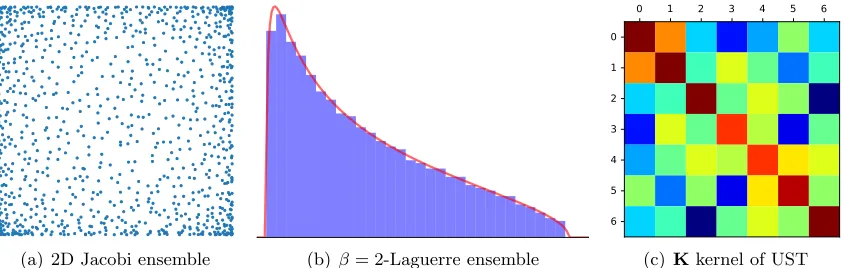
In applications where the cost of exact sampling becomes a bottleneck, users rely on approximate sampling. Research has focused mainly on kernel approximation (Affandi et al.,2013) and MCMC samplers (Anari et al.,2016;Li et al.,2016;Gautier et al.,2017). However, specific DPPs admit efficient exact samplers that do not rely on Equation4, e.g., uniform spanning trees (UST, Propp & Wilson, 1998, Figure1(c)) or eigenvalues of random matrices. For instance, aβ-ensemble is a set ofN points ofRwith joint distribution
1 ZN,β
Y
p<n
|xp−xn|β N
Y
n=1
ω(xn) dxn, where β >0.
For some choices of the weight function ω, the β-ensemble can be sampled by computing the eigenvalues of simple tridiagonal (Dumitriu & Edelman,2002) or quindiagonal random matrices (Killip & Nenciu,2004). In particular, (β = 2)-ensembles correspond to projection DPPs (K¨onig,2004). They are therefore examples of continuous DPPs that can be sampled exactly inO(N2) time, without rejection. Some of these ensembles are of direct interest to MLers. The Laguerre ensemble, for instance, has ω be a Gamma pdf, and corresponds to the eigenvalues of the empirical covariance matrix of i.i.d. Gaussian vectors, see Figure1(b). Finally, we mention thatDPPyalso features an exact sampler of the multivariate extension of theJacobi ensemble, which has been central in recent results on faster-than-Monte Carlo numerical integration (Bardenet & Hardy,2019;Gautier et al.,2019;Mazoyer et al.,2019).
4. The DPPy toolbox
DPPyhandles Python objects that fit the natural definition of the corresponding DPPs; see also the documentationî and the correspondingJupyter notebooks, which showcaseDPPy
objects. For example, FiniteDPP(kernel_type="correlation", **{"K":K})instantiates a
finite DPP(K). Its two main methods,.sample_exact()and.sample_mcmc()implement the
different exact samplers and current state-of-the-art MCMC samplers. To sample k-DPPs, the additional.sample_exact_k_dpp() and .sample_mcmc_k_dpp() methods are available.
A Laguerreβ-ensemble is instantiated asLaguerreEnsemble(beta=2).Whenβ ∈ {1,2,4},
it can be sampled either with .sample_full_model(), as the eigenvalues of a random
co-variance matrix, or, more efficiently and for any β > 0, using a tridiagonal matrix with
.sample_banded_model(). Samples can be displayed via.plot()or.hist()to construct the
empirical distribution that converges to the Marˇcenko-Pastur distribution, see Figure1(b).
DPPy can readily serve as research and teaching support. DPPy is also ready for other contributors to add content and enlarge its scope, e.g., with procedures for learning kernels.
(a) 2D Jacobi ensemble (b) β= 2-Laguerre ensemble (c)Kkernel of UST
Acknowledgments
We acknowledge funding by European CHIST-ERA project DELTA, the French Ministry of Higher Education and Research, the Nord-Pas-de-Calais Regional Council, Inria and Otto-von-Guericke-Universit¨at Magdeburg associated-team north-European project Allo-cate, and French National Research Agency project BoB (n.ANR-16-CE23-0003).
References
Affandi, R. H., Kulesza, A., Fox, E. B., and Taskar, B. Nystr¨om Approximation for Large-Scale Determinantal Processes. InInternational Conference on Artificial Intelligence and
Statistics (AISTATS), 2013.
Anari, N., Gharan, S. O., and Rezaei, A. Monte Carlo Markov Chain Algorithms for Sam-pling Strongly Rayleigh Distributions and Determinantal Point Processes. InConference
on Learning Theory (COLT), 2016. arXiv:1602.05242.
Baddeley, A. and Turner, R. spatstat : An R Package for Analyzing Spatial Point Patterns.
Journal of Statistical Software, 2005.
Bardenet, R. and Hardy, A. Monte Carlo with Determinantal Point Processes. Annals of
Applied Probability, in press, 2019. arXiv:1605.00361.
Borodin, A., Diaconis, P., and Fulman, J. On adding a list of numbers (and other one-dependent determinantal processes). Bulletin of the American Mathematical Society, 2010. arXiv:0904.3740.
Burt, D., Rasmussen, C. E., and Wilk, M. V. D.Rates of Convergence for Sparse Variational Gaussian Process Regression. InInternational Conference on Machine Learning (ICML), 2019. arXiv:1903.03571.
Derezi´nski, M., Calandriello, D., and Valko, M. Exact sampling of determinantal point pro-cesses with sublinear time preprocessing. InAdvances in Neural Information Processing
Systems (NeurIPS), 2019. arXiv:1905.13476.
Dumitriu, I. and Edelman, A. Matrix Models for Beta Ensembles.Journal of Mathematical
Physics, 2002. arXiv:math-ph/0206043.
Dupuy, C. and Bach, F. Learning Determinantal Point Processes in Sublinear Time.
In International Conference on Artificial Intelligence and Statistics (AISTATS), 2018.
arXiv:1610.05925.
Gartrell, M., Paquet, U., and Koenigstein, N. Low-Rank Factorization of Determinantal Point Processes for Recommendation. In AAAI Conference on Artificial Intelligence, 2016. arXiv:1602.05436.
Gautier, G., Bardenet, R., and Valko, M. Zonotope hit-and-run for efficient sampling from projection DPPs. International Conference on Machine Learning (ICML), 2017.
arXiv:1705.10498.
Gautier, G., Bardenet, R., and Valko, M. On two ways to use determinantal point processes for Monte Carlo integration. In Advances in Neural Information Processing Systems
(NeurIPS), 2019.
Gillenwater, J. Approximate inference for determinantal point processes. PhD thesis, University of Pennsylvania, 2014.
Hough, J. B., Krishnapur, M., Peres, Y., and Vir´ag, B. Determinantal Processes and Independence. InProbability Surveys, 2006. arXiv:math/0503110.
Kammoun, M. S. Monotonous subsequences and the descent process of invariant random permutations. Electronic Journal of Probability, 2018. arXiv:1805.05253.
Kathuria, T., Deshpande, A., and Kohli, P. Batched Gaussian Process Bandit Optimiza-tion via Determinantal Point Processes. In Advances in Neural Information Processing
Systems (NIPS), 2016. arXiv:1611.04088.
Killip, R. and Nenciu, I. Matrix models for circular ensembles. International Mathematics
Research Notices, 2004. arXiv:math/0410034.
K¨onig, W. Orthogonal polynomial ensembles in probability theory. Probability Surveys, 2004. arXiv:math/0403090.
Kulesza, A. and Taskar, B. Determinantal Point Processes for Machine Learning.
Founda-tions and Trends in Machine Learning, 2012. arXiv:1207.6083.
Launay, C., Galerne, B., and Desolneux, A. Exact Sampling of Determinantal Point Pro-cesses without Eigendecomposition. ArXiv e-prints, 2018. arXiv:1802.08429.
Lavancier, F., Møller, J., and Rubak, E. Determinantal point process models and statistical inference : Extended version.Journal of the Royal Statistical Society. Series B: Statistical
Methodology, 2012. arXiv:1205.4818.
Li, C., Jegelka, S., and Sra, S. Fast Mixing Markov Chains for Strongly Rayleigh Measures, DPPs, and Constrained Sampling. InAdvances in Neural Information Processing Systems
(NIPS), 2016. arXiv:1608.01008.
Macchi, O. The coincidence approach to stochastic point processes. Advances in Applied
Probability, 1975.
Mazoyer, A., Coeurjolly, J.-F., and Amblard, P.-O. Projections of determinantal point processes. ArXiv e-prints, 2019. arXiv:1901.02099.
Møller, J. and Waagepetersen, R. P. Statistical inference and simulation for spatial point processes. Chapman & Hall/CRC. 2004.
Poulson, J. High-performance sampling of generic Determinantal Point Processes. ArXiv
e-prints, 2019. arXiv:1905.00165.
Propp, J. G. and Wilson, D. B. How to Get a Perfectly Random Sample from a Generic Markov Chain and Generate a Random Spanning Tree of a Directed Graph. Journal of
Algorithms, 1998.
Rasmussen, C. E. and Williams, C. K. I. Gaussian processes for machine learning. MIT Press. 2006.
Soshnikov, A. Determinantal random point fields. Russian Mathematical Surveys, 2000.
arXiv:math/0002099.