The Thirty-Third AAAI Conference on Artificial Intelligence (AAAI-19)
Heterogeneous Transfer Learning via Deep
Matrix Completion with Adversarial Kernel Embedding
Haoliang Li,
1Sinno Jialin Pan,
2Renjie Wan,
1Alex C. Kot
11Rapid-Rich Object Search (ROSE) Lab, Nanyang Technological University, Singapore 2School of Computer Science and Engineering, Nanyang Technological University, Singapore
{lihaoliang,sinnopan,rjwan,eackot}@ntu.edu.sg
Abstract
Heterogeneous Transfer Learning (HTL) aims to solve trans-fer learning problems where a source domain and a target domain are of heterogeneous types of features. Most exist-ing HTL approaches either explicitly learn feature mappexist-ings between the heterogeneous domains or implicitly reconstruct heterogeneous cross-domain features based on matrix com-pletion techniques. In this paper, we propose a new HTL method based on a deep matrix completion framework, where kernel embedding of distributions is trained in an adversar-ial manner for learning heterogeneous features across do-mains. We conduct extensive experiments on two different vision tasks to demonstrate the effectiveness of our proposed method compared with a number of baseline methods.
Introduction
Transfer learning aims to transfer knowledge from one do-main with sufficient labeled data to another dodo-main where labeled data is sparse or no labeled data is available. In the literature, many existing transfer learning approaches focus on cross-domain learning problems of homogeneous fea-tures, which are referred to as homogeneous transfer learn-ing problems (Pan and Yang 2010). However, there exist many other applications where data from the source do-main and the target dodo-main is characterized by different sets of features, which are referred to as heterogeneous transfer learning (HTL) problems. For example, in some computer vision problems, one may extract powerful deep features with a well-trained deep learning network in a domain where sufficient labeled data is available for training. However, in some other domains, training data may be protected by a privacy policy (e.g. EU data protection rule (Carey 2018)). In this case, one cannot employ deep learning but use hand-crafted features to represent the data. In some other applica-tions, one domain can be text (e.g. food recipe) and the other can be images (e.g. photos of food) which also leads to het-erogeneous feature presentation. Thus, it is highly desired if knowledge extracted from the learning tasks with the public available data can be transferred to help the learning tasks where the corresponding training data is regularized by the privacy policy. In this context, as each data instance, e.g.,
Copyright c2019, Association for the Advancement of Artificial Intelligence (www.aaai.org). All rights reserved.
an image, is represented by heterogeneous features across different domain, HTL techniques are crucial.
Recently, matrix completion based methods have been proposed for HTL problems (Xiao and Guo 2013; Zhou et al. 2016). The key idea is that instead of learning an (or a pair of) explicit feature mapping(s) between feature spaces of the source domain and the target domain, one can directly re-construct cross-domain heterogeneous features for each in-stance through matrix completion techniques. For inin-stance, recently, Zhou et al. (2016) proposed a method named Dis-tribution Matching based Matrix Completion (DMMC) to encode the distance in distributions between domains into feature reconstruction in order to reduce the distance be-tween domains. However, existing matrix-completion-based methods have several major problems. First, they directly reduce the distance between domains and learn a classifier based on the recovered feature, which may fail to capture the intrinsic underlying low-dimensional structure, which indeed may benefit knowledge transfer and classifier train-ing. In addition, to make the optimization problem tractable, DMMC adopts the Maximum Mean Discrepancy (MMD) metric (Gretton et al. 2006; 2012) with a linear kernel to measure the distance between distributions, rather than a characteristic kernel (Sriperumbudur et al. 2009). As a re-sult, the distance between distributions may not be measured precisely. Moreover, they require plenty of corresponding instances between the source domain and the target domain when performing matrix completion, which limits their ap-plications in real-world problems as the corresponding data instances may be difficult to collect in some scenarios.
in the RHKS in the semi-supervised manner. We conduct ex-tensive experiments on two different vision tasks to verify the effectiveness of our proposed method.
The contributions of our work are three folds.
• We propose a novel deep neural network architecture for HTL problems, where the learned latent features can bet-ter benefit distribution matching and classifier training. • Different from previous on employing linear kernel for
measuring MMD (Zhou et al. 2016), our proposed method learns a suitable function under a RKHS in order to obtain more accurate distribution measure. The function can be jointly learned with other components.
• Experimental results on different vision tasks demonstrate that our proposed method achieves superior performance in terms of classification accuracy over some state-of-the-art HTL methods.
Related Work
Traditional transfer learning methods focus on learning problems where the source domain and target domain are represented by the same type of features (Pan et al. 2011; Gong et al. 2012), which cannot be directly applied to HTL problems. Generally, existing HTL approaches can be categorized into two groups. A first group requires a few labeled data and some unlabeled in the target do-main for training, which is referred to as semi-supervised HTL. Early works (Wang and Mahadevan 2011; Harel and Mannor 2011; Shi et al. 2010) focused on aligning het-erogenous features in a common latent space for knowl-edge transfer. Kulis, Saenko, and Darrell (2011) proposed to learn a metric for instances from heterogeneous do-mains. Zhou et al. (2014) and Xiao and Guo (2015) pro-posed semi-supervised HTL methods for multi-class clas-sification problems by exploiting the Error-Correcting Out-put Coding (ECOC) scheme, respectively. Chen et al. (2016) proposed a neural network based transfer learning ap-proach for cross-domain feature adaptation. Tsai, Yeh, and Frank Wang (2016) proposed a landmark selection strategy to align MMD and conditional MMD based on label infor-mation. More recently, Yan et al. (2018) proposed to use Gromov-Wasserstein discrepancy instead of MMD for dis-tribution matching with semantic consistency regularization. Feature augmentation, which was originally introduced in (Daum´eIII 2007) for homogeneous transfer learning, can also be applied to HTL problems based on this setting. The idea was to augment the original feature space Rd to R3d, where the source domain featurexS is augmented as
[xS,xS,0]and the target domain featurexT is augmented
as[xT,0,xT]. Here,0denotes the vector of all zeros with
dimension d. As such, the connection between the source domain and the target domain can be established. In (Duan, Xu, and Tsang 2012), the idea was extended to HTL prob-lems by introducing a common subspace for the source do-main and the target dodo-main. In particular, two projection ma-tricesPandQare introduced for the source domain and the target domain, respectively. The common space is then for-mulated in a feature augmentation manner as[PxS,xS,0T]
and[QxT,0S,xT], where0S and0T denote the vectors of
all zeros with the same dimension asxS andxT,
respec-tively. The HTL problem is solved by jointly optimizing
P,Qas well as the parameters of classifier (e.g. SVM). A follow-up semi-supervised method was proposed by Li et al. (2014), where unlabeled target domain data are utilized during the training process. Our proposed method also lever-ages the advantage of heterogeneous feature augmentation with few labeled target domain data, which has proven to be effective for HTL.
Another group of approaches does not require labeled data in the target domain but a set of unlabeled corre-spondences between the source domain and the target do-main for training. Existing matrix completion based ap-proaches (Xiao and Guo 2013; Zhou et al. 2016), which also leveraged feature augmentation, fall into this group and will be briefly reviewed as preliminary in the next section. Different from matrix completion based approaches, Dai et al. (2008) and Prettenhofer and Stein (2010) proposed to learn a feature mapping between the heterogeneous features using feature-level correspondences, e.g., word-level trans-lations. It is also worth noting that in our problem setting, though we propose a matrix completion based method for HTL, we do not require any correspondences between do-mains. However, a few labeled data in the target domain need to be provided in advance for training, which is dif-ferent from existing matrix completion based approaches.
More prior information/assumption can be leveraged to make the heterogeneous transfer learning problem more trackable. Zhuang et al. (2012) proposed to use multiple do-mains information based on Probabilistic Latent Semantic Analysis to align text distributions caused by different index words. Yang et al. (2016) proposed to learn the transferred weights with the aid of co-occurrence data which contain the same set of instances but in different feature spaces. Luo, Wen, and Tao (2017) proposed to leverage the data from multiple domains to learn high-order statistics in a multitask metric learning manner.
Model Formulation
Problem Statement and Preliminary
In this paper, we focus on semi-supervised transfer learn-ing problems, where besides plenty of source-domain la-beled data, there are a few lala-beled instances and some un-labeled instances in the target domain for training. We de-note by XS = [x>S1, ...,x
>
SNS]> and YS ∈ RNS×1 the
source-domain input matrix with each row being an instance
xSi ∈ R
1×dS, and the corresponding output vector,
re-spectively. We also denote by XT = [x>T1, ...,x >
TNT]
> the
target-domain input matrix with xTi ∈ R
1×dT. In HTL, xSiandxTiare of heterogeneous features, and thus in
gen-eral dS 6= dT. Suppose the firstNTl instances inXT are
labeled, whose corresponding label vector is denoted by
YTl ∈ R
NTl×1, and the restN
Tu = NT −NTl are
unla-beled. We assume the two domains share the same set of class labels.
the previous section, heterogeneous features augmentation introduces zero-padding for missing features. Thus, one in-tuitive idea is to recover such missing features using matrix completion for more effective knowledge transfer. Given the source-domain input matrixXSand the target-domain input
matrixXT, one can first augment the data by simply padding
zeros, which are considered as missing values, to make the dimensions of the data from the two domains identical1,
X=
XS 0
0 XT
∈R(NS+NT)×(dS+dT). (1) The goal of matrix completion based methods is to recon-struct the missing entries inXvia solving
min
Xr
kP◦(X−Xr)k
2
F+λΩ(Xr), (2)
where Xr ∈ R(NS+NT)×(dS+dT) is the recovered
aug-mented matrix, where each row is an instance with the orig-inal features and the learned augmented features,P is an indicator matrix withPij = 1ifXij is observed, otherwise
0, the operator◦is the Hadamard product,Ω(Xr)is a
regu-larization term onXr, andλ >0is a tradeoff parameter.
Deep Matrix Completion
We reformulate the matrix completion method in (2) with an auto-encoder style framework by jointly reconstructing the missing entries inXand learning a latent feature repre-sentation based on X. To be specific, we introduce an en-coderW(·)and decoderV(·), which are multi-layer fully-connected neural networks. Given a sparse augmented fea-ture input x ∈ R1×(dS+dT) drawn from X, where x =
[xS,0]if it is from the source andx= [0,xT]otherwise, we
first mapxthrough the encoderW to obtain a dense latent feature representationh, whereh=W(x). We then aim to reconstruct the missing entries inxto obtain the dense re-constructedxrthrough the decoderV. That meansxrcan
be represented asxr=V(W(x)).
For implementation, we consider the augmented matrix
Xin (1) as the input. We further denote the latent feature representation and reconstructed output as H andXr,
re-spectively. Thus, equation (2) can be reformulated in a deep learning based framework, which can be represented by
min
W,VkP◦(X−V(W(X)))k
2
F +λkV(W(X))k∗. (3)
Here we impose low-rank regularization on V(W(X)) in-duced by the nuclear normk·k∗. The motivations behind this
are two folds. First, the dimensions of augmented feature are supposed to be linearly dependent as there may be some re-dundant information among heterogeneous features across domains. Second, in many applications, high-dimensional data is usually controlled by a few latent factors.
Different from (Zhou et al. 2016), which recovers the matrix based on adapted matrix completion techniques, our method is based on deep learning to perform non-linear ma-trix factorization to reconstruct missing values of the mama-trix,
1
It should be noted that we omit the corresponding data (Xiao and Guo 2013; Zhou et al. 2016) here as the corresopnding data are not available in our setting.
where the “dictionary”V and learned representationW(X)
can be jointly learned. By doing so, the low-dimensional representative information can be explored, which can ben-efit distribution matching and classifier training.
The gradient of (3) w.r.tWandV can be computed by the chain rule with ∂Lmc(W,V)
∂Xr , whereLmc(W, V)denotes the
objective in (3). As the nuclear norm is non-differentiable, we follow (Bernstein 2005) to compute the subgradient of (3), which is given by
∂Lmc(W, V)
∂Xr
=P◦(X−Xr) +λAB> (4)
whereAandB>are the components induced by performing SVD onXrasXr=AΣB>, the gradient respect toWand
V can be computed through network back-propagation with
∂Lmc(W,V) ∂Xr .
Distribution Matching
The network described so far can estimate the missing val-ues, i.e., the missing heterogenous features. However, we also expect to extract domain-invariant information between the source domain and the target domain. We aim to achieve this by minimizing MMD (Gretton et al. 2006) between the two domains with the latent representation.
Specifically, with the hidden featuresH obtained by the W, we split it asH= [HS;HT]whereHS =W([XS,0])
andHT =W([0,XT])following two probability
distribu-tionsPS andPT, respectively. The technique of kernel
em-bedding (Gretton et al. 2006) for representing an arbitrary distribution is to introduce a mean map operation µ(·)to map instances to a reproducing kernel Hilbert space (RKHS) H, and to compute their mean in the RKHS as follows,
µP :=µ(P) =Ex∼P[φ(x)] =Ex∼P[k(x,·)], (5)
whereφ:Rd→ His a feature map, andk(·,·)is the kernel function induced byφ(·). If the conditionEx∼P(k(x,x))<
∞is satisfied, thenµP is also an element inH. It has been proven that if the kernel k(·,·) is characteristic, then the mapping µ : P → H is injective (Sriperumbudur et al. 2009). The injectivity indicates an arbitrary probability dis-tributionPis uniquely represented by an element in a RKHS through the mean map. Based on the MMD theory (Gretton et al. 2006), the distance between the source domain and the target domain (orPSandPT) can be measured by
MMD(HS,HT) = supf∈H{hf, µPS −µPTi}
= kµPS−µPTkH, (6)
wheref is a measure function defined in RKHS.
Adversarial Kernel Embedding Training
One intuitive solution to align the distribution between source and target domain is imposing MMD with a prede-fined kernel (Pan et al. 2011) onHSandHT, which leads to
the gap between deep learning and the MMD measurement, Li, Swersky, and Zemel (2015) proposed a multi-layer data space network to parameterizef by mapping the data from one space to another which is suitable for MMD measure-ment. Though their work was originally proposed for gen-eration tasks, it tackles a similar problem as transfer learn-ing problems we focus on in a high level, as it aims to map the data drawn from one domain (noise) to another domain (data space) where the distributions of the training data and the generated data are aligned in terms of the MMD distance in (6).
Therefore, we introduce an encoding networkfφe to
pa-rameterizef, and reformulate (6) as
MMD(HS,HT)
= max fφe 1 NS
fφe(HS)
>1
S−
1
NT
fφe(HT)
>1 T 2 F ,(7)
where1S and1T are all-one vectors with the sizeNS and
NT, respectively. N1
Sfφe(HS)
>1
S and N1
Tfφe(HT)
>1
T
are the empirical measure (Gretton et al. 2006) ofµPS and µPT, respectively.
Aligning the distribution between source and target do-main can be achieved by minimizingWas
min
W maxfφe
1 NS
fφe(HS)
>1
S−
1
NT
fφe(HT)
>1 T 2 F . (8)
Note that (8) is related to Generative Adversarial Network (GAN) (Goodfellow et al. 2014). In GAN, there are two types of networks: a generative modelGthat aims to capture the distribution of the training data for data generation, and a discriminative modelD that aims to distinguish between the instances drawn fromGand the instances sampled from the dataset. In our model, the networkfφeworks in a
simi-lar manner asDto maximize MMD in order to distinguish distributions, andW is trained to map the input to the latent feature space where MMD is minimized. These two compo-nents are jointly trained in a competitive fashion: 1) to train fφeto distinguish the two feature distributions generated by
W, and 2) to trainW to foolfφe with its latent features.
To make the kernel embedding more effective, there are two issues need to be considered. First, the continuous func-tion is supposed to be bounded in the RKHS (Theorem 3.5 in (Muandet et al. 2017)). To achieve this condition, we im-pose locally Lipschitz constraint by adding weight clipping onfφe. Second,fneeds to be injective (Sriperumbudur et al.
2009; Muandet et al. 2017). We therefore introduce another neural networkfφdto parameterizedf
−1in order to
approx-imate the injective property byf−1(f(h)) = h,∀h ∈ H. Similar to (Li et al. 2017), we obtain the final distribution divergence loss termLd(W, fφe, fφd)as
Ld(W, fφe, fφd) =ζ
1 NS
fφe(HS)
>1
S−
1 NT
fφe(HT)
>1 T 2 F
−ηH−fφd(fφe(H))
2
F. (9)
Label Propagation for Semi-supervised Learning
To make matrix completion more effective, existing ap-proaches (Xiao and Guo 2013; Zhou et al. 2016) assume
some cross-domain instance correspondences are given in advance to build a bridge between domains. However, as discussed this assumption is difficult to satisfy in practice. Therefore, instead, we assume only a few target-domain la-beled instances are given. Our goal is to introduce a clas-sification network denoted byCbased on the latent repre-sentationHto bridge the gap between domains via labels. In particular, the classification network is a full-connected network with the Softmax function,
p(yi=k|C) =
exp(Ck(Hi))
P
k0exp(Ck0(Hi))
, (10)
whereyi ∈ YS if the sample is from source domain and
yi ∈ YTl for labeled target domain,Hi denotes thei-th
instance fromH, andCk(·)denotes the output on thek-th
class generated by Softmax.
As we only have a few target-domain labeled instances, we employ graph-based semi-supervised learning to propa-gate label information. In particular, a Laplacian matrix (He
et al. 2005) given as Lg=
LgS 0
0 LgT
, is introduced
by adding tr(H>LgH)as the manifold regularization term,
whereLgS andLgT are the Laplacian matrices onXS and XT, respectively. The loss on the semi-supervised classifier
is then defined as
Lcg(W, C) = −
1
NS NS
X
i=1
1(yi=k) logp(yi=k|W, C)
− 1 NTl
NS+NTl
X
j=NS+1
1(yj=k) logp(yj=k|W, C)
+γtr(H>LgH), (11)
where1is an indicator function which returns 1 when argu-ment is true, otherwise 0. In this work, we use 5-NN with 0/1 weights to construct the Laplacian matrices.
Model Optimization
The final objective of our proposed Deep-MCA method is formulated as
L=Lmc(W, V) +Lcg(W, C) +Ld(W, fφe, fφd) (12)
where the first term defined in (3) serves as a matrix comple-tion component, the second term defined in (11) is the semi-supervised classifier on the learned feature representation, and the third term defined in (9) is a distribution divergence component which captures the difference in distribution be-tween domains.
Algorithm 1 illustrates our training algorithm based on the adaptive moment estimation (ADAM) algorithm (Kingma and Ba 2014). We first initialize the network parameters by Gaussian distribution withN ∼ (0,0.02). The source and target features are augmented by zero padding as discribed in (1). Similar to GAN, the network can be trained in a mini-max manner. During mini-maximization step, we adopt weight clipping to satisfy the Lipschitz constraint condition. Fi-nally, we follow the generative adversarial networks (GAN) (Goodfellow et al. 2014) by trainingfφd for few iterations
followed by trainingfφe, which is the parameterBin
Figure 1: Proposed framework for heterogeneous transfer learning. We first augment the data through zero padding. Then we aim to learn feature representation which capture shareable information across heterogeneous domain through our proposed method. In this figure, we use the augmented feature from source domain for visualization.
Algorithm 1Deep-MCA
Input:XS,XT,YS andYTlinitialized parametersW,
V,C,fφeandfφd.
Output:Learned parametersW∗,V∗,C∗,fφ∗
eandf
∗
φd.
1: Augment the source and target domain asX.
whileStopping criterion is not metdo fort=1:Bdo
2: Compute the gradient of (9) w.r.t. fφe and fφd
based on augmented dataX.
3: Take a gradient step to updatefφeandfφdto
max-imize the objective (9).
4: Conduct weight clipping based onfφeandfφd. end for
5: Compute the SVD ofXrto obtainAandB.
6: Compute the gradient of (12) w.r.t.W,V,ConX
withAandB, respectively.
7: Take a gradient step to updateW,V,Cto minimize the objective (12), alternatingly.
end while
Experiment
In the section, we conduct experiments on two different vision tasks, cross-domain object recognition and text-to-image classification with heterogeneous features to verify the effectiveness of our proposed method compared with some state-of-the-art HTL baselines. For the experimental setup, we assume that we only have one source domain and one target domain. We use a limited number of target-domain labeled instance and some target-target-domain unlabeled instances for training in our HTL problems. We report the averaged results over 10 random splits on the target-domain unlabeled instances for both cross-domain object recogni-tion and text-to-image classificarecogni-tion tasks.
Experimental Setup
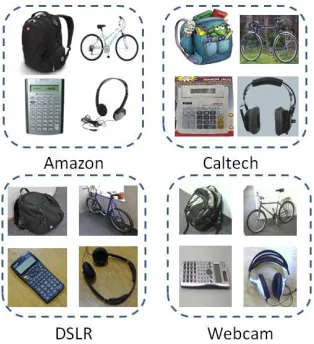
Object Recognition We follow the setting (Tsai, Yeh, and Frank Wang 2016; Yan et al. 2018) by using images col-lected from Amazon dataset (A), DSLR dataset (D), we-bcam dataset (W) and Caltech-256 dataset (C), where ten common categories in all these datasets are used for con-duct experiments. For the HTL setting, considering that it
Figure 2: Example images of Amazon, DSLR, Webcam and Caltech-256 datasets.
is difficult to train a robust deep neural network with only few data, we then consider deep feature representation for source domain and hand-crafted feature for target domain. In particular, we use instances of the DeCAF6features (Jia et al. 2014) with dimension 4,096 to construct a source do-main and instances of the bag-of-words based SURF fea-tures (Gong et al. 2012) with dimension 800 to construct a target domain. We randomly select 20 labeled instances per category from the source domain and 3 labeled instances per category from the target domain for training, and the remain-ing instances in target domain are used for testremain-ing. For the source domains constructed on DSLR, we randomly choose 5 source instances per category as suggested in (Yan et al. 2018) since the number of instances in D is much smaller.
Text-to-Image Classification We apply NUS-WIDE (Chua et al. 2009) and ImageNet (Deng et al. 2009) as the datasets for text-to-image classification task. NUS-WIDE contains 269,648 images with tag information collected from Flickr and ImageNet wis with 5247 synsets and 3.2 million images in total. We follow (Chen et al. 2016) by extracting the 64-dimensional feature representation from a five-layer neural network as the feature for tag data. We consider DeCAF6feature for image data. Eight overlapping categories from these two datasets are considered, which include airplane, birds, buildings, cars, dog, fish, flowers, horses. All tag data are used as source domain. Three images per category from ImageNet dataset are randomly selected as labeled data, and another 100 images for prediction.
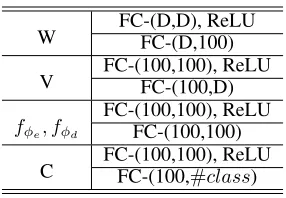
Network Architecture and Parameter Setting In our proposed method, we consider to adopt a two-layer ar-chitechture for encoder (W), decoder (V), feature mapping network (fφe), injection network (fφd) as well as the
labeled target domain. In our experiment, we fix the param-eters for all experiments for simplicity. In particular, we set λ = 0.001, ζ = 10and all others as1. We set the dimen-sion of hidden layer as100 for fair comparison with other baseline methods.
Table 1: Details of our proposed network architechture.D indicates the dimension of input augmented feature.
W FC-(D,D), ReLUFC-(D,100)
V FC-(100,100), ReLUFC-(100,D)
fφe, fφd
FC-(100,100), ReLU FC-(100,100)
C FC-(100,100), ReLUFC-(100,#class)
Baseline Methods We compare our proposed method with the following baselines: (SVM t) that simply employs labeled data from target domain to train a model, and some state-of-the-art HTL methods, including SHFA (Li et al. 2014), DMMC (Zhou et al. 2016), CDLS (Tsai, Yeh, and Frank Wang 2016), SGW (Yan et al. 2018) and the deep learning based TNT (Chen et al. 2016). We follow the previ-ous works to search the parameters in spaces recommended by the original papers and report their best results.
Experimental Results
For object recognition, we report experimental results by constructing HTL tasks on the same dataset and cross datasets. The results are shown in Table 2. From the re-sults, we can see that the SVM t baseline method performs poorly for all different object recognition tasks. This is rea-sonable because there are only a few labeled in the target domain for training. By exploiting the labeled training data of heterogeneous features from the source domain, we no-tice that the learning performance in terms of prediction accuracy improvements. Among all the HTL methods, our proposed method can achieve the best performance among eight out of nine cases, which indicates the effectiveness of kernel adaptation compared with linear adaptation. Another possible explanation is that, while other HTL methods fo-cus on either MMD alignment (Tsai, Yeh, and Frank Wang 2016) or classifier exploiting (Li et al. 2014), we focus on both as regularization. Although TNT method (Chen et al. 2016) is based on neural network, it is lack of distribution alignment term thus the shareable cross-domain informa-tion may not be properly extrated. SGW was the most re-cent proposed method for HTL problem. However, only lin-ear mapping was llin-earned based on the data, which may not model the distribution distance accurately since linear kernel is not characteristic. We also investigate linear matrix com-pletion, DMMC, without correspondences. We observe that DMMC performs poorly when there are no cross-domain correspondences, which is consistent with the results re-ported in (Zhou et al. 2016). This suggests that to use ma-trix completion based method, when there are no
correspon-dences, utilizing target-domain label information is crucial for effective knowledge transfer.
Table 2: Classification accuracy (in %) for heterogeneous object recognition (DeCAF6 for source domain, SURF for target domain), where A, C and W denote Amazon, Caltech and Webcam respectively.
S/T SVM t SHFA DMMC CDLS SGW TNT Deep-MCA
A/A 42.1 44.9 34.9 43.7 46.4 43.1 47.4
C/C 30.1 31.1 25.7 32.3 34.1 30.7 34.7
W/W 57.3 62.7 50.3 63.1 63.5 60.0 66.4
S/T SVM t SHFA DMMC CDLS SGW TNT Deep-MCA
A/D
57.9 58.1 49.1 59.4 59.7 56.5 60.1
W/D 62.7 48.6 60.2 59.4 57.2 63.0
D/A
42.1 42.7 32.7 43.5 44.1 40.5 44.7
W/A 44.2 35.1 45.1 50.8 41.8 48.6
A/W
57.3 62.5 44.2 63.5 63.9 59.9 66.8
D/W 60.8 46.4 63.7 64.4 60.1 66.4
For text-to-image task, we can also observe that our pro-posed method can outperforms the other baseline methods. DMMC without correspondence achieves a relatively poor performance which is consistent with the results on object recognition. Another interesting result we find is that the TNT method can achieve a relatively better performance compared with the results obtained for object recognitiont task. One possible explanation is that tree based neural net-work can better deal with inbalanced heterogeneous feature representation scenario better compared with other baseline methods (64 dim for TAG feature extracted by a five-layer neural network compared with the 4096 dim for DeCAF6).
Table 3: Classification accuracy (in %) for adapting text (NUS-WIDE) to image data (ImageNet).
S/T SVM t SHFA DMMC CDLS SGW TNT Ours
Tag/Image 67.5 67.3 60.7 69.0 68.3 70.4 71.7
Impact on Different Components
In this section, we further conduct experiments on object recognition to understand the impact of different compo-nents of our proposed algorithm with object classification task by considering the same dataset setting from Amazon, DSLR and Webcam dataset with DeCAF6 for source do-main and SURF as target dodo-main. Experimental results are shown in Table 4. “No Low-rank” means that we remove the low-rank constraintkXrk∗ for the final objective. “No
In-jective” means that we remove the subnetworkfφd and the
termkH−fφd(fφe(H))k
2
F. “No MMD” means that we
re-move the MMD regularization term as well as the “injective” regularization term from the objective (as injective regular-ization is meaningless without MMD) and “No Manifold” means that we remove the manifold constraint on the latent feature representation.
(a) (b) (c)
Figure 3: Parameter sensitivity analysis. Accuracy under varying (a)λ, (b)ζ, (c)γ
framework: 1) Considering “low-rank” constraint benefits latent feature representation learning regarding augmented input 2) Using MMD-based regularization is helpful to re-duce difference between the seen source domains, and thus able to learn invariant features across source domains. 3) Imposing “injective” regularization helps to learn a better representation for distribution matching. 4) Incorporating manifold regularization helps to learn a more robust clas-sifier based on target domain. Moreover, compared with the SVM tbaseline, it is observed that we still can achieve bet-ter performance under all scenarios.
Table 4: Impact of different components on performance, where A, C and W denote Amazon, Caltech and Webcam respectively.
S/T No Low-rank No Injective No MMD No Manifold Ours
A/A 43.7 47.0 43.0 44.6 47.4
C/C 30.2 34.5 32.0 30.4 34.7
W/W 62.3 63.1 58.4 62.7 66.4
We further observe that, “low-rank”, “MMD” and “Man-ifold” constraints play more important roles in the final results. Therefore, we also aim to analyze the sensitivity of the parameters λ, ζ and γ which control “low-rank”, “MMD” and “Manifold” regularization. Experimental re-sults are shown in Figure 3. From the figure, we notice that the parameters we choose are reasonable based on all sce-narios. Forλ, we can achieve good performances when the parameter is relatively small. Forζ, we observe that the per-formances are stable whenζ ≥1. However, forγ, we only achieve the best performance whenγ= 1.
Convergence Analysis
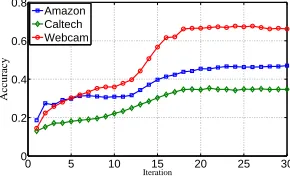
Finally, we are interested in the convergence property of our proposed method. We therefore conduct experiment based on object classification task by considering the same dataset setting from Amazon, DSLR and Webcam dataset with DeCAF6 for source domain and SURF as target domain. We report the classification accuracy respect to the iteration number. The results are shown in Figure 4. Based on the results, we observe that our method can converge after 20 it-erations for all cases despite the fact that the neural network is nonlinear and our objective is non-convex.
0 5 10 15 20 25 30
0 0.2 0.4 0.6 0.8
Iteration
Accuracy
Amazon Caltech Webcam
Figure 4: Convergence analysis of our proposed algorithm on Amazon, Caltech and Webcam dataset.
Conclusion
In this paper, we presented a new framework Deep-MCA for HTL. The main idea is to develop an end-to-end solution based on a deep architecture with adversarial kernel train-ing to perform nonlinear matrix factorization for learntrain-ing heterogeneous features for HTL problems. We conduct ex-periments on two vision tasks to demonstrate that Deep-MC generally outperforms other state-of-the-art baselines. We have also conduct experiments to test the impact of different components of Deep-MC as well as empirical convergence analysis on Deep-MCA.
Acknowledgement
This research was carried out at the Rapid-Rich Ob-ject Search (ROSE) Lab at the Nanyang Technological University, Singapore. This research is supported by the National Research Foundation, Prime Minister’s Office, Singapore, under the NRF-NSFC grant NRF2016NRF-NSFC001-098. Sinno J. Pan thanks the support from NTU Singapore Nanyang Assistant Professorship (NAP) grant M4081532.020.
References
Bernstein, D. S. 2005. Matrix mathematics: Theory, facts, and formulas with application to linear systems theory, vol-ume 41. Princeton university press.
Carey, P. 2018. Data protection: a practical guide to UK and EU law. Oxford University Press, Inc.
Chua, T.-S.; Tang, J.; Hong, R.; Li, H.; Luo, Z.; and Zheng, Y. 2009. Nus-wide: a real-world web image database from national university of singapore. InCIVR, 48.
Dai, W.; Chen, Y.; Xue, G.-R.; Yang, Q.; and Yu, Y. 2008. Translated learning: Transfer learning across different fea-ture spaces. InNIPS.
Daum´eIII, H. 2007. Frustratingly easy domain adaptation. InACL.
Deng, J.; Dong, W.; Socher, R.; Li, L.-J.; Li, K.; and Fei-Fei, L. 2009. Imagenet: A large-scale hierarchical image database. InCVPR.
Duan, L.; Xu, D.; and Tsang, I. W. 2012. Learning with augmented features for heterogeneous domain adaptation. In
ICML.
Gong, B.; Shi, Y.; Sha, F.; and Grauman, K. 2012. Geodesic flow kernel for unsupervised domain adaptation. InCVPR. Goodfellow, I.; Pouget-Abadie, J.; Mirza, M.; Xu, B.; Warde-Farley, D.; Ozair, S.; Courville, A.; and Bengio, Y. 2014. Generative adversarial nets. InNIPS.
Gretton, A.; Borgwardt, K. M.; Rasch, M.; Sch¨olkopf, B.; and Smola, A. J. 2006. A kernel method for the two-sample-problem. InNIPS.
Gretton, A.; Borgwardt, K. M.; Rasch, M. J.; Sch¨olkopf, B.; and Smola, A. 2012. A kernel two-sample test. Journal of Machine Learning Research13(Mar):723–773.
Harel, M., and Mannor, S. 2011. Learning from multiple outlooks. InICML.
He, X.; Cai, D.; Yan, S.; and Zhang, H.-J. 2005. Neighbor-hood preserving embedding. InICCV.
Jia, Y.; Shelhamer, E.; Donahue, J.; Karayev, S.; Long, J.; Girshick, R.; Guadarrama, S.; and Darrell, T. 2014. Caffe: Convolutional architecture for fast feature embedding. In
MM.
Kingma, D. P., and Ba, J. 2014. Adam: A method for stochastic optimization.arXiv preprint arXiv:1412.6980. Kulis, B.; Saenko, K.; and Darrell, T. 2011. What you saw is not what you get: Domain adaptation using asymmetric kernel transforms. InCVPR.
Li, W.; Duan, L.; Xu, D.; and Tsang, I. W. 2014. Learning with augmented features for supervised and semi-supervised heterogeneous domain adaptation. IEEE transactions on pattern analysis and machine intelligence36(6):1134–1148. Li, C.-L.; Chang, W.-C.; Cheng, Y.; Yang, Y.; and P´oczos, B. 2017. Mmd gan: Towards deeper understanding of moment matching network. InNIPS.
Li, Y.; Swersky, K.; and Zemel, R. 2015. Generative mo-ment matching networks. InICML.
Long, M.; Cao, Y.; Wang, J.; and Jordan, M. 2015. Learn-ing transferable features with deep adaptation networks. In
ICML.
Luo, Y.; Wen, Y.; and Tao, D. 2017. Heterogeneous multi-task metric learning across multiple domains. IEEE trans-actions on neural networks and learning systems.
Muandet, K.; Fukumizu, K.; Sriperumbudur, B.; Sch¨olkopf, B.; et al. 2017. Kernel mean embedding of distributions: A
review and beyond. Foundations and TrendsR in Machine Learning10(1-2):1–141.
Pan, S. J., and Yang, Q. 2010. A survey on transfer learn-ing.IEEE Transactions on knowledge and data engineering
22(10):1345–1359.
Pan, S. J.; Tsang, I. W.; Kwok, J. T.; and Yang, Q. 2011. Domain adaptation via transfer component analysis. IEEE Transactions on Neural Networks22(2):199–210.
Prettenhofer, P., and Stein, B. 2010. Cross-language text classification using structural correspondence learning. In
ACL.
Shi, X.; Liu, Q.; Fan, W.; Yu, P. S.; and Zhu, R. 2010. Transfer learning on heterogenous feature spaces via spec-tral transformation. InICDM.
Sriperumbudur, B. K.; Fukumizu, K.; Gretton, A.; Lanck-riet, G. R. G.; and Sch¨olkopf, B. 2009. Kernel choice and classifiability for RKHS embeddings of probability distribu-tions. InNIPS.
Tsai, H. Y.-H.; Yeh, Y.-R.; and Frank Wang, Y.-C. 2016. Learning cross-domain landmarks for heterogeneous do-main adaptation. InCVPR.
Wang, C., and Mahadevan, S. 2011. Heterogeneous domain adaptation using manifold alignment. InIJCAI.
Xiao, M., and Guo, Y. 2013. A novel two-step method for cross language representation learning. InNIPS.
Xiao, M., and Guo, Y. 2015. Semi-supervised subspace co-projection for multi-class heterogeneous domain adaptation. InECML/PKDD.
Yan, Y.; Li, W.; Wu, H.; Min, H.; Tan, M.; and Wu, Q. 2018. Semi-supervised optimal transport for heterogeneous domain adaptation. InIJCAI.
Yang, L.; Jing, L.; Yu, J.; and Ng, M. K. 2016. Learning transferred weights from co-occurrence data for heteroge-neous transfer learning. IEEE transactions on neural net-works and learning systems27(11):2187–2200.
Zhou, J. T.; Tsang, I. W.; Pan, S. J.; and Tan, M. 2014. Heterogeneous domain adaptation for multiple classes. In
AISTATS.