279 Copyright © 2011-15. Vandana Publications. All Rights Reserved.
Volume-5, Issue-1, February-2015
International Journal of Engineering and Management Research
Page Number: 279-284
LEACH and Its Enhancements Techniques–A Review
Deepika verma1, Rekha Jain2, Anurag Shrivastava3 1,2,3
Electronics & Telecommunication Department, SGSITS, Indore, Madhya Pradesh, INDIA
ABSTRACT
In Wireless Sensor Network (WSN), the life span depends on the energy consumption of the sensor node, by reducing the energy consumption of each node which in turn increases the lifetime of the network. Clustering is an effective technique to reduce the energy consumption. Low Energy Adaptive Clustering Hierarchy (LEACH) protocol is the first hierarchical cluster based routing protocol successfully used in the Wireless Sensor Networks (WSN). In this paper, we present a recent survey of hierarchical routing protocols which are based on LEACH protocol. Specifically, we will show the network life time and energy consumption for each protocol. Furthermore, a comparison of these protocols in terms of advantages, disadvantages, communication pattern and energy efficiency are provided to identify the research issues to be solved and idea for the future proposed routing algorithms of wireless networks based on LEACH routing algorithm.
Index Terms— wireless sensor network, LEACH, hierarchical routing, clustering, CH selection, energy consumption, network lifetime.
I.
INTRODUCTION
Wireless sensor network composed of large number of sensor nodes. Sensor nodes consist of microprocessor, memory, transceiver, and power supply. Sensor nodes can measure various factors like temperature, humidity etc. These sensors nodes have limited sensing, processing and communication capabilities. Remote and random location of nodes makes them irreplaceable. Due to the restrictions of the resources in wireless sensor network it is important to minimize the amount of transmission.
In real-life applications of wireless sensor networks (WSNs), the life span depends on the energy consumption of
the sensor node. Energy optimization is important issue to improve the lifetime of the network. Energy efficiency is one of the most important design factors for WSN, as the typical sensor nodes are equipped with limited power batteries. The transmission of data consumes most of the limited nodes energy. So there is a need of energy efficient routing strategies to increase the network lifetime. Many techniques are proposed to achieve longer lifetime and efficient energy consumption. One of the interesting techniques is the Hierarchical Routing, which introduces the concept of cluster creation and assigning special tasks to selected sensor node within the cluster called cluster head CH. Hierarchical Routing is an efficient technique to reduce energy consumption by doing data aggregation and fusion in order to reduce the number of transmissions to the Base Station (BS). Thus increases the lifetime of the network.
The first hierarchical protocol is the Low Energy Adaptive Clustering Hierarchy (LEACH) that was introduced by Heinzelman [8]. The low-energy adaptive clustering hierarchy (LEACH) protocol is one of the most adaptive protocols designed for communication in sensor networks (WSNs). LEACH provides a powerful strategy for energy balancing, using cluster head rotations and increase the lifetime of the network. Many hierarchical protocols were emerged based on the idea of LEACH. Our goal is to provide a recent survey of LEACH based protocols.
II.
LOW ENERGY ADAPTIVE
CLUSTERING HIERARCHY
280 Copyright © 2011-15. Vandana Publications. All Rights Reserved.
all sensor nodes in the network. The nodes organize themselves into local clusters, where one node acts as the local base station or cluster head. LEACH also performs local data compression, reducing the amount of data sent from the clusters to the base station, which further reduces energy dissipation and enhances system lifetime.
The concept of LEACH is to organize the nodes into clusters to distribute the energy among the sensor nodes in the network, and in each cluster there is an elected node called a cluster head (CH). Fig.1 shows LEACH communication hierarchy.
The operation of LEACH breaks down into rounds as shown in Fig 2. Each round has two phases: the setup phase and the steady-state phase. During the setup phase, clusters are organized; during the steady-state phase, data transmission is performed.
1. Setup Phase
In this phase clusters are formed and a CH is chosen for each cluster. Every sensor node n chooses a random number between 0 and 1. If this random number is less than a threshold value T(n), the node becomes a cluster-head for the current round. T (n) is defined as follows
Figure1. Illustration of LEACH protocol [2]
Figure 2.LEACH phases: setup and steady state phase [2]
. T(n) =
))
/
1
mod(
(
1
p
r
p
p
−
if n є G0 Otherwise (1)
Where, p is the percentage CH to all the nodes, r is the current round, G is the set of nodes that have not been elected in the past 1/p rounds of election. When r = 0, the possibility of each node becoming the cluster head is P. If any node becomes the cluster head node in the first r rounds, it can be
no longer re-elected in the future (1/P-r) round which enhances the possibility of other nodes to become a cluster head. After 1 / P rounds, all nodes have a possibility of P to be a cluster head once again, over and over again [8], [1], [2].
The nodes which are being cluster-head for the current round broadcast advertisement message to rest of the nodes with same transmit energy. There must be receiver of the non cluster-head on while advertising. After this, each node decide to which it would belongs based on receiving signal strength of advertising signal. When clusters are formed, each CH creates a TDMA schedule according to the number of nodes in the cluster. Each node sends their sensed data to its CH during its allocated transmission time in the TDMA.
2. Steady-state Phase
In this phase, all the non-CH nodes start sensing data and send it to their CH according to the TDMA schedule. The CH node compresses the received data and sends it to the base-station. Communication is via direct-sequence spread spectrum and each cluster uses a unique spreading code to reduce inter-cluster interference. After certain period of time, the network again goes into the setup phase and enters another round of selecting cluster heads (CHs).
LEACH protocol assumes a simple radio model [8],[2] which describe the energy dissipation though the electronic devices, transmitter, power amplifier and the receiver. Fig 3 shows the radio model use to study LEACH and other LEACH-based protocols.
Figure.3 Radio Energy Dissipation Model [2]
In this Radio model of Tx amplifier, we use n=2 for free space and n=4 for multipath model. Thus if a node transmits K number of bits, the energy used in transmission will be
ETX(K, d) = Eelect.K + Eamp(K, d)
ETX(K, d) = K . Eelect +K. єfs.d2 if (d ≤ do) K . Eelect +K. єmp.d4 if (d > do)
Here,
d
mp fs
∈
∈
o =
281 Copyright © 2011-15. Vandana Publications. All Rights Reserved.
ERX(K) = = Eelect.K
The parameters shown in Table 1.1 are used to evaluate the energy consumption in a wireless sensor network.
Disadvantages of LEACH
1. LEACH does not provide clarity about position of sensor nodes and the number of cluster heads in the network.
2. Each Cluster-Head directly communicates with BS no matter the distance between CH and BS. It will consume lot of its energy if the distance is far.
3. The CH uses most of its energy for transmitting and collecting data, therefore it will die faster than other nodes.
4. The CH is always on and when the CH die, the cluster will become useless because the data gathered by cluster nodes will never reach the base station.
5. It does not work well with the applications that require large area coverage along with multi-hop inter-cluster communication.
III.
LEACH IMPROVEMENT
TECHNIQUES
There are many techniques of LEACH that have been proposed by many authors that described the improvement of the efficient LEACH protocol in many factors to overcome the disadvantages which are there in the LEACH clustering protocol. Some of the improvements of LEACH protocol are mentioned below.
1. LEACH-E (Energy Low Energy Adaptive Clustering
Hierarchy)
Yuling Li et al. [6] proposed LEACH-E protocol to improve the CH selection process compared to LEACH protocol. The LEACH-E is divided into different round that is same as LEACH protocol. In the first round all the sensor nodes would having the same probability to be CH of the cluster. After the first round of transmission the residual
energy of each node would got different and based on this, the node who would have the high residual energy would be chosen as CH of the cluster and other nodes in the cluster would became the cluster member who would having the less energy.
2. TL-LEACH (Two level Low Energy Adaptive Clustering
Hierarchy)
In LEACH protocol, the CH sends the aggregated data to the sink directly. Due to this process CHs would die very early compared to the other sensor nodes due to energy loss for transmission of information to the sink because sink node may be located too far away from the CHs. To overcome this, Farooq et al. [1] proposed TL-LEACH. In this CH collects information as LEACH protocol, but for transmission to the sink it uses one of the CHs that lies between the CH and the sink as a relay station.
3. M-LEACH (Multi-hop Low Energy Adaptive Clustering
Hierarchy)
When the network diameter is increased beyond a certain level, the distance between the CHs and the sink node would get increased and this is disadvantage of the LEACH protocol. To address this problem, N.Javaid et al. [4] introduced the Multi-Hop LEACH which aims to increase energy efficiency of a WSN. In multi-hop LEACH CH sends the data to the sink using the other CHs as relay stations. M-LEACH is a complete distributed clustered based routing protocol. M-LEACH allows two types of communication operations. These are the inter-cluster communication and the intra-cluster communication.
4. LEACH-C (Centralized Low Energy Adaptive
Clustering Hierarchy)
X.H.Wu et al. [7] introduced LEACH-C. LEACH-C uses a centralized clustering algorithm and same steady state phase as LEACH. In the set-up phase of LEACH-C, each node would send its current location position and energy level information to the sink node based on this information from the sensor nodes the BS will determine the different clusters along with CH node and non-CH nodes of each and every cluster. The BS would able to produce better clusters by utilizing its global information of the whole network and by this process less energy is being consumed for data transmission purpose.
5. I-LEACH (Improved Low Energy Adaptive Clustering
Hierarchy)
282 Copyright © 2011-15. Vandana Publications. All Rights Reserved.
many numbers of neighbors, and smaller distance to the BS as CH node. Based on the CH formation, all the sensor nodes managed to formthe clusters in such a way to maximize WSN lifetime and minimize average energy dissipation per each sensor node. I-LEACH improved the performance at least 65%, decreases the consumption of energy up to 62%, and improves the successfully PDR by at least 56% as compared to the these algorithms for WSN.
6. LEACH - CC(Low Energy Adaptive Clustering
Hierarchy centralized with chain)
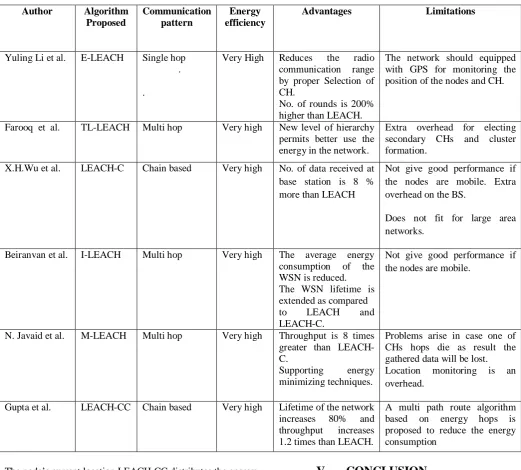
Gupta et al. [5] proposed a low energy-consumption chain based routing protocol LEACH-CC. LEACH-CC is an improved version of LEACH-C. LEACH-CC uses a centralized clustering algorithm, minimize the distance between non-cluster-nodes to cluster nodes, and use only one cluster-head transmission to the base station per round. During the set-up phase of LEACH-CC, each node sends information about its current location and energy level to the base station. The base station runs an optimization algorithm to determine the clusters for that round. The clusters formed by the base station will in general be better than those formed using the distributed algorithm. However, LEACH-CC requires that each node transmit information about its location to the base station at the beginning of each round. This information may be obtained by using a global positioning system (GPS) receiver that is activated at the beginning of each round to get criteria advantages (improvements), and disadvantages. We summarize them in Table II.
283 Copyright © 2011-15. Vandana Publications. All Rights Reserved.
Table II. Comparison Among the Different LEACH Improvement Techniques
The node’s current location LEACH-CC distributes the energy and load to all the nodes thus increasing the lifetime and quality of the network. LEACH-CC can be improved even further when the size of the network increases.
IV.
COMPARISION AMONG THE
DIFFERENT LEACH
IMPROVEMENT TECHNIQUES
Our survey shows that each of the various
LEACH Based routing protocols has its own assumptions, CH selection criteria, advantages (improvements), and disadvantages. We summarize in Table II.
V.
CONCLUSION
One of the main challenges in the design of routing protocols for WSNs is how to efficiently consume energy because energy resources are very limited. The ultimate objective behind the routing protocol design is to keep the sensors in operation for as long as possible, thus extending the network’s lifetime. In this paper we have surveyed various LEACH-based protocols. We also studied various improved version of LEACH protocol which improves energy consumption in WSNs and increase network’s lifetime
Author Algorithm
Proposed
Communication pattern
Energy efficiency
Advantages Limitations
Yuling Li et al. E-LEACH Single hop .
.
Very High Reduces the radio communication range by proper Selection of CH.
No. of rounds is 200% higher than LEACH.
The network should equipped with GPS for monitoring the position of the nodes and CH.
Farooq et al. TL-LEACH Multi hop Very high New level of hierarchy permits better use the energy in the network.
Extra overhead for electing secondary CHs and cluster formation.
X.H.Wu et al. LEACH-C Chain based Very high No. of data received at base station is 8 % more than LEACH
Not give good performance if the nodes are mobile. Extra overhead on the BS.
Does not fit for large area networks.
Beiranvan et al. I-LEACH Multi hop Very high The average energy consumption of the WSN is reduced.
The WSN lifetime is extended as compared to LEACH and LEACH-C.
Not give good performance if the nodes are mobile.
N. Javaid et al. M-LEACH Multi hop Very high Throughput is 8 times greater than LEACH- C.
Supporting energy minimizing techniques.
Problems arise in case one of CHs hops die as result the gathered data will be lost.
Location monitoring is an overhead.
Gupta et al. LEACH-CC Chain based Very high Lifetime of the network increases 80% and throughput increases 1.2 times than LEACH.
284 Copyright © 2011-15. Vandana Publications. All Rights Reserved.
from the given survey that for an energy-efficient and prolonged network lifetime, still it is needed to find more efficient, scalable and robust clustering scheme for better result. It is observed that future research on LEACH algorithm aims to use the multi hop communication pattern and optimal number and election of cluster heads.
REFERENCES
[1] Alakesh Braman, Umapathi G. R. “A Comparative Study on Advances in LEACH Routing Protocol for Wireless Sensor Networks: A survey”, International Journal of Advanced Research in Computer and Communication Engineering, Vol. 3, Issue 2, pp. 5683-5690, February 2014.
[2] Raed M. Bani Hani and Abdalraheem A. Ijje, “A Survey on LEACH-Based Energy Aware Protocols for Wireless Sensor Networks”, Journal of Communications, Vol. 8, No. 3, pp 192-206, March 2013.
[3] M. Madheswaran and R. N. Shanmugasundaram, "Enhancements of LEACH Algorithm For Wireless Network: A Review", Published in ICTACT Journal on Communication Technology, Vol. 4, pp. 821-827, Dec 2013.
[4] N. Javaid, M. Aslam, A. Rahim, U. Nazir, A. Bibi, Z. A. Khan,” Survey of Extended LEACH-Based Clustering Routing Protocols for Wireless Sensor Networks”, In IEEE 14th International Conference on High Performance Computing and Communications, pp 1232-1238, 2012.
[5] Ankit Gupta, Sangeeta Malik, Monika Goyal and Pankaj Gupta, “Clustering Approach for Enhancing Network Energy using LEACH Protocol in WSN”, Published in International Journal of Wired and Wireless Communications, Vol.2, No. 1, pp. 20-25, 2012.
[6] Yuling Li, Luwei Ding, FengLiu. “The Improvement of LEACH Protocol in WSN”. In IEEE published in International Conference on Computer Science and Network Technology, pp 1345-1348, December 24-26, 2011.
[7] Wu Xinhua, Wang Sheng , “Performance Comparison of LEACH and LEACH-C Protocols by NS2”. In IEEE Ninth International Symposium on Distributed Computing and Applications to Business, Engineering and Science, pp 254-258, 2010.
[8] Heinzelman Wendi Rabiner, Chandrakasan Anantha, and Balakrishnan Hari.”Energy-Efficient Communication Protocol for Wireless Micro sensor Networks”, In IEEE. Published in the Proceedings of the Hawaii International Conference on System Sciences, January 4-7, 2000.
[9] Beiranvand Z, Patooghy A and Fazeli, M., “I-LEACH: An efficient routing algorithm to improve performance & to reduce energy consumption in Wireless Sensore Networks”, Proceedings of the 5thConference on Information and Knowledge Technology, pp. 13-18, 2013.