Journal of Applied Economics and Business
UNDERSTANDING CONSUMER
PREFERENCE BIASES
Petra Platz1*, Zoltán Veres2
1Marketing and Management Department, Széchenyi István University, Hungary 2Research Centre, Budapest Business School, Hungary
Abstract
The goal of this article is to identify and group consumer preference biases in purchase situations. We suppose the contextual dysfunctions of the transitive preferences have: (1) physiological; (2) psychological; and (3) environmental reasons. The primary axiom of the concerning marketing research project is that underlying preferences related to product attributes are not valid under all circumstances: the consumer preferences are context dependent. Furthermore, we suppose that preference reversals unconditionally happen, which is eventually expressed in the post-purchase’s unsatisfied feeling. Based on a proper explanation of biases, the frequency of preference inconsistencies could be decreased. By applying improved selling techniques, which consider the imperfections of human nature, shoppers would lack the negative post-purchase impressions.
Keywords
Marketing research; Preferences; Buying behavior.
INTRODUCTION
A QUESTIONABLE AXIOM OF MARKETING
It must be admitted that Bettman’s article (1979) was inspiring, because its idea violates a basic axiom of marketing. The theoretical principle says: the consumer evaluates certain product attributes in different ways before purchase; which refers to an existing preference system prior to the buying situation. Supposing a well-known operating mechanism makes the consumer’s behaviour predictable. Notwithstanding that, the stability of this preference system varies on individual level; depending on the depth of the experiences, the intentions, the power of will, the willingness of the purchase or the importance etc. Recent researches, for example Eliaz and Spiegler (2006) focused on proving inter temporal inconsistencies in practice. However, they worked with a very wide interpretation, their result was that some consumers underestimated their future preference reversals: they thought they keep their value ranking as the time goes by - according to the research: most of them did not manage. The preference intransitivity caused by time shift can be understood by the changes of the circumstances and can be explained by the effects on the consumer in the meantime, but what happens, if we narrow our focus on a couple of minutes; exactly onto the buying situation. Considering decision making about goods with different complexities can the preferences change in a short time interval, too? If yes, why?
We remark if preference biases really happen, we have to calculate with them during the primary research. However, the classical marketing tools designed for the measurement of attribute preferences (e.g. conjoint analysis, self-explicated method or other similar experiments) do not consider any inconsistencies.
DESCRIPTION OF TRADITIONAL EXPERIMENTAL DESIGNS USED IN PREFERENCE RESEARCH
In this chapter first we compare two traditional methods (the self-explicated method and the conjoint analysis) used in consumer preference measurement. We show a third approach to the problem through an experimental research design developed for the analysis of underlying consumer preferences. We marginally mention relative new ways (logit models) to discover the buying preferences, which application is not widespread yet.
Self-explicated method and conjoint analysis
A relevant difference between self-explicated and conjoint analyses lies on their angles:
Journal of Applied Economics and Business
proved that decision makers tend to leave out - according to their evaluation - relevant viewpoints even if it is about an important decision;
- The original conjoint method helps measuring the relative importance of those product attributes, which were taken into consideration in the decision process, so as the utility that belongs to particular attribute levels (Malhotra & Simon, 2008). During the conjoint analysis respondents are not asked directly to evaluate product portfolios. Researchers calculate utilities from particular preferences. By understanding consumer preferences in the case of complex products with lots of attributes the application of the traditional conjoint analysis is adequate (Lakatos, 1999), at the same time it has some deficiencies: it can handle a sample with maximum 9 attributes and the involved characteristics assume homogeneous consumers (assuming that every consumer use the same routine to define the preference order). The retractable number of the attributes depends on the way researchers show the profiles. Hair et al. (2010) emphasizes that while in the full profile method there are six or less factors that can be involved in the case of the trade-off method this number is between seven and ten.
Further non-compliance is that the respondents never have to consider for decision all of the preferences at one time (Green & Srinivasan, 1990), which is true for the other hybrids developed from these basic techniques. The revealed preference method (similar to the conjoint analysis) has many versions. One of the most common is developed by Green and Srinivasan (1990), which consists of two steps. In the first step, the respondents assign the unacceptable level of characteristics to each attribute. The rest of the attributes will be evaluated on a scale between 10 and 0, where 0 means the less desirable and 10 the most desirable value. In the second step participants share 100 points among these attributes, depending on their importance. A part of utility is based on the product of the importance weights and the desirability order of the attribute levels. Netzer and Srinivasan(2011) converted the self-explicated to a so-called adaptive self-explicated method, while Scholz et al. (2010) introduced a Paired Comparison-based Preference Measurement (PCPM), which was developed from the Analytic Hierarchy Process (AHP) aspect. In the adaptive self-explicated method instead of ranking the attributes based on their importance, instead of dividing the constant sum among the attributes, the requirement is to share the serial constant sum out among pairs between two-two attributes.
computer-assisted version, the respondent first evaluate the characteristics of each attribute with the help of the self-explicated method. This technique is called adaptive, because during the application the computer’s decisions depend on the current answer (preferences) which characteristics should be compared. Netzer et al. (2008) developed a web-based upgrade method combining the conjoint analysis with the self-explicated method, which unites the advantages of both models and eliminate their disadvantages.
Experimental research design
Veres et al. (2012) built a research design based on Stephenson’s Q-grid technique (1953). This experimental design is a computer assisted method that runs in Microsoft Excel. However, the research group heavily relied on the conclusions derived from the literature review, so they tried to use a new approach, considering preference biases in measurement. The essence of this attribute measurement is that it stops at the first point, when the respondent gives an intransitive answer. The main inspiration was given by Chen and Risen (2010). These researchers worked also with a multi-step task. In their experiment they represented the different stages of preference building: rank or rate - choose - rank or rate again (Figure 1). In case the ranking of a certain good improves, or declines - simply changes - in the circulation, these are examples for cognitive dissonance reduction.
Stage One Two Three
Participants: Rank or Rate Choose Rank or Rate
FIG 1. THREE STEPS OF FREE CHOICE PARADIGM (Chen & Risen, 2010)
Veres et al. (2012) marked the introduction to the experiment as a critical part from the aspect of the expected results. This experimental research design applies an indirect technique similar to the conjoint analysis. The subjects were not aware of the research’s theoretic focus: the intransitivity of preferences. Similar to the Multi Attribute Utility Theory this research puts psychological value into the focus, which is based on the subjective evaluation of the individual. This is why the participants are allowed to think aloud; telling more about their evaluation concept. Based on their "discussions" the researcher gains insights into the current decision-making process.
Journal of Applied Economics and Business
as a present for your beloved one? With this formulation on one hand the money’s influence was reduced and on the other hand the participants were motivated to take the best option. The experimental method includes the sorting based forced choice. The Q methodology saves as much as possible from the subjectivity of the participants. The Q method enables the selection and exclusion of the most and least important values sorted on the extremities of the answer grid. Only the neutral values (sorted in the middle of the grid) are transmitted to the next phase of experiment. The application operates in the following order: after filling the Q-grid the program cuts the columns with values of the positive and negative extremes (the so-called inherent preferences as discussed at Simonson, 2008), and then generates a pair-based comparison in random sequence using only the neutral features from the middle column of the grid. The program calculates the maximum number of options and tests the respondents until the first inconsistent answer appears. The participants can only go through all the comparisons if their responses remain transitive all along.
Logit models
The choice experiments have another type of methodology, called Random Logit Model (RLM). Many forms of the RLM also have been developed. The first logit model, the conditional one was introduced by McFadden (1973). The logit models are easy to deal with, however they have some strong limitations. One of the premises is that the consumer preferences are homogeneous, meaning that they evaluate the same attributes in a same way. It also supposes that the involved profiles are independent from each other. This, basically, means that if one attribute changes in a certain profile that involves a proportional change in the probable choice of other profiles. The logit model considers only one good solution. During the data processing, one can explain the non-significant parameters as they had were not important or a possible reason can be a preference inconsistency: the different preferences among attribute levels can neutralize the effects on one another (Train, 2003).
All above described methods however visibly or in a latent way suppose transitivity of the attribute preferences and also neglect the moderating effects of the environment.
POTENTIAL REASONS FOR BUYING PREFERENCE BIASES
environment of the individual and external circumstances or due to the nature of preference construction processing. In the line, one may note:
- Importance of the product attributes according to the buyers’ evaluation; - Accuracy of the attribute preference weights;
- Stability of the attribute preference weights; - Complexity of the product;
- Task (rating-ranking-choice); - Closeness to lifelike circumstances; - Decision making environment; and - Memories and former experiences.
The logic of choice
Mérő (2007) believes in the similarity of people’s decision making structures, explaining why they behave predictable (!). The contradiction is the following: economists consider humans as rational decision makers, who follow rational patterns in certain situations, so their behavior can be foreseen. There are signs which refer to human irrationality rather than rationality. Goldstein and Hogarth (1997) have already refined that our decision-making seems to be irrational, but it is descriptive in a rational way, by understanding its specificities. In this sense we should think like this: humans follow their irrational human nature: they follow irrational patterns, so their decisions can be foreseen. Economists should calculate with the built-in biases. Harman (1995) says one shall differentiate between theoretical and practical rationality, so as psychological and logical functions have to be separated. In marketing framework, rationality means stable consumer decisions which are constructed in the situation and they are realized in actions. This context follows Samuelson’s (1947) preference manifestation idea. The expressed preferences can be observed in the situations of purchase. According to Kovács (2009) to economize is to choose. This softer aspect supposes only a foreseeability link to the theoretical preferences (Richter, 1966).
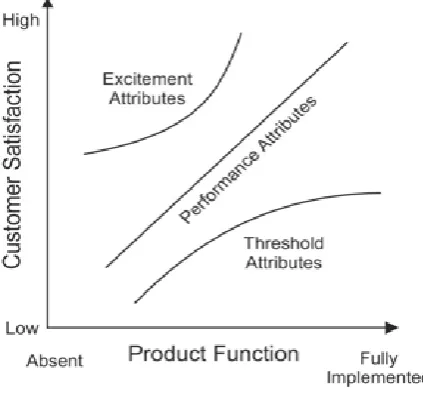
On Kano’s categories
Journal of Applied Economics and Business
they mostly get to the performance attribute category. The threshold category is of a binary nature so if this category extends that involves a birth of a new product. E.g.: since we can surf on the Internet with our cell phones we call them smartphones.
FIG 2. Kano model (Kano et. al. 1984)
Gap in the dyad
The technological development boundlessly increases product complexity causing competence asymmetry in usage; because the technological knowledge diffuses slowly among end-consumers (Veres, 2008). The gap especially can be experienced between the laic consumers and the professional producers, i.e. in consumer goods’ market. The lack of required technological skills or information causes deficits: the consumer cannot enjoy all the benefits which the product offers, because s/he does not recognize them. The consumer is also unable to judge the real value of such products, consequently competence asymmetry weakens the correct judgment of product attributes meaning by the consumer. In this case the personal selling can support the purchase.
Nondiscrete preference values
When the ‘very important’ and the ‘not important’ columns are cut from the Q-grid only the neutral attributes left. They quasi fluctuate in a - sometime - wide interval, consequently their preference level cannot be handled as an equally discrete value. These neutral attributes are not stable, they are rather context-dependents as compared to the inherent preferences, and their rank is defined on the scale through the decision (not earlier!), which can be ad absurdum random (Veres et al, 2012).
they applied another methodology. The position of the ‘not relevant’ attributes compared to one another is not stable, which can be resulted in the change of the preference order (Hlédik, 2012). The level of the preferences is unstable: the difference between the level of two attributes and even its measures are not equal in each case: there are overlaps or unequal distances, which enhance the change in the preference order (i.e. turn of preferences).
The context always influences the preference stability (as discussed by Warren et al, 2011). Goldstein (1990) differentiated between global and local attributes. Slavic and Lichtenstein (1971) supposed that the importance weights are judged on the intuition so can it happen that under certain circumstances one attribute is clearly better than another, while in a different case this might turn. These kinds of characteristics are called local preferences: their value is context-dependent. In contrast the global attributes are independent from the stimuli they represent a fix value in the preference order. The rate of the global attributes is lower compared to the local ones. The weight of the global attributes lies in the personality of the consumer, and their judgment is likely to change if cognitive dissonance appears. In the case of local attributes, their value appears on an aggregated level: they cause a complex change in the preference pattern. Yet, the consumer is not aware of it. Observing the structure we can say that the interval of global preferences is narrower then the interval of local preferences: in case local preferences change their places - in this relative long interval - that makes the probability of preference reversal higher.
Inconsistencies in rating
Journal of Applied Economics and Business
Assuming that the consumer is not aware of his own preference structure, consumer is unable to identify the importance, and besides this revealed preference order always represents a status quo, which might be influenced by one of the shopper’s identities. The strongest determining factors are the consumer’s profile and his/her actual conditions.
Boundaries of brain capacity
According to Lehrer (2012) different parts of the brain are responsible for an emotional and for rational decisions. He proves that in cases, when our emotions influence us, we are excited, and there is not enough time left to measure the rational arguments. There are also outside effects, which should be worked-up (just like during the purchase). The Loewenstein and O’Donoghue’s (2004) theory just strengthens that the decision-making path has two parallel lanes: the rational and the emotional one. They furthermore suggest that consumers are more capable to decide in a less considered way if they perceive an emotional stimulus during the purchase - notwithstanding that in such cases extra cognitive energy is required to take the rational way instead of the emotional one. Neuromarketing based researches (Lindstrom, 2009) using FMRI showed that different parts of the brain is activated during different decision paths; meaning that different decision methods end up with different solutions. Our model does not identify them, because both has a preference ranking, from the aspect of the stated preferences it does not count which was an emotional, and which was a rational linked criteria, respectively.
On a personal level the identity economics says that in our decisions the position of our currently dominant selfes plays a determining role: human beings are conform to their close environment; they want to unconsciously choose that behavior model which fits the expectations of others (Király, 2014). This principle might violate the axiom of the individual utility maximization or the total self-expression. These meaningful personal differences in the identities and the perception can lead to non-homogenous consumer choices.
more important nodes appear more often. Bettman (1979) emphasized another issue related to human memory: the reminiscences are not based on real stimulus - during the recall the brain reconstructs the required information, based on memories. This mechanism contains serious distortions by its nature. First, by the stimulus survey the data should be handled in a way to be suitable for the reminiscence: even at the beginning, one should be aware of how he wants to use it later in order to choose the right form of storage. The recall method is deeper, so it requires bigger capacity than the STM. The attribute preference order building requires appropriate and recallable bits of information. The new original stimulus makes the process more complicated by forming the original memories of the product. The process is complete, if the consumer is able to link the new bit of information to the former node, practically to put the new data to the right place. This method works vice versa: the existing and available memories influence the categorization of the new experiences (Bettman, 1979) except the situation, when the brain creates a new node for the new stimulus. This is called the assimilation-contrast theory (Monroe, 1971).
Other influencing factors
During the improvement of the system of preference biases there are several other influencing factors which have not been explicated in details yet, like:
o Risk: the monetary, the performance and the subjective risks moderate the perception of the buyers;
o Prior experience: Mangleburg et al. (1998) found the attitude of consumers
with prior experience is different: the personal experiences reduce the external influencing effects, which potentially could cause preference inconsistencies;
o Transition utility (the concept was developed by Thaler, 2003): a high degree
of desire may reduce the appearance of external originated discrepancies. We decided to narrow our focus on product attributes, we neglected the brand and the effects in connection with the label: originally, there is a strong relationship between actual self-identity and product image, which supports the preference order construction (Birdwell, 1968; Belch, 1978). This differentiation cannot be measured; we cannot estimate the importance of a certain brand in the model. The shoppers with a little enthusiasm are not motivated to invest time and energy in the decision making process, which is also true, or can be felt even better during an experiment. These subjects with the low involvement construct their preference system more holistic, by using simple criteria (Sirgy & Johar, 1999);
o Location: it would be essential to conduct data survey in-store or on-line
Journal of Applied Economics and Business
factors so we did not consider visuals, trials, voice alerts or subliminal messages, POS techniques, sensory branding etc. We did not count with the shopkeepers appearance; (2) new bits of information for the consumer, which also influence the current decision. Early studies revealed that those consumers, who find knowledge important, they not only tend to expand their information base, but used them consciously in processing utilitarian attributes. Therefore, the “qualified consumers” during the evaluation do not pay that much attention to the circumstances and the visible experiences, like image - they are supported by their prior information;
o Culture: our research team supposes that cultural differences regarding this
area are insignificant: one culture is not less transitive than the other. The technique of preference order construction is universal, determined by evolutionary characteristics. Our goal is rather to identify specific consumer-related behaviors in buying situation. We did not differentiate the attribute representations of joint or community preferences. Community preferences are about to keep in mind the interest of the society, or a certain segment of society, instead of caring about the advantages for the individual. A community preference could be a sustainable development, equality, transparency, protection of environment;
o Perception: the perception happens through more senses and products are
reaching towards the consumer thought all the modalities of perception. Not any experiment can involve all those attributes, which are percepted by different senses; we only present the attributes in a written description. The determining part of the evaluation consist of at least visible attributes or even more, it may include multiple modalities;
o Time pressure: this issue should also be considered during both the purchase
and the experiment. We cannot identify - nor the decision maker himself - which thinking structure, System (1) for thinking fast or System (2) for thinking slow were used in the decision making process. The cognitive work for evaluation in real life and also in the laboratory cannot be spared: the strict time constraints result a different choice than under “normal” circumstances.
CONSEQUENCES AND FURTHER RESEARCH
- However we have not dealt with the common preferences, we agree on that the preference intransitivity might have an effect on an aggregated level, which would explain macroeconomic processes in context of behavioral economics (Koltay & Vincze, 2009). Developing large database conclusions can be drawn about a certain segment, not only individuals, which could give an explanation on certain economic or commercial trends; and
- Involving more psychology theories (from gestalt, cognitive and behavioral schools), we could identify and differentiate between the preference structuring method and stability.
The expected results rock the traditional framework of consumer behavior and selling techniques, especially the Pareto principle in case of intransitive preferences where the market is unable to establish the optimum. Considering preference intransitivity, both scholars and practitioners should rethink the methodology of service quality perception and measurement, so as product development strategies.
REFERENCES
Belch, G. E. (1978). Belief systems and the differential role of the self-concept. In: Hunt HK, editor. Advances in Consumer Research, vol. 5. Ann Arbor (MI): Association for Consumer Research, 320-325.
Birdwell, A. E. (1968). A study of influence of image congruence on consumer choice, Journal of Business Research, 41, 76-88.
Bettman, J. R. (1979). Issues in Research on Consumer Choice. In NA - Advances in Consumer Research Volume 06, eds. William L. Wilkie, Ann Abor, MI : Association for Consumer Research, 214-217.
Bond, S. D., Carlson, K. A. & Keeney, R. L. (2008). Generating objectives: Can decision makers articulate what they want? Management Science, 54(1), 56-70.
Chen, M. K. & Risen, J. L. (2010). How Choice Affects and Reflects Preferences: Revisiting the Free-Choice Paradigm, Journal of Personality and Social Psychology, 99(4), 573-594.
Donohew, L. (1980). An activation model of information exposure, Communication Monographs, 47, 295-303.
Eliaz, K. & Spiegler, R. (2006), Contracting with Diversely Naive Agents, Review of Economic Studies, 73(3), 689-714.
Journal of Applied Economics and Business
Goldstein, W. M. & Hogarth, R. M. (1997). Research on Judgment and Decision Making: Currents, Connections, and Controversies. Cambridge: Cambridge University Press.
Green, P. & Srinivasan, V. (1990). Conjoint Analysis in Marketing: New Developments with implications for Research and Practice, Journal of Marketing, 54(4), 3-19.
Hair, J. F., Black, W. C., Babin, B. J. & Anderson, R. E. (2010). Multivariate Data Analysis. Seventh Edition. Upper Saddle River, NJ: Prentice Hall.
Harman, G. (1995). Rationality. In: E. E. Smith & D. N. Osherson (eds.), Thinking (3, 175-211), Cambridge, MA: The MIT Press.
Hlédik, E. (2012). Attribute Preference Stability for Complex Product, Marketing & Menedzsment, 46(1-2), 104-112.
Király (2014). A közgazdaságtan és a szociológia határán - az identitás-gazdaságtan által ... elméleti kérdések, [Between economics and sociology – by identity-economics… theoretical questions], Közgazdasági Szemle, 61, 92-107 (in Hungarian).
Koltay, G. & Vincze, J. (2009). Fogyasztói döntések a viselkedési közgazdaságtan szemszögéből, [Consumer decisions from the viewpoint of behavioural economics], Közgazdasági Szemle, 56, 495-525 (in Hungarian).
Kano, N., Nobuhiku, S., Fumio, T. & Shinichi, T. (1984). Attractive quality and must-be quality, Journal of the Japanese Society for Quality Control, 14(2), 39-48.
Kovács, M. (2009). Kinyilvánított preferencia és racionalitás [Revealed preference and rationality], Közgazdasági Szemle, 56, 546-562 (in Hungarian).
Lakatos, I. (1999). A falszifikáció és a tudományos kutatási programok metodológiája [Falsification and methodology of scientific research programmes]. In Forrai, G. & Szegedi, P. (szerk.). Tudományfilozófia: Szöveggyűjtemény. Budapest: Áron Kiadó (in Hungarian).
Lehrer, J. (2012). Hogyan döntünk?...és hogyan kellene? [How do we decide … and how to…?]. Budapest: Akadémiai Kiadó (in Hungarian).
Loewenstein, G. & O’Donghue, T. (2004). Animal Spirits: Affective and Deliberative Processes in Economic Behavior, Working Papers 04-14. Cornell University, Center for Analytic Economics.
Lindstrom, M. (2009). Buyology. Random House Business Books. New York.
Mangleburg, T. F., Sirgy, M. J., Grewal, D., Axsom, D., Hatzios, M., Claiborne, C. B., & Bogle, T. (1998). The moderating effect of prior experience in consumers’ use of user-image based versus utilitarian cues in brand attitude, Journal of Business and Psychology, 13(1), 101-113.
McFadden, D. (1973). Conditional logit analysis of qualitative choice behavior. In: Zarmebka, P. (Ed.), Frontiers in Econometrics. Academic Press, New York.
Mérő, L. (2007). Mindenki másképp egyforma [Everybody is similar in a different way]. Budapest: Tercium Kiadó (in Hungarian).
Monroe, K. B. (1971). Measuring Price Thresholds by Psychophysics and Latitudes of Acceptance, Journal of Marketing Research, 8, 460-464.
Netzer, O. & Srinivasan, V. S. (2011). Adaptive Self-Explication of Multi-Attribute Preferences, Journal of Marketing Research, 48(1), 140-156.
Netzer, O., Toubia, O., Bradlow, E. T., Dahan, E., Evgeniou, Th., Feinberg, F. M., Feit, E.M., Hui, S. K., Johnson, J., Liechty, J. C., Orlin, J. B. & Rao, V. R. (2008). Beyond conjoint analysis: Advances in preference measurement, Springer Science, 19, 337-354.
Richter, M. K. (1966). Revealed Preference Theory, Econometrica, 34(3), 635–645.
Samuelson, P. A. (1947). Foundations of Economic Analysis. Cambridge, MA: Harvard University Press. Reprinted in 1983.
Scholz, S. W., Meissner, M. & Decker, R. (2010). Measuring Consumer Preferences for Complex Products: A Compositional Approach Based on Paired Comparisons, Journal of Marketing Research, 47, 685-698.
Simonson, I. (2008). Regarding Inherent Preferences, Journal of Consumer Psychology, 18(3), 191-196.
Sirgy, M. J. & Johar J. S. (1999). Toward an Integrated Model of Self-Congruity and Functional Congruity. In E - European Advances in Consumer Research 4, eds. Bernard Dubois, Tina M. Lowrey, and L. J. Shrum, Marc Vanhuele, 252-256.
Slavic, P. & Lictenstein, S. (1971). Comparison of Bayesian and regression approaches to the study of information processing in judgement, Orgnizational Behavior and Human Performance, 6, 649-744.
Stephenson, W. (1953). The study of behavior: Q-technique and its methodology. Chicago: University of Chicago Press.
Thaler, R. (2003). Mental Accounting Matters. In Cramerer, C., Loewenstein, G. & Rabin, M. (eds.) Advances in Behavioral Economics. Princeton: Princeton University Press, 75-103.
Journal of Applied Economics and Business
Veres, Z. (2008). Egy régi mánia: A gap-modell az elégedettségkutatásban [An old mania: The gap-model in satisfaction research]. Marketing & Management, 42(2), 4-17 (in Hungarian).
Veres, Z., Tarján, T. & Platz, P. (2012). Interrelaciones del carácter del producto y las preferencias por el producto [Relationship of product attributes and preferences]. In Ferkelt, B. & Molina, A.V. (eds.): Interdisciplinarity and Synergies in Economics and Business, European Academic Publishers, Madrid, CD-ROM, 160-166 (in Spanish).