Computational Analysis of MHD Flow in
Trapezoidal Cavity with Sinusoidal wavy
Surface Filled with Hybrid Nanofluid
Mahede- Ul- Hassan1*, Khadiza Begum2 and Abdul Karim3
1*
Lecturer, Department of Mathematics and Statistics, Bangladesh University of Business and Technology, Dhaka-1216, Bangladesh
2
Lecturer, Department of Computer Science and Engineering, Prime University, Dhaka-1216, Bangladesh
3
Lecturer, Department of Mechanical Engineering, Sonargaon University, Dhaka-1215, Bangladesh
Abstract -Two or more nanoparticles in a base fluid has been an increasing interest in modern years due to great improvement in heat transfer performance. In the present work, an analysis is carried out to study the flow characteristics and heat transfer performance on convection in a lid-driven trapezoidal cavity with sinusoidal bottom wall composed of equal quantities of Cu and Al2O3 nanoparticles dispersed in water base fluid. Further,
the effect of an applied magnetic field 𝐵𝑜 on the flow pattern of the cavity is also be analysed.The sinusoidal
bottom wall is heated while the top side of the cavity is cooled isothermally and the left and right walls are insulated. All the walls of the cavity are kept as no-slip walls except the upper wall which is a moving wall driven by a uniform velocity 𝑉 along the 𝑥-axis. The associated governing equations have been solved using finite element method. The parametric study on the implication of Richardson number Ri and solid volume fraction of nanoparticles 𝜑, Prandtl number 𝑃𝑟 and Hartmann number 𝐻𝑎on the flow structure and heat transfer characteristics are performed in details while the Reynolds number and Prandtl number considered fixed. The numerical results indicated that the Richardson number have significant effects on the flow and heat transfer performance. On the other hand the results also show significant effects of increasing the volume fraction of hybrid nanofluid. Moreover, it is also noticed that combination of two different nanoparticles suspension have a better performance of heat transfer. Results are presented in terms of streamlines, isotherms and average Nusselt number of the hybrid nanofluid for different values of respective parameters.
Keywords: Hybrid Nanofluid, Finite Element Method, MHD, CFD, Cavity, Convection.
I. INTRODUCTION
Usage of nanofluid in heat transport enhances the efficiency of thermal systems like; heat exchangers, thermal storages, solar collectors, photovoltaic system, biomedical devices, nuclear reactors, engine/vehicle, cooling of electronic components, transformers etc. Researchers [1-3] are interested in conjugate heat transfer by free convection inside cavities as it has huge applications in engineering and advanced technology. In order to remain side by side developments in the extent applications and exponentially developing studies about nanofluids, many review papers have been written.“Hybrid” nanofluid can be prepared by suspending more than one type of nanoparticles in base fluid. Very recently, hybrid nanofluid, is a gradually mounting research field parallelly to the incessant developments of common nanofluids [4. Compromised properties between the advantages and disadvantages of the properties of individual nanoparticles are a task of hybridization. Moreover, nanoparticles suppliers exhibit noticeable differences in prices of different nanoparticles types. For example, the price of copper nanoparticles is about 10 times greater than that of alumina nanoparticles. Hence, it is appropriate if one achieves the properties of expensive nanoparticles with minimum quantity. Indeed, the “hybrid” nanoparticles should be limited to those prepared as a single composite substance in a base fluid for which their synthetization requires more attention [5-6].
Sheikholeslami et al. [11] have performed a numerical study of MHD effects on natural convection around a horizontal circular cylinder inside a square cavity filled with nanofluid. They found that the heat transfer rate is an increasing function of nano-particle volume fractions as well as the Rayleigh number, while it is a decreasing function of the Hartmann number 𝐻𝑎. In addition, their results indicated that for 𝐻𝑎 < 20 the enhancement in average Nusselt number at 𝑅𝑎 = 104 is greater than at other Rayleigh numbers. In a similar work, Sheikholeslami et al. [12] studied the effects of magnetic field on ferrofluid flow and heat transfer in a semi annulus cavity. They reported that increasing magnetic number, Rayleigh number and volume fraction of the nano-particles lead to augmentation of the heat transfer rate but the average Nusselt number decreases with increase of 𝐻𝑎.
MHD mixed convection in a trapezoidal sinusoidal enclosure filled with hybrid nanofluid depending on the existing mathematical formulae needs additional attention to disclose its performance in this significant field. The objective of this paper is an effort to contribute in starting the groundwork of this research area and investigate the influence of an applied magnetic field.
II. PHYSICAL MODEL
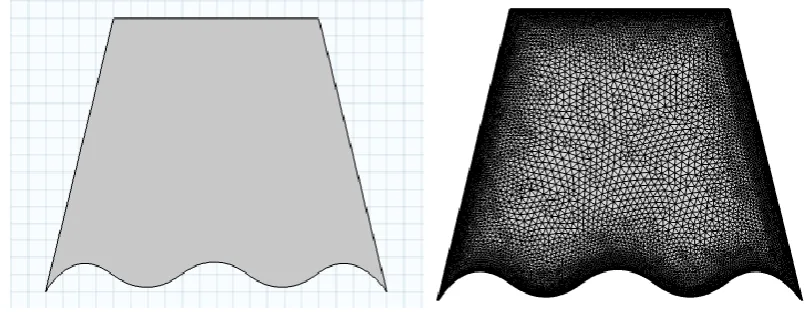
The geometry of the interested domain consists of a two dimensional lid-driven trapezoidal enclosure of side length H. The enclosure is filled with hybrid Al2O3-Cu/water nanofluid. The bottom wavy wall is assigned to temperature Th while the top wall of the enclosure is cooled at a cool temperature Tc. The conditionTh>Tc is
maintained, under all circumstances. The bottom wall is a wavy wall. The left and the right walls are thermally insulated. Furthermore, the top wall is assumed to slide in its upper plane at a constant speed 𝑉.
Fig. 1 Geometrical model of the interested domain and the finite element free-triangular meshing
It is also assumed that both the fluid and nanoparticles are in thermal equilibrium and there is no slip between them. The hybrid nanofluid used in the analysis considered as laminar and incompressible. It is also assumed that the gravitational acceleration 𝑔acts to the vertical downward surface. Thermophysical properties of the used nano-particles and the base fluid are given in Table 1, assumed constant except for the density variation, which is maintained on Boussinesq approximation.
Table 1
PhysicalProperties Fluid Phase (H2O)
Nano-particle 1 (Cu)
Nano-particle 2 (TiO2)
Nano-particle 3 (Al2O3)
𝐶𝑝(J/kgK) 4179 385 686.2 765
𝜌 (kg/m3
) 997.1 8933 4250 3970
𝑘 (W/mK) 0.6 401 8.9538 40
𝛽 × 10−5 (1/K) 21
𝜎(μS/cm) 0.05 5.9610-7 6.2810-5 110-10
III. MATHEMATICAL MODEL
The two dimensional numerical simulation has performed in steady state conditions. The non-dimensionalized governing partial differential equations for laminar flow and thermal energy equations usinghybrid nanofluidare given below:
𝜕𝑈 𝜕𝑋+
𝜕𝑉
𝜕𝑌 = 0 (1)
𝑈𝜕𝑈𝜕𝑋+ 𝑉𝜕𝑈𝜕𝑌 = −𝜕𝑃𝜕𝑋+ 𝜌𝑓 𝜌 𝑛𝑓
𝜇 𝑛𝑓 𝜇𝑓
1 𝑅𝑒(
𝜕2𝑈 𝜕𝑋2+
𝜕2𝑈
𝜕𝑌2) (2)
𝑈𝜕𝑉𝜕𝑋+ 𝑉𝜕𝑉𝜕𝑌 = −𝜕𝑃𝜕𝑌+𝜌𝜌𝑓
𝑛𝑓 𝜇 𝑛𝑓
𝜇𝑓 1 𝑅𝑒
𝜕2𝑉 𝜕𝑋2+
𝜕2𝑉 𝜕𝑌2 +
𝜌𝛽 𝑛𝑓 𝜌𝛽 𝑓 𝑅𝑖𝜃 −
𝜌𝑓 𝜌 𝑛𝑓
𝜎 𝑛𝑓 𝜎𝑓 𝐻𝑎
2 1
𝑅𝑒𝑉 (3)
𝑈𝜕𝜃𝜕𝑋+ 𝑉𝜕𝜃𝜕𝑌 =𝛼 𝑛𝑓 𝛼𝑓
1 𝑅𝑒𝑃𝑟
𝜕2𝜃 𝜕𝑋2+
𝜕2𝜃
𝜕𝑌2 (4)
where, 𝑃𝑟 =𝜇𝑓𝑘𝐶𝑝
𝑓 , 𝑅𝑖 = 𝑔𝛽𝑓∆𝑇𝐻
𝑈0 ,𝐻𝑎 = 𝐵0𝐻
𝜎𝑓
𝜇𝑓and𝑅𝑒 = 𝑈0𝐻𝜌𝑓
𝜇𝑓 be the Prandtl number, Richardson number
andReynolds number respectively.
The above equations are non-dimensionalized by using the following dimensionless quantities
𝑋 =𝑥𝐻, 𝑌 =𝐻𝑦,𝑈 =𝑢𝐻𝛼
𝑓, 𝑉 = 𝑣𝐻 𝛼𝑓, 𝜃 =
𝑇−𝑇𝑐 𝑇−𝑇𝑐, 𝑃 =
𝑝𝐻2
𝜌𝑓𝛼𝑓2 (5)
The flow boundary conditions
Top wall:𝑈 = 𝑈0, 𝑉 = 0
Bottom wall:𝑈 = 𝑉 = 0
Left wall: 𝑈 = 𝑉 = 0
Right wall: 𝑈 = 𝑉 = 0
The Thermal Boundary Conditions
Top wall:𝜃 = 0
Bottom wall:𝜃 = 1
Left wall:𝜕𝑋𝜕𝜃= 0
Rightwall:𝜕𝜃𝜕𝑋= 0
At the fluid solid wall interfaces: 𝜕𝑋𝜕𝜃
𝑓𝑙𝑢𝑖𝑑 = 𝐾 𝜕𝜃
𝜕𝑋 𝑠𝑜𝑙𝑖𝑑 , where K = 𝐾 𝑛𝑓
𝐾𝑓
The constructive equations of the effective properties of hybrid nanofluids have been chosen:
The thermal diffusivity ∝𝑛𝑓=𝐾𝑛𝑓 𝜌𝐶 𝑝 𝑛𝑓
The density𝜌𝑛𝑓 = 1 − 𝜑 𝜌𝑓+ 𝜑1𝜌1+ 𝜑2𝜌2
The heat capacitance 𝜌𝐶𝑝 𝑛𝑓 = 1 − 𝜑 𝜌𝐶𝑝 𝑓+ 𝜑1 𝜌𝐶𝑝 1+ 𝜑2 𝜌𝐶𝑝 2
The thermal expansion coefficient, 𝜌𝛽 𝑛𝑓 = 1 − 𝜑 𝜌𝛽 𝑓+ 𝜑1 𝜌𝛽 1+ 𝜑2 𝜌𝛽 2
The specific heat𝐶𝑝𝑛𝑓 =
1−𝜑 𝜌𝐶𝑝 𝑓+𝜑1 𝜌𝐶𝑝 1+𝜑2 𝜌𝐶𝑝 2 1−𝜑 𝜌𝑓+𝜑1𝜌1+𝜑2𝜌2
The viscosity of Brinkman model 𝜇𝑛𝑓 = 𝜇𝑓 1−𝜑1−𝜑22.5
The thermal conductivity𝐾𝑛𝑓 = 𝐾𝑓
𝜑 1𝑘1+𝜑2𝑘2
𝜑 +2𝑘𝑓+2 𝜑1𝑘1+𝜑2𝑘2 −2𝜑𝑘𝑓 𝜑 1𝑘1+𝜑2𝑘2
Ratio of electric Conductivity 𝜎𝜎 𝑛𝑓
𝑓 = 1 +
3 𝜑 1𝜎1+𝜑2𝜎2
𝜎 𝑓 − 𝜑1+𝜑2 𝜑 1𝜎1+𝜑2𝜎2
𝜑𝜎 𝑓 +2 − 𝜑 1𝜎1+𝜑2𝜎2 𝜎 𝑓 + 𝜑1+𝜑2
where 𝜑 is the overall volume concentration of two different types of nanoparticles dispersed inhybrid nanofluid and is calculated as𝜑 = 𝜑1+ 𝜑2
The Average NusseltNumber at the heated wall of the enclosure is expressed as, 𝑁𝑢 = −
𝐾 𝑛𝑓 𝐾𝑓
𝜕𝜃 𝜕𝑋𝑑𝑌 𝐻
0 , where
H is the length of the heated surface.
IV.COMPUTATIONAL METHODOLOGY
The momentum and energy equations have been solved that is a set of partial differential equations by using the Galerkin weighted residual approach of the finite element method [14]. In this method, the interested domain is discretized into finite elementsusing non-uniform, unstructured, free triangular meshes. Then the nonlinear governing partial differential equations are transferred into a system of integral equations by applying Galerkin Weighted Residual approach. The basic unknowns for the above differential equations are the velocity components U, V, the temperature θ and the pressure P.the six-node triangular elements are used in this work. All six nodes are associated with velocities as well as temperature. Three corner nodes are correlated with pressure. The nonlinear algebraic equations so obtained are modified by imposition of appropriate boundary conditions. These modified nonlinear equations are transferred into linear algebraic equations by using Newton’s method. Finally, these linear equations are solved by using tri-diagonal matrix algorithm (TDMA).The convergence criterion for the solution procedure is defined as n1n104, where n is the number of iteration and 𝜓 is a function fromU, V and θ.
V. RESULT AND DISCUSSION
The results are represented in terms of streamlines and isotherm patterns. The variations of average Nusselt numbers are also highlighted. The solid fluid thermal conductivity ratio 𝐾 = 7.0 have considered throughout the simulation.
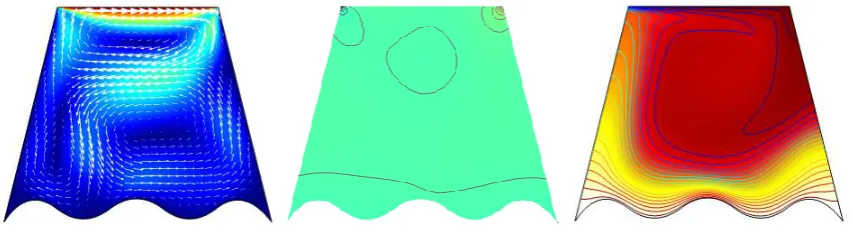
Fig. 2 (a) Velocity field with arrow surface, (b) Pressure surface with contour plots and (c) Temperature field with isothermal contours without an imposition of magnetic field
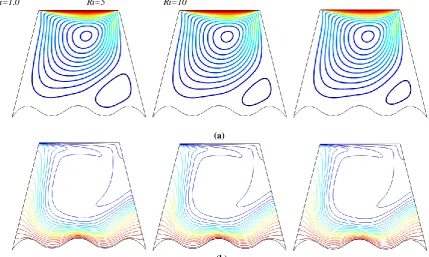
Richardson number is the ratio that measures the effect of natural to forced convection modes. Figure. 2 (a) and (b) provides the information about the sensitivity of the stream line and isotherms pattern due to the variations of Richardson number for 𝑅𝑒 = 100,𝑃𝑟 = 6.2, 𝜑 = 0.05 and 𝐾 = 7.From the streamlines contours it is found that for forced convection (Ri=1) there exist one primary clockwise circulation cell with two secondary egg shape cores in the cavity. This is due to the dominance of forced convection exerted by the movement of the inclined walls of the cavity. At 𝑅𝑖 = 1.0 (combined convection regime) it can be seen that shape of the primary cell become large in size.It ia also noticed that at this step the secondary two core reduces to one single core near the heated circular cylinder. On the other hand when 𝑅𝑖 = 5.0 and 𝑅𝑖 = 10 the clockwise vortex spread in wavy form with egg shape core near the heated moving wall. In this case the strength of the natural convection dominant the flow regime. This is reasonable because increasing the parameter Ri assists buoyancy flow, hence the natural convection mode.
cavity and, subsequently the conduction heat transfer regime has become the dominant mode of energy transfer in the cavity with vertical isotherms near the heated wall. With further increase of 𝑅𝑖 = 1 steeper temperature gradient near the heated wall are evident and the isotherms get the parabolic shape near the inclined cold wall. In the considered regime, the buoyancy effect balanced the effect of sliding top wall and hence, the total heat transfer in the cavity is controlled by the combined mechanisms of forced and free convection. Escalating the convective parameter Ri up to 10, a thin boundary layer is developed near the top corner of the inclined wall. From the figure it is also ascertain that increasing in the buoyancy force causes the isotherms to deform due to the dominating influence of the convective flow.
Ri=1.0 Ri=5 Ri=10
(a)
(b)
Fig. 2 (a) Stream lines and (b) Isotherms for different values of Ri at Re = 100, Pr = 6.2, 𝝋 = 𝟎. 𝟎𝟓, 𝑲 = 𝟕
As mentioned before the volume fraction of hybrid nanofluid comprises of equal quantities of two different Cu and Al2O3 nanoparticles. From the Figure 3(a), When the nanoparticles volume fraction is increased from
0.0
to 0.05for 𝑅𝑒 = 100, 𝑅𝑖 = 1, 𝑃𝑟 = 6.2, 𝐾 = 7, the vertical double eye behavior of streamlines associated with pure water
0
is transformed into single eye behavior with the increase in the nanoparticle volume fraction 𝜑 ≥ 0.03and the intensification of the fluid flow behavior decrease when the fluid particle volume fraction drop out. This is due to the enhancement of viscosity of the hybrid nanofluid. Since with the augment of, the thermal conductivity of the nanofluid increases, hence the buoyancy flow, these interns improved the heat transfer rate.𝜑 = 0.01𝜑 = 0.03𝜑 = 0.05
(b)
Fig. 3 (a) Stream lines and (b) Isotherms for different values of 𝜑at Ri=1.0, Re =100, Pr=6.2, K = 7
However, it is also obvious from figure 3(b), that the temperature gradients are generally not affected on escalating the solid volume fraction of nanoparticle with any fraction except with the increase of 𝜑 the isotherms close to the heated wall begin to be more scattered. Theenrichment of the thermal conductivity produces denser isotherms which is the indication of development nanofluid convection. We can conclude that the mixing advantage of Copper and Alumina nanoparticles may blow up the convective heat transfer. Hence, this results encourage us to examine other combination of different types of nanoparticles, with different ratio of nanoparticles, and to work with innovative models on behalf of dissimilar thermo-physical properties.
From the Figure 4(a), it is also obvious that with the incrase of the value of 𝑅𝑖 heat transfer rate increase. Because with the augmentation of 𝑅𝑖 buoyancy effect enhance, so large amount of heat is transferred from the heated wall to the enclosure. It is also perceived that the rate of heat transfer is much higher for hybrid nanofluid compared to the base fluid. This is a decent discovery to use hybrid nanofluid.
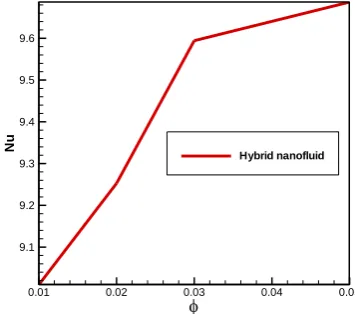
However, the distribution of Nusselt number for different solid volume fraction of nanoparticles presented in Figure 4(b) indicates that the intensifying of viscous and inertia forces dominant over the enhanced thermal conductivity, which effects both buoyancy and share rate in addition. Consequently, the enhancement in the Nusselt number is recorded for a range of 𝜑. It is also perceptible that rate of increasing heat transfer is much higher while the value of solid volume fraction is small than for the superior value of 𝜑. So, it is very reasonable to conclude that the impact of the hybrid nanofluid becomes active when the natural convection is tiny.
Fig. 4(a): Average Nusselt number at various Richardson numbers
Fig. 4(b): Average Nusselt number at various volume concentrations of nanoparticles
Ri
N
u
1 2 3 4 5
8.6 8.8 9 9.2 9.4 9.6 9.8
Hybrid nanofluid Water
N
u
0.01 0.02 0.03 0.04 0.05
9.1 9.2 9.3 9.4 9.5 9.6
𝑯𝒂 = 𝟎𝑯𝒂 = 𝟓 𝑯𝒂 = 𝟏𝟎𝑯𝒂 = 𝟐𝟎
(a)
(a)
(b)
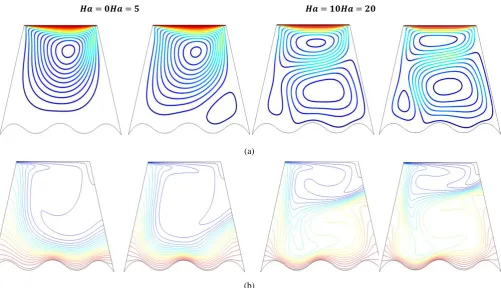
Fig. 3 (a) Stream lines and (b) Isotherms for various values of magnetic parameter 𝑯𝒂, the Hartmann number at
Ri=1.0, Re =100, Pr=6.2, K = 7
VI. CONCLUSION
MHD effect on hybrid nanofluid flow in convective lid-driven sinusoidal trapezoidal enclosure is investigated numerically. Varying the parameters 𝑅𝑖and 𝜑 have leads to the conclusion that the corrugated lid-driven cavity could be considered as an significantly effective heat transfer apparatus for the bottom wavy surface amplitude.The mixed convection parameter 𝑅𝑖affects extensively on the flow patterns and heat transfer mechanism inside the hybrid nanofluid filled cavity.The increment of Richardson number promoted heat transfer by convection.Compared with regular nanofluid, a hybrid nanofluid dispersed in water base fluid has very modest enhancement on the Average Nusselt Number values.The effect of volume fraction of the hybrid nanofluid becomes significant in the situation of the case of small buoyancy force. The induction of the applied magnetic field reduces the flow rate and decreases further when the intensity of magnetic field increases. Also the flow rate of the nanofluid reduces for the increasing values of Hartmann number 𝐻𝑎.
VII. ACKNOWLEDGMENTS
The authors wish to acknowledge the technical supports provided by Department of Mathematics and Syed Ali Afzal Computational Lab, Bangladesh University of Engineering and Technology (BUET), Dhaka-1000, Bangladesh.
VIII. REFERENCE
[1] J. Sarkar, P. Ghosh, A. Adil, A review on hybrid nanofluids: Recent research, development and applications, Renewable and Sustainable Energy Reviews 43 (2015), pp. 164–177.
[2] Cruz, J. M. S., Hammond, G. P. and Reis, A. J. P. S., “Thermal performance of a trapezoidal-shaped solar collector/energy store”, Applied Energy, vol. 2002, pp. 195-212, 2002.
[3] Ishrat Zahan and M.A. Alim, MHD effect on solid fluid thermal conductivity ratio and wall thickness in a Nanofluid Filled Enclosure, Journal of Engineering Mathematics & Statistics, Vol. 2 (1) (2018), pp. 1-23.
[4] S.U.S. Choi, J.A. Eastman, Enhancing thermal conductivity of fluids with nanoparticles, ASME International Mechanical Engineering Congress &Exposition San Francisco, Vol. 231 (1995), pp. 99-105.
[5] Z.H. Han, B. Yang, S.H. Kim, M.R. Zachariah, Application of hybrid sphere/carbon nanotubeparticles in nanofluids, Nanotechnology 18 (2007) 105701.
[7] C.J. Ho, J.B. Huang, P.S. Tsai, Y.M. Yang, Preparation and properties of hybrid water based suspension of Al2O3 nanoparticles and MEPCM particles as functional forced convection fluid, Int. Commun. Heat Mass Transf. 37 (2010), pp. 490–494.
[8] S.S. Botha, P. Ndungu, B.J. Bladergroen, Physicochemical properties of oil based nanofluids containing hybrid structures of silver nanoparticle supported on silica, Ind. Eng. Chem. Res. 50 (2011), pp. 3071–3077.
[9] J.C. Maxwell, A treatise on electricity and magnetism, Oxford, UK: Clarendon Press; 1873.
[10] A.J. Chamkha, I.V. Miroshnichenko, M.A. Sheremet, Numerical analysis of unsteady conjugate natural convection of hybrid water-based nanofluid in a semicircular cavity, J. Thermal Science Engineering Applications 9 (2017).
[11] M. Sheikholeslami, M. G. Bandpy and D. D. Ganji, Lattice Boltzmann method for MHD natural convection heat transfer using nanofluid, Powder Technology, 254 (2014), 82-93.
[12] M. Sheikholeslami, D. D. Ganji and M. M. Rashidi, Ferrofluid flow and heat transfer in a semi annulus enclosure in the presence of magnetic source considering thermal radiation , J. Taiwan Inst. Chem. Eng. 47 (2015), 6-17.
[13] M. M. Rahman and M.A. Alim, MHD Mixed Convection flow in a vertical lid-drive square enclosure including a heat conducting horizontal circular cylinder with Joule heating, Nonlinear Analysis: Modeling and Control, Vol. 15 (2) (2010), pp. 199-211.
[14] A.M. Rashad, Ali J. Chamkha, Muneer A. Ismae, Taha. Salah, MHD natural convection in a triangular cavity filled with a Cu-Al2O3/water hybrid nanofluid with localized heating from below and internal heat generation, J. of Heat Transfer (2018), pp. 1-23.
[15] G. H. Bagheri and M. M. Rashidi, Two phase simulation of natural convection and mixed convection of the nanofluid in a square cavity, J. Chem. Phys. 20 (2015), pp. 571-581.