The Thirty-Third AAAI Conference on Artificial Intelligence (AAAI-19)
Labor Division with Movable Walls: Composing Executable
Specifications with Machine Learning and Search (Blue Sky Idea)
David Harel,
1Assaf Marron,
1Ariel Rosenfeld,
1Moshe Vardi,
2Gera Weiss
31Weizmann Institute of Science, Rehovot, Israel. 2Rice University, Houston, Texas, USA. 3Ben-Gurion University, Beer-Sheva, Israel.
Abstract
Artificial intelligence (AI) techniques, including, e.g., ma-chine learning, multi-agent collaboration, planning, and heuristic search, are emerging as ever-stronger tools for solv-ing hard problems in real-world applications. Executable specification techniques (ES), including, e.g., Statecharts and scenario-based programming, is a promising development ap-proach, offering intuitiveness, ease of enhancement, compo-sitionality, and amenability to formal analysis. We propose an approach for integrating AI and ES techniques in develop-ing complex intelligent systems, which can greatly simplify agile/spiral development and maintenance processes. The ap-proach calls for automated detection of whether certain goals and sub-goals are met; a clear division between sub-goals solved with AI and those solved with ES; compositional and incremental addition of AI-based or ES-based components, each focusing on a particular gap between a current capability and a well-stated goal; and, iterative refinement of sub-goals solved with AI into smaller sub-sub-goals where some are solved with ES, and some with AI. We describe the principles of the approach and its advantages, as well as key challenges and suggestions for how to tackle them.
Introduction
Artificial intelligence (AI) techniques are increasingly prov-ing their power and usefulness in implementprov-ing real-world systems — resulting in a growing use of components based on machine learning, planning and search, multi-agent sys-tems, a host of heuristics-based techniques, etc. In another area of software and system engineering, certain specifi-cations and modeling formalisms, like Statecharts (Harel 1987) and scenario-based programming (Damm and Harel 2001; Harel and Marelly 2003; Harel, Marron, and Weiss 2012), which describe separately each facet of the desired system behavior, are also directly executable. Such for-malisms, collectively referred to here as executable speci-fications (ES) can endow systems with often-absent proper-ties. These include, e.g., intuitiveness of the specifications, alignment of the system’s structure with the requirements, and compositionality/incrementality, i.e., the ability to en-hance or refine a system by simply adding modules, sim-ilarly to how one can enhance a requirements document
Copyright c2019, Association for the Advancement of Artificial Intelligence (www.aaai.org). All rights reserved.
by adding clarifications, refinements and exceptions in the form of new sentences in the body of the document or as independent appendices and footnotes. Another impor-tant property is the amenability of ES to formal verification and analysis. This includes, e.g., model-checking in search for undesired behaviors (Harel et al. 2013; Baier and Ka-toen 2008) and realizability checking—looking for inherent conflicts within the specifications (Greenyer et al. 2016; Vardi 1995). In this paper we outline a novel approach for integrating the use of AI and ES techniques in developing complex intelligent systems, which can result in systems that are much easier to enhance and maintain compared with cur-rent uses of AI in system development.
Basic Principles of the Approach
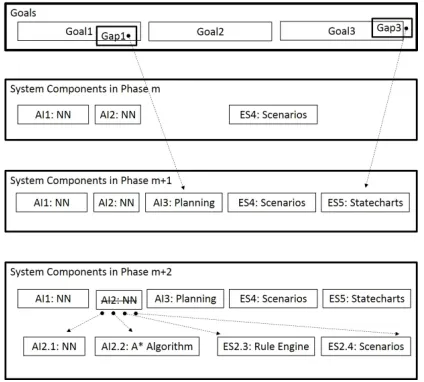
Below we list the basic general principles of the proposed approach. Further illustration, explanations and examples appear in Fig. 1 and in subsequent sections.
First, one must state the overall problem or mission as a set of explicit goals, where the recognition of whether they are achieved or not in a given system run can be automated. While automatic detection of mission-accomplishment at run-time is valuable, the approach initially suffices with re-quiring it only at development time.
Second, when such a test or verification fails, one must be able to succinctly describe the difference, or gap, between what the system does and what it should do, generalizing a single or few bad runs into the common characteristics of all bad runs that could be associated with the noticed failure.
Third, as goals are refined and requirements added, or when certain bugs are discovered, rather than enhancing and often complicating existing components to address the issue, we strive to add new components that precisely address the difference, or the gap, between the (revised) goals and the what the existing specification accomplishes.
Fourth, we aim at an architecture in which independent ES-only components can be readily composed with indepen-dent AI-only components, where each AI or ES component addresses a particular (sub-)goal, and each is essentially un-aware of the existence of the others.
Figure 1: Progression of system structure: As Gap1 & Gap3 are discovered in verification against goals, new components AI3 and ES5 are developed to respectively address these gaps. Then, the neural net in AI2 is replaced by executable rules and scenarios, and by another neural net and a search for two remaining subproblems.
of the elements of a particular goal by engineers and stake-holders, a demand by engineers or regulators for better visi-bility of the logic or rationale of a specific system behavior, or a performance issue that must be corrected. For illustrat-ing the principles, in Fig. 1, AI component AI2, based on a neural net, is replaced by two ES components ES2.3, ES2.4 containing rules and scenarios, and sub-problems previously covered by AI2 that are not addressed by ES2.3 and ES2.4, are solved by a new neural net and an A* search in compo-nents AI2.1 and AI2.2.
Goal Specification and Recognition
Complex intelligent systems, and reactive systems in gen-eral (see (Harel and Pnueli 1985)), are normally developed incrementally, using established software-engineering tech-niques, in a process where goals are set, and behavior is specified, implemented, and verified against those goals. Thegoals of a system (or component thereof) describe its ultimate functional requirements, or, in other words, ‘what the users, customers, engineers or other stakeholders really want’. Such requirements are usually documented in texts and diagrams, and then implemented in code. The code for a given requirement is sometimes considered the ultimate formalization of that requirement. Nevertheless, because the code is often arcane and might be spread across multiple modules, there is a need to formalize the requirements them-selves. Although this is sometimes done in a purely declar-ative fashion, executable specificationsconstitute a formal system description, whose parts describe the various aspects of the system’s behavior, and whose semantics enables di-rect execution of the desired behavior, most often without involving computationally-expensive synthesis.
Some kinds of executable specifications, e.g., theplay-out technique for the LSC language (Harel and Marelly 2003), or the event-selection mechanism of behavioral program-ming in Java or in C++ (Harel, Marron, and Weiss 2012), are characterized by the ability of the execution engine to continuously consult the constraints implied by the specifi-cations, in an attempt to determine a valid next action for the system to take that does not violate those constraints. Even so, the development artifacts of complex reactive systems normally prescribe local reactions to events and conditions, and not the pursuit of overall system goals as is often the case in AI-based systems. Look-ahead search techniques in ES, as insmart play-out(Harel et al. 2002), can sometimes help choose among multiple options allowed by the specifi-cation to within a limited depth/horizon (i.e., looking ahead some fixed number of steps, while taking into account all possible responses by the environment, even an adversarial one). Complete, computationally expensive (and often im-practical) program synthesis is, however, needed in order to generate an event selection strategy that copes with any en-vironment behavior at any depth.
Thus, if the system is developed completely with ES, many overall goals might remain only in the mind of the de-signer. Indeed, some of the advantages of ES are in that one can decompose powerful systems into simple scenarios that are oblivious not only to each other’s functions, as would be in standard object-oriented and structured programming en-capsulation, but also to each other’s very existence, since the various modules do not even call each other; they only exist and run in parallel. One can readily observe, however, that many of the original overall intentions and requirements, whether tacit or already documented,canbe formalized in some way. Or, at least, one can automate the recognitionat development timeof whether certain goals are achieved or not, in observing actual system behavior in test runs.
Consider, for example, an at-home patient-assistant robot, or an autonomous service vehicle for factory yards, and fo-cus on the task of fetching and delivering an object. Regard-less of how each of these systems is programmed to do its tasks, one may be able to specify explicit criteria for rec-ognizing, say, efficient vs. inefficient routes, steady vs. un-steady motion, successful vs. unsuccessful object or location recognition, safe vs. unsafe negotiation of obstacles, etc.
Further, in addition to, or instead of, such explicit specifi-cations, one may program AI-based ‘recognizers’ for such properties. Since these are development-time recognizers, their input can be visual videos or trace/log files with ac-tual data, like commands, environment signals, objects, ob-ject locations and speeds, etc. Further, neither the ES-based nor the AI-based recognizers have to complete their tasks in real time, which contributes to making them feasible.
formalization of overall desired results, at various abstrac-tion levels. The actual formal verificaabstrac-tion of the system, or even that of only a single component, is, however, often in-tractable. Overall behavior is thus often verified only at high abstraction levels, and precise formal verification is achieved only for smaller components with well-defined boundaries.
Further, during development, formal methods may be able to check if given specifications are realizable, or if an imple-mentation meets its specifications, but these methods might miss tacit needs, which are noticed only at much later stages. A step towards addressing this limitation can be by us-ing the goal-accomplishment recognizers discussed earlier. Thus, in addition to employing ordinary restricted test cases and limited formal verification, one may conduct extensive automated runs, with a variety of coverage-related parame-ters, and examine where the existing system or component indeed seems to meet its goals.
Succinct Description of Functional Gaps
When presented with a failed run or a counter-example re-sulting from formal verification, engineers can often gen-eralize it to provide a broader description of gaps between what the system presently does and what it should do. E.g., in the above home-assistant robot and factory vehicle ex-ample, one may translate a near collision into a conclusion such as “the robot does not understand that certain obsta-cles, like a wet-floor sign or a horizontal area-demarcation tape, mark an entire forbidden area, which must not be en-tered , even when the path is physically open”. Or, a sin-gle spilling of some drink may be translated into “the robot changes of speed and direction are such that they may cause open liquid containers like a glass of tea or a bucket of paint, to spill over”. While engineers may offer such summaries of causalities and conditions after seeing only one example, au-tomating this process can present a significant challenge, re-quiring multiple examples, and a-priori hints or constraints about the kinds of statements that would appear in the de-scription (Alur et al. 2013).Thus, regardless of the manual or automated methods used to create the gap description (not yet addressing the gap), when verification or testing shows that a well-defined goal is not met, our approach calls for creating a formal rep-resentation of the gap between the present capabilities of the system and those required by the goal. Such descriptions should emphasize the specific gap and its boundaries, com-parable to sentences that a coach might use to draw an ath-lete’s attention to a particular motion within an exercise, as opposed to just showing the entire exercise done correctly.
Gap descriptions can come in a variety of forms: a concise mathematical specification of a desired reaction, paired with a specification of how the system does it at present; a set ofmultipleconcrete simulations of counterexamples, paired with desired runs, with the differences highlighted; in some cases the very component that closes the gap (as described in the next section) can serve as its definition (e.g., the detec-tion and correct handling of previously-unrecognized obsta-cles), but this does not have to be the case. E.g., the cor-rection of the spilling from liquid containers could come from slower and smoother robot motions, or from checking
that liquid containers are closed well, or, alternatively, from checking that such containers are not filled to the top.
Closing Gaps with Dedicated Components
Given a concise representation of a particular gap between the capabilities of a given specification and a given goal, we propose that, rather than improving the existing components such that they also handle the gap area correctly, one should create one or more dedicated components (AI- or ES-based) that address the gap as their only, or their main, goal.Going back to our example systems, for handling wet-floor signs or closed-off areas, a new component can detect these objects and feed its findings to existing components that would now handle the obstacle better. Alternatively, it can enforce smoother motions by either dictating new accel-erations or angles of direction changes, overriding existing ones, or by constraining some non-deterministic accelera-tion and angle choices made by other modules. See the next section for more details about this composition.
Component Composition
We propose that applications be built in ways that allow in-cremental addition of components, where each component is relatively oblivious to the others, is responsible only for one or very few aspects of behavior, and is activated and composed with the rest of the system by the run-time in-frastructure, rather than by invoking, or being invoked by, other application modules. Examples for such techniques (each with its capabilities and limitations) include aspect oriented programming (Kiczales et al. 1997), feature ori-ented software development (Apel and K¨astner 2009), BIP (Behavior, Intention, Priority) (Bliudze and Sifakis 2008), and scenario-based programming (SBP) (a.k.a. behavioral programming) (Damm and Harel 2001; Harel and Marelly 2003; Harel, Marron, and Weiss 2012).
In particular, we observe that AI-based components can be composed smoothly with SBP, as follows. In SBP, system behavior is abstracted as events. Each component is a sce-nario that can wait for events (coming from the environment or the system), and then propose events that should be con-sidered for triggering (termed requested events). The sce-nario can also declare events as forbidden (termedblocked events) until some other event occurs. All scenarios run in parallel, and an event-selection mechanism in the run-time infrastructure selects the next event and notifies and resumes all affected scenarios. All resumed scenarios then proceed to their next synchronization point and present their (pos-sibly revised) declarations of requested and blocked events. The process then repeats.Sensor scenariostranslate real en-vironment events (e.g., receiving a voice command or notic-ing an object in the environment) into behavioral events, and actuator scenarios translate certain behavioral events into their respective physical changes in the environment (e.g., displaying some text or turning a vehicle’s wheels).
ways: they can serve as sensor components, translating com-plex environment conditions, as captured, e.g., in a raw im-age of a street intersection, into concrete and succinct behav-ioral events, e.g., “the traffic light changed to green”; they can take over certain actuator functions, e.g., physically con-trolling motor speed changes; or, they may join the SBP sce-narios in deciding on the next event, requesting and block-ing certain events, e.g., if the changblock-ing of the motor speed allowed multiple non-deterministic choices, the AI compo-nent can block the choices that it deems to be undesired. This composition may, of course, be augmented with a variety of collaboration and joint decision techniques, like (Kaminka and Frenkel 2007; Bliudze and Sifakis 2008).
Transitioning AI components towards ES
While AI solutions using neural nets, search or the emer-gent behavior of collaborating aemer-gents are powerful, there is a constant pressure to replace them with explicit specification and even with conventional algorithmic code. Thus, as more knowledge is gained about the problem, one may wish to strengthen parts of the solution by applying specific proce-dural components; stakeholders and regulators may demand more detailed explanation of how and why a particular neu-ral net works, and the explanation may be used to actually re-develop aspects of the solution; or, performance issues may emerge which slow down the AI-based solution, driving towards replacement with efficient, explicit specifications.Such transitioning from AI to ES, however, does not have to be complete. Certain parts of the AI solution may be trans-formed into ES components while others are redeveloped using AI techniques, but addressing a ‘smaller’ problem, which is part of the original problem. (The word ‘smaller’ appears here in quotes, since often the issues at hand can be infinitely or unboundedly complex, preventing a meaningful definition and comparison of problem sizes.) For example, assume that the robot had an AI-based solution for obsta-cle detection and avoidance. This may be refined into hav-ing an ES-based handlhav-ing of well-recognized obstacles, such as walls, fences, and standard no-entry traffic signs, com-bined with an AI-based handling of other kinds of obstacles, including the abovementioned wet-floor signs or tapes that close off an area. This may then be further refined, towards using AI only forrecognition of the special obstacles, but having explicit ES rules for the reactive behavior of comput-ing the boundaries of the restricted area.
Similarly, an AI-based solution for controlling a robot’s speed and direction changes, may be divided into explicit ES rules for computing rotation and acceleration parameters depending on the nature of the payload, path conditions and urgency, while ‘smaller’ AI-based solutions may be used to detect ‘only’ the input to these rules, i.e., the payload prop-erties, path conditions or scheduling constraints expected by the user (see, e.g.,(Rosenfeld and Kraus 2018)).
Converting AI to ES may be done manually, but it can also be assisted by automated tools. For example, specification-mining tools can observe actual behaviors of a system con-taining a neural net, in the form of trace/log files or input-output examples, and infer scenarios and event-sequence causalities (Ammons, Bodik, and Larus 2002; Lo and Maoz
2008), algorithms (Beschastnikh et al. 2013), or procedural programs (Balog et al. 2016) that carry out the related func-tion or a subset thereof.
Related Work
Artificial Intelligence and software engineering have evolved as separate disciplines within computer science. In recent years, however, there are research efforts and calls for action, intended to bring about cross fertilization of tech-niques and approaches between the two (see, e.g., (Xie 2018)). These are manifested in a variety of forms, in devel-opment tools, testing, risk analysis, and of course in the run-ning system itself. Specific examples include applying rig-orous software engineering methods in developing collabo-rating agents (Jim´enez, Piattini, and Vizca´ıno 2009; Sturm and Shehory 2014), recent efforts to apply formal verifica-tion techniques to neural nets (Katz et al. 2017), using AI al-gorithms for speeding up automated program synthesis and formal verification in bounded model-checking (Biere et al. 2009), and using AI planning algorithms for run-time looka-head in formally-specified systems (Harel and Segall 2007; Weinstock 2015; Brukman et al. 2015). Additional examples can be found in (WISE Intl. Workshop 2017).
In this paper, we focused on a particular form of archi-tectural integration: dividing a system into modules based on AI and modules based on executable specifications, and composing these two kinds of components via underlying run-time infrastructure services.
Discussion and Conclusion
Clearly, each of the principles of our approach to develop-ing and designdevelop-ing the architecture of complex systems — automated detection of goal compliance, verification against goals, explicit statement of gaps, developing modules that exactly address particular gaps, transparent infrastructure composition of AI and ES modules, and decomposing AI modules into ES and ‘smaller’ AI modules — presents a challenge in its own right. E.g., the design of the ES aspects of a system will have to overcome some of the challenges faced by earlier attempts at developing expert systems; the translation of a single failure into a formal, yet more general, description of a functional gap, may initially turn out to be more complex than in our examples; or, the decomposition of an AI-based component into smaller sub goals may not readily result in smaller and simpler components. However, based on preliminary observations, we believe that with ap-propriate research work it will be possible to demonstrate both the feasibility and advantages of the approach. These advantages include:
Intuitiveness.The division of the problem and goals into stand-alone modules responsible for various aspects of the problem, with little or no knowledge of, and interaction with, each other, is aligned with how humans often describe the behaviors and capabilities of systems — in requirements documents, in user manuals, or informally to each other.
fea-tures and resolve deficiencies with highly-focused and intu-itive modules, seems like a promising enabler of achieving stability under a variety of conditions.
Testing and verification. The combination of having mechanisms for automatically detecting whether goals and subgoals in a given test or production run are met, hav-ing executable-specification modules that are in themselves formally verifiable, and having AI-modules with very well-scoped functions, strengthens the developers’ ability to en-sure the safety and correct operation of the system.
Potential for run-time goal awareness.Integrating au-tomated development-time detection of whether goals are achieved, into the run-time real-world execution of the sys-tem can further improve the syssys-tem’s robustness and its abil-ity to cope with conditions that were not seen earlier, or whose handling was not prescribed in advance.
Acknowledgments.
This research was supported by grants from The German-Israeli Foundation for Scientific Research (GIF), The Min-erva Foundation, The Israel Science Foundation (ISF), Koshland postdoctoral fellowship, NSF grants IIS-1527668, IIS-1830549, and NSF Expeditions in Computing project “ExCAPE: Expeditions in Computer Augmented Program Engineering”.
References
Alur, R.; Bodik, R.; Juniwal, G.; Martin, M.; Raghothaman, M.; Seshia, S.; Singh, R.; Solar-Lezama, A.; Torlak, E.; and Udupa, A. 2013. Syntax-Guided Synthesis. InFMCAD. Ammons, G.; Bodik, R.; and Larus, J. 2002. Mining Speci-fications. ACM Sigplan Notices37(1):4–16.
Apel, S., and K¨astner, C. 2009. An Overview of Feature-Oriented Software Development. Journal of Object Tech-nology8(5):49–84.
Baier, C., and Katoen, J.-P. 2008. Principles of Model Checking. The MIT Press.
Balog, M.; Gaunt, A. L.; Brockschmidt, M.; Nowozin, S.; and Tarlow, D. 2016. Deepcoder: Learning to write pro-grams. arXiv preprint arXiv:1611.01989.
Beschastnikh, I.; Brun, Y.; Abrahamson, J.; Ernst, M. D.; and Krishnamurthy, A. 2013. Unifying fsm-inference algo-rithms through declarative specification. InConference on Software Engineering, 252–261. IEEE Press.
Biere, A.; Cimatti, A.; Clarke, E. M.; Strichman, O.; and Zhu, Y. 2009. Bounded model checking. Handbook of satisfiability185:457–481.
Bliudze, S., and Sifakis, J. 2008. A Notion of Glue Expres-siveness for Component-Based Systems. InProc. 19th Int. Conf. on Concurrency Theory (CONCUR), 508–522. Brukman, O.; Dolev, S.; Weinstock, M.; and Weiss, G. 2015. Self-* programming: run-time parallel control search for re-flection box.Evolving Systems6(1):23–40.
Damm, W., and Harel, D. 2001. LSCs: Breathing life into message sequence charts. J. on Formal Methods in System Design19(1):45–80.
Greenyer, J.; Gritzner, D.; Katz, G.; and Marron, A. 2016. Scenario-Based Modeling and Synthesis for Reactive Sys-tems with Dynamic System Structure in ScenarioTools. In MoDELS. CEUR.
Harel, D., and Marelly, R. 2003.Come, Let’s Play. Springer. Harel, D., and Pnueli, A. 1985. On the development of reac-tive systems. InLogics and Models of Concurrent Systems, 477–498.
Harel, D., and Segall, I. 2007. Planned and Traversable Play-Out: A Flexible Method for Executing Scenario-Based Programs. InTACAS, 485–499.
Harel, D.; Kugler, H.; Marelly, R.; and Pnueli, A. 2002. Smart Play-Out of Behavioral Requirements. InFMCAD. Harel, D.; Kantor, A.; Katz, G.; Marron, A.; Mizrahi, L.; and Weiss, G. 2013. On composing and proving correctness of reactive behavior. EMSOFT.
Harel, D.; Marron, A.; and Weiss, G. 2012. Behavioral Programming. Comm. of the ACM55(7):90–100.
Harel, D. 1987. Statecharts: A visual formalism for complex systems. Science of Computer Programming8(3):231–274. Jim´enez, M.; Piattini, M.; and Vizca´ıno, A. 2009. Chal-lenges and improvements in distributed software develop-ment: A systematic review.Advances in Software Engineer-ing2009:3.
Kaminka, G. A., and Frenkel, I. 2007. Integration of coor-dination mechanisms in the bite multi-robot architecture. In Robotics and Automation, 2007 IEEE International Confer-ence on, 2859–2866. IEEE.
Katz, G.; Barrett, C.; Dill, D.; Julian, K.; and Kochenderfer, M. 2017. Reluplex: An efficient SMT solver for verifying deep neural networks. arXiv preprint arXiv:1702.01135. Kiczales, G.; Lamping, J.; Mendhekar, A.; Maeda, C.; Lopes, C.; Loingtier, J.-M.; and Irwin, J. 1997. Aspect-oriented programming.ECOOP’97220–242.
Lo, D., and Maoz, S. 2008. Mining scenario-based triggers and effects. InASE, 109–118. IEEE.
Rosenfeld, A., and Kraus, S. 2018. Predicting Human De-cision Making: From Prediction to Intelligent Agent Design. Morgan & Claypool.
Sturm, A., and Shehory, O. 2014. Agent-oriented software engineering: revisiting the state of the art. InAgent-Oriented Software Engineering, 13–26. Springer.
Vardi, M. Y. 1995. An automata-theoretic approach to fair realizability and synthesis. InInternational Conference on Computer Aided Verification, 267–278. Springer.
Weinstock, O. M. 2015. Online search in behavioral pro-gramming models. Proceedings of the ACM Student Re-search Competition at MODELS58–63.
WISE Intl. Workshop. 2017. WISE Intl. Workshop on In-telligent Software Engineering, co-located with ASE. URL: https://isofteng.github.io/wise2017/.