271
I. INTRODUCTION
“You can't manage what you don't measure.” This
sentence is alleged to have been claimed by Edward
Deming or Peter Drucker [1] and explains the importance
of measurement. The Korea Ministry of National Defense
(MND) is conducting evaluations in various fields to obtain
meaningful effects from IT investment. The evaluation in
the defense informatization sector is divided into defense
informatization
policy
evaluation
and
defense
informatization project evaluation [2], [3]. The defense
informatization policy evaluation assesses various policies
of MND and military forces related to the defense
informatization, and the defense informatization project
evaluation assesses IT projects such as information system
(IS) development projects, IT procurement projects, and IS
operation projects that are being carried out by the MND,
Army, Navy, and Air Force [4]. On the other hand, the
defense informatization level evaluation can measure the
informatization level such as the informatization capacity
of the MND and the related organizations or agencies.
Defense informatization aims to achieve military
missions and create results by utilizing information
technology. If the level of defense informatization
associated with input or process factors is improved, the
outcome factor, which is a performance or net effect, can
be improved. The purpose of measuring the level of
informatization
can
be
improving
the
level
of
informatization (input or process factors) apart from the
performance management of informatization (output
factors).
This study proposes the evaluation system to measure the
level of defense informatization in terms of defense
information network, computer systems, interoperability
and standardization, information security, informatization
environment, and IS use, and also describes quantitative
evaluation metrics in each field.
II. RELATED WORKS
2.1. Information Systems Success Model
Development of Evaluation System for Defense Informatization
Level
Seungbae Sim
1,
Sangho Lee
2*Abstract
There is a description that you cannot manage what you do not measure. The Korea Ministry of National Defense (MND) is conducting evaluations in various fields to obtain meaningful effects from IT investments, and views that the evaluation of the defense informatization sector is divided into defense informatization policy evaluation and defense informatization project evaluation. The defense informatization level evaluation can measure the informatization level of MND and the armed forces or organizations. Since the evaluation system being studied to measure the level of defense informatization is composed mainly of qualitative metrics, it is necessary to reconstruct it based on quantitative metrics that can guarantee objectivity. In addition, for managing the level of change by evaluation objects, the evaluation system should be designed with a focus on homeostasis of
metrics
so that it can be measured periodically. Moreover, metrics need to be promoted in terms of performance against targets. To this end, this study proposes to measure the level of defense informatization by dividing it into defense information network, computer systems, interoperability and standardization, information security, information environment, and information system use, and suggests their metrics.Key Words: Defense Informatization Level, Evaluation Metric, Informatization Performance, IT Effect.
Manuscript received November 03, 2019; Revised November 22, 2019; Accepted November 25, 2019. (ID No. JMIS-19M-11-030)
Corresponding Author (*): Sangho Lee, 70 Sunmoon-ro 221beon-gil, Asan-si, Chungcheongnam-do, 31460, Republic of
Korea, +82-41-530-2515, [email protected]
1
Center for Military Analysis and Planning, Korea Institute for Defense Analyses, Seoul, Republic of Korea,
[email protected]
272
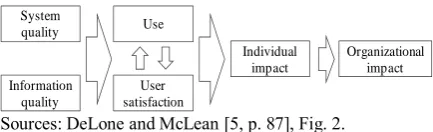
DeLone and McLean [5] suggested an information
systems (IS) success model (Fig. 1) after reviewing various
existing researches related to IS performance. The model
suggests that both IS quality and information quality affect
both IS use and user satisfaction, that both IS use and user
satisfaction affect the individual performance of IS, and that
the individual performance lastly affects organizational
performance. In addition, the IS use affects and is affected
by the user satisfaction. In the view of the IS success model,
the IS performance depends on IS quality and information
quality, which is related to an input factor, IS use and user
satisfaction, which is a process factor.
Sources: DeLone and McLean [5, p. 87], Fig. 2. Figure. 1. DeLone and McLean’s IS success model
DeLone and McLean [6] reviewed the many empirical
studies applied with their model [5], and suggested updated
IS success model (Fig. 2). They included service quality
and intention to use in their IS success model [5] and added
a feedback from net benefits to the intention to IS use and
the user satisfaction. In the view of the updated IS success
model, the net benefits (performance) depends on IS quality,
information quality, service quality, intention to use, use,
and user satisfaction. This model focuses quality of systems,
information, service, IS use, user satisfaction as an
informatization level.
Sources: DeLone and McLean [6, p. 24], Fig. 3.
Figure. 2. DeLone and McLean’s updated IS success model.
2.2. ITU ICT Development Index
International Telecommunication Union (ITU) measures
the level of informatization for each country by calculating
the
Information
and
Communication
Technology
Development Index (IDI) [7, 8, 9]. IDI is measured in
Information and Communication Technology (ICT) access,
ICT use, and ICT skills. ICT access measures the
fixed-telephone subscriptions per 100 inhabitants, the
mobile-cellular telephone subscriptions per 100 inhabitants, the
international Internet bandwidth (bit/s) per Internet user,
the percentage of households with a computer, and the
percentage of households with Internet access.
ICT use applies metrics such as the percentage of
individuals using the Internet, the fixed-broadband
subscriptions per 100 inhabitants, and the active
mobile-broadband subscriptions per 100 inhabitants. ICT skills
uses the metrics of the adult literacy rate, the secondary
gross enrolment ratio, and the tertiary gross enrolment ratio.
The weights for ICT access, ICT use, and ICT skills are
40%, 40%, and 20%, respectively. The same weights are
assigned to the metrics within each item. In 2017, ITU
member countries decided to revise and expand the IDI [10],
but the results have not yet been published as of October
2019. Infrastructure, use, and skills (user capability) are
evaluated in the IDI.
2.3. Evaluation Method of Korean Government
The Korean government's evaluation of informatization
capability (level) is being implemented as part of the
evaluation of administrative management capability to
improve the system in the informatization field [11]. This
evaluation is managed by the Ministry of the Interior and
Safety, which is based on the Framework Act on Public
Service Evaluation [12]. Organizations to be evaluated are
44 central government departments including the MND.
Table 1. Metrics for national informatization level evaluation in Korea.
Type Evaluation metric Weight
Implemen-tation of effective e-government (20 points)
Propulsion of performance management of e-government
14
Measurement of information resource management level Implementation level of phased
performance management Prevention of redundant investment
3 7 4 Efficiency of website operation
management
6 Web compatibility/access level
Website plug-in removal ratio
3 3
Reinforce-ment of cyber safety level (15 points)
Privacy protection level 4 E-government civil service
information security level
4
Cyber security management level 6 Administrative information security
level
Cyber crisis management and technical information security level
3 3 Cyber-attack response training result 1
The Ministry of the Interior and Safety conducts a
preliminary evaluation of the informatization field with the
National Information Society Agency (NIA), and notifies
the preliminary evaluation results to each central
Information quality
Use
User satisfaction
Individual impact
Organizational impact System
quality
Information quality
use
User satisfaction
Net benefits
Service quality Systems
quality
273
government department. The central administrative
departments finally evaluate their informatization level
themselves with the results.
The evaluation system of the informatization field in
2019 shows that a perfect score is 35 points, and measures
the implementation of effective e-government (20 points)
and the reinforcement of cyber safety level (15 points).
Evaluation metrics and their weights are shown in Table 1.
The evaluation system also describes the evaluation
formula as well as the evaluation method for each metric
[11].
A survey on informatization level for small and medium
enterprises (SMEs) is conducted by the Ministry of SMEs
and Startups and Korea Technology & Information
Promotion Agency for SMEs. This survey is for
establishing informatization strategies and establishing
policy directions for supporting SMEs [13]. It examines the
general status of companies, the willingness and plans for
informatization reinforcement, the environment for
informatization reinforcement, the current status of IS
implementation and use, the level of informatization
effectiveness, and smart factories and new ICT
technologies. Since 2012, the evaluation of SMEs
informatization level has not been carried out using all the
surveyed items, but only three items: the willingness and
plans for informatization reinforcement, the environment
for informatization reinforcement, and the current status of
IS implementation and use.
Many researches have been conducted on the evaluation
system for defense informatization level and the metrics for
each item. Lim et al. [14] suggest to measure the level of
defense informatization in terms of informatization
infrastructure,
informatization
environment,
informatization use, and informatization performance. In
the informatization infrastructure, defense information
network,
computer
systems,
interoperability
and
standardization are measured. In the informatization
environment, information security, organization, education,
investment, and strategy of informatization are measured.
The use of informatization measures the use of battlefield
management information system (MIS) and resource MIS.
The informatization performance measures the level of
informatization combat power and the improvement of the
efficiency of defense management. Also, various
evaluation metrics are presented in the study [14]. The
weights of evaluation items or metrics were calculated
using Analytic Hierarchy Process (AHP). It is speculated
that a method of calculating the evaluation metrics may
have been developed, but the study [14] did not provide it.
In order to demonstrate the usability of the developed
evaluation system for defense informatization level, the
informatization level was measured for military units in the
operation command or higher with surveys on current status
and questionnaires.
For other methods of informatization level measurement,
such as the corporate informatization level evaluation, and
a survey on the SMEs informatization level prior to 2012,
refer the existing study [14].
Since the evaluation system of defense informatization
level is mainly composed of qualitative evaluation metrics,
it is necessary to reconstruct it based on quantitative
evaluation metrics that can guarantee objectivity [15]. It
should be able to manage the increase and decrease of the
level by evaluation area. It should be designed with a focus
on homeostasis of metrics so that it can be measured
periodically. In addition, it is necessary to refrain from
evaluating all evaluation metrics using the 5-point scale
without a clear comparison, and to promote the evaluation
in terms of achieved performance against targets. The
method of measuring the informatization level with a
questionnaire is simple, but there are limitations. This may
be a subjective result by the survey respondent's perception
rather than an objective one. The informatization level may
be measured differently by the change of the survey
respondent even though the organization or institution was
the same informatization level. Longitudinal analysis also
needs to be available for level improvement or trend
analysis.
The level evaluation can be performed in the manner of
improvement of metrics compared to the previous year, the
level comparison to domestic or overseas organizations
(institutes), and absolute maturity level. In the short term, it
is advisable to conduct a level assessment in order to
compare the level of metric improvement compared to the
previous year or to compare the level of metrics with other
organizations. To use the evaluation system for the
informatization maturity level, at least several years of data
must be accumulated and available.
III. EVALUATION FOR DEFENSE
INFORMATIZATION LEVEL
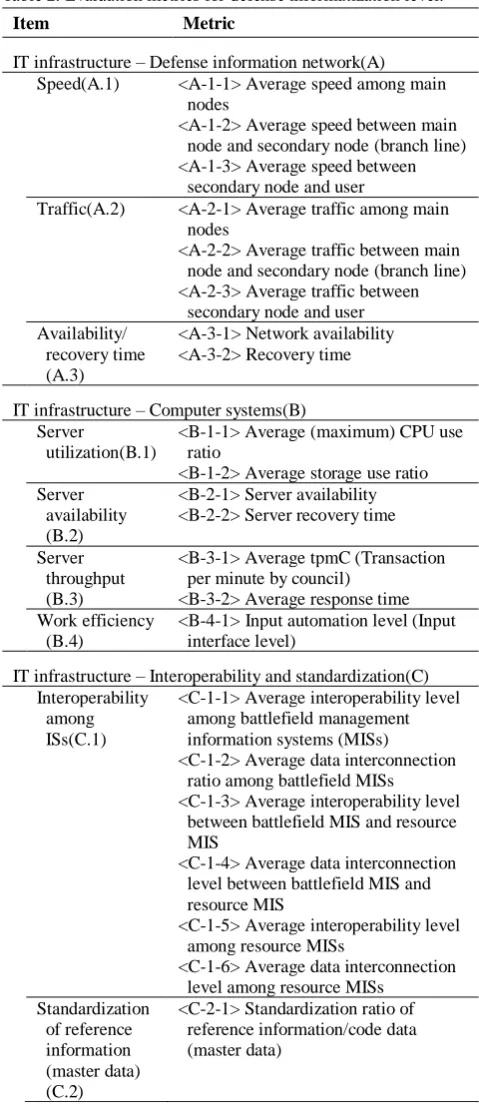
274
and work efficiency are measured in Computer systems (B).
Interoperability among ISs, standardization of reference
information (master data), and interoperability between
weapon systems and IS are measured in Interoperability
and standardization (C). The detection level (capability) of
infringement incident, the response level (capability) of
infringement incident, and the recovery of infringement
incident are measure in Information security (D).
Table 2. Evaluation metrics for defense informatization level.
Item Metric
IT infrastructure – Defense information network(A) Speed(A.1) <A-1-1> Average speed among main
nodes
<A-1-2> Average speed between main node and secondary node (branch line) <A-1-3> Average speed between
secondary node and user
Traffic(A.2) <A-2-1> Average traffic among main nodes
<A-2-2> Average traffic between main node and secondary node (branch line) <A-2-3> Average traffic between
secondary node and user Availability/
recovery time (A.3)
<A-3-1> Network availability <A-3-2> Recovery time
IT infrastructure – Computer systems(B) Server
utilization(B.1)
<B-1-1> Average (maximum) CPU use ratio
<B-1-2> Average storage use ratio Server
availability (B.2)
<B-2-1> Server availability <B-2-2> Server recovery time Server
throughput (B.3)
<B-3-1> Average tpmC (Transaction per minute by council)
<B-3-2> Average response time Work efficiency
(B.4)
<B-4-1> Input automation level (Input interface level)
IT infrastructure – Interoperability and standardization(C) Interoperability
among ISs(C.1)
<C-1-1> Average interoperability level among battlefield management information systems (MISs) <C-1-2> Average data interconnection
ratio among battlefield MISs <C-1-3> Average interoperability level
between battlefield MIS and resource MIS
<C-1-4> Average data interconnection level between battlefield MIS and resource MIS
<C-1-5> Average interoperability level among resource MISs
<C-1-6> Average data interconnection level among resource MISs
Standardization of reference information (master data) (C.2)
<C-2-1> Standardization ratio of reference information/code data (master data)
Table 2. Evaluation metrics for defense informatization level (continued).
Interoperability between weapon systems and IS (C.3)
<C-3-1> Average interoperability level between weapon systems and battlefield MIS
<C-3-2> Average data interconnection ratio between weapon systems and battlefield MIS
IT infrastructure – Information security(D) Detection level
(capability) of infringement incident(D.1)
<D-1-1> Intrusion detection ratio in advance
Response level (capability) of infringement incident(D.2)
<D-2-1> Number of intrusion incidents per year
<D-2-2> Intrusion incident response time
Recovery of infringement incident(D.3)
<D-3-1> Trace ratio of infringement incidents
<D-3-2> Recovery time after infringement incident Informatization environment(E)
Efforts to improve informatization capability(E.1)
<E-1-1> Annual time of informatization education
Informatization master plan(E.2)
<E-2-1> Informatization master plan
Efficient execution of budget(E.3)
<E-3-1> Efficiency of budget execution
IS use(F) Business
informatization (F.1)
<F-1-1> Ratio of tasks implemented by IS
Business use(F.2)
<F-2-1> Business use
Table 3. Metrics for Speed (A.1).
Item Description
Evaluation item
Defense information network(A) >> Speed(A.1)
Metric <A-1-1> Average speed among main nodes <A-1-2> Average speed between main node
and secondary node (branch line) <A-1-3> Average speed between secondary
node and user
Explanation Average speed among main nodes, the main node and the secondary node, and the secondary node and the user in the defense information network
Measurement method X =
𝑚𝑒𝑎𝑠𝑢𝑟𝑒𝑑 𝑠𝑝𝑒𝑒𝑑 𝑜𝑓 𝑛𝑒𝑡𝑤𝑜𝑟𝑘 𝑚𝑎𝑥𝑖𝑚𝑢𝑚 𝑠𝑝𝑒𝑒𝑑(𝑑𝑒𝑠𝑖𝑔𝑛𝑒𝑑 𝑠𝑝𝑒𝑒𝑑)
Y = 𝑋
𝑇𝑎𝑟𝑔𝑒𝑡 𝑉𝑎𝑙𝑢𝑒× 100 (satisfaction ratio of
network speed) Data gathering
method (Data sources)
■ System □ Data □ Questionnaires □ Interview ※ Measure with network management
275
The level evaluation for defense information network is
performed using metrics for Speed (A.1), Traffic (A.2), and
Availability/recovery time (A.3). Table 3 shows the
evaluation metrics for Speed (A.1). These are average
speed among main nodes (main lines), average speed
between the main node and the secondary node (branch
line), and average speed between the secondary node and
the user (user network). The equation is the ratio of
measured speed of network against maximum speed
(designed speed) to the target ratio. The data for network
speed can be acquired from network management systems
(NMS).
Table 4. Metrics for Traffic (A.2).
Item Description
Evaluation item
Defense information network(A) >> Traffic(A.2)
Metric <A-2-1> Average traffic among main nodes <A-2-2> Average traffic between main node
and secondary node (branch line)
<A-2-3> Average traffic between secondary node and user
Explanation Average traffic among main nodes, the main node and the secondary node, and the secondary node and the user in the defense information network
Measurement method X =
𝑚𝑒𝑎𝑠𝑢𝑟𝑒𝑑 𝑢𝑝/𝑑𝑜𝑤𝑛 𝑡𝑟𝑎𝑓𝑓𝑖𝑐 𝑖𝑛 𝑛𝑒𝑡𝑤𝑜𝑟𝑘 𝑎𝑣𝑎𝑖𝑙𝑎𝑏𝑙𝑒 𝑡𝑟𝑎𝑓𝑓𝑖𝑐 𝑎𝑠𝑠𝑖𝑔𝑛𝑒𝑑 𝑡𝑜 𝑛𝑒𝑡𝑤𝑜𝑟𝑘
Y =𝑋−𝑇𝑎𝑟𝑔𝑒𝑡 𝑉𝑎𝑙𝑢𝑒
𝑇𝑎𝑟𝑔𝑒𝑡 𝑉𝑎𝑙𝑢𝑒 × 100 (excess ratio of
traffic)* Data gathering
method (Data sources)
■ System □ Data □ Questionnaires □ Interview ※ Measure average, minimum, and
maximum traffic of network with network management systems (NMS)
* Note. The scoring method of metrics in the form of excess ratios: 0% or less, 100 points; 0 to 20% or less, 80 points; 20 to 40% or less, 60 points; 40 to 60% or less, 40 points; 60 to 80% or less, 20 points; 80% or more, 0 points.
Table 4 describes metrics for traffic. The evaluation
metrics for Traffic (A.2), like the metrics for Speed (A.1),
measure a traffic on trunk, branch, and user network. These
measure if an excessive traffic against a designed or
estimated traffic occurs. The data for network traffic can be
acquired from NMS.
The evaluation of Availability/recovery time (A.3)
metric calculates availability with a probability that the
network can be serviced without interruption, and manages
data on network average recovery time to calculate
availability. Table 5 presents a metric for network
availability. The data for network availability can be
acquired from NMS. The mean time to failure (MTTF) is
average time of network service between failure of network
and failure of network.
Table 5. <A-3-1> Network availability metric.
Item Description
Evaluation item
Defense information network(A) >> Availability/recovery time(A.3) Metric <A-3-1> Network availability
Explanation A probability that the defense information network can be serviced without interruption
Measurement method
X = MTTF / (MTTF + MTTR)
Y = 𝑋
𝑇𝑎𝑟𝑔𝑒𝑡 𝑉𝑎𝑙𝑢𝑒× 100 (satisfaction ratio of
availability)
※ MTTF (Mean Time To Failure): average time of network service
※ MTTR (Mean Time To Repair): average time to recovery after network service outage
Data gathering method (Data sources)
■ System □ Data □ Questionnaires □ Interview ※ Measure with network management
systems (NMS)
Table 6. <A-3-2> Recovery time metric.
Item Description
Evaluation item
Defense information network(A) >> Availability/recovery time(A.3) Metric <A-3-2> Recovery time
Explanation Average time to recovery after network service outage
Measurement method
X = MTTR
Y =𝑋−𝑇𝑎𝑟𝑔𝑒𝑡 𝑉𝑎𝑙𝑢𝑒
𝑇𝑎𝑟𝑔𝑒𝑡 𝑉𝑎𝑙𝑢𝑒 × 100 (excess ratio of
recovery time)
※ MTTR (Mean Time To Repair): average time to recovery after network service outage
Data gathering method (Data sources)
■ System □ Data □ Questionnaires □ Interview ※ Measure with network management
systems (NMS)
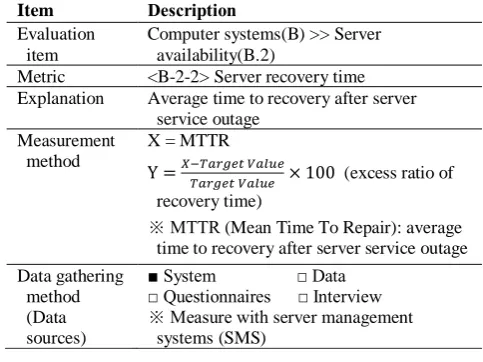
Table 6 shows the measurement method for the
Recovery time metric. This calculates MTTR (Mean Time
To Repair), and suggests providing service within target
time of recovery. Shorter MTTR is better.
Other metrics are shown in appendix.
IV. CONCLUSION
276
evaluation. The evaluation method that was being
implemented by the government is accommodated as much
as possible so that the efficient evaluation can be carried out
while reducing the burden on the defense organization.
As with most researches and methodologies, there are
limitations in the proposed evaluation system. It is
necessary to set the target value for each metric. One also
needs to consider metrics such as power usage effectiveness
(PUE), which are used as metrics for US government data
centers [16, 17]. In addition, the study should have provided
some cases or results applying the proposed evaluation
system, but it does not due to a defense security issue.
Rather than waiting for the development of a sufficiently
reasonable and theoretically complete evaluation system, it
is better to complement the evaluation system by measuring
the level of informatization. It is more significant to
develop and apply the evaluation system that users can
intuitively understand or use. Accumulated experiences
with repetitive use of the evaluation system can lead to
lessons learned and complementary needs, which can make
the evaluation system more robust. Through such a virtuous
cycle, the evaluation system of the defense informatization
level and measurement metrics that are actively accepted by
the stakeholders of the evaluation can be developed.
Acknowledgements
This manuscript is based on Research Report [15]. The
authors wish to thank the editors and the anonymous
reviewers for their careful reviews and constructive
suggestions. Their suggestions helped strengthen the paper.
All errors are the sole responsibility of the authors.
R
EFERENCES[1] A. McAfee and E. Brynjolfsson, “Big data: The
management revolution,”
Harvard Business Review
, pp.
60-68, October 2012.
[2] Korea Ministry of National Defense (MND),
Act on
Establishment of Infrastructure for Informatization of
National Defense and Management of Informational
Resources for National Defense (Abbreviation: Act on
Defense
Informatization)
,
Act
No.
12553,
http://elaw.klri.re.kr/kor_service/lawView.do?hseq=32
670&lang=ENG
,
May 9, 2014.
[3] Korea Ministry of National Defense (MND),
Defense
Informatization Task Directive
, MND Directive No.
2129, http://www.law.go.kr/
행정규칙
/
국방정보화업
무훈령
, Feb. 5, 2018. (
In Korean
)
[4] H. J. Kwon, J. S. Choi, S. T. Kim, H. J. Lee, and Y. P.
Sung, “A study for improving an evaluation systems of
defense informatization,” Korea Institute for Defense
Analyses, Seoul, Republic of Korea, Research Report,
Feb. 2012. (
In Korean
)
[5] W. H. DeLone and E. R. McLean, “Information systems
success: The quest for the dependent variable,”
Information System Research
, vol. 3, no. 1, pp. 60-95,
1992.
[6] W. H. DeLone and E. R. McLean, “The DeLone and
McLean model of information systems success: A
ten-year update,”
Journal of Management Information
Systems
, vol. 19, no. 4,
pp. 9-30, Spring 2003.
[7] International Telecommunication Union, “
Measuring
the Information Society Report-Executive summary
,”
ITU Publications, 2010-2015.
[8] International Telecommunication Union, “
Measuring
the Information Society Report-Executive Summary
,”
ITU Publications, 2017.
[9] E. J. Lee and B. M. Ahn, “
Evaluation of Informatization
Level of ITU (IDI, ICT Development Index)
,” Korea
Institute of S&T Evaluation and Planning, Seoul,
Republic of Korea, KISTEP Statistic Brief, 2013-26,
2013. (
In Korean
)
[10] International Telecommunication Union, “
Measuring
the Information Society Report
,” Volume 1, Statistical
Reports, ITU Publications, 2018.
[11] Korea Ministry of the Interior and Safety, “
2019
Central Government Department Self-evaluation
(Public Administration Capability Part) Plan (Draft)
,”
May 17, 2019. (
In Korean
)
[12] Office for Government Policy Coordination,
Framework Act on Public Service Evaluation
, Act No.
14839, July 26, 2017. (
In Korean
)
[13] Ministry of SMEs and Startups, and Korea Technology
& Information Promotion Agency for SMEs, “
2018
Survey on the Information Level of Korean Small and
Medium Enterprise
,” Daejeon, Republic of Korea,
TIPA Research Report 19-01, May 31, 2019. (
In
Korean
)
;
https://www.mss.go.kr/site/smba/foffice/ex/statDB/St
ReportContentDetailView.do?gb=1&reSeq=1712
.
[14] G. G. Lim, D. C. Lee, H. J. Kwon, and S. R. Cho, “A
case of developing performance evaluation model for
Korean defense informatization,”
Information Systems
Review
, Vol. 19, No. 3, pp. 23-45, 2017. (
In Korean
)
[15] S. Lee, H. S. Jung, and S. J. Yoon, “An application
with an evaluation methodology
for defense
informatization and validating the methodology,” Sun
Moon University, Asan, Republic of Korea, Research
Report, Nov. 2012. (
In Korean
)
[16] U.S. Department of Energy, “Data center metering and
resource
guide,”
February
2017;
277
[17] U.S. General Services Administration,
Optimization
Metrics
,
2019;
https://www.gsa.gov/technology/government-it-
initiatives/dcoi/dcoi-data-center-resources/optimization-metrics#Energy%20Metering
.
Authors
Seungbae Sim
is a research fellow in
the Center for Military Analysis and
Planning at Korea Institute for
Defense Analyses, Republic of Korea.
He received the B.S. and M.S. degree
in Industrial Systems Engineering
from Yonsei University and Ph.D.
degree in Information and Industrial
Engineering from Yonsei University. His research interests
include software policy, software productivity, analysis and
audit of information system, IT project management, and
data science.
Sangho Lee
is an associate professor
in the Department of IT Management
at Sun Moon University, Republic of
Korea. He received his Ph.D. from
Korea Advanced Institute of Science
Technology
(KAIST)
and
Master/Bachelor's
degree
at
Sungkyunkwan
University.
His
research interests are the business
value of IT, the evaluation of IT investment projects,
software engineering, and causality between IT investment
and performance.
A
PPENDIXTable A1. <B-1-1> Average (maximum) CPU use ratio metric.
Item Description
Evaluation item
Computer systems(B) >> Server utilization(B.1)
Metric <B-1-1> Average (maximum) CPU use ratio Explanation Average CPU use ratio of IS server Measurement
method
X = Daily / Monthly / Yearly average (maximum) CPU use ratio
Y =𝑋−𝑇𝑎𝑟𝑔𝑒𝑡 𝑉𝑎𝑙𝑢𝑒
𝑇𝑎𝑟𝑔𝑒𝑡 𝑉𝑎𝑙𝑢𝑒 × 100 (excess ratio of
CPU use) Data gathering
method (Data sources)
■ System □ Data □ Questionnaires □ Interview ※ Measure with server management
systems (SMS)
Table A2. <B-1-2> Average storage use ratio metric.
Item Description
Evaluation item
Computer systems(B) >> Server utilization(B.1)
Metric <B-1-2> Average storage use ratio
Table A2. <B-1-2> Average storage use ratio metric (continued). Explanation Average storage use ratio of IS server Measurement
method
X = daily / monthly / yearly average storage use ratio
Y =𝑋−𝑇𝑎𝑟𝑔𝑒𝑡 𝑉𝑎𝑙𝑢𝑒
𝑇𝑎𝑟𝑔𝑒𝑡 𝑉𝑎𝑙𝑢𝑒 × 100 (excess ratio of
storage use) Data gathering
method (Data sources)
■ System □ Data □ Questionnaires □ Interview ※ Measure with server management
systems (SMS)
Table A3. <B-2-1> Server availability metric.
Item Description
Evaluation item
Computer systems(B) >> Server availability(B.2)
Metric <B-2-1> Server availability
Explanation A probability that the server can be serviced without interruption
Measurement method
X = MTTF / (MTTF + MTTR)
Y = 𝑋
𝑇𝑎𝑟𝑔𝑒𝑡 𝑉𝑎𝑙𝑢𝑒× 100 (satisfaction ratio of
availability)
※ MTTF (Mean Time To Failure): average time of server service
※ MTTR (Mean Time To Repair): average time to recovery after server service outage Data gathering
method (Data sources)
■ System □ Data □ Questionnaires □ Interview ※ Measure with server management
systems (SMS)
Table A4. <B-2-2> Server recovery time metric.
Item Description
Evaluation item
Computer systems(B) >> Server availability(B.2)
Metric <B-2-2> Server recovery time Explanation Average time to recovery after server
service outage Measurement
method
X = MTTR
Y =𝑋−𝑇𝑎𝑟𝑔𝑒𝑡 𝑉𝑎𝑙𝑢𝑒
𝑇𝑎𝑟𝑔𝑒𝑡 𝑉𝑎𝑙𝑢𝑒 × 100 (excess ratio of
recovery time)
※ MTTR (Mean Time To Repair): average time to recovery after server service outage Data gathering
method (Data sources)
■ System □ Data □ Questionnaires □ Interview ※ Measure with server management
systems (SMS) Table A5. <B-3-1> Average tpmC metric.
Item Description
Evaluation item
Computer systems(B) >> Server throughput(B.3)
Metric <B-3-1> Average tpmC (transaction per minute by council)
Explanation Average transaction processing speed of IS server
Measurement method
X = average tpmC
Y = 𝑋
𝑇𝑎𝑟𝑔𝑒𝑡 𝑉𝑎𝑙𝑢𝑒× 100 (satisfaction ratio of
278
Table A5. <B-3-1> Average tpmC metric (continued). Data gathering
method (Data sources)
■ System ■ Data □ Questionnaires □ Interview ※ Measure with server management
systems (SMS) and server specification Table A6. <B-3-2> Average response time metric.
Item Description
Evaluation item
Computer systems(B) >> Server throughput(B.3)
Metric <B-3-2> Average response time
Explanation Average response time of IS server to client requirement
Measurement method
X = Average response time of IS server
Y =𝑋−𝑇𝑎𝑟𝑔𝑒𝑡 𝑉𝑎𝑙𝑢𝑒𝑇𝑎𝑟𝑔𝑒𝑡 𝑉𝑎𝑙𝑢𝑒 × 100 (excess ratio of response time)
Data gathering method (Data sources)
■ System ■ Data □ Questionnaires □ Interview ※ Measure with server management
systems (SMS) and server specification Table A7. <B-4-1> Input automation level (Input interface level) metric.
Item Description
Evaluation item
Computer systems(B) >> Work efficiency (B.4)
Metric <B-4-1> Input automation level (Input interface level)
Explanation Automation level of data input in IS Measurement
method X =
# 𝑜𝑓 𝑑𝑎𝑡𝑎 𝑖𝑛𝑝𝑢𝑡 𝑤 𝑏𝑎𝑟𝑐𝑜𝑑𝑒/𝑅𝐹𝐼𝐷/𝑄𝑅 𝑐𝑜𝑑𝑒 𝑡𝑜𝑡𝑎𝑙 # 𝑜𝑓 𝑑𝑎𝑡𝑎 𝑖𝑛𝑝𝑢𝑡
Y = 𝑋
𝑇𝑎𝑟𝑔𝑒𝑡 𝑉𝑎𝑙𝑢𝑒× 100
Data gathering method (Data sources)
■ System ■ Data □ Questionnaires □ Interview
Table A8. <C-1-1> Average interoperability level among battlefield MISs metric.
Item Description
Evaluation item
Interoperability and standardization(C) >> Interoperability among ISs(C.1) Metric <C-1-1> Average interoperability level
among battlefield MISs
Explanation Average Levels of Information System Interoperability (LISI) among battlefield MISs
Measurement method
X = Average LISI among battlefield MISs
Y = 𝑋
𝑇𝑎𝑟𝑔𝑒𝑡 𝑉𝑎𝑙𝑢𝑒× 100 (satisfaction ratio of
interoperability) Data gathering
method (Data sources)
□ System ■ Data □ Questionnaires □ Interview
※ Use the LISI result measured by Defense Interoperability Center
Table A9. <C-1-2> Average data interconnection ratio among battlefield MISs metric.
Item Description
Evaluation item
Interoperability and standardization(C) >> Interoperability among ISs(C.1)
Metric <C-1-2> Average data interconnection ratio among battlefield MISs
Explanation Average data interconnection ratio of interface among battlefield MISs Measurement
method X =
# 𝑜𝑓 𝑟𝑒𝑎𝑙𝑖𝑧𝑒𝑑 𝑖𝑛𝑡𝑒𝑟𝑐𝑜𝑛𝑛𝑒𝑐𝑡𝑖𝑜𝑛 𝑎𝑚𝑜𝑛𝑔 𝐼𝑆𝑠 # 𝑜𝑓 𝑟𝑒𝑞𝑢𝑖𝑟𝑒𝑑 𝑖𝑛𝑡𝑒𝑟𝑐𝑜𝑛𝑛𝑒𝑐𝑡𝑖𝑜𝑛 𝑎𝑚𝑜𝑛𝑔 𝐼𝑆𝑠
Y = 𝑋
𝑇𝑎𝑟𝑔𝑒𝑡 𝑉𝑎𝑙𝑢𝑒× 100 (satisfaction ratio of
data interconnection) Data gathering
method (Data sources)
■ System ■ Data □ Questionnaires □ Interview ※ Measure the number of the realized
interconnection from ISs and the number of the required interconnection from
Requirement of Capability (ROC) / Information Exchange Requirement (IER) / System/Subsystem Specification (SSS) Table A10. <C-1-3> Average interoperability level between battlefield MIS and resource MIS metric.
Item Description
Evaluation item
Interoperability and standardization(C) >> Interoperability among ISs(C.1) Metric <C-1-3> Average interoperability level
between battlefield MIS and resource MIS Explanation Average LISI between battlefield MIS and
resource MIS Measurement
method
X = Average LISI between battlefield MIS and resource MIS
Y = 𝑋
𝑇𝑎𝑟𝑔𝑒𝑡 𝑉𝑎𝑙𝑢𝑒× 100 (satisfaction ratio of
interoperability) Data gathering
method (Data sources)
□ System ■ Data □ Questionnaires □ Interview
※ Use the LISI result measured by Defense Interoperability Center
Table A11. <C-1-4> Average data interconnection ratio between battlefield MIS and resource MIS metric.
Item Description
Evaluation item
Interoperability and standardization(C) >> Interoperability among ISs(C.1)
Metric <C-1-4> Average data interconnection ratio between battlefield MIS and resource MIS Explanation Average data interconnection ratio of
interface between battlefield MIS and resource MIS
Measurement method X =
# 𝑜𝑓 𝑟𝑒𝑎𝑙𝑖𝑧𝑒𝑑 𝑖𝑛𝑡𝑒𝑟𝑐𝑜𝑛𝑛𝑒𝑐𝑡𝑖𝑜𝑛 𝑎𝑚𝑜𝑛𝑔 𝐼𝑆𝑠 # 𝑜𝑓 𝑟𝑒𝑞𝑢𝑖𝑟𝑒𝑑 𝑖𝑛𝑡𝑒𝑟𝑐𝑜𝑛𝑛𝑒𝑐𝑡𝑖𝑜𝑛 𝑎𝑚𝑜𝑛𝑔 𝐼𝑆𝑠
Y =𝑇𝑎𝑟𝑔𝑒𝑡 𝑉𝑎𝑙𝑢𝑒𝑋 × 100 (satisfaction ratio of data interconnection)
Data gathering method (Data sources)
■ System ■ Data □ Questionnaires □ Interview ※ Measure the number of the realized
interconnection from ISs and the number of the required interconnection from
279
Table A12. <C-1-5> Average interoperability level among resource MISs metric.
Item Description
Evaluation item
Interoperability and standardization(C) >> Interoperability among ISs(C.1) Metric <C-1-5> Average interoperability level
among resource MISs
Explanation Average LISI (Levels of Information System Interoperability) among resource MISs
Measurement method
X = Average LISI among resource MISs
Y = 𝑋
𝑇𝑎𝑟𝑔𝑒𝑡 𝑉𝑎𝑙𝑢𝑒× 100 (satisfaction ratio of
interoperability) Data gathering
method (Data sources)
□ System ■ Data □ Questionnaires □ Interview
※ Use the LISI result measured by Defense Interoperability Center
Table A13. <C-1-6> Average data interconnection ratio among resource MISs metric.
Item Description
Evaluation item
Interoperability and standardization(C) >> Interoperability among ISs(C.1)
Metric <C-1-6> Average data interconnection ratio among resource MISs
Explanation Average data interconnection ratio of interface among resource MISs Measurement
method X =
# 𝑜𝑓 𝑟𝑒𝑎𝑙𝑖𝑧𝑒𝑑 𝑖𝑛𝑡𝑒𝑟𝑐𝑜𝑛𝑛𝑒𝑐𝑡𝑖𝑜𝑛 𝑎𝑚𝑜𝑛𝑔 𝐼𝑆𝑠 # 𝑜𝑓 𝑟𝑒𝑞𝑢𝑖𝑟𝑒𝑑 𝑖𝑛𝑡𝑒𝑟𝑐𝑜𝑛𝑛𝑒𝑐𝑡𝑖𝑜𝑛 𝑎𝑚𝑜𝑛𝑔 𝐼𝑆𝑠
Y = 𝑋
𝑇𝑎𝑟𝑔𝑒𝑡 𝑉𝑎𝑙𝑢𝑒× 100 (satisfaction ratio of
data interconnection) Data gathering
method (Data sources)
■ System ■ Data □ Questionnaires □ Interview ※ Measure the number of the realized
interconnection from ISs and the number of the required interconnection from
Requirement of Capability (ROC) / Information Exchange Requirement (IER) / System/Subsystem Specification (SSS) Table A14. <C-2-1> Standardization ratio of reference information/code data (master data) metric.
Item Description
Evaluation item
Interoperability and standardization(C) >> Standardization of reference information (master data)(C.2)
Metric <C-2-1> Standardization ratio of reference information/code data (master data) Explanation The ratio of standardized code to total code
data/reference information Measurement
method X =
# 𝑜𝑓 𝑠𝑡𝑎𝑛𝑑𝑎𝑟𝑑𝑖𝑧𝑒𝑑 𝑐𝑜𝑑𝑒 𝑖𝑛 𝑑𝑒𝑓𝑒𝑛𝑠𝑒 𝐼𝑆𝑠 𝑡𝑜𝑡𝑎𝑙 # 𝑜𝑓 𝑐𝑜𝑑𝑒 𝑑𝑎𝑡𝑎 𝑖𝑛 𝑑𝑒𝑓𝑒𝑛𝑠𝑒 𝐼𝑆𝑠
Y = 𝑋
𝑇𝑎𝑟𝑔𝑒𝑡 𝑉𝑎𝑙𝑢𝑒× 100 (satisfaction ratio of
standardization) Data gathering
method (Data sources)
■ System ■ Data □ Questionnaires □ Interview
Table A15. <C-3-1> Average interoperability level between weapon systems and battlefield MIS metric.
Item Description
Evaluation item
Interoperability and standardization(C) >> Interoperability between weapon systems and IS(C.3)
Metric <C-3-1> Average interoperability level between weapon systems and battlefield MIS
Explanation Average LISI (Levels of Information System Interoperability) between weapon systems and battlefield MIS
Measurement method
X = Average LISI between weapon systems and battlefield MIS
Y = 𝑋
𝑇𝑎𝑟𝑔𝑒𝑡 𝑉𝑎𝑙𝑢𝑒× 100 (satisfaction ratio of
interoperability) Data gathering
method (Data sources)
□ System ■ Data □ Questionnaires □ Interview
※ Use the LISI result measured by Defense Interoperability Center
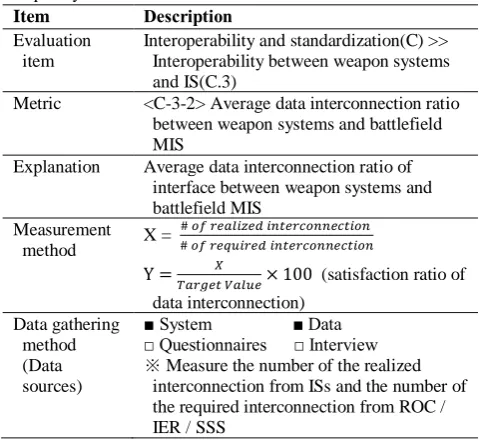
Table A16. <C-3-2> Average data interconnection ratio between weapon systems and battlefield MIS metric.
Item Description
Evaluation item
Interoperability and standardization(C) >> Interoperability between weapon systems and IS(C.3)
Metric <C-3-2> Average data interconnection ratio between weapon systems and battlefield MIS
Explanation Average data interconnection ratio of interface between weapon systems and battlefield MIS
Measurement method X =
# 𝑜𝑓 𝑟𝑒𝑎𝑙𝑖𝑧𝑒𝑑 𝑖𝑛𝑡𝑒𝑟𝑐𝑜𝑛𝑛𝑒𝑐𝑡𝑖𝑜𝑛 # 𝑜𝑓 𝑟𝑒𝑞𝑢𝑖𝑟𝑒𝑑 𝑖𝑛𝑡𝑒𝑟𝑐𝑜𝑛𝑛𝑒𝑐𝑡𝑖𝑜𝑛
Y = 𝑋
𝑇𝑎𝑟𝑔𝑒𝑡 𝑉𝑎𝑙𝑢𝑒× 100 (satisfaction ratio of
data interconnection) Data gathering
method (Data sources)
■ System ■ Data □ Questionnaires □ Interview ※ Measure the number of the realized
interconnection from ISs and the number of the required interconnection from ROC / IER / SSS
Table A17. <D-1-1> Intrusion detection ratio in advance metric.
Item Description
Evaluation item
Information security(D) >> Detection level (capability) of infringement incident(D.1) Metric <D-1-1> Intrusion detection ratio in advance Explanation The ratio of detecting the infringement
incident in advance Measurement
method X =
# 𝑜𝑓 𝑑𝑒𝑡𝑒𝑐𝑡𝑖𝑜𝑛 𝑖𝑛 𝑎𝑑𝑣𝑎𝑛𝑐𝑒 𝑡𝑜𝑡𝑎𝑙 # 𝑜𝑓 𝑖𝑛𝑓𝑟𝑖𝑛𝑔𝑒𝑚𝑒𝑛𝑡 𝑖𝑛𝑐𝑖𝑑𝑒𝑛𝑡
Y = 𝑋
𝑇𝑎𝑟𝑔𝑒𝑡 𝑉𝑎𝑙𝑢𝑒× 100 (satisfaction ratio of
detection in advance) Data gathering
method (Data sources)
■ System ■ Data □ Questionnaires □ Interview
280
Table A18. <D-2-1> Number of intrusion incidents per year metric.
Item Description
Evaluation item
Information security(D) >> Response level (capability) of infringement incident(D.2) Metric <D-2-1> Number of intrusion incidents per
year
Explanation The number of the infringement incident per year in organization
Measurement method
X = The number of the infringement incident per year in organization
Y =𝑋−𝑇𝑎𝑟𝑔𝑒𝑡 𝑉𝑎𝑙𝑢𝑒
𝑇𝑎𝑟𝑔𝑒𝑡 𝑉𝑎𝑙𝑢𝑒 × 100 (excess ratio of
infringement incident occurrence) Data gathering
method (Data sources)
■ System □ Data □ Questionnaires □ Interview
※ Measure the total number of infringement incident from target IS
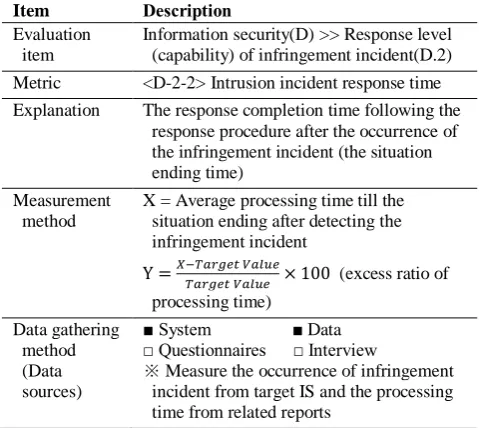
Table A19. <D-2-2> Intrusion incident response time metric.
Item Description
Evaluation item
Information security(D) >> Response level (capability) of infringement incident(D.2) Metric <D-2-2> Intrusion incident response time Explanation The response completion time following the
response procedure after the occurrence of the infringement incident (the situation ending time)
Measurement method
X = Average processing time till the situation ending after detecting the infringement incident
Y =𝑋−𝑇𝑎𝑟𝑔𝑒𝑡 𝑉𝑎𝑙𝑢𝑒
𝑇𝑎𝑟𝑔𝑒𝑡 𝑉𝑎𝑙𝑢𝑒 × 100 (excess ratio of
processing time) Data gathering
method (Data sources)
■ System ■ Data □ Questionnaires □ Interview
※ Measure the occurrence of infringement incident from target IS and the processing time from related reports
Table A20. <D-3-1> Trace ratio of infringement incidents metric.
Item Description
Evaluation item
Information security(D) >> Recovery of infringement incident(D.3)
Metric <D-3-1> Trace ratio of infringement incidents
Explanation The success ratio of trace about the origin of the infringement incident
Measurement method X =
# 𝑜𝑓 𝑡𝑟𝑎𝑐𝑒 𝑜𝑓 𝑖𝑛𝑓𝑟𝑖𝑛𝑔𝑒𝑚𝑒𝑛𝑡 𝑖𝑛𝑐𝑖𝑑𝑒𝑛𝑡 𝑡𝑜𝑡𝑎𝑙 # 𝑜𝑓 𝑖𝑛𝑓𝑟𝑖𝑛𝑔𝑒𝑚𝑒𝑛𝑡 𝑖𝑛𝑐𝑖𝑑𝑒𝑛𝑡
Y = 𝑋
𝑇𝑎𝑟𝑔𝑒𝑡 𝑉𝑎𝑙𝑢𝑒× 100 (success ratio of
trace) Data gathering
method (Data sources)
■ System ■ Data □ Questionnaires □ Interview
※ Measure the occurrence of infringement incident from target IS and the trace information from related reports
Table A21. <D-3-2> Recovery time after infringement incident metric.
Item Description
Evaluation item
Information security(D) >> Recovery of infringement incident(D.3)
Metric <D-3-2> Recovery time after infringement incident
Explanation Average time to recovery after infringement incident
Measurement method
X = Average time to recovery after the infringement incident
Y =𝑋−𝑇𝑎𝑟𝑔𝑒𝑡 𝑉𝑎𝑙𝑢𝑒
𝑇𝑎𝑟𝑔𝑒𝑡 𝑉𝑎𝑙𝑢𝑒 × 100 (excess ratio of
time to recovery) Data gathering
method (Data sources)
■ System ■ Data □ Questionnaires □ Interview
※ Measure the occurrence of infringement incident from target IS and the recovery time from related reports
Table A22. <E-1-1> Annual time of informatization education metric.
Item Description
Evaluation item
Informatization environment(E) >> Efforts to improve informatization capability(E.1) Metric <E-1-1> Annual time of informatization
education
Explanation Annual time of informatization education Measurement
method
X = Annual time of informatization education per person in organization
Y =𝑀𝑖𝑛(𝑋,𝑇𝑎𝑟𝑔𝑒𝑡 𝑉𝑎𝑙𝑢𝑒)
𝑇𝑎𝑟𝑔𝑒𝑡 𝑉𝑎𝑙𝑢𝑒 × 100 (completion
ratio of informatization education) Data gathering
method (Data sources)
□ System ■ Data □ Questionnaires □ Interview
Table A23. <E-2-1> Informatization master plan metric.
Item Description
Evaluation item
Informatization environment(E) >> Informatization master plan(E.2) Metric <E-2-1> Informatization master plan Explanation Enterprise Architecture (EA) maturity level
measured by National Information Society Agency (NIA) method and the execution level of basic informatization plan Measurement
method
𝑋1 = (EA maturity level) ⁄ 5
𝑋2 =
# 𝑜𝑓 𝑒𝑥𝑒𝑐𝑢𝑡𝑒𝑑 𝑖𝑡𝑒𝑚𝑠 𝑖𝑛 𝑚𝑎𝑠𝑡𝑒𝑟 𝑝𝑙𝑎𝑛 𝑡𝑜𝑡𝑎𝑙 # 𝑜𝑓 𝑖𝑡𝑒𝑚𝑠 𝑖𝑛 𝑚𝑎𝑠𝑡𝑒𝑟 𝑝𝑙𝑎𝑛
Y = ( 𝑤1𝑋1
𝑇𝑎𝑟𝑔𝑒𝑡 𝑉𝑎𝑙𝑢𝑒1+
𝑤2𝑋2
𝑇𝑎𝑟𝑔𝑒𝑡 𝑉𝑎𝑙𝑢𝑒2) × 100, 𝑤1+ 𝑤2= 1
Data gathering method (Data sources)
281
Table A24. <E-3-1> Efficiency of budget execution metric.
Item Description
Evaluation item
Informatization environment(E) >> Efficient execution of budget(E.3)
Metric <E-3-1> Efficiency of budget execution Explanation Efficiency level of budget execution:
executed budget against planned budget, the ratio of budget for new IT project to informatization budget, and the ratio of informatization budget to total defense budget
Measurement
method 𝑋1 =
𝑒𝑥𝑒𝑐𝑢𝑡𝑒𝑑 𝑏𝑢𝑑𝑔𝑒𝑡 𝑝𝑙𝑎𝑛𝑛𝑒𝑑 𝑏𝑢𝑑𝑔𝑒𝑡
𝑋2 = 𝑏𝑢𝑑𝑔𝑒𝑡 𝑓𝑜𝑟 𝑛𝑒𝑤 𝐼𝑇 𝑝𝑟𝑜𝑗𝑒𝑐𝑡𝑖𝑛𝑓𝑜𝑟𝑚𝑎𝑡𝑖𝑧𝑎𝑡𝑖𝑜𝑛 𝑏𝑢𝑑𝑔𝑒𝑡
𝑋3 =
𝑖𝑛𝑓𝑜𝑟𝑚𝑎𝑡𝑖𝑧𝑎𝑡𝑖𝑜𝑛 𝑏𝑢𝑑𝑔𝑒𝑡 𝑡𝑜𝑡𝑎𝑙 𝑑𝑒𝑓𝑒𝑛𝑠𝑒 𝑏𝑢𝑑𝑔𝑒𝑡
Y = ( 𝑤1𝑋1
𝑇𝑎𝑟𝑔𝑒𝑡 𝑉𝑎𝑙𝑢𝑒(𝑇𝑉)1+
𝑤2𝑋2
𝑇𝑉2 +
𝑤3𝑋3
𝑇𝑉3) × 100, 𝑤1+ 𝑤2+ 𝑤3= 1
Data gathering method (Data sources)
□ System ■ Data □ Questionnaires □ Interview
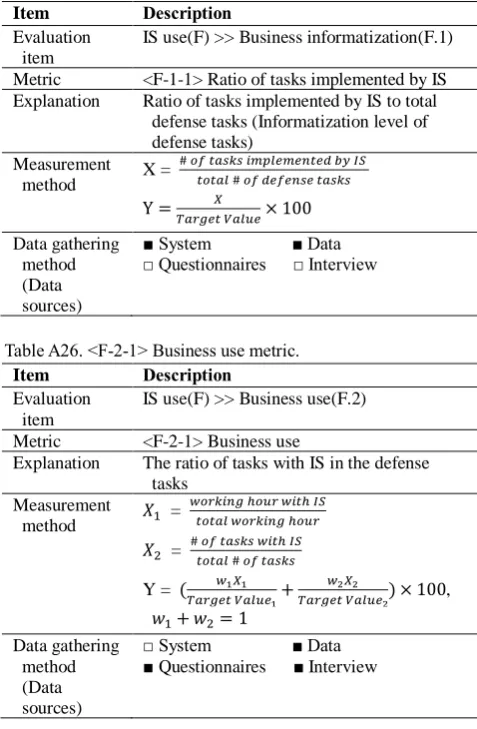
Table A25. <F-1-1> Ratio of tasks implemented by IS metric.
Item Description
Evaluation item
IS use(F) >> Business informatization(F.1) Metric <F-1-1> Ratio of tasks implemented by IS Explanation Ratio of tasks implemented by IS to total
defense tasks (Informatization level of defense tasks)
Measurement method X =
# 𝑜𝑓 𝑡𝑎𝑠𝑘𝑠 𝑖𝑚𝑝𝑙𝑒𝑚𝑒𝑛𝑡𝑒𝑑 𝑏𝑦 𝐼𝑆 𝑡𝑜𝑡𝑎𝑙 # 𝑜𝑓 𝑑𝑒𝑓𝑒𝑛𝑠𝑒 𝑡𝑎𝑠𝑘𝑠
Y =𝑇𝑎𝑟𝑔𝑒𝑡 𝑉𝑎𝑙𝑢𝑒𝑋 × 100 Data gathering
method (Data sources)
■ System ■ Data □ Questionnaires □ Interview
Table A26. <F-2-1> Business use metric.
Item Description
Evaluation item
IS use(F) >> Business use(F.2) Metric <F-2-1> Business use
Explanation The ratio of tasks with IS in the defense tasks
Measurement
method 𝑋1 =
𝑤𝑜𝑟𝑘𝑖𝑛𝑔 ℎ𝑜𝑢𝑟 𝑤𝑖𝑡ℎ 𝐼𝑆 𝑡𝑜𝑡𝑎𝑙 𝑤𝑜𝑟𝑘𝑖𝑛𝑔 ℎ𝑜𝑢𝑟
𝑋2 =
# 𝑜𝑓 𝑡𝑎𝑠𝑘𝑠 𝑤𝑖𝑡ℎ 𝐼𝑆 𝑡𝑜𝑡𝑎𝑙 # 𝑜𝑓 𝑡𝑎𝑠𝑘𝑠
Y = ( 𝑤1𝑋1
𝑇𝑎𝑟𝑔𝑒𝑡 𝑉𝑎𝑙𝑢𝑒1+
𝑤2𝑋2
𝑇𝑎𝑟𝑔𝑒𝑡 𝑉𝑎𝑙𝑢𝑒2) × 100
,
𝑤1+ 𝑤2= 1
Data gathering method (Data sources)