PROGRESSIVE REPLICATION IDENTIFICATION
1.) S.Ramaraj, 2.) S.Jagadeesan M.Sc. MCA., M.Phil., ME(CSE)
Final MCA, Engineering College (Autonomous), Erode-52, Tamilnadu, India. Email: [email protected]
AP/MCA, Nandha Engineering College (Autonomous), Erode-52, Tamilnadu, India. Email: [email protected]
---
************************
---Abstract:
Duplicate detection is the process of identifying multiple representations of same real world entities. Today, duplicate detection methods need to process ever larger datasets in ever shorter time: maintaining the quality of a dataset becomes increasingly difficult. We present two novel, progressive duplicate detection algorithms that significantly increase the efficiency of finding duplicates if the execution time is limited: They maximize the gain of the overall process within the time available by reporting most results much earlier than traditional approaches. Comprehensive experiments show that our progressive algorithms can double the efficiency over time of traditional duplicate detection and significantly improve upon related work. Comprehensive experiments show that progressive algorithms can double the efficiency over time of traditional duplicate detection and significantly improve upon related work. Data are among the most important assets of a company. But due to data changes and sloppy data entry, errors such as duplicate entries might occur, making data cleansing and in particular duplicate detection indispensable.
Keywords —Duplication, Dataset, Algorithms, Detection, Traditional approach.
---
************************
---I. INTRODUCTION
Data mining, or understanding discovery, is the pc-assisted technique of digging via and studying good sized units of statistics after which extracting the meaning of the information. Data mining equipment are expecting behaviours and destiny tendencies, allowing companies to make proactive, understanding-driven choices. Data mining equipment can solution enterprise questions that traditionally were too time consuming to solve.
They scour databases for hidden patterns, locating predictive records that experts may pass over as it lies outdoor their expectations. Data mining derives its name from the similarities between trying to find valuable data in a massive
database and mining a mountain for a vein of treasured ore. Both techniques require both sifting thru an enormous amount of cloth, and intelligently probing it to locate where the price is living.
• To become aware of the more than one representations of identical actual global entities • To advise revolutionary reproduction detection algorithms that drastically will increase the efficiency of finding duplicates if the execution time is limited.
• To maximize the benefit of the general manner in the time available through reporting most effects plenty earlier than traditional procedures.
• To double the efficiency over time of
conventional reproduction detection and notably enhance upon associated paintings.
• To use concurrent technique. I.E., all the statistics are taken and checked as a parallel processes.
• To lessen Execution time.
• To employ Resource intake that is equal as
existing device but the information is kept in more than one aid memories.
II.RELATEDWORKS
The Entity resolution (ER) is the problem of identifying which records in a database refer to the same entity. In practice, many applications need to resolve large data sets efficiently, but do not require the ER result to be exact. For example, people data from the Web may simply be too large to completely resolve with a reasonable amount of work. As another example, real-time applications may not be able to tolerate any ER processing that takes longer than a certain amount of time.
This paper investigates how we can maximize the progress of ER with a limited amount of work using “hints,” which give information on records that are likely to refer to the same real-world entity. A hint can be represented in various formats (e.g., a grouping of records based on their likelihood of matching), and ER can use this information as a guideline for which records to compare first. We introduce a family of using the hints to maximize the number of matching records identified using a limited amount of work. Using real data sets, we illustrate the potential gains of our pay-as-you-go approach compared to running ER without using hints.
The World Wide Web is witnessing an increase in the amount of structured content – vast heterogeneous collections of structured data are on the rise due to the Deep Web, annotation schemes like Flickr, and sites like Google Base. While this phenomenon is creating an opportunity for structured data management, dealing with heterogeneity on the web-scale presents many new challenges. In this paper, we highlight these challenges in two scenarios – the Deep Web and Google Base. We contend that traditional data integration techniques are no longer valid in the
face of such heterogeneity and scale. We propose a new data integration architecture, PAYGO, which is inspired by the concept of data spaces and emphasizes pay-as-you-go data management as means for achieving web-scale data integration.
The similarity join is a useful primitive operation underlying many applications, such as near duplicate Web page detection, data integration, and pattern recognition. Traditional similarity joins require a user to specify a similarity threshold. In this paper, we study a variant of the similarity join, termed top-k set similarity join. It returns the top-k pairs of records ranked by their similarities, thus eliminating the guess work users have to perform when the similarity threshold is unknown beforehand. An algorithm, top k-join, is proposed to answer top-k similarity join efficiently. It is based on the prefix fliteringg principle and employs tight upper bounding of similarity values of unseen pairs. Experimental results demonstrate the efficiency of the proposed algorithm on large-scale real datasets.
The duplicate detection is the process of finding multiple records in a dataset that represents the same real-world entity. Due to the enormous costs of an exhaustive comparison, typical algorithms select only promising record pairs for comparison. Two competing approaches are blocking and windowing. Blocking methods partition records into disjoint subsets, while windowing methods, in particular the Sorted Neighborhood Method, slide a window over the sorted records and compare records only within the window. We present a new algorithm called Sorted Blocks in several variants, which generalizes both approaches. To evaluate Sorted Blocks, we have conducted extensive experiments with different datasets. These show that our new algorithm needs fewer comparisons to find the same number of duplicates.
binary relations, while focusing on both storage and computational complexity issues. Moreover, it proposes a novel transitive closure algorithm that has a remarkably low computational complexity (below O(n2)) for the average sparse relation; such are the relations encountered in intelligent retrieval.
The data cleaning or data scrubbing refers to the process of resolving such identification problems in the data. We distinguish between two types of data heterogeneity: structural and lexical. Structural heterogeneity occurs when the fields of the tuples in the database are structured differently in different databases. For example, in one database, the customer address might be recorded in one field named, say, address, while, in another database, the same information might be stored in multiple fields such as street, city, state, and zip code. Lexical heterogeneity occurs when the tuples have identically structured fields across databases, but the data use different representations to refer to the same real-world object. In this paper, we focus on the problem of lexical heterogeneity and survey various techniques which have been developed for addressing this problem.
We focus on the case where the input is a set of structured and properly segmented records, i.e., we focus mainly on cases of database records. Hence, we do not cover solutions for various other problems, such as that of mirror detection, in which the goal is to detect similar or identical Web pages. Also, we do not cover solutions for problems such as anaphora resolution in which the problem is to locate different mentions of the same entity in free text.
We should note that the algorithms developed for mirror detection or for anaphora resolution are often applicable for the task of duplicate detection. Techniques for mirror detection have been used for detection of duplicate database records and techniques for anaphora resolution are commonly used as an integral part of de duplication in relations that are extracted from free text using information extraction systems.
III.SYSTEMMETHODOLOGY
A. INPUT PARAMETERS (D, K, W, I, N)
In this input for the Algorithm PSNM is selected. The algorithm takes five input parameters: D is a reference to the data, which has not been loaded from disk yet. The sorting key K defines the attribute or attributes combination that should be used in the sorting step. W specifies the maximum window size, which corresponds to the window size of the traditional sorted neighborhood method. When using early termination, this parameter can be set to an optimistically high default value. Parameter I defines the enlargement interval for the progressive iterations. N is the number of records.
B. INPUT PARAMETERS (D, K, R, S, N)
In this input for the Algorithm PB is selected. The algorithm takes five input parameters: D is a reference to the data, which has not been loaded from disk yet. The sorting key K defines the attribute or attribute combination that should be used in the sorting step. R specifies the maximum block range, S Block Size and N Total No. of Records. When using early termination, this parameter can be set to an optimistically high default value.
IV.PROGRESSIVESORTED
NEIGHBORHOODMETHOD
ALGORITHM
Require: dataset reference D, sorting key K, window size
W, enlargement interval size I, number of records N
1: procedure PSNM(D, K, W, I, N) 2: pSize calcPartitionSize(D) 3: pNum N Size /W þ 1Þ de 4: array order size N as Integer 5: array recs size pSize as Record
6: order sortProgressive(D, K, I, pSize, pNum) 7: for currentI 2 to W I de do
8: for currentP 1 to pNum do 9: recs loadPartition (D, currentP) 10: for dist 2 range(currentI, I, W) do 11: for i 0 to recs jj dist do
12: pair recs½i recs[i] dist+hi 13: if compare(pair) then
14: emit(pair) 15: lookAhead(pair)
In Line 3, the algorithm calculates the number of necessary partitions pNum, while considering a partition overlap of W - 1 records to slide the window across their boundaries. Line 4 defines the order-array, which stores the order of records with regard to the given key K. By storing only record IDs in this array, we assume that it can be kept in memory. To hold the actual records of a current partition, PSNM declares the recs-array in Line 5.
In Line 6, PSNM sorts the dataset D by key K. The sorting is done using progressive sorting algorithm. Afterwards, PSNM linearly increases the window size from 2 to the maximum window size W in steps of I (Line 7). In this way, promising close neighbors are selected first and less promising far-away neighbors later on. For each of these progressive iterations, PSNM reads the entire dataset once. Since the load process is done partition-wise, PSNM sequentially iterates (Line 8) and loads (Line 9) all partitions. Require: dataset reference D, key attribute K, maximum block range R, block size S and record number N
1: procedure PB(D, K, R, S, N) 2: pSize calcPartitionSize(D) 3: bPerP pSize S bc
4: bNum N S de
5: pNum bNum bPerP de 6: array order size N as Integer
7: array blocks size bPerP as Integer Record hi 8: priority queue bPairs as Integer Integer Integer hi
9: bPairs 1 1 hi ... bNum bNum hi fg
10: order sortProgressive(D, K, S, bPerP, bPairs) 11: for i 0 to pNum 1 do
12: pBPs get(bPairs, i bPerP,(i þ 1) bPerP) 13: blocks loadBlocks(pBPs, S, order)
14: compare(blocks, pBPs, order) 15: while bPairs is not empty do 16: pBPs fg
17: bestBPs takeBest( bPerP 4 bc, bPairs, R) 18: for bestBP 2 bestBPs do
19: if bestBP[1] bestBP[0] R then 20: pBPs pBPs [ extend(bestBP) 21: blocks loadBlocks(pBPs, S, order) 22: compare(blocks, pBPs, order) 23: bPairs bPairs [ pBPs
24: procedure compare(blocks, pBPs, order) 25: for pBP 2 pBPs do
26: dPairs cNum hi comp(pBP, blocks, order) 27: emit(dPairs)
28: pBP[2] dPairs jj / cNum
To process a loaded partition, PSNM first iterates overall record rank-distances dist that are within the current window interval current I. For I= 1 this is only one distance, namely the record rank-distance of the current main-iteration. In Line 11, PSNM then iterates all records in the current partition to compare them to their dist-neighbor. The comparison is executed using the compare (pair) function in Line13. If this function returns “true”, a duplicate has been found and can be emitted.
V.BLOCKING TECHNIQUES
A. Block size.
community properly, because they constitute a too small pattern. A block pair inclusive of large blocks, in evaluation, may additionally define too many, less promising comparisons, however produces better samples for the extension step. The block length parameter S, consequently, trades off the execution of non-promising comparisons and the extension satisfactory.
Magpie Sort. To estimate the information’ similarities, the PB algorithm make use of an order of data. As inside the PSNM algorithm, this order may be calculated using the revolutionary Magpie Sort algorithm. Since each generation of this algorithm provides a wonderfully sorted subset of data, the PB algorithm can immediately use this to execute the preliminary comparisons.
B. Attribute Concurrent PSNM
The simple idea of AC-PSNM is to weight and re-weight all given keys at runtime and to dynamically transfer among the keys based totally on intermediate effects. Thereto, the set of rules pre-calculates the sorting for every key attribute. The pre-calculation additionally executes the first modern iteration for every key to count number the wide variety of outcomes. Afterwards, the algorithm ranks the distinct keys through their result counts. The pleasant key's then decided on to process its next generation. The variety of effects of this iteration can trade the ranking of the modern-day key so that some other key might be selected to execute its next new release.
C. EXPERIMENTAL RESULTS
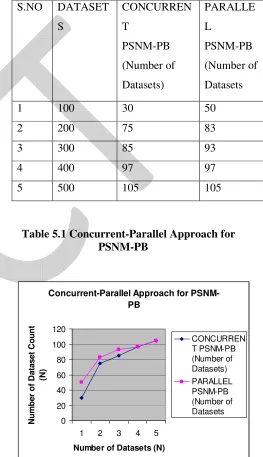
Progressive replica detection is a good and handy solution for many facts cleaning use cases. In cooperation with plista agency presenting target-oriented on line commercial, we used our innovative algorithms to stumble on personality in web server log data. A persona is a user with a certain hobby region. Hence, the same person is and must be reflected through one-of-a-kind persona, if her interests vary. Compared to the quantity of entity duplicates in conventional statistics cleaning responsibilities, to expect many more persona duplicates in this dataset. The desk suggests
experimental consequences for innovative reproduction detection set of rules for PSNM - PB concurrent and parallel method. The desk contains wide variety of information set, concurrent PSNM-PB dataset and Parallel PSNM-PSNM-PB dataset info are display.
S.NO DATASET S
CONCURREN T
PSNM-PB (Number of Datasets)
PARALLE L
PSNM-PB (Number of Datasets
1 100 30 50
2 200 75 83
3 300 85 93
4 400 97 97
5 500 105 105
Table 5.1 Concurrent-Parallel Approach for PSNM-PB
Concurrent-Parallel Approach for PSNM-PB
0 20 40 60 80 100 120
1 2 3 4 5
Number of Datasets (N)
N
u
m
b
e
r
o
f
D
a
ta
s
e
t
C
o
u
n
t
(N
)
CONCURREN T PSNM-PB (Number of Datasets) PARALLEL PSNM-PB (Number of Datasets
VI.CONCLUSION
Through this challenge, the performance of duplication detection is increased better than current system. This mission delivered the revolutionary taken care of community approach and progressive blockading. Both algorithms boom the performance of duplicate detection for conditions with restrained execution time; they dynamically change the ranking of contrast candidates primarily based on intermediate consequences to execute promising comparisons first and much less promising comparisons later.
The challenge proposed a unique quality measure for progressiveness that integrates seamlessly with present measures. It uses more than one type keys concurrently to interleave their modern iterations. By analyzing intermediate outcomes, each method dynamically rank the extraordinary sort keys at runtime, considerably easing the key selection hassle. It is believed that almost all the system targets which have been planned on the commencements of the software program improvement were net with and the implementation method of the venture is completed.
A trial run of the device has been made and is giving desirable results the methods for processing is straightforward and normal order. The technique of preparing plans been overlooked out which is probably considered for in addition amendment of the application.
VII.REFERENCES
[1] S. E.Whang, D. Marmaros, and H. Garcia-Molina, “Pay-as-you-go
entity resolution,” IEEE Trans. Knowl. Data Eng., vol. 25, no. 5,pp. 1111–1124, May 2012.
[2] A. K. Elmagarmid, P. G. Ipeirotis, and V. S. Verykios, “Duplicate record detection: A survey,” IEEE Trans. Knowl. Data Eng., vol. 19, no. 1, pp. 1–16, Jan. 2007.
[3] F. Naumann and M. Herschel, An Introduction to Duplicate Detection.
San Rafael, CA, USA:Morgan & Claypool, 2010.
[4] H. B. Newcombe and J. M. Kennedy, “Record linkage: Making
maximum use of the discriminating power of identifying information,” Commun. ACM, vol. 5, no. 11, pp. 563–566, 1962.
[5] M. A. Hern andez and S. J. Stolfo, “Real-world data is dirty: Data cleansing and the merge/purge problem,” Data Mining Knowl. Discovery, vol. 2, no. 1, pp. 9–37, 1998.
[6] X. Dong, A. Halevy, and J.Madhavan, “Reference reconciliation in
complex information spaces,” in Proc. Int. Conf. Manage. Data, 2005, pp. 85–96.
[7] O. Hassanzadeh, F. Chiang, H. C. Lee, and R. J. Miller, “Framework for
evaluating clustering algorithms in duplicatedetection,” Proc. Very Large Databases Endowment, vol. 2, pp. 1282–1293, 2009.
[8] O. Hassanzadeh and R. J. Miller, “Creating probabilistic databases from
duplicated data,” VLDB J., vol. 18, no. 5, pp. 1141–1166, 2009.
[9] U. Draisbach, F. Naumann, S. Szott, and O. Wonneberg, “Adaptive
windows for duplicate detection,” in Proc. IEEE 28thInt. Conf. Data Eng., 2012, pp. 1073–1083.
[10] S. Yan, D. Lee,M.-Y. Kan, and L. C. Giles, “Adaptive sorted neigh-borhood methods for efficient record linkage,” in Proc. 7th ACM/IEEE Joint Int. Conf. Digit. Libraries, 2007, pp. 185–194.