Copyright © 2012 IJECCE, All right reserved
Visual Image Search
Amol B. Rajmane
[email protected]Deepali A. Nikam
[email protected]Pradeep M. Patil
[email protected]Aparna A. Junnarkar
[email protected]Abstract – Traditional search engines are unable to capture the user’s intention when the query term is ambiguous. In order to bring effectiveness in search performance, reranking with the user interactions is highly needed. The main problem in active reranking is to target the user’s intention. In this paper, we have proposed Visual Image Search which is the best method for the image search. The main goal of the Visual Image Search is to target the user’s intention efficiently and effectively. This is achieved by using the active user interaction. This paper presents the idea that reranks the images resulting from initial text-only searches based on visual features and content similarity. A query image is first categorized into one of several predefined intention categories, and a specific similarity measure is used inside each category to combine image features for reranking based on the query image.
Keywords - Visual image search, active reranking, active user interaction.
I.
I
NTRODUCTIONNow days, most of the Web search engines work on the principle of “query by words”. When the user provides keyword e.g. tiger, then the search engine provides results based on the textual information associated like file name, URL etc. This kind of scenario is appropriate when user search for documents, but same is not useful when user search for images. The textual information associated with the images is quite insufficient to represent semantic contents of the images. Also, there is mismatch between images and their associated textual information. Due to this problem, whenever user search for particular keyword, it is highly possible that the search engine will return the results that contain irrelevant images that the user is not expecting. The image for “tiger” mistakenly taken as relevant only due to the similarity in associated text in “tiger” though it is irrelevant. The same query words may refer to images that are semantically different, e.g., we cannot differentiate an animal tiger image from an image for a person whose name is Tiger, just with the text word “tiger”.
As the text based image search is always not the best method for image search. The best way for image search is based on visual information of the images. Based on visual information, several image reranking methods are available
The semantic space is user-driven, according to their different intentions but with identical query keywords. Therefore, we propose to target the user-driven intention from localizing the visual characteristics of the user’s intention in this specific semantic space.
II.
R
ELATEDW
ORKWe have to depend on visual information while searching for images as the textual information is insufficient for semantic image retrieval. To exploit the usage of the visual information for refining the text-based search result, several image reranking methods have been proposed [2], [3], [7], [8], [9]. The IntentSearch [2] reorders the text-based search result by using query by example, with the query image specified by the user from the initial text-based search result. IntentSearch [2] can be regarded as a simplified active reranking method with only one relevant image labelled by the user. Unsupervised reranking methods, e.g., the clustering based algorithm [8], the random work [9], the VisualRank [7] and the Bayesian reranking [3], can only achieve limited performance improvements. This is because the visual information is insufficient to infer the user’s intention, especially when the query term is ambiguous. For example, “tiger” can be either an animal or a person whose name is Tiger. Without user interactions, we have no idea which kind of tiger images are preferred by the user. However, if the user interactions are available, we can learn his/her intention and then rerank the initial search results to achieve a significant performance improvement. For instance, in the query “tiger”, if the user labels the animal tigers as relevant and other images as irrelevant, different kinds of animal tiger will be returned to the user.
Many of the existing traditional Image search engines are based on the “query by keyword” but when the query term is ambiguous it is very difficult to differentiate the relevant and irrelevant images. We also have studied and presented few of such existing systems these are as follows-
Google Image Search
The Google Image Search is based on “query by keyword” scenario i.e. user provides the keyword to search engine and it returns the corresponding images by processing the label and associated information of the image such as links. Googlebot crawls the webpage then data is classified into the various buckets and images are indexed as well as the duplicates are removed and finally ranking is performed. During search when the query is given to the search engine it will display the top ranked images related to the query.
Intent Search: Interactive On-line Image Search
Reranking
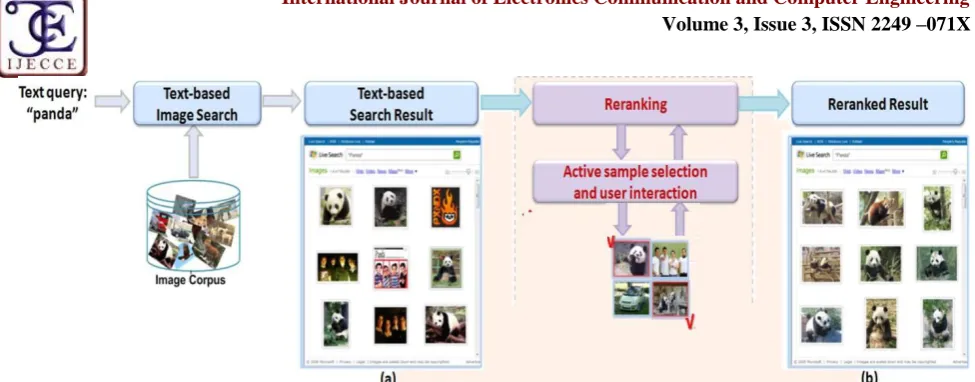
Fig.1. Framework for active reranking illustrated with the query “panda”. When the query is submitted, the text-based image search engine returns a coarse result (a). Then the active reranking process is adopted to obtain a more satisfactory result (b), by learning the
user’s intention.
user’s intension is defined by only one query image. But it cannot work well then the user intension is too complex to be represented by one image.
Text-based search results are re-ranked in an interactive manner according to user intention. User can drag image to “Key Image” pad and initiate the content based query. Images are classified into the typical intention categories.
Page Rank for Product Image Search
The goal of image-search engines is to retrieve image results that are relevant to the query and diverse enough to cover variations of visual on semantics concept. Through an iterative procedure based on the PageRank computation, a numerical weight is assigned to each image, this measures its relative importance to the other images being considered. The ability to reduce the number of irrelevant images is extremely poor not only for the task of image ranking for image retrieval applications, but also for applications in which only a tiny set of images must be selected from a very large set of candidates.
III.
P
ROPOSEDW
ORKFig. 1 shows the proposed general framework for active reranking in Web image search. Take the query term “panda” as an example. When “panda” is submitted to the Web image search engine, an initial text-based search result is returned to the user, as shown in Fig. 1(a) (only the top nine images are given for illustration).
This result is unsatisfactory because both person and animal images are retrieved as top results. This is caused by the ambiguity of the query term. Without the user interactions, it is impossible to eliminate this ambiguity. In particular, which kind of images, animal panda or person whose name is Panda, are user’s intention? Therefore, traditional reranking methods, which improve the initial search results by only utilizing the visual property of images, cannot achieve good performances. To solve this problem, active reranking, i.e., reranking with user interactions, is proposed. As shown in Fig. 1, four images are first selected according to an active sample selection strategy, and then the user is required to label them. If the user labels the animal pandas as query relevant (indicated
as query irrelevant. Then we can learn that the animal panda is the user’s intention. To represent this intention, i.e., the animal panda, a discriminative submanifold should be exploited to separate query relevant images from irrelevant ones. A dimension reduction step is thus introduced to localize the visual characteristics of the user’s intention. With the knowledge of the user’s intention, including both the labeling information and the learned discriminative submanifold, the reranking process is conducted and different kinds of animal pandas are returned, as shown in Fig. 1(b). Sometimes, several interaction rounds are preferred to achieve a more satisfactory performance. The active reranking process is adopted to obtain a more satisfactory result by learning the user’s intention.
A.
Active Sample Selection
Active sample selection strategy is presented to learn the user’s intention efficiently which selects images by considering not only the ambiguity but also the representativeness in the whole image database. Ambiguity and representativeness are two important aspects in active sample selection. The ambiguity denotes the uncertainty whether an image is relevant or not. Representativeness considers how many other images can share the labeling information with the labelled one. After getting the result from traditional search engine, User selects one or more images which he intends to see the result. The selected images are then used as the query image to rerank the result.
B.
Reranking
Copyright © 2012 IJECCE, All right reserved
IV.
E
XPERIMENTS ONW
EBI
MAGES
EARCHConsiderable work has been done in the area of reranking of Web Image search. Basically we rerank the images in two phases i.e. modules:
Generally the ambiguous search keyword would result in showing combinations of relevant as well as irrelevant images from traditional image search engine. Our work redefines the result based on user’s intention by using various algorithms of image comparisons and processing.
A.
Traditional
Image
Search
Engine
Result
Collection
The user enters the text query (image name) to the Yahoo Image Search API. The user’s text based query is first passed to Yahoo Image Search. Then it will retrieve the query related top results. Retrieved images are displayed to the user. These results are saved in the format of thumbnail on the local file system of server machine.
Yahoo Image Search API consists of Yahoo Search Web Services. It enables programmatically perform searches using the Yahoo search engine. Yahoo Search offers an array of web services to provide you with access to our investments in search technology and infrastructure. It is a .NET API that uses a familiar request - response pattern.
Yahoo Image Search API consists of Yahoo Search Web Services. It provides the facility to search the images on the web i.e. Yahoo image. Yahoo Image API provides the facility to save the images on the local file system. Images can be saved in various formats such as the thumbnails or .jpg or .jpeg or .bmp. The ApplicationId is a required value that you get when you sign up with Yahoo! as a developer. It establishes the identity of the application that is calling the Yahoo! search service. The Query is the specific search string that will be processed.
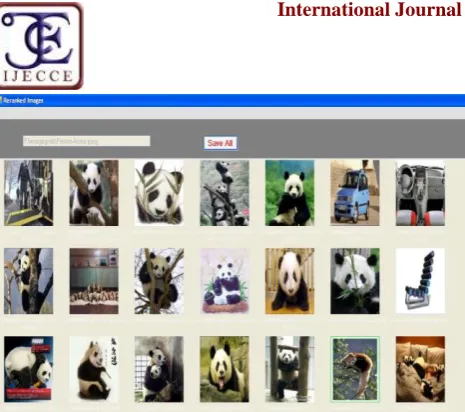
GetResponse() serializes the query as an HTTP GET, sends it to Yahoo, and then desterilizes the results. When the query “panda” is given to the Yahoo Image Search API the result is shown in the Fig. 2.
B.
Reranking Image Search Results
If suppose we enter any query q then there are the chances that both relevant and irrelevant images are retrieved. For example,
Let q= “Apple”
Here we get images from traditional image search engine are:
1. Apple as a fruit.
2. Apple as a company name. 3. Apple as a mobile.
Fig.2. The result of the query “panda” submitted to Yahoo Image Search API.
We cannot identify the user’s intention by using only query as the intention of the one user is different from other. So we use Active Reranking for Web Image Search method. The various options considered are as follows:-
a.
Active Reranking:
In Active Reranking method we use user interaction. User interaction means user selects the image explicitly and tells by choosing the base image query. The selected image is taken as the base query and used for further processing.
b.
Bitmap:
Bitmap of image is an important factor in image processing. The bits representing the bitmap pixels may be packed or unpacked, depending on the format or device requirements. Depending on the color depth, a pixel in the picture will occupy at least n/8 bytes, where n is the bit depth.
Bitmap is the collection of pixels, which are used for further processing on images. The Image class is an abstract base class that provides methods for working with raster images (bitmaps) and vector images (metafiles). The Bitmap class and the Metafile class both inherit from the Image class. The Bitmap class expands on the capabilities of the Image class by providing additional methods for loading, saving, and manipulating raster images.
c.
Luminosity
Luminosity is a measurement of brightness. Luminosity is an intrinsic measurable property independent of distance, and is appraised as absolute magnitude, corresponding to the apparent luminosity in visible light of a star. In this method, we have calculated the luminosity of source image and compared it with destination image. The images matching the highest luminosity are taken for further processing.
d.
RGB Color Model
Fig.3. Active Reranking method is applied here. User selects the image explicitly and tells by choosing the base image query. The selected image is taken as the base query and used for further processing and the result is displayed.
A color in the RGB color model is described by indicating how much of each of the red, green, and blue is included. The color is expressed as an RGB triplet (r,g,b), each component of which can vary from zero to a defined maximum value. If all the components are at zero the result is black; if all are at maximum, the result is the brightest representable white. We have taken the RGB of the each image and check that 60% of similarity in images
is considered as the relevant images. The Fig. 3 shows the result after following all the active reranking process. Table1. Web Image Search Results.
Table 2. The results for each query submitted to the Yahoo Image Search API and Active Reranking Image for Web Image Search.
V.
R
ESULTA
NDC
ONCLUSIONActive reranking is done with the possible use of visual semantics, namely luminosity, color and edge detection for processing images from the Web Image Search. We applied the traditional Image search & Active Reranking for Web Image Search for Web Image Search on the
queries from various image domains such as animal, objects and we have found that the results
Fig. 4 Performance Comparison between Yahoo & Active Reranking obtained by Active Reranking Image for Web Image Search are tremendously accurate than the Yahoo Image Search API. The Table1 shows the results for each query submitted to the Yahoo Image Search API and Active Reranking Image for Web Image Search. It is shown that for the query like “Tiger” the Yahoo Image Search API retrieved 50 images out of that only 37 are relevant while Active Reranking Image for Web Image Search retrieved 12 images out of that 9 are relevant. It clearly indicates that the average of 2% to 6% of the result is improved by using Active Reranking Image for Web Image Search. The Table 2 shows the difference in performance in percentage of both the Web Search. From the results we come to conclusion that when we apply the Active Reranking for Web Image Search, we achieve better efficiency and performance than Traditional Query by Keyword search. User intention is satisfied but if we consider performance in terms of the time, Active Reranking for Web Image Search is less efficient than the Traditional Image Search Engine. The graphical representation is shown in Fig.4.
VI.
F
UTURE WORKIn this paper, we described a possible use of semantics, namely color, for processing uncertain images from the Web. We are able to segment the object in the image, with better results than classical algorithm for objects with more than one color. In the future, we’ll develop new methods to speed the reranking processes in large-scale visual search systems. Beyond the visual features used in this work, we’ll also explore the use of a large set of generic concept detectors in computing shot similarity or multimedia document context.
VII.
R
EFERENCES[1] Active Reranking for Web Image Search by Xinmei Tian, Dacheng Tao, Member, IEEE, Xian-Sheng Hua, Member, IEEE, and Xiuqing Wu,2010.
Query
Yahoo Image Search Active Reranking For
Web Image Search Images
Retrieved
Relevant Images
Images Retrieved
Relevant Images
Panda 50 38 22 17
Tiger 50 37 12 9
Zebra 50 30 15 10
Taj 50 26 15 10
Pen 50 32 18 12
Query
Yahoo Image Search Active Reranking For
Web Image Search
Relevant Images (%) Relevant Images (%)
Panda 76 78
Tiger 74 77
Zebra 60 66
Taj 52 59
Pen 64 66
0 10 20 30 40 50 60 70 80 90
Yahoo Image Search
Copyright © 2012 IJECCE, All right reserved [2] J. Cui, F. Wen, and X. Tang, “Real time google and live
image search re-ranking,” presented at the ACM Int. Conf. Multimedia, 2008.
[3] X. Tian, L. Yang, J.Wang, Y. Yang, X. Wu, and X.-S. Hua, “Bayesian video search reranking,” in Proc. ACM Int. Conf. Multimedia, 2008.
[4] L. S. Kennedy and S.-F. Chang, “A reranking approach for contextbased concept fusion in video indexing and retreival,” in Proc. ACM Int. Conf. Image and Video Retrieval, 2007.
[5] Fergus R. & Fei-Fei L. & Perona P. & Zisserman A. (2005). Learning Object Categories from Google's Image Search, Tenth IEEE International Conference on Computer Vision, ICCV.
[6] Hao Shao, T. Svoboda, V. Ferrari, T. Tuytelaars and L. Van Gool “Fast indexing for image retrieval based on local appearance with re-ranking.” in Proc. ACM Int. Conf. Multimedia, 2010.
[7] Y. Jing and S. Baluja, “Pagerank for product image search,” in Proc. Int. Conf. World Wide Web, 2008, pp. 307–316.
[8] W. H. Hsu, L. S. Kennedy, and S.-F. Chang, “Video search reranking via information bottleneck principle,” in
Proc. ACM Int. Conf. Multimedia, 2006, pp. 35–44. [9] W. H. Hsu, L. S. Kennedy, and S.-F. Chang, “Video
search reranking through random walk over document-level context graph,” in Proc. ACM Int. Conf. Multimedia, 2007, pp. 971–980.
A
UTHOR’
SP
ROFILEAmol B. Rajmane
received the BE degree in Computer Science and Engineering from Walchand College of Engineering,Sangli,India in 2000 and M.E in Computer Science and Engineering from Walchand College of Engineering,Sangli,India in 2007. He is working as Associate Professor at Ashokrao Mane Group of Institutions, Vathar(Dist.-Kolhapur). He is a member of various professional bodies like CSI, ISTE. He has published various papers on data mining and web search.
Dipali A. Nikam
received the BE degree in Computer Science and Engineering from DKTE Society’s Textile and Engineering Institute, Ichalkaranji, India in 2004 and M.Tech in Computer Science and Technology from Shivaji University, Kolhapur, India in 2010.From 2004 to 2007, she worked as lecturer at DKTE Society’s Textile and Engineering Institute, Ichalkaranji. Since 2007, she is working as Assistant Professor at Dr.J.J.Magdum College of Engineering, Jaysingpur. She has published various papers on data mining and web search.
Pradeep M. Patil
received the B.E. degree in Electronics Engineering in 1988 from Amravati University, Amravati (India) and M.E. Electronics in 1992 from Marathwada University, Aurangabad (India). He received his Ph.D. degree in Electronics and Computer Engineering in 2004 at Swami Ramanand Teerth Marathwada University (India). He is working as a teacher since 1988 and presently he is working as Principal, Singhgad College of Engineering, Warje, Pune (India). He is a member of various professional bodies like IE, ISTE, IEEE and Fellow of IETE. He has been recognized as a Ph.D. guide by University of Pune and North Maharashtra University, Jalgaon (India). His research areas include pattern recognition, neural networks, fuzzy neural networks and power electronics. His work has been published in various national and international journals and conferences including IEEE and Elsevier.