148 | P a g e
The Impact of Informal and Non-formal Learning Setting on Language Development: A
case study of CISV International Seminar Camp Programme
Sophio TALAKHADZE*
Abstract
After the 1970s "informal learning" has become which offered individuals development through self-education. Nowadays in some countries the entire education sector is classified as providing non-formal learning. This article will provide an overview of differences between formal, informal and non-formal learning. The description of an international programme is given as an example which provides informal and non-formal learning setting to young participants and the study which was conducted in this educational seminar camp programme reveals a positive impact on language development.
Keywords: CISV International camp,informal, non-formal learning of languages
Introduction
With the development of technology and teaching methods, learning opportunities became larger and individuals have many different ways of acquiring new skills and competencies. Lifelong learning can be formal, informal and non-formal. The American educator John Dewey was probably the first who argued that informal education was a good basis for all formal education (Dewey, 1916). He spoke about keeping balance between these two forms of learning: "Hence one of the weightiest problems with which the philosophy of education has to cope is the method of keeping a proper balance between the informal and the formal, the incidental and the intentional, modes of education." (Dewey 1916, p. 10).
The differences between formal, informal and non-formal learning are briefly outlined as:
Formal learning - this type of learning is essential, organized and structured. Formal learning opportunities are usually arranged by institutions. Often this type of learning is guided by a curriculum or other type of a formal program. Credits and grades are compulsory components of formal learning.
*
MA, independent researcher, Tbilisi, Georgia.
149 | P a g e Non-formal learning - this type of learning may or may not be intentional or arranged by an institution, but is usually organized in some way, even if the organization is loose. There are no formal credits granted in non-formal learning situations.
Informal learning - this type of learning is never organized. Rather than being guided by a rigid curriculum, it is often thought of as experiential and spontaneous (Werquin, 2007). Fordham (1993) suggests that in the 1970s, four characteristics came to be associated with non-formal education: relevance to the needs of disadvantaged groups, concern with specific categories of person, focus on clearly defined purposes, and flexibility in organization and methods.
However, informal learning works through, and is driven by, conversation. It is spontaneous and involves exploring and enlarging experience. It can take place in any setting.
There are different categories of learning contexts, but it is worth mentioning that all learning is good and valuable whether it takes place in a formal, non-formal or informal learning setting. All types of learning contribute to an individual’s growth cognitively, emotionally, socially, etc. The combination of various types of learning complement each other and make the acquired knowledge and skills systematic, wide, deep, and related to practical needs.
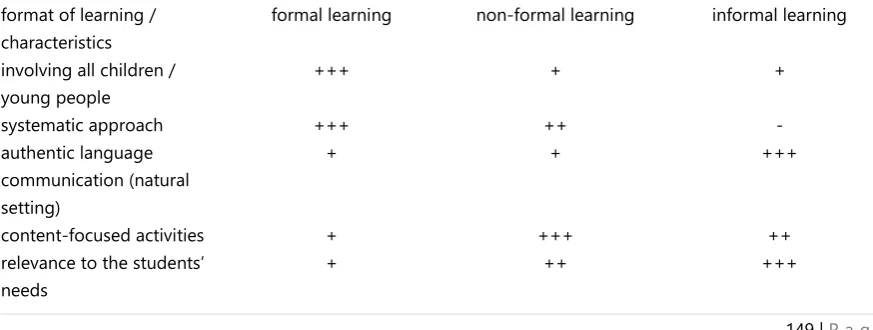
It is a widely accepted notion that the experience of learning a second and foreign language in a classroom is different from learning it in the “natural” setting. The questions which have been raised by L2 and Foreign language researchers are: what are the significant characteristics of these environments, how does each contribute to the language development process? Do they contribute to specific domains of language development? If so, what are these domains and how they can be described? Answers to these questions are extremely important for both psychologists and teachers concerned with being able to discover, describe and provide the optimal conditions for successful language learning to take place. To put it short, table 1 was developed by the researcher, based on the ideas expressed in Ainsworth & Eaton (2010), Cameron & Harrison (2012) and Schwier & Seaton (2013). In the table three pluses (+++) stand for “very characteristic”, two pluses (++) - for “characteristic”, one plus (+) – characteristic to a minor degree, and a minus (-) - for “not characteristic”.
format of learning / characteristics
formal learning non-formal learning informal learning
involving all children / young people
+++ + +
systematic approach +++ ++ -
authentic language communication (natural setting)
+ + +++
content-focused activities + +++ ++
relevance to the students’ needs
150 | P a g e
flexibility in organization - ++ +++
contributes to cognitive domain
+++ ++ +
contributes to emotional domain
+ + +++
contributes to social domain
++ + +++
stressfulness, due to being assessed
+++ + -
communication ++ (if taught well) + +++
It is easy to see from the table that, although informal learning alone can hardly create sufficient knowledge of language system, it is free from the rigidness and stressfulness of formal learning, thus, avoiding the big problems of formal language learning – anxiety and lack of communication.
About CISV International
CISV International (Children's International Summer Villages) is a non-governmental organization dedicated to education and inspiration of young people for peace through fun, non-formal, "learning by doing" educational programmes (CISV, 2008; 2009a; 2009b). The organization was founded in the late 1940s by child psychologist Doris Allen, who had an idea of creating an opportunity for children of different cultures to learn how to live together, in order to create a peaceful world. In 1950, after hard work, CISV was registered as a non-governmental organization in Ohio and the first village was held in Cincinnati in 1951. In this first village programme young people from nine different countries took part. These countries were: Austria, Britain, Denmark, France, Germany, Mexico, Norway, Sweden and USA.
Today the organization has 70 member association with over 200 chapters or local groups. Beginning with the first programme, CISV volunteers have organized over 6,000 international programmes for some 2030,000 participants. All the programmes are organized by volunteer members and their administrative work is supported by paid staff of the International Office (IO) in Newcastle-upon-Tyne, England.
CISV offers local activities, international camps, family-hosted exchange programmes, local community-based projects for all ages, starting from the age of 11 to participate and volunteer. The list of the programmes that CISV offers is: Village, Interchange, Step up, Seminar Camp, Youth Meeting, International People's Projects (IPPs), and Mosaic. The programmes differ according to the age, duration, and number of participants.
151 | P a g e Interchange is a two-way family-hosted exchange programme that takes place in two "phases". Participant/delegation visits and is hosted by a CISV family and then in return the participants host the family they visited. The programme normally lasts 14-28 days. Educational activities during the programme are based on the same CISV principles as it is in other camp-based programmes. The interchange offers an opportunity to experience CISV "taste" not only to participants, but also the whole family involved.
IPPs (International People’s Projects) are community-based programmes for people aged 19+ that last for 14-23 days. Participants/volunteers from at least four different countries work together to run the project with local organizations to benefit the community and its environment. Approximately 25 volunteers work together, including staff. The example of IPPs is supporting for immigrants, socially vulnerable groups, etc.
Besides camp-based programmes, CISV International also offers community-based projects. One of them is Mosaic, which is a project for all ages. It could be one-off event or a year-long project. Mosaic is planned and delivered by CISV chapters to meet the local needs and interests. If participants are new in CISV, this is a great way to get involved. It offers a real-life experience that has a lasting impact.
JB (Junior Branch) is run by local CISVers who take initiative and responsibility to plan educational and social activities. JBers also take initiatives for administrative work of local CISV chapter.
CISV Seminar Camp programme
The first Seminar Camp (SC) programme was Village Reunion in 1971; since then the concept changed and evolved. Now it is a three-week programme for 24-30 international participants aged 17-18, supervised by adult staff. SC "blends social aspects of a large group living together with individual personality development" (CISV, 2008, p.20.). SC has characteristics that are quite different from other programmes, such as limitation of number of participants which is maximum four per country, participants are allowed to attend the camp only once, participants have responsibilities on planning educational activities, cleaning, cooking, and camp schedule, which they share. The experience that participants can get while being in the camp is not only about being/making friends, but also learning from one another. And the most important, every SC has an activity that involves LMO (Like-Minded Organization), when members from partner organization come to the camp to deliver a presentation or an activity, to give participants an idea about the outside world, other ways of working for peace and cultural understanding.
Goals and procedure of the study
152 | P a g e home staff members from Germany, one camp director from Netherlands, two international staff members from Mexico and Georgia. Their responsibilities included supervision, facilitating participants in legal and educational matter, managing the camp to meet all the needs of participants. The programme lasted for three weeks where the communication language was English. 3 participants out of 30 did not take part in the study since they were native speakers from Canada and were English native speakers. Three educational activities were planned each day (2.5 hrs) by participants, which is considered as non-formal learning and the rest of the "activities", such as cooking, cleaning, and working in groups to plan activities for the next day, are considered as informal learning. Both during the informal and non-formal activities the education and communication language was English. Participants were not involved in any formal learning of English.
While preparing for research, Yin (2009) and Oppenheim (1992) and recommendations were taken into consideration.
Two instruments were used to carry out the research:
1. Pre-Test and Post-Test to identify, analyze, compare and see the results of English-language development. 2. Questionnaire, which was designed and developed by the researcher as the research tool for this study.
27 participants out of 30 were given the questionnaire in paper-based variants at the end of the programme. The questionnaire consisted of 12 questions, some of them with comments for freedom of expressing ideas. Measures of the questionnaire were participants’ expression on statements of a 5-point scale ranging from 1 (not at all) to 5 (extremely).
The ethical consent to conduct the research was gained from CISV International. The Research Proposal Form to the Education Department and the Evaluation and Research Committee (EVR) of CISV International was submitted by the researcher. Two months before the camp started participants were sent detailed information about the camp (Pre-camp), including the explanation on the research they were going to take part in. In addition to this, they were explained the process of data collection at the beginning of the programme, so that they had a chance to decide whether to participate or not. Thus, consent of all participants was obtained.
Description of Test used for the assessment of English proficiency
153 | P a g e were given a card which asked them to talk about a particular topic. They had 1 minute to prepare before speaking for up to 3-4 minutes. Speaking test sample was the same in both cases to ensure the comparability of the results.
The assessment of speaking skills was carried out by a 9-point system, an easy scale that clearly identifies proficiency level, from non-user (band score 1) through to expert (band core 9).
The participants’ responses to the test were recorded and then transcribed for the ease of analysis. Later they were analyzed by the researcher with two other English Language Teachers for the purpose of validation. These two teachers were: Natia Jojua - Ph.D. candidate at IBSU (International Black Sea University), also an English language teacher at a public school, and Nino Bitskinashvili - Ph.D. candidate at IBSU, also an ICT (Information and Communication Technology) Trainer at National Centre for Teacher Professional Development, Ministry of Education and Science of Georgia.
Test Results
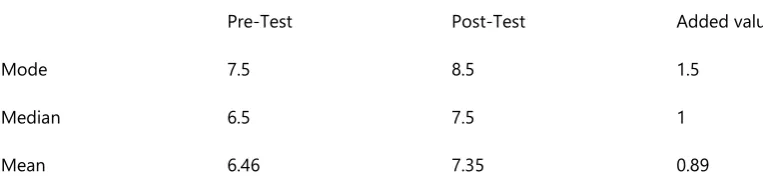
The test results for study group are presented in table 2 below. All 27 participants were successful in the development of English language proficiency. The difference between the Pre- Test and Post-Test results showed the success. Some of the participants had a slight improvement, but their educational background and experience in participating in CISV programmes needs to be taken into consideration. The majority of the participants - 18 out of 27 - showed a considerable improvement and the group overall improved by 0.89 points in a 9-point system, from 6.46 to 7.35.
Table 2. Test results for study group
Pre-Test Post-Test Added value
Mode 7.5 8.5 1.5
Median 6.5 7.5 1
Mean 6.46 7.35 0.89
154 | P a g e Results for the end-of-the-programme questionnaire
At the end of the program the participants filled in a self-report to reflect how they felt they improved. Item 1: Your English speaking skills enhanced.
Figure 1: Speaking skills’ improvement
The answers show that the majority of participants’ speaking skills improved during the programme. 52% of them allocated to the response “Quite”. The number of the participants who answered “Extremely” is approximately 8%. By combining these two answers, it is more than half of the participants who answered that they have enhanced their communicative competence. About 27% think that their speaking competence increased fairly, where we need to consider participants' initial high level of English and their education background. Nobody answered “Not at all”. These answers are in agreement with test results, which showed an overall improvement by 0.89 points in a 9-point system, from 6.46 to 7.35.
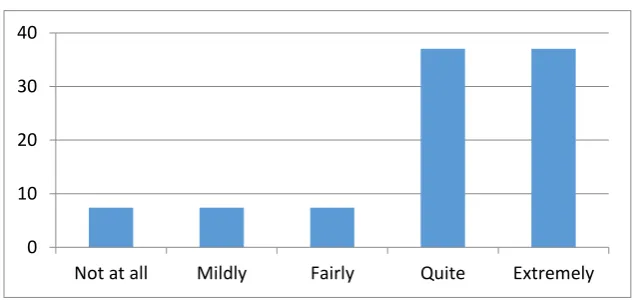
Item 2: Your listening skill enhanced.
Figure 2. Listening skills’ improvement
37% of participants think that their listening skill improved “Quite” and similarly the same number of participants think they improved “Extremely”, which means that camp life and experience in working in groups with native and native-like speakers helped them to develop their listening skill. In formal learning nobody listens or
0 10 20 30 40 50 60
Not at all Mildly Fairly Quite Extremely
0 10 20 30 40
155 | P a g e speaks the foreign language all day long, so the practice opportunities were immense. Only about 7% gave the answers “Not at all”, “Mildly” and “Fairly”.
Item 3: You prepared yourself in terms of vocabulary (specific words and phrases) before each activity.
Figure 3. Learning vocabulary before activities
The results show that the same number of participants - 33% -either did not prepare or “Mildly” prepared for each informal activity in terms of vocabulary. The students who prepared “Fairly” and “Quite”, probably, felt they did not know well enough the vocabulary dealing with the topic and studied beforehand with a dictionary, searching the potentially needed words. The participants had a chart with the activities for the next day, but without description or with any details.
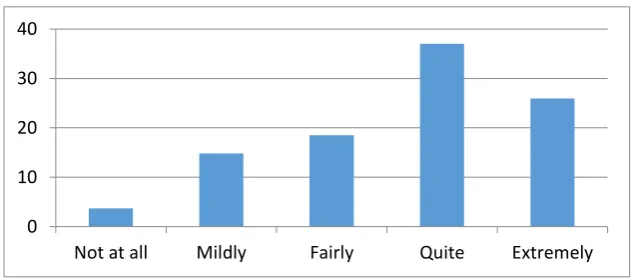
Item 4: You learned vocabulary from each other during activities.
Figure 4. Vocabulary acquisition during activities
Learning vocabulary during discussion was more like hands-on experience, "learning by doing" rather than preparing beforehand. As the participants were responsible for planning, leading and participating in each discussion activity, they had an opportunity to apply the new vocabulary that was related to the chosen topic in real-life practically useful activities. Correspondingly, here we have a completely different picture. The majority of participants - 37% - learned vocabulary “Quite” and “Extremely” from each other during the non-formal activities
0 10 20 30 40
Not at all Mildly Fairly Quite Extremely
0 10 20 30 40
156 | P a g e and the follow-up discussions. Only 3% think that they did not learn any vocabulary and rest of them answered “Mildly” or “Fairly”.
Item 5: Camp themes (Human Rights, Conflict and Resolution, Diversity, Sustainable Development) often helped you develop your language proficiency. If yes, how did it help you to learn new words?
Figure 5. Language proficiency development with the help of camp themes
There are four different themes in all CISV programmes which rotate every year and it is the same for all camps. Each camp or programme could have another topic, but all the activities that are planned either by a participant or adult leaders have to be related to these topics. The theme itself helps participants to gain the vocabulary in specific area. And figure 5 also shows the positive results: camp themes helped to more than 60% of participants to develop their language proficiency. In the comments to the selected answers the participants mentioned they both used electronic dictionaries and asked each other for clarification of meaning of some words. And, of course, they mentioned abundant practice in real-life situations, the desire to understand each other.
Item 6: Team working assisted you to improve your language skills. If yes, how?
Figure 6. The impact of team working on the improvement of language skills
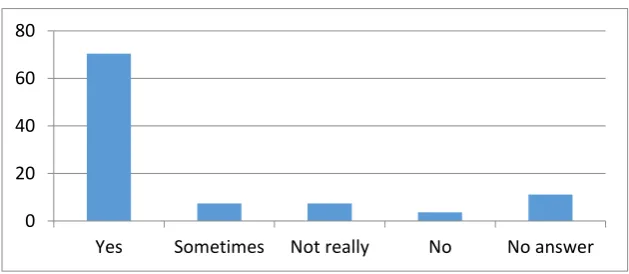
Each day participants had more than one hour for working together in groups to plan an activity for the next allocated time. Each planning group consisted of five participants. This helped them to assist each other to improve language skills and the results show the same. They benefitted from each other’s background and language
0 10 20 30 40 50 60 70
Yes So so No No answer
0 20 40 60 80
157 | P a g e knowledge. They were involved in dialogues. 70 % of participants chose the response “Yes”. 10% did not answer at all.
Item 7: You contributed much to group discussions. Figure 7. Contribution to group discussion
Group discussion is one of the most important in CISV camps. It could be small group discussions, mostly at the beginning of the programme, when participants did not know each other well and they were not ready for big group discussion. The participants, adult leaders, whoever who planned an activity considered the culture factor as well. More than half of the participants answered they contributed to group discussion, which is around 65%. 7% contributed “Mildly” and 3% - “Not at all”. Besides the development of language skills, group discussions helped develop team relationships and friendships.
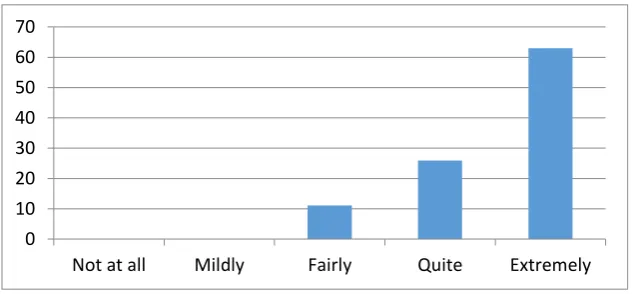
Item 8: Rate the level of your motivation in using English as a means of communication. Figure 8. Rating the level of motivation in using English
Communicating in English positively influenced participants and increased their level of motivation and involvement in educational activities. The table shows that the majority of participants answered they were “Extremely” motivated. Also about 28% rated their motivation as “Quite” high and only 10% as “Fairly” high. This shows that the motivation to take part in such events and better understand each other is an important factor of the language improvement during the program.
0 10 20 30 40 50
Not at all Mildly Fairly Quite Extremely
0 10 20 30 40 50 60 70
158 | P a g e Item 9: Your self-confidence in using English language increased while being in camp.
Figure 9. Self-confidence of using English increase
As we can see, most of the participants responded that their self-confidence in using English increased “Extremely” (26%) and “Quite” (36%) while being in camp. They realized they can cover both everyday personal communication and talking on serious and sophisticated topics. The responses “Fairly” and “Mildly” were given together by 32% of the participants. And 6 % think that the programme did not help them to increase their self-confidence.
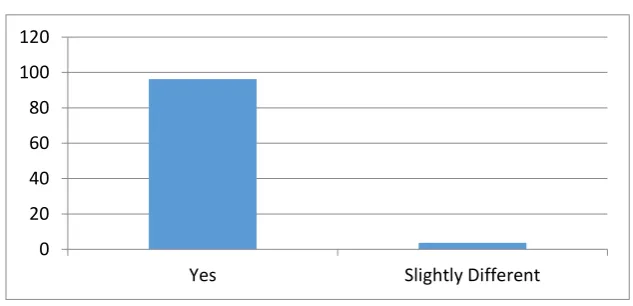
Item 10: Learning/practicing a language while staying at an international camp is different from formal/school work. If yes, how?
Figure 10. Difference of formal and informal learning of languages
CISV programmes provide the participants with informal and non-formal learning settings, the educational activities are semi-structured, since they have goals and principles discussed in the previous section of the article in detail. The educational activities used in the programs gives the participants an opportunity to learn from real-life experience rather than from lectures and books. This environment is absolutely different from school / university work, which is structured and students do not have much opportunity to choose what to learn and to discuss. The answers to item 10 show the same. Almost every participant thinks that CISV camp has provided them with a different learning environment than schools and other institutions. Only 1% thinks that it differs slightly.
0 10 20 30 40
Not at all Mildly Fairly Quite Extremely
0 20 40 60 80 100 120
159 | P a g e Item 11: Planning and leading activities helped you in terms of making presentations.
Figure 11. Presentation skills improvement
Each group had to present the activity plan 2 days before the allocated time to the staff members, so that they had a chance to approve it or to give suggestions to the planning group after discussing details, possible difficulties and risks. The planning groups were responsible for the activity planned by them. Starting from explaining the instructions, rules, location, time, what to wear, materials, ending with the lead follow-up debrief. All these helped them to make the presentation in a better way. 55% think that they “Quite” improved presentations skills and 13 % of participants found it “Extremely” helpful. For 20% it was “Fairly” and “Mildly “(7 %) helpful.
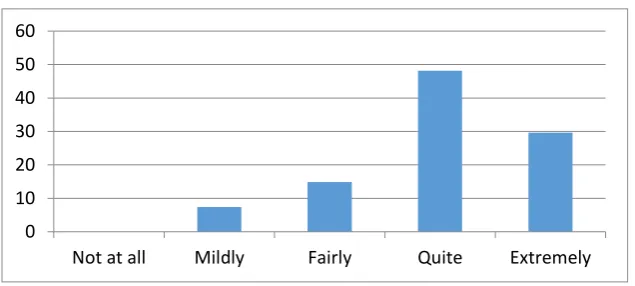
Item 12: You considered the culture factor while planning and facilitating activities.
Figure 12. Considering culture factor while planning activities
As it was mentioned previously, 30 participants from 16 different countries participated in this Seminar Camp programme. Participants were from Asia, Europe and North America. So the group dynamic was quite different in terms of culture factor. While staying at the camp, participants also gained awareness of different cultures, opinions and attitudes. They considered culture factors as values while planning and leading discussion, while cooking as well. Again, the majority of the respondents (approximately 80%) considered culture factors “Quite” and “Extremely”, only 20 % - “Fairly” and “Mildly”. And what is the most important there was none who did not respect others’ culture at all.
0 10 20 30 40 50 60
Not at all Mildly Fairly Quite Extremely
0 10 20 30 40 50 60
160 | P a g e Conclusions and Recommendations
The study revealed that informal and non-formal learning environment which was provided by CISV SC programme had a positive effect on young adults' language development. The study also showed how their level of motivation, self-confidence, and ability of making presentation increased while being in the camp. Informal and non-formal learning setting helps to learn from each other rather than to prepare in advance. Although the study was not carried out with very numerous participants or for a very long time, its results are in agreement with some other studies (Yiang Yan, 2010; Watson, 2014), and thus can be viewed as generalizable. It can be recommended to educators that, to provide more authentic practice, better language skills and higher level of language learning motivation and self-confidence in using it, practicing the target language in an informal and non-formal environment is needed, additionally to learning it in formal educational institutions.
References
Ainsworth, H.L. & Eaton, S.E. (2010). Formal, Non-Formal and Informal Learning in the Sciences. Calgary: Onate Press. Cameron, R. & Harrison, J.L. (2012). The interrelatedness of formal, non-formal and informal learning: Evidence
from labour market program participants. Australian Journal of Adult Learning, 52,2, 277-309
CISV (2008). CISV General Programme Guide. Newcastle upon Tyne: CISV International Ltd.
CISV (2009a). Big Education Guide. CISV Resources: Document Centre. Newcastle upon Tyne :CISV International Ltd. CISV (2009b) CISV Passport for Active Global Citizenship. Newcastle upon Tyne: CISV
Dewey, J. (1916). Democracy and Education. New York: Macmillan Co.
Fordham, P.E. (1993). Informal, non-formal and formal education programmes. In YMCA George Williams College ICE301 Lifelong Learning Unit 2. London: YMCA George Williams College.
Jiang Yan (2010), Intercultural Learning in a CISV Village and its Short-Term and Long-Term Impact on the Participants’ Intercultural Communicative Competence Development. PhD Thesis. Birkbeck: University of London.
Oppenheim, A. N. (1992). Questionnaire Design, Interviewing and Attitude Measurement. London: Printer Publishers. Schwier, R.A. & Seaton, J.X. (2013). A comparison of participation patterns in selected for-mal, non-formal and
informal online learning environments. Canadian Journal of Learning and Technology, 39, 1, 1-15.
Werquin, P. (2007). Terms, Concepts and Models for Analysing the Value of Recognition Programs. Vienna: Organisation for Economic Co-operation and Development (OECD).
Yin, R.K. (2009). Case Study Research Design and Methods (4th Edition), Thousand Oaks, CA: Sage.