
Small Grant Proposal
Advancing marine conservation in European and
contiguous seas with the MarCons Action
Stelios Katsanevakis, Peter Mackelworth, Marta Coll , Simonetta Fraschetti, Vesna Mačić,
Sylvaine Giakoumi, Peter J.S. Jones , Noam Levin, Paolo G. Albano, Fabio Badalamenti, Ruth E. Brennan, Joachim Claudet , Dubravko Culibrk, Giovanni D'Anna, Alan Deidun , Athanasios Evagelopoulos, José A. García-Charton , David Goldsborough , Draško Holcer , Carlos Jimenez ,
Salit Kark ,Thomas Kirk Sørensen ,Bojan Lazar ,Georg Martin ,Antonios Mazaris ,Fiorenza Micheli , E.J. Milner-Gulland, Carlo Pipitone , Michelle Portman , Fabio Pranovi , Gil Rilov ,
Robert J. Smith , Vanessa Stelzenmüller , Ioannis N. Vogiatzakis , Gidon Winters
‡ University of the Aegean, Department of Marine Sciences, Mytilene, Greece § Blue World Institute of Marine Research and Conservation, Veli Lošinj, Croatia | Institut de Ciències del Mar (ICM-CSIC), Barcelona, Spain
¶ Ecopath International Initiative (EII) Research Association, Barcelona, Spain
# Dipartimento di Scienze e Tecnologie Biologiche ed Ambientali, Università del Salento, CoNISMa, Lecce, Italy ¤ Institute of marine biology, University of Montenegro, Kotor, Montenegro
« Université Côte d'Azur, CNRS, Nice, France
» Department of Geography, University College London, London, United Kingdom
˄Department of Geography, The Hebrew University of Jerusalem , Jerusalem, Israel
˅Department of Palaeontology, University of Vienna, Vienna, Austria ¦ CNR-IAMC Laboratorio di Biologia Marina, Castellammare del Golfo, Italy
ˀTechnion, Israel Institute of Technology, Haifa, Israel
ˁNational Center for Scientific Research, CRIOBE, Perpignan, France
₵Laboratoire d’Excellence, CORAIL, France
ℓ Faculty of Technical Sciences, University of Novi Sad, Serbia
₰CNR-IAMC, Castellammare del Golfo, Italy
₱ Department of Geosciences, University of Malta, Malta
₳Department of Ecology and Hydrology, University of Murcia, Murcia, Spain
₴Van Hall Larenstein, University of Applied Sciences, Leeuwarden, Netherlands
₣Croatian Natural History Museum, Zagreb, Croatia
₮Enalia Physis, Nicosia, Cyprus
₦ The Biodiversity Research Group, The School of Biological Sciences, ARC Centre of Excellence for Environmental Decisions (CEED), The University of Queensland, Brisbane, Australia
₭ NESP Threatened Species Recovery hub, Centre for Biodiversity & Conservation Science, The University of Queensland, Brisbane, Australia
₲National Institute of Aquatic Resources, Technical University of Denmark, Charlottenlund, Denmark
‽ Department of Biodiversity, Faculty of Mathematics, Natural Sciences and Information Technologies, University of Primorska, Koper, Slovenia
₩ Marine Sciences Program, Juraj Dobrila University of Pula, Pula, Croatia
₸Estonian Marine Institute, University of Tartu, Tallinn, Estonia
‡‡ Department of Ecology, School of Biology, Aristotle University of Thessaloniki, Greece §§ Hopkins Marine Station, Stanford University, United States of America
|| Department of Zoology, University of Oxford, Oxford, United Kingdom ¶¶ Technion - Israel Institute of Technology, Haifa, Israel
## Environmental Sciences, Informatics and Statistics Dept, Ca’ Foscari University of Venice, Italy ¤¤ National Institute of Oceanography, Israel Oceanographic and Limnological Research, Haifa, Israel «« Durrell Institute of Conservation and Ecology, University of Kent, Canterbury, United Kingdom
‡ § |,¶ # ¤
« » ˄ ˅ ¦
ˀ ˁ,₵ ℓ ₰ ₱
‡ ₳ ₴ ₣,§ ₮
₦,₭ ₲ ‽,₩ ₸ ‡‡
§§ || ₰ ¶¶ ## ¤¤
«« »» ˄˄ ˅˅
Reviewable v1
»» Thünen-Institute of Sea Fisheries, Hamburg, Germany
˄˄School of Pure and Applied Sciences, Open University of Cyprus, Nicosia, Cyprus
˅˅The Dead Sea-Arava Science Center, Neve Zohar, Israel
Corresponding author: Stelios Katsanevakis ([email protected])
Received: 20 Jan 2017 | Published: 25 Jan 2017
Citation: Katsanevakis S, Mackelworth P, Coll M, Fraschetti S, Mačić V, Giakoumi S, Jones P, Levin N, Albano PG, Badalamenti F, Brennan R, Claudet J, Culibrk D, D'Anna G, Deidun A, Evagelopoulos A, García-Charton J, Goldsborough D, Holcer D, Jimenez C, Kark S, Sørensen T, Lazar B, Martin G, Mazaris A, Micheli F, Milner-Gulland E, Pipitone C, Portman M, Pranovi F, Rilov G, Smith R, Stelzenmüller V, Vogiatzakis IN, Winters G (2017) Advancing marine conservation in European and contiguous seas with the MarCons Action. Research Ideas and Outcomes 3: e11884. https://doi.org/10.3897/rio.3.e11884
Abstract
Cumulative human impacts have led to the degradation of marine ecosystems and the decline of biodiversity in the European and contiguous seas. Effective conservation measures are urgently needed to reverse these trends. Conservation must entail societal choices, underpinned by human values and worldviews that differ between the countries bordering these seas. Social, economic and political heterogeneity adds to the challenge of balancing conservation with sustainable use of the seas. Comprehensive macro-regional coordination is needed to ensure effective conservation of marine ecosystems and biodiversity of this region. Under the European Union Horizon 2020 framework programme, the MarCons COST action aims to promote collaborative research to support marine management, conservation planning and policy development. This will be achieved by developing novel methods and tools to close knowledge gaps and advance marine conservation science. This action will provide support for the development of macro-regional and national policies through six key actions: to develop tools to analyse cumulative human impacts; to identify critical scientific and technical gaps in conservation efforts; to improve the resilience of the marine environment to global change and biological invasions; to develop frameworks for integrated conservation planning across terrestrial, freshwater, and marine environments; to coordinate marine conservation policy across national boundaries; and to identify effective governance approaches for marine protected area management. Achieving the objectives of these actions will facilitate the integration of marine conservation policy into macro-regional maritime spatial planning agendas for the European and contiguous seas, thereby offsetting the loss of biodiversity and ecosystem services in this region.
Keywords
1. Introduction
The overall goal of the Convention on Biological Diversity is to halt the loss of biodiversity and ecosystem services by 2020. To attain this goal, the international community agreed in 2010 on 20 biodiversity-related goals, the ‘Aichi Targets’. However, mid-term assessments of the progress towards these global targets suggest that, despite the acceleration of policies and management responses to the biodiversity crisis, these efforts are unlikely to improve negative trends in the state of biodiversity or protection coverage targets by 2020 (Tittensor et al. 2014, Butchart et al. 2015). The European and contiguous seas, consisting of the Mediterranean Sea, the Black Sea, the Baltic Sea and the North-Eastern Atlantic Ocean (Fig. 1), are threatened by pressures deriving from multiple human activities in a highly populated and complex socio-economic and political region. It is also widely acknowledged that the negative impacts of anthropogenic drivers on biodiversity and ecosystem services are further amplified by their interaction with the impacts of global environmental change (Coll et al. 2012, Korpinen et al. 2012).
This paper introduces a new European Cooperation in Science and Technology (COST) Action, ‘Advancing marine conservation in the European and contiguous seas’ (MarCons). Funded through the European Union (EU) ‘Horizon 2020’ framework programme for research and innovation, this action brings together researchers, policy-makers and other stakeholders to address the threats to marine biodiversity in the European and contiguous seas.
Figure 1.
This paper briefly summarizes the main regulatory framework for marine conservation in this region, outlines the need for maritime (or marine) spatial planning (MSP) and identifies the role of marine protected areas (MPAs). In addition, the key scientific requirements for successful marine conservation in the European and contiguous seas are outlined and the innovations and expected contributions of the action are highlighted. Finally, the issues facing this region and the importance of strong stakeholder networking to help meet international commitments to the conservation of marine ecosystems are summarized.
2. The regulatory framework underlying marine conservation in
the European and contiguous seas
Efforts to coordinate and advance marine conservation in the European and contiguous seas are conducted under four United Nations Environment Programme (UNEP) regional seas conventions covering the North-Eastern Atlantic (OSPAR), the Baltic Sea (HELCOM) the Mediterranean Sea (Barcelona Convention) and the Black Sea (Bucharest Convention) (Kirkman and Mackelworth 2016). While all of these instruments vary in structure, they all consist of protocols to protect the marine environment from pollution and include the potential for the establishment of networks of MPAs for biodiversity conservation. Effective implementation of these protocols requires close transboundary and inter-regional cooperation and coordination with other international legal instruments.
These four conventions have historically been important for marine conservation efforts. However, the role of the EU has evolved in recent years and its Directives and Policies have changed the focus of conservation in the European and contiguous seas, particularly for EU Member States and acceding countries. Among the significant Directives and Policies that apply are, the Habitats Directive (92/43/EEC), the Birds Directive (79/409/ EEC), the Water Framework Directive (2000/60/EC), the Marine Strategy Framework Directive (2008/56/EC), the Framework for Maritime Spatial Planning (2014/89/EU) and the Common Fisheries Policy (Regulation 508/2014).
3. Scientific research needs to address challenges to
biodiversity
The European and contiguous seas are becoming ever more crowded, and marine resources previously considered difficult to exploit are now becoming available through the advancement of new technologies (Kark et al. 2015b, Mackelworth 2016, Portman 2016). The expansion of human activities into deeper and more distant areas has been actively promoted by the European Commission through its ‘Blue Growth’ strategy, which champions the concept of ‘offshore economy’. Given the rate of ‘Blue Growth’ and development, it is likely that coastal and marine areas will be under further pressure and there will be few, if any, areas in the European and contiguous seas that can still be considered technologically off-limits. Trade-offs between sectors and between marine biodiversity conservation and ecosystem services delivery are becoming both more acute and more widely distributed.
The requirement for the application of some form of order in an otherwise chaotic system is apparent. Maritime (or Marine) Spatial Planning (MSP), which incorporates environmental features and human uses into a coherent and integrated decision-supporting framework, has become a necessity (Katsanevakis et al. 2011, Tidd et al. 2015). In the past decade, the concepts of MSP and ecosystem-based management have been well developed and widely accepted as essential for ensuring the protection of biodiversity and the sustainability of ecosystem service uses (Douvere 2008). The implementation of comprehensive MSP, in which biodiversity conservation is a major stakeholder, requires strategies to coordinate research activities and expertise from multiple geographic locations and disciplines to provide sound science to underpin the policy decision-making process. Despite important advances in MSP, such efforts have rarely been translated into coordinated conservation actions. It is important that while conservation planning is only one aspect of the development of equitable MSP frameworks, the marine ecosystem provides the basis for all development and it is an important factor for long-term sustainability.
Conservation planning and impact-mitigation strategies could greatly benefit from cumulative impact assessments (Coll et al. 2012, Stelzenmüller et al. 2010, Micheli et al. 2013). This has been a challenging task in the absence of a well-defined methodology and a frequent lack of data. Recent efforts have resulted in a number of methodologies and techniques aimed at integrating different human impacts with the purpose of performing an integrated assessment of the status of the sea and of its biodiversity (Borja et al. 2016, Halpern et al. 2015, Korpinen and Andersen 2016). However, cumulative impact assessments have not yet been effectively integrated into conservation planning and conservation action prioritization (Korpinen and Andersen 2016, Giakoumi et al. 2015b).
significantly constrain management of marine ecosystems. These include current and future impacts of past human activities, so called ‘legacy effects’, and social or politically problematic activities related to ‘committed behaviours’ which may affect the environment in the short to medium term (O'Higgins et al. 2014). In addition, climate change, results in geographical shifts in species distribution, temporal changes in biological events, changes in abundance and behaviour, biological invasions, and local extinctions (Jordà et al. 2012, Verges et al. 2014, Katsanevakis et al. 2014a, Blanfuné et al. 2016), which are major challenges for conservationists and policy makers. Given that spatial conservation measures such as MPAs are a static tool proposed as a solution to a dynamic world, a critical question arises whether current networks of MPAs could safeguard the coherence of marine ecosystems and their resilience to these threats.
Rapid globalization and increasing trends of trade, travel, and transport in recent decades have accelerated the rates of marine biological invasions (Hulme 2009), increasing the risk for endangered species and habitats, and hampering conservation efforts (Rilov and Crooks 2009, Katsanevakis et al. 2014b). In some areas, such as the south-eastern Mediterranean, alien species can completely restructure ecological communities, which can lead to drastic changes in resources like fisheries (Edelist et al. 2013). The understanding of biological invasion processes and their impacts on native marine biodiversity and ecosystems, as well as the quantification and mapping of the impacts of invasive alien species, are considered as prerequisites for the prioritization of conservation management actions (Blackburn et al. 2011, Katsanevakis et al. 2016). Biological invasions are being widely disregarded when planning for conservation in the marine environment, although their explicit consideration can significantly alter spatial conservation priorities (Giakoumi et al. 2016). Additional management actions aimed at prevention as well as the mitigation of the impact of invasive species are required at all levels.
A holistic approach to conservation also requires integrated land-sea planning (Stoms et al. 2005). Traditional conservation planning has traditionally overlooked or indirectly considered the strong connections between different environments (Álvarez-Romero et al. 2011, Mateos-Molina et al. 2015). Yet, transitional and freshwater ecosystems are also an integral part of the land-sea connection. Very few studies have incorporated aspects of integrated conservation planning across these environments (e.g. Klein et al. 2012), with none, to our knowledge, having been conducted in the European and contiguous seas to date.
marine conservation policy into marine resource development policy. Coordinating marine management at macro-regional level provides the opportunity for adjacent states to resolve issues based on the protection of shared resources.
The spatial manifestation of conservation planning is invariably protected areas. While MPAs are considered a valuable tool to protect biodiversity in European waters, especially the Natura 2000 networks of the Habitats and Birds Directives, recent figures from the European Environment Agency indicate that the majority of them are ineffective in achieving their biodiversity conservation objectives (Jones et al. 2016). Investment in the effective governance of MPAs needs to be supported. Improving the effectiveness of MPAs in these areas, moving from single protected areas to protected areas networks and establishing of open sea and cross-border reserves, is likely to become a policy priority.
4. MarCons COST action - an initiative to meet the challenges of
conservation of European and contiguous seas
The MarCons COST action will consolidate a network of scientists involved in marine conservation and in the promotion of the sustainable use of marine ecosystem services. MarCons expands on previous related efforts (Giakoumi et al. 2012), whilst seeking to forge new opportunities for cooperation. It aims to promote collaboration that will reduce redundancy by enhancing communication and exchange of knowledge and experience, and by assembling, integrating, and advancing the most promising tools and methods into a comprehensive and efficient research framework.
MarCons will provide support to decision makers for the development of appropriate European policies for the improvement of marine conservation in the European and contiguous seas. The connective nature of the marine environment requires that European seas are considered together with their contiguous water bodies. Hence, the network established by the MarCons consortium stretches beyond the European territories. This will provide real opportunities for deriving new experience for knowledge sharing and capacity building with the involvement of countries from North Africa, the Middle East as well as North America, and Australia.
5. Progress beyond the state-of-the-art and innovation potential
of MarCons
5.1 Methodological approach of MarCons
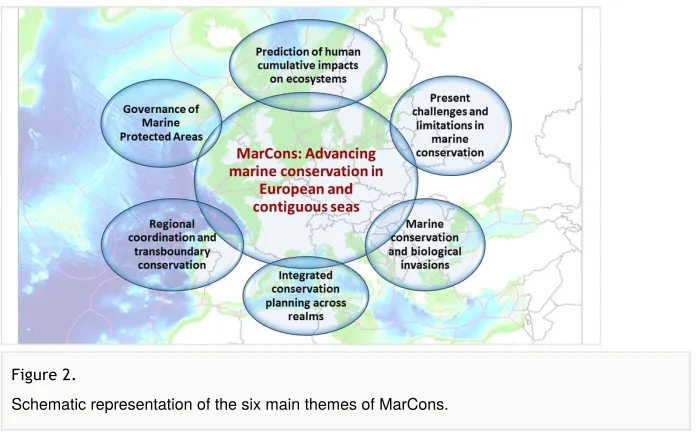
MarCons will revolve around six main themes (Fig. 2) that cover major gaps in European marine conservation. While each of the themes has a specific focus, they will be conducted in parallel, with coordination and collaboration. As such, the initiative facilitates a type of integration often lacking in ecosystem-based management and MSP (Portman 2011). The thematic working groups will capitalize upon existing knowledge, adapt and evolve conservation planning tools implemented in other regions of the world, and develop new methodological and computational tools, databases and background information to support the decision-making process for marine policies in the region. Adopting a multidimensional and flexible methodological context, MarCons will employ an approach, which is:
1. trans-disciplinary, combining knowledge from the fields of conservation biology, biogeography, fisheries science, invasions biology, marine ecology, historical ecology, conservation paleo-biology, computational science and modelling, integrated and political geography, spatial planning, environmental sociology, economics, international relations, social-ecological systems and natural resource governance;
2. trans-boundary, spanning three continents (Europe, Asia, Africa), many countries and various jurisdictions; and,
Figure 2.
3. trans-realm, considering in the conservation planning also terrestrial and freshwater environments, in order to ensure a holistic and inclusive approach to address the challenge.
5.2 MarCons themes and expected outcomes
5.2.1 Theme 1: From description to prediction of cumulative human impacts on marine ecosystems and informed conservation planning
MarCons will explore the framework and development of cumulative human impact assessments, considering how to factor in their spatial and temporal heterogeneity. It will then integrate this knowledge into conservation planning and action prioritization. In an integrated and dynamic way MarCons will advance the understanding of cumulative impacts of human stressors, considering their additive, synergistic and antagonistic effects and their influence on marine species, communities and ecosystems. It will also progress towards a greater integration of the historical perspective in the delineation of the current status of ecosystems and conservation strategies.
In this context, MarCons aims to apply and further develop new methods to analyse the cumulative impacts on marine biodiversity and ecosystems (e.g., fisheries, pollution, habitat modification, biological invasions), including those related to climate change. New methods will be applied (e.g., the new Ecospace Habitat Capacity model; Christensen et al. 2014) and further developed (e.g., a link between Marxan and Ecospace; Christensen et al. 2009, Metcalfe et al. 2015). Methodological advances are expected to further tackle the lack of understanding and description of non-linear responses of ecosystem components to cumulative impacts and the quantification of non-additive cumulative impacts.
5.2.2 Theme 2: Present challenges and limitations in marine conservation
In recent years, major advances in conservation biology have been made through a range of dedicated international research projects and initiatives. There is a need to translate these advances into coordinated conservation actions, including tools, which can deal with irreconcilable ideologies. This requires both natural and social scientists to develop an awareness of the underlying assumptions shaping their epistemologies and ontologies (Gunderson and Holling 2002). MarCons will capitalize on the experience of previous efforts in order to address the more relevant gaps in conservation science.
5.2.3 Theme 3: Marine conservation and biological invasions
Another important issue that has been largely overlooked by the scientific community is how to account for biological invasions in marine conservation planning (Giakoumi et al. 2016). This globally important threat to biodiversity, often facilitated by climate change, needs to be mitigated through specific conservation actions. Whereas such actions are often well defined for terrestrial ecosystems, conditions differ in the marine environment and the feasibility of many terrestrially developed actions is limited. The development of methodological approaches and tools for conservation planning and the definition of specific conservation plans and actions that will explicitly account for marine biological invasions will be the focus of this theme.
MarCons will investigate if approaches applied to terrestrial and freshwater ecosystems can be adapted to the marine environment and will develop a methodological framework to effectively account for biological invasions in conservation planning. Furthermore, specific management actions will be proposed to mitigate the impacts of the most invasive marine alien species in European and contiguous seas.
5.2.4 Theme 4: Integrated conservation planning across terrestrial, freshwater and marine environments
Although MarCons focuses on the marine environment, the connection between terrestrial, freshwater and marine ecosystems, and threats spanning across these realms cannot be disregarded. There has been a number of scientific publications pointing out the necessity of identifying and quantifying links between realms when planning for conservation and managing ecosystems (e.g. Álvarez-Romero et al. 2011, Beger et al. 2010, Reuter et al. 2016). Until recently, these connections were totally disregarded and spatial plans (including conservation plans) focussed on one particular realm ignoring the others. The need for integrated conservation planning is even more pronounced for threatened species that use more than one realm during their life-cycle, such as anadromous fishes and sea birds.
MarCons will promote integrated conservation planning by (1) investigating inter-relations among land-river-sea ecosystems, including the natural flows between systems, and cross-realm threats; (2) the development of methods for integrated cross-cross-realm spatial plans, using case studies of coastal zones; (3) the development of methods for integrated cross-realm prioritization of conservation actions to maximize benefits for biodiversity across ecosystems in a cost-effective way (see Giakoumi et al. 2015a).
5.2.5 Theme 5: Regional coordination and transboundary conservation
agreements applicable to the region. Research will identify ongoing maritime border disputes and identify areas of mutual interest and potential cooperation. Development of a conflict resolution framework will seek to analyse the deeper underlying causes of conflict. Finally, the role of the EU as a catalyst and facilitating organisation, in particular regard to legislation and policy diffusion into third states, will be examined. This working group will involve expertise from multiple disciplines including planning, law and policy making and will seek to provide this expertise to other working groups as required.
5.2.6 Theme 6: Governance of marine protected areas
Globally, MPAs are regarded as the cornerstone of marine conservation strategies (Edgar et al. 2014, Gell and Roberts 2003). Many examples of the failure of MPAs in achieving their stated objectives have been ascribed to inappropriate governance (Cinner et al. 2009, Jones 2014). Through a range of case studies, spanning several different countries and maritime regions, different governance approaches will be analysed with respect to their effectiveness in achieving MPA conservation objectives, employing the MPA Governance (MPAG, www.mpag.info) analysis framework (Jones et al. 2016, Jones et al. 2013). Combinations of governance incentives will be analysed with the aim of identifying combinations that may promote more effective MPAs in particular contexts.
6. Concluding remarks
Marine conservation in Europe is challenged by knowledge gaps, methodological limitations and heterogeneity in the geographical extent of available data and collaborations. The increasing pressures on marine biodiversity and the drivers behind these pressures cannot be effectively managed with the current ad hoc reactive approach. In the dynamic context of marine ecosystems and their communities, the effectiveness of any future conservation initiative depends on an understanding of ecosystem functionality and resilience across various temporal and spatial scales within coupled social-ecological systems. Scientific advances will only support the necessary conservation action if they are made in tandem with policy needs.
In addition, clearly articulating the social aspects of biodiversity conservation by making explicit the human value systems and worldviews underpinning management strategies and conservation targets would contribute towards transparent and collaborative decision-making (Mee et al. 2008). It would also help scientists and policy-makers to understand the origins of stakeholder resistance to conservation measures. Making marine conservation truly interdisciplinary, through engagement with economists, anthropologists and other social scientists is critically needed, but challenging to achieve (Pooley et al. 2014).
Acknowledgements
This article is based upon work from COST (European Cooperation in Science and Technology) Action 15121 ‘Advancing marine conservation in the European and contiguous seas (MarCons) - supported by the Horizon 2020 framework programme for research and innovation.
Grant title
COST Action 15121 ‘Advancing marine conservation in the European and contiguous seas' (MarCons) - http://www.cost.eu/COST_Actions/ca/CA15121
References
• Álvarez-Romero J, Pressey R, Ban N, Vance-Borland K, Willer C, Klein CJ, Gaines S (2011) Integrated Land-Sea Conservation Planning: The Missing Links. Annual Review of Ecology, Evolution, and Systematics 42 (1): 381‑409. https://doi.org/10.1146/ annurev-ecolsys-102209-144702
• Beger M, Grantham H, Pressey R, Wilson K, Peterson E, Dorfman D, Mumby P, Lourival R, Brumbaugh D, Possingham H (2010) Conservation planning for connectivity across marine, freshwater, and terrestrial realms. Biological Conservation 143 (3): 565‑575. https://doi.org/10.1016/j.biocon.2009.11.006
• Blackburn T, Pyšek P, Bacher S, Carlton J, Duncan R, Jarošík V, Wilson JU, Richardson D (2011) A proposed unified framework for biological invasions. Trends in Ecology & Evolution 26 (7): 333‑339. https://doi.org/10.1016/j.tree.2011.03.023
• Blanfuné A, Boudouresque CF, Verlaque M, Thibaut T (2016) The fate of Cystoseira crinita, a forest-forming Fucale (Phaeophyceae, Stramenopiles), in France (North Western Mediterranean Sea). Estuarine, Coastal and Shelf Science 181: 196‑208.
https://doi.org/10.1016/j.ecss.2016.08.049
• Borja A, Elliott M, Andersen J, Berg T, Carstensen J, Halpern B, Heiskanen A, Korpinen S, Stewart Lowndes J, Martin G, Rodriguez-Ezpeleta N (2016) Overview of Integrative Assessment of Marine Systems: The Ecosystem Approach in Practice. Frontiers in Marine Science 3: 20. https://doi.org/10.3389/fmars.2016.00020
• Butchart SM, Clarke M, Smith R, Sykes R, Scharlemann JW, Harfoot M, Buchanan G, Angulo A, Balmford A, Bertzky B, Brooks T, Carpenter K, Comeros-Raynal M, Cornell J, Ficetola GF, Fishpool LC, Fuller R, Geldmann J, Harwell H, Hilton-Taylor C, Hoffmann M, Joolia A, Joppa L, Kingston N, May I, Milam A, Polidoro B, Ralph G, Richman N, Rondinini C, Segan D, Skolnik B, Spalding M, Stuart S, Symes A, Taylor J, Visconti P, Watson JM, Wood L, Burgess N (2015) Shortfalls and Solutions for Meeting National and Global Conservation Area Targets. Conservation Letters 8 (5): 329‑337. https:// doi.org/10.1111/conl.12158
• Christensen V, Coll M, Steenbeek J, Buszowski J, Chagaris D, Walters C (2014) Representing Variable Habitat Quality in a Spatial Food Web Model. Ecosystems 17 (8): 1397‑1412. https://doi.org/10.1007/s10021-014-9803-3
• Cinner J, Wamukota A, Randriamahazo H, Rabearisoa A (2009) Toward institutions for community-based management of inshore marine resources in the Western Indian Ocean. Marine Policy 33 (3): 489‑496. https://doi.org/10.1016/j.marpol.2008.11.001
• Coll M, Piroddi C, Albouy C, Rais Lasram FB, Cheung WL, Christensen V, Karpouzi V, Guilhaumon F, Mouillot D, Paleczny M, Palomares ML, Steenbeek J, Trujillo P, Watson R, Pauly D (2012) The Mediterranean Sea under siege: spatial overlap between marine biodiversity, cumulative threats and marine reserves. Global Ecology and Biogeography 21 (4): 465‑480. https://doi.org/10.1111/j.1466-8238.2011.00697.x
• Douvere F (2008) The importance of marine spatial planning in advancing ecosystem-based sea use management. Marine Policy 32 (5): 762‑771. https://doi.org/10.1016/ j.marpol.2008.03.021
• Edelist D, Rilov G, Golani D, Carlton J, Spanier E (2013) Restructuring the Sea: profound shifts in the world's most invaded marine ecosystem. Diversity and Distributions 19 (1): 69‑77. https://doi.org/10.1111/ddi.12002
• Edgar GJ, Stuart-Smith RD, Willis TJ, Kininmonth S, Baker SC, Banks S, Barrett NS, Becerro MA, Bernard ATF, Berkhout J, Buxton CD, Campbell SJ, Cooper AT, Davey M, Edgar SC, Försterra G, Galván DE, Irigoyen AJ, Kushner DJ, Moura R, Parnell PE, Shears NT, Soler G, Strain EMA, Thomson RJ (2014) Global conservation outcomes depend on marine protected areas with five key features. Nature 506 (7487): 216‑20.
https://doi.org/10.1038/nature13022
• Gell F, Roberts C (2003) Benefits beyond boundaries: the fishery effects of marine reserves. Trends in Ecology & Evolution 18 (9): 448‑455. https://doi.org/10.1016/ s0169-5347(03)00189-7
• Giakoumi S, Brown C, Katsanevakis S, Saunders M, Possingham H (2015) Using threat maps for cost-effective prioritization of actions to conserve coastal habitats. Marine Policy 61: 95‑102. https://doi.org/10.1016/j.marpol.2015.07.004
• Giakoumi S, Participants W, Mazor T, Fraschetti S, Kark S, Portman M, Coll M, Steenbeek J, Possingham H (2012) Advancing marine conservation planning in the Mediterranean Sea. Reviews in Fish Biology and Fisheries 22 (4): 943‑949. https:// doi.org/10.1007/s11160-012-9272-8
• Giakoumi S, Guilhaumon F, Kark S, Terlizzi A, Claudet J, Felline S, Cerrano C, Coll M, Danovaro R, Fraschetti S, Koutsoubas D, Ledoux J, Mazor T, Mérigot B, Micheli F, Katsanevakis S (2016) Space invaders; biological invasions in marine conservation planning. Diversity and Distributions 22 (12): 1220‑1231. https://doi.org/10.1111/ ddi.12491
• Giakoumi S, Halpern B, Michel L, Gobert S, Sini M, Boudouresque C, Gambi M, Katsanevakis S, Lejeune P, Montefalcone M, Pergent G, Pergent-Martini C, Sanchez-Jerez P, Velimirov B, Vizzini S, Abadie A, Coll M, Guidetti P, Micheli F, Possingham H (2015) Towards a framework for assessment and management of cumulative human impacts on marine food webs. Conservation Biology 29 (4): 1228‑1234. https:// doi.org/10.1111/cobi.12468
• Halpern B, Frazier M, Potapenko J, Casey K, Koenig K, Longo C, Lowndes JS, Rockwood RC, Selig E, Selkoe K, Walbridge S (2015) Spatial and temporal changes in cumulative human impacts on the world’s ocean. Nature Communications 6: 7615.
https://doi.org/10.1038/ncomms8615
• Hulme P (2009) Trade, transport and trouble: managing invasive species pathways in an era of globalization. Journal of Applied Ecology 46 (1): 10‑18. https://
doi.org/10.1111/j.1365-2664.2008.01600.x
• Jones PJ (2014) Governing Marine Protected Areas: Resilience through diversity. Routledge, 256 pp. URL: http://dx.doi.org/10.4324/9780203126295 [ISBN 9781844076635] https://doi.org/10.4324/9780203126295
• Jones PJ, Santo EMD, Qiu W, Vestergaard O (2013) Introduction: An empirical framework for deconstructing the realities of governing marine protected areas. Marine Policy 41: 1‑4. https://doi.org/10.1016/j.marpol.2012.12.025
• Jones PS, Lieberknecht LM, Qiu W (2016) Marine spatial planning in reality: Introduction to case studies and discussion of findings. Marine Policy 71: 256‑264.
https://doi.org/10.1016/j.marpol.2016.04.026
• Jordà G, Marbà N, Duarte C (2012) Mediterranean seagrass vulnerable to regional climate warming. Nature Climate Change 2 (11): 821‑824. https://doi.org/10.1038/ nclimate1533
• Kark S, Brokovich E, Mazor T, Levin N (2015a) Emerging conservation challenges and prospects in an era of offshore hydrocarbon exploration and exploitation. Conservation Biology 29 (6): 1573‑1585. https://doi.org/10.1111/cobi.12562
• Kark S, Tulloch A, Gordon A, Mazor T, Bunnefeld N, Levin N (2015b) Cross-boundary collaboration: key to the conservation puzzle. Current Opinion in Environmental Sustainability 12: 12‑24. https://doi.org/10.1016/j.cosust.2014.08.005
• Katsanevakis S, Tempera F, Teixeira H (2016) Mapping the impact of alien species on marine ecosystems: the Mediterranean Sea case study. Diversity and Distributions 22 (6): 694‑707. https://doi.org/10.1111/ddi.12429
• Katsanevakis S, Coll M, Piroddi C, Steenbeek J, Rais Lasram FB, Zenetos A, Cardoso AC (2014a) Invading the Mediterranean Sea: biodiversity patterns shaped by human activities. Frontiers in Marine Science 1: 32. https://doi.org/10.3389/fmars.2014.00032
• Katsanevakis S, Wallentinus I, Zenetos A, Leppäkoski E, Çinar ME, Oztürk B, Grabowski M, Golani D, Cardoso AC (2014b) Impacts of invasive alien marine species on ecosystem services and biodiversity: a pan-European review. Aquatic Invasions 9 (4): 391‑423. https://doi.org/10.3391/ai.2014.9.4.01
• Katsanevakis S, Stelzenmüller V, South A, Sørensen TK, Jones PS, Kerr S, Badalamenti F, Anagnostou C, Breen P, Chust G, D’Anna G, Duijn M, Filatova T, Fiorentino F, Hulsman H, Johnson K, Karageorgis A, Kröncke I, Mirto S, Pipitone C, Portelli S, Qiu W, Reiss H, Sakellariou D, Salomidi M, Hoof Lv, Vassilopoulou V, Fernández TV, Vöge S, Weber A, Zenetos A, Hofstede Rt (2011) Ecosystem-based marine spatial management: Review of concepts, policies, tools, and critical issues. Ocean & Coastal Management 54 (11): 807‑820. https://doi.org/10.1016/
j.ocecoaman.2011.09.002
• Kirkman H, Mackelworth P (2016) Defining Approaches for the Management of Large Marine Systems. In: Mackelworth P (Ed.) Marine Transboundary Conservation and Protected Areas. Routledge, London and New York, 35–50 pp. [ISBN
• Klein C, Jupiter S, Selig E, Watts M, Halpern B, Kamal M, Roelfsema C, Possingham H (2012) Forest conservation delivers highly variable coral reef conservation outcomes. Ecological Applications 22 (4): 1246‑1256. https://doi.org/10.1890/11-1718.1
• Korpinen S, Andersen J (2016) A Global Review of Cumulative Pressure and Impact Assessments in Marine Environments. Frontiers in Marine Science 3: 153. https:// doi.org/10.3389/fmars.2016.00153
• Korpinen S, Meski L, Andersen J, Laamanen M (2012) Human pressures and their potential impact on the Baltic Sea ecosystem. Ecological Indicators 15 (1): 105‑114.
https://doi.org/10.1016/j.ecolind.2011.09.023
• Levine AS, Richmond L, Lopez-Carr D (2015) Marine resource management: Culture, livelihoods, and governance. Applied Geography 59: 56‑59. https://doi.org/10.1016/ j.apgeog.2015.01.016
• Levin N, Tulloch AI, Gordon A, Mazor T, Bunnefeld N, Kark S (2013) Incorporating Socioeconomic and Political Drivers of International Collaboration into Marine Conservation Planning. BioScience 63 (7): 547‑563. https://doi.org/10.1525/ bio.2013.63.7.8
• Mackelworth P (2012) Peace parks and transboundary initiatives: implications for marine conservation and spatial planning. Conservation Letters 5 (2): 90‑98. https:// doi.org/10.1111/j.1755-263x.2012.00223.x
• Mackelworth P (2016) Introduction to Marine Transboundary Conservation and Protected Areas. In: Mackelworth P (Ed.) Marine Transboundary Conservation and Protected Areas. Routledge, London and New York, 1–14 pp. [ISBN
978-1-138-85113-9].
• Marbà N, Jordà G, Agustí S, Girard C, Duarte C (2015) Footprints of climate change on Mediterranean Sea biota. Frontiers in Marine Science 2: 56. https://doi.org/10.3389/ fmars.2015.00056
• Mateos-Molina D, Palma M, Ruiz-Valentín I, Panagos P, García-Charton JA, Ponti M (2015) Assessing consequences of land cover changes on sediment deliveries to coastal waters at regional level over the last two decades in the northwestern Mediterranean Sea. Ocean & Coastal Management 116: 435‑442. https:// doi.org/10.1016/j.ocecoaman.2015.09.003
• Mee L, Jefferson R, Laffoley D, Elliott M (2008) How good is good? Human values and Europe’s proposed Marine Strategy Directive. Marine Pollution Bulletin 56 (2): 187‑204.
https://doi.org/10.1016/j.marpolbul.2007.09.038
• Metcalfe K, Vaz S, Engelhard G, Villanueva MC, Smith R, Mackinson S (2015) Evaluating conservation and fisheries management strategies by linking spatial prioritization software and ecosystem and fisheries modelling tools. Journal of Applied Ecology 52 (3): 665‑674. https://doi.org/10.1111/1365-2664.12404
• Micheli F, Halpern B, Walbridge S, Ciriaco S, Ferretti F, Fraschetti S, Lewison R, Nykjaer L, Rosenberg A (2013) Cumulative Human Impacts on Mediterranean and Black Sea Marine Ecosystems: Assessing Current Pressures and Opportunities. PLoS ONE 8 (12): e79889. https://doi.org/10.1371/journal.pone.0079889
• Pooley SP, Mendelsohn JA, Milner-Gulland EJ (2014) Hunting down the chimera of multiple disciplinarity in conservation science. Conservation biology : the journal of the Society for Conservation Biology 28 (1): 22‑32. https://doi.org/10.1111/cobi.12183
• Portman ME (2011) Marine spatial planning: achieving and evaluating integration. ICES Journal of Marine Science 68 (10): 2191‑2200. https://doi.org/10.1093/icesjms/fsr157
• Portman ME (2016) Connections: Environmental Planning, Oceans and Coasts. Environmental Planning for Oceans and Coasts: Methods, Tools and Technologies. Springer International Publishing, Switzerland, 3-18 pp. https://
doi.org/10.1007/978-3-319-26971-9_1
• Reuter KE, Juhn D, Gtantham HS (2016) Integrated land-sea management: recommendations for planning, implementation and management. Environmental Conservation 43 (2): 181‑198. https://doi.org/10.1017/s0376892916000023
• Rilov G, Crooks J (Eds) (2009) Biological Invasions in Marine Ecosystems: Ecological, Management, and Geographic Perspectives. Springer, 640 pp.
• Stelzenmüller V, Lee J, South A, Rogers S (2010) Quantifying cumulative impacts of human pressures on the marine environment: a geospatial modelling framework. Marine Ecology Progress Series 398: 19‑32. https://doi.org/10.3354/meps08345
• Stoms D, Davis F, Andelman S, Carr M, Gaines S, Halpern B, Hoenicke R, Leibowitz S, Leydecker A, Madin EP, Tallis H, Warner R (2005) Integrated Coastal Reserve Planning: Making the Land-Sea Connection. Frontiers in Ecology and the Environment 3 (8): 429.
https://doi.org/10.2307/3868659
• Tidd A, Vermard Y, Marchal P, Pinnegar J, Blanchard J, Milner-Gulland EJ (2015) Fishing for Space: Fine-Scale Multi-Sector Maritime Activities Influence Fisher Location Choice. PLOS ONE 10 (1): e0116335. https://doi.org/10.1371/journal.pone.0116335
• Tittensor DP, Walpole M, Hill SLL, Boyce DG, Britten GL, Burgess ND, Butchart SHM, Leadley PW, Regan EC, Alkemade R, Baumung R, Bellard C, Bouwman L, Bowles-Newark NJ, Chenery AM, Cheung WWL, Christensen V, Cooper HD, Crowther AR, Dixon MJR, Galli A, Gaveau V, Gregory RD, Gutierrez NL, Hirsch TL, Höft R, Januchowski-Hartley SR, Karmann M, Krug CB, Leverington FJ, Loh J, Lojenga RK, Malsch K, Marques A, Morgan DHW, Mumby PJ, Newbold T, Noonan-Mooney K, Pagad SN, Parks BC, Pereira HM, Robertson T, Rondinini C, Santini L, Scharlemann JPW, Schindler S, Sumaila UR, Teh LSL, van Kolck J, Visconti P, Ye Y (2014) A mid-term analysis of progress toward international biodiversity targets. Science (New York, N.Y.) 346 (6206): 241‑4. https://doi.org/10.1126/science.1257484
• Verges A, Steinberg PD, Hay ME, Poore AGB, Campbell AH, Ballesteros E, Heck KL, Booth DJ, Coleman MA, Feary DA, Figueira W, Langlois T, Marzinelli EM, Mizerek T, Mumby PJ, Nakamura Y, Roughan M, Sebille Ev, Gupta AS, Smale DA, Tomas F, Wernberg T, Wilson SK (2014) The tropicalization of temperate marine ecosystems: climate-mediated changes in herbivory and community phase shifts. Proceedings of the Royal Society B: Biological Sciences 281 (1789): 20140846‑20140846. https://

![Sustainability and adequacy of the Spanish pension system after the 2013 reform: a microsimulation analysis [WP]](data:image/gif;base64,R0lGODlhAQABAIAAAP///wAAACH5BAEAAAAALAAAAAABAAEAAAICRAEAOw==)