A new taxon within Biscutella laevigata L.
(Brassicaceae) endemic to calamine areas in
southern Poland
Małgorzata Wierzbicka1, Maria Pielichowska1,2, Olga Bemowska-Kałabun1,
Adam Rostański3, Paweł Wąsowicz4
1 Faculty of Biology, University of Warsaw, Miecznikowa 1, 02-096 Warszawa, Poland 2 The Maria Grze-gorzewska University, Szczęśliwicka 40, 02-353 Warszawa, Poland 3 Faculty of Natural Sciences, Institute of Biology, Biotechnology and Environmental Protection, University of Silesia, Jagiellońska 28, 40-032 Katowice, Poland 4 Icelandic Institute of Natural History, Borgir vid Nordurslod, 600 Akureyri, Iceland
Corresponding author: Paweł Wąsowicz ([email protected])
Academic editor: Peter de Lange | Received 5 May 2020 | Accepted 7 August 2020 | Published 8 September 2020
Citation: Wierzbicka M, Pielichowska M, Bemowska-Kałabun O, Rostański A, Wąsowicz P (2020) A new taxon within Biscutella laevigata L. (Brassicaceae) endemic to calamine areas in southern Poland. PhytoKeys 160: 123–129. https://doi. org/10.3897/phytokeys.160.53937
Abstract
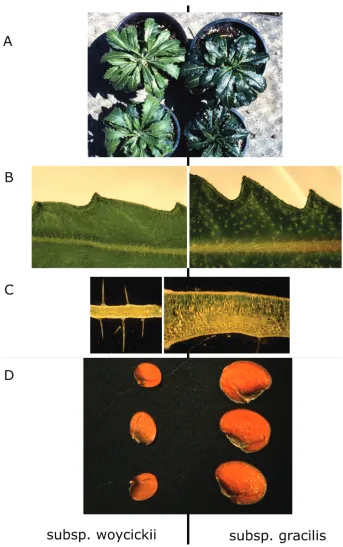
A new taxon Biscutella laevigata subsp. woycickii (Brassicaceae) is described from southern Poland. The taxon is similar to B. laevigata subsp. gracilis, but differs in having thin, light-green rosette leaves very densely covered by simple non-glandular trichomes, smaller seeds and the ability to tolerate and accumu-late high amounts of heavy metals. This new taxon is supported by results of cultivation experiments, as well as genetic and paleobotanical evidence.
Keywords
Biscutella, Biscutella laevigata subsp. woycickii, Brassicaceae, new subspecies, southern Poland, taxonomy
Introduction
Heavy-metal-rich calamine soils have been attracting human attention for several thousand years. Initially, the total area occupied by these environments was limited to small, isolated outcrops of ore-bearing rocks. Usually these areas were easy to spot due to unique vegetation covering soils that naturally developed on a metal-rich rocky
http://phytokeys.pensoft.net
Copyright Małgorzata Wierzbicka et al. This is an open access article distributed under the terms of the Creative Commons Attribution License (CC BY 4.0), which permits unrestricted use, distribution, and reproduction in any medium, provided the original author and source are credited.
substrate. Mining activities carried out in Europe since the Bronze Age (ca. 3 kyr BP) (Coulson 2012) contributed to a significant increase in the areas covered by calamine soils (nowadays represented mainly by mining waste heaps, riparian areas along rivers polluted by wastewater and sediments from ore-processing factories, mines etc.) and to the almost total destruction of the primary habitats of calamine vegetation (Baker et al. 2010). However, this huge, anthropogenic environmental change did not lead to the total extinction of all the plant taxa connected with calamine areas (Baker et al. 2010). On the contrary, while primary habitats of the calamine flora were destroyed, new and often more spacious environments have developed around the mining sites. Heaps of waste materials from early metal mines, which could not be easily colonised by other plants due to the very high content of zinc and lead, became ideal refugia for calamine-adapted plants.
Heavy-metal-polluted calamine soils and natural processes that resulted in the de-velopment of metal-tolerant vegetation covering such places have been at the focus of attention for many scholars since the beginning of the 20th century (Baker et al. 2010).
Soon this research demonstrated that calamine areas host unique plant taxa that are often endemic. In Europe, a number of such taxa have already been formally
recog-nised. Examples of these taxa include: Viola calaminaria (DC. ex Ging.) Lej., Noccaea
caerulescens (J.Presl & C.Presl) F.K.Mey. subsp. calaminaris (Lej.) Holub and Armeria alpina Willd. subsp. halleri (Wallr.) Nyman.
In the vicinity of Olkusz (southern Poland), there is an old mining area with
lead and zinc mining activities dating back to the 12th century (Molenda 1984).
Until the end of the 20th century, open, shallow pits were used to excavate Zn-Pb
ores that were located close to the ground level (Szarek-Łukaszewska et al. 2015). During the 900 years of ore exploitation, natural sites of calamine vegetation have been completely erased, but the rich and diverse calamine flora can be found in secondary habitats in the vicinity of Olkusz. Calamine grasslands occurring there on old mining waste heaps have been studied by biologists since the beginning of the
20th century (Wóycicki 1913).
In this paper, we argue that a new taxon endemic to calamine areas close to Olkusz in southern Poland deserves formal recognition at a subspecies level within
Biscutella laevigata L.
Materials and methods
The study is based on field surveys, laboratory studies including experiments under controlled growing conditions, as well as on genetic analyses. Results of these studies have already been published in several papers dealing with ecology and physiology of
Taxonomy
Biscutella laevigata L. subsp. woycickii M.Wierzb., Pielich. & Wasowicz, subsp. nov. urn:lsid:ipni.org:names:77211421-1
Figure 1
Type. Poland. Olkusz, 1922, R. Kobendza, s.n. (holotype, WA0000071422 !). Diagnosis. Biscutella laevigata subsp. woycickii is similar to subsp. gracilis, but differs from the latter in having thin, light-green rosette leaves very densely covered by simple non-glandular trichomes. Plants belonging to subsp. woycickii have smaller seeds and are characterised by the ability to tolerate and accumulate high quantities of heavy metals.
Etymology. This subspecies is dedicated to a renowned Polish botanist Zygmunt Wóycicki (1871–1941), a pioneer of biological research on calamine areas.
Distribution and ecology. Calamine areas in the vicinity of Olkusz, Powiat Olkuski (Olkusz County), Województwo Małopolskie (Lesser Poland Voivodeship/ Province), southern Poland.
Phenology. Flowering in April–May, fruiting in July–August.
Chromosome number. A study carried out by Skalińska (1950) on plants from the calamine population in the vicinity of Olkusz resulted in the diploid chromosome number, 2n = 18.
Preliminary conservation status. Currently, the taxon is known only from cala-mine areas in the vicinity of Olkusz, where it is quite abundant on calacala-mine soils. The
extent of occurrence (EOO) of the taxon is 7 km2 and the area of occupancy (AOO) is
14 km2. A steady decline in population size has been observed during the last 20 years.
It seems that the new taxon could be classified as Vulnerable according to the IUCN criteria (Standards IUCN 2019), but more research is needed to estimate the number of mature individuals and population dynamics.
Discussion
The morphological and geographic distinctiveness of B. levigata populations from the
Olkusz Ore Bearing Region have been recognised by botanists already in the 19th
cen-tury (Zalewski 1886, Wóycicki 1913, Zając 1996), but the detailed morphological, anatomical and physiological studies on the problem were initiated only at the begin-ning of 21st century. The research, carried out by us previously and already published,
demonstrated that a significant amount of morphologic, physiologic and genetic
dif-ferentiation exists between the isolated population of B. laevigata from the calamine
areas near Olkusz (S Poland) and the nearest mountainous populations located in the
Tatra Mountains and belonging to subsp. gracilis. We determined that the calamine
Figure 1. A holotype of Biscutella laevigata subsp. woycickii Wierzbicka, Pielichowska & Wasowicz (WA0000071422).
(as compared to subsp. gracilis) and shows an intense formation of daughter rosettes
present in the calamine population (Wierzbicka and Pielichowska 2004). Our previous research showed that this differentiation is not merely a result of phenotypic plasticity. The phenotypic differentiation was stable and preserved when plants were grown in the greenhouse under standard conditions (Wierzbicka and Pielichowska 2004) (Fig. 2). Genetic analyses, carried out using Amplified Fragment Length Polymorphisms (AFLPs), showed that a strong genetic differentiation exists between calamine popula-tions and the nearest natural populapopula-tions located in the Western Carpathians (Wasow-icz et al. 2014) and there are no signs of gene flow between these two areas. No evident signs of a bottleneck effect were evidenced by AFLP (Wasowicz et al. 2014). The DW Index (Schönswetter and Tribsch 2005), measuring the genetic divergence, was high in the calamine population, suggesting their long-term isolation (Wasowicz et al. 2014).
The paleobotanical study carried out in the near vicinity clearly suggests that cala-mine populations in the area of Olkusz could have originated before the Last Glacial Maximum (LGM) from local, interglacial populations. The presence of the species in the region has been determined by Szafer (1930), who, during his research in Ludwinow (about 40 km SE from Olkusz), found fossil siliques of Biscutella laevigata dating back to the Weichselian glaciation in Northern Europe (115–11.7 kyr BP, mainly correspond-ing to the Würm glaciation in the Alps and the Valdai glaciation in Eastern Europe).
A recently published study, carried out on local populations in southern Poland and focused on population genetic structure using nine nuclear micro-satellite loci (Babst-Kostecka et al. 2014), fully agrees with the paleobotanical data and our AFLP results (Wasowicz et al. 2014). Babst-Kostecka et al. (2014) concluded that the local calamine population in the vicinity of Olkusz originated as a result of an old vicariance predating the Last Glacial Maximum.
All these findings have led us to propose a hypothesis that the calamine
popula-tion of B. laevigata from Olkusz Ore Bearing Region is a descendant of an ancient
relict population that, through development of a series of adaptations to heavy metal stress, colonised natural calamine areas in the vicinity of Olkusz and, subsequently (when natural calamine sites were destroyed due to mining activities), also secondary sites (Wasowicz et al. 2014). Taking the above-mentioned differences into account, we argue that the morphotype from calamine areas in the vicinity of Olkusz should be formally recognised at subspecies level.
References
Babst-Kostecka AA, Parisod C, Godé C, Vollenweider P, Pauwels M (2014) Patterns of genetic divergence among populations of the pseudometallophyte Biscutella laevigata from southern Poland. Plant and Soil 383(1–2): 245–256. https://doi.org/10.1007/s11104-014-2171-0 Baker AJM, Ernst WHO, van der Ent A, Malaisse F, Ginocchio R (2010) Metallophytes: the
Coulson M (2012) The history of mining: The events, technology and people involved in the industry that forged the modern world. Harriman House Limited, 600 pp.
Molenda D (1984) Der polnische Bleibergbau und seine Bedeutung für den europäischen Blei-markt vom 12. bis 17. Jahrhundert. In: Kroker W, Westermann E (Eds) Montanwirtschaft Mitteleuropas vom 12. bis 17. Jahrhundert: Stand, Wege und Aufgaben der Forschung. Veröffentlichungen aus dem Deutschen Bergbau-Museum Bochum, Bochum, 187–198. Schönswetter P, Tribsch A (2005) Vicariance and dispersal in the alpine perennial Bupleurum
stellatum L. (Apiaceae). Taxon 54(3): 725–732. https://doi.org/10.2307/25065429 Skalińska M (1950) Studies in chromosome numbers of Polish Angiosperms. Acta Societatis
Botanicorum Poloniae 20(1): 45–68. https://doi.org/10.5586/asbp.1950.003
Standards IUCN (2019) Guidelines for Using the IUCN Red List Categories and Criteria. Ver-sion 14. Prepared by the Standards and Petitions Committee. http://www.iucnredlist.org/ documents/RedListGuidelines.pdf
Szafer W (1930) Element górski we florze niżu polskiego (The mountain element in the flora of the Polish Plain) Rozprawy Wydziału Matematyczno-Przyrodniczego, Polska Akademia Umiejętności 69, Seria III 29. Dział B 3: 1–112.
Szarek-Łukaszewska G, Nowak T, Grodzińska K, Kapusta P, Godzik B (2015) Przyroda Olkusk-iego Okręgu Rudnego. In: Wierzbicka M (Ed.) Ekotoksykologia: rośliny, gleby, metale. Wydawnictwo Uniwersytetu Warszawskiego, Warszawa, 163–174.
Wasowicz P, Pielichowska M, Przedpelska-Wasowicz EM, Bednarek P, Szarek-Łukaszewska G, Abratowska A, Wierzbicka M (2014) Physiological and genetic differentiation between metallicolous and non-metallicolous diploid populations of alpine Biscutella laevigata (Brassicaceae) in the Tatra Mountains and the northern Carpathian foreland. Annales Bo-tanici Fennici 51: 227–239. http://www.sekj.org/PDF/anbf51/anbf51-227.pdf
Wierzbicka M, Pielichowska M (2004) Adaptation of Biscutella laevigata L., a metal hyper-accumulator, to grow on a zinc-lead waste heap in southern Poland. I: Differences be-tween waste-heap and mountain populations. Chemosphere 54: 1663–1647. https://doi. org/10.1016/j.chemosphere.2003.08.031
Wóycicki Z (1913) Roślinność terenów galmanowych Bolesławia i Olkusza. Obrazy roślinności Królestwa Polskiego. Kasa Mianowskiego, Warszawa, 1–56.