Volume 01, No. 10, October 2015
P
age
1
Effect of Drying Time on Drying Rate of Fluidized Bed
Drying of Beetroot
Yashwant Kumar
Assistant Professor, Department of Food Processing and Technology, Bilaspur University, Bilaspur, Chhattisgarh, India
ABSTRACT
Effort were made to determine the effect of drying time on drying rate, during fluidized bed drying (FBD) of beetroot. Three set of temperature was taken for the research viz. 60 oC, 67.5
o
C and 75oC along with the air velocity likewise 9 m/s, 10.5 m/s and 12 m/s. It was observed that the beetroot samples obtained from the FBD system had lower final moisture content. Thus for a particular temperature, the initial drying rate after 5 min drying was higher for higher air velocities and at a particular air velocity, the initial drying rate after 5 min drying was also higher for higher air temperature.
Key-words- Drying time, drying rate, beetroot, drying, fluidized bed drying.
INTRODUCTION
Drying is the oldest method of preserving food. Compared with other methods, drying is quite simple. Dried foods keep well because the moisture content is so low that spoilage organisms cannot grow. Drying will never replace canning and freezing because these methods do a better job of retaining the taste, appearance, and nutritive value of fresh food. But drying is an excellent way to preserve foods that can add variety to meals and provide delicious & nutritious food. One of the biggest advantages of dried foods is that they take much less storage space than canned or frozen foods. Although solar drying is a popular and very inexpensive method. Dependable solar dehydration of foods requires 3 to 5 consecutive days when the temperature is 95 ºF (35 ºC) and the humidity is very low hence solar drying is thus not feasible (www.aces.uiuc.edu).
The fluidized bed drying technique holds an important position among modern drying methods. It is widely used mainly for granular materials and also applicable in the drying of solution, pastes and liquids sprayed on the fluidized inert bed the principle of operation of the fluidized bed dryer is to provide sufficient air pressure to fluidize a thin bed of grain/product, giving excellent air/grain contact. Above a certain pressure, related to the weight per unit area of the grain bed, the pressure drop across the bed becomes constant, with volume flow rate, so that the fast drying can occur.
In, fluidized bed drying process, the drying completed mostly in falling rate period that can be subdivided into unsaturated surface drying region and internal movement of moisture-control region (Kumar and Khan, 2015).
Volume 01, No. 10, October 2015
P
age
2
al., 1966; Hovmand, 1987). It is also a very convenient method for drying heat sensitive food materials as it prevents them from overheating due to mixing (Gibert et al., 1980).
Beetroot (Beta vulgaris L.) is crop belonging to the Chenopodiaceae family having, bright crimson colour. It is famous for its juice value and medicinal properties; and known by several common names like beet, chard, spinach beet. sea beet. garden beet, white beet and Chukander (in Hindi). Beetroot gives the best value from June to November, and for storing, the beetroot leaves should be cut 50 mm above the root. They will keep for 4-5 days when refrigerated in the vegetable crisper (Yashwant, 2015).
MATERIALS AND METHODS
Raw materials
Good quality fresh beetroot of sanguina variety was procured from the local market of Aligarh, Uttar Pradesh, India. The damaged, immature and dried fruits were removed manually by visual inspection while beetroot of uniform size free from pest and disease was taken for experiment.
Experimental plan
After cleaning of beetroot, it was washed, peeled and sliced. Then FBD system was used for drying of beetroots (mentioned in Fig. 1). The entire experimental studies were conducted in the laboratories of the Department of Post Harvest and Technology, A.M.U. Aligarh where well-established facilities are available.
Drying
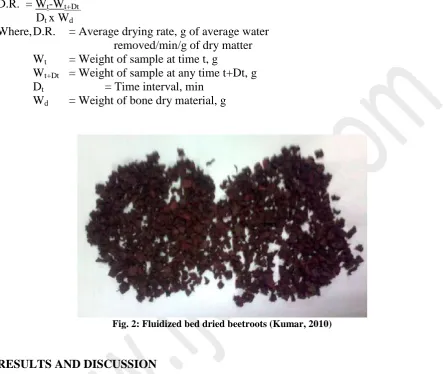
The experiment for the samples (size 500 g) was carried out until constant weight is achieved using inlet hot air temperature 60 ºC, 67.50 ºC and 75 ºC at air velocity 9, 10.50 and 12 m/s for each temperature. The sample weighed after each 5 min interval for determining the moisture content. Drying time was observed, 80-105 min depending upon the inlet air temperature and air velocity. Beetroot dried in fluidized bed dryer is shown in Fig. 2.
Volume 01, No. 10, October 2015
P
age
3
Drying rate analysis
Drying rate was calculated using following equation as suggested by Jain and Singh (1997) –
D.R. = Wt-Wt+Dt
Dt x Wd
Where, D.R. = Average drying rate, g of average water removed/min/g of dry matter Wt = Weight of sample at time t, g
Wt+Dt = Weight of sample at any time t+Dt, g
Dt = Time interval, min
Wd = Weight of bone dry material, g
Fig. 2: Fluidized bed dried beetroots (Kumar, 2010)
RESULTS AND DISCUSSION
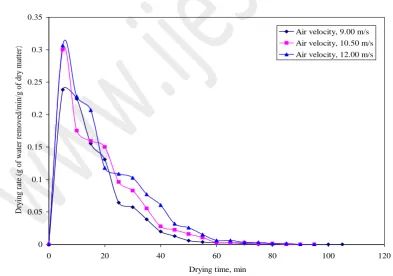
The effect of drying rates of samples under fluidized bed drying are shown in Fig. 3 to 5 which indicate that the drying rate decreased with the increase in drying time. After some period, drying rate decreased rapidly with the increase in drying time and then decreased gradually and attained zero drying rates. The drying rate at all the air temperatures and air velocities combination for all the samples at 5 minutes interval. The moisture content of beetroots was relatively higher during the initial phase of drying, which resulted in higher absorption of heat and led to an increased product temperature and higher drying rate due to higher moisture diffusion. As the drying of beetroots sample progressed, the loss of moisture in the product decreased the absorption of heat and resulted in fall of drying rate during later part of the drying.
Volume 01, No. 10, October 2015
P
age
4
but at the same temperature when air velocities were 10.50 m/s and 12 m/s the samples attained zero drying rates at the end of 95 min in both air velocities.
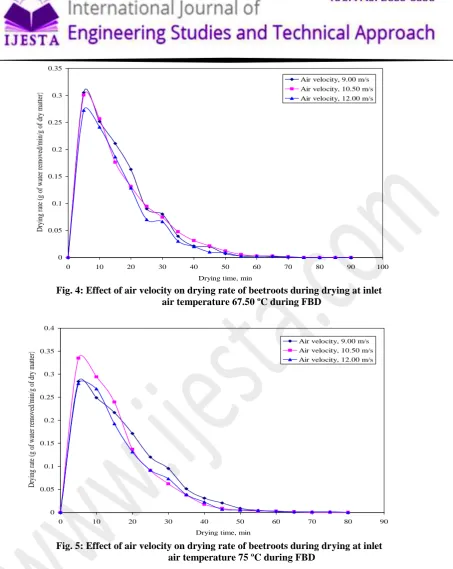
At 67.50 °C air temperature and air velocity of 9 m/s, the drying rate of beetroots was 0.306 g / min / g. of dry matter at the end of first 5 min drying but at the same temperature when air velocities were 10.50 m/s and 12 m/s the drying rates were respectively 0.300 and 0.274 g / min / g of dry matter at the end of first 5 min drying. At 67.50 °C air temperature and air velocity of 9 m/s the drying rate of beetroots was decreased rapidly up to 35 - 40 min drying time and then decreased gradually and attained zero drying rates at the end of 95 min drying but at the same temperature when air velocities were 10.50 m/s and 12 m/s the samples attained zero drying rates at the end of 95 min in both air velocities (up to lower moisture level).
At 75 °C air temperature and air velocity of 9 m/s, the drying rate of beetroots was 0.344 g/min/g of dry matter at the end of first 5 min drying and at the same temperature when air velocities were 10.50 m/s and 12 m/s the drying rate values were respectively 0.334 and 0.280 g / min / g of dry matter at the end of first 5 min drying. At 75 °C air temperature and air velocity of 9 m/s the drying rate of beetroots was decreased rapidly up to 40-45 min drying time and then decreased gradually and attained zero drying rates at the end of 80 min drying but at the same temperature when air velocities were 10.50 m/s and 12 m/s the samples attained zero drying rates at the end of 80 min in both samples (up to lower moisture level). Similar fashion was observed by Kumar et al. (2012).
Thus for a particular temperature, the initial drying rate after 5 min drying was higher for higher air velocities and at a particular air velocity, the initial drying rate after 5 min drying was also higher for higher air temperature. Drying rate vs Drying time
0 0.05 0.1 0.15 0.2 0.25 0.3 0.35
0 20 40 60 80 100 120
Drying time, min
Dr
ying
ra
te
(g
of
wa
ter
r
emoved/mi
n/g
of
dr
y
matter
)
Air velocity, 9.00 m/s Air velocity, 10.50 m/s Air velocity, 12.00 m/s
Volume 01, No. 10, October 2015
P age
5
Drying rate vs Drying time
0 0.05 0.1 0.15 0.2 0.25 0.3 0.35
0 10 20 30 40 50 60 70 80 90 100
Drying time, min
Dr ying ra te (g of wa ter r emoved/mi n/g of dr y matter )
Air velocity, 9.00 m/s Air velocity, 10.50 m/s Air velocity, 12.00 m/s
Fig. 4: Effect of air velocity on drying rate of beetroots during drying at inlet air temperature 67.50 ºC during FBD
Drying rate vs Drying time
0 0.05 0.1 0.15 0.2 0.25 0.3 0.35 0.4
0 10 20 30 40 50 60 70 80 90
Drying time, min
Dr ying ra te (g of wa ter r emoved/mi n/g of dr y matter )
Air velocity, 9.00 m/s Air velocity, 10.50 m/s Air velocity, 12.00 m/s
Fig. 5: Effect of air velocity on drying rate of beetroots during drying at inlet air temperature 75 ºC during FBD
For the same temperature, if air velocity will increase then drying rate will increase as per Kumar et al. (2014). In that case faster drying rate will reduce the drying time.
CONCLUSIONS
Volume 01, No. 10, October 2015
P
age
6
fluidized bed dryer is a very feasible drying technique for increasing the shelf life of fruits and vegetables especially for the commercial purpose as compare to conventional drying system like tray dryer.
ACKNOWLEDGEMENT
I am enormously grateful to Professor, Mohammad Ali Khan of Post Harvest Engineering and Technology Department, Aligarh Muslim University, Aligarh for their kind support, guidance and remarks.
REFERENCES
i. Borgolte, G. and Simon, E. J. 1981. Fluid bed processes in the manufacture of snacks products. CED review for chocolate, Confectionery and Bakery. 6(2), pp. 7-8, 10.
ii. Gibert, H., Baxerres, J. L., and Kim H., 1980. Blanching time in fluidized beds. In Food Process Engineeing; 1: Food Processing Systems, (P. Linko, Y. Malkki, J. Olkku and J. Larinkari Eds) pp. 75-85, Applied Science Publishers, London.
iii. Hovmand, S 1987. Fluidized bed drying. In hand booh of industrial drying. (A. S. Majumdar eds). Marcel Dekker, NY, USA.
iv. Jain N. K. and Singh Jabbar (1997). Drying kinetic of green gram, J. food. Sci. Technol, Vol. 34, 360 362.
v. Kumar Yashwant and M A Khan, 2015. Application of RSM in Fluidized Bed Drying of Beetroot (Beta Vulgaris L.). International Journal of Research Studies in Biosciences, Special issue, P. 1.
vi. Kumar Yashwant, 2015, Beetroot: A Super Food. International Journal of Engineering Studies and Technical Approach, 1(3), p.22.
vii. Kumar Yashwant, A comparative study on fluidized bed drying and microwave assisted fluidized bed drying of beetroot, M. Tech. Dissertation. Aligarh Muslim University, Aligarh, Uttar Pradesh (INDIA).Pp. 34 (2010).
viii. Kumar Yashwant, Khan MA, Patel KK, Effect of Microwave on Fluidized Bed Drying of Beetroot (Beta vulgaris L.). American Journal of Engineering Research 3: 267-273, (2014).
ix. Kumar Yashwant, Vivek Kumar, M. A. Khan, Jarnail Singh, A.K.Singh and S.Tiwari, Fluidized bed drying of beetroot (Beta vulgaris). Crop Improvement. Special Issue, Pp 1129-30, (2012).
x. Vanecek, C., Markvart, M. and Drbohlar, R. 1966. Fluidized bed drying, Lenard Hill London, UK.