The Journal of Threatened Taxa (JoTT) is dedicated to building evidence for conservation globally by publishing peer-reviewed articles online every month at a reasonably rapid rate at www.threatenedtaxa.org. All articles published in JoTT are registered under Creative Commons Attribution 4.0 International License unless otherwise mentioned. JoTT allows allows unrestricted use, reproduction, and distribution of articles in any medium by providing adequate credit to the author(s) and the source of publication.
www.threatenedtaxa.org
ISSN 0974-7907 (Online) | ISSN 0974-7893 (Print) Building evidence for conservation globally
Journal of Threatened Taxa
For Focus, Scope, Aims, Policies, and Guidelines visit https://threatenedtaxa.org/index.php/JoTT/about/editorialPolicies#custom-0 For Article Submission Guidelines, visit https://threatenedtaxa.org/index.php/JoTT/about/submissions#onlineSubmissions For Policies against Scientific Misconduct, visit https://threatenedtaxa.org/index.php/JoTT/about/editorialPolicies#custom-2 For reprints, contact <[email protected]>
Short Communication
First camera trap documentation of the
Crab-eating Mongoose Herpestes urva (Hodgson, 1836)
(Carnivora: Feliformia: Herpestidae) in
Barandabhar Corridor Forest in Chitwan, Nepal
Trishna Rayamajhi, Saneer Lamichhane, Aashish Gurung, Pramod Raj Regmi, Chiranjibi Prasad Pokheral & Babu Ram Lamichhane
26 June 2019 | Vol. 11 | No. 8 | Pages: 14051–14055 DOI: 10.11609/jott.4567.11.8.14051-14055
Partner
Member
Threatened Taxa
Publisher & Host
PLATINUM OPEN ACCESS
14051
Shor
t C
ommunica
tion
DOI:https://doi.org/10.11609/jott.4567.11.8.14051-14055 | ZooBank: urn:lsid:zoobank.org:pub:66F52D31-7C1C-4CD2-A557-155A21BB515F
Editor: S.S. Talmale, Zoological Survey of India, Pune, India. Date of publication: 26 June 2019 (online & print)
Manuscript details: #4567 | Received 09 December 2018 | Final received 02 June 2019 | Finally accepted 12 June 2019
Citation:Rayamajhi, T., S. Lamichhane, A. Gurung, P.R. Regmi, C.P. Pokheral & B.R. Lamichhane (2019). First camera trap documentation of the Crab-eating Mon -goose Herpestes urva (Hodgson, 1836) (Carnivora: Feliformia: Herpestidae) in Barandabhar Corridor Forest in Chitwan, Nepal. Journal of Threatened Taxa 11(8): 14051–14055. https://doi.org/10.11609/jott.4567.11.8.14051-14055
Copyright: © Rayamajhi et al. 2019. Creative Commons Attribution 4.0 International License. JoTT allows unrestricted use, reproduction, and distribution of this article in any medium by adequate credit to the author(s) and the source of publication.
Funding: U.S. Fish and Wildlife Service (USFWS).
Competing interests:The authors declare no competing interests.
Acknowledgements: We would like to acknowledge the Government of Nepal (GoN), Ministry of Forest and Environment (MoFE), Department of National Park
and Wildlife Conservation (DNPWC), Chitwan National Park (CNP), National Trust for Nature Conservation (NTNC), and the U.S. Fish and Wildlife Service (USFWS) - Grant F13AP00825. We are thankful to Mr Ram Kumar Aryal, acting officer-in-charge (NTNC-BCC) and all the wildlife technicians of NTNC-BCC who helped to accomplish the objective of this study.
First camera trap documentation of
the Crab-eating Mongoose Herpestes urva
(Hodgson, 1836) (Carnivora: Feliformia: Herpestidae)
in Barandabhar Corridor Forest in Chitwan, Nepal
Trishna Rayamajhi 1 , Saneer Lamichhane 2 , Aashish Gurung 3 , Pramod Raj Regmi 4 ,
Chiranjibi Prasad Pokheral 5 & Babu Ram Lamichhane 6
1–6 National Trust for Nature Conservation, P.O. Box 3712, Khumaltar, Lalitpur 44600, Nepal.
1 [email protected] (corresponding author), 2 [email protected], 3 [email protected],
4 [email protected], 5 [email protected], 6 [email protected]
Journal of Threatened Taxa | www.threatenedtaxa.org | 26 June 2019 | 11(8): 14051–14055
Abstract: The systematic study in 2015 and 2016 documented the
first camera trap image of the Crab-eating Mongoose Herpestes urva
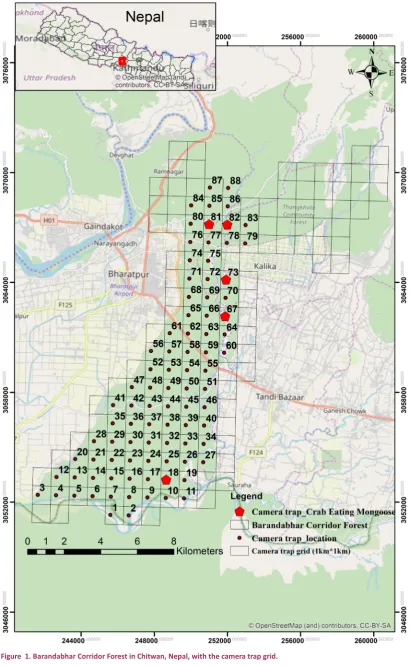
in Barandabhar Corridor Forest in Chitwan, Nepal. The corridor was divided into 88 grids, each of 1km by 1km. A pair of cameras was placed for 15 nights in each grid and the total camera trap night effort was 2,640. There were two separate events capturing three independent images and five separate events capturing seven independent images of the Crab-eating Mongoose in 2015 and 2016, respectively. Photo capture rate in camera traps were 0.01 and 0.03 respectively in 2015 and 2016. The presence of this species opens new scope for wildlife professionals and scientific communities to take further steps for its conservation.
Keywords:Camera trap ratio, camera trap survey, carnivore.
ISSN 0974-7907 (Online) ISSN 0974-7893 (Print)
PLATINUM OPEN ACCESS
A mongoose is an agile and resilient carnivore with a long pointed face with small rounded ears, a tubular body with short legs, and a tapering bushy tail (Yonzon 2005). Four species of mongoose, namely the Small
Indian Mongoose, the Indian Grey Mongoose, the Crab-eating Mongoose, and the Ruddy Mongoose, are found in Nepal (Sharma & Lamichhane 2017). The Crab-eating Mongoose Herpestes urva is characterized by a white stripe on its neck that runs from its cheeks to the chest (De & Chakraborty 1995). According to the IUCN Red List of Threatened Species, the population trend of this species is decreasing. It is categorized as Vulnerable in Nepal’s National Red List (Jnawali et al. 2011).
Journal of Threatened Taxa | www.threatenedtaxa.org | 26 June 2019 | 11(8): 14051–14055
Crab-eating Mongoose in Barandhabar CF, Nepal Rayamajhi et al.
14052
(1836) mentioned that the Crab-eating Mongoose was first reported as ‘Gulourva’in the central and northern regions of Nepal. Fry (1925) was the first to publish the record of the mongoose with its specific locality. Additionally, Thapa (2013) confirmed the image-validated direct sighting of the Crab-eating Mongoose in eastern Sankhuwasabha District in Nepal. Further, the camera trap image of the Crab-eating Mongoose was recorded in Parsa National Park in 2017 (Sharma & Lamichhane 2017). The recent findings of Thapa (2013) and Sharma & Lamichhane (2017) validate the details mentioned by Jnawali et al. (2011).
Sharma & Lamichhane (2017) mentioned that the priority species for camera traps are large charismatic species like the Tiger Panthera tigris and the Leopard P. pardus in comparison to smaller carnivores. In Barandabhar Corridor Forest (BCF), a camera trap survey was carried out as ‘Tiger and prey base monitoring in Barandabhar Corridor Forest’, focusing particularly on the Bengal Tiger Panthera tigristigris. The camera trap, however, also worked as a means to disclose the photographic proof for the existence of many species including smaller carnivores like the Crab-eating Mongoose. This study presents the first image documentation of the Crab-eating Mongoose using a systematic camera trap technique. Since corridors are the cornerstones of modern conservation and act as a linear strip of habitat to facilitate the movement of species through the landscape (Puth & Wilson 2001), the presence of the Crab-eating Mongoose in BCF represents its healthy functionality. The study also supports managers and researchers for future conservation actions in BCF.
Study area
BCF (87.9km2) is the only remaining forest patch of
Chitwan that joins Chitwan National Park in the south with the Mahabharat range in the north (Bhattarai & Basnet 2004). Though continuous, it is in two parts, the south and the north, from the existing Mahendra Highway. The southern part is a buffer zone and the northern part lies in the district forest area. The southern part is guarded by the Nepal Army and is enlisted as a Ramsar Site (site number 1313), as Beeshazar and associated lakes. The aim of the corridor is to mitigate the effects of local communities on conservation and vice versa (Axelsson & Andersson 2012). There are heavy populated municipalities around the corridor, namely Ratnagar Municipality in the east, Kalika in the northeast, and Bharatpur Metropolitan City in the west.
Methods
BCF was divided into 88 grids of 1km by 1km. Camera traps were systematically placed in each grid. The whole operation was completed in two shifts due to limited resources, i.e., the southern part of the corridor (59 grids) was covered in the first deployment and the northern part (29 grids) in the second deployment. In each grid, one pair of cameras was installed locating a suitable place on each side at a distance of about 4–5 m from the midline of the trail, and the installation details with GPS points were recorded. Four models of cameras, namely Reconyx 550, Moultrie 40D, Bushnell HD, and Cuddeback, were used. Each camera was checked on alternate days to ensure its functionality. The cameras were left for 15 nights in each grid (Karanth & Nicholas 2002; Pokheral 2002; Wang & MacDonald 2009; Thapa 2013; Lamichhane et al. 2014) with a sampling effort of 1,320 trap nights. The monitoring was conducted in two consecutive years, i.e., from March to April 2015 and from January to February 2016. The same method was used in both the years and the total sampling effort was doubled from 1,320 to 2,640 trap nights. All camera trap images were downloaded. The images were considered independent events if they were 30 minutes or more apart (Silver et al. 2004; Thapa 2013). The trapping rate was calculated as the number of independent images per total number of captured images per 100 trap nights (Karanth & Nicholas 2002).
Results
Crab-eating Mongoose in Barandhabar CF, Nepal Rayamajhi et al.
Journal of Threatened Taxa | www.threatenedtaxa.org | 26 June 2019 | 11(8): 14051–14055 14053 Image 3. Crab-eating Mongoose captured in grid no. 18 towards
south of BCF (2015).
Image 2. A pair captured in grid no. 73 towards north of BCF (2016). Image 1. A pair of Crab-eating Mongoose captured in grid no. 67
towards north of BCF (2016).
Image 4. Crab-eating Mongoose captured in grid no. 81 towards the north of the highway (2015).
Discussion
The Crab-eating Mongoose is common in southeastern Asia except for Nepal (Than Zaw et al. 2008). The primary reason for this rarity in the country remains unclear (Thapa 2013), but it has affected the study and data of the species. Sharma & Lamichhane (2017) referred to camera traps focusing only on large charismatic mammals as the apparent reason for the mongoose species being rare and localized. Wildlife research in southeastern Asia is largely donor-dependent and the probability of the acceptance of a proposal on small carnivores like Crab-eating Mongoose is low and in the case of high budget research null and void. It is the charismatic species that receive attention from the government and the media and have higher chances of acceptance in high budget proposals. Therefore, it is obvious that the selected proposal will determine the
focus of camera trap studies, as mentioned by Sharma & Lamichhane (2017).
Journal of Threatened Taxa | www.threatenedtaxa.org | 26 June 2019 | 11(8): 14051–14055
Crab-eating Mongoose in Barandhabar CF, Nepal Rayamajhi et al.
14054
Crab-eating Mongoose in Barandhabar CF, Nepal Rayamajhi et al.
Journal of Threatened Taxa | www.threatenedtaxa.org | 26 June 2019 | 11(8): 14051–14055 14055
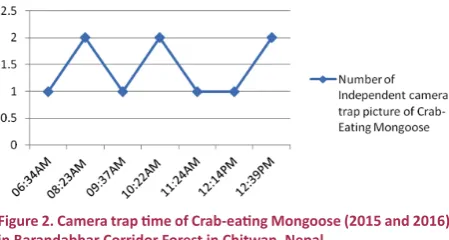
Figure 2. Camera trap time of Crab-eating Mongoose (2015 and 2016)
inBarandabhar Corridor Forest in Chitwan, Nepal.
prey. This may be because the predator saves energy according to the foraging theory, i.e., to minimize energy for capturing and searching for food.
Habitat destruction and poaching of the mongoose for fur trade are considered the major threats of the species in Nepal (Yonzon 2005; Jnawali et al. 2011; Thapa 2013; Sharma & Lamichhane 2017). No evidence of poaching, however, was found in Chitwan District. Other possible threats to the species in this region are overfishing, habitat loss, and the poisoning of waterholes (a method of illegal fishing). In BCF, the result showed an increase in camera trap ratio in consecutive years. This has spread a positive message on the success of conservation and management in the BCF.
This study reveals the presence of the Crab-eating Mongoose in both the southern and the northern parts of the highway and presents the first camera trap distribution documentation of the species in BCF. It extended the present range of this species and highlights the value of the corridor in its conservation. Publication of similar records is essential for the updated status of the distribution of the species in Nepal. This data opens a new scope and base for wildlife professionals and scientific communities to take further steps for the conservation of the Crab-eating Mongoose to maintain a healthy ecosystem in BCF.
References
Axelsson, E.P. & J. Andersson (2012). A case study of termite mound
occurrence in relation to forest edges and canopy cover within the Barandabhar Forest Corridor in Nepal. International Journal of Biodiversity and Conservation 4(15): 633–641.
Bhattarai, B.F. & K. Basnet (2004). Assessment of crop damage by
wild ungulates in the eastern side of Barandabhar Corridor Forest, Chitwan. Proceedings of IV National Conference on Science and Technology, March 23–26.
Chuang, S.A. & L.L. Lee (1997). Food habits of three carnivore species
(Viverricula indica, Herpestes urva, and Melogale moschata) in Fushan Forest ecosystem, northern Taiwan. Journal of Zoology
243(1): 71–79.
De, J.K. & R. Chakraborty (1995). Structure and pattern of guard hairs
of Crab-eating Mongoose, Herpestes urva (Hodgson) (Mammalia: Carnivora: Herpestidae). Proceeding of the Zoological Society,
Calcutta 48: 33–36.
Fry, T.B. (1925). Report No. 37a: Nepal. Bombay Natural History
Society’s Mammal Survey of India, Burma, and Ceylon. Journal of
the Bombay Natural History Society 30: 525–530.
Hodgson, B.H. (1836).Synoptical description of sundry new animals, enumerated in the Catalogue of Nepalese Mammals. Journal of the
Asiatic Society of Bengal 5: 231–238.
Jnawali, S.R., H.S. Baral, S. Lee, K.P. Acharya, G.P. Upadhyay, M. Pandey, R. Shrestha, D. Joshi, B.R. Lamichhane, J. Griffiths, A. Khatiwada & R. Amin (compilers) (2011). The Status of Nepal
Mammals: The National Red List Series. Department of National Parks and Wildlife Conservation, Kathmandu, Nepal, viii+81pp.
Karanth, K.U. & J.D. Nichols (2002). Monitoring tigers and their prey: a
manual for researchers, managers, and conservationists in tropical Asia. Centre for Wildlife Studies, Bangalore, India.
Lamichhane, B.R., M. Dhakal, N. Subedi & C.P. Pokheral (2014).
Clouded Leopard co-exist with other five felids in Chitwan National Park, Nepal. Cat News 61: 30–32.
Pokharel, C.P. (2002). Censusing tigers by camera trapping: testing the
method and estimating the population in Karnali floodplain of Royal Bardia National Park, Nepal. M.Sc. Thesis. Agriculture University of Norway.
Puth, L.M. & K.A. Wilson (2001). Boundaries and corridors as a
continuum of ecological flow control: lessons from rivers and streams. Conservation Biology 15: 21–30.
Silver, S., L. Ostro, L. Marsh, L. Maffei, A. Noss, M. Kelly & G. Ayala (2004). The use of camera traps for estimating Jaguar Panthera onca
abundance and density using capture/recapture analysis. Oryx 38(2):
148–154. https://doi.org/10.1017/S0030605304000286
Sharma, B. & B.R. Lamichhane (2017). Record of Crab-eating
Mongoose Herpestes urva from Parsa Wildlife Reserve, central Nepal. Small Carnivore Conservation 55: 97–103.
Thapa, S. (2013). Observations of Crab-eating Mongoose Herpestes
urva in eastern Nepal. Small Carnivore Conservation 49: 31–33.
Than Zaw, Saw Htun, Saw Htoo Tha Po, Myint Maung, A.J. Lynam, Kyaw Thinn Latt & J.W. Duckworth (2008). Status and distribution
of small carnivores in Myanmar. Small Carnivore Conservation 38: 2–28.
Wang, S.W. & D.W. MacDonald (2009). Feeding habits and niche
partitioning in a predator guild composed of tigers, leopards and Dholes in a temperate ecosystem in central Bhutan. Journal of
Zoology 277(4): 275–283.
Yonzon, P. (2005). Mongoose trade in Nepal. Tiger Paper:Regional Quarterly Bulletin on Wildlife and National Parks Management 32(2):
14–16.
ISSN 0974-7907 (Online) | ISSN 0974-7893 (Print)
June 2019 | Vol. 11 | No. 8 | Pages: 13951–14086 Date of Publication: 26 June 2019 (Online & Print)
DOI: 10.11609/jott.2019.11.8.13951-14086 www.threatenedtaxa.org
The Journal of Threatened Taxa (JoTT) is dedicated to building evidence for conservation globally by publishing peer-reviewed articles online every month at a reasonably rapid rate at www.threatenedtaxa.org. All articles published in JoTT are registered under Creative Commons Attribution 4.0 International License
unless otherwise mentioned. JoTT allows allows unrestricted use, reproduction, and distribution of articles in any medium by providing adequate credit to the author(s) and the source of publication.
Communications
The status of wild canids (Canidae, Carnivora) in Vietnam
– Michael Hoffmann, Alexei Abramov, Hoang Minh Duc, Le Trong Trai, Barney Long, An Nguyen, Nguyen Truong Son, Ben Rawson,
Robert Timmins, Tran Van Bang & Daniel Willcox, Pp. 13951–13959
Diel activity pattern of meso-carnivores in the suburban tropical dry evergreen forest of the Coromandel Coast, India
– Kangaraj Muthamizh Selvan, Bawa Mothilal Krishnakumar, Pasiyappazham Ramasamy & Thangadurai Thinesh, Pp. 13960–13966
On the importance of alpha behavior integrity in male Capybara
Hydrochoerus hydrochaeris (Mammalia: Rodentia: Caviidae) following
immuno-contraceptive treatment
– Derek Andrew Rosenfield & Cristiane Schilbach Pizzutto, Pp. 13967– 13976
Dietary analysis of the Indian Flying Fox Pteropus giganteus
(Brunnich, 1782) (Chiroptera: Pteropodidae) in Myanmar through the analysis of faecal and chewed remnants
– Moe Moe Aung & Than Than Htay, Pp. 13977–13983
Report on three ectoparasites of the Greater Short-nosed Fruit Bat
Cynopterus sphinx Vahl, 1797 (Mammalia: Chiroptera: Pteropodidae)
in Cachar District of Assam, India
– Anisur Rahman & Parthankar Choudhury, Pp. 13984–13991
A checklist of mammals of Tamil Nadu, India
– Manokaran Kamalakannan & Paingamadathil Ommer Nameer, Pp. 13992–14009
A comparative study on dragonfly diversity on a plateau and an agro-ecosystem in Goa, India
– Andrea R.M. D’Souza & Irvathur Krishnananda Pai, Pp. 14010–14021
Review
Contributions to the knowledge of moths of Bombycoidea
Latreille, 1802 (Lepidoptera: Heterocera) of Bhutan with new records –Jatishwor Singh Irungbam & Meenakshi Jatishwor Irungbam, Pp. 14022–14050
Short Communications
First camera trap documentation of the Crab-eating Mongoose
Herpestes urva (Hodgson, 1836) (Carnivora: Feliformia:
Herpestidae) in Barandabhar Corridor Forest in Chitwan, Nepal – Trishna Rayamajhi, Saneer Lamichhane, Aashish Gurung, Pramod Raj Regmi, Chiranjibi Prasad Pokheral &
Babu Ram Lamichhane, Pp. 14051–14055
First camera trap record of Red Panda Ailurus fulgens (Cuvier, 1825) (Mammalia: Carnivora: Ailuridae) from Khangchendzonga, Sikkim, India
– Tawqir Bashir, Tapajit Bhattacharya, Kamal Poudyal & Sambandam Sathyakumar, Pp. 14056–14061
First record of black scavenger fly of the genus
Meroplius Rondani, 1874 (Diptera: Sepsidae) from Pakistan – Noor Fatima, Ansa Tamkeen & Muhammad Asghar Hassan, Pp. 14062–14064
Scully’s Balsam Impatiens scullyi Hook.f. (Balsaminaceae): a new record for India from Himachal Pradesh
– Ashutosh Sharma, Nidhan Singh & Wojciech Adamowski, Pp. 14065–14070
Notes
Odisha’s first record of a free-tailed bat (Mammalia: Chiroptera: Molossidae): what could it be?
– Subrat Debata & Sharat Kumar Palita, Pp. 14071–14074
Additions to the flora of Arunachal Pradesh State, India – Umeshkumar Lalchand Tiwari, Pp. 14075–14079
A report on additions to the flora of Andaman & Nicobar Islands, India
– Johny Kumar Tagore, Ponnaiah Jansirani & Sebastian Soosairaj, Pp. 14080–14082
Range extension of Trigonella uncata Boiss. & Noë (Leguminosae) in peninsular India and a new record for Maharashtra State, India – Shrikant Ingalhalikar & Adittya Vishwanath Dharap, Pp. 14083–14086