Published by Central Fisheries Research Institute (SUMAE) Trabzon, Turkey in cooperation with Japan International Cooperation Agency (JICA), Japan
R E S E A R C H P A P E R
Study of the Bioaccumulation of UO
2
2+
onto the Green
Microalgae
Botryococcus braunii
Using Response Surface
Methodology
Fatih Celik
1,* , Mahmoud Ali Asker Aslani
1, Safak Seyhaneyildiz Can
21 Ege University, Institute of Nuclear Sciences, 35040, Izmir, Turkey.
2 Munzur University, Department of Bioengineering, 62000, Tunceli, Turkey.
Article History
Received 07 March 2018 Accepted 04 July 2018 First Online 11 July 2018
Corresponding Author
Tel.: +90.534 6298424
E-mail: [email protected]
Keywords
Bioaccumulation Uranium
Response Surface Methodology (RSM)
Botryococcus braunii
Experimental design
Abstract
The bioaccumulation of UO22+ (uranyl ion) was investigated by using dry biomass of
Botryococcus braunii. Experiments were conducted based on a rotatable central composite design (CCD) and analyzed using response surface methodology (RSM), which was used to optimize the bioaccumulation process. In this goal, the effects of parameters such as initial uranium (VI) concentration, pH, temperature and contact time were studied. The optimum conditions for maximum removal (87%) of UO22+ from an aqueous solution were as follows: initial uranium (VI) concentration (55 mg/l), pH (3.6), temperature (46°C) and contact time (74 min). Langmuir and
Freundlich isotherms and also thermodynamic parameters like Enthalpy (∆H°), Entropy (∆S°), standard Gibbs free energy (∆G°) were investigated, as well.
Introduction
Uranium mining and mineral processing for nuclear power lead to accumulation of significant amounts of radioactive wastes with tremendous environmental impact. Uranium is one of the most serious contamination concerns attracting wide environmental attention due to its radioactivity, long half-life (4.47x10⁹ years for U-238) and heavy-metal toxicity. Uranium occurs naturally in the +2, +3, +4, +5 and +6 valence states, but it is most commonly found in the hexavalent form. In nature, hexavalent uranium is commonly associated with oxygen as the uranyl ion, UO22+(Wisser & Hartkopf, 2006). The uranyl ions (UO22+) are easily soluble in water. Soluble uranium compounds, for example; such as UO2(NO3)2.6H2O, easily pass through the surface and groundwater, and consequently cannot be separated by ordinary physical
means of separation. Heavy metals in industrial
wastewater could be removed by some
physicochemical methods, such as chemical
precipitation, chemical oxidation or reduction, electrochemical treatment, evaporative recovery, filtration, adsorption, coagulation, ion exchange, membrane technologies, etc. (Gunatilake, 2015). Bioaccumulation is economically and environmentally more viable treatment alternative to some of these ineffective or expensive processes.
mechanism is not well elucidated. The type of metal and the biosorbent structure determine biosorption mechanisms (Brinza, Nygard, Dring, Gavrilescu, & Benning, 2009). There are effective biosorbents easily available in all the four groups: algae, fungi, bacteria and also plant biomass.
The bioaccumulation of uranyl by various biomaterials has been reported by different research groups. Bhat, Melo, Chaugule, and D’Souza (2008) characterized bioadsorption of uranium (VI) from aqueous medium onto Catenella caespitosa (With.) L.M.Irvine, a red alga. Marine macroalga Padina pavonica (L.) Thivy was successfully used to removing of UO22+ by Aytas et al. (Aytas, Gunduz, & Gok, 2014). Bai et al. (2014) reported that the uranium could be removed by immobilized cells of Rhodotorula glutinis (Fresen.) F.C. Harrison (Basidiomycota) from wastewaters. Lee et al. (2014) claimed that brown alga Saccharina japonica (Aresch.) C.E.Lane, Mayes, Druehl and G.W. Saunders could be used for adsorption of uranium (VI) ions. Sana, Roostaazad, and Yagmaei (2014) applied live and dead Aspergillus niger Tiegh:as biosorbent for removal of uranium from the aqueous medium. Yang and Volesky (1999) studied the adsorption of uranium from aqueous solutions using Sargassum biomass. Also, many researchers reported adsorption of uranium by using biosorbents such as fungi (Pang et al., 2011), alga (Ghasemi, Keshtkar, Dabbagh, & Jaber Safdari, 2011; Zhao, Wang, Liu, & Wu, 2013), bacteria (Sheng & Fein, 2013; Morcillo et al., 2014) and yeast (Omar, Merroun, Gonzalez Munoz, & Arias, 1996). Microalgae have higher photosynthetic efficiency than plants for the production of biomass (Benemann, 1997; Miao & Wu, 2006). They can be used for biofuel production, purification of wastewater, extractions of high added value foods and pharmaceutical products or as food for aquaculture (Spolaore, Joannis-Cassan, Duran, & Isambert, 2006). Moreover, microalga cells grown under different culture conditions have the ability to accumulate uranium (Manikandan, Prasath, & Prakash, 2011).
Response surface methodology (RSM) is a collection of mathematical and statistical techniques used for optimizing, improving and developing processes by analyzing the effects of several independent variables (Myers, Montgomery, & Anderson-Cook, 2009). This methodology is used to reduce the number of experiments or repeats and to improve the qualification of the information obtained from the results. This means considerably less process, time and cost. Previously, RSM for heavy metal adsorption has been successfully applied. Sert and Eral (2010) reported uranium adsorption studies on aminopropyl modified mesoporous sorbent using statistical design method, Cakir, İnan, and Altas (2014) have investigated strontium and uranium sorption onto zirconium-antimony oxide/polyacrylonitrile (Zr-Sb oxide/PAN) composite using an experimental design. Kütahyali, Çetinkaya, Acar, Işik, & Cireli (2012),
reported biosorption of Ce(III) onto modified Pinus brutia leaf powder using central composite design, etc. The aim of the present research is to study the effect of pH, initial uranium (VI) concentration, contact time and temperature on the bioaccumulation of uranyl using Botryococcus braunii Kütz. biomass. Optimum conditions for the elimination of UO22+ was determined with RSM technique by using Design Expert software Version 9.0.0 (State-Ease, USA).
Materials and Methods
Chemicals
All chemicals used in the experiments are of analytical grade. Bi-distilled deionized water obtained by Milli-Q water system (resistivity ≥ 18.2 MΩ.cm at 298 K) was used in all experiments. Uranyl stock solution of 1000 mg/l was prepared by dissolving a required amount of uranyl nitrate hexahydrate, UO2 (NO3)2.6H2O (Merck, Germany) in distilled water at room temperature and then diluted to the desired concentration as required. The pH value of all solutions used in this study was adjusted with ammonia and nitric acid solutions.
Preparation of Biosorbent
B. braunii biomass used in this study were obtained from the alga culture collection of Utex (The University of Texas, TX). Cells were maintained in the medium of Modified Bristol solution whose composition was as follows: (per liter) 0.025 g NaCl, 0.25 g NaNO3, 0.075 g MgSO4.7H2O, 0.025 g CaCl2.2H2O, 0.175 g KH2PO4, 0.075 g K2HPO4, and 40 ml soil water extract. Nutrient media were placed in Erlenmeyer flasks and their pH values were adjusted to 7.5. After inoculation of 10 ml of alga into each flask, they were cultured for 20 days in the laboratory under 33.6 µmol photon m-2.s-1 light intensity. Continuously aerated and the temperature was kept constant at 26ºC. At the end of the 20-day production period, all alga were harvested by centrifugation at 4000 rpm for 10 minutes. Biomass remaining in the centrifuge vials were rinsed with distilled water and dried for 12 hours in the oven set to 100°C (Lee, Yoon, & Oh, 1998).
Nomenclature of Botryococcus braunii
B. braunii which is a green, colonial, slow-growing microalga is widespread in freshwater, brackish lakes, reservoirs, and ponds. During observation under a light microscope, B. braunii colonies appear as a cluster of cells (Orpez et al., 2009). The pyriform shaped cells are usually 13 µm x 7 µm. This species is characterized by an original organization of colonies and an unusual
capacity to produce unsaturated long-chain
1991). Nomenclature of Microalgae information used in the sorption is listed below according to Guiry and Guiry (2018).
Phylum : Chlorophyta Classis : Trebouxiophyceae
Ordo : Trebouxiales
Family : Botryococcaceae
Genus : Botryococcus
Species : Botryococcus braunii
Sorption Experiments
A batch technique using a thermostated shaker bath (GFL-1083) at 150 rpm has been used for the adsorption experiments. The amounts of uranyl before and after process were calculated by estimating the concentration of uranium with the Arsenazo III spectrophotometric method by measuring the absorbance at 653 nm using Shimadzu UV–vis 1601 Model spectrophotometer (Niazi, Ghasemi, Goodarzi, & Ebadi, 2007). The pH measurements were made using a digital pH meter calibrated with pH 4 and 7 buffers.
The batch experiments were performed in 15 ml stoppered polypropylene (PP) tubes where 0.01 g of B. braunii and 10 ml of U (VI) solution at a desired initial concentration (20–100 mg/l) were added. The PP tubes were agitated at 150 rpm until desired contact time (15–155 min). The supernatant was separated from the biomass by centrifugation. Residual concentration of U (VI) ions in the supernatant were determined using spectrophotometric Arsenazo-III method.
In order to optimize the process, the batch experiments were dealt with according to the Central Composite Design (CCD). The response of experiment, bioaccumulation percentage was calculated as
Bioaccumulation percentage (%) = 𝐶0−𝐶𝑒
𝐶𝑒 𝑥100 (1)
where, C0 and Ce are initial concentration of solute (mg/l) and concentration of solute at equilibrium (mg/l), respectively. Each experiment was performed twice and the mean values were calculated. The standard deviation was found as about ±2%.
Experimental Design for Optimization of Experiment Parameters
The optimization of U (VI) bioaccumulation was realized by four selected independent process variables, pH (X1), the initial concentration of uranium (VI) (X2), contact time (X3) and temperature (X4) with six replicates at center points according to Central Composite Design (CCD). The lowest and highest levels of the variables were pH 2 and 6, the initial concentration of uranium (VI) 20 and 100 mg/l, contact time 15 and 155 min and temperature 15 and 75ºC,
respectively. Based on the preliminary experiments, the ranges of variables were selected and were given in Table 1. The broad ranges were used for each variable. The design matrix is designed to be in five level (-2, -1, 0, +1, +2) and four variables (X1, X2, X3, X4, X5).
The metal bioaccumulation percentage of Botryococcus branuii biomass was multiply regressed with respect to the different parameters by the least square methods as follows:
Yi = 𝛽0+ ∑𝑘𝑖=1𝛽𝑖 Xi +∑𝑘𝑖=1𝛽𝑖𝑖𝑋𝑖2+ ∑𝑖=1𝑘−1∑𝑘𝑗=𝑖+1𝛽𝑋𝑖𝑋𝑗+ 𝜀 (2)
where Yi is the predicted response variable.
In a system involving three independent variables, 14 coefficients have to be determined, as are coefficients of the 6 interaction effects, 4 quadratic effects, 4 main effects and 1 intercept term. β0 is the
intercept term, βi (i =1, 2, ..., k) are the linear
coefficient, βii(i =1, 2, ..., k) are the quadratic
coefficient, βij (i =1, 2, ..., k ; (j =1, 2, ..., k) are the
interaction coefficient, 𝜺 is a random error, Xi and Xj represent the coded independent variables in this model. In this study, Eq. (3) can be given as a second-order polynomial equation.
yi = β 0+ β1X1+ β2X2+ β3X3+ β4X4+ β11X12+ β22X22+ β33X32+ β44X42 + β12 X1X2 + β13 X1X3+ β14 X1X4+ β23 X2X3+ β24 X2X4+ β34 X3X4 (3)
The coefficient of determination (R2) and F value was used to evaluate the accuracy and fitness of the above model. The predicted values for uranium sorption were obtained by applying quadratic model (Design-Expert® Software Version 9 Free Trial). The optimum values of the variable parameters for metal sorption were obtained by solving the regression equation, analyzing the contour plots and constraints for the variable parameters using the same software. Bioaccumulation percentage was studied with a standard RSM design called CCD (Montgomery, 2001). With solving the regression equation and analyzing the response surface contour plots the optimum values of the selected variables were obtained. The variability independent variables were explained by the multiple coefficients of determination, R2 and the model equation was used to predict the optimum value and then to elucidate the interaction between the factors within the specified range (Elibol & Ozer, 2002).
Results and Discussion
Fourier Transform Infrared Analysis of Biomass (FTIR-ATR):
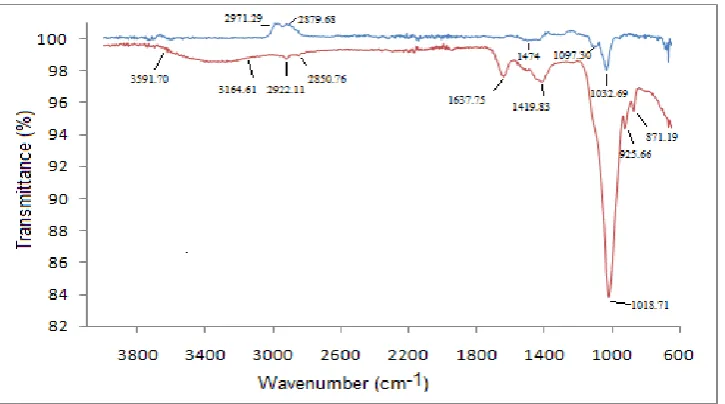
the range of 4000–600 cm-1 wavenumbers. The obtained vibrational frequency changes were used to enlighten the functional groups in the B. braunii biomass. The FTIR-ATR spectra of B. braunii biomass with and without UO22+ are shown in Figure 1 a,b.
The outer walls of the green alga B. braunii show a complex structure. It contains extraordinarily high hydrocarbon levels (15-75% of dry wt.) in structure. Light peaks observed at 2922 and 2850 cm-1 can be
interpreted as vibration peaks of the CH2 chain in the
green alga. Moreover, B. braunii contains fewer hydroxyl groups in the broadband between 3700-3100 cm-1 (Berkaloff et al., 1983; Toyoda, Gishi, & Ihara,
2011).
The observed wide absorption band at 3591– 3164 cm-1 can be used as an evidence for the formation
of intermolecular bonding of the hydroxyl groups on the uranium ions (Bellamy, 1975; Aslani, Yusan, Yenil, & Kuzu, 2012; Yusan, Yenil, Kuzu, & Aslani, 2011). The observed strong peaks at 1000 and 1100 cm-1 also confirmed the presence of carboxyl ion groups in the alga biosorbent (Gok, Turkozu, & Aytas, 2011). The peaks indicate the asymmetrical stretching band of the ionized carboxylate (COO−) groups at 1637-1419 cm -1.The spectra of vibration arising from the amino
groups is observed at around 1470 cm-1 (Socrates, 2004). The main distinguishing feature observed on the B. braunii biomass after the accumulation of UO22+ is the presence of additional peaks at 925 and 871 cm-1
(Figure 1b).
Experimental Design Results:
Model Selection and Statistical Evaluation
The different parameters such as pH (2, 3, 4, 5 and 6), initial uranium (VI) concentration (20, 40, 60, 80 and 100 mg/l), contact time (15, 50, 85, 120 and 155 min) and temperature (15, 30, 45, 60 and 75°C) were chosen as the critical variables and respectively designated as X1, X2, X3 and X4. The levels of each variable were respectively designated as -2, -1, 0, +1 and +2, and tabulated in Table 1. All the experiments were carried out in a random order by using different parameters and the low and high levels of the factors were selected according to some preliminary experiments.
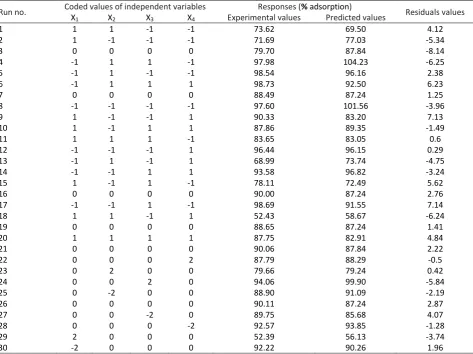
The dependence of yield on individual parameters as well as interactions for simultaneous variations of parameters was calculated from the regression equation developed from different sets of the experiment. The batch technique experimental results of uranium accumulation on the B. braunii biomass were tabulated in Table 2.
The variability of four dependent variables were explained by the multiple coefficients of determination, R2, and the model equation was used to predict the Figure 1. (a) The FTIR-ATR spectra of Botryococcus braunii biomass,(b)(UO2)+2 adsorbed on Botryococcus braunii biomass.
Table 1. Independent variables and their levels in the experimental design
Factors Factor
code
Level and range (coded)
-2 -1 0 +1 +2
pH X1 2 3 4 5 6
Initial concentration of uranium (VI) (mg/l) X2 20 40 60 80 100
Contact time (min) X3 15 50 85 120 155
optimum value and to subsequently elucidate the interaction between the factors within a specified range (Elibol & Ozer, 2002).
As a result of analysis of the experimental data quadratic model was reckoned appropriately to obtaine the suitable regression equation (Table 3). The value of R2 is close to 1.0 which has advocated a high correlation between the observed values and the predicted values. The presence of multiple R-value 0.93, regression is statistically significant, and only 7% of the total variable portion cannot be explained with this model.
The application of the RSM based on the estimates of the parameters indicated an empirical relationship between the input variables and response expressed by the following quadratic model Eq. (4):
UO22+ accumulation percentage = +87.84 – 8,53.X1
– 2.96.X2 + 3.56 X3 – 1.39 X4 – 3.66.X12 – 0.67 X22 + 1.24.X32 + 0.81.X42 – 0.53 X1X2 + 1.37 X1X3 + 2.90 X1X4 + 4.52.X2X3 – 4.25 X2X4 + 2.67 X3X4 (4)
Significance of each coefficient presented in Eq. (4) is determined by the p-values and F values (Montgomery, 2001). F-test for the significance level of data gave P<0.05 (<0.0001) with a model F value of 16.65 revealing that this regression is statistically significant. The results of the quadratic model for percentage accumulation in the form of analysis of variance (ANOVA) are given in Table 4.
The regression model provides an excellent explanation of the relationship between the independent variables (factors) and the response values (% bioaccumulation). The larger and smaller values of F and P are more significant for the Table 2. Experimental data points used in CCD statistical design and observed and predicted values for Uranium uptake capacity of Botryococcus braunii
Run no. Coded values of independent variables Responses (% adsorption) Residuals values
X1 X2 X3 X4 Experimental values Predicted values
1 1 1 -1 -1 73.62 69.50 4.12
2 1 -1 -1 -1 71.69 77.03 -5.34
3 0 0 0 0 79.70 87.84 -8.14
4 -1 1 1 -1 97.98 104.23 -6.25
5 -1 1 -1 -1 98.54 96.16 2.38
6 -1 1 1 1 98.73 92.50 6.23
7 0 0 0 0 88.49 87.24 1.25
8 -1 -1 -1 -1 97.60 101.56 -3.96
9 1 -1 -1 1 90.33 83.20 7.13
10 1 -1 1 1 87.86 89.35 -1.49
11 1 1 1 -1 83.65 83.05 0.6
12 -1 -1 -1 1 96.44 96.15 0.29
13 -1 1 -1 1 68.99 73.74 -4.75
14 -1 -1 1 1 93.58 96.82 -3.24
15 1 -1 1 -1 78.11 72.49 5.62
16 0 0 0 0 90.00 87.24 2.76
17 -1 -1 1 -1 98.69 91.55 7.14
18 1 1 -1 1 52.43 58.67 -6.24
19 0 0 0 0 88.65 87.24 1.41
20 1 1 1 1 87.75 82.91 4.84
21 0 0 0 0 90.06 87.84 2.22
22 0 0 0 2 87.79 88.29 -0.5
23 0 2 0 0 79.66 79.24 0.42
24 0 0 2 0 94.06 99.90 -5.84
25 0 -2 0 0 88.90 91.09 -2.19
26 0 0 0 0 90.11 87.24 2.87
27 0 0 -2 0 89.75 85.68 4.07
28 0 0 0 -2 92.57 93.85 -1.28
29 2 0 0 0 52.39 56.13 -3.74
30 -2 0 0 0 92.22 90.26 1.96
Table 3. Model Summary Statistics
Source Std. Dev. R2 Adjusted R2 Predicted R2 Multiple R
Linear 8.79 0.5446 0.4717 0.3003 0.7379
2FI 7.36 0.7568 0.6289 0.2820 0.8699
Quadratic 5.97 0.8740 0.7564 0.3580 0.9349 Suggested
Suggested
corresponding coefficient terms. The associated Prob. > F value for the model is lower than 0.05 indicating that the model is considered as statistically significant. The non-significant value of lack of fit (more than 0.05) showed that the quadratic model was valid for the present study. The lack-of-fit term is non-significant as it is desired (Hamsaveni, Prapulla, & Divakar, 2001). The results also suggest that the selected quadratic model were adequate in predicting the response variables for the experimental data.
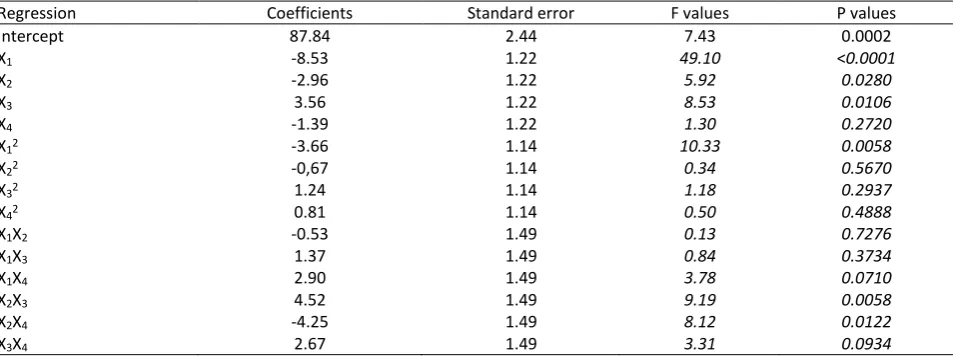
Statistical analysis of the main parameters effect, main parameters affect squares and interactions between them were performed, as well. The coefficients of independent variables F and P values according to the investigated parameters are given in Table 5.
The three-dimensional response surface plots, obtained as a function of two factors with maintaining all other factors constant, are used in evaluating both the main effects and the interaction effects of these two factors (Adinarayana & Ellaiah, 2002). The obtained interferences were an explained below.
Effects of Main Parameters on UO22+ Bioaccumulation
At the studies on the adsorption of metal ions, the solution pH is one of the most important factors. Based on the analysis of data obtained in this study, the
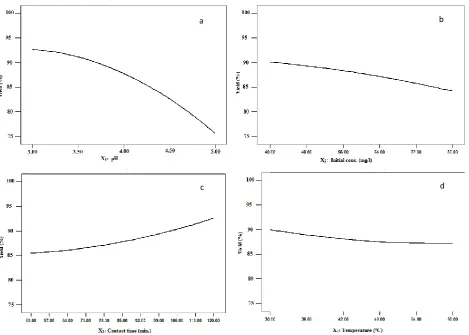
bioaccumulation of UO22+ onto the B. braunii biomass was investigated at varied pH values between 2 to 6. The pH parameter was found statistically significant (P = 0.0001, P<0.05). The negative coefficient value belonging to pH (X1= -8.53) indicates that the pH has a negative effect on bioaccumulation of UO22+ from aqueous solution. It means to decrease the uptake of uranyl from solution while increasing pH of the solution. Figure 2a illustrates the pH effect of UO22+ accumulation onto B. braunii provided that the other variables are constant.
The bioaccumulation of UO22+ on the B. braunii was determined at different initial uranium (VI) concentration values ranging from 20 mg/l to 100 mg/l. Initial uranium (VI) concentration was found statistically significant (P=0.0280, P<0.05). The negative value of coefficient (X2 = ˗2.96) belonging to initial U (VI) concentration represents that this parameter has a negative effect on the process. It means that increasing initial metal concentration of the solution decreases the bioaccumulation percentage of uranium from solution. According to Figure 2b, while initial uranium (VI) concentration increased, bioaccumulation percentage decreased.
Different contact time values ranging from 15 min. to 155 min. were also considered as another parameter which affect the process. The positive value of coefficient belonging to the contact time (X3= +3.56) Table 4. Analysisof variance (ANOVA) for a quadratic model for U(VI) adsorption on the Botryococcus braunii
Sources of squares variation Sum of
squares df Mean square F-Value Probability>
Model 4838.61 14 345.61 16.65 <0.0001 significant
Residual 290.68 14 20.76
Lack of Fit 271.72 10 27.17 5.73 0.0535 not significant
Pure error 18.96 4 4.74
Cor Total 5129.28 28
R2 = 0.9433, CV=5.81%, df= degree of freedom
Table 5. Estimated regressioncoefficient and corresponding F and P values
Regression Coefficients Standard error F values P values
Intercept 87.84 2.44 7.43 0.0002
X1 -8.53 1.22 49.10 <0.0001
X2 -2.96 1.22 5.92 0.0280
X3 3.56 1.22 8.53 0.0106
X4 -1.39 1.22 1.30 0.2720
X12 -3.66 1.14 10.33 0.0058
X22 -0,67 1.14 0.34 0.5670
X32 1.24 1.14 1.18 0.2937
X42 0.81 1.14 0.50 0.4888
X1X2 -0.53 1.49 0.13 0.7276
X1X3 1.37 1.49 0.84 0.3734
X1X4 2.90 1.49 3.78 0.0710
X2X3 4.52 1.49 9.19 0.0058
X2X4 -4.25 1.49 8.12 0.0122
X3X4 2.67 1.49 3.31 0.0934
indicates that the contact time has a positive effect on the process (Table 5). It means that the uptake of UO22+ increased while contact time was increased. Contact time was found statistically significant (P=0.0106, P<0.05) for this biomass. Figure 2c shows the contact time effect of UO22+ adsorption onto B. braunii with other variables being at fixed levels.
The bioaccumulation of UO22+ on the B. braunii was also determined at different process temperature values ranging from 15℃ to 75℃. According to Table 5, the negative value (X4= ˗ 1.39) of coefficient belongs to the media temperature indicates that the temperature has a negative effect on bioaccumulation of UO22+ from aqueous solution. It means that the uptake of UO22+ decreases while solution temperature increases. Process temperature was found statistically nonsignificant (P=0.2720, P>0.05). Figure 2d shows the effect of the process temperature with the other variables being at fixed levels.
Three-Dimensional Response Surface Plots
In order to understand the main and the interaction effects of each of the two factors, response surface plots as a function of two factors were used simultaneously, while maintaining all the other factors at their fixed levels. These plots can be obtained by calculating the regression model and the values taken
by one factor where the second varies with the constraint of a given uranyl ions (UO22+) bioaccumulation percentage value. The percentage values for different concentrations of the variables can also be predicted from the respective response surface plots (Figure 3). The maximum predicted yield was indicated by the surface confined in the response surface diagram.
The independent variable interactions are displayed in Figure 3 in three dimensions (3D) surface plots with other variables being at their fixed levels. A combined effect of initial uranium (VI) concentration (X2) and contact time (X3) was found statistically significant (P = 0.0058, P<0,05). Figure 3a shows the combined effect of two independent variables of initial uranium (VI) concentration (X2) and contact time (X3). The rate of UO22+ bioaccumulation showed to be significantly dependent on the initial uranium (VI) concentration and the contact time. It was observed that percentage metal ions removal increased with increasing initial concentration of uranium (VI). Figure 3a shows that the maximum uranyl removal was predicted at an initial uranium (VI) concentration of 55 mg/l and contact time 74 minutes. Beyond this range, there was a significant decrease in the uranyl removal due to a decrease in adsorptive capacity.
Figure 3b shows the interaction between contact time (X3) and temperature (X4). It was observed that Figure 2. Effect of investigated parameters on U(VI) adsorption onto Botryococcus Braunii. (a) Effect of a solution pH, (b) initial U(VI) concentration, (c) contact time and (d) temperature.
a b
uranyl ions removal percentage increased with decreasing contact time of uranium and temperature. A combined effect of contact time (X3) and temperature (X4) was found statistically significant (P=0.0122, P<0.05) for uranyl bioaccumulation on the B. braunii biomass. From the contour plot and 3D plot (Figure 3b), the maximum uranium removal was predicted at a contact time of 74 min and temperature of 46℃.
Figures 3 c-f shows interaction effects between another two factors. The interaction effects were found statistically nonsignificant (P>0.05) for uranyl
bioaccumulation by the B. braunii.
Optimal Conditions for Uranyl Uptake
Accumulation Isotherms
For characterization of the accumulation process, concerned data were calculated by using Langmuir and Freundlich isotherms. Langmuir model is a theoretical model for monolayer adsorption while the Freundlich model allows multilayer adsorption at heterogeneous surfaces. Dönmez and Aksu (2002) implied that the sorption of chromate onto the biomass was complex and may involve more than one mechanism based on Langmuir and Freundlich model data.
Four series of tests were conducted with UO22+ solutions varying the initial uranium (VI) concentration between 30 and 140 mg/l. The pH value (3.6), temperature (46°C) and contact time (74 min) were maintained at optimum conditions. The Langmuir equation, which has been successfully applied to many sorption experiments, is given by (6) :
𝐶𝑒
𝑞𝑒=
1
𝑏.𝑞𝑚+
𝐶𝑒
𝑞𝑚 (5)
where qe is the amount absorbed at equilibrium
(mg/g), Ce is the equilibrium concentration (mg/l), qm is
the Langmuir constants related to monolayer maximum capacity and b is the equilibrium constant of the adsorption (l/mg). The monolayer coverage of the sorption surfaces is modeled by Langmuir sorption isotherm. This model assumed that sorption occurs on a structurally homogeneous adsorbent and all the sorption sites are energetically identical (Unlu & Ersoz, 2006).
The Freundlich equation, which was applied for the sorption of U (VI), is given as,
qe=KF.Cen (6)
If equation (6) is rearranged, linear equation (7) can be obtained.
Log qe = log KF + n log Ce (7)
where Ce is the equilibrium concentration, qe is the amount of solute adsorbed per mass unit adsorbent and n and KF are the ion-exchange intensity and the Freundlich constants related to the adsorption capacity of the adsorbent, respectively. The values of n greater than 1 show favorable ion exchange of metal on biomass. The Freundlich expression is an empirical equation based on a heterogeneous surface (Kutahyali, Cetinkaya, Acar, Isik, & Cireli, 2012). The corresponding Freundlich and Langmuir parameters along with correlation coefficients are reported in Table 6.
The correlation coefficients (R2) indicate that the Langmuir model fits better than the Freundlich model for the UO22+ sorption onto B. braunii (Table 6). The Langmuir model has a much high value of R2 (0.96). The adsorption of UO22+ onto B. braunii biomass fully obeys the Langmuir isotherm. qm and b were also found to be 67.8 mg/g and 0.0125 l/mg, respectively.
Comparison with Other Alga Biosorbents
The theoretical biosorption capacity (qm) for adsorption of UO22+ on onto B. braunii biomass in the present work compared with the literature values reported for other biosorbents. The reported qm values for the adsorption of UO22+on Green alga Tetradesmus
olbliquus (Turpin) M.J.Wynne 34 (Xiaozhi, Shanggeng, Qun, Huaili, & Jinying, 1997), Scenedesmus sp. LX1 (Li, Hu, Yu, & Zhao, 2016), Brown alga Saccharina japonica (Lee et al., 2014), Sargassum fluitans (Børgesen) Børgesen (Yang & Volesky, 1999), Chlorella sp. (Horikoshi, Nakajima, & Sakaguchi, 1979), Chlamydomonas reinhardtii P.A. Dangeard (Acikgoz, Arica, Akbulut, & Bayramoglu, 2014), Sargassum sp. biomass (Yang & Volesky, 1999), Polycladia indica (Thivy & Doshi) Draisma, Ballesteros, F.Rousseau & T.Thibaut (Khani, Keshtkar, Ghannadi, & Pahlavanzadeh, 2008), Cystoserirasp. and (Gok, Aytas, & Sezer, 2017) were found to be 75mg/g, 40.7 mg/g, 96.4 mg/g, 560 mg/g, 15.6 mg/g, 192.3 mg/g, 0.701 mmol/g, 233 mg/g and 37 mg/g, respectively. It is worth underlining that B. braunii biomass can be used for the biosorption of UO22+ ions with its adsorption capacity (67.8 mg/g).
Thermodynamic Results
The values of sorption enthalpy (∆H) and entropy (∆S) were calculated from the slope and intercept of the linear van’t Hoff plot respectively, using the relation (8):
ln Kd= ∆S0
R −
∆H0
RT (8)
Where, ΔS° and ΔH° are the standard entropy and enthalpy change for the sorption, respectively. Negative ΔH° values for UO22+ sorption onto B. braunii biosorbent indicate that adsorption of U(VI) is exothermic and those results are given in Table 7.
The values of free energy of specific adsorption, ∆G, at various temperatures were calculated by using Eq. (9)
∆G0= ∆H0− T∆S0 (9)
temperature increased from 298 to 323 K. These values are higher than values related to chemisorption’s (–80 to –400 kJ mol–1), so the physisorption was dominated for uranyl-Botryococcus braunii biomass system. Physical adsorption is resulted mainly by Van der Waals forces and electrostatic forces between adsorbate molecules and atoms. As seen from Table 7, the above assertion about physisorption confirm with negative ∆H° value (–38.04 kJ.mol–1) emphasis that the process has exothermic nature. The negative ∆S° value (–70.83 J.mol–1.K–1) suggests a decrease in the randomness at the solid-solution interface during the sorption process (Aslani, Celik, Yusan, & Kutahyali Aslani, 2017).
Conclusions
Botryococcus branuii biomass was used for the bioaccumulation of uranyl ions. The affecting parameters were statistically analyzed using CCD as the experimental design method. The four independent variables such as initial pH, temperature, initial uranium (VI) concentration and contact time were selected for this study. This experimental design and statistical analysis provide a polynomial equation which can be used to predict adsorption values within the range of the independent variables and also to draw the response surface plots. The ANOVA of the obtained model was carried out at 95% confidence level and checked to the fitting of experimental and predicted values, as well. The values of the F and P related to the model were calculated as 16.65 and <0.0001 (<0.05), respectively. These results showed that this model is statistically significant. The correlation coefficient value (R2) to be obtained as 94% indicated that there is a high correlation between the predicted and the observed values. The main effects, main affects squares and the interactions between the main effects are statistically analyzed and their effects on the adsorption process are investigated. The influences of initial pH, contact time and initial U(VI) concentration on the adsorption process are considered statistically significant as main effects. On the other hand, interaction effects of initial uranium (VI) concentration and contact time, initial uranium (VI) concentration and temperature were
considered as significant parameters on the accumulation process. The optimum condition of accumulation process was found to be at initial pH 3.6, temperature 46oC, initial uranium (VI) concentration 55 mg/l and contact time 74 minutes. At this condition, uranyl accumulation yield was obtained as 89±2%.
In order to the characterization of the sorption process, concerned data were calculated by using Freundlich and Langmuir isotherms. The results indicated that the sorption of uranyl on B. braunii was described as Langmuir isotherm monolayer type. The correlation coefficients (R2) indicate that the Langmuir model fits better than the Freundlich model for the UO22+ sorption onto B. braunii. The Langmuir model has a much high value of R2 (0.96). The adsorption of UO
22+ onto B. braunii biomass fully obeys the Langmuir isotherm. qm and b were also found to be 67.8 mg/g and 0.0125 l/mg, respectively.
Thermodynamic parameters (ΔGo, ΔHo and ΔSo) showed the overall process is found to be physical, exothermic and spontaneous in nature. As a consequence B.braunii can be used as a potential biosorbent for purification of Uranium (VI) and may be used for the efficient removal of this toxic ion from aqueous solutions.
Acknowledgments
The authors wish to thank directory of Ege University, Institute of Nuclear Sciences, Bornova, Izmir, Turkey.
References
Acikgoz Erkaya, I., Arica, M.Y., Akbulut, A., & Bayramoglu, G. (2014). Biosorption of uranium (VI) by free and entrapped Chlamydomonas reinhardtii: kinetic, equilibrium and thermodynamic studies. Journal of Radioanalytical and Nuclear Chemistry, 299,1993–2003. http://dx.doi.org/10.1007/s10967-014-2964-x
Adinarayana, K., & Ellaiah, P. (2002). Response surface optimization of the critical medium components for the production of alkaline protease by a newly isolated
Bacillus sp. Journal of Pharmacy and Pharmaceutical Sciences, 5(3), 272-278.
Table 6. Sorption isotherm constants for the sorption of uranium onto Botryococcus braunii biomass
Freundlich Langmuir
R2 n (l/mg) KF (mg/g) R 2 qm (mg/g) b (l/mg)
Botryococcus braunii 0.61 3.6 114.5 0.96 67.8 0.0125
Table 7. Thermodynamic parameters for UO22+sorption onto Botryococcus braunii biomass
ΔH°(kJ/mol) ΔS°(j/mol.K) ΔG° (kj/mol)
298K 303K 308K 313K 323K
Arslan, G., & Pehlivan, E. (2007). Batch removal of chromium(VI) from aqueous solution by Turkish brown coals. Bioresource Technology, 98(15), 2836-2845. http://dx.doi.org/10.1016/j.biortech.2006.09.041 Aslani, M.A.A., Yusan, S., Yenil, N., & Kuzu, S. (2012). Sorption
profile of uranium (VI) from aqueous medium onto 3-O- acetyl-(S)-1,2-O-trichloroethylidene-5,6,8-trideoxy-alpha-D-xylo-oct-5(E)-eno-1,4-furano-7-ulose
(OASOTCETDOXDXOEEFU). Chemical Engineering Journal,200, 391-398.
http://dx.doi.org/10.1016/j.cej.2012.06.072
Aslani, M.A.A., Celik, F., Yusan, S., & Kutahyali Aslani, C. (2017). An Assessment of the Adsorption of Thorium onto Styrene-divinylbenzen Based Resin: Optimization using Central Composite Design and Thermodynamic parameters. Process Safety and Environment Protection. 109, 192-202.
http://dx.doi.org/10.1016/j.psep.2017.02.019
Aytas, S., Gunduz, E., & Gok, C. (2014). Biosorption of Uranium Ions by Marine Macroalga Padina pavonia.
Clean-Soil Air Water,42(4), 498-506. http://dx.doi.org/10.1002/clen.201300019
Bai, J., Li, Z., Fan, F., Wu, X., Tian, W., Yin, X., Zhao, L., ... Guo, J. (2014). Biosorption of uranium by immobilized cells of Rhodotorula glutinis. Journal of Radioanalytical and Nuclear Chemistry,299, 1517.
https://doi.org/10.1007/s10967-013-2900-5
Bellamy, L.J. (1975). The infra-red spectra of complex molecules Vol.1 (3rd ed.). New York, Halsted Press, a division of John Wiley & Sons, Inc., 433 pp.
Benemann, J.R. (1997). CO2 mitigation with microalgae systems. Energy Conversion and Management,38, 475-479. http://dx.doi.org/10.1016/S0196-8904(96)00313-5 Berkaloff, C., Casadevall, E., Largeau, C., Metzger, P., Peracca, S., & Virlet, J. (1983). Hydrocarbon Formation in the Green-Alga Botryococcus-Braunii. 3. The Resistant Polymer of the Walls of the Hydrocarbon-Rich Alga
Botryococcus-Braunii. Phytochemistry, 22(2), 389-397. http://dx.doi.org/ 10.1016/0031-9422(83)83010-6 Bhat, S.V., Melo, J.S., Chaugule, B.B., & D'Souza, S.F. (2008).
Biosorption characteristics of uranium (VI) from aqueous medium onto Catenella repens, a red alga.
Journal of Hazardous Materials,158(2-3), 628-635. http://dx.doi.org/10.1016/j.jhazmat.2008.02.042 Brinza, L., Nygard, C.A., Dring, M.J., Gavrilescu, M., &
Benning, L.G. (2009). Cadmium tolerance and adsorption by the marine brown alga Fucus vesiculosus
from the Irish Sea and the Bothnian Sea. Bioresource Technology, 100(5), 1727-1733. http://dx.doi.org/10.1016/j.biortech.2008.09.041 Cakir, P., Inan, S., & Altas, Y. (2014). Investigation of
strontium and uranium sorption onto zirconium-antimony oxide/polyacrylonitrile (Zr-Sb oxide/PAN) composite using experimental design. Journal of Hazardous Materials, 2014 Apr 30;271:108-19. http://dx.doi.org/ 10.1016/j.jhazmat.2014.02.014 Chen, Q. (2010). Study on the adsorption of lanthanum(III)
from aqueous solution by bamboo charcoal. Journal of Rare Earths,28, 125-131.
http://dx.doi.org/10.1016/S1002-0721(10)60272-4 Dönmez, G., & Aksu Z. (2002). Removal of chromium (VI)
from saline wastewaters by Dunaliella species. Process Biochemisty, 38, 751–762.
http://dx.doi.org/10.1016/S0032-9592(02)00204-2 Elibol, M., & Ozer, D. (2002). Response surface analysis of
lipase production by freely suspended Rhizopus arrhizus. Process Biochemistry, 38(3), 367-372.
http://dx.doi.org/10.1016/S0032-9592(02)00076-6 Ghasemi, M., Keshtkar, A.R., Dabbagh, R., & Jaber Safdari, S.
(2011). Biosorption of uranium (VI) from aqueous solutions by Ca-pretreated Cystoseira indica alga: breakthrough curves studies and modeling. Journal of Hazardous Materials, 189(1-2), 141-149.
http://dx.doi.org/10.1016/j.jhazmat.2011.02.011 Gok, C., Turkozu, D.A., & Aytas, S. (2011). Removal of Th(IV)
ions from aqueous solution using bi-functionalized algae-yeast biosorbent. Journal of Radioanalytical and Nuclear Chemistry, 287(2), 533-541.
http://dx.doi.org/10.1007/s10967-010-0788-x
Gok, C., Aytas, S., & Sezer, H. (2017) Modeling uranium biosorption by Cystoseira sp. and application studies,
Separation Science and Technology, 52:5, 792-803. http://dx.doi.org/10.1080/01496395.2016.1267212 Guiry, M.D.,& Guiry, G.M. (2018). AlgaeBase. World-wide
electronic publication, National University of Ireland, Galway. Retrieved from http://www.algaebase.org; searched on 16 March 2018.
Gunatilake, S.K., (2015). Methods of Removing Heavy Metals from Industrial Wastewater, Journal of Multidisciplinary Engineering Science Studies,1(1), 12-18.
Hamsaveni, D.R., Prapulla, S.G., & Divakar, S. (2001). Response surface methodological approach for the synthesis of isobutyl isobutyrate. Process Biochemistry, 36(11), 1103-1109.
http://dx.doi.org/ 10.1016/S0032-9592(01)00142-X Horikoshi, T., Nakajima, A., & Sakaguchi, T. (1979). Uptake of
uranium by various cell fractions of Chlorella regularis.
Radioisotopes. 1979 Aug;28(8):485-8. PMID: 542634 Khani, M.H., Keshtkar, A.R. Ghannadi, M., & Pahlavanzadeh,
H. (2008). Equilibrium, kinetic and thermodynamic study of the biosorption of uranium onto Cystoseria indica algae. Journal of Hazardous Materials. Volume
150, Issue 3, 11 February 2008, Pages 612-618. https://doi.org/10.1016/j.jhazmat.2007.05.010 Kutahyali, C., Cetinkaya, B., Acar, M. B., Isik, N.O., & Cireli, I.
(2012). Investigation of strontium sorption onto Kula volcanics using Central Composite Design. Journal of Hazardous Materials, 201-202, 115-124.
http://dx.doi.org/10.1016/j.jhazmat.2011.11.047 Lee, S.J., Yoon, B.D., & Oh, H.M. (1998). Rapid method for the
determination of lipid from the green alga Botryococcus braunii. Biotechnology Techniques, 12(7), 553-556. http://dx.doi.org/ 10.1023/A:1008811716448
Lee, K.L., Kim, K.W., Baek, Y.J., Chung, D.Y., Lee, E.H., Lee, S.Y.,& Moon, J.K. (2014). Biosorption of Uranium (VI) from of aqueous solution by biomass of brown algae
Laminaria Japanica. Water Science & Technology,
70(1):136-143. http://dx.doi.org/
10.2166/wst.2014.205
Li, X., Hu, H.Y., Yu, J.Y., & Zhao W.Y. (2016). Selection of Suitable Microalgal Species for Sorption of Uranium in Radioactive Wastewater Treatment. Huan Jing Ke Xue. 2016 May 15;37(5):1858-63. Chinese. PubMed PMID: 27506041.
Manikandan, N., Prasath, C.S.S., & Prakash, S. (2011). Biosorption of uranium and thorium by Marine micro algae. Indian Journal of Geo-Marine Sciences, 40(1), 121-124.
Microalga Botryococcus braunii. Chemical Structure and Biosynthesis. Geochemical and Biotechnological Importance. Progress in the Chemistry of Organic Natural Products (pp. 1-70): Springer Vienna., 212 pp. http://dx.doi.org/10.1007/978-3-7091-9119-4
Miao, X., & Wu, Q. (2006). Biodiesel production from heterotrophic microalgal oil. Bioresource Technology, 97(6), 841-846.
http://dx.doi.org/10.1016/j.biortech.2005.04.008 Montgomery, D.C. (2001). Design and Analysis of Experiments
(5th Edition ed.). New York, John Wiley and Sons, 684 pp.
Morcillo, F., Gonzalez-Munoz, M.T., Reitz, T., Romero-Gonzalez, M.E., Arias, J.M., & Merroun, M.L. (2014). Biosorption and Biomineralization of U(VI) by the marine bacterium Idiomarina loihiensis MAH1: effect of background electrolyte and pH. Plos One, 9(3), e91305. http://dx.doi.org/10.1371/journal.pone.0091305 Myers, R.H., Montgomery, D.C., & Anderson-Cook, C.M.
(2009). Response Surface Methodology: Process and Product Optimization Using Designed Experiments (3rd Edition ed.). New Jersey: John Wiley & Sons., 816 pp. Niazi, A., Ghasemi, N., Goodarzi, M., & Ebadi, A. (2007).
Simultaneous spectrophotometric determination of uranium and thorium using arsenazo III by H-point standard addition method and partial least squares regression. Journal of the Chinese Chemical Society, 54(2), 411-418.
https://dx.doi.org/10.1002/jccs.200700058
Omar, N.B., Merroun, M.L., Gonzalez Munoz, M.T., & Arias, J.M. (1996). Brewery yeast as a biosorbent for uranium.
Journal of Applied Bacteriology, 81(3), 283-287. http://dx.doi.org/ 10.1111/j.1365-2672.1996.tb04330.x Orpez, R., Martinez, M. E., Hodaifa, G., El Yousfi, F., Jbari, N.,
& Sanchez, S. (2009). Growth of the microalga
Botryococcus braunii in secondarily treated sewage.
Desalination, 246(1-3), 625-630.
http://dx.doi.org/10.1016/j.desal.2008.07.016
Pang, C., Liu, Y.H., Cao, X.H., Li, M., Huang, G.L., Hua, R., . . . An, X.F. (2011). Biosorption of uranium (VI) from aqueous solution by dead fungal biomass of Penicillium citrinum. Chemical Engineering Journal, 170(1), 1-6. http://dx.doi.org/10.1016/j.cej.2010.10.068
Sana, S., Roostaazad, R., & Yagmaei, S., (2014). Biosorption of Uranium from Aqueous Solution by Live and Dead
Asprgillus niger. Journal of Hazardous Toxic, and Radioactive Waste, v.18 (3).
http://dx.doi.org/10.1061/(ASCE)HZ.2153-5515.0000220
Sert, S., & Eral, M. (2010). Uranium adsorption studies on aminopropyl modified mesoporous sorbent
(NH2-MCM-41) using statistical design method. Journal of Nuclear Materials, 406(3), 285-292.
http://dx.doi.org/10.1016/j.jnucmat.2010.08.024 Sheng, L., & Fein, J.B. (2013). Uranium adsorption by
Shewanella oneidensis MR-1 as a function of dissolved inorganic carbon concentration. Chemical Geology, 358, 15-22.
http://dx.doi.org/10.1016/j.chemgeo.2013.08.039 Socrates, G. (2004). Infrared and Raman characteristic group
frequencies. Tables and charts. (Third Edition), John Wiley and Sons Ltd, Chichester, 342 pp.
Spolaore, P., Joannis-Cassan, C., Duran, E., & Isambert, A. (2006). Commercial applications of microalgae. Journal of Bioscience and Bioengineering, 101(2), 87-96. http://dx.doi.org/10.1263/jbb.101.87
Toyoda, K., Gishi, M., & Ihara, I. (2011). Effect of Light Quality and Nutrients on Growth of Hydrocarbon-Rich Microalgae, Botryococcus braunii. VI. International Symposium on Light in Horticulture, 907, 255-258. https://dx.doi.org/10.17660/ActaHortic.2011.907.40 Unlu, N., & Ersoz, M. (2006). Adsorption characteristics of
heavy metal ions onto a low cost biopolymeric sorbent from aqueous solutions. Journal of Hazardous Materials, 136(2), 272-280.
http://dx.doi.org/10.1016/j.jhazmat.2005.12.013 Wisser, S., & Hartkopf, J. (2006). Natural and Artificial
Radioactivity in the Rhine and Its Tributaries. In T. P. Knepper (Ed.), The Handbook of Environmental Chemistry, Vol. 5, Deutschland: Springer Science, pp. 255-306.
Xiaozhi, Z., Shanggeng, L. Qun, Y. Huaili, Z., & Jinying, L. (1997). Accumulation of uranium at low concentration by the green alga scenedesmus obliquus 34. Journal of Applied Phycology, 9, 65-71.
http://dx.doi.org/10.1023/A:1007911119029
Yang, J. B., & Volesky, B. (1999). Biosorption of uranium on
Sargassum biomass. Water Research, 33(15), 3357-3363.
http://dx.doi.org/ 10.1016/S0043-1354(99)00043-3 Yusan, S., Yenil, N., Kuzu, S., & Aslani, M.A.A. (2011).
Properties of Uranium (VI) Adsorption by Methyl 3-O-Acetyl-5, 6-dideoxy-(S)-1,2-trichloroethylidene-alpha-D-xylo-hept-5(E)-eno-1, 4-furano-uronate. Journal of Chemical and Engineering Data, 56(5), 2013-2019. http://dx.doi.org/10.1021/je101030r