ISSN (Print) : 2320 – 3765 ISSN (Online): 2278 – 8875
I
nternational
J
ournal of
A
dvanced
R
esearch in
E
lectrical,
E
lectronics and
I
nstrumentation
E
ngineering
(A High Impact Factor, Monthly, Peer Reviewed Journal)
Website: www.ijareeie.com
Vol. 6, Issue 11, November 2017
An Efficient Scheme for Inter Carrier Interference
Cancellation in High Speed OFDM System
Ch.Sundeer Kumar1, S.Vinay Kumar2, Mohammad Javeed3
Assistant Professor, Dept. of ECE, Mahaveer Institute of Science and Technology, Hyderabad, Telangana, India1
Assistant Professor, Dept. of ECE, Sree Dattha Group of Institutions, Hyderabad, Telangana, India2
Assistant Professor, Dept. of ECE, Sree Dattha Institute of Engineering and Science, Hyderabad, Telangana, India3
ASTRACT: We have proposed an optimal and sub-optimal scheme for SSR ICI cancellation scheme to improve the CIR performance. The scheme is based on SSR ICI self cancellation scheme, in which a data is modulated at two symmetrically placed subcarriers i.e. and N-1- and utilizes a data allocation of (1,- ) to improve CIR performance. To further reduce the effect of ICI, received modulated data signal at and N-1- subcarriers are combined with weights 1 and - . The and ξ are the optimal values resulting in maximum CIR. The optimum values
of and ξ are the function of normalized frequency offset i.e. for every normalized frequency offset; there exist a
unique value of and ξ. This process requires continuous CFO estimation. To overcome this problem, we have proposed a suboptimal approach to find suboptimal values. The obtained sub-optimal values are independent of normalized frequency offset. Thus, the proposed scheme does not require any CFO estimation or feedback circuitry and hence eliminates the requirement of complex hardware circuitry.
KEY WORDS: OFDM, Inter Carrier Interference, Bit Error Rate, CIR.
I. INTRODUCTION
ISSN (Print) : 2320 – 3765 ISSN (Online): 2278 – 8875
I
nternational
J
ournal of
A
dvanced
R
esearch in
E
lectrical,
E
lectronics and
I
nstrumentation
E
ngineering
(A High Impact Factor, Monthly, Peer Reviewed Journal)
Website: www.ijareeie.com
Vol. 6, Issue 11, November 2017
frequency offset. Thus for every normalized frequency offset, a unique value of µ is to be multiplied with the data which again requires CFO estimation and feedback circuitry. A symmetric symbol repeat ICI self cancellation scheme, which utilizes data allocation and combining of (1,-1) at and N-1- subcarrier. This scheme shows better CIR performance than ICI self cancellation scheme. One of the major advantages of this scheme is to achieve the frequency diversity and hence its performance in frequency selective fading channel found to be better than ICI self cancellation scheme. The coding and numerical methods have discussed in [8]. Analysis of OFDM in the Presence of Frequency Offset and a Method to Reduce Performance Degradation discussed in [6].
In this paper, we have proposed an optimum data allocation scheme for SSR ICI cancellation scheme to improve the CIR performance. The scheme is based on SSR ICI self cancellation scheme, in which a data is modulated at two symmetrically placed subcarriers i.e. and N-1- and utilizes a data allocation of (1,- ) to improve CIR
performance. To further reduce the effect of ICI, received modulated data signal at and N-1- subcarriers are combined with weights 1 and -µ. The and µ are the optimal values resulting in maximum CIR. The optimum values of and µ are the function of normalized frequency offset i.e. for every normalized frequency offset; there exist a unique value of and µ. This process requires continuous CFO estimation. To overcome this problem, we have proposed a suboptimal approach to find suboptimal values The obtained sub-optimal values are independent of normalized frequency offset. Thus, the proposed scheme does not require any CFO estimation or feedback circuitry and hence eliminates the requirement of complex the hardware circuitry. Multi spectrum spread analysis have been clearly discussed in [9]. About the signal encryption in CDMA has shown clearly in [10].
II.METHODOLOGY
A. OFDM System
The discrete time OFDM symbol at the transmitter can be expressed as
(1)
Where N is total numbers of subcarriers and X (k) denotes the modulated data symbol transmitted on subcarrier. Due to AWGN channel and frequency offset, the received OFDM signal can be written as
(2)
Where is the normalized frequency offset and is the sample of additive white Gaussian noise. The received
data signal on subcarrier can be written as
(3)
Where is the sample of DFT of additive noise. The sequence is defined as the ICI coefficient
between and subcarriers, which can be expressed as
ISSN (Print) : 2320 – 3765 ISSN (Online): 2278 – 8875
I
nternational
J
ournal of
A
dvanced
R
esearch in
E
lectrical,
E
lectronics and
I
nstrumentation
E
ngineering
(A High Impact Factor, Monthly, Peer Reviewed Journal)
Website: www.ijareeie.com
Vol. 6, Issue 11, November 2017
The CIR at the subcarrier can be written as
(5)
B. SSR ICI Self Cancellation Scheme
In SSR ICI self cancellation scheme [6], the data symbol to be transmitted at the subcarrier is repeated at
the subcarrier with opposite polarity, i.e.,
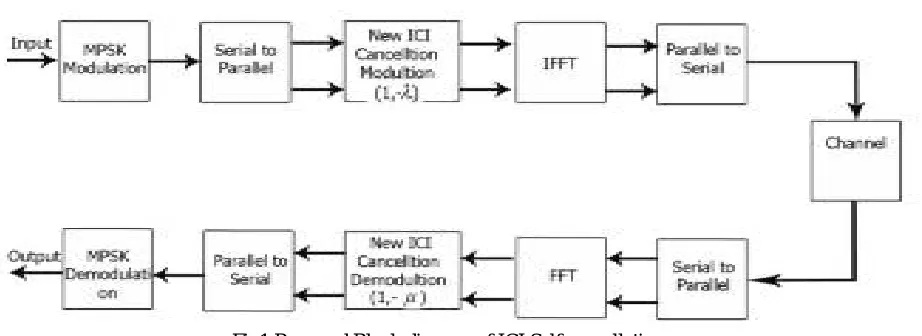
The block diagram of the proposed SSR ICI self cancellation scheme is depicted in Fig1. The received data signal at the subcarrier is thus given by
(6)
Combining the received data at and subcarriers, we have
(7)
Using (6) & (7) we have
(8)
Thus, CIR of conventional SSR ICI self cancellation scheme can be written as
(9)
III.PROPOSED SYSTEM
In the proposed scheme at the transmitter a data allocation (1,- ) is utilized at and subcarriers .i.e.
ISSN (Print) : 2320 – 3765 ISSN (Online): 2278 – 8875
I
nternational
J
ournal of
A
dvanced
R
esearch in
E
lectrical,
E
lectronics and
I
nstrumentation
E
ngineering
(A High Impact Factor, Monthly, Peer Reviewed Journal)
Website: www.ijareeie.com
Vol. 6, Issue 11, November 2017
After Combining the received data at and subcarriers with weight 1 and -µ, we have
(11)
(12)
Thus, CIR of proposed optimal SSR ICI self cancellation scheme is given by
(13)
The optimal values of and µ have been found by using an optimization technique known as Nelder Mead Simplex Algorithm. The optimum values of and µ are calculated for at a very small interval of which
results in maximum CIR for the given . Thus for every , we have a unique optimal value of and and µ these are
denoted by . The optimum values are to be used for data allocation and combining the data at
and subcarriers to maximize the CIR of the OFDM system. But, this will require a continuous CFO estimation.
(14)
Here, corresponds to maximum value of CIR for and so on and
(15)
Where, are the lowest and the highest possible values of the normalized frequency offset. Here, we have
considered and . To avoid the problem of continuous estimation, sub-optimal pair
amongst all has been found by using the following criterion as
(16)
ISSN (Print) : 2320 – 3765 ISSN (Online): 2278 – 8875
I
nternational
J
ournal of
A
dvanced
R
esearch in
E
lectrical,
E
lectronics and
I
nstrumentation
E
ngineering
(A High Impact Factor, Monthly, Peer Reviewed Journal)
Website: www.ijareeie.com
Vol. 6, Issue 11, November 2017
Fig1 Proposed Block diagram of ICI Self cancellation
IV.RESULTS
ISSN (Print) : 2320 – 3765 ISSN (Online): 2278 – 8875
I
nternational
J
ournal of
A
dvanced
R
esearch in
E
lectrical,
E
lectronics and
I
nstrumentation
E
ngineering
(A High Impact Factor, Monthly, Peer Reviewed Journal)
Website: www.ijareeie.com
Vol. 6, Issue 11, November 2017
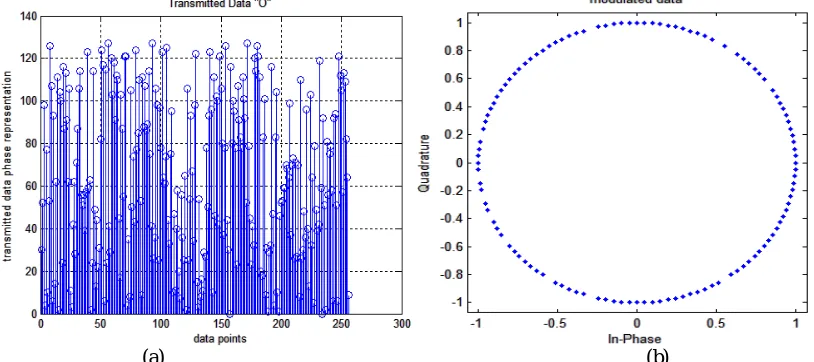
Fig3 (a) and (b) shows that the transmitted data and modulated data with 128 subcarriers and 128-PSK. The performance of the proposed scheme with higher modulation levels has shown in fig4 and fig5. We tested it with 128-QAM and N=128 subcarriers and we got the CIR of 63.9932 dB, which is an improved performance than the fig2 results.
(a) (b)
Fig. 3 (a) Data of Transmitter (b) modulated data
Fig. 4 CIR Performance with N=128 and 128-QAM Fig.5 BER performance with 128-QAM and N=128
ISSN (Print) : 2320 – 3765 ISSN (Online): 2278 – 8875
I
nternational
J
ournal of
A
dvanced
R
esearch in
E
lectrical,
E
lectronics and
I
nstrumentation
E
ngineering
(A High Impact Factor, Monthly, Peer Reviewed Journal)
Website: www.ijareeie.com
Vol. 6, Issue 11, November 2017
The modulated output of 128-QAM in presence of AWGN is shown in fig6 and it has got the CIR which is shown in fig4. Further CIR improvement can be achieved by using Rayleigh distribution instead of AWGN. Fig7 shows the performance of the proposed scheme in presence of Rayleigh channel distribution with 128-PSK and 256 subcarriers. We can see that the proposed scheme has got maximum CIR of 71.325with the Rayleigh distribution. Fig7 shows the transmitted data with 256 subcarriers and modulated data with 128-PSK and the fig10 shows the comparison between the conventional schemes with AWGN and with Rayleigh. It can be observed that while increasing in the frequency offset still the CIR performance stable with the proposed Rayleigh approach and has maximum CIR of 51dB. It’s much higher than the other conventional ICI reduction techniques [3-8]. Fig10 shows the performance of Rician, which has got almost equal results as Rayleigh channel.
(a) (b)
Fig. 7 (a) Transmitted Data of N=256 and (b) modulated data with 128-PSK
ISSN (Print) : 2320 – 3765 ISSN (Online): 2278 – 8875
I
nternational
J
ournal of
A
dvanced
R
esearch in
E
lectrical,
E
lectronics and
I
nstrumentation
E
ngineering
(A High Impact Factor, Monthly, Peer Reviewed Journal)
Website: www.ijareeie.com
Vol. 6, Issue 11, November 2017
Table I Simulation parameters
Parameters Specifications FFT & IFFT size 8
No. of Subcarriers 64, 128 and 256
Cyclic prefix 1
Channel model AWGN, Rayleigh and Rician
Modulation scheme QAM, QPSK
Constellation points
4, 8,16, 32, … and 128
OFDM block size 8
V.CONCLUSION
The proposed scheme very well improves the CIR performance of the OFDM system without increasing hardware complexity. The proposed sub optimal scheme completely removes the requirement of CFO estimation. However, the proposed scheme is slightly less efficient than conventional SSR ICI self cancellation in terms of BER.
REFERENCES
[1]. Y.Wu and W. Y. Zou, “Orthogonal frequency division multiplexing: A multicarrier modualtion scheme”, IEEE Transaction on Consumer Electronics, vol. 41, no. 3,pp 392-399, Aug. 1995.
[2]. P.H.Moose, “A Technique for orthogonal frequency division multiple xing frequency offset correction,’’IEEE Trans. Commun., vol.42, pp 2908-2914, Oct. 1994.
[3]. Y. Zhao and S.G. Haggman, “Intercarrier Interference Self-Cancellation Scheme for OFDM Mobile Communication Systems ’’,IEEE Trans.Commun., vol. 49, no. 7, pp. 1185-1191, Jul. 2001.
[4]. H.-G. Yeh, Y.-K. Chang, and B. Hassibi, “A scheme for cancelling intercarrier interference using conjugate transmission in multicarrier communication systems," IEEE Trans. Wireless Communication., vol. 6, no. 1, pp. 3-7, Jan. 2007.
[5]. Chin-Liang Wang and Yu-Chih Huang, “Inter carrier Interference Cancellation Using General Phase Rotated Conjugate Transmission for OFDM Systems” IEEE Transactions on Communications, vol. 58, no. 3, pp. 812-819, March 2010.
[6]. K.Sathanantham , R.M.A.P.Rajatheva and Slimane Ben Slimane “Analysis of OFDM in the Presence of Frequency Offset and a Method to Reduce Performance Degradation” Global Telecommunications Conference, 2000. GLOBECOM '00. IEEE,vol. 1,pp. 72-76, 2000.
[7]. Yu Fu and Chi Chung Ko, “A New ICI Self –Cancellation Scheme for OFDM Systems based on a Generalized Signal Mapper”, 5th International Symposium on Wireless Personal Multimedia Communications, vol. 3, pp. 995-999, Oct. 2002.
[8]. J. H. Mathews, K. K. Fink, Numerical Methods using Matlab, 4th edition, Prentice-Hall Inc. , 2004
[9]. Olanrewaju B. Wojuola, Stanley H. Mneney, “Performance of even- and odd-degree Gold codes in a multi-user spread-spectrum system” Wireless Communications, Vehicular Technology, Information Theory and Aerospace & Electronic Systems (VITAE), 2014 4th International Conference, 23 October 2014.