Turkish Journal of Fisheries and Aquatic Sciences 14: 817-824 (2014)
www.trjfas.org ISSN 1303-2712 DOI: 10.4194/1303-2712-v14_3_24
© Published by Central Fisheries Research Institute (CFRI) Trabzon, Turkey in cooperation with Japan International Cooperation Agency (JICA), Japan
Early Morphological Development and Allometric Growth Patterns in
Hatchery-Reared Red Porgy (
Pagrus pagrus
)
Introduction
Efficient production of high quality fry is one of the most important requirements for aquaculture expansion and to obtain independence from wild populations to produce healthy and high quality fish stocks (Lahnsteiner and Patarnello 2003). The red porgy, Pagrus pagrus, is one of the most attractive
candidate species for diversification of aquaculture (Mihelakakis et al. 2001; Conides and Glamuzina, 2001; Suzer et al. 2007). It is a species intensively farmed in the Mediterranean (Basurco and Abellan 1999) and has been targeted because of its fast growth under intensive farming conditions (Divanach et al.
1993; Stephanou et al. 1995; Kentouri et al. 1995). As described by Koumoundouros et al. (1999),
Şükrü Yıldırım
1,*, Deniz Çoban
2, Cüneyt Suzer
1, Birsen Kırım
2, Kürşat Fırat
1, Şahin Saka
11
Ege University, Faculty of Fisheries, Aquaculture Department, Bornova, Izmir, Turkey. 2
Adnan Menderes Univerity, Faculty of Agriculture, Fisheries and Aquaculture Engineering Department, Aydın, Turkey.
* Corresponding Author: Tel.: +90.232 3115214; Fax: +90.232 3883685 E-mail: [email protected]
Received 18 April 2014 Accepted 30 September 2014
Abstract
Morphological development and allometric growth were investigated in the red porgy, Pagrus pagrus, during larval development until the end of weaning at 46 days after hatching (DAH). Total length (TL) of newly hatched larvae was 2.77±0.09 mm (mean±SE). Onset of exogenous feeding occurred at 4 DAH (3.74±0.13 mm TL). Initial swimbladder inflation occured at 10 DAH (4.22±0.18 mm TL) and post-inflation became more elongate at 16 DAH (4.95±0.26 mm TL). Notochord flexion occurred between 22 DAH (5.56±0.43 mm TL) and 34 DAH (8.22±0.63 mm TL). At the end of the weaning at 46 DAH, TL of larvae was 15.81±1.36 mm. According to individual measurements of a total of 1026 larvae of 18 body parameters for allometric growth, in 19 of 35 respective regression equations, the allometry coefficients were positive, while coefficients of 7 equations showed negative allometry. The majority of all allometric changes from inflection point were expressed during the larval stage and were integrated with the metamorphosis stage. Inflections in body proportion changes occurred mainly at TL values of 3.74, 4.22 and 5.56 mm, coinciding with mouth opening, initial swimbladder inflation and flexion of notochord, respectively.
Keywords: Red porgy, Pagrus pagrus, early development, allometry
Kültürü Yapılan Fangrilerde (Pagrus pagrus) Erken Dönem Morfolojik Gelişim ve Allometrik Büyüme Modelleri
Özet
Bu çalışmada, kültürü yapılan fangrilerde Pagrus pagrus larval dönem boyunca toz yem girişinin sona erdiği 46. güne kadar erken dönem morfolojik gelişim ve allometrik büyüme modelleri incelenmiştir. Yumurtadan yeni çıkan larvalarda total boy (TB) 2,77±0,09 mm (ort±SH) olarak ölçülmüştür. İlk hava kesesi şişmesi 10. günde (4,22±0,18 mm TB) meydana gelmiş ve kesede uzama şişme sonrası 16. günde (4,95±0,26 mm TB) tespit edilmiştir. Notokorda bükülmesi 22. gün (5,56±0,43 mm TB) ile 34. günler (8,22±0,63 mm TB) arasında izlenmiş ve toz yem giriş periyodunun sonu olan 46. günde larvalarda total boy 15,81±1,36 mm ulaşmıştır. Allometrik büyüme için toplam 1026 larvada 18 vücıt parametresi incelenmiş, 35 adet regresyon eşitliğinden 19 adedinde allometri katsayısı pozitif tespit edilirken 7 adet eşitlikte ise negatif allometri belirlenmiştir. Regresyon grafiklerindeki kırılma noktalarındaki allometrik değişimlerin büyük çoğunluğu larval dönemde meydana gelmiş ve metamorfoz dönemi ile ilişkili bulunmuştur. Vücut bölümlerine bağlı olarak regresyon grafiklerindeki kırılmalar 3,74, 4,22 ve 5,56 mm TB değerlerinde olmuş, sırasıyla ağız açılımı, ilk hava kesesi şişmesi ve notokorda bükülmesi ile eş zamanlı olarak tespit edilmiştir.
818
ontogeny is a complex process of growth and differentiation during which larvae undergo extreme changes in body shape, morphology, metabolism and behavior in order to transform into juveniles. The change of body shape, which results from the growth of its components at different relative rates (allometry), reflects the close relationship between ontogeny of morphology and functions (Fuiman 1983; Kendall et al. 1984; Koumoundouros et al. 1999; Çoban et al., 2009b). At hatching, most functional systems of fish are incomplete and morphogenesis and differentiation are very intense during early life stages of development (Gisbert 1999). Consequently, important quantitative morphometric changes take place and are responsible for a progressive transformation of recently hatched specimens from a larval body shape to a juvenile or adult form in a relatively short time, suggesting that growth functionally optimized for survival is a common feature among teleost fish larvae (Osse et al. 1995).
In the last decade, numerous studies have been carried out on red porgy reproduction and physiology (Kokokiris et al. 1999; Hood and Johnson 2000), larval rearing (Hernandez-Cruz et al. 1999; Roo et al., 1999; Machinandiarena et al. 2003), feeding (Papandroulakis et al. 2004), osteological development (Çoban et al., 2009a) and digestive enzyme activities (Darias et al. 2006; Suzer et al.
2007). In contrast, literature regarding the early life history of larval red porgy reared in intensive culture conditions is scarce, either fragmentary or related to the internal morphology of a few individuals caught in the wild (Alarcon and Alvarez, 1999), morphological and histological features (Diaz et al, 2013) and/or limited to yolk-sac larvae and larval development under captivity (Mihelakakis et al.
2001). Therefore, the objective of this study was to describe the ontogeny of the early stages of development of red porgy larvae with focus on the age and size in the morphological and functional development under intensive culture conditions using ambient temperature regime.
Materials and Methods
Broodstock and Egg Incubation
Red porgy broodstocks were collected from the wild and stocked in a 20 m3 tank with a seawater supply of 35 L.min-1. Frozen cuttlefish (Sepia officinalis) and leander squilla (Palaemon elegans) were provided as the primary food source twice daily to apparent satiation. The fish were subjected to natural photoperiod in rearing seasons.Water temperatures varied throughout the experimental period between 17.5ºand 19.0º C. Eggs spawned were immediately collected following fertilization, and the viable buoyant eggs were separated from the dead sinking eggs. Eggs were incubated in 50 L incubators at an initial density of 1500 eggs.L-1 with a gentle
flow of seawater of 18.0±0.5 °C. Oxygen saturation was 85%, salinity was 37 ppt and pH was approximately 7.65. Ammonia and nitrite were <0.012 mg.L-1.
Larval Rearing
Biotical and abiotical parameters and rearing procedures during larval rearing of red porgy was based on Marangos (1995). After hatching, the larvae were reared in cylindrical tank (15 m3), at an average density of 100 ind.L-1. The color of the tank was dark-gray. To improve water quality, seawater was recirculated through a sand filter, a biofilter, UV system, a protein skimmer, and a battery of 4 screening cartridges down to 1 µm, before being pumped into the larvae tank. Physico-chemical parameters of seawater during the experiment are summarised in Table 1.
Newly hatched larvae were fed from day 4 (when the mouth opened) to day 15 with rotifers (70%, Brachionus rotundiformis and 30%,
Brachionus plicatilis) cultured with algae and enriched (DHA Protein Selco, Artemia Systems SA, Gent, Belgium) at a density of 10-15 rotifers/mL. In addition, the tank was maintained with green-water composed of Nannochloropsis sp., Chlorella sp. and
Isochrysis sp. at a density of 3-4 x 10⁵ cells.mL-1. From day 8 to day 20, they were fed Artemia nauplii (AF 480, INVE Aquaculture, Gent, Belgium) at 4-6 individuals.mL-1 and from day 15 until the end of the experiment, Artemia metanauplii at 2-4 individuals.mL-1 (EG, Artemia Systems SA), enriched with Protein Selco (Artemia Systems SA). Extruded micro diet (Proton, INVE Aquaculture) was used from 32 DAH until 46 DAH as 3-8% of biomass per day.
Morphological Observations and Measurements
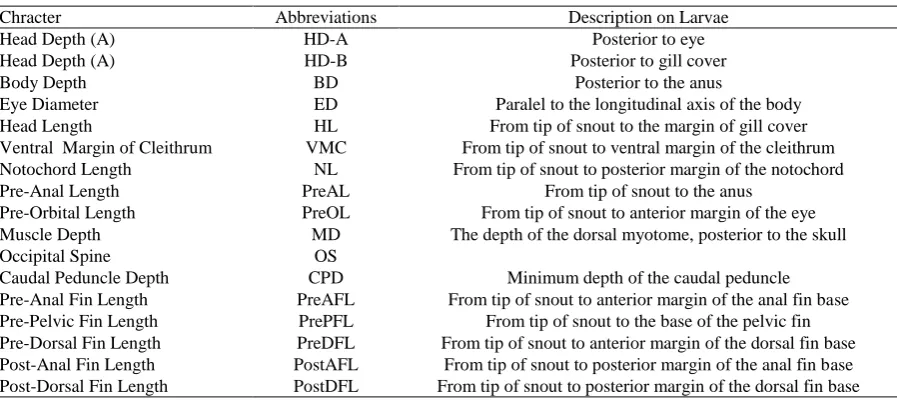
Morphological observations and body measurements were conducted on subsamples of minimum 30 specimens per sample taken randomly at 3-day intervals from 1 to 46 DAH. Photographs (left side of each larva) were taken on anaesthetized (ethyleneglycol-monophenylether, Merck, 0.2-0.5 ml.L-1) specimens using a stereoscopic microscope. Morphometric characters were measured by using TpsDig (version 1.37) software with 0.01 mm on the photographs. Eighteen body parts were measured from these images (Table 2). Curled larvae were not measured in the present study. Measured morphometric results are given as mean±SE.
The alterations of body shapes such as morphometric ratios (R) of all the characters (Y) to TL (i.e. R=Y/TL) during the process of development and also the different developmental stages were identified according to Fukuhara (1988), Yoshimatsu
819
the allometric growth of the body. The allometric equation of every character on TL (Y=aTLb, Fuiman 1983) was estimated separately for each stage of development by linear regression analysis (after logarithmic transformation of all the variables) according to Koumoundouros et al. (1999). Also, a Student t-test was applied to test any differences between stages (Sokal and Rohlf, 1981).
Results
Larval Growth
During the experimental period, speed of growth was slow from 1 to 22 DAH (y=3.139e0.027x, R2=0.896, n= 566) and accelerated exponentially (y=1.830e0.046x, R2=0.967, n= 460) between 22 and 46 DAH, once the notochord flexion occurred (Figure 1). Y is total length (TL) in millimeters and x is days after hatching.
Morphological Development
The changes in TL of reared P. pagrus larvae are shown in Figure 2. The mean TL of newly hatched larvae was 2.77±0.09 mm with 2.69±0.12 mm notochord length (NL). Hatched larvae were
transparent with closed mouth and anus (Figure 2-A). On this day (1 DAH), larval pigmentation consisted of punctuate and stellate melanophores which were located on dorsal part of the head, pre-hemal region and between 16 and 20 vertebra in hemal region. At the onset of exogenous feeding on 4 DAH, larvae measured 3.74±0.13 mm TL and 3.61±0.08 mm NL and they were identified with a functional mouth, opened anus, developed stomach, completely consumed vitelline reserve but not oil globule (Figure 2-B).
On 4 DAH, punctuate and stellate melanophores were scattered on the anterior and posterior of the eye, dorsal side of the digestive tract, anus, and also between 16 and 20 vertebra in hemal region. In P. pagrus, initial swim bladder began to inflate at 4.22±0.18 mm TL and 4.04±0.20 mm NL on 10 DAH (41%; n=61) and also fins were present at the pectorals and the primordial marginal fin fold (Figure 2-C). On 16 DAH, larvae were 4.95±0.26 mm TL and 4.81±0.36 mm NL (Figure 2-D). Notochord flexion started on 22 DAH at 5.56±0.43 mm TL (Figure 2-E). On 28 DAH, the dorsal, anal, caudal, and pectoral fin shapes were present and the pelvic fin rays began to develop at 6.24±0.56 mm TL (Figure 2-F). The complement of the notochord flexion was characterized by the antero-posterior orientation of the caudal rays, present at 8.22±0.63 mm TL on 34
Table 1. Physico-chemical parameters of seawater during the experiment
Temperature (°C) 18-24 (depending on age and size)
Salinity (‰) 37.2-37.8
Ammonia and nitrite (mg.L-1) <0.01
Flow rate (%) 5-6<
Light intensity (lx) 30-100 (depending on age and size)
Photoperiod (h) 24 h L (by algal addition), 16:8 L:D
Dissolved oxygen (mg/lt) 6.6-8.8
pH 7.2-8.4
Table 2. Abbreviations and description of morphometric characters measured during larval development
Chracter Abbreviations Description on Larvae
Head Depth (A) HD-A Posterior to eye
Head Depth (A) HD-B Posterior to gill cover
Body Depth BD Posterior to the anus
Eye Diameter ED Paralel to the longitudinal axis of the body
Head Length HL From tip of snout to the margin of gill cover
Ventral Margin of Cleithrum VMC From tip of snout to ventral margin of the cleithrum Notochord Length NL From tip of snout to posterior margin of the notochord
Pre-Anal Length PreAL From tip of snout to the anus
Pre-Orbital Length PreOL From tip of snout to anterior margin of the eye Muscle Depth MD The depth of the dorsal myotome, posterior to the skull
Occipital Spine OS
Caudal Peduncle Depth CPD Minimum depth of the caudal peduncle
820
Figure 1. Feeding regime and growth in TL of P. pagrus from 1 to 46 DAH.
821
DAH (Figure 2-G). At the end of the study larvae were 15.81±1.36 mm TL on 46 DAH, punctuate and small stellate melanophores were visible all over the trunk, mainly in the head and around the fins except the caudal fin (Figure 2-H).
Allometric Growth
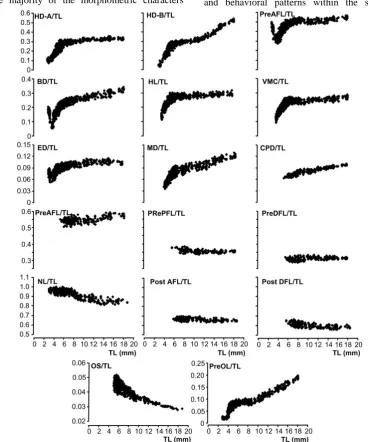
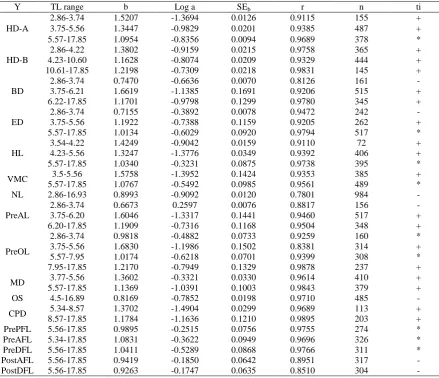
The allometric growth patterns of 18 body parts (including TL) measured in 1026 specimens of P. pagrus larvae are presented in Figure 3. Morphometric ratios (R) of larvae were not constant during the study except NL, OS, PrePFL, PreAFL, PreDFL, PostAFL and PostDFL. In contrast, only NL showed negative allometry during the larval development. These inflection points of TL were differentiated between measured characters. The allometric equations of the morphometric characters were studied in comparison to TL as shown in Table 3.
The majority of the morphometric characters
became distinct at opening of mouth on 4 DAH at 3.74±0.13 mm TL. Also, initial swimbladder inflation was observed on 10 DAH at 4.22±0.18 mm TL and flexion of notochord was detected on 22 DAH at 5.56±0.43 mm TL. Additionally, BD, PreAL and ED showed negative allometry between 2.86 and 3.74 mm TL, which was the yolk sac period. In 19 of 35 respective regression equations, the allometry coefficients were positive allometry, while coefficients of 7 equations showed negative allometry. Finally, remaining nine coefficients of regression equations showed isometry, which were observed mainly between 5.57 and 17.85 mm TL in HD-A, ED, HL, VMC, PrePFL, PreAFL and PreDFL.
Discussion
Different temperatures play important roles in yolk utilization, as well as, result in different development sequences of morphological characters and behavioral patterns within the same species
822
(Fukuhara 1990). In this study, absorption of yolk sac of P. pagrus was complete at 3.74±0.13 mm TL on 4 DAH but most of the oil globule remained. Other studies also reported that yolk absorption was complete in 3.93±0.09 mm TL at 4 DAH (Mihelakakis et al. 2001) and 2.5-3.2 mm TL at 5 DAH in P. pagrus larvae (Stephanou et al. 1995). The differences might result from changes in rearing temperatures. In other Sparid species, this absorption occurred at 3.2 mm TL in Pagrus major (Kitajima 1978), 3.22 mm TL at 5 DAHin Dentex dentex (Fırat
et al. 2003), and 2.6-2.8 mm TL at 3 DAH in Sparus aurata (Saka et al. 2001). Generally, the presence and functioning of swimbladder are crucially important in fish larvae which can occur at and/or follow the onset of exogenous feeding, as they control buoyancy and make swimming activity and prey capture more energy efficient (Ronnestad et al. 1994; Fırat et al.
2005; Bjelland and Skiftesvik 2006). In this study, initial swimbladder inflation was first observed at 4.22±0.18 mm TL on 10 DAH, but only in 41% of the sampled larvae. This increased to 96% at 16 DAH and
post inflation of swimbladder (80%) occurred on this day. In this species, Mihelakakis et al. (2001) reported that inflation of swimbladder began to inflate and be functional between 5 and 7 DAH. Also, inflation of swimbladder occurred at 3.4 mm TL during the 5-10 DAH in P. major (Kitajima 1978), 4-5 mm TL during the period from 5 to 9 DAH for S. aurata
(Chatain 1986) and 5-9 DAH for Diplodus puntazzo
larvae (Marangos 1995). The start of notochord flexion in Sparids depend on the species, size of newly hatched larvae, and culture conditions (especially rearing temperature)(Koumoundouros et al. 1999; Sfakianakis et al. 2004; Fırat et al. 2005). In the present study, notochord flexion of P. pagrusappeared at 5.56±0.43 mm TL. In contrast, it
was reported that the beginning of the notochord flexion of P. pagrus occurred at 4.40 mm standard length (Machinandiarena et al. 2003). In addition to this, notochord flexion was observed at 5.4 mm TL in
Pagellus erythrinus (Sfakianakis et al. 2004), 6.5 mm TL and 7.1 mm TL in S. aurata (Çoban et al., 2008b; Koumoundouros et al. 1997), 5.6 mm TL in P. pagrus Table 3. Parameters of the allometry equations (Y = a.TLb) of the morphometric characters studied (Y) against TL (b allometry coefficient; a constant of the allometry equation; SEb standard error of b; r coefficient of determination; n number of measured individuals; ti test of isometry) (Morphometric abbreviations are listed in Table 1)
Y TL range b Log a SEb r n ti
HD-A
2.86-3.74 1.5207 -1.3694 0.0126 0.9115 155 +
3.75-5.56 1.3447 -0.9829 0.0201 0.9385 487 +
5.57-17.85 1.0954 -0.8356 0.0094 0.9689 378 *
HD-B
2.86-4.22 1.3802 -0.9159 0.0215 0.9758 365 +
4.23-10.60 1.1628 -0.8074 0.0209 0.9329 444 +
10.61-17.85 1.2198 -0.7309 0.0218 0.9831 145 +
BD
2.86-3.74 0.7470 -0.6636 0.0070 0.8126 161 -
3.75-6.21 1.6619 -1.1385 0.1691 0.9206 515 +
6.22-17.85 1.1701 -0.9798 0.1299 0.9780 345 +
ED
2.86-3.74 0.7155 -0.3892 0.0078 0.9472 242 -
3.75-5.56 1.1922 -0.7388 0.1159 0.9205 262 +
5.57-17.85 1.0134 -0.6029 0.0920 0.9794 517 *
HL
3.54-4.22 1.4249 -0.9042 0.0159 0.9110 72 +
4.23-5.56 1.3247 -1.3776 0.0349 0.9392 406 +
5.57-17.85 1.0340 -0.3231 0.0875 0.9738 395 *
VMC 3.5-5.56 1.5758 -1.3952 0.1424 0.9353 385 +
5.57-17.85 1.0767 -0.5492 0.0985 0.9561 489 *
NL 2.86-16.93 0.8993 -0.9092 0.0120 0.7801 984 -
PreAL
2.86-3.74 0.6673 0.2597 0.0076 0.8817 156 -
3.75-6.20 1.6046 -1.3317 0.1441 0.9460 517 +
6.20-17.85 1.1909 -0.7316 0.1168 0.9504 348 +
PreOL
2.86-3.74 0.9818 -0.4882 0.0733 0.9259 160 *
3.75-5.56 1.6830 -1.1986 0.1502 0.8381 314 +
5.57-7.95 1.0174 -0.6218 0.0701 0.9399 308 *
7.95-17.85 1.2170 -0.7949 0.1329 0.9878 237 +
MD 3.77-5.56 1.3602 -0.3321 0.0330 0.9614 410 +
5.57-17.85 1.1369 -1.0391 0.1003 0.9843 379 +
OS 4.5-16.89 0.8169 -0.7852 0.0198 0.9710 485 -
CPD 5.34-8.57 1.3702 -1.4904 0.0299 0.9689 113 +
8.57-17.85 1.1784 -1.1636 0.1210 0.9895 203 +
PrePFL 5.56-17.85 0.9895 -0.2515 0.0756 0.9755 274 *
PreAFL 5.34-17.85 1.0831 -0.3622 0.0949 0.9696 326 *
PreDFL 5.56-17.85 1.0411 -0.5289 0.0868 0.9766 311 *
PostAFL 5.56-17.85 0.9419 -0.1850 0.0642 0.8951 317 -
PostDFL 5.56-17.85 0.9263 -0.1747 0.0635 0.8510 304 -
823
(Çoban et al. 2008a) and 6.4 mm TL in D. sargus
larvae (Koumoundouros et al. 2001).
It is known that growth in fish is often accompanied with changes in proportion as well as in size, the phenomenon of relative or allometric growth (Katsanevakis et al. 2007). Moreover, morphometric ratios are useful indicators for intraspecific variations between rearing methods and cultivated populations of larvae and juvenile (Fukuhara 1983; Suda et al.
1987; Mihelakakis et al. 2001). These ratios may be used as supplementary criteria for quality assessment and control of cultured larvae (Wyatt 1972; Yin and Blaxter 1986; Koumoundouros et al. 1995). In the present study, main proportional changes and inflection points in the proportions of P. pagrus
occurred at 3.74, 4.22 and 5.56 mm TL with growth. Besides, P. pagrus larvae inflated initial swimbladder at the second turning point (4.22 mm TL) and also the commencement of the upward bending of the notochord occurred at third turning point (5.56 mm TL). Mihelakakis et al. (2001) reported that inflection point in body proportion changes in P. pagrus
occurred at 4 mm and 7 or 9 mm TL, corresponding to morphological transitions to the postlarval stage and juvenile stage. Koumoundouros et al. (1999) pointed out that the morphometric development of D. dentex was basically characterized by the transition of the sharp allometric growth of the early larval stages (mainly of 3.6 to 6.7 mm TL) to the lighter allometric or isometric of the following stages.
In conclusion, the present study desribes important morphological developments and morphometric modifications which occurred in P. pagrus larvae during early life stages under gradually increasing temperature profile. The data are hepful for management using similar regimes. Further studies with sufficient replicates are needed at several constant tempratures to provide a baseline data set for comparison with other studies.
Acknowledgements
The authors thank the staff of the Teknomar Sea Fish Broodstock Centre (Akuvatur Marine Product Inc., Izmir, Turkey) where the experiments were conducted and for their technical assistance.
References
Alarcon, J.A. and Alvarez, M.C. 1999. Genetic identification of sparid species by isozyme markers: application to interspecific hybrids. Aquaculture, 173(1-4): 95-103. doi:10.1016/S0044-8486(98)00473-6
Basurco, B. and Abellán, E. 1999. Finfish species diversification in the context of Mediterranean marine fish farming development. In: Marine Finfish Diversification: Current Situation and Prospects in Mediterranean Aquaculture, Abellán, E. and Basurco, B. (eds). Options Mediterranennes, Serie B, 24: 9-25. Bjelland, R.M. and Skiftesvik, A.B. 2006. Larval development in European hake (Merluccius
merluccius L.) reared in a semi-intensive culture system. Aquaculture Research, 37: 1117-1129. doi:10.1111/j.1365-2109.2006.01536.x.
Chatain, B. 1986. La vessie natatoire chez Dicentrarchus labrax et Sparus auratus: I. Aspects morphologyques du developpement. Aquaculture, 53: 303–311. doi:10.1016/0044-8486(86)90361-3.
Çoban, D. Suzer, C., Kamacı, H.O., Saka, Ş. and Fırat, K. 2009a. Early osteological development of the fins in the hatchery-reared red porgy, Pagrus pagrus (L. 1758). Journal of Applied Ichthyology, 25: 26-32. doi: 10.1111/j.1439-0426.2008.01165.x
Çoban, D., Kamacı, H.O., Suzer, C., Saka, Ş. and Fırat, K. 2009b: Allometric growth in hatchery-reared the gilthead seabream (Sparus aurata). North American Journal of Aquaculture, 71: 189-196. doi:10.1577/A08-028.1
Conides, A. and Glamuzina, B. 2001. Study on the effects of rearing density, temperature and salinity on hatching performance of the European sea bass, Dicentrarchus labrax (Linnaeus, 1758). Aquaculture International, 9: 217-224.
doi:10.1023/A:1015330608607
Darias, M.J., Murray, H.M., Gallant, J.W., Astola, A., Douglas, S.E., Yúfera, M. and Martínez-Rodríguez, G. 2006. Characterization of a partial α-amylase clone from red porgy (Pagrus pagrus): Expression during larval development. Comparative Biochemistry and Physiology Part B, 143: 209–218.
doi:10.1016/j.cbpb.2005.11.010
Diaz, M.V., Arano, M.F., Pájaro, M., Aristizábal, E.O. and Macchi, G.J., 2013. The use of morphological and histological features as nutritional condition indices of Pagrus pagrus larvae. Neotropical Ichthyology, 11: 649-660. doi:10.1590/S1679-62252013000300018 Divanach, P., Boglione, C., Menu, M., Koumoundouros, G.,
Kentouri, M. and Cataudella, S. 1996. Abnormalities in finfish mariculture: an overview of the problem, causes and solutions. Sea-bass and Sea Bream Culture: Problems and Prospects, Verona, Italy, October 16–18. European Aquaculture Society, Oostende, Belgium, 45–66.
Fırat, K., Saka, Ş. and Çoban, D. 2003. The effect of light intensity on early life development of common dentex Dentex dentex (L. 1758) larvae. Aquaculture Research, 34: 727-732. doi:10.1046/j.1365-2109.2003.00875.x
Fırat, K., Saka, Ş. and Çoban, D. 2005. Early life history of cultured common dentex, Dentex dentex (L. 1758). Turk J. Vet. Anim. Sci., 29: 1-7.
Fuiman, L. A. 1983. Growth gradients in fish larvae. J. Fish Biol., 23: 117-123. doi:10.1111/j.1095-8649.1983.tb02886.x
Fukuhara, O. 1983. Development and growth of laboratory reared Engraulis japonica (Houttuyn) larvae. J. Fish Biol., 23: 641–652. doi:10.1111/j.1095-8649.1983.tb02943.x
Fukuhara, O. 1988. Morphological and functional development of larval and juvenile Limanda yokohamae (Pisces: Pleuronectidae) reared in the laboratory. Mar. Biol., 99: 271–281.
doi: 10.1007/BF00391990
Fukuhara, O. 1990. Effects of temperature on yolk utilization, initial growth, and behaviour of unfed marine fish larvae. Mar. Biol., 106: 169-174. doi: 10.1007/BF01314797
824
patterns in Siberian sturgeon and their ecological significance. Journal of Fish Biology, 54: 852–862. doi: 10.1111/j.1095-8649.1999.tb02037.x
Hernández-Cruz, C.M., Salhi, M., Bessonat, M., Izquierdo, M.S., González, M. M. and Fernández-Palacios, H., 1999. Rearing techniques for red porgy (Pagrus pagrus) during larval development. Aquaculture, 179: 489-497. doi: 10.1016/S0044-8486(99)00182-9 Hood, P. B., and A. K. Johnson. 2000. Age, growth,
mortality, and reproduction of red porgy,Pagrus pagrus, from the eastern Gulf of Mexcio. Fish.Bull., 98: 723–735.
Katsanevakis, S., Thessalou-Legaki, M., Karlou-Riga, C., Lefkaditou, E., Dimitriou, E., Verriopoulos, G. 2007. Information-theory approach to allometric growth of marine organisms. Mar Biol, in press. doi: 10.1007/s00227-006-0529-4
Kendal, A.W., Ahlstrom, E.H. and Moser, H.G. 1984. Early life history stages of fishes and their characters. In: Ontogeny and systematics of fishes. American Society of Ichthyologists and Herpetologists (Eds. H. G. Moser, W. J. Richards and S. L. Richardson), No. 1. Allen Press Inc, Lawrence, pp 11-22.
Kentouri, M., Papandroulakis, N., Pavlidis, M. and Divanach, P. 1995. Culture of the red porgy, Pagrus pagrus, in Crete. Present knowledge, problems and perspectives. In: Marine Aquaculture Finfish Species Di versification, Vol. 16 (ed. C. Zaragoza), pp. 65–78. Cahiers Options M´editerran´eennes, FAO.
Kitajima, C. 1978. Acquisition of fertilized eggs and massculture of juveniles of red sea bream, Pagrus major. Special Report of Nagasaki Prefectural Institute of Fisheries, 5: 25-86.
Kokokiris, L., Brusl´e, S., Kentouri, M. Fostier, A. 1999. Sexual maturity and hermaphroditism of the red porgy Pagrus pagrus (Teleostei: Sparidae). Marine Biology, 134(4): 621–629.
Koumoundouros, G., Kiriakos, Z., Divanach, P. and Kentouri, M. 1995. Morphometric relationships as criteria for the evaluation of larval quality of gilthead sea bream. Aquacult. Int., 3: 143–149.
Koumoundouros, G., Oran, G., Divanach, P., Stefanakis, S. and Kentouri, M. 1997: The opercular complex deformity in intensive gilthead sea bream (Sparus aurata L.) larviculture. Moment of apparition and description. Aquaculture, 156: 165–177. doi:10.1016/S0044-8486(97)89294-0
Koumoundouros, G., Divanach, P. and Kentouri M. 1999. Ontogeny and allometric plasticity of Dentex dentex in rearing conditions. Marine Biology, 135: 561–572. doi: 10.1007/s002270050657
Koumoundouros, G., Divanach, P., Anezaki, L. and Kentouri, M. 2001. Temperature-induced ontogenetic plasticity in sea bass (Dicentrarchus labrax). Marine Biology, 139: 817–830. doi: 10.1007/s002270100635 Lahnsteiner, F. and Patarnello, P. 2003. Investigations on
the metabolism of viable and nonviable gilthead sea bream (Sparus aurata) eggs. Aquaculture, 223: 159– 174. Doi: 10.1016/S0044-8486(03)00159-5
Machinandiarena L, Müler M. and Lopez A. 2003. Early life stages of development of the red porgy Pagrus pagrus (Pisces, Sparidae) in captivity. Argentina Invest. Mar., 31(1): 5-13.
Marangos, C. 1995. Larviculture of the sheepshead bream, Puntazzo puntazzo (Gmelin 1789) (Pisces, Sparidae).
Cah. Options Mediterr. 16: 41–46.
Mihelakakis, A., Yoshimatsu, T., Tsolkas, C. 2001. Spawning in captivity and early life history of cultured red porgy, Pagrus pagrus. Aquaculture, 199: 333–352. doi: 10.1016/S0044-8486(01)00560-9 Osse, J. W. M., and J. G. M. van den Boogaart. 1995. Fish
larvae, development, allometric growth and the aquatic environment. ICES Marine Science Symposia, 201: 21–34.
Papandroulakis, N., Kentouri, M., Maingot, E. and Divanach, P. 2004. Mesocosm: a reliable technology for larval rearing of Diplodus puntazzo and Diplodus sargus sargus. Aquacult. Int., 12: 345–355.
doi: 10.1023/B:AQUI.0000042134.21211.ab
Ronnestad, I., Koven, W.M., Tandler, A., Harel, M. and Fyhn, H.J. 1994. Energy metabolism during development of eggs and larvae of gilthead sea bream (Sparus aurata). Mar. Biol., 120: 187–196. doi: 10.1007/BF00349678
Roo, F. J., Socorro, J., Izquierdo, M. S., Caballero, M. J., Hernández-Cruz, C. M., Fernández, A. and Fernández-Palacios, H. 1999. Development of red porgy Pagrus pagrus visual system in relation with changes in the digestive tract and larval feeding habits. Aquaculture, 179: 499-512.
doi: 10.1016/S0044-8486(99)00183-0
Saka, Ş., Fırat, K. and Suzer, C. 2001. Effects of light intensity on early life development of gilthead sea bream larvae (Sparus aurata). The Israeli Journal of Aquaculture- BAMIDGEH, 53 (3-4): 139-146. Sfakianakis, D.G., Koumoundouros, G., Divanach, P. and
Kentouri, M. 2004: Osteological development of the vertebral column and the fins in Pagellus erythrinus (L. 1758). Temperature effect on developmental plasticity and morpho-anatomical abnormalities. Aquaculture, 232: 407–424.
doi:10.1016/j.aquaculture.2003.08.014
Sokal, R.R. and Rohlf, F.J. 1981. Biometry. Freeman, San Francisco.
Stephanou, D., Georgiou, G. and Shoukri, E. 1995. Reproduction and larval rearing of the common sea bream (Pagrus pagrus), an experimental culture. CIHEAM-Options Mediterraneennes, 16: 79–87. Suda, Y., Shimizu, M. and Nose, Y. 1987. Morphological
differences between cultivated and wild jack mackerel Trachurus japonicus. Bull. Jpn. Soc. Sci. Fish., 53: 59–61.
Suzer, C., Aktülün, S., Çoban, D., Kamacı, H.O., Saka, Ş., Fırat, K., Alpbaz, A. 2007: Digestive enzyme activities in larvae of sharpsnout seabream (Diplodus puntazzo). Comparative Biochemistry and Physiology, Part A, 148: 470–477. doi:10.1016/j.cbpa.2007.06.418
Wyatt, T. 1972. Some affects of food density on the growth and behavior of plaice Pleuronectes platessa larvae. Mar. Biol., 14: 210–216. doi: 10.1007/BF00348281 Yin, M.C. and Blaxter, J.H.S. 1986. Morphological changes
during growth and starvation of larval cod Gadus morhua and flounder Platichthys flesus. J. Exp. Mar. Biol. Ecol., 104: 215–228. doi: 10.1016/0022-0981(86)90106-1