This is an open access journal, and articles are distributed under the terms of the Creative Commons Attribution-Non Commercial-ShareAlike 4.0 License, which allows others to remix, tweak, and build upon the work non-commercially, as long as appropriate credit is given and the new creations are licensed under the identical terms.
Development of methodical bases for business process
management optimization in clinical trials
Sanna G. Sboeva*, Yuliya A. Klyueva, Nikolay I. Burdaev, Maksim A. Zaharchenko
Sechenov First State Medical University, Moscow, 119435, Russia.
Correspondence: Sanna G. Sboeva, Sechenov First State Medical University, Moscow, 119435, Russia.
ABSTRACT
The author justified the need to develop a scientific and methodical approach to the management by pharmaceutical company activities during the conduct of clinical trials. In this regard, the aim of this study was to build a model for business process modernization and evaluate its effectiveness. A clinical trial of the 3rd phase of an innovative antidiabetic drug was chosen as the model object of the study.
They used the IDEF0 (Integrated Definition Function Modeling) method in the work, accepted as the state standard in the USA and as the recommendations of RF Gosstandart Р 50.1.028-2001. CASE (Computer-Aided Software/System Engineering) means ERwin Process Modeler r7.3 was selected as the tool for analysis, organization, and reorganization of business processes. During the evaluation of the effectiveness of the clinical trial management system, the authors used the net present value (NPV) calculation method.The article proposed the methodological principles of management optimization, which included the construction of two models of business processes in the clinical studies of a pharmaceutical company before and after modernization ("AS-IS" and "AS-WILL"). The structure of the AS-WILL model has a new functional unit "To support clinical research", which can allow organizing the company activities more efficiently through the introduction of highly specialized positions - a logistics expert and an expert in regulatory procedures. For the economic evaluation of modernization, negative cash flows were taken into account and distributed throughout the quarters during the clinical study, a discount rate was determined depending on the projected risks and NPV value was calculated. The authors found that the business process model including the "Clinical Research Support" unit, can increase net present value.
Keywords: Optimization of clinical research management, modernization of business processes, the net present value
Introduction
In recent years, there has been a decline in the activity of the clinical research (CR) market in Russia. According to the experts the reasons are the complication of regulatory procedures and an unstable economic situation. With the entry of the Federal Law No. 61-FL "On the circulation of medicines" into force on
12.04.2010, the requirements for registration of clinical trials and the control of medicinal product safety have been modified and clarified.[1]
Every organization comes with a vision in the business. It has certain goals and objectives, which it wants to achieve. Medications are crucial in healthcare delivery, and when used appropriately, they can help in treating diseases, alleviate symptoms, and lessen patient suffering.[2] New techniques and
devices are introduced to the market annually.[3, 4] Hence, there
is a need to use effective tools for business process management of a pharmaceutical company without the loss of competitive advantages, as well as in the search for and introduction of new management technologies in clinical research, which determined the purpose of the present work: To develop the model of business process modernization in CR and assess its effectiveness.
Material and Methods
Access this article onlineWebsite: www.japer.in E-ISSN: 2249-3379
How to cite this article: Sanna G. Sboeva, Yuliya A. Klyueva, Nikolay I. Burdaev, Maksim A. Zaharchenko. Development of methodical bases for business process management optimization in clinical trials. J Adv Pharm Edu Res 2019;9(2):137-142.
The CR of the 3rd phase of an innovative antidiabetic drug
(Polysialinated human oxyntomodulin/human glucagon-like peptide receptor 1 receptor agonist) was selected as a model object of the study. It was carried out by the contract research organization.
The authors used the IDEF0 (Integrated Definition Function Modeling) methodology, adopted as a state standard in the US and as the recommendations of the State Standard of Russia R 50.1.028-2001. Using this standard, an "information section" is implemented, where business processes are represented as system elements that interact with each other, exchanging information and material flows. IDEF0 was used to analyze the functions of clinical trials and to show the mechanisms by which these functions are performed.
Functional-oriented description of CR business processes using IDEF0 methodology is based on three principles:
• The principle of functional decomposition, which allows dividing the main areas of the company activities into smaller ones.
• The principle of complexity constraint, which makes it possible to compose IDEF0-diagrams with no more than 6 units. Thus, the AS-IS model is structured and easily subjected to analysis.
• The context diagram principle is used to display the main mission of a simulated system, the diagram of which indicates its boundaries and interaction with the environment.
The author selected CASE (Computer-Aided Software / System Engineering) ERwin Process Modeler r7.3 from the "Computer Associates" company as the tool for analysis, organization, and reorganization of CR business processes. The choice of this product was conditioned by successful examples of its application in the pharmaceutical field.[5, 6]
During the evaluation of CR modernization management system effectiveness, the methodology for net present value (NPV) calculation was used. This is a standard method that is widely used in investment projects and shows the assessment of investment effect, given to the present moment of time, taking into account the different time values of money.
NPV value is the difference between all cash inflows and outflows that are given to the current moment of time (the time of an investment project evaluation).
NPV is calculated by the following formula:
where
CF – cash flow,
CFt— the payment in t years (t=1, …, N)
IC (InvestedCapital) – initial investment in the amount of IC = - CF0
i — discounting rate.
In this methodology, investments were subjected to discounts as they were not implemented simultaneously in projects but were stretched for several periods.
Using NPV, the comparative effectiveness of alternative investments (with the same initial investments the project with the largest NPV is more profitable) could also be evaluated.
Results and Discussion
With the purpose of business process effective modernization, the authors developed the methodological bases for CR management, which included 3 interrelated stages:
1. The development of the AS-IS model using the IDEF0 standard. The model reflects the business processes of the company as it was before modernization.
2. The development of the AS-WILL model using the IDEF0 standard. AS-WILL model is an "ideal" model of business processes, namely the post-modernization of company systems.
3. The calculation of business process modernization efficiency in terms of NPV.
1. Design of business process model in CR using the example of AS-IS.
Based on the preliminary information retrieval and the analysis of research organization activities, the CR process structure of the innovative anti-diabetic drug 3rd phase is represented by 9 business
processes, united into 2 functional units. The first unit "Manage the CR process" includes information on the preparation of the CR project, its management, and closure. The second unit "To perform CR processes" reflects the totality and the interconnection of all processes occurring in the organization during the CR of an innovative drug.
Using ERwin Process Modeler r7.3 meant the authors described all the activities in the CR consistently. The zero-level decomposition was represented by the processes in CR ("CR process management" and " CR processes implementation"), which were provided by a set of basic and managerial functions performed by the organization employees to achieve the objectives.
The key process of the whole functional system was the “monitoring of CR” (Figure 1), which began with the selection of treatment facilities that met the CR performance conditions. Then, the personnel training of the research center [5] took place
0
Figure 1.Diagram of the business process functions "Clinical monitoring"
The second most expensive business process was "Logistic Support" - about 10% of the research budget. The analysis showed that the process was labor-intensive and required special knowledge and experience.
2. Design of an "ideal" model of business processes in CR (AS-WILL)
During the second stage of the methodological basics for business process redesign and "ideal" model development, the method of functional-informative description was applied, after which:
• The decomposition of previously allocated business processes and their interrelationships were performed.
• More efficient business processes were determined and identified.
• Data flow, information, control actions, and the executors of new business processes were determined.
• A functional-informative description of business processes in CR was carried out using the IDEF0
USED AT:AUTHOR: Klyueva Yu.A.DATE: REV: PROJECT: Business
process model in CR
21.08.2014 08.08.2018
NOTES: 1 2 3 4 5 6 7 8 9 10
WORKING DRAFT
RECOM M ENDED PUBLICATION
READERDATE CONTEXT:
A2
NODE: TITLE:
Clinical monitoring
NUM BER:A22
Russian Federation legislation
Normative
documentation of the M inistry of Health
CR quality improvement
Clinical Research Associate Research Centers
Russian Federation legislation
Used CR materials CR
documents
The molecule under study
Equipment, laboratory materials, drug
Results of patient indicator analysis
M anagement solutions
Clinical monitoring reports Permits for the conduct of CR Provision with
CR materials
1
0р.
Logistic support
2
0р.
Selection of research centers
3
0р.
Training of the CR Center researchers
4
0р.
Routine M onitoring of Research Centers
5
0р.
• They simulated the interaction of managerial and technological structures in CR.
The authors constructed the process structure of an "ideal" CR model (As-Will) of the innovative preparation, which was
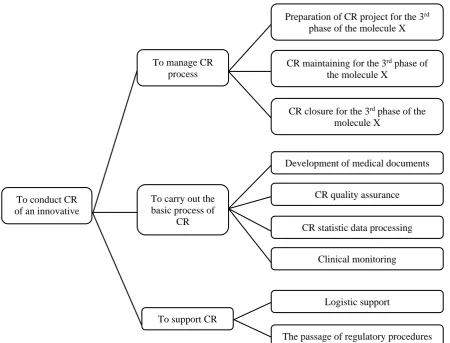
represented by the main business processes, united into 3 functional blocks "the CR process management", "Maintaining the main CR processes", "CR support implementation" (Fig. 2).
Figure 2.Process structure of the "ideal" CR model
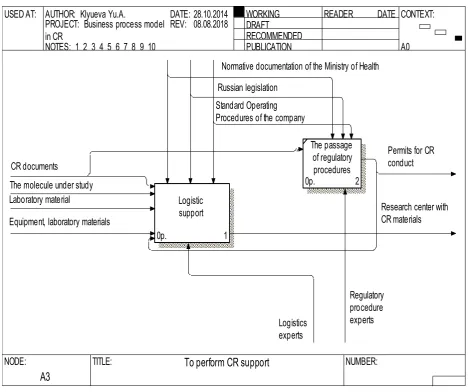
The structure of an "ideal" model had a new functional unit "CR Support Implementation", which in our opinion was necessary for an efficient and high-quality CR implementation due to the introduction of highly specialized posts - logistics expert and
regulatory procedure expert. This modernization would make it possible to organize the storage and the supply of medicinal products (materials for research) and receive permits from the Ministry of Health in a short time (Fig. 3).
To conduct CR of an innovative
drug
To manage CR process
To carry out the basic process of
CR
To support CR
Preparation of CR project for the 3rd
phase of the molecule X
The passage of regulatory procedures Logistic support
Development of medical documents
Clinical monitoring CR statistic data processing
CR quality assurance
CR closure for the 3rd phase of the
molecule X
CR maintaining for the 3rd phase of
Figure 3.The scheme of the business process functions "Implement CR support"
The calculation of business process modernization efficiency in terms of NPV.
The calculation of NPV value was carried out for two CR models of the innovative drug: AS-IS and AS-WILL (for business processes before and after modernization) and consisted of three stages. At the first stage, a table was compiled (Table 1), taking into account negative cash flows for the innovative drug CR (cash payments - costs) during the period from February 1, 2016 to January 31, 2017. The table was based on the following information:
1. AS-IS and AS-WILL business process models that were designed, which allowed the authors to take into account all the processes necessary for CR conduct. 2. Operational data on the timing of each business process
performance in all areas of activity. The analysis of reporting documentation allowed us to determine the terms of CR process implementation. In general, the
study of the molecule of the 3rd phase took place for 2
years, 6 months of which was spent on preparatory processes and the final processes took 3 months. 3. The data on the cost of each business process. The
authors analyzed the research budget and determined the cost of an assistant's hour of work ($ 20), a junior expert's hour of work ($ 30) and an expert's hour of work ($ 40).
Summarizing the data, the researchers distributed the cash flows by quarters.
It should be taken into account that CR did not bring profit to the organization, but made an investment in the further development of the company and operated at the expense of the investment. Thus, the cash flow (CF) would always be negative and represent the cost for CR conduct in a certain period of time.
Table 1. Negative cash flows by quarters for AS-IS and AS-WILL models of CR innovative drug
AS-IS 236 164 USA dollars
CF1 CF2 CF3 CF4 CF5 CF6 CF7 CF8
3920 27354 32620 32740 32740 32740 32740 40830
AS-WILL 224 474 USA dollars
USED AT: AUTHOR: Klyueva Yu.A. DATE:
REV: PROJECT: Business process model in CR
28.10.2014 08.08.2018
NOTES: 1 2 3 4 5 6 7 8 9 10
WORKING DRAFT RECOMMENDED PUBLICATION
READER DATE CONTEXT:
A0
NODE: TITLE:
To perform CR support
NUMBER:A3
Logistics experts
Research center with CR materials The molecule under study
Equipment, laboratory materials
Russian legislation
Normative documentation of the Ministry of Health
Standard Operating Procedures of the company
CR documents
Permits for CR conduct
Laboratory material
Regulatory procedure experts 1
0р.
Logistic support
2 0р.
3760 24596 31279,33 31339,33 31339,33 31339,33 31339,33 39481,33
During the second stage of the methodology, the discount rate was determined analytically, depending on the projected economic risks during CR conduction and the rate of return on risk-free investments. The increase in discount value reduced the projected inflow of funds. At the same time, the choice of a low discount rate implied low risks of CR conduction.
In order to determine a discount rate, the researchers modified the calculation for the investment in the innovative project "The development of new pathogenetic drugs for abstinent opium syndrome withdrawal".[7] The following risk values were
determined:
• The annual rate of return on risk-free investments - 10%
• The risk of investment in an innovative project - 9%
• The risk associated with the source of financing and the structure of assets - 3%
• The risk of investment in Russia - 7%
• Forecast error risk - 2%
Thus, the total discount rate (i) was 31%.
Since the estimated CR was an investment project, the researchers took into account the funds allocated by the sponsor for the study - $ 190,000. These funds were initial investments (II) and were the same for AS-IS and AS-WILL models.
Using the Microsoft Exel program, the NPV calculation for the AS-IS and AS-WILL model of the innovative CR preparation was carried out during the third stage (Table 2):
NPV AS-IS = IC + CF1/ (1+i)1 +CF2/ (1+i)2 =
190000+((-3920-27354-32620-32740) / (1+0,31) 1) +
((-32740-32740-32740-40830) / (1+0,31) 2) = 35206,84
NPV AS-WILL = IC + CF1/ (1+i)1 +CF2/ (1+i)2 =
190000+((-3760-24596-31279,33-31339,33) / (1+0,31) 1) +
((-31339,33-31339,33-31339,33- 39481,33) / (1+0,31) 2) =
42761,42
Table 2. NPV calculation for AS-IS and AS-WILL model of innovative preparation CR
Model Year № Total cash flow for
the year, USD
Discounted NPV per year, USD
Initial investment from the sponsor, USD
NPV total, USD
AS-IS
1 -96634 -73766,41
190000 35206,84
2 -139050 -81026,75
AS-WILL 1 -90974,66 -69446,31 190000 42761,42
2 -133499,32 -77792,27
Thus, it was revealed that the modernization of processes will increase net unrequited profit by $ 7,554.58.
Conclusion
The purpose of the current research was to study and determine the functions (managerial, basic, auxiliary ones), and an "ideal" model was designed for the clinical trial of the innovative drug 3rd phase. The calculation of business process modernization
efficiency was performed according to the NPV indicator, and it was revealed that the model including the process "CR support implementation" would increase net unreconciled profit by $ 7,554.58.
Acknowledgment
The study was supported by the "Russian Academic Excellence Project 5-100".
References
1. Klyueva Yu.A., Sboeva S.G. The development of methodological bases to manage the process of clinical research using outsourcing. Pharmacia 2013; 6: 35-38. 2. Medvedev S N, Tregubov A G, Chupandina E E,
Glembotskaya G T, Medvedeva O A. Applying of probabilistic methods for managing pricing in a
pharmaceutical organization.J. Phys.: Conf. Ser. 2019 1203 012058
3. Ludmila A. Lobuteva, Alisa V. Lobuteva, Oksana V. Zakharova, Sergey A. Krivosheev, Oksana V. Kartashova. Instruments to form doctor’s loyalty to visits of medical representative. J Adv Pharm Edu Res 2019;9(3):68-75. 4. Koshechkin K., Lebedev G., Tikhonova J. Regulatory
Information Management Systems, as a Means for Ensuring the Pharmaceutical Data Continuity and Risk Management. Intelligent Decision Technologies 2019. Smart Innovation, Systems and Technologies, vol 142. Springer, Singapore, 265-274
5. Ustinova L.V., Logunova L.N. The construction of the pharmacy enterprise process model. New pharmacy. Effective management 2008; 3: 12.
6. Sboev G.A. The development of methodological bases for pharmacy practice harmonization and the integration of quality assurance and management systems: abstract from the thesis of Pharmaceutical Science Candidate: 15.00.01, 15.00.02. Moscow 2009; 22.