Volume 01, No.5, May, 2015
P
age
8
Optimization of operation parameters on a Novel internally
ventilated cross drilled Disc Brake by using Taguchi Method
A.K. Matta
**Assistant Professor, Department of Mechanical Engineering, GMRIT, Rajam, Srikakulam, A.P, India.
ABSTRACT:
In this paper, a novel internally ventilated cross drilled disc is evaluated experimentally using non-contact thermometer and Taguchi approach. The main purpose of Taguchi method is to assess the significance of different operation parameters that effect novel brake performance. This approach facilitated the study factors and their settings with a small number of experimental runs leading to considerable economy in time and cost for the process optimization. Four control factors are defined as applied pressure, vehicle speed, temperature and coefficient of friction, each at four levels are selected and an orthogonal array layout are performed. From the signal-to-noise (S/N) ratio of the test results, the significant parameters to improve novel disc brake behavior are suggested. The new brake performance based on the experimental results is compared with the predicted results using Taguchi approach and they are found to be in good agreement.
Keywords: Brake rotor; design; finite element method; optimization.
1. MAIN TEXT
The Primary function of a Disc rotor is to act as friction resistance, generating an opposite torque to a shaft. The automobile and aerospace industries rely on these devices to provide deceleration. In this application Brake rotor commonly forms part of the wheel assembly. During braking , energy is transferred to the rotor in the form of heat. As a result the brake rotor must also serve as an efficient energy dissipation and storage device. In most cases air must be circulated through the rotor to provide adequate cooling.
To improve the performance of brake rotor, an understanding of heat transfer phenomena is of utmost importance. Of particular interest is Stress distribution and heat flow through the passage. While numerical Modeling can predict heat transfer characteristics and serve as an efficient design tool. The experimental approach provides an assessment of actual performance and serves as a critical validation tool to numerical modeling.
Volume 01, No.5, May, 2015
P
age
9
during braking action is presented by H. Mazidi [4].In studies conducted by A.K.Matta [5], a test bench was built which makes it possible to investigate different brakes under identical conditions in the laboratory and able to check any rim temperature. In the research presented by Junichiro YAMABE[6], rotor materials were experimentally produced with the goal of achieving cost reduction. AJIT A[7], the influence of sample preparation conditions such as pressure, temperature, modifier concentration and extraction time on the wedelolactone yield using Taguchi L9 orthogonal array design.JIN MIN YANG[8], CFD software FLUENT was used to carry out a coupling simulation of aluminum bath and combustion space for different parameters of an aluminum melting furnace and the optimal parameters are then obtained by the Taguchi method and cross-table-based analysis of variance. P. KARTHIKEYAN[9], implementation of Taguchi method for optimizing operating and design parameters for performance enhanced studies on PEM fuel cell has been addressed. RAMAZAN CAKIROG˘LU[10], the modeling and optimization of cutting parameters on drill bit temperature measurements in drilling process of Al 7075 alloys were investigated by using the Taguchi design method. I.N.TANSEL[11], complete procedure for selection of the optimal cutting conditions by combining Taguchi Method and GONNS.A. MARIAJAYAPRAKASH[12], identify the failures which are frequently occurred in the boiler and to minimize those failures. Mostafa M. Makrahy[13], Four control factors are defined as applied pressure, sliding speed, angle inclination and water spraying, each at four levels are selected and an orthogonal array layout ofL16 (44) are performed. From the signal-to-noise (S/N) ratio of the test results, the significant parameters to improve wedge disc brake behavior are suggested.
In this research, the investigation carried out is to better understand the effect of the applied pressure, rotational speed, temperature and coefficient of friction on the performance of a new internally ventilated cross drilled disc brake. Statistical study using the Taguchi method is conducted to give the optimum working conditions of the parameter that affects the performance of disc brake. Four control factors are defined as applied pressure, vehicle speed, temperature and co-efficient of friction, each at four levels are selected and an orthogonal array layout are performed. From the signal-to-noise (S/N) ratio of the test results, the significant parameters to improve disc brake behavior are suggested.
2. EXPERIMENTAL METHOD
The main objective of the current test rig (simplified thermometer) is to enable the measurement of performance of the new internally ventilated cross drilled disc brake system. A thermometer is designed to provide the necessary disc rotation temperature, other apparatus for applied pressure; vehicle speed and coefficient of friction to the new novel brake. It can be divided into three main groups: the driving unit, the braking unit and the measurement facilities. Figure 1 shows a photo of the test rig.
Volume 01, No.5, May, 2015
P
age
10
capturing the spatial temperature distribution of the brake rotor. An encoder mounted to the rotor shaft facilitates measurement of the rotor speed.[5]
Brake performance are recorded at four vehicle speeds 64, 67, 70 km/hr. Equivalent to (380, 400 and 420 rpm.), that is obtained from the gearboxes reduction ratios and measured by speed tachometer. Different brake pressure in the range 2.5 to 10 bar is controlled and adjusted manually, temperature upto 3600 is measured by non-contact thermometer.
Fig. 1.Test Rig
2.1Structure of ventilated Heads
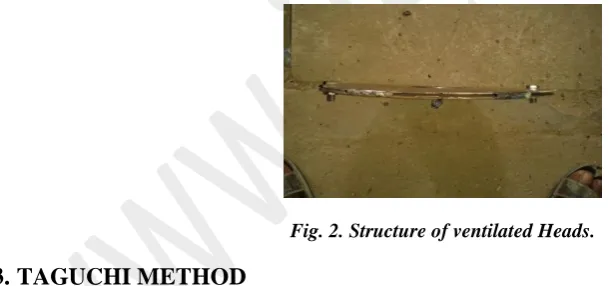
In order to solve the problem of improper fit of heads to discs, following assumtions are made. The remote elastic support is neglected at the bottom of the head to distribute the load equally, to take up sum of self weights of discs, inner concentrated loads and self weight of heads; the position is at 1800 to the neutral surface of disc as shown in Fig.2. The support force is not adjustable. Due to the fabrication and assembly as well as the deformation caused by gravity, a inflexible and unrestrictive welding is adopted so as to avoid improper fit of the ventilated heads and discs. The strengthening discs and heads are made of cast iron
Fig. 2.Structure of ventilated Heads.
3. TAGUCHI METHOD
Volume 01, No.5, May, 2015
P
age
11
the orthogonal array. 5. Analyse the experimental results using the signal-to-noise ratio and statistical analysis of variance. 6. Select the optimal levels of parameters. 7. Verify the optimal parameters through the confirmation experiment.[13]
3.1. Selection of Variables and Their Levels
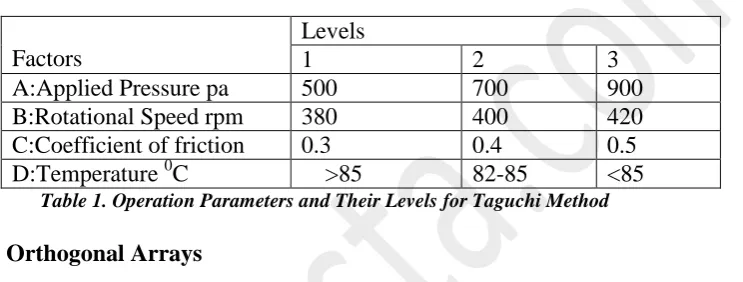
Based on the detailed literature survey, the novel disc brake performance influences by applied pressure, rotational speed, temperature and coefficient of friction that are important and their design have effects on the performance. To select the optimum values for the each parameter for effective increasing brake performance, the following parameters are considered for the experiments, as listed in Table 1.
Factors
Levels
1 2 3
A:Applied Pressure pa 500 700 900
B:Rotational Speed rpm 380 400 420
C:Coefficient of friction 0.3 0.4 0.5
D:Temperature 0C >85 82-85 <85
Table 1. Operation Parameters and Their Levels for Taguchi Method
3.2. Taguchi Orthogonal Arrays
While there are many standard orthogonal arrays available, each of the arrays is meant for a specific number of independent design variables and levels. In this research, if there is an experiment having 4 factors which have three values, then total number of experiment is 64. Then results of all experiments will give 100 accurate results. In comparison to above method the Taguchi orthogonal array make list of six experiments in a particular order which cover all factors. Those six experiments will give 99.96% accurate result. By using this method number of experiments reduced to 6 instead of 64 with almost same accuracy. The present set of experimental tests is conducted as per the Taguchi orthogonal design array to identify the “most significant” variables by ranking with respect to their relative impact on the brake performance. The experimental tests are carried out for six row and the results are recorded in the Table 2.
Table 1. Design Layout
Test in Areas
Speed Pressure Coeff. friction
Temp Trail I
Temp Trail II
Temp Trail III
Temp Mean
1 380 500 0.3 107.5 107.8 108.9 108.067
2 380 700 0.3 79.8 81.1 77.6 79.5
3 400 900 0.4 62.5 62.1 63.1 62.567
4 400 500 0.4 82.5 88.4 84.6 85.167
5 420 700 0.5 82.6 84.1 83.8 83.5
Volume 01, No.5, May, 2015
P
age
12
3.3. Signal-to-Noise Ratio
The optimization of rotor shape is performed by using Taguchi method of the speed, pressure, coefficient of friction and temperature. Combined with analytical solution and 3D Finite Element Model , to determine the effect each variable has on the output, the signal-to-noise ratio, or the SN number, needs to be calculated for each experiment conducted.
Where yi is the mean value and si is the variance. yi is the value of the performance characteristics for a given experiment.
For the case of minimizing the performance characteristic, the following definition of the SN ratio should be calculated:
For the case of maximizing the performance characteristic, the following definition of the SN ratio should be calculated:
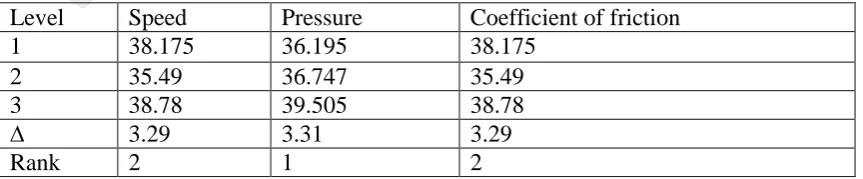
Once these SN ratio values are calculated for each factor and level, they are tabulated as shown below and the range R (R = high SN - low SN)of the SN for each parameter is calculated and entered into the table. The larger the R value for a parameter, the larger the effect the variable has on the process. This is because the same change in signal causes a larger effect on the output variable being measured. Table 3, shows the response table for S/N ratios using larger-the-better approach.
Table 3. Response Table for S/N Ratios Using Larger-The-Better
Level Speed Pressure Coefficient of friction
1 38.175 36.195 38.175
2 35.49 36.747 35.49
3 38.78 39.505 38.78
∆ 3.29 3.31 3.29
Volume 01, No.5, May, 2015
P
age
13
4. RESULTS AND DISCUSSION
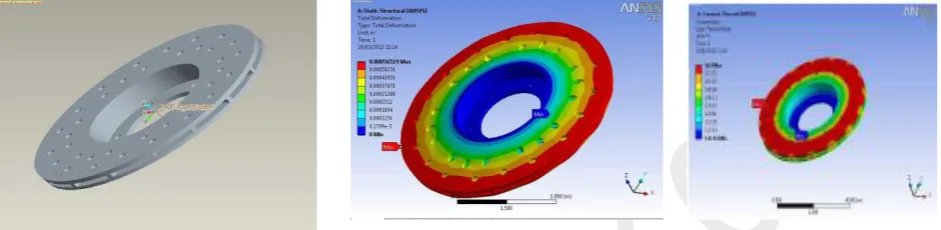
It can be seen that pressure has the largest effect on the processor yield and that speed and coefficient of friction has the smallest effect on the processor yield.An additional confirmation analysis are done using FEA. The Pro-E and ANSYS predicted results are shown in Fig 3.
Fig.3a,3b,3c. Pro-E model , Static structural analysis, Transient thermal analysis
The predicted results of brake performance using Taguchi method, FEA and experimental results from brake test rig found to be in good agreement. It shows the adequacy of the Taguchi approach in prediction of the brake performance. It can be concluded that the optimal value of braking speed is 420 rpm, at pressure value 700pa, coefficient of friction 0.5, temperature 83.50c degree and with dry conditions.
5. CONTRIBUTIONS OF PARAMETERS
Based on the Taguchi method and S/N ratio, contributions of parameters are computed and plotted, as shown in Figure 4. It is found that the applied pressure contributes 51% of the total brake performance. It is followed by the speed, which contributes 38 % of the system performance. Temperature and coefficient of friction contribute 11 and 0.0 % respectively.
Fig. 4.Contribution of different parameters on the novel brake performance.
5. CONCLUSION
Volume 01, No.5, May, 2015
P
age
14
contributes 51 % of the total brake performance of new brake. . It is followed by the speed, which contributes 38 % of the system performance. Temperature and coefficient of friction contribute 11 and 0.0 % respectively. It can be observed that the most significant parameters in this research are applied pressure and speed. At the end of this research, it is seen that Taguchi method can simplify the test protocol required to optimize internally ventilated cross drilled disc brake by reducing the number of trial batches.
REFERENCES
i M.Z.Akop, “Thermal Stress Analysis of Heavy truck brake disc rotor”, IJMET ISSN, Vol.1 No.1,pp.2180-1053,2009.
ii Danet Suryatama, “Thermal Judder on drum brakes due to mounted radial run out ”, 2nd ANSA,pp.2180-1053,2009.
iii F.Talati and S.Jalalifar, “Investigation of Heat Transfer phenomena in a ventilated disk brake rotor with straight radial rounded vanes”, IJAS, 8(20),pp.3583-3592,2008. iv H,Mazidi, S.Jalaifar and J.Chakhoo, “Mathematical Modeling of Heat Conduction in
a Disk Brake System During Braking”, AJAS,ISSN Vol.4(2),pp.119-136,2011. v A.K.Matta,“Construction of a Test Bench for Bike rim and Brake Rotor”, IOSRJEN,
ISSN Vol. 2(8),pp.40-44,2012.
vi Junichiro YAMABE, Masami TAKAGI, Toshiharu MATSUI, “Development of Disc Brake Rotors for Heavy-and Medium- Duty Trucks with high thermal Fatigue Strength”, Technical Review ,No. 15 ,pp.42-51,2003
vii Ajit A. Patil, “Optimization of supercritical fluid extraction and HPLC identification of wedelolactone from Wedelia calendulacea by orthogonal array design” IJAS,pp.1- 7,2013
viiiJi-Min Wang, “Optimization of parameters for an aluminum melting furnace using the Taguchi approach”, ATE,elseveir,pp.33-43,2013
ix P.Karthikeyan, “Optimization of Operating and Design Parameters on Proton ExchangeMembrane Fuel Cell by using Taguchi method” ,IconDM,elseveir,pp.409-418,2013.
x Ramazan Cakırog˘lu, “Optimization of cutting parameters on drill bit temperature in drilling by Taguchi method”, measurement, Elseveir, pp.3525-3531,2013.
xi I.N. Tansel, “Taguchi Method–GONNS integration: Complete procedure covering from experimental design to complex optimization” , Elseveir, pp.4780-4789,2011. xii Mariajayaprakash, “Failure detection and optimization of sugar mill boiler using
FMEA and Taguchi method” , EFA,Eslevier,pp.17-26,2013.