DEVELOPMENT OF WEB COMPONENT GENERATORS
USING ONE-STAGE METAPROGRAMMING
Vytautas Štuikys, Marijus Montvilas, Robertas Damaševičius
Software Engineering Department, Kaunas University of Technology Studentų St. 50, LT−51368 Kaunas, Lithuania
e-mail: [email protected], [email protected], [email protected]
Abstract. We consider a methodology for the development and application of a class of generators that are externally parameterized tools enabling to generate Web component instances on demand depending on the context of use. Such generators are generalized entities of conventional Web components that indeed are lower-level generators for the portal domain. We use one-stage heterogeneous metaprogramming techniques for implementing the externally parameterized metaprograms as a specification of the generators. The first our contribution is a systemized process to create the externally parameterized metaprograms for building Web domain generators. The process describes a logical linking into the coherent structure of the following entities: semantic model for change, program generator model, Web component instance model, and given metalanguages. The second our contribution is the complexity estimation of Web component generators that were developed and used for generating Web component instances to incorporate them into real portal settings. The complexity is estimated using the Kolmogorov’s complexity measures and Cyclomatic Complexity. We analyze also specific features and characteristics of the developed generators.
Keywords: Web component models, Web component generator, one-stage heterogeneous metaprogram-ming, complexity measures of metaprogram, Kolmogorov’s complexity.
1. Introduction
Over at least ten past years, various organizations have envisioned portal solutions (Web) as a necessity to develop and maintain integrated, personalized en-vironments for collaborative activities. Though now the rate of growth of Web portals has stabilized in comparison to the boom of the last decade of the 20th
century [1], creating new portals remains as actual problem as ever due to unsurpassable capabilities of Web technology for connecting peoples for interaction and information interchange. Many organizations and design teams are involved in creating Web-based ap-plications until now. This continues to happen because of the fact that the initial Web implementation, defined by its static nature and a purposefully low barrier to entry, was sufficient only for some time for sharing documents. But now this is inadequate to more ad-vanced applications.
Though the infrastructure problems of the Web have been largely solved now [2-4], the market pres-sure and complexity growth of applications result in the need for a more effective design process of the Web portal development per se. The problem we deal with here is the development of Web component gene-rators through the use of the one-stage metaprogram-ming techniques.
In the context of the paper, by Web component generators we mean a class of generators which are externally parameterized tools enabling to generate Web component instances on demand depending on the context of use. Such generators are generalized entities of conventional Web components that indeed are lower-level generators for the portal domain [5-7]. Before using in a concrete context, parameterized generators are firstly to be instantiated.
By one state-stage metaprogramming techniques we mean heterogeneous metaprogramming [8], in which the functionality of portal domain is expressed through multiple languages relevant to the domain and the external generalization is expressed using at least one metalanguage (e.g., ASP that is used as a meta-language to express through parameterization scripting and modifications). The term “one-stage” means that we do not exclude the possibility to apply “multi-stage” metaprogramming in the other context. The aim of using the metaprogramming techniques is to en-hance reuse and to extend generating capabilities of the known technological infrastructure, such as the one proposed by Microsoft [9] and used in practical implementations of the created generators.
describes a logical linking of the following entities into the coherent structure: semantic model for change, program generator model, Web component instance model, and given metalanguages. The second our contribution is the complexity estimation of Web component generators that were developed and used for generating Web component instances to incor-porate them into real portal settings. The complexity is estimated using the Kolmogorov’s complexity mea-sures [10] and Cyclomatic Complexity.
The rest part of the paper is organized as follows. Section 2 analyzes related works. Section 3 presents a domain analysis framework and portal domain models (as a result of the analysis and input to building gene-rators). Section 4 provides the problem formulation and the definition of basics terms. Section 5 analyzes some properties of Web components. Section 6 pre-sents the Web component generator model. Section 7 describes a method as a detailed process for creating externally parameterized metaprograms, i.e., input specifications that enable functioning of domain generators. Section 8 provides and deals with experi-mental results and complexity issues of the developed generators. Section 9 provides analysis and evaluates the total results. Finally, Section 10 states conclusions and future work.
2. Related Works
Since we consider the development of portal com-ponents as a connection of two domains (i.e., portal technology and its application, and solution domain based on using meta-programming techniques), we identify two basics streams of related works: 1) Web technology and Web-based generators; 2) heteroge-neous metaprogramming techniques. Other sources which are important in the context of the paper (such as those related to domain analysis and reuse) are introduced in other Sections together with our consi-derations.
Stream 1. As the portal development is indeed a very wide field, here we restrict ourselves by present-ing only those works which are either general and most informative for portal development (such as overviews, taxonomies, technology needs evaluation, etc.) or directly relates to the problem we consider (such as Web-based generators).
Coffmam and Odlyzko [1] evaluate the size and the growth rate of the Internet at the end of the last century when the boom of the technology was evident. Fielding and Taylor [2] analyze design issues of the modern Web architecture. In a similar paper, Hazra [3] analyzes architectures of Enterprise Portals and for-mulates basic principles of their design. ST Electro-nics (Info-Software Systems) Pte. Ltd. [11] applies a lightweight, reactive approach to support an industrial Web Portal product line. According to the announce-ment, unique characteristics of the approach are fast, low-cost migration from a single, conventional Web Portal towards a reusable “generic Web Portal”
solution, effective handling of large number of func-tional variants and their dependencies, the ability to rapidly develop new Web Portals from the generic one, and to independently evolve multiple Web Portals without ever losing a connection between them and the “generic Web Portal”.
Doyle and Lopes [4] present a survey of Web based technologies for the Web application develop-ment. Authors conclude that although the infrastruc-ture problems have largely been solved, “the caco-phony of technologies for Web-based applications reflects the lack of a solid model tailored for this domain”. Losh [7] analyzes the simplest Web gene-rators as a form of the online hypertext and provides taxonomy of some of the most popular generator types (i.e., those that create original verbal or visual online texts).
Rajapakse and Jarzabek [12] identify important technological needs in relation to reference architec-ture for Web Applications and show how different technological trends address each need. The paper is interesting to those who want to get a grasp of the Web technology landscape and understand major trends. Djemaa et al. [6] describe a generator for adaptive Web applications called GIWA that aims at the design and automatic generation of adaptable Web interface. The GIWA methodology is based on three levels: semantic level, adaptation level and presen-tation level. The implemenpresen-tation of GIWA is based on java swing interface to instantiate the models which are translated in XML files. The methodology uses then XSL files to generate the HTML page corres-ponding to the user. Helman and Fertalj [5] present generators in Web development process and overview of key features of Web applications and development. The research focuses on how those features are im-plemented and supported by different Web application generators and other Web development tools.
Stream 2. Metaprogramming-based techniques and approaches are also widely discussed in the literature. What is important to know is that the relative ap-proaches very often are called using different terms (e.g., transformation-based, generative, multi-stage programming, etc.) as it is identified in [13]. In this paper, Damaševičius and Štuikys analyze also the known taxonomies in the field and present a more extended taxonomy of the fundamental concepts of metaprogramming. Taha, in his contributory work [14], calls metaprogramming as ‘multi-stage program-ming’. Trujillo with colleagues [15] generalize the metaprpogramming approaches identifying them as ‘generative metaprogramming’. Cruz et al. [16] ana-lyze the role of the languages and compare generators for language-based tools.
the main focus is given to variability aspects in order to implement domain generators. Combining approa-ches in both categories (a) and (b) one might agree with the Veldhuizen’s vision that metaprogramming is “the study about software generalization” [23]. We exploit the observation given to the metaprogramming techniques as it is explained in the remaining Sections 3 to 7.
3. Domain analysis
With the generative reuse approach [24, 25] in mind, the initial assumption as a roadmap for investi-gation is as follows: the approved way for building domain generators is to start from domain analysis. The next assumption follows: either a designer/ana-lyzer is an expert in two domains at once (Web portal and program generator design using metaprogram-ming techniques), or a team that performs the work has the stated knowledge.
In general, analyzer has at least three possibilities: 1) to apply an ad hoc analysis method; 2) to apply a systematic method which should be selected from a series of known methods such as FODA [26], FORM [27], Prieto-Diaz [28], etc.; 3) to modify the known methods or combine them in somewhat way. Here we use ad hoc analysis. Reasons for that are two: sim-plicity and our determination to rely on the analyzer’s knowledge in the portal field. A success of the use of ad hoc methods depend on such factors as: 1) under-standing by analyzer the aims of analysis including the awareness on which aspects to focus; 2) expert’s /analyzer’s knowledge including literature studies; 3) understanding what result from analysis should be
obtained and what representation of the result is most relevant for generators design.
Analysis of (a) generator design approaches [8, 17-19] and (b) product line approaches [20-22] and other sources shows that the main focus should be given to variability aspects. On the other hand, as Web based approaches are so rapidly evolving, the “cacophony of technologies” [4] is another aspect to focus on. We focus on these aspects in analysis of the portal do-main. The variability aspects can also be treated as
design for change [29]. Thus the result of analysis should reflect the both sides of the domain: tech-nological characteristics and application or user-related characteristics. The later issues are conceived in this context as requirements for change. Domain analysis results in collecting of the relevant infor-mation in order to achieve the goal. In reuse literature (see [30]), this information is called by general term, namely domain model.
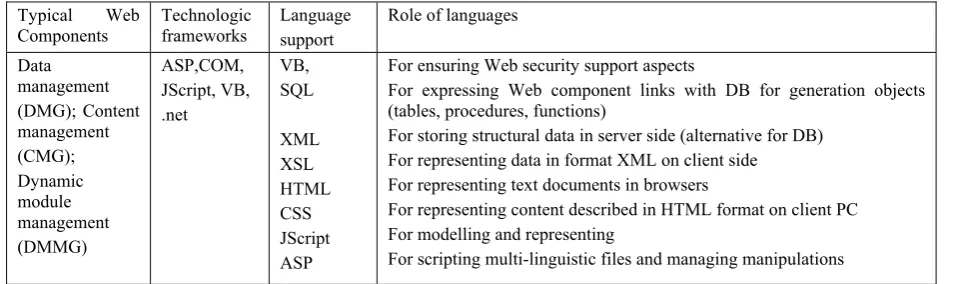
What aspects describe the domain model we extract through analysis of the portal domain? Firstly, we obtain the portal model that describes technological characteristics which are most important to our context: typical Web components that practi-cally appear in most types of portals, technological infrastructure that is needed to implement portals; domain languages as a part of the infrastructure. The language aspect is represented separately in the model because of the importance of this aspect for generators (most types of generators are language-based tools [16]). As portal domain is the one, which is specified through a multi-linguistic approach, the role of each language within the framework should be identified too. Table 1 summarizes technological aspects of the domain model.
Table 1. Basic technological aspects of portal domain Typical Web
Components Technologic frameworks
Language support
Role of languages
Data management (DMG); Content management (CMG); Dynamic module management (DMMG)
ASP,COM, JScript, VB, .net
VB, SQL
XML XSL HTML CSS JScript ASP
For ensuring Web security support aspects
For expressing Web component links with DB for generation objects (tables, procedures, functions)
For storing structural data in server side (alternative for DB)
For representing data in format XML on client side For representing text documents in browsers
For representing content described in HTML format on client PC For modelling and representing
For scripting multi-linguistic files and managing manipulations
The next part of the model is the application-rela-ted or possible user-relaapplication-rela-ted information. This informa-tion connects the anticipated requirements for change with the portal components characteristics. The list of component characteristics with examples includes: data formats, data types, modes of their representation, selecting conditions, features such as a structure of files that are increments of the components, etc. Constraints identify what relationships are not feasible among variants of various characteristics (some of
these characteristics are presented along with experi-mental results in Section 8).
4. Problem statement
model and a metalanguage to support one-stage programming. The design task is formulated as fol-lows:
To transform the given models 2 and 3 into the external metaprogram written using the given meta-language (model 4) so that two pre-defined conditions are satisfied: a) the requirements for change and constraints are fulfilled; b) the metaprogram, when executed, generates a set of Web component instances that are syntactically and semantically correct in the given context of use.
To facilitate the problem to be solved, one pre-liminary step should be done firstly: we need to com-bine the requirements for change and models 2 and 3 into a unified model, which we call a semantic model. If this preliminary step is done, then the task can be reformulated as a transformation of the semantic mo-del into a metaprogram satisfying the same constrains. The other note relates to the terminology. As there are many terms with a very close meaning, we define the terms with the extending explanation of their meaning in this Section.
(Parameterized) Web component generator is an externally parameterized tool enabling to generate component instances on demand (the definition em-phasizes the process aspects). Such a generator is a generalized entity of conventional Web components that indeed are lower-level generators for the portal domain. Before using parameterized generators in a concrete context, they are firstly to be instantiated. The output of the parameterized generator is not the data (Web page as it is in the case of simple gene-rators) but a domain program that generates Web-based data.
One-stage metaprogramming is the one that uses only one level for expressing generalizations in the heterogeneous metaprogramming paradigm. External metaprogram is the one which: a) is developed accor-ding to the principles of heterogeneous metaprogram-ming; b) serves as an input specification to the para-meterized generator. Metaprogram is also a generator but metaprogram expresses specification aspects that govern the generation process. Metaprogram can be also called metaspecification. Structurally, metaprog-ram (metaspecification) consists of the two interrela-ted parts: metainterface (for specifying parameteriza-tion) and metabody (for expressing generalizations through modifications/changes).
Web component instance is an object for imple-menting generalizations, i.e., for creating metaprog-ram/parameterized generator. Metalanguage is a lan-guage, which serves for specifying operations that implement generalizations through changes. Target (or domain language) is the one which describes some functional aspects of Web component instances.
In the next two Sections, we describe and analyze the structure and some properties of Web component instances, which are essential to understand the ins-tance and generator models, respectively.
5. Properties of Web component instances As a result of analysis, three typical Web com-ponents were identified (see Table 1). They are: Data management (DMG); Content management (CMG) and Dynamic module management (DMMG). The components are applied across multiple applications but with slightly different characteristics. Differences follow from the model (see Table 1). The next description identifies the properties of components in detail.
1. Structural properties of Web components are as follows: structure of the component is a set of different files each representing some particular attributes (e.g., representation, selection of data, data management, etc.).
2. Components are reusable entities which were not created from scratch but were extracted from the previously developed projects. The latter means that the entities were reused and their quality was approved by the use cases.
3. Files as constituents of the components have the following structure: invariant and variant parts. The invariant part represents the description, which does not depend on the context of use. The variant part represents such a functionality that may vary depending on the context of use, but in a concrete context it has a pre-defined value. 4. When the variant part within the given file is
recognized and each variant is identified by a de-signer, such a structure can be treated as a temp-late for reusing in multiple contexts.
5. As a template file is a model for the instantiation of the file in a given context, it can be treated as a low-level semi-automatic generator; where the instantiation is performed manually and the inva-riant part is represented automatically (this is a lower-level domain generator [4]).
6. As the intrinsic features of the files describe a variety of specific attributes of the domain (e.g., representation, transferring, security, etc.), files are to be combined into a coherent structure that, from the designer’s viewpoint, is treated as a monolithic component.
7. Each file has a separate technological support, i.e., a file is described using different languages (one or a few for the same file, e.g., ASP+ Jscript + HTML). The capabilities of the given techno-logy ensure the composition of files into the coherent monolithic structure through a simple integrating mechanism, i.e., the file name (if there is nothing to transfer to other file) or the call-type statement (if there are data/parameters to transfer to other file). The file name/the call-type state-ment are also treated as an interface for integ-rating files into a coherent structure.
9. The sequencing of files within a given component is arbitrary. The given sequence pre-specifies the structure of the component. As the arrangement of files within the component is arbitrary, one can consider the model of the component as distri-buted files. The position of the file within the component is also its interface.
The specified properties are sufficient to generalize the Web component model in order to device the externally parameterized Web component generator, which uses the white-box reuse model combined with metaprogramming techniques as it is described in the next two sections.
6. Web Component generator model
The aim is to show that typical component models used in other domains and Web-based component models are slightly different entities. Typical
compo-nent models (e.g., those that describe software [30], or hardware [31] components) contain two essential parts: interface and functionality. The basic feature of the parts is that they are explicitly separable (see Figure 1, a). In order to construct a generator based on heterogeneous metaprogramming techniques the com-ponent model is to be generalized. One way to do so is to introduce new functional aspects into the initial model through changes. The additional functionality usually affects the internal structure of both parts of the model, its interface and functionality. Such a kind of generalization is also known as widening [30]. The generalization using widening results in the creation of a metamodel (metacomponent); this contains meta-interface for managing changes and generalized func-tionality (aka metafuncfunc-tionality or metabody) for managing generation (when implemented) as it is shown in Figure 1b. Metainterface is clearly separable from its metabody (see a dotted line in Figure 1b).
Figure 1. Component models: a) typical component instance; b) typical metacomponent; c) Web-based component model; d) Web-based metacomponent model
Now we can present and discuss the Web-based component and their generator models (see Figure 1c
and d), which are based on the properties discussed in the previous section. The graphical notation has the following meaning. In Figure 1 c, contour (rectangu-lar) represents a file; darkened places within a rect-angular denote variable part and interface; the rest part of a rectangular denotes the invariant part. In Figure 1
d, broken line denotes metainterface as an irregularly distributed structure; the distributed rectangular (with 45 degree lines) indicates generalization aspects (scripting and modification of the files).
Conceptually (if we ignore a great number of files and their distribution within the models c, and d) models have the same structure as their counterparts
(see Figure 1a and b). The difference can be obtained if one looks at the semantics (roles) and internal structure of these two kinds of the models. The models (a and b) are intended to describe computational or structural aspects only, while the models (c, d) are intended to describe representational, distributional (transferring) and manageable aspects (e.g., to support both server and user sides connections via the network) in the first place. If computational aspects are needed, they are not ignored too, but their role is miserable in this context. It is the reason why we need to reflect all these aspects in the Web-based model (see Figure 1 and compare a and c). Generalization of the Web-based model (in order to obtain the model d) follows the same track as it was described above. Interface
Functionality
IiIntIiiiiiiIn
Functionality Interface Metainterface
a)
b)
c)
d)
Generalized functionality (meta-functionality) through changes introduced changes
Metabody
Legend:
–variant part
and interface –metainterface –generalization
–file;
The basic idea behind building domain generators is the model transformation into relevant programs and metaprograms. To implement a domain generator, such as the Web-based generator, a technological sup-port (e.g., Web-based languages and their interpreters) should encompass all aspects the model describes. Since the Web-based component model reflects many aspects of the domain it is difficult to express these aspects using one or two languages only and a series of languages are used (see, e.g., [4, 9] and as well experimental results here). Today, despite of the “cacophony of technologies”, the Web infrastructure is developed and it is giving a good enough support for designers.
7. One-stage metaprogramming: A method for implementing domain generators
We accept the following pre-conditions: 1) All initial data are given as they were identified in Section 4; 2) target (domain) language(s) and tools that support the language(s) are execution-level domain generator(s) [6]; 3) metaprogram that modifies in some way a target program written in the target language is the designer’s-level (construction time) program generator. The aim is to describe a method stating how metadesigner creates a metaprogram in general, i.e., independently on the application domain and metalanguage. But when we need to make some emphasis on domain specificity, which affects meta-programming, we reflect the specificity in the method. Below we describe the method as a logical sequence
of the processes metadesigner performs in order to develop a metaprogram.
1. To make a choice in selecting a metalanguage or metalanguages (e.g., in Web component design) to support the implementation of generation/gene-ralization aspects (in other words white-box reuse). For example, in the case of using meta-programming to develop Web-component genera-tors, we apply two metalanguages (e.g., ASP+VB, where ASP supports modification (change) as-pects and VB supports Web security asas-pects) in the same metaspecification at once.
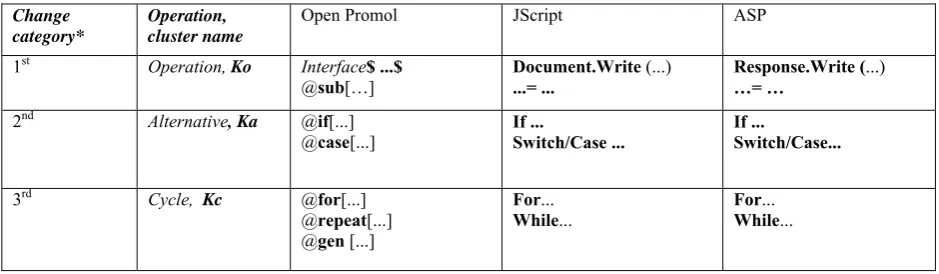
2. To analyze the selected metalanguage/metalan-guages and, according to structural programming principles, to form three clusters of constructs for each metalanguage as follows. The first cluster
Ko contains constructs that correspond to
ope-rations such as assignment, Read/Write (see Table 2). The second cluster Ka contains those
const-ructs that enable to realize alternative decisions (e.g., if, case). The third cluster Kc contains
constructs that enable to code loops in a meta-program. Table 2 provides clusters Ko, Ka and Kc
for three different languages (Open Promol, JScript, ASP), which may be candidates for the metalanguage selection in various contexts. 3. To perform semantic analysis of requirements for
change aiming: a) to identify and fix constraints (if yet they are not given) within requirements; b) to form two clusters (classes) within requirements (orthogonal changes, which have no other changes within and hierarchic changes that con-tain other changes within).
Table 2. Clusters as subsets of constructs of three different languages
Change category*
Operation, cluster name
Open Promol JScript ASP
1st Operation,
Ko Interface$ ...$
@sub[…]
Document.Write (...) ...= ...
Response.Write (...) …= …
2nd Alternative
, Ka @if[...]
@case[...] If ... Switch/Case ... If ... Switch/Case...
3rd Cycle,
Kc @for[...]
@repeat[...] @gen [...]
For...
While... For... While...
Note:*) type of change in orthogonal category
What is important to emphasize is that orthogonal changes are also categorized into three categories as follows:
I. Changes of the 1st category are those that are
im-plemented using operations from cluster Ko.
II. Changes of the 2nd category are those that are
im-plemented using operations from cluster Ka.
III. Changes of the 3rd category are those that are
im-plemented using operations from cluster Kc.
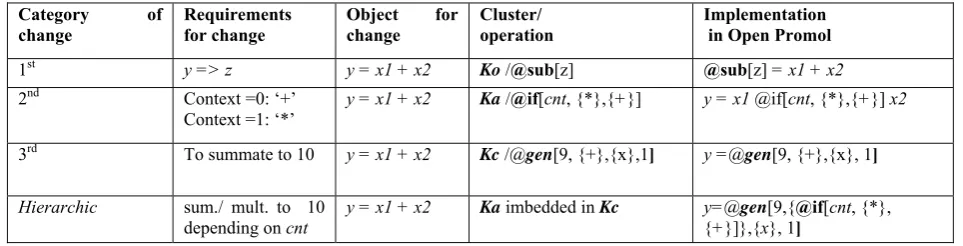
Simple examples explain the meaning of ortho-gonal changes in each category as well hierarchic
changes below (see Table 3).
4. To form a semantic model SM for change, which
describes links or relationships among require-ments and other given initial data, clusters of operations, constraints and represents changes types by parameters and their values. The model is described by sixth sets as identified by (3):
Table 3.Matching between categories of change and operation clusters and implementation of requirements for change Category of
change
Requirements for change
Object for change
Cluster/ operation
Implementation in Open Promol
1st y => z y = x1 + x2 Ko /@sub[z] @sub[z] = x1 + x2
2nd Context =0: ‘+’
Context =1: ‘*’
y = x1 + x2 Ka /@if[cnt, {*},{+}] y = x1 @if[cnt, {*},{+}] x2
3rd To summate to 10 y = x1 + x2
Kc /@gen[9, {+},{x},1] y =@gen[9, {+},{x}, 1]
Hierarchic sum./ mult. to 10
depending on cnt y = x1 + x2
Ka imbedded in Kc y=@gen[9,{@if[cnt, {*},
{+}]},{x}, 1]
Note. cnt is a metaparameter meaning the context of use (if cnt=1, to perform multiplication; otherwise – summation).
Explanation:
<semantic description for change> serves for transferring information to metaprogrammer about semantics of change; this information is extracted from the informal description of requirements and it is used as comments in the metaprogram to be deve-loped;
<class of change with operation type > may be orthogonal in three categories or hierarchical; it is obtained in step 3; it also indicates operations needed to implement a given class of changes; operations are obtained from Table 4 (see also step 2); for each category, an orthogonal operation from clusters is identified separately;
<libelled component instance> indicates a place-holder within a given component instance (domain/ target program), where a given change is to be per-formed; to identify placeholders for change, semantic analysis is to be performed; the procedure is a part of activity of creating SM (see step 5);
<change parameter> is the metaprogram object or metaparameter through which manipulations are ex-pressed when metaprogram is executed (simply speak-ing, it is a metaprogram variable to support operation declarations and their execution; it plays the same role as variable in a conventional program);
<set of parameter values> is a set of feasible para-meter values identified during requirement analysis and semantic model formation;
<constraints > show forbidden combinations between parameter values.
5. To analyze a given component instance and identify placeholders within the code where changes are to be embedded; though the component consists of many parts described using multiple language (see Table 1 and model in Figure 1c), a metadesigner treats the component as homogeneous structure that is coded using a unique scripting language (e.g., ASP).
6. To perform a logical linking of four entities: a gi-ven component instance (see step 5); metaprogram structure (it consists of metainterface and meta-body), clusters of a metalanguage (see Table 3) and
semantic model (3). Rules for logical linking are as follows:
• Rule A: To form the metainterface of the meta-program to be designed according to formula (4), where metainterface MI is formally expressed through mappings and transformations of ade-quate sets. Sets are found in the semantic model.
( )
(
)
(
)
( )MI C
M V P
SM k K K K ML
i i
c a
o ∈
⇒
= , ,
' ; , ,MI∈ML. (4)
Here SM
'
– semantic model reflecting the change aspects, where the instance is ignored (it is assumed that the instant I is described implicitly);Pi – (meta)parameter for change i (i=1, .... n); n –
number of changes (parameters); Vik – set of
va-riants for (meta)parameter i; M – set of
modifi-cation (change) classes with identified operations,
C – set of constraints, MI – metainterface; ML –
set of constructs of a metalanguage;
⇒
– is treated as a model transformation.• Rule B: To codify and transform the semantic model SM into the metaspecification body MB
according to formula (5), where metabody MBis formally expressed through mappings and trans-formation of adequate sets:
(
)
(
I P M C)
( ) MBSM i K K K ML
c a
o ∈
⇒
= ; , , , ,
( )
(
ML TLI)
MB∈ ∪ . (5)
Here SM is the semantic model that specifies the needed sets including those that describe changes
M; I – a component instant with placeholders (see also Table 4 and properties 3-5 in Section 5), which is seen as a function of parameters and a set of modifications M; TL – target language (lan-guages) to describe the instant I.
We receive the product, the metaprogram (see (6)), as a result either of concatenation of models (4) and (5) (e.g., using Open Promol [8], where metainterface is an external entity) or integration of the models (e.g., using metalanguages, which support internal inter-faces within the program structure).
MP MB
where ∪ means the integration of MI and MB accor-ding to the syntax rules of a given ML.
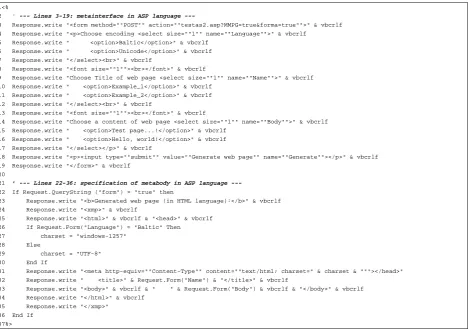
Figure 2 illustrates the result of the process of creating metaprograms according to the proposed methodology. Note that there is an illustrative example
of a metaprogram only, which contains one file with metainterface (lines 3-19) and metabody (lines (22-36). This metaprogram, which is coded in ASP, generates the domain program in HTML (not shown).
1<%
2 ' Lines 3-19: metainterface in ASP language
---3 Response.write "<form method=""POST"" action=""testas2.asp?MMPG=true&forma=true"">" & vbcrlf 4 Response.write "<p>Choose encoding <select size=""1"" name=""Language"">" & vbcrlf
5 Response.write " <option>Baltic</option>" & vbcrlf 6 Response.write " <option>Unicode</option>" & vbcrlf 7 Response.write "</select><br>" & vbcrlf
8 Response.write "<font size=""1""><br></font>" & vbcrlf
9 Response.write "Choose Title of web page <select size=""1"" name=""Name"">" & vbcrlf 10 Response.write " <option>Example_1</option>" & vbcrlf
11 Response.write " <option>Example_2</option>" & vbcrlf 12 Response.write "</select><br>" & vbcrlf
13 Response.write "<font size=""1""><br></font>" & vbcrlf
14 Response.write "Choose a content of web page <select size=""1"" name=""Body"">" & vbcrlf 15 Response.write " <option>Test page...!</option>" & vbcrlf
16 Response.write " <option>Hello, world!</option>" & vbcrlf 17 Response.write "</select></p>" & vbcrlf
18 Response.write "<p><input type=""submit"" value=""Generate web page"" name=""Generate""></p>" & vbcrlf 19 Response.write "</form>" & vbcrlf
20
21 ' --- Lines 22-36: specification of metabody in ASP language ---
22 If Request.QueryString ("form") = "true" then
23 Response.write "<b>Generated web page (in HTML language):</b>" & vbcrlf 24 Response.write "<xmp>" & vbcrlf
25 Response.write "<html>" & vbcrlf & "<head>" & vbcrlf 26 If Request.Form("Language") = "Baltic" Then 27 charset = "windows-1257"
28 Else
29 charset = "UTF-8" 30 End If
31 Response.write "<meta http-equiv=""Content-Type"" content=""text/html; charset=" & charset & """></head>" 32 Response.write " <title>" & Request.Form("Name") & "</title>" & vbcrlf
33 Response.write "<body>" & vbcrlf & " " & Request.Form("Body") & vbcrlf & "</body>" & vbcrlf 34 Response.write "</html>" & vbcrlf
35 Response.write "</xmp>" 36 End If
37%>
Figure 2. An illustrative example of the fragment of a metaprogram (with the metainterface and metabody in ASP)
The process of creating a metaprogram is yet not complete, if there is no evidence on quality of the product. As we use abstracts models, we ensure quality through generation and testing of generated instances. Testing should cover at least all different paths in the metaprogram. Each tested path should correspond at least to one variant for each parameter. Testing of a particular instance is similar to a conventional program testing: we need to execute the instance using the target language (interpreter/pro-cessor) and check syntactic and semantic correctness. In this paper we provide two complexity measures to reason about the complexity of created metaprog-rams (see Section 8).
8. Experimental results
8.1. Analysis of characteristics of developed generators
The experimental results have been obtained through the development and the use of three Web
component generators. The Generators incorporate those components that are most frequently used to implement portal-based systems (see Tables 1, 4). Using the generators, the needed component instances were automatically generated on demand depending on the context of a concrete usage. The derived instances were then integrated into 3 portal settings for different organizations. The results we describe below are split among Tables 4-6. Table 4 summarizes multi-linguistic aspects of the generators only.
Table 4. Multi-linguistic aspects of parameterized Web components described as one-stage metaprograms
No Component
generator type Meta-language
s*
Target languages Explanation of roles of languages
1 Data management
(DMG) generator
VB ASP
SQL (Server side) XML (more ser XSL (Client) HTML (Client) CSS (Client) ASP (for Scripting)
2 Content
management (CMG) generator
VB ASP
XML,
XSL, HTML, CSS JScript
ASP
3 Dynamic module
management (DMMG) generator
ASP XML, XSL, HTML,
JScript, ASP
Roles of target languages were identified yet at the analysis phase (see Table 1). ASP as a target language is for scripting of other files *). ASP as a metalanguage is for specifying generation of the anticipated changes. VB as a metalanguage supports Web security aspects. Both metalanguages support generation aspects, i.e., ASP calls VB components when it is needed in the generating process and the VB part returns the generated data.
*) Note. We distinguish two kinds of scripting: logical and physical. The first means creating links between files through the call-type statements. The second means physical composition of files resulting in the change of the file structure.
Table 5. Characteristics of metaprograms as domain generators
Metaparameters (MP) Characteristics of Internal files Generator’s (metaprogram’s)
size Generator
type
MP
# Variants # of a MP [from… to]
Constraints #
Number of files
#*)
Average # of lines/B
Total # of
lines/MB interface Meta-(lines/~MB)
Meta-body (lines/ ~MB)
DMG 14 4..16 >50** 105 106/4800 B 11130/7.3 3339/2.2 7791/5.1
CMG 21 1..50 >200** 140 210/6590 B 29400/14.4 13230/6.5 16170/7.9
DMMG 4 1..4 0 40 79/2870 B 3160/5.4 1896/3.2 1264/2.2
Notes: *) - see Figure 1, c, d and Section 5. **) Constraints are introduced through analysis: either 1) to comply standards (e.g., HTML, SQL, etc.), 2) to fulfil requirements or 3) to simplify the implementation.
8.2. Estimation of complexity of the developed generators
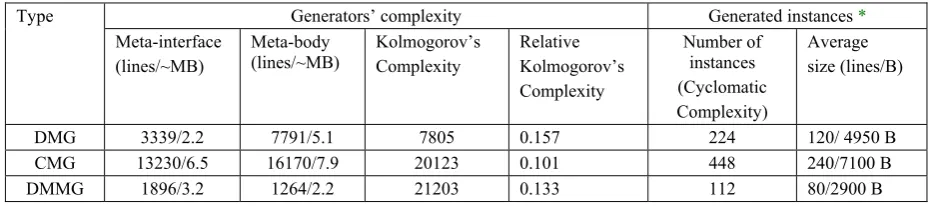
It is important to estimate the complexity of the developed generators (i.e., metaprograms) for many reasons (e.g., comparative study, testing and compre-hension, etc.). Table 6 presents derivative characte-ristics of the complexity of the generators. The comp-lexity of metaprograms can be evaluated, e.g., using such measures as LOC (lines of code), Kolmogorov’s Complexity (KC), Relative Kolmogorov’s Complexity (RKC) and Cyclomatic Complexity (CC). KC mea-sures complexity of an object by the length of the
smallest program that generates it. RKC is calculated as complexity of an object divided by the length of an object. A high value of RKC means that there is a high variability of metaprogram’s code content, i.e., high complexity. A low value of RKC means high redun-dancy, i.e., the abundance of repeating code fragments in metaprogram. CC was proposed by McCabe in 1976. It directly measures the number of linearly independent paths through a program's source code from entrance to each exit. For metaprograms, CC is equal to the number of distinct domain program instances that can be generated from a metaprogram.
Table 6. Comparison of complexity measures of the developed generators and generated instances
Generators’ complexity Generated instances *
Type
Meta-interface (lines/~MB)
Meta-body (lines/~MB)
Kolmogorov’s Complexity
Relative Kolmogorov’s Complexity
Number of instances (Cyclomatic Complexity)
Average size (lines/B)
DMG 3339/2.2 7791/5.1 7805 0.157 224 120/ 4950 B
CMG 13230/6.5 16170/7.9 20123 0.101 448 240/7100 B
DMMG 1896/3.2 1264/2.2 21203 0.133 112 80/2900 B
A higher value of CC indicates higher complexity of the metaprogram’s parameter set (metainterface). It is worth to know that CC depends on the number of
space of values, Table 6 represents the only lower bound on CC, i.e., the number of instances which were generated and tested.
Based on the values of these complexity metrics, we can conclude that CMG is the most complex metaprogram with the largest number of component instances that can be generated from it. However, despite its complexity, CMG still has much room for further generalization as indicated by low RKC metric language. To calculate the complexity using the Kolmogorov’s complexity measure, see [10] for details.
9. Discussion and evaluation
The basic results we have achieved and described in the paper are the two: 1) the detailed process of creating externally parameterized metaprograms which are higher-level program generators for the portal domain; 2) functional characteristics and also non-functional characteristics such as complexity measures (e.g., cyclomatic number and Kolmogorov’s complexity measures) of Web components generators which were used in three real portal settings. The dis-cussion relates to those aspects that outline a specifi-city of the methodology used with respect to the portal domain.
Though, in general, the process of creating a metaprogram we have described in Section 7 is inde-pendent upon the application domain, nevertheless some aspects of the process may have specific features for a particular domain. For example, the Web compo-nents are described using not a unique target language but rather a set of portal-oriented languages, each ex-pressing different aspects of that multi-faced domain. Therefore a Web component instance which is to be generalized consists of separate fragments described using different target languages. The fragments are combined in a coherent specification using ASP be-cause of its scripting capabilities. Next, for that do-main, ASP is better suited as a metalanguage for describing modifications than other metalanguages.
On the other hand, it is not enough to have only one meta-language because of the need to specify security aspects independently. Thus the metaprog-ramming-based specification for Web components is multi-linguistic also in terms of generalization because we need to use at least two metalanguages (e.g., VB and ASP). Furthermore, a metalanguage may perform two roles: it describes scripting and modifications in the same specification at once (as it is the case for ASP). As a result of the aforementioned features, the structure of the metaprogram that describes externally parameterized Web generators is slightly different (e.g., metainterface distributed across multiple ins-tance fragments) in comparison to stand-alone meta-programs.
Depending on the capabilities of metalanguage, the semantic model as a basis for developing metaprog-rams may have a slightly different interpretation. For
example, if a metalanguage supports the external in-terface (as it is in the case of using Open Promol), there is no need to express a component instance in the semantic model explicitly. Otherwise, if a meta-language supports an internal interface (e.g., through the WRITE statement, see also Table 2) the semantic model reflects the instance explicitly. Combing these two cases into the one we can write (7):
( )
(
)
(
PV M C)
SM k
i
i ; ,
'= ⊆ SM
(
I(
P M)
C)
i; ,
= . (7)
Though the semantic model SM enables to under-stand the process of creating metaprograms well be-cause of its main focus on linguistic features that are essential to form the metaprogram, however, this is not enough when the amount of changes is big and relationships (including constraints) between them are complex. The semantic model is not a weak instru-ment per se but rather its expressive power is not enough in that case because of complexity of the dealing problem. The complexity of the problem arises due to 1) difficulties of domain understanding and expressing its artefacts through the adequate model, 2) difficulties of implementation technology (i.e., one-stage metaprogramming with multiple meta-languages and multiple domain meta-languages). What is the way for managing the complexity issues? We see the solution by the extending (or combining) the se-mantic model with feature diagrams [26], which are the more relevant models for expressing domain vari-ability and constraints. But this is beyond the scope of the paper.
10. Conclusions and future work
The externally parameterized Web component generators that implement pre-defined and pre-prog-rammed changes according to the principles of hetero-geneous metaprogramming enable to achieve higher quality and productivity with the opportunity for wide-range adaptations in comparison to lower-level generators. But this result is due to the more extensive and accurate analysis of the portal domain per se. The foundation of applying one-stage metaprogramming techniques is a semantic model which is to be devised as a result of portal domain analysis and the analysis of requirements for change. More abstractly, para-meterized Web component generators use the white-box reuse model combined with metaprogramming techniques. We have also identified specific features of the Web component generators in comparison to stand-alone domain program generators. Those fea-tures are: multi-linguistic aspects at two levels (meta and domain) and structural aspects of metaspecification. The complexity measures of the de-veloped generators we present enable to evaluate the complexity of the products and reason about the limits of their evolution.
dia-grams, as well as investigation of multi-stage meta-programming techniques in the development of more powerful Web component generators.
References
[1] K.G. Coffman, A.M. Odlyzko. The size and growth rate of the Internet. AT&T Labs, 1998.
[2] R.T. Fielding, R.N. Taylor. Principled Design of the ModernWeb Architecture. Proc. of 22nd Int. Conf. on
Software Engineering (ICSE '00), Limerick, Ireland,
June 2000, 407–416.
[3] T. K. Hazra. Building Enterprise Portals: Principles
to Practice. ICSE’02, 2002, May, 19-25, Orlando,
623-633.
[4] B. Doyle, C.V. Lopes. Survey of Technologies for Web Application Development. arXiv:0801.2618v1
[cs.SE] 2008 January, http://arxiv.org/PS_cache/
arxiv/pdf/0801/0801.2618v1.pdf.
[5] T. Helman, K. Fertalj. A critique of Web application generators. Proc. of the 25th Int. Conf. on Information
Technology Interfaces, ITI’ 2003, 639 – 644.
[6] R.B. Djemaa, I. Amous, A.B. Hamadou. GIWA: A
generator for adaptive Web applications. Advanced
Int. Conf. on Telecommunications / Int. Conf. on
Inter-net and Web Applications and Services (AICT/ICIW’
06), February 2006, Guadeloupe, French
Carib-bean,19-25.
[7] E. Losh. Assembly Lines: Web Generators as
Hyper-texts. Proc. of the 18th Conf. on Hypertext and
Hyper-media. New York: ACM Press, 2007, 115-122.
[8] V. Štuikys, R. Damaševičius. Metaprogramming Techniques for Designing Embedded Components for Ambient Intelligence. In T. Basten, M. Geilen, H. de Groot (eds.), Ambient Intelligence: Impact on Embed-ded System Design. Kluwer Academic Publishers,
Boston, November 2003, 229-250.
[9] ASP, ASP.NET, COM, JScript, VBScript and .NET
at, http://www.microsoft.com/.
[10] R. Damaševičius. On the Quantitative Estimation of
Abstraction Level Increase in Metaprogramms.
Com-puter Science and Information Systems, Vol.3, No.1,
2006, 53-64.
[11] U. Pettersson, S. Jarzabek. Industrial Experience with Building a Web Portal Product Line Using a
Lightweight, Reactive Approach. ESEC-FSE'05,
Euro-pean Software Engineering Conference and ACM SIGSOFT Symposium on the Foundations of Software
Engineering, ACM Press, September 2005, Lisbon,
326-335.
[12] D.C. Rajapakse, S. Jarzabek. A Need-Oriented As-sessment of Technological Trends in Web Enginee-ring. In D. Lowe, M. Gaedke (Eds.): Proc. of 5th Int.
Conf. on Web Engineering, ICWE 2005, Sydney,
Aust-ralia, July 27-29, LNCS 3579, Springer, 2005, 30-35.
[13] R. Damaševičius, V. Štuikys. Taxonomy of the
Fun-damental Concepts of Metaprogramming. Information
Technology and Control, 37(2), 2008, 124-132.
[14] W. Taha. Multi-Stage Programming: Its Theory and
Applications. Ph.D thesis, Oregon Graduate Institute
of Science and Technology, 1999.
[15] S. Trujillo, M. Azanza, O. Diaz. Generative
Meta-programming. Proceedings of the Conf. Generative
Programming and Component Engineering. GPCE’
07, October 1–3, 2007, Salzburg, Austria, ACM
Publication, 2007, 105-114.
[16] D. da Cruz, M.J.V. Pereira, M. Béron, R. Fonseca, P.R. Henriques. Comparing Generators for
Langua-ge-based Tools. Proc. of the 1st Conf. on Compiler
Related Technologies and Applications, CoRTA'07,
Portugal, 2007.
[17] K. Czarnecki, U.W. Eisenecker. Generative
Prog-ramming – Methods, Tools, and Applications.
Addi-son-Wesley, June 2000.
[18] G. Kiczales. Aspect-Oriented Programming. ACM
Comput. Surv., Vol.28, No.4, 1996.
[19] S. Jarzabek, S. Li. Eliminating redundancies with a "composition with adaptation" meta-programming
technique. Proc. of the 11th ACM SIGSOFT
Sympo-sium on Foundations of Software Engineering 2003 at
9th European Software Engineering Conference,
ESEC/FSE 2003, Helsinki, Finland, September 1-5,
2003, 237-246.
[20] J. Bosch. Design and use of software architectures:
adopting and evolving a product-line approach. ACM
Press/Addison-Wesley Publishing Co., New York, NY,
2000.
[21] K.C. Kang , J. Lee, P. Donohoe. Feature-Oriented
Project Line Engineering, IEEE Software, Vol.19,
No.4, July 2002, 58-65.
[22] K. Pohl, G. Bockle, F. van der Linden. Software
Product Line Engineering. Berlin, Heidelberg, New
York: Springer-Verlag, 2005.
[23] T. L. Veldhuizen. Tradeoffs of Metaprogramming. In: ACM SIGPLAN Workshop Partial Evaluation and Semantic-Based Program Manipulation. Charleston,
South Carolina (USA), 2006.
[24] T. J. Biggerstaff. A perspective of generative reuse.
Annals of Software Engineering, 5, 1998, 169–226.
[25] I.D. Baxter. Transformation Systems: Generative Reuse for Software Generation, Maintenance and Reengineering. In C. Gacek (Ed.): Proc. of 7th Int. Conf. on Software Reuse: Methods, Techniques, and
Tools, ICSR-7, Austin, TX, USA, April 15-19, 2002,
LNCS 2319 Springer, 2002, 341-342.
[26] K.C. Kang, S. Cohen, J. Hess, W. Novak, A. Peter-son. Feature-Oriented Domain Analysis (FODA)
Feasibility Study. SEI Technical Report CMU/SEI
-90-TR-021, 1990.
[27] K.C. Kang, S. Kim, J. Lee, K. Kim, E. Shin, M. Huh. FORM: A Feature-Oriented Reuse Method with
Domain-Specific Reference Architectures. Ann.
Soft-ware Eng. 5, 1998, 143-168.
[28] R. Prieto-Díaz. Status Report: Software Reusability.
IEEE Software 10(3), 1993, 61-66.
[29] P. Grogono. Designing for change. In J. E. Botsford, A. Gawman, W. M. Gentleman, E. Kidd, K. A. Lyons,
J. Slonim, and J. H. Johnson (Eds.): Proc. of the 1994
Conf. of the Centre for Advanced Studies on
Collabo-rative Research, October 31 – November 3, 1994,
Toronto, Ontario, Canada. IBM, 1994, 21.
[30] J. Sametinger. Software Engineering with Reusable
Components. Springer-Verlag, 1997.
[31] P.J. Ashenden. The Designer's Guide to VHDL.
Morgan Kaufmann Publishers, 2nd ed., 2002.