White Rose Research Online
Universities of Leeds, Sheffield and York
http://eprints.whiterose.ac.uk/
White Rose Research Online URL for this paper: http://eprints.whiterose.ac.uk/5422/
Book chapter
Ruddle, R.A. (2001) Navigation: am I really lost or virtually there? In: Harris, D. (ed) Engineering Psychology and Cognitive Ergonomics - Volume Six : Industrial Ergonomics, HCI, and Applied Cognitive Psychology. Ashgate , pp. 135-142.
Navigation: Am I really Lost
or Virtually There?
Roy A. Ruddle
Cardiff University
Abstract
Data is presented from virtual environment (VE) navigation studies that used building- and chessboard-type layouts. Participants learned by repeated navigation, spending several hours in each environment. While some participants quickly learned to navigate efficiently, others remained almost totally disoriented. In the virtual buildings this disorientation was illustrated
by mean direction estimate errors of approximately 90°, and in the
chessboard VEs disorientation was highlighted by the large number of rooms that some participants visited. Part of the cause of disorientation, and generally slow spatial learning, lies in the difficulty participants had learning the paths they had followed through the VEs.
Introduction
Large-scale spaces are those in which it is not possible to resolve all the information required for efficient navigation from a single position if a human’s-eye viewpoint is used. In large-scale virtual environments (VEs), navigation has been researched for approximately 10 years. Anecdotal evidence from early studies indicated that people became disoriented very easily, and this sometimes persisted when they were provided with a map to aid their navigation (Henry, 1992).
primary difference, therefore, between real and virtual environments is the rate at which people develop spatial knowledge (e.g., see Grant & Magee, 1998; Richardson, Montello, & Hegarty, 1999; Witmer, Bailey, Knerr, & Parsons, 1996), and the cause lies somewhere in the reduced interface and environment fidelity of VEs (Waller, Hunt, & Knapp, 1998). Examples of the reduced interface fidelity include the lack of physical movement that is required to travel around VEs, with an associated reduction in kinaesthetic
feedback, and the impoverished field of view (typically 50° - 90°).
Important factors of environment fidelity include the amount of visual detail (e.g., features that can be used as landmarks) and the omission of non-visual sensory information.
The present article illustrates the magnitude of the problems that people encounter when they navigate in VEs. New data is provided from existing studies that used two different types of layout: (i) virtual buildings (Ruddle et al., 1997; Ruddle, Payne, & Jones, 1998), and (ii) chessboard-type environments (Ruddle, Howes, Payne, & Jones, in press).
Virtual Buildings
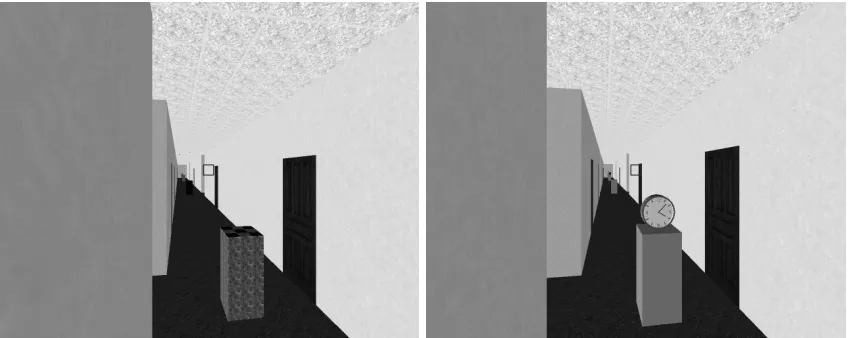
The data reported here are from Experiments 2 and 3 of the 1997 study, and Experiment 2 of the 1998 study. The environments used in these experiments were virtual buildings and, although they only existed in a virtual form, they had the sort of structure that is frequently encountered in the real world. This consisted of a regular network of corridors, off which lay a large number of rooms. The 1997 experiments investigated the effects of adding local landmarks (see Figure 1) to VEs, and the 1998 experiment investigated the effect of providing global orientation information in the form of a compass. A repeated measures design was used, with each participant navigating equivalent VEs (or sections of VEs) both with and without supplementary aids.
Methodology
Participants had to learn the location of several target rooms that were identified using 3D models of characteristic furniture. Learning was performed in a series of navigation sessions (9 sessions (1997) or 8 sessions
(1998)), that were each structured using a day at the office metaphor. With
participant was guided by the experimenter along the shortest route between the rooms. In the remaining sessions, the participant had to find their own way. In all of the sessions, the path that participants followed was continuously recorded. In some of the sessions, and always in the final session, participants estimated the direction and straight-line distance between the target rooms, performing a set of estimates each time they arrived at one of the targets.
Figure 1 A virtual building with abstract landmarks (left) and everyday objects as landmarks (right)
Results and Discussion
In all three experiments, the provision of navigational aids (landmarks or a compass) had little effect on the accuracy of participants spatial knowledge when compared with the control (no aid) condition. The only statistically significant effect was a 16% reduction in the distance that participants travelled when everyday objects were used as landmarks (Experiment 3, 1997). The data reported here refer to the percentage extra distance travelled
(PE-distance = 100 * (distance travelled - minimum possible distance) /
minimum possible distance) and mean direction estimate error in the final
session in each experiment, averaged over the aid and control conditions. These data measured participants’ performance once they had already spent a considerable amount of time (1-2 hrs) navigating a VE.
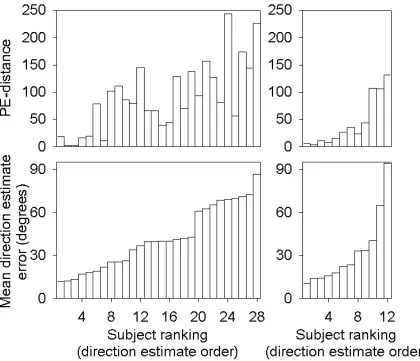
In all three experiments, participants’ mean direction estimate error was
highly correlated with their PE-distance data (r = .86, p < .01 (1997,
measured participants’ sense of orientation. The correlation between the two show that direction estimates, which take only a few minutes to perform, can be used to estimate the overall accuracy of a person’s spatial knowledge. The PE-distance and direction estimate data for the experiments are shown in Figure 2, with the data for the two 1997 experiments combined because they used the same structures of virtual building and experimental procedure. In each case the participants are ranked according to the magnitude of their direction estimate errors.
Figure 2 Mean direction estimate error and PE-distance data for the final navigation session of the 1997 (left) and 1998 studies (right)
their own way between different places and, mathematically, were almost completely disoriented (random guesses for the direction estimates would
produce a mean error or 90°). Thus, although it is true to say that, on
average, people learn spatial knowledge substantially more slowly in VEs than in the real world, this is statement is also an over-generalisation. VEs seem to magnify the differences that exist between individuals to the extent that a minority of participants were unable to learn the layout of environments that had only moderately complex layouts (e.g., a 4 x 4 grid of corridors) and, there can be little doubt, would be straightforward for anyone to learn in the real world.
Chessboard-type Environments
VEs with a chessboard-type structure were used to study the effects of different spatial and temporal attributes of hyperlinks on navigation (Ruddle et al., in press). The data reported here, however, are from the control conditions of Experiments 1 and 2 of the study, where participants navigated conventional versions of the VEs. In these versions, the rooms were connected by doors that opened automatically when a participant approached.
Methodology
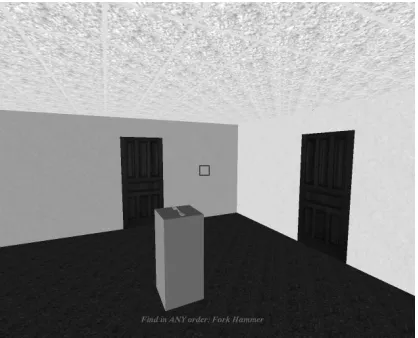
Each participant performed an extended practice in a 12-room VE, and then repeatedly navigated 16-room, test VEs. Each room contained a 3D model of a different everyday object, placed on a 1 metre high plinth (see Figure 3). Participants were informed that there was only one instance of each object. For consistency with the hyperlink conditions, each object was turned on like a light when a participant entered the object’s room, and turned off when the participant exited. This meant that participants had to enter each room to see its contents.
In the test VEs, participants repeatedly searched for eight of the objects, which had been designated as targets. In the first two searches, a participant
searched for the objects in any order. As the participant had no prior
knowledge of the environment’s layout the first search was uninformed
search, whereas the search was an informed search. In the subsequent
searches the participant had to find the objects in a specific order. Only the
Figure 3 View inside a room in a chessboard-type VE
Results and Discussion
For the purposes of the present article, the data for the control (conventional VE) conditions of Experiments 1 and 2 have been combined, because these conditions were identical in the two experiments. Participants’ performance was measured in terms of the number of rooms that they entered in each search.
In the any-order searches, some participants deliberately backtracked to over-learn an environment’s layout. The intention of these participants was, presumably, to reduce the amount of time they took in the specific-order searches but there was little correlation between the percentage of backtracking that participants performed and the number of rooms they
subsequently entered in the specific-order searches (r = -.02, p > .05
(uninformed), and r = .12, p > .05 (informed)). In other words, backtracking
was a deliberate, but often ineffective, strategy.
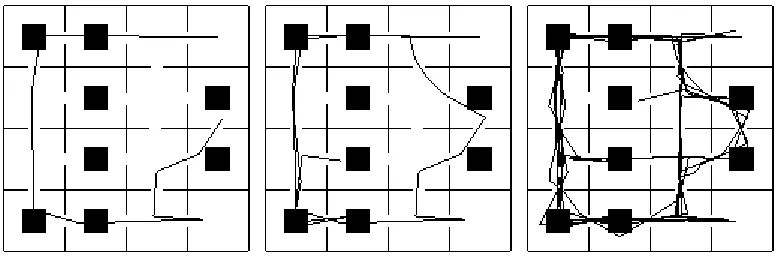
Figure 4 Path followed during the 95-room, informed search. The target objects were in the rooms indicated by the black squares.
General Discussion
In the chessboard study, each room was uniquely identified by an object and participants were informed that there was only one instance of each object. Therefore, when a participant repeatedly encountered a particular object, there can be no doubt that they knew they were repeatedly entering the same room. Two explanations can be offered for the performance and behaviour of participants who navigated inefficiently. The first is that these participants had little memory for the paths they had travelled through the VE and, as a result, repeatedly travelled along the same path instead of going through doors that, up to then, had remained unopened. The second is that the participants travelled in a straight line whenever possible instead of “exploring” because the former required less effort in terms of input to the user interface. Given the time taken by the slowest searchers, the first explanation is more likely. This explanation is supported by the data from the virtual building studies, where informal observation indicated that aids such as landmarks helped participants identify where they were (e.g., beside the clock) but only had a modest (or no) effect on the rate at which participants could connect together the different locations to begin to form an accurate mental model.
Acknowledgements
Part of this work was supported by grant GR/L25449 from the Engineering and Physical Sciences Research Council.
References
Grant, S. C. & Magee, L. E. (1998). ‘Contributions of proprioception to
navigation in virtual environments’. Human Factors, Vol. 40, pp.
489-497.
Henry, D. (1992). ‘Spatial perception in virtual environments: Evaluating an architectural application’. Unpublished master's thesis, University of Washington.
May, M., Péruch, P. & Savoyant, A. (1995). ‘Navigating in a virtual environment with map-acquired knowledge: Encoding and alignment
effects’. Ecological Psychology, Vol. 7, pp. 21-36.
Richardson, A. E., Montello, D. R. & Hegarty, M. (1999). ‘Spatial
knowledge acquisition from maps and from navigation in real and virtual
environments’. Memory and Cognition, Vol. 27, pp. 741-750.
Ruddle, R. A., Howes, A., Payne, S. J. & Jones, D. M. (in press). ‘The effects of hyperlinks on navigation in virtual environments’.
International Journal of Human-Computer Studies.
Ruddle, R. A., Payne, S. J. & Jones, D. M. (1997). ‘Navigating buildings in “desk-top” virtual environments: Experimental investigations using
extended navigational experience’. Journal of Experimental Psychology:
Applied, Vol. 3, pp. 143-159.
Ruddle, R. A., Payne, S. J. & Jones, D. M. (1998). ‘Navigating large-scale “desk-top” virtual buildings: Effects of orientation aids and familiarity’.
Presence: Teleoperators and Virtual Environments, Vol. 7, pp. 179-192.
Waller, D., Hunt, E. & Knapp, D. (1998). ‘The transfer of spatial knowledge
in virtual environment training’. Presence: Teleoperators and Virtual
Environments, Vol. 7, pp. 129-143.
Witmer, B. G., Bailey, J. H., Knerr, B. W. & Parsons, K. C. (1996). ‘Virtual spaces and real-world places: Transfer of route knowledge’.