Cryptanalysis and Improvement of an Enhanced Two-Factor User
Authentication Scheme in Wireless Sensor Networks
Fushan Wei
1;2, Jianfeng Ma
1, Qi Jiang
1, Jian Shen
3, Chuangui Ma
21 School of Computer Science and Technology, Xidian University Xi’an 710071, China
2 State Key Laboratory of Mathematical Engineering and Advanced Computing, Zhengzhou 450002, China
e-mail: [email protected]
3 School of Computer and Software, Nanjing University of Information Science and Technology, Nanjing 210000, China
http://dx.doi.org/10.5755/j01.itc.45.1.11949
Abstract. In order to address the scenario in which the user wants to access the real-time data directly from the sensor node in wireless sensor networks (WSNs), Das proposed a two-factor authentication scheme. In 2010, Khan et al. pointed out that Das’s scheme has some security flaws and proposed an improved scheme. Recently, Yuan demonstrated that Khan et al.’s improvement is still insure against several attacks. Yuan also proposed an enhanced two-factor user authentication scheme using user’s biometrics to fix the security flaws in Khan et al.’s scheme. In this paper, we show that Yuan’s scheme still suffers from the stolen smart card attack and the GW-node impersonation attack. Moreover, biometric keys are misused in Yuan’s scheme such that even the valid user cannot pass the biometric verification. To remedy these problems, we propose an improved two-factor authenticated key distribution scheme based on fuzzy extractors. Security and performance analysis demonstrates that our scheme is more secure and efficient than previous schemes.
Keywords: wireless sensor networks; two-factor authentication; bio-metrics; smart card.
1. Introduction
Wireless sensor network (WSN) is a high and new technology that consists of spatially distributed auto-nomous sensors to cooperatively monitor physical or environ-mental conditions and pass their data through the network to a main location. WSNs are widely used in many applications, such as battlefield surveillance, health care monitoring, forest fire detection, water quality monitoring, and traffic control [1]. WSNs are often deployed in an unattended or a rather hostile environment, and the data collected are confidential and valuable. Therefore, user authentication is a primary concern in WSNs before accessing data from the sensor nodes [2–4].
Usually, most of the queries in WSN applications are managed by base sta-tions or Gateway nodes (GW-nodes) of the network. However, there are also great needs to access the real-time data inside the WSN. In such cases, the user can directly access the real-time data from the sensor nodes(S-nodes) when
Networks
improvement. He et al. [10] found that Das’s scheme is vulnerable to the insider attack and the derived impersonation attack. Khan and Alghathbar [11] pointed out that Das’s scheme is vulnerable to the GW-node bypassing attack and privileged insider attack, it does not provide methods to change users’ passwords, and it does not achieve mutual authentication between the GW-node and the sensor node. Khan et al. also presented an improved scheme to overcome the security weaknesses of Das’s scheme. Unfortunately, Sun et al. [12] showed that Khan and Alghathbar scheme still suffers from the GW-node impersonation attack, the GW-node bypassing attack, and the privileged insider attack. They proposed a new user authentication scheme which is proved to be secure under the security model of Bellare and Rogaway [13]. Very recently, Yuan [14] also found that in Khan and Alghathbar scheme, there is no provision of non-repudiation, it is susceptible to attack due to a lost smart card, and mutual authentication between the user and the GW-node does not attained. To fix these weaknesses, Yuan proposed an improved scheme using user’s biometrics and proved the security of the new scheme by the GNY logic [15]. Yuan claimed his improvement contains several security features and is more secure.
In this paper, we demonstrate that the scheme proposed by Yuan has the following vulnerabilities; (1) The biometric keys are misused such that even a valid user cannot pass the biometric verification; (2) When a user’s smart card is stolen, the adversary can personalize many registered users attack and impersonate the GW-node; (3) A malicious user can perform the GW-node impersonation attack using the information stored in his smart card; (4) No session key is established between the user and the sensor node, so the adversary can eavesdropping the real-time data transmitted in the insecure network. To fix the aforementioned weaknesses, we propose an improved two-factor authenticated key distribution scheme using fuzzy extractors [16]. Based on the security analysis and the performance evaluation, we believe that the proposed scheme is more secure and efficient than other related schemes.
The remainder of this paper is organized as follows. In Section 2, we briefly review Yuan’s scheme. We demonstrate the vulnerabilities of this scheme in Section 3. In Section 4, our proposed scheme is described. The security of our scheme is analyzed in Section 5. We compare the efficiency and security features of our protocol with related schemes in Section 6. In Section 7, we conclude the paper with a brief summary and outline our future work.
2. Review of Yuan's scheme
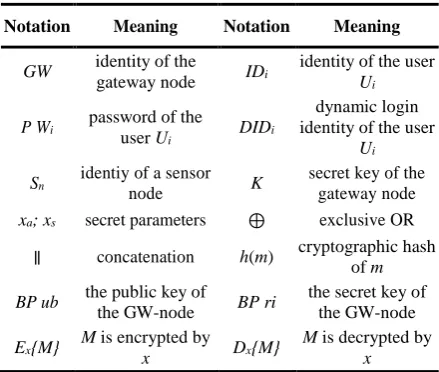
In this section, we will briefly review Yuan’s enhanced two-factor authentication scheme. For more details, refer to [14]. Some notations used throughout
Table 1. Notations
Notation Meaning Notation Meaning
GW identity of the
gateway node IDi
identity of the user
Ui
P Wi password of the
user Ui DIDi
dynamic login identity of the user
Ui
Sn identiy of a sensor
node K
secret key of the gateway node
xa; xs secret parameters ⊕ exclusive OR
∥ concatenation h(m) cryptographic hash of m
BP ub the public key of
the GW-node BP ri
the secret key of the GW-node
Ex{M} M is encrypted by
x Dx{M}
M is decrypted by
x
this paper are summarized in Table 1. Yuan’s scheme is composed of three phases: the registration phase, the authentication phase and the password updating phase.
2.1. Registration phase
In the registration phase, the user Ui inputs his personal biometrics Mi on the specific device, provides his identity IDi and password P Wi to the GW-node in a secure manner. On receiving the registration request, the GW-node computes Ni = h(IDi∥h(PWi)∥Ei)⊕ h(K), where Ei= h(Mi). The GW-node generates a smart card with parameters IDi; Ni; h(h(P Wi)); h(·); Ei; xa, and sends the user’s smart card to Ui through a secure channel.
2.2. Authentication phase
When the user Ui wants to access the real-time data from the WSN, the authentication phase is invoked. The steps involved are as follows:
Step A.1 The user Ui inserts his smart card into the card reader and in-puts Mi. The smart card computes Ei∗ = h(Mi) and checks whether Ei∗ = Ei or not. If the verification fails, the user’s authentication request is terminated. Otherwise Ui also inputs IDi and P Wi, the smart card verifies these two values with the stored ones in it. If the entered IDi and P Wi are correct, the smart card computes DIDi = h(IDi∥h(PWi)∥Ei) ⊕ h(xa∥T), where T is the current timestamp of Uis‘ system. The smart card also computes Ci = h(Ni∥xa∥T ) and sends login-req = EBP ub{DIDi; Ci; T} to the GW-node.
Step A.2 Upon receiving login-req at time T∗, the
GW-node decrypts the ciphertext by its private key BPri and gets (DIDi; Ci; T ) = DBPri{login-req}. The GW-node first checks if (T∗−T ) ≤ △T , where △T is
request; otherwise the GW-node also computes Ai = h(DIDi∥Sn∥xs∥T1), where Sn is some nearest sensor node that will respond to the query of Ui and T1 is the current timestamp of the GW-node’s system. Here xs is a secret parameter shared between the GW-node and the sensor node Sn. Finally, the GW-node sends the message (DIDi∥Ai∥T1) to the sensor node Sn.
Step A.3 Upon receiving (DIDi∥Ai∥T1) at time T2, the sensor node Sn checks if (T2 − T1) ≤ △T . If it holds, Sn computes A∗i = h(DIDi∥Sn∥xs∥T1) and checks
whether A∗i = Ai or not. If the check if successful, Sn
computes Bi= h(Sn∥xs∥T3) and sends back the mutual authentication message (Bi; T3) to the GW-node, where T3 is the current timestamp of the sensor node’s system.
Step A.4 Upon receiving (Bi; T3) at time T4, the GW-node checks if (T4 − T3) ≤ △T . If it holds, the GW-node computes Bi∗ = h(Sn∥xs∥T3) and checks whether Bi∗ = Bi or not. If it is true, the GW-node computes Fi = h(h(K)∥xa∥T5) and sends the message (Fi; T5) to the user Ui.
Step A.5 Upon receiving (Fi; T5) at time T6, the user Ui checks if (T6−T5) ≤△T . If it is true, the user Ui computes h(K)∗ = Ni ⊕ h(IDi∥h(P Wi)∥Ei), Fi∗ = h(h(K)∗∥xa∥T5), and checks whether Fi∗= Fior not. If
it holds, the usertrusts in the GW-node and enjoys the data from the WSN.
2.3. Password updating phase
The user Ui inserts his smart card into the card reader and inputs his biometric template Mi to verify his biometric. If Ui passes the biometric verification, he can input IDi, the old password PWi and the new password PWi∗. The smart card validates IDi and P Wi with the stored values. If these two values are correct, the smart card computes Ni∗ = Ni ⊕h(IDi∥h(PWi)∥Ei)
⊕ h(IDi∥h(PWi∗)∥Ei). The smart card then replaces Ni,h(h(PWi)) with Ni∗, h(h(PWi∗)).
3. Cryptanalysis of Yuan's Scheme
3.1. Misuse of biometrics
In Yuan’s scheme, biometric keys are introduced to provide non-repudiation and resist the stolen smart card attack. More specifically, the user Ui inputs his biometric Mi to the GW-node in the registration phase. The GW-node computes Ei = h(Mi) and stores Ei in Ui’s smart card. In the authentication phase, the user Ui needs to input his biometric Mi again. The smart card computes Ei∗ = h(Mi) and checks whether Ei∗ = Ei. If the verification is successful, further operations will be performed.
However, biometric keys are actually misused in Yuan’s scheme. As is noted by [17], biometric match-ing is probabilistic in nature, which means that two samples of the same individual are never exactly the same. Unlike some pass-word systems that perform a one-way hash function on the user input, biometric
systems cannot rely on the same process. The reason is that the hash values will never be the same for the reference template value and current presented sam-ple. Instead, biometric authentication must tolerate fai-lures within a reasonable bound. As a result, biome-trics in the registration phase and the authentication phase of Yuan’s scheme are not exactly the same. Yuan’s scheme is incorrectly designed such that even the honest user cannot pass the biometric verification.
3.2. Stolen smart card attack
Yuan claimed his scheme can resist the stolen smart card attack. However, we find that Yuan’s scheme is still insecure against the same attack if user’s smart card is stolen.
If an adversary steals a smart card, he can perform the following two at-tacks. For one thing, the adversary can perform the many registered user at-tack without the GW-node’s secrets. Firstly, the adversary extracts IDi, Ni, h(h(PWi)), Ei, and xafrom the smart card by side channel attacks [18, 19]. The adversary guesses the correct password PWi via off -line dictionary attacks with the information h(h(PWi)). Yuan stated that the adversary cannot obtain h(P Wi) from h(h(PWi)) because of the one-way characteristic of the hash function. However, this is actually incorrect. Because the adversary can iteratively guess a password PWi′ and verify whether h(h(PWi′)) = h(h(PWi)) or not until he finds out the correct password. The adversary then gets h(K) by computing Ni⊕h(IDi∥h(PWi)∥Ei). Secondly, the adversary can generate a new smart card with parameters IDi∗, Ni∗ = h(K) ⊕h(IDi∗∥h(PWi∗)∥Ei∗), h(h(PWi∗)), h(·), Ei∗, and xa, where IDi∗, P Wi∗, and Ei∗ are the identity, the password, and the bio-metric of the new user, respectively. It is obvious that the new smart card can pass user authentication of the WSN. The adversary can generate many valid smart cards in this way and employs them to access data from the network.
For another attack, the adversary can impersonate the victim user whose smart card is stolen, because the adversary can obtain the victim user’s IDi, P Wi, and Eifrom the smart card. This attack demonstrates that Yuan’s scheme does not achieve the two-factor security. Anyone could impersonate the user as long as he gets the user’s smart card.
3.3. GW-node impersonation attack
In Yuan’s scheme, It was claimed that mutual authentication between the user and the GW-node is achieved. Mutual authentication between the user and the GW-node means that nobody except the GW-node can authenticate himself to the user, and vise versa. However, we will show that a malicious user Uj can impersonate the GW-node to fool an honest user Ui. The malicious use Uj extracts the parameters Nj, xa, and Ej from his smart card. Uj can compute h(K) = Nj
Networks
after receiving the login request of the honest user Ui, the malicious user Uj simply waits for a while and send the message (Fi; T5) back to Ui, where Fi = h(h(K)∥xa∥T5) and T5 is the current timestamp of Uj. Moreover, the malicious user Ui can also perform the many registered user attack as described in section 3.2. Therefore, the GW-node impersonation attack is a serious security flaw in Yuan’s scheme.
3.4. No session key is distributed between the user and the sensor node
In Yuan’s scheme, the user can access the real-time data from the sensor node after login in. Unfortunately, no session key is shared between the user and the sensor node, which means the real-time data will be transmitted in plaintext. Therefore, the adversary can simply eavesdropping the real-time data from the insecure network. To ensure the confidentiality and integrity of the real-time data, a session key should be established between the user and the sensor node. Moreover, public key mechanism is used in Yuan’s scheme to ensure that the first message comes from the user Ui. Considering power consumption and computation capacity, we should avoid using the public key mechanism in WSNs. As a result, Yuan’s scheme is inefficiently designed to prove that the first message comes from Ui.
4. Our Proposed Scheme
In this section, we propose an improved user authentication scheme based on [14], which keeps the merits of the original scheme and can overcome the security weaknesses described in previous section. Our main technical tool is the fuzzy extractor [16]. Roughly speaking, a fuzzy extractor consists of two efficient algorithms Gen and Rep. The generation algorithm Gen takes the user’s bio-metric Mi as input and outputs an extracted random string Ri and an auxiliary string Pi. The reproduction algorithm Rep takes as inputs the auxiliary string Pi and the user’s biometric Mi∗, and returns the random string Rias long as the two biometric templates Mi and Mi∗ are close enough. We should note that Ri remains uniformly random even given the auxiliary string Pi. For more details, refer to [16, 20]. To avoid the GW-node impersonation attack and the GW-node bypassing attack, we require that the GW-node generates xn = h(Sn∥xa) and writes it in the sensor node Sn before deploying the WSN, where xn can be seen as Sn’s secret. There are three phases in our improved scheme: the registration phase, the authentication phase and the password updating phase.
4.1. Registration phase
When registering with the GW-node, the user Ui
inputs his biometric template Mi on the specific
devi-ce. We assume this device extracts the biometric
tem-plate and carries out the calculations in the fuzzy ex-tractor. A pair (Ri; Pi) is generated using Ui’s biome-tric template Mi by the generation algorithm Gen in
the fuzzy extractor. Ui computes h(IDi∥Ri∥PWi) and
sends the message (IDi; h(IDi∥Ri∥P Wi)) to the GW-node in a secure manner. On receiving the registration request, the GW-node computes Vi = h(IDi∥K∥xa), Ni = Vi ⊕ h(IDi∥Ri∥P Wi) and
Hi= h(Vi). The GW-node generates a smartcard with parameters IDi, Ni, Hi, h(·), and sends the user’s smart
card to Ui through a secure channel. Ui updates the
data in the smart card by adding the auxiliary string Pi
and the reproduction algorithm Gen.
4.2. Authentication phase
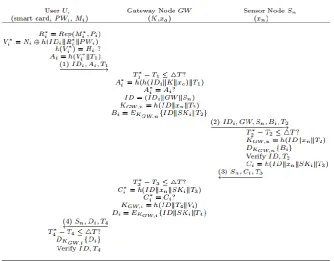
The authentication phase is invoked when Ui wants to access the real-time data from the WSN. The detailed steps of the authentication phase, as shown in Fig.1, are described as follows:
1. Uiinserts his smart card into the card reader, inputs his biometric Mi∗, identity IDi and password PWi. The smart card computes Ri∗ using the re-production algorithm Gen with inputs Mi∗ and Pi. The smart card computes Vi∗ = Ni ⊕ h(IDi∥Ri∗∥PWi) and checks whether Hi = h(Vi∗). If the verification is successful, the smart card computes Ai = h(Vi∗∥T1) and sends the message (IDi; Ai; T1) to the GW-node, where T1 is the current timestamp of Ui’s system.
2. Upon receiving the message (IDi; Ai; T1) at time T1∗, the GW-node checks if T1∗−T1 ≤ △T, where△T denotes the expected time interval for the transmis-sion delay. If it
is true, the GW-node computes
A∗i = h(h(IDi∥K∥xa)∥T1). If A∗i= Ai, the
GW-node accepts the login request. The GW-GW-node then chooses a random session key SKi for the user and the sensor node Sn. The GW-node computes KGW;n = h(IDi∥GW
∥Sn∥xn∥T2) and Bi = EKGW;n {IDi∥GW ∥Sn∥ SKi∥T2} using a symmetric encryption scheme, where T2is the currenttimestamp of the node’s system. Finally, the GW-node broadcasts the message (IDi; GW; Sn; Bi; T2) to all the sensor nodes.
of Sn’s system. Sn also stores the session key SKi for future communication.
4.
Upon receiving the message (Sn; Ci; T3) at time T3∗, the GW-node checks if T3∗−T3 ≤ △T. If it is true, the GW-node computes Ci∗ = h(IDi∥GW ∥Sn∥xn∥ SKi∥T3) and checks if Ci∗= Ci. If the verification fails, the GW-node terminates the session. Otherwise, it computes KGW;i = h(IDi∥GW∥Sn∥T4∥Vi) and Di = EKGW;i {IDi ∥GW
∥Sn∥SKi∥T4} using a symmetric encryption scheme, where T4 is the current timestamp of
the GW-node’s system. The GW-node sends the message (Sn; Di; T4) to the user Ui. 5. Upon receiving the message (Sn; Di; T4) at
time T4∗, Ui checks if T4∗−T4≤△T. If it is
true, Ui also computes KGW;i = h(IDi∥GW
∥Sn∥T4∥Vi) and decrypts Di. If IDi, GW,
Sn and T4 from the decrypted message are
correct, Ui accepts the session and stores the
session key SKi for future communication.
Finally, Ui and Sn could use the common session key SKi in upcoming private communication.
Figure 1. Authentication phase of the proposed scheme
4.3. Password updating phase
This phase is invoked whenever Ui wants to change his password P Wi with a new one, say P Wi∗. Ui inserts his smart card into the terminal and inputs his identity IDi, the biometric Mi′, the old password PWi and the new password PWi∗. The smart card computes Ri∗ using the reproduction algorithm Rep with inputs Mi′ and Pi. The smart card then computes Vi∗ = Ni ⊕h(IDi∥Ri∗∥PWi), Hi∗ = h(Vi∗) and checks whether Hi = Hi∗. If the verification is successful, the smart card computes Ni∗ = Ni ⊕ h(IDi∥Ri∗∥PWi) ⊕ h(IDi∥Ri∗∥PWi∗) and replaces Ni with Ni∗.
5. Security Analysis
In this section, we analyze the security of the proposed scheme. The advantages of the proposed scheme are explained as follows.
Resistance to the replay attack. A replay attack (replaying an intercepted message) cannot work in our scheme due to the timestamp in each message. Suppose the intruder intercepts a valid login request (IDi; Ai; T1) and tries to login to the GW-node by replaying the same. The verification of this login request fails because of the interval T1∗ − T1 > △T, where T1∗ is the GW-node’s system time while receiving the replayed message.
GW-Networks
node can neither get a valid biometric template of the user nor know Pi, so the proposed scheme can resist the privileged insider attack.
Resistance to the GW-node impersonation attack. If a malicious user Ujwants to impersonate the GW-node to another honest user Ui, Uj needs to compute Vi = h(IDi∥K ∥xa). However, Uj can only extract Vj = h(IDj ∥K∥xa) from his smart card. To compute Vi, Uj needs to get K and xa from Vj, but this is unlikely because K and xa are high-entropy secret keys. So a malicious user cannot impersonate the GW-node in the proposed scheme.
Resistance to the stolen verifier attack. An adversary can attack any system which has verifier tables for authentication, but in our proposed scheme, the GW-node does not store any verification table at all. As a result, the proposed scheme can resist the stolen-verifier attack.
Resistance to the stolen smart card attack. If the user Ui’s smart card is stolen, the adversary can extract the parameters IDi, Ni, Hi and Pi from the smart card. However, the adversary still cannot impersonate the user. In order to impersonate the user, the adversary needs to compute Vi from Ni, which in turn needs to compute h(IDi∥Ri∥PWi). However, the adversary does not know P Wi and Ri from the parameters extracted from the smart card. What is more, it is obvious that the adversary cannot impersonate the GW-node or the sensor node in this situation.
Resistance to the off-line dictionary attack. In the proposed scheme, the user’s password PWi is combined with the secret value Ri. Ri is a random high-entropy random value which can only be computed using Pi and the user’s valid biometric templates. So our protocol can resist the off-line dictionary attack performed by the GW-node or other insider users. The only exception is when the adversary gets the user’s smart card and a valid biometric template, the adversary can guess the correct password by an off-line dictionary attack in this case. We will comment on such a situation later.
Resistance to the compromised sensor node attack. If the sensor node Sn is compromised in our scheme, the adversary knows Sn’s secret key xn = h(Sn∥xa). It is obvious that the adversary can impersonate Sn since Sn is compromised. However, the adversary cannot impersonate any other sensor node in the WSN because the secret keys of the sensor nodes are different. And due to the high entropy of xa, the adversary cannot extract xa from h(Sn∥xa).
Mutual authentication. In the proposed scheme, after receiving the first message, the GW-node can verify the authenticity of the user by checking whether A∗i = Ai. The user can verify the authenticity of the
GW-node by checking whether IDi, GW, Sn and T4 from the decrypted message are correct. So our
scheme achieves mutual authentication between the user and the GW-node. With a similar analysis, we can see that our scheme also provides mutual authentication between the GW-node and the sensor node.
Session key distribution. A user authentication scheme in WSN will be followed by the delivery of the real-time data. The user and the sensor node should have a common session key to protect the confidentiality and integration of the data. In the proposed scheme, a session key SKi is distributed between the user and the sensor node with the help of the GW-node. The GW-node serves as a key distribution center and distributes a unique secure session key to the user and the sensor node. The user and the sensor node can communicate in a secure and authentic way with the session key SKi.
6. Performance Analysis
In this section, we compare security features and efficiency of the proposed protocol with related sche-mes [5, 8, 10–12, 14]. Table 2 presents the comparison of computation cost and communication cost of the proposed scheme and other schemes. With respect to computation, we only consider some expensive types of computation. Let “H” denote the computation cost of one hash operation, “Tpub” denote the computation cost of one public key operation, “Tsym” denote the computation cost of one symmetric key encryp-tion/decryption. The computation cost of an efficient fuzzy extractor [20] is no more than the cost of one hash operation. For simplicity, we use the cost of one hash operation to represent the computation cost of the algorithms of Gen and Rep in the fuzzy extractor. With respect to bandwidth, we assume that the identifica-tions can be represented with 32 bits, the output size of secure hash functions. Nonces is 160 bits, the time-stamp can be represented with 64 bits. The ciphertext is the same size with the plaintext in symmetric
encryptions, and the size of the ciphtext is usually doubled in public key encryptions.
We can see from Table 2 that the computation costs of the registration phase and the password updating phase are more or less the same. The registration/password updating phase is a one-time job for some period of time, so we focus on the computation cost of the authentication phase. Our scheme needs 11 hash operations and 4 symmetric encryption/decryption operations in the authentication phase. The symmetric encryption/decryption opera-tions arise from the distribution of the session key. Among the related schemes [5, 8, 10–12, 14], only Nyang and Lee’s scheme [8] establishes the session key for the user and the sensor node. Our scheme is more efficient than Nyang and Lee’s scheme. In terms of hash operations, our protocol is slightly less efficient than Das’s scheme [5] and Sun et al.’s scheme [12]. However, Das’s scheme is insecure against several attacks. Although Sun et al.’s scheme is quite efficient in computation and provides strong
Table 2. Comparisons of efficiency
The proposed scheme
Das’s scheme [5]
N-L- scheme [8]
H-G-C- scheme [10]
K-A- scheme [11]
S-L-F- scheme [12]
Yuan’s scheme [14]
E1 2H 0 0 H H 0 0
E2 2H 3H 3H 5H 2H 2H 5H
E3 4H+Tsym 4H 7H+Tsym 5H 4H 2H 8H+Tpub
E4 5H+2Tsym 4H 8H+Tsym 5H 5H 5H 8H+Tpub
E5 2H+Tsym H 4H+2Tsym H 2H 2H 2H
E6 4H N/A N/A 6H 4H 2H 6H
E7 1344bits 832bits 1344bits 928bits 992bits 1056bits 1600bits
E8 4 3 3 3 3 8 4
E1: Computation cost of the registration phase for a user E2: Computation cost of the registration phase for a GW-node E3: Computation cost of the authentication phase for a user E4: Computation cost of the authentication phase for a GW-node E5: Computation cost of the authentication phase for a sensor node
E6: Computation cost of the password updating phase for a user E7: Bandwidth of the authentication phase
E8: Message flows of the authentication phase N/A:Not Available
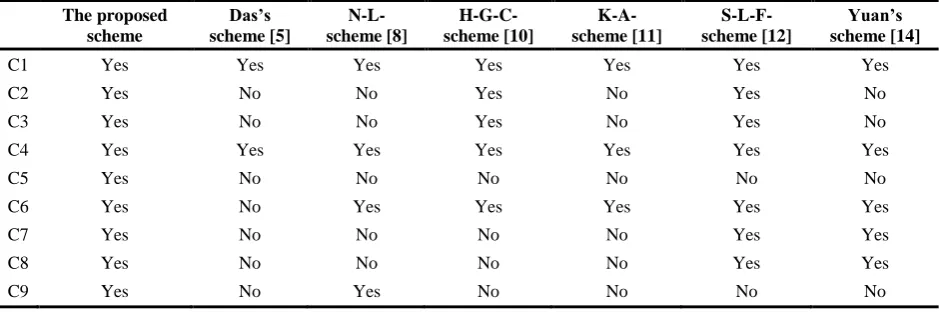
Table 3. Comparisons of security features
The proposed scheme
Das’s scheme [5]
N-L- scheme [8]
H-G-C- scheme [10]
K-A- scheme [11]
S-L-F- scheme [12]
Yuan’s scheme [14]
C1 Yes Yes Yes Yes Yes Yes Yes
C2 Yes No No Yes No Yes No
C3 Yes No No Yes No Yes No
C4 Yes Yes Yes Yes Yes Yes Yes
C5 Yes No No No No No No
C6 Yes No Yes Yes Yes Yes Yes
C7 Yes No No No No Yes Yes
C8 Yes No No No No Yes Yes
C9 Yes No Yes No No No No
Networks
security, it needs 8 message flows. In wireless sensor networks, transmitting radio signals on resource-constrained wireless devices usually consumes much more power than computation does, so it is more important to reduce the number of message flows than the computation cost. Sun et al.’s scheme has high communication complexity and is not suitable for WSNs. With respect to communication complexity, our scheme needs more bandwidth than schemes [5, 10–12]. The rea-son is still because a session key is distributed in our scheme. The bandwidth is increased due to the transmission of the common session key. Our scheme needs 4 message flows, this is the least number of message flows to achieve mutual authentication among the user, the GW-node and the sensor node.
Table 3 summarizes security features of the proposed protocol with related schemes [5, 8, 10–12, 14]. We can see from Table 3 that our scheme provides more security features than other related schemes. Our scheme is an improvement of Yuan’s scheme. It is not only more secure but also more efficient than Yuan’s scheme. It is worth noting that our scheme is the only one scheme which can resist the stolen smart card attack.
Considering the computation cost, communication cost and security features as a whole, only Sun et al.’s scheme [12] is comparable to our scheme. However, Sun et al.’s scheme is insecure against the stolen smart card attack and does not distribute session key for the user and the sensor node. What is more, Sun et al.’s scheme has high communication complexity to achieve provable security. Therefore, our scheme is more secure than related scheme while preserving high efficiency. As a result, the proposed scheme is more suitable for real-life applications in WSNs.
7. Conclusions and future work
In this paper, we have analyzed the security weaknesses of a recently proposed two-factor user authentication protocol by Yuan for WSNs. We show that Yuan’s scheme is susceptible to the stolen smart card attack and the GW-node impersonation attack. Moreover, the biometrics are misused and no session key is established in Yuan’s scheme. We also propose an improved scheme to defeat the attacks. The proposed scheme not only preservers the merits of Yuan’s scheme but also fixes its security flaws. The security and performance comparison shows that our protocol achieves both higher efficiency and stronger security. Therefore, we believe the proposed scheme is more suitable for applications in WSNs.
Until now, there is no formal security model to prove the security of the two-factor user authentication schemes in WSNs. This is the reason why several two-factor user authentication schemes are insecure against various attacks. Our future work will focus on summarizing the security requirements of the two-factor user authentication schemes in WSNs and
presenting a formal security model to evaluate the security of these schemes.
Acknowledgment
The authors would like to thank the anonymous referees for their helpful comments. This study was funded by the National High Technology Research and Development Program (863 Program) (No. 2015AA011704), the National Natural Science Foundation of China (Nos. 61309016, 61379150, 61501515), Postdoctoral Science Foundation of China (No. 2014M562493), Postdoctoral Science Foundation of Shanxi Province, Fundamental Research Funds for the Central Universities (Program No. JB140302), and Key Scientic Technological Project of Henan Province (No. 122102210126,092101210502).
References
[1] S. Xie, Y. Wang. Construction of tree network with limited delivery latency in homogeneous wireless sensor networks. Wireless Personal Communications, 2014, Vol. 78, No. 1, 231-246.
[2] D. He, N. Kumar, N. Chilamkurti. A secure tempo-ral-credential-based mutual authentication and key agreement scheme with pseudo identity for wireless sensor networks. Information Sciences, 2015, Vol. 321, 263-277.
[3] D. He, S. Zeadally. Authentication protocol for am-bient assisted living system. IEEE Communications Magazine, 2015, Vol. 53, No. 1, 71-77.
[4] P. Guo, J. Wang, B. Li, S. Lee. A variable threshold-value authentication architecture for wireless mesh networks. Journal of Internet Technology, 2014, Vol. 15, No. 6, 929-936.
[5] M. L. Das. Two-factor user authentication in wireless sensor networks. IEEE Transactions on Wireless Communications, 2009, Vol. 8, No. 3, 1086-1090. [6] D. He, D. Wang. Robust biometrics-based
authentica-tion scheme for multi-server environment. IEEE Systems Journal, 2015, Vol. 9, No. 3, 816-823. [7] D. He, N. Kumar, J.-H. Lee, R. S. Sherratt.
Enhan-ced three-factor security protocol for mass consumer storage devices. IEEE Transactions on Consumer Electronics, 2014, Vol. 60, No. 1, 30-37.
[8] D. H. Nyang, M. K. Lee. Improvement of Das’s two-factor authentication protocol in wireless sensor networks. Cryptology, ePrint archive, 2009. http://eprint.iacr.org/2009/631.pdf. Accessed 28 February 2010.
[9] T. H. Chen, W. K. Shih. A robust mutual authentica-tion protocol for wireless sensor networks. ETRI Journal, 2010, Vol. 32, No. 5, 704-712.
[10] D. J. He, Y. Gao, S. Chan, C. Chen, J. Bu. An en-hanced two-factor user authentication scheme in wire-less sensor networks. Ad Hoc & Sensor Wirewire-less Networks, 2010, Vol. 10, No. 4, 361-371.
[12] D. Z. Sun, J. X. Li, Z. Y. Feng, Z. F. Cao, G. Q. Xu. On the security and improvement of a two-factor user authentication scheme in wireless sensor networks.
Personal and Ubiquitous Computing, 2013, Vol. 17, No. 5, 895-905.
[13] M. Bellare, P. Rogaway. Entity authentication and key distribution. In: Proceedings of 13th Annual International Cryptology Conference: Advances in Cryptology-Crypto’93, 2013, Springer-Verlag, Berlin, Germany, LNCS 773, pp. 232-249.
[14] J. J. Yuan. An enhanced two-factor user authentica-tion in wireless sensor networks. Telecommunication Systems, 2014, Vol. 55, No. 1, 105-113.
[15] L. Gong, R. Needham, R. Yahalom. Reasoning about belief in cryptographic protocols. In: Proceedings of 1990 IEEE Computer Society Symposium Research in Security and Privacy, 1990, pp. 234-246.
[16] Y. Dodis, L. Reyzin, A. Smith. Fuzzy extractors: how to generate strong keys from biometrics and other noisy data. In: Proceedings of International Europe Cryptology Conference: Advances in
Cryptology-Eurocrypto’04, 2004, Springer-Verlag, Berlin, Germany, LNCS 3027, pp. 523-540.
[17] A. Bhargav-Spantrel, A. C. Squicciarini, S. Modi, M. Young, E. Bertino, S. J. Elliott. Privacy preserving multi-factor authentication with biometrics.
Journal of Computer Security, 2007, Vol. 15, No.5, 529-560.
[18] T. S. Messerges, E. A. Dabbish, R. H. Sloan. Exami-ning smart-card security under the threat of power analysis attacks. IEEE Transactions on Computers, 2002, Vol. 51, No. 5, 541-552.
[19] P. Kocher, J. Jaffe, B. Jun. Differential power analysis. In: Proceedings of 19th Annual International Cryptology Conference: Advances in Cryptology-CRYPTO’99, 1999, Springer-Verlag, Berlin, Germany, LNCS 1666, pp. 388-397.
[20] Y. Dodis, B. Kanukurthi, J. Katz, L. Reyzin, A. Smith. Robust fuzzy extractors and authenticated key agreement from close secrets. IEEE Transactions on Information Theory, 2012, Vol. 58, No. 9, 6207-6222.