Security Weaknesses on a Delegation-Based
Authentication Protocol for PCSs
Prosanta Gope, Tzonelih Hwang
Department of Computer Science and Information Engineering National Cheng Kung University, Tainan, Taiwan, R.O.C. e-mail: [email protected], [email protected]
http://dx.doi.org/10.5755/j01.itc.44.3.9777
Abstract. Rapid development of wireless networks brings about many security problems in Portable Communication Systems (PCS), which can provide mobile users with an opportunity to enjoy global roaming services. In this regard, designing a secure user authentication scheme, especially for recognizing legal roaming users is indeed a challenging task. Recently, C-C Lee et al. proposed such scheme, which is claimed to be an improvement of T. F. Lee et al.’s protocol. However, in this article, we reveal that the scheme proposed by C-C Lee et al. still suffers from certain weaknesses like vulnerability to DoS attack, no perfect forward secrecy, loss of untraceability, etc. Hence, C-C Lee et al.’s delegation-based protocol cannot guarantee secure communication for PCS environment.
Keywords: Delegation-based authentication; DoS attack; Untraceability.
1. Introduction
Portable Communication Systems (PCS) provide roaming services among wireless communication networks [1-4]. In this regard, a mobile user (MU) at first registers his/her legality in some home location register (HLR). Before, roaming MU logins some visiting location register (VLR) and VLR validates the user's legality with the help of the HLR. If the MU is legal of some HLR, VLR offers services and charges the roaming fee. In recent years, many protocols used the public-key systems to provide the privacy of the MU. In 2005, Lee and Yeh [5] proposed a new delegationbased authentication protocol for PCSs. Their protocol is also based on the public-key cryptosystems to provide user anonymity, non-repudiation, mutual authentication. Moreover, their protocol used off-line authentication process to reduce the communication overhead between the VLR and HLR and mobile users'. However, T. F. Lee et al. [6] pointed out that Lee and Yeh’s off-line authentication process is vulnerable to masquerade user attacks. To overcome this flaw, T. F. Lee et al. proposed an enhanced protocol. Unfortunately, Youn and Lim [7], and Wang et al. [8] pointed out that T. F. Lee et al.’s protocol suffers from linkable problem. Independently, C-C Lee et al. [9] thoroughly investigated T. F. Lee et al.’s protocol. Subsequently, they pointed out that apart from linkable problem T. F. Lee et al.’s protocol also cannot achieve the forward secrecy property, and
because of that once the session key is disclosed in an off-line authentication, the adversary can obtain the next session key. In order to resolve this problem they proposed an improved protocol. However, in this article, we show that the scheme proposed by C-C Lee et al. has some serious weaknesses which have been overlooked during design. So, the contribution of this article is to disclose the weaknesses of the C-C Lee et al.’s scheme, which have not been revealed yet.
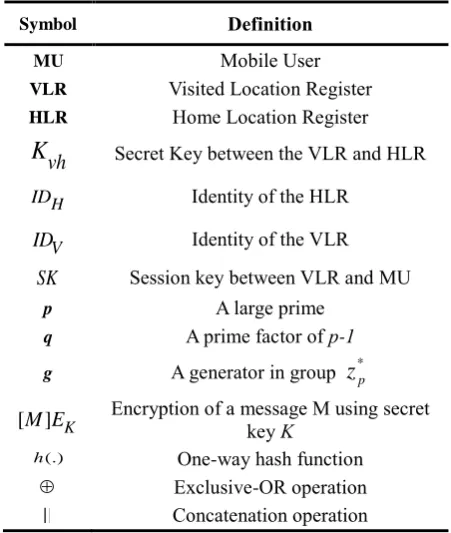
Therefore, the remainder of this article is orga-nized as follows. Section 2 reviews the protocol of [9] whose weaknesses are pinpointed in Section 3. Finally, a concluding remark is given in Section 4. The abbreviations and cryptographic functions used in this article are defined in Table 1.
2. Review of C-C Lee et al.’s Delegation-Based
Authentication Protocol
details of the phases are described in the following sub-sections.
Table 1. Notation and Abbreviations
Symbol Definition
MU Mobile User
VLR Visited Location Register
HLR Home Location Register
vh
K
Secret Key between the VLR and HLRH
ID Identity of the HLR
V
ID Identity of the VLR
SK
Session key between VLR and MUp A large prime
q A prime factor of p-1 g A generator in group
z
*p[M E] K Encryption of a message M using secret key K
(.)
h One-way hash function
Exclusive-OR operation Concatenation operation
2.1. Phase I: Setup Phase
The HLR computes its public key vgxmod ,p where x is the HLR’s private key. When MU sends requests to the HLR for registration, then the HLR computes the MU’s public key Kgkmod p and the private key x kK(mod )p and subsequently decides an initialized temporary identityTID, where k is the random number generated by the HLR. Afterwards, the HLR personalizes the SIM card with ( , K) and TID and issues it to MU. Upon receiving the SIM card, MU generates a nonce
n
1
, and pre-computes a hash chain (1) (2) ( 1)( 1), ( 1), ..., n ( 1)
h n h n h n
and stores them in its database, where h(1)( 1)n h n( 1)
and h( 1)i ( 1)n h h( ( )i ( 1))n for i= 1, 2, …,n.
2.2. Phase II: On-line Authentication Phase
Step 1. M : MU1 VLR : {TID}
The MU acquires the initialized temporary identity TID from the SIM card and then sends it to VLR.
Step 2. M : VLR2 MU : { 2,n IDV}
After receiving M1 from the MU, the VLR generates a random number n2 and responses n2, and
IDVto MU.
Step 3. M : MU3 VLR : { , ,r s TID,N ID1, H,IDV}
Upon receiving the message M2, MU computes
mod t
rg p and picksTID,N1 from his/her database to compute s. (h N1 n2 IDV)t r. (mod p),where t is a
random number and ( 1) ( 1). 1
n
N h n Finally, MU forms a response message M3 and sends it to VLR.
Step 4. M : VLR4 HLR :{[N1 n2 TID K]E ,IDH,IDV} vh
After receiving the message M3 , the VLR acquires K by checking TID from his/her database. It is assumed that the VLR maintains a table mapping between the public key K and the corresponding initial temporary identityTID. Then the VLR computes gs
and (vKK)h N n( 1 2IDV)rr(mod )p . If they are same, that means the VLR successfully authenticated the MU and then VLR forms a request message M4 and sends it to the HLR. Otherwise, the VLR rejects the MU’s request.
Step 5.
M : HLR5 VLR : {[[ 1, 2, , ]
2 ] , , }
1
N n IDV TIDnewE
n l C TIDnewEK IDH IDV vh
Upon receiving the request message M4from the VLR, the HLR decrypts [N1 n2 TID]EK
vh and
obtainsTID. Subsequently, the system (HLR) finds
from its database according to TID. If it is not found, then the HLR rejects the VLR request. Otherwise, the HLR generates a random number n3, and then computes C1h N( 1 n2 n3 ) and l N1 . Hereafter, the HLR further generates a temporary identity TIDnew and forms a response message M5 and sends it to the VLR, where Kvh denotes the long-term shared secret key between VLR and HLR.Step 6. M : VLR6 MU : {[N n ID1, 3, V,TIDnew]E,IDV}
After receiving the message M5from HLR, the VLR decrypts the message and subsequently obtains
[N n ID1, 3, V,TIDnew]E , n2, , l C1, TIDnew . Then the VLR checks n2 and l and sets C1as the current session key SK. Finally, the VLR replaces TID with TIDnew in its database and subsequently forwards the
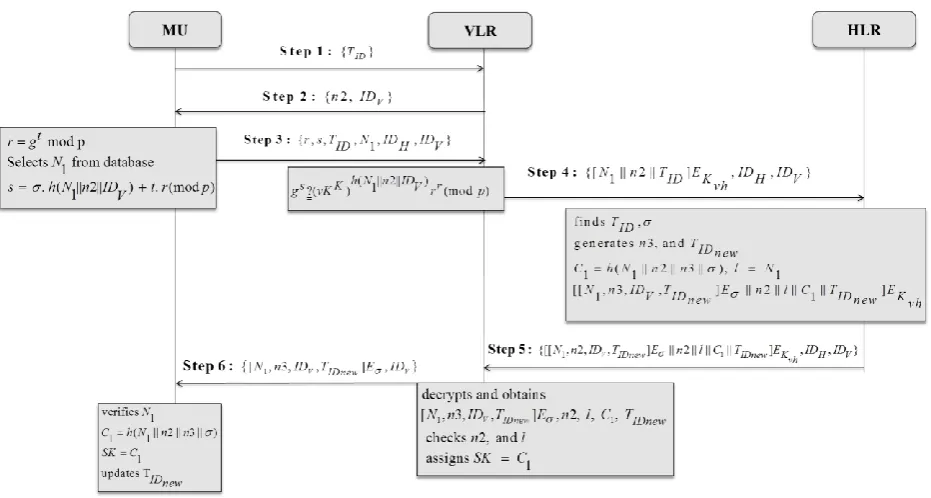
Figure 1. The on-line authentication process of the C-C Lee et al.’s protocol
Upon receiving the message M6from VLR, MU at
first decrypts the message and checks whether N1 is the same as previously sent in Step 3. If so, then MU successfully authenticates the VLR and computes
( 2 3 )
1 1
C h N n n as the current session key and updates his/her database for next communication. Otherwise, MU terminates the connection and starts with a new request. Details of this phase are shown in Fig. 1.
2.3. Phase III: Off-line Authentication Phase ( 1)
MU VLR : [h n i ( 1)n TIDnew]E Ci
MU picks ( 1) ( 1)
n i
h n and TIDnew stored in
his/her database and sends ( 1)
[hn i ( 1)n TIDnew]E Ci
to the VLR . After receiving these messages from the MU, the VLR obtains ( 1)
( 1)
n i
h n by using the session
key TIDnew. Subsequently, the VLR checks whether
( 1) ( 1)
n i
h n is the same as l or not. If so, then the VLR updates ( 1)
( 1)
n i
lh n and i = i+1, where the count
i
n
. The VLR computes the session key( , ) 1
Ci h l Ci and randomly decides a new temporary
identity T i
IDnew and updates the verification table. Afterwards, the VLR sends [ ]
1 T i TIDnew EC
IDnew i
to MU and sends [T i]E Kvh
IDnew to HLR. Upon
receiving these messages, the MU obtains T i IDnew and updates the SIM card for next communication process. Similarly, after receiving [T i]E
Kvh IDnew from VLR HLR decrypts the message and subsequently, updates its database with the new temporary identity.
3. Security weaknesses in the C-C Lee et al.’s
delegation-based authentication protocol
In this section, we present several weaknesses of the C-C Lee et al.’s protocol, which certainly cause an insecure wireless communication system.
3.1. Vulnerable to DoS Attacks
DoS attack [10,11] is an imperative concern, which may occur because of the loss of synchronization between MU and HA. That can be comprehended if the last authentic response message sent by VLR has been interrupted by an adversary, so that MU cannot receive the message within a specific time period. Unfortunately, C-C Lee et al.’s protocol cannot resist DoS attack, where if an adversary interrupts the response message M6 then MU cannot receive
[N n1, 3,IDV,TIDnew]E,IDV . In that case, both the
HLR and VLR may update their databases with
TIDnew but MU cannot. Now, if the MU attempts to
execute the “On-line Authentication Phase” with the old TID then the HLR will not comprehend that. On the other hand, because of the interruption of the messageM6, MU cannot even acquire the random
compute the session keySK C1h N( 1 n2 n3 ).
Therefore, without having session key and the temporary id TIDnew, the MU cannot even execute the “Off-line Authentication Phase”.
3.2. Loss of Untraceability
An orthogonal security arising as a result of mobility is the confidentiality of the mobile subscriber’s any identity and movements. For obvious reasons, it is desirable to keep this information secret. In other words, passive eavesdroppers and active intruders should not be able to identify or keep track the user. In fact, it can be argued that even the visited locations (VLRs) should not be privy to know any identification of the user. Unfortunately, in Step 5 of the C-C Lee et al.’s protocol, the VLR receives the MU’s latest temporary identity TIDnew from HLR. Now, if the MU moves to a new VLR, the old VLR can still track him/her. In this way, the protocol cannot maintain the domain separation [3, 4, 12, 13, 14, 15] that means conspiracy of the all visited domains may cause to identify the movement of the user. Therefore, C-C Lee et al.’s protocol cannot ensure the untraceability property, which is greatly important for the privacy of the mobile user.
3.3. No Perfect Forward Secrecy
Perfect forward secrecy [13] is a form of security requirements in network systems. In general, a protocol that provides perfect forward secrecy (PFS) can resist an adversary from learning any previous session key, especially when the long term secret keying material is compromised by the adversary. However, we found that C-C Lee et al.’s protocol for PCSs fails to provide PFS. In the C-C Lee et al.’s delegation-based protocol, once the secret key pair (K,
𝜎�) is disclosed, then all the previous session keys established based on the execution “On-line Authentication Phase” will be exposed. Precisely,an adversary can learn the previous session key if the home agent is compromised by the adversary. So that, the adversary may acquire secret key pair (K, 𝜎�) and/or the shared secret key Kvh. Therefore, the session key in this scheme is not secure. In fact, Lee and Yeh’s scheme [5] and T. F. Lee et al.’s scheme [6] also cannot ensure PFS.
3.4. Vulnerable to Side Channel Attacks
In practice, it is possible to read some sensitive information from SIM card by executing the side channel attacks [13, 17], and the information can be used for breaking the whole system. Hence, it is highly desirable to use countermeasures for securing the secret values stored in SIM card. However, sometimes, developers do not use countermeasures due to expensive production cost. In this regard, the best alternative plan is to ensure the security of
unspoiled SIM cards by restricting the damage caused by the revelation of sensitive information. Unfortu-nately, the C-C Lee et al.’s delegation-based protocol can be entirely broken, since an adversary always can recover the key pair( ,
K), the latest temporary iden-tity of the MU i.e. TIDnew, and even the latest hash chain values with the session key Ci from the SIM card. Once the adversary obtains these parameters, then he/she can easily impersonate as MU, which is a serious threat against the privacy of the mobile user. Similar problem can also be found in [5-9].4. Conclusion
In this article, we have demonstrated that the C-C Lee et al.’s delegation-based protocol fails to ensure several security properties like perfect forward secrecy, resistance to DoS and side-channel-attacks. In addition to that, the protocol also cannot provide untraceability, where a VLR can still trace the MU, even if the MU moves to a new VLR. Therefore, the C-C Lee et al.’s delegation-based protocol fails to guarantee the privacy of the mobile user, which is greatly desirable in PCS.
Acknowledgments
This work is financially supported by the Ministry of Science and Technology, under Contract No. MOST 103-2221-E-006-177-. The authors would like to thank the Ministry of Science and Technology, Taiwan for their benign supports. The authors also would like to thank the anonymous referee for his/her valuable suggestions.
References
[1] C. C. Lee, I. E. Liao, M. S. Hwang. An efficient authentication protocol for mobile communication. Telecommunication Systems, 2011, Vol. 46, No. 1, 3144.
[2] C. C. Lee, M. S. Hwang, W. P. Yang. Extension of authentication protocol for GSM. IEE Proceedings-Communications, 2003, Vol. 150, No. 2, 91-95. [3] T. Hwang, P. Gope. Provably secure mutual
authentication and key exchange scheme for expeditious mobile communication through synchronously one-time Secrets. Wireless Personal Communications, 2014, Vol. 77, No. 1, 197-224. [4] P. Gope, T. Hwang. Enhanced secure mutual
authenti-cation, and key agreement scheme preserving user ano-nymity in global mobile networks. Wireless Personal Communications, 2015, Vol. 82, No. 4, 2231-2245. [5] W. B. Lee, C. K. Yeh. A new delegation-based
authentication protocol for use in portable communication systems. IEEE Transactions on Wireless Communications, 2005, Vol. 4, No. 1, 57-64. http://dx.doi.org/10.1109/TWC.2004.840220. [6] T. F. Lee, S. H. Chang, T. Hwang, S. K. Chong.
for PCSs. IEEE Transactions on Wireless Communications, 2009, Vol. 8, No. 5, 2166-2171. http://dx.doi.org/10.1109/TWC.2009.070032. [7] T.-Y Youn, J. Lim. Improved delegation-based
authentication protocol for secure roaming service with unlinkability. IEEE Communications Letters, 2011, Vol. 14, No. 9, 791-793.
[8] R.-C Wang, W.-S Juang, C. L. Lei. A privacy and delegation-enhanced user authentication protocol for portable communication systems. International Jour-nal of AdHoc and Ubiquitous Computing, 2011, Vol. 6, No. 3, 183-190.
[9] C. C. Lee, R. X. Chang, T. Y. Chen, L. A. Chen. An improved delegation-based authentication protocol for PCSs. Information Technology and Control, 2012, Vol. 41, No. 3, 258-267.
[10] C. H. Wang, C. Y. Lin. An efficient delegation-based roaming payment, protocol against denial of service attacks. In: Proc. 2011 International Conference on Electronics, Communications and Control, 2011, pp. 4136–4140.
[11] J. L. Tsai, N. W. Lo, T. C. Wu. Secure delegation-based authentication protocol for wireless roaming service. IEEE Communications Letters, 2012, Vol. 16, No. 7, 1100-1102.
[12] A. Herzberg, H. Krawczyk, G. Tsudik. On travelling incognito. IEEE Workshop on Mobile Computing Systems and Applications, 1994, pp. 205-211.
[13] P. Gope, T. Hwang. Lightweight and Energy Efficient Mutual Authentication and Key Agreement Scheme with User Anonymity for Secure Communication in Global Mobility Networks. IEEE Systems Journal, 2015 DOI: 10.1109/JSYST.2015.2416396.
[14] P. Gope, T. Hwang. Untraceable Sensor Movement in Distributed IoT Infrastructure. IEEE Sensors Journal, Vol. 15, No. 9, pp. 5340–5348, 2015, DOI: 10.1109/JSEN.2015.2441113.
[15] P. Gope, T. Hwang. A Realistic Lightweight Authen-tication Protocol Preserving Strong Anonymity for Securing RFID System. Computers & Security, 2015, DOI: 10.1016/j.cose.2015.05.004.
[16] W. Diffie, P. C. van Oorshot, M. J. Wiener. Authen-tication and Authenticated Key Exchanges. Designs, Codes and Cryptography, V.2, Kluwer Academic Publishers, 1992, pp. 107-125.
[17] P. Kocher, J. Jaffe, B. Jun. Differential power analysis. In: Proc. CRYPTO’99, 1999, LNCS 1666, pp. 388-397, Springer-Verlag.