O R I G I N A L A R T I C L E
Open Access
Language play facilitates language learning:
Optimizing the input for gender-like
category induction
Johanna Bebout and Eva Belke
*Abstract
Gender induction has been claimed to be virtually impossible unless nouns provide reliable semantic or phonological gender-relevant cues. However, learners might exploit syntactic cues, such as definite articles, to infer the gender of gender-unmarked nouns. In children’s poems and songs, such syntactic cues are presented in a highly structured fashion. We assessed gender-like category induction in an artificial language that provided exclusively syntactic cues for its gender-like subclasses. We trained participants with structured or unstructured input presented in a prose, a
rhyming, a melodic, or a rhyming and melodic fashion. Input structuring significantly facilitated gender-like category induction. Participants trained in the Rhyme-and-Melody mode significantly outperformed participants trained in the Prose mode, especially when the input was structured. The Rhyme-only and Melody-only modes yielded intermediate results. Thus, a highly structured rhyming and melodic input substantially facilitates gender-like category induction, making a case for the use of children’s songs in language teaching.
Keywords:Language learning, Language play, Grammatical gender, Language acquisition
Significance
For learners of German, especially those learning German as a second language, the correct use of determiners con-stitutes a major challenge. They appear to struggle most with the correct assignment of nouns to gender subclasses, which is rather opaque in German. Mastering the gender assignment of nouns is key to sentence comprehension, so failing to acquire it can have substantial knock-on effects on academic success. Given that about a quarter of the children in Germany acquire German as a second lan-guage, it is crucial that they are optimally supported during their acquisition process at an early age.
We investigated how the acquisition of opaque gender-like noun subclasses seen in German and several other languages, such as Russian, can be facilitated by means of input optimization. As a starting point, we considered language play, as seen in children’s poems, songs, or nursery rhymes. They are highly structured, structurally repetitive, and often combine a highly structured input with a rhyming or a melodic presentation, or both.
Arguably, these characteristics render language plays an excellent starting point for language learning and teaching but, as yet, this claim has not been verified experimentally. In an artificial language learning study, we demonstrate that input structuring, rhyme, and melody are effective means to enhance the acquisition of gender-like subclasses.
Our findings make a clear case for using children’s songs and poems in language training and teaching. Most likely, they apply across languages to other grammatical categor-ies marked as opaquely as German gender.
Introduction
One of the challenges of language learning is to acquire knowledge about how verbs and nouns in an unfamiliar language are inflected. It requires the learner to find out about the relevant markers for inflection, also called morphemes, and about which words are associated with which sets of inflectional morphemes. Regular verbs in English, for instance, are associated with a specific set of morphemes, often referred to as a paradigm, that are re-quired to indicate information on tense, number, and person, such as -s, -ed, -∅ in I paint-∅, he/she paint-s, she paint-ed.
* Correspondence:[email protected]
Sprachwissenschaftliches Institut, Ruhr-Universität Bochum, D-44780 Bochum, Germany
Gender-marking languages, such as French, Italian, German, or Russian, typically feature different paradigms of morphemes for each grammatical gender. For ex-ample, Table 1 presents the three paradigms of definite articles in German associated with each gender subclass (masculine, feminine, or neuter singular) to mark the four cases of singular nouns (nominative, genitive, dative, and accusative). The number of gender subclasses and the rules for assigning nouns to these subclasses differ consid-erably between languages.
When acquiring a gender-marking language, a learner can make use of a variety of cues towards a noun’s gen-der. Syntactic cues are available in the morphosyntactic environment of a noun, including gender-marked mor-phemes, such as definite articles or pronouns that co-occur with a noun. In Italian, for example, the definite articles“il”and“la”are strong cues that the nouns they accompany are masculine and feminine, respectively (Danesi, 2012). Noun cues, by contrast, are cues based on a noun’s meaning or form, i.e., its phonology or morphology. In Italian, the phonological forms of many nouns provide strong cues towards their gender; for in-stance, nouns ending in -a are feminine and nouns ending in -o are masculine in most of the cases (Danesi, 2012). In German, derivational morphemes, such as -ung, -heit or -er (see (1) below), which turn a verb or an adjective into a noun, constitute one of the few unambiguous noun cues in the language; in fact they determine the gender of the derived form, which is feminine for -ung and -heit, and masculine for -er:
Gender systems of languages such as Italian, which provide many unambiguous noun cues towards the gen-der of their nouns, are often described as being relatively easy to acquire compared to languages such as German, whose gender system provides few unambiguous noun cues requiring the learners to make increased use of syn-tactic cues (Brooks, Braine, Catalano, Brody, & Sudhalter, 1993; MacWhinney, Leinbach, Taraban, & McDonald, 1989; Wegener, 1995).
In the present study, we aimed to find out whether op-timizing the presentation of the input during training can facilitate the acquisition of gender assignment in a gender-marking language which provides exclusively syntactic and no noun cues. As a starting point for our research we considered language plays, i.e., aesthetic texts, such as poems, songs, or nursery rhymes, that are produced in playful situations (E. Belke & G. Belke, 2006). Language plays are characterized by being highly structured and structurally repetitive, often featuring the same sequence of utterances over and over again with varying agents or objects. This distinguishes them from everyday interaction, which is structurally rather variable. Moreover, language plays often combine a highly struc-tured input with a rhyming or a melodic presentation or both. It has been argued that these characteristics render language plays an excellent starting point for language learning and teaching (see G. Belke, 2007, 2012; E. Belke & G. Belke, 2006; Cook, 1997, 2000; Haueis, 1985). How-ever, experimental evidence to support this claim is scarce. We studied the acquisition of artificial gender-like sub-classes in two groups of participants, with one being trained with highly structured input such as that seen in language plays and the other receiving the same training sentences in an unstructured training regime, mimicking verbal interac-tions in everyday life. For both groups, we tested the effect of rhyme and melody—key features of nursery rhymes and children’s songs—on participants’performance.
In the remainder of this introduction, we will first re-view evidence suggesting that the acquisition of gender assignment systems with very few or no phonological but only syntactic cues is extremely hard but possible, provided that the input is structured in a learner-friendly fashion. In doing so, we introduce the artificial language learning paradigm used for studying the ac-quisition of gender-like subclasses. We shall then turn to German, a gender-marking language with three gen-der subclasses whose gengen-der assignment system has been described by some as being largely arbitrary for its small number of valid noun cues (Maratsos, 1983, but see Köpcke, 1982). In the final section, we make the case for why language play in general, and children’s songs in particular, are a means of presenting syntactic cues in an optimal way.
Cues in gender-like category induction
In a seminal study, Brooks et al. (1993) hypothesized that the acquisition of artificial gender-case-like subclasses might be impossible unless the nouns are phonologically or semantically marked for gender. They trained under-graduate students with an artificial language under two conditions. In the experimental condition, the nouns were assigned to two grammatical subclasses (Subclass 1 and Subclass 2) in such a way that the phonological form of Table 1The definite articles in the German gender-case
paradigm (singular only) for nominative, genitive, dative and accusative cases
Case Gender category
Masculine Feminine Neuter
Nominative der die das
Genitive des der des
Dative dem der dem
most of the nouns was informative regarding their as-signment to gender subclasses. In the control condi-tion, by contrast, the nouns were assigned randomly to the two subclasses.
Every noun referred to an object, such as “hoik” for house, and was combined with other elements of the artificial language to form sentences. These sentences described how an actor, “Frippy”, moved relative to the object depicted by the noun. All sentences included the agent, “Frippy”, an object noun, and a locative suffix (either“eef”, “rog”, “ast”,“foo”, “ilg”, or“tev”). The suf-fixes indicated one of three different prepositions (to, at, or from) relating to the direction or location of
“Frippy”relative to the object. For instance, the sentence for “Frippy” walking towards a house (“hoik”) would be
“Frippy hoik-eef”. The suffix paradigm for the prepositions to, at, and from differed depending on the grammatical subclass of the object noun. For example, the preposition totranslated to“eef”for nouns of Subclass 1, but to“foo” for nouns of Subclass 2. Hence, in both the experimental and the control condition the suffix paradigm presented reliable information about the subclass of the noun with which each suffix was associated. The conditions differed, however, with respect to the availability of additional phonological cues at the noun.
One experimental and one control group were exposed to the language in four or five training sessions involving comprehension and production tasks. In the test session, the experimental group yielded significantly better results in comparison to the control group with regard to both tests, suggesting that a combination of noun cues and syn-tactic cues is sufficient to enable participants to acquire grammatical subclasses in an artificial language. Critically, the performance attained by the control group did not exceed chance, indicating that syntactic cues alone are insufficient for acquiring information on grammatical subclasses. In Experiment 2 of their study, the authors replicated their findings with 9- and 10-year-old children. Taken together, these findings provide evidence for noun-cue models of gender acquisition, according to which phonological or semantic noun cues are indispensable for acquiring a noun’s gender. Subsequent studies have confirmed the central role of noun cues (e.g., Frigo & McDonald, 1998; Kempe & Brooks, 2008; Monaghan, Chater, & Christiansen, 2005; Monaghan, Christiansen, & Chater, 2007; Taraban, 2004; Taraban & Kempe, 1999).
However, Taraban (2004; Experiment 3) showed that the acquisition of phonologically and semantically un-marked gender subclasses is possible if the learners’ at-tention is drawn towards the relevant syntactic context. In his study, he employed the same language as Brooks et al. (1993), making sure that there were no noun cues, i.e., all nouns were phonologically unmarked for their gender subclass. In one condition, the blocked condition,
Taraban (2004) presented the input in such a way that all phrases pertaining to one noun were shown in imme-diate succession. For example, the three to, at, and from phrases for the noun “billit” (ball) were presented as a group, allowing participants to process the whole para-digm of morphemes pertaining to this noun. This way, their attention was guided towards the relevant markers in the syntactic context. In a second, random condition, Taraban exposed participants to all phrases in random order, as had Brooks et al. (1993).
The results showed that the performance of the blocked group was significantly better than that of the random group. Interestingly, the advantage for the blocked group emerged only when the lexicon was about as large as the one Brooks et al. had used (including 11 words per sub-class). There was no such advantage for a small lexicon with only four words per subclass. This suggests that, pro-vided the lexicon to be acquired is of a reasonable size, a blocked presentation is sufficient for drawing the attention towards the underlying lexical subclasses of the nouns.
Gender assignment in German
German presents an interesting case in the light of the findings reported by Brooks et al. (1993), as it provides only very few valid noun cues. There is only one set of highly valid noun cues associated with the derivational morphemes reviewed in (1). Note, however, that these cues typically occur in rather abstract and long words that are unlikely to be part of the vocabulary of young children.1 All other semantic, morphological, or phonological gender-assignment regularities have many exceptions. This is partly due to the fact that the regularities override each other: morphological regularities override semantic regularities, such as the natural gender principle,2and se-mantic regularities override phonological regularities (see Wegener, 1995). For instance, “Mädchen” (girl) (see (2) below) should be assigned feminine gender by the natural gender principle; however, this semantic regularity is over-ruled by the stronger morphological rule that the diminu-tive suffix “-chen” is associated with neuter gender.1 Similarly, by its phonological form,“Junge” in (2) should be assigned female gender because it is disyllabic and ends in /ə/; however, due to the natural gender principle,2it is assigned masculine gender.
phonological gender assignment regularities for 1466 monosyllabic nouns in German. Some of the regularities are quite valid but apply to only a very small number of words. For instance, the regularity that nouns beginning with /kn/, as inKnopf(button.M) orKnall(bang.M), are masculine applies to only 15 out of 1466 monosyllabic words. Furthermore, about half of the regularities identi-fied by Köpcke assign either masculine or neuter gender, hence only ruling out the feminine gender.Notassigning the feminine gender to a monosyllabic word is the de-fault anyway, as most of the monosyllabic nouns Köpcke analyzed were either masculine (940 words) or neuter (321 words), exceeding the number of feminine words (205 words) by 4.6 and 1.6 respectively (see Köpcke, 1982).
Revising and extending Köpcke’s work, Wegener (1995) put forward a smaller set of gender assignment rules that apply to not only monosyllabic but also multisyllabic words (see Table 11 in Appendix 1). One of these rules is that monosyllabic nouns have a masculine gender by de-fault. This rule covers two-thirds of the nouns Köpcke had analyzed; however, it also leaves one-third of the nouns unaccounted for. Given the difficulties in establishing valid gender assignment rules for monomorphemic words in German, some authors have argued that, from the learners’ perspective, these words are largely arbitrarily assigned to gender subclasses (Maratsos, 1983).3
Indeed, compared to noun cues, the gender of German monomorphemic nouns appears to be more reliably in-dicated by syntactic cues in the morphosyntactic envir-onment of the noun, such as the definite and indefinite determiners and other gender-marking morphemes (e.g., pronouns) (MacWhinney et al., 1989; Schwichtenberg & Schiller, 2004). This is consistent with syntactic-context models, according to which the morphosyntactic context plays a pivotal role when acquiring gender (Maratsos & Chalkley, 1980; Taraban, 2004). According to these models, gender categories are learnable through the combination of the noun with small sets of associated marker morphemes (e.g., the articles in the German masculine singular form (der,des,dem,den; see Table 1) plus the associated mascu-line singular pronounser(‘he’),sein(‘his’),ihm(‘him’),ihn (‘him’)). Note, however, that in German individual markers, such as “il” or “la” in the Italian case, may be misleading gender assignment cues: some markers feature across gen-der subclasses, as shown in Table 1 for the case of German definite articles. While each gender subclass is associated with a distinct case marking paradigm of definite articles, the full set of 12 grammatical functions (three genders by four cases) is served by only six different forms;“der”, for instance, occurs in two different genders and three different cases.
Despite these difficulties, most children with German as their native language master the gender system by the age of three (Szagun, Stumper, Sondag, & Franik 2007).
Critically, however, there is a large proportion of children in Germany who acquire German as a second language. These children experience apparent difficulties during the acquisition of the German gender-case system (e.g., Jeuk, 2007; Rösch, 2003), producing incorrectly gender- and case-marked determiners, adjectives, and pronouns. Jeuk (2007) observed that for second language learners aged six and older, the correct use of German determiners consti-tutes a major challenge with the most pressing problem being the correct assignment of nouns to gender sub-classes. The reasons for these problems are probably manifold. One is that children growing up with German as their second language are not exposed to as frequent and as rich a German input in their early childhood as their monolingual peers. A second one is that they may have a harder time making use of the cues that are avail-able in the input, simply because their mastery of German is less advanced than that of their monolingual peers.
Mastering the gender-case system is key to sentence comprehension. For instance, in order to establish the referent of a pronoun, gender is a most relevant cue. Take the two sentences in (3) (taken from Köpcke & Zubin, 1984, p. 43): In (3a) the pronoun“sie” refers unambigu-ously to the bowl, in (3b) the pronoun“er” refers unam-biguously to the jug:
Note that in (3b) the referent of“er” (it.M) is not the noun immediately preceding the pronoun but a noun further away. Such long-distance pronominal references can only be decoded when the gender-number agreement of the pronoun and its referent is evaluated correctly. They are particularly prevalent in complex written texts, which is why failing to fully acquire the gender-case (and number) system of German can have knock-on effects on text comprehension and, ultimately, on academic success. Given that about a quarter of the children in Germany ac-quire German as a second language (Authoring Group Educational Reporting, 2016) it is crucial that these children are optimally supported during their acquisition process at an early age.
Language play as input optimization?
on their ability to understand complex written texts. Given that syntactic cues represent the most reliable hint as to the gender of a German noun, we asked whether there is a way to optimize the presentation of the relevant syntactic cues for language teaching and intervention pur-poses. We looked at language play as a starting point, for it has many features beneficial to language learning, in-cluding input structuring, repetition, and repeatablility, upon which we want to focus here.
First, language plays, such as songs, tongue twisters, or nursery rhymes, typically include many repetitions and can be repeated many times at no pragmatic cost. Cook (1997, 2000) points out that young children in particular enjoy repeated patterns and like to listen to the same stories again and again without getting bored. Additionally, children like to produce language plays by heart (Cook, 1997). By repeating a text over and over again, the time for language processing as well as the text’s predictability in-creases (Cook, 2000).
Many nursery rhymes, children’s songs, and also chil-dren’s stories repeat grammatical structures while only making few lexical substitutions, facilitating the detection and isolation of individual linguistic units (G. Belke, 2012). Cook (2000) argues that one function of such parallelisms across repetitions might be to draw“attention to individ-ual words, while also illustrating their occurrence in com-mon collocations and colligations”(p. 30). In Appendix 2, we present an adapted version of a well-known German children’s song by Fredrik Vahle (1988) as an example. In this song, a variety of animals approach a cat and ask it to dance, but the cat finds all kinds of excuses for why it would rather dance alone. Critically, in each verse of the adapted version, the animal approaching the cat is mentioned in three different grammatical cases—nominative, accusative, and dative—establishing the three relevant cases needed for identifying a para-digm of articles unique to the grammatical gender of the animal (e.g., Igel (hedgehog.M): der–dem–den; Ente (duck.F): die–der–die; Schwein (pig.N): das–dem–das; cf. Table 1 and Appendix 2). Hence, in this case, the verse structure introduces a structured presentation of the gender-relevant syntactic context of the animals while the lexical content is kept rather simple and repeti-tive (cf. Frieg, Hilbert, E. Belke, & G. Belke, 2012; for more text examples and songs, see G. Belke, 2007; Kauffeldt et al., 2014).
It is noteworthy that the presentation of the nouns in this version of the children’s song is akin to the blocked input presentation employed by Taraban (2004). Critically, in the children’s song, the relevant linguistic input is pre-sented in a rhyming, melodic, and rhythmic presentation. It would seem intuitive that melody, rhythm, and rhyme enhance the intensity of engaging with a text and render language learning even more effective overall. However, to
date, there is only very little research to prove or disprove this intuition, as we will review in the following sections.
Effects of rhyme and melody on utterance likeability
Children’s songs and rhymes are easy to recognize for their rhythmicity and lyrical simplicity, their repetitiveness and, in the case of songs, the simplicity of their tunes. Children seem to like these features and enjoy singing and playing with language. It is conceivable that increased likeability leads participants to process the linguistic input more attentively and memorize it better. In a study with adult speakers, Obermeyer et al. (2013) showed that rhyming and metered speech is perceived as more likeable than prose speech. Using five-point Likert scales, they assessed real-word and pseudoword variants of rhyming and metered poems in comparison to rhyming, non-metered, and non-rhyming and non-metered variants of the poems in terms of a) the participants’ liking ratings (very bad to very good), b) the self-rated intensity of their emotional response (weak to strong), c) the emotion they perceived from the spoken text, and d) their felt emotion (very negative to very positive). Meter and rhyme increased the liking ratings and the intensity rat-ings. Participants rated their felt emotion higher for rhyming than for non-rhyming texts, especially when listening to the pseudoword variants of the poem. These findings suggest that, like melody, rhyme can boost a posi-tive emotional response and the likeability of a spoken text. Metered text may be perceived as more likeable than non-metered text because its pitch contours present a protoform of a melodic presentation (Heffner & Slevc, 2015; Lehrdahl, 2001).
Effects of rhyme and melody on language processing
(e.g., saying “ba-ba-KA-ba-ba-KA” for a weak–weak– strong–weak–weak–strong sequence).
Ludke, Ferreira, and Overy (2014) found that partici-pants engaged in a paired-associate phrase learning task in a foreign language (Hungarian) performed signifi-cantly better when they imitated melodic input in train-ing (i.e., when they listened to sung utterances and sang them as well) than when they imitated plain prose or rhythmic speech. No parallel effect emerged when the task was performed in English, the participants’ native language. These findings suggest that sung input can enhance the verbatim recall of phonetic input when the input language is unfamiliar or the task is difficult (see Ludke et al. (2014) and Racette and Peretz (2007) for further discussion).
Effects of rhyme and melody on implicit language learning
Apart from short-term effects on verbal recall, a rhyming or melodic input presentation may have a positive effect on the acquisition of linguistic categories and sequences. After all, like prose, melodies and rhymes are organized temporally and incorporate variations in pitch, volume, and tone (Fonseca Mora, 2000; McMullen & Saffran, 2004), which serve as cues in language learning. Hence, it is conceivable that a melodic or rhyming presentation of linguistic input enhances language learning. Studies looking at musical and linguistic sequence learning in isolation demonstrate that adults and infants are sensi-tive to transitional probabilities in both domains. Such transitional probabilities are particularly informative re-garding structural boundaries, and adults and infants appear to exploit them in order to segment speech and music alike (Aslin, Saffran, & Newport, 1998; Saffran, Aslin, & Newport, 1996; Saffran, Johnson, Aslin, & Newport, 1999; Saffran, Newport, & Aslin, 1996). For instance, in learning music and language, participants exploit prosodic cues, such as rhythm, stress, or inton-ation (Hirsh-Pasek et al., 1987; Jusczyk & Krumhansl, 1993; McMullen & Saffran, 2004). There is evidence to suggest that implicit learning of melodies creates auditory expectations (e.g., Tillmann & Poulin-Charronnat, 2010; for review see Ettlinger, Margulis, & Wong, 2011), and such expectations may be beneficial when the melodies accompany novel linguistic sequences, much like the rhythmic expectation effects on phoneme monitoring reviewed above (Cason & Schön, 2012; Ludke et al., 2014). Indeed, Schön et al. (2008) demonstrated that music can facilitate the acquisition of word boundaries. In their ex-periments, participants listened to a continuous stream of synthesized artificial three-syllable words that included no acoustic cues regarding the word boundaries. In order to segment individual words, participants had to rely on transitional probabilities, which were higher within words than across word boundaries. The stream was presented
in either a synthesized spoken version (Experiment 1) or a synthesized sung version (Experiment 2), where each syllable was assigned a specific pitch. In the test phase, only those participants who had been exposed to a sung version of the stream were able to discriminate words from non-words. The positive effect of melodic input was still observed when the linguistic and me-lodic information was decoupled and variable syllable-pitch mappings were used, such that there was no cor-relation between linguistic and melodic transitional probabilities (Experiment 3). This suggests that a me-lodic presentation alone can facilitate language learn-ing. Critically, however, the best results were attained by those participants who had received fully matched syllable-pitch mappings during training, suggesting that correlated transitional probabilities critically add to the positive effect of a melodic presentation.
With respect to rhyme, previous studies have indicated that rhyme awareness is associated with language abil-ities, such as articulation (Mann & Foy, 2007), phono-logical perception (Foy & Mann, 2001), and rhythmic awareness (Wood, 2006). There has also been growing support for a connection of rhyme awareness with reading and spelling abilities (e.g., Bryant, MacLean, & Bradley, 1990; Wood & Terrell, 1998). However, to date, no studies have evaluated the role of rhyming abilities for morphosyntactic learning.
To summarize, it is quite likely that meter, rhyme, and melody function as mnemonic aids (Wallace, 1994) and as aids in language processing and language learning: melodies provide cues to the length of lines in a song, the pitch contour within a line, and the number of utter-ance segments in a line. This can enhutter-ance verbatim recall and the detection of structurally relevant cues in the input. Rhymes provide most of these cues as well, being spoken rhythmically and with a proto-melodic pitch contour (Lehrdahl, 2001). Rhythmic speaking may be particularly beneficial for processing grammatically relevant words or parts of words, which, in prose, are often realized off-beat and in a phonetically reduced fashion. It is noteworthy that, in principle, both rhyme and melody allow for more variability in rhythm and pitch contour than prose. In children’s rhymes and songs, however, this variability is limited to the extent that specific rhythmic and melodic patterns are repeated across stanzas or lines.
present infants with a near-optimal level of complexity: enough to facilitate, but not enough to overwhelm. Nat-ural musical and linguistic systems may have been shaped, by successive generations of learners, into a form that is well calibrated to infant learners.”
The present study
The purpose of the present study was to examine how the combination of input structuring, rhyme, and mel-ody affects the acquisition of gender-like subclasses in an artificial grammar that provides exclusively syntactic cues towards the gender-like subclass of any given noun. The artificial language contained three gender-like cat-egories, as seen in German, and three case-like categories (see Table 2). It is noteworthy that most preceding studies have tested two instead of three gender-like categories, that is, the gender-case-like marker system we tested was more complex than most of the systems tested before. Furthermore, unlike in any of the preceding studies, there was considerable overlap in the markers featuring within and across the inflectional paradigms associated with each gender. Such syncretism is characteristic of the German gender-case system, which fills a total of twelve grammat-ical functions in the singular inflectional paradigms with only about half as many different forms (see Table 1 for the case of definite articles).
Following Brooks et al. (1993), the German case paradigm was replaced by a paradigm of locative markers (expressing to, by, and from). There were no noun cues as to the gender category membership of the nouns. In Experiment 1A, all sentences concerning one noun were presented in immediate succession as in Taraban (2004). This way, participants could mutu-ally process all three case-like markers that belonged to one noun. In Experiment 1B, all sentences were presented in random order so that the sentences were no longer grouped together for each noun. This train-ing method mimicked everyday life interactions, which are unlikely to feature the three case or case-like markers pertaining to one noun in immediate succes-sion. In both experiments, participants were trained in one of the following four training modes: a) Prose, b) Rhyme, c) Melody, and d) Rhyme&Melody.
Experiments 1A and 1B
Method
Participants
Ninety-six participants (22 men), recruited at the Ruhr-University Bochum and Ruhr-University of Münster, Germany, took part in exchange for payment or course credits. All participants were German native speakers between the ages of 18 and 30 years (mean age 23.47 years, SD= 3.09 years, N= 92, with four participants not specifying their age in the post-experiment question-naire). Participants were randomly assigned to one of eight groups, with each group consisting of 12 partici-pants. There were no age differences between groups (F< 1) and female participants markedly outnumbered male participants in all groups.
Ethics, consent and permissions
Ethical approval was obtained from the Ethics commit-tee of Ruhr-Universität Bochum as part of application number 4160-11. Upon signing up to the study, partici-pants were informed about the general purpose of the experiment; their consent to participate was obtained in the first training session. At the end of the study, they were fully debriefed.
Materials
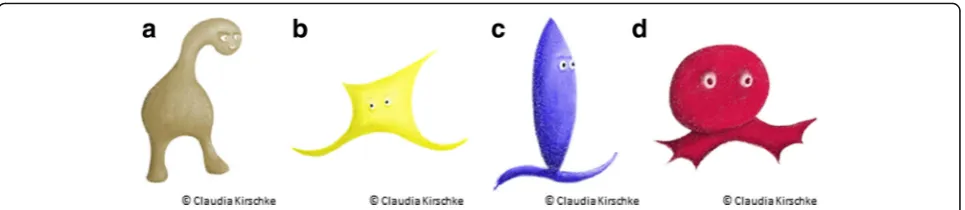
For the language training, we created animated scenes of moving fantasy creatures in Microsoft PowerPoint. These animated scenes were combined with sentences describing the respective actions. In each scene, a single creature,“Tika”(see Fig. 1a), moved towards, around, or away from a variety of other fantasy creatures. Figure 1b, c, and d provide examples for three of these other crea-tures. All pictures depicting the fantasy creatures were created by Claudia Kirschke, who has kindly made the pictures available to us.
The lexicon All elements of the lexicon were pseudo-words in German with no orthographic German real-word neighbors. The pseudoreal-words were generated using the program WinWordGen 1.0 for German (Duyck, Desmet, Verbeke, & Brysbaert, 2004). We took care that the pseudowords had a high bigram frequency. This ensured that that they were easy to pronounce for native speakers of German, i.e., they did not include overly complex consonantal combinations of more than two consonants. Despite their status as pseudowords, we shall refer to the individual lexical entries as nouns, verbs, and markers in order to indicate their grammat-ical function in the artificial language.
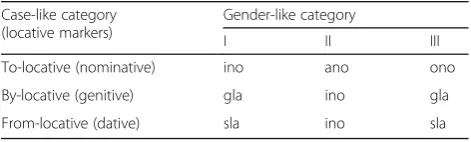
The lexicon of the artificial language contained 37 nouns referring to 37 corresponding fantasy creatures. There was one subject noun, “Tika”, which was the agent of all actions. The remaining 36 nouns depicted Table 2The artificial gender-case-like markers used in Experiments
1A and 1B
Case-like category (locative markers)
Gender-like category
I II III
To-locative (nominative) ino ano ono
By-locative (genitive) gla ino gla
the patients of the actions, such as “Lelop”, “Filan”, or “Tekes” (see Fig. 1). They all featured in the gram-matical function of an object, so these nouns will be referred to as object nounsin the following. Each object noun consisted of four to five letters (see Appendix 3 for an overview). They were pronounced as disyllabic words with four to six phonemes. We ensured that none of the object nouns included suffixes associated with a specific gender in German (e.g., -e, -el, -en, -er, -heit and -ung; see Wegener (1995) and Table 11 in Appendix 1). The object nouns and the creatures they depicted were assigned pseudorandomly to one of the three gender-like subclasses (I, II, III; see Table 2).4
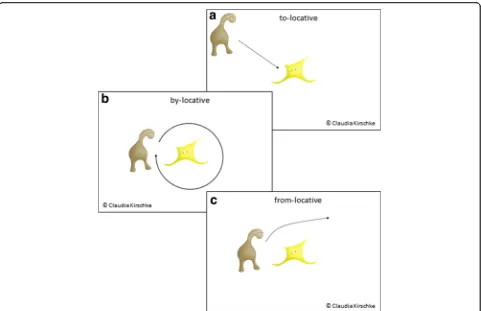
Apart from the nouns, the lexicon included five gram-matical markers carrying information about the gender-and case-like categories of the object nouns (see Table 2). As detailed previously, this set of markers differed from the sets of markers used in previous studies in that only five markers fulfilled a total of nine grammatical functions within the gender-case-like paradigm. Since German na-tive speakers have already acquired a gender-case system in their first language, we made sure that the system of gender-case-like markers did not refer to thematic roles as do the German gender-case markers. Instead, our artificial markers expressed three locative conditions, with the choice of grammatical markers depending on the gender-like subclass of the object noun and the locative orienta-tion of the subject noun’s (i.e., Tika’s) action. That is, a sentence was associated with a to-locative marker when Tika walked towards an object noun creature, it was asso-ciated with a by-locative marker when Tika walked around an object noun creature, and it was associated with a from-locative marker when Tika walked away from an object noun creature.
In addition to the nouns and the markers, the language included two verbs (pimandpif).Pifreferred to the action of Tika moving towards or away from another creature, pimreferred to Tika moving around another creature in a circle. As some gender-case-like markers featured more than once within the marker paradigm (see Table 2), these
verbs ensured that all sentences differed from one another. For instance, the sentences describing the by- and from-locative movements for gender-like category II would be identical if only one verb had been used.
The language We embedded the markers in sentences using the following syntactic structure: object noun– locative marker–subject noun (Tika)–verb. This sentence structure differed from the standard German sentence structure in the order of the syntactic units. Given the three case-like categories, each object noun was associated with three sentences expressing that Tika walks towards, around, or away from the object noun creature, respect-ively (see Fig. 2). For the creature “Lelop”, for example, which was assigned to the gender-like category I, the three sentences are shown in (4) to (6). In the linguistic glosses, we use G to refer to the respective gender-like category (I–III) and C to refer to the respective case-like category (I–III).
In the Rhyme condition, we used the same sentences and added a nonsense line rhyming with the last syllable Fig. 1Examples of the fantasy creatures used in Experiments 1A and 1B. Tika (a) was the creature that acted as a subject in all stimulus
of the sentence. As we had positioned the verbs at the end of the sentences and the verbs were the same for all object nouns, we were able to create identical nonsense lines for all object nouns, as exemplified below for“Lelop”:
In conditions Melody and Rhyme&Melody, participants were exposed to a melodic versions of the non-rhyming and the rhyming training material, respectively, presenting all sentences (and rhymes, if applicable) in a sung version.
Creating and recording the training utterances In order to prepare the stimuli to be used under the con-ditions Prose, Rhyme, Melody, and Rhyme&Melody, we asked a female professional singer and songwriter, Linda Kauffeldt, to compose the melodies for the sung conditions and to sing and record all utterances used in the training and test sessions of the experiment. In the Prose condition, she enunciated the utterances at a regular to slow speaking rate, articulating all vowels clearly without hyperarticulating them. As in a typical German declarative sentence, all pseudowords in the utterance were stressed on the first syllable, and pitch fell from the beginning to the end of the utterance. Figure 4 in Appendix 4 presents the average pitch con-tours for the to-, by-, and from-locative sentences in the Prose condition (red lines), based on a phonetic analysis for the items Lelop, Molun, and Gitun. These pitch con-tours were virtually identical across the to, by, and from sentences.
“Lelop”), the marker (e.g.,“ino”),“Tika”, and“pif”, respect-ively. Across the case-like variants of the training sen-tences, the creature’s name (e.g., “Lelop”) would always feature as an up-beat with the full beat (printed in fat letters in (10)) coinciding with the marker.
Figure 4 in Appendix 4 presents the pitch contour for the Rhyme condition (blue lines), based on a phonetic analysis for items Lelop, Molun, and Gitun. With Lelop (or any other creature’s name) being enunciated as an up-beat, pitch increased on the full beat, coinciding with the marker. Again, this pitch contour was virtually iden-tical across the three case-like sentence types.
Figure 5 in Appendix 4 presents the melodies the com-poser created and sang for the conditions Melody and Rhyme&Melody, respectively. Again, the creature’s name functioned as an upbeat, with the full beat coinciding with the marker. In order to highlight the musical style of these conditions, the vocals were accompanied by a piano, which played the same tune as the singer.
In composing the melodies for the conditions Melody and Rhyme&Melody, the composer made sure that the structures of the sung sentences fit with standard struc-tures of children’s songs, taking into account elemental common features of popular children’s music, such as repeatability, the use of major and minor harmonies, and a simple rhythm. These features support the transparency and accessibility of popular songs (Kramarz, 2007; see also Kauffeldt, 2011). Indeed, from a musical point of view, children’s songs lend themselves well to bringing together the components melody, meter, grammatical structure, and text content in an optimal way (Kauffeldt, 2011). The composer matched the two melodies for the groups Melody and Rhyme&Melody according to their form, structure, and musical quality (see Appendix 4). Note that based on the existing sentences, a six-lined struc-ture was given for the Rhyme&Melody condition, while a three-lined structure occurred in the Melody condition (see examples for“Lelop”above). Since a six- or four-lined structure but no three-lined structure is common in children’s songs (see Appendix 2 for an example of a four-lined structure), we facilitated a four-lined structure for the Melody condition by embedding a nonsense line after the second sentence ([dubida: dubidu:]; see Figure 5a in Appendix 4).
When recording the utterances, we made sure that, within a given condition, the speed of delivery of the
sentences was kept at a consistent rate by means of a metronome. For any given condition, the metronome speed was set to be at a typical speed of delivery for the training mode at hand, i.e., the speed was slightly faster in modes Prose and Rhyme than in modes Melody and Rhyme&Melody. Table 3 lists the duration of the re-corded sentences. They were very similar across condi-tions, ranging from 2.15 to 2.98 s. However, due to the use of a metronome, the subtle differences in speed between conditions were very consistent. In an ana-lysis of variance of the sentence durations measured in the four conditions, condition yielded a significant effect (F(3, 63) = 262.31;p< 0.001). There was no differ-ence in sentdiffer-ence durations between the three gender-like subclasses and no interaction of condition and gender-like subclass (bothFs < 1.15,p> 0.33).
To assess whether introducing a rhythmic mode of speaking induced any changes to the clarity and distinct-iveness of the vowels enunciated by the speaker, we com-pared the vowel space of the vowels included in the six sentences for each of items Lelop, Gitun, and Molun in the Prose and the Rhyme condition, respectively (see Figure 6 in Appendix 4). There was virtually no difference in the vowel dispersion observed across the two conditions,
Table 3Duration of the recorded sentences (in seconds) by condition and gender-like subclass: mean, standard errors (SE), minimum (Min), and maximum (Max)
Gender-like Category All Items
I II III
Prose
Mean 2.11 2.15 2.17 2.15
SE 0.017 0.022 0.042 0.017
Min 2.04 2.04 2.06 2.04
Max 2.18 2.25 2.42 2.42
Rhyme
Mean 2.30 2.31 2.32 2.31
SE 0.013 0.016 0.018 0.009
Min 2.26 2.26 2.24 2.24
Max 2.35 2.40 2.42 2.42
Melody
Mean 2.98 2.99 2.98 2.98
SE 0.010 0.010 0.005 0.005
Min 2.94 2.94 2.97 2.94
Max 3.02 3.02 3.00 3.02
Rhyme&Melody
Mean 2.91 2.92 2.91 2.91
SE 0.011 0.016 0.014 0.008
Min 2.85 2.86 2.86 2.85
suggesting that the rhythmic style of speaking in the Rhyme condition did not render the vowels more distin-guishable. We were not able to perform parallel analyses for the conditions Melody and Rhyme&Melody, as the singer’s voice was accompanied by a piano in these conditions.
Design
Using a 2 × 4 design, we tested the effects of training method (blocked, random) and training mode (Prose, Rhyme, Melody, Rhyme&Melody). In Experiment 1A, we employed a blocked input presentation, that is, all sentences concerning one noun were presented consecu-tively. Thus, for example, participants were first exposed to all three sentences associated with the creature“Lelop” (see sentences (4) to (6) above), then to all three sentences associated with“Filan”, and so on, imitating the strophe-based structure of a children’s song, a poem, or a pun or language play. The sentences were presented in a fixed se-quence, with Tika first walking towards, then around, and finally away from the object noun creature. In Experiment 1B, the training sentences were no longer grouped into sets of three sentences per creature. Instead, the sentences were presented in a random fashion. For example, first the to-locative sentence for“Filan” would be presented, next the from-locative sentence for“Lelop”, and so forth. Par-ticipants never saw the same object creature with Tika in a row and the locative relations were presented in a random order rather than in fixed sequences. Within each of the two levels of the factor training method, language training took place in one of the four different training modes. Training method and training mode were tested between participants.
Training and test procedure
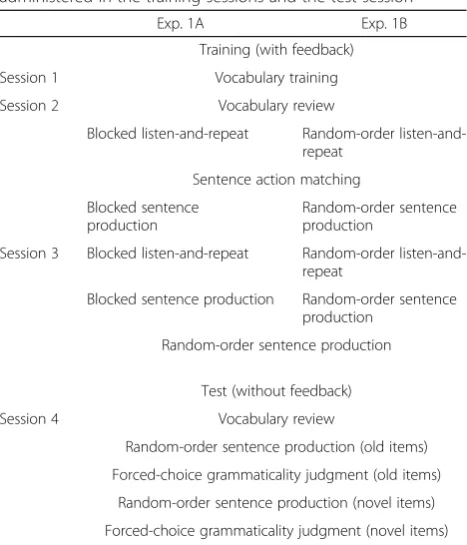
In keeping with previous studies (Brooks et al., 1993; Taraban, 2004), the sentence training was preceded by a dedicated vocabulary training session (Session 1). After that, we administered two language training sessions using animated PowerPoint scenes and sentence recordings (Sessions 2 and 3) and one test session (Session 4). The choice of the tasks used in the training and test sessions was based on the relevant predecessor studies (e.g., Brooks et al., 1993; see Table 4 for an overview).
Out of the 36 object nouns, 30 were used for training purposes. The sessions were conducted sequentially within 2 consecutive weeks, with two sessions of approximately 60 min each per week. Participants were instructed that they would learn an artificial language and that no further information about the language could be given until the debriefing after the completion of the study.
Session 1 (vocabulary training) In Session 1, all 31 crea-ture nouns were trained. At the beginning of the session,
participants learned that they would get to know all fan-tasy creatures and were supposed to learn their associated nouns as a requirement for the next sessions. They were then exposed to the creature nouns in five blocks, each block containing six to seven different PowerPoint slides displaying one creature and its corresponding spoken and written name. Each block was trained separately. First, the items were introduced by twice presenting each picture of a single creature along with its spoken and written name. Subsequently, only images of the creatures were shown and participants were asked to name each of them from memory. Immediate auditory and orthographic feedback, i.e., the correct name, followed each response. This task was continued until participants were able to name all creatures in the block of creatures correctly. Then partici-pants proceeded to the next vocabulary block. After com-pleting all five vocabulary blocks, participants were given a set of cards, each showing one of the 31 creatures at the front and their written names at the back. Participants were instructed to review them at home and to return the cards to the experimenter at the beginning of the next ses-sion, which took place 2 or 3 days later. Apart from the written creature names used in Session 1, no further orthographic information was provided in the present study. All following syntactic items were provided aurally to ensure that our training method paralleled the condi-tions of first language acquisition as closely as possible.5
Table 4Experiments 1A (blocked presentation in training) and 1B (random presentation in training): Overview of the tasks administered in the training sessions and the test session
Exp. 1A Exp. 1B
Training (with feedback)
Session 1 Vocabulary training
Session 2 Vocabulary review
Blocked listen-and-repeat Random-order listen-and-repeat
Sentence action matching
Blocked sentence production
Random-order sentence production
Session 3 Blocked listen-and-repeat Random-order listen-and-repeat
Blocked sentence production Random-order sentence production
Random-order sentence production
Test (without feedback)
Session 4 Vocabulary review
Random-order sentence production (old items)
Forced-choice grammaticality judgment (old items)
Random-order sentence production (novel items)
Sessions 2 and 3 (language training) Session 2 started by testing the participants’knowledge of the 31 creature nouns acquired during the first session. All participants reached the learning criterion of 95%, i.e., 29 correct re-sponses. During all the following tasks administered in Sessions 2 and 3, 6 of the 30 object nouns were withheld in order to be used as novel-old items in the test session (see Appendix 3). As each object noun was associated with three sentences (see Materials), the tasks adminis-tered in Sessions 2 and 3 featured a maximum of 72 sen-tences in total. During all tasks, participants were instructed that they should provide the best answer they could, even if they were not sure of their response.
As the first task in Session 2, we administered a listen-and-repeat task(see Table 4). Participants listened to one or more sentences while watching the related actions, then repeated the sentence(s) and finally listened to the correct sentences as auditory feedback to monitor their response. In Experiment 1A, all sentences were presented in a blocked fashion, so participants listened to the three sentences associated with one object noun, and were then asked to repeat them and received auditory feedback for all three sentences. In Experiment 1B, featuring a random sentence presentation, participants were no longer re-quired to memorize and repeat three sentences in a row, rather they repeated each sentence immediately and re-ceived immediate auditory feedback. Compared to a train-ing mode that is fully analogous to the blocked condition and presents trios of randomly assorted sentences in the listen-and-repeat task, the presentation in a sentence-by-sentence manner should ease the processing load associ-ated with memorizing the individual sentences. We sur-mised that, if anything, this should enhance participants’ training outcome, but that this enhancement would be unlikely to outweigh the advantage of the blocked over the random method of presentation.
In the second task of session 2 (sentence-action match-ing; see Table 4), the participants listened to 24 single sen-tences, one sentence per each object noun. Each sentence was presented along with a sample of pictures showing the three associated actions of the object noun creature. Participants were asked to select the corresponding image. The participants received immediate feedback on the cor-rectness of the response via a red box marking the correct picture. The target sentence played with any given object creature was selected pseudorandomly, with each partici-pant seeing 8 creatures each with a to, by, and from loca-tive. The sentence-action matching task was administered identically in Experiments 1A and 1B, as there was only one test item per object noun and blocking of sentences by object creature was not possible.
Next, productive language training was introduced (see Table 4). Participants were instructed to watch an action and to generate the corresponding sentence for it. In
Experiment 1A, all actions were presented grouped by ob-ject nouns (blocked sentence production). However, unlike in the blocked listen-and-repeat task administered earlier, participants produced the sentence for each action imme-diately and did not wait for the three actions for a creature to be completed. After each group of three sentences, the correct sentences were given as auditory feedback. In Ex-periment 1B, the actions to be described were presented in a pseudorandom fashion and participants were asked to produce the correct sentence to each action (
random-order sentence production). Feedback was given
immedi-ately after each sentence (see Table 4).
In Session 3, participants first completed theblockedor
random listen-and-repeatand theblockedorrandom
sen-tence production tasksonce again, as described for Session 2 (see Table 4). After that, they all worked through a random-order sentence production task, that is, the task administered to the participants of Experiment 1B in Ses-sion 2 and early in SesSes-sion 3 was now administered to all participants. By including it as the very last task in the last training session, we were able to compare participants’ performance on this task immediately after training and in the test session, which took place 2 or 3 days after the last training session (see Table 4).
Session 4 (test) In the final session, which was identical for Experiments 1A and 1B, several tasks were adminis-tered to test participants’mastery of the artificial language (see Table 4). It began with a vocabulary review of the 30 object creature nouns followed by four tests. In the first two tests, all stimuli pertained to the 24 object nouns the participants had worked with during training (old items).
First, we carried out a random-order sentence produc-tion test. It was almost identical to the last task adminis-tered in training, except that participants received no feedback and were exposed to only half of the trained ma-terial. The material comprised of the three actions pertain-ing to 12 of the 24 trained object nouns (four nouns per gender-like subclass), resulting in 36 actions in total. Next, participants performed a forced-choice grammaticality
judgment test. They watched 36 actions associated with
gender-like class of each object noun as well as the gender-case-like paradigms was necessary.
In the remaining two tests, participants were tested with novel, untrained sentences in order to test their ability to generalize the acquired gender-case-like paradigm to new object nouns. To this end, we employed the six object nouns not included in the training tasks, but reviewed regularly in the vocabulary review (novel-old object nouns). Additionally, six novel-new object nouns were tested which the participants had never seen or heard be-fore (see Appendix 3). Two novel-new and two novel-old object nouns were assigned to each gender-like category. In the novel + hint sentence production test, participants were required to produce sentences to actions performed with the novel object nouns. Since the participants had no way of knowing the gender-like subclass of the novel nouns, we gave them a hint by aurally presenting the to-locative sentence of an object noun along with the corre-sponding action. Next, we asked the participants to gener-ate the two remaining sentences (by-locative and from-locative) for the object noun along with the visual presen-tation of the actions. Finally, in the novel forced-choice grammaticality judgment test, participants listened to sen-tences pertaining to novel vocabulary. The sensen-tences were presented in groups of three that each pertained to the same novel object noun. For each of the 12 novel object nouns, one correct and one incorrect group of sentences was presented, resulting in 24 test items in total. Incorrect test items included one incorrect sentence, which was ei-ther false concerning a) the gender-like category, b) the case-like category, or c) both, with each type of error fea-turing in one-third of the incorrect sentences. We asked participants to decide whether the group of sentences as-sociated with one noun sounded grammatically correct or incorrect.
After the tests, we asked participants to fill in a questionnaire in order to find out about the level of awareness regarding the gender-case-like paradigm. Participants were asked questions on the structure of the acquired material to assess which aspects of the grammat-ical system they had learned and were able to report.
Data analysis
In the production tests (random-order sentence production in Session 3 and the test session andnovel + hint sentence productionin the test session), errors were restricted to par-ticipants using the wrong markers. Other mistakes, namely the wrong use of an object or verb, occurred rarely (15 and 265 out of 6336 cases in Experiments 1A and 1B, respect-ively, corresponding to 0.24% and 4.18% of the data). They were not excluded from the analyses. There were no invalid trials; that is, all participants responded to all stimuli.
In a first set of analyses, we compared the participants’ accuracy with the chance level (50%) using binomial tests
(p< 0.05 for all tests). We set this chance level following the analyses reported in previous studies (Frigo & McDonald, 1998; Kempe & Brooks, 2008; Taraban, 2004). It reflects that, with any answer a participant produces, he or she can produce the correct or an incorrect response, be that a sentence including a particular locative marker or a forced-choice grammaticality judgment.
Next, we assessed the effects of training method and training mode on participants’ performance. Marker ac-curacy was analyzed using linear mixed effects models as implemented in the lmer-function of the lme4 package (Bates, Maechler, Bolker, & Walker, 2015) for R (R Devel-opment Core Team, 2012), using a binomial link function and the Bobyqa optimizer. For all analyses, the full model supported by the design was used, including maximal random effects (Barr, Levy, Scheepers, & Tily, 2013), i.e., random intercepts for participants and items, as well as random slopes for items for the effects of training method, training mode, and their interaction. Training mode was contrast coded using sum coding with Prose functioning as the baseline and Rhyme, Melody, and Rhyme&Melody being compared to it. Following Barr et al. (2013), we used a model comparison approach. Based on the full model, we computed models excluding Blocking, Rhyme, Melody, Rhyme&Melody or the interactions of Blocking with each of the presentation modes, carrying forth the random slopes and intercepts of the full model. As the models in-cluded a large number of factors, they often failed to con-verge. For most of the models, convergence was reached when the random correlations were removed (see Barr et al., 2013). Occasionally, random slopes also had to be removed. In these cases, we removed the slope(s) that were associated with the least amount of variance.
Results and discussion
the other three training modes exceeded the chance level. In theforced-choice grammaticality judgmenttests, partic-ipants trained with the random training method per-formed significantly better than chance.
Next, we analyzed the effects of training method (blocked, random) and training mode (Prose, as compared to Rhyme, Melody, and Rhyme&Melody) for each task.
Old items
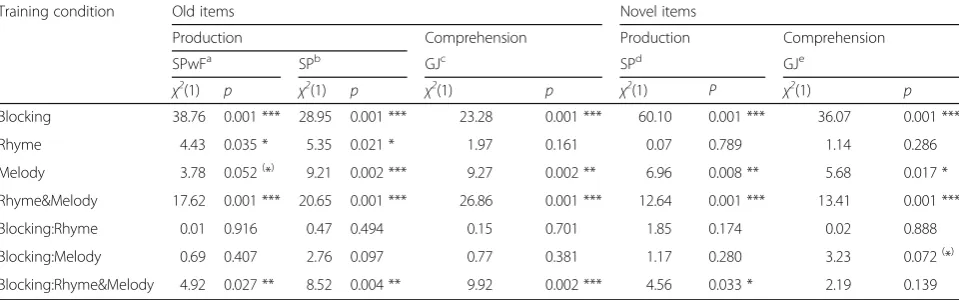
Production tasks The results of the random-order sen-tence production tests with feedback (Session 3) and with-out (Session 4) are summarized in Table 5. Participants who had received blocked input during training signifi-cantly outperformed those receiving randomly structured input (see Table 6 for a summary of the results of the stat-istical analyses). Tables 5 and 6 also show that, compared to a Prose training mode, the modes Rhyme, Melody, and Rhyme&Melody significantly enhanced participants’ per-formance in both production tests. At both testing times, there was a significant interaction of training method and Rhyme&Melody, reflecting that, compared to Prose, the effect of Rhyme&Melody was particularly strong in the blocked as compared to the random training method. This increase was as high as 20% and 29% in Sessions 3 and 4, respectively, for the blocked training method, whereas it was much lower (11% in Session 3 and Session 4) with the random training method.
Comprehension test The analyses of the participants’ performance in the forced-choice grammaticality judg-ment test with old items yielded results largely parallel to those found for the production tasks (see Table 5). As shown in Table 6, there was a main effect of training method, with the blocked groups performing significantly better than the random groups. Compared to the Prose
training mode, modes Melody and Rhyme&Melody, but not Rhyme, significantly improved participants’ perform-ance (see Table 6). For Rhyme&Melody, this effect was en-hanced further by a blocked training method.
To summarize, the analysis of the results for the old items showed that a blocked input presentation yielded significantly better learning outcomes than a random in-put presentation. The best results were attained when both rhyme and melody were added to the blocked train-ing method.
Learning trajectories for old items In supplementary analyses, we analyzed the types of errors participants made with the old items when producing sentences during the course of training and test, i.e., in the blocked/ran-dom-order sentence production task in Sessions 2 and 3, and the random-order sentence production tasks at the end of the last training session and in the test session (see Table 4). Four different error types were analyzed: a) an error in which the case-like category of the marker was correct, i.e., a marker from the correct locative category was produced, but the marker was from the wrong gender-like category (gender error); b) an error in which the marker was from the correct gender-like category but the case-like category was incorrect (case error); c) an error in which both the gender- and the case-like categor-ies were incorrect (gender-case error); and d) an error that could be either a gender error, a case error, or a gender-case error (not classifiable). Table 7 summarizes the total number of each error type for each task, collapsed across experiments and training modes. Clearly, across sessions, participants mostly made gender errors, whereas other errors occurred at a lesser rate. Gender errors were dom-inant during all sessions and did not vanish towards the
Table 5Experiments 1A (blocked presentation in training) and 1B (random presentation in training): Percentages of correct markers (subject means with standard deviations) in the random-order sentence production task with old object nouns at the end of the last training session (with feedback) (SPwF), the random-order sentence production test with old object nouns in the test session (without feedback) (SP), the forced-choice grammaticality judgment task with old object nouns (GJ), the novel + hint sentence production task (SP, collapsed over novel-old and novel-new nouns), and the novel forced-choice grammaticality judgment task (GJ, collapsed over novel-old and novel-new nouns)
Blocked presentation (Experiment 1A) Random presentation (Experiment 1B)
Old items Novel items Old items Novel items
Training mode Production Comprehension Production Comprehension Production Comprehension Production Comprehension
SPwF SP GJ SP GJ SPwF SP GJ SP GJ
later sessions, indicating that, as we had anticipated, choosing the correct gender-like category in the produc-tion tasks constituted the most prominent problem for the learners. Therefore, all following analyses focus on gender errors.
Figure 3 depicts the percentage of gender errors out of all responses for all eight groups in each task. In order to assess the effects of session, training method, and training mode on the number of gender errors, we coded the errors as a binary variable (with all gender errors scoring 1 and all correct responses and all other errors scoring 0) and assessed the effects of training method and training mode for each session (see Fig. 3 and Table 8). As of session 3, there was an effect of training method, with participants trained with the ran-dom training method producing significantly more gen-der errors than those trained with the blocked training method.
With respect to the effects of training mode, we ob-served a significant advantage of mode Rhyme&Melody as of Session 3. From the start, this effect interacted with the
training method, with the number of gender errors de-creasing most clearly in the blocked Rhyme&Melody group (see Fig. 3). At the end of the study (Session 4), participants of the groups Rhyme, Melody, and Rhyme& Melody outperformed those of the group Prose (see Fig. 3).6
Novel items
As detailed in the Methods section, the production and comprehension tests were also carried out with six novel-old object nouns, which referred to creatures the partici-pants had worked with during the vocabulary training but in no other part of the training phase, and with six novel-new object nouns, which participants had never encoun-tered before.
Table 5 presents the test results of the novel + hint sentence production task and the novel forced-choice grammaticality judgment task, collapsed across novel-old and novel-new object nouns.7 As Tables 5 and 6 show, a blocked training method significantly increased participants’ levels of performance; in fact, the partici-pants in the blocked condition performed near ceiling,
Table 7Number of error types produced in Session 2 (blocked/random-order sentence production), the first production task in Session 3 (blocked/random-order sentence production), the second production task in Session 3, and in the test session (random-order sentence production)
Session Total
number of items
Error type
Gender error Case error Gender-Case error Not classifiable
Session 2 6912 2127 (31%) 133 (2%) 96 (1%) 1215 (18%)
Session 3 (1st) 6912 1365 (20%) 113 (2%) 82 (1%) 851 (12%)
Session 3 (2nd) 6912 1089 (16%) 93 (1%) 73 (1%) 666 (10%)
Session 4 3456 683 (20%) 45 (1%) 35 (1%) 358 (10%)
Table 6Experiments 1A and 1B: Inferential statistics testing for the effect of a blocked as compared to a random training method and for the difference between the prose training mode and the three training modes Rhyme, Melody, and Rhyme&Melody in the sentence production (SP) and forced-choice grammaticality judgment tasks (GJ). SPwF refers to the sentence production task administered at the end of the last training session
Training condition Old items Novel items
Production Comprehension Production Comprehension
SPwFa SPb GJc SPd GJe
χ2(1)
p χ2(1) p χ2(1) p χ2(1) P χ2(1) p
Blocking 38.76 0.001 *** 28.95 0.001 *** 23.28 0.001 *** 60.10 0.001 *** 36.07 0.001 ***
Rhyme 4.43 0.035 * 5.35 0.021 * 1.97 0.161 0.07 0.789 1.14 0.286
Melody 3.78 0.052(*) 9.21 0.002 *** 9.27 0.002 ** 6.96 0.008 ** 5.68 0.017 *
Rhyme&Melody 17.62 0.001 *** 20.65 0.001 *** 26.86 0.001 *** 12.64 0.001 *** 13.41 0.001 ***
Blocking:Rhyme 0.01 0.916 0.47 0.494 0.15 0.701 1.85 0.174 0.02 0.888
Blocking:Melody 0.69 0.407 2.76 0.097 0.77 0.381 1.17 0.280 3.23 0.072(*)
Blocking:Rhyme&Melody 4.92 0.027 ** 8.52 0.004 ** 9.92 0.002 *** 4.56 0.033 * 2.19 0.139
(
*)
p< 0.08, *p< 0.05, **p< 0.01, ***p< 0.001
a
Full model’s AIC: 6543.5, BIC: 6639.3, excluding the random effects of Melody, Blocking:Rhyme, and Blocking:Melody
b
Full model’s AIC: 3534.0, BIC: 3638.5
c
Full model’s AIC: 2583.0, BIC: 2669.1, excluding the random effects of Melody, Blocking:Melody, and Blocking:Rhyme&Melody
d
Full model’s AIC: 1674.8, BIC: 1766.6, excluding the random effects of Rhyme&Melody
e
yielding over 90% correct responses in the Prose condi-tion. Nevertheless, the modes Melody and Rhyme&Mel-ody increased participants’accuracy rates significantly in both training methods. However, this increase was sub-stantially smaller for the participants in the blocked training groups than those in the random-order training groups, simply because participants trained with the blocked method performed exceptionally well from the start. In the novel + hint sentence production task, this discrepancy yielded a significant interaction of training method and Rhyme&Melody training mode.
At first sight, it may seem odd that participants per-formed better overall in the tests with novel items than in the tests with old items (see Table 5), especially so in the sentence production task. However, since for the novel items participants had no way of telling their gen-der, participants were given a to-locative action for each novel creature and listened to the corresponding to-locative sentence. Next, they were asked to produce the by-locative and the from-locative sentences for this crea-ture while watching the corresponding actions, so all they had to do was to retrieve the correct case-markers within a given gender-like marker paradigm. By contrast, in all tasks with old items, participants received no hints regarding the gender-like subclass of the individual object nouns. Thus, to perform well on the tests with old items, participants needed to not only use their knowledge about the paradigms of locative markers, but also assign the right gender-like category to each object noun. Therefore, provided the participants were aware of the marker paradigms associated with each gender-like category, the generalization tests with novel items were easier to complete than those with old items. The fact that participants of the blocked training groups performed exceptionally well from the start suggests that, by the time of the test session, they
were fully aware of the composition of the three marker paradigms.
In summary, the results from Experiments 1A and 1B demonstrate that a blocked presentation is necessary and sufficient for the acquisition of a complex grammatical paradigm with three gender-like and three case-like sub-classes, even when it includes substantial form overlap. In sentence production, participants in the group Rhyme&-Melody consistently outperformed the participants in the Prose group, especially when being trained with structured input. This suggests that acquiring gender-like subclasses when no noun cues but only syntactic cues are available can be enhanced considerably by a combination of struc-tured input, rhyme, and melody in training.
Questionnaire
To examine the extent of explicit knowledge participants were able to establish about the system of gender-case-like markers, we asked participants to fill in a questionnaire at the end of the study. They were asked to indicate whether they had noticed that the sentences followed certain rules and, if so, to write down those rules. The answers reflected four different types of paradigm knowledge: a) correct and full knowledge of the gender-case-like system, meaning that participants were able to describe which markers were used in connection with which action (e.g.,“ino, ano and ono go along with walking towards a creature”) and which sets of markers belonged together (e.g., “ino goes along with gla and sla”) (cf. column‘full’ in Table 9); b) complete knowledge of the case-like system only, i.e., par-ticipants were able to describe which markers occurred in connection with which actions, but could not describe which set of markers belonged to a shared gender-like cat-egory (column‘locative’in Table 9); c) incomplete know-ledge of the gender- and case-like system, i.e., participants could describe an extract of the gender-case-like system Table 8Results of the statistical analyses of gender errors with old items observed in Session 2 (blocked/random-order sentence production), the first production task in Session 3 (blocked/random-order sentence production), the second production task in Session 3, and in the test session (random-order sentence production)
Session 2a Session 3 (1st)b Session 3 (2nd)c Session 4d
χ2
(1) p χ2(1) p χ2(1) p χ2(1) p
Blocking 1.75 0.186 20.99 0.001 *** 31.16 0.001 *** 21.70 0.001 ***
Rhyme 3.39 0.066(*) 1.05 0.306 1.94 0.164 5.27 0.022 *
Melody 0.37 0.544 0.76 0.383 3.57 0.059(*) 8.11 0.004 **
Rhyme&Melody 1.92 0.166 5.34 0.021 * 16.68 0.001 *** 27.02 0.001 ***
Blocking: Rhyme 0.13 0.722 0.84 0.359 0.72 0.395 0.42 0.516
Blocking:Melody 0.23 0.634 0.01 0.960 0.51 0.476 1.64 0.201
Blocking:Rhyme&Melody 0.31 0.580 5.33 0.021 * 3.82 0.051(*) 6.16 0.013 *
(
*)
p< 0.08, *p< 0.05, **p< 0.01, ***p< 0.001
a
Full model’s AIC: 5090.3, BIC: 5206.6
b
Full model’s AIC: 4668.0, BIC: 4784.3
c
Full model’s AIC: 4112.3, BIC: 4228.6
d