MURDOCH RESEARCH REPOSITORY
This is the author’s final version of the work, as accepted for publication following peer review but without the publisher’s layout or pagination.
The definitive version is available at
http://dx.doi.org/10.1016/j.jas.2014.05.023
Jacomb, C., Holdaway, R.N., Allentoft, M.E., Bunce, M., Oskam,
C.L., Walter, R. and Brooks, E. (2014) High-precision dating and
ancient DNA profiling of moa (Aves: Dinornithiformes) eggshell
documents a complex feature at Wairau Bar and refines the
chronology of New Zealand settlement by Polynesians. Journal
of Archaeological Science, 50 . pp. 24-30.
http://researchrepository.murdoch.edu.au/23310/
Copyright: © 2014 Elsevier Ltd
Accepted Manuscript
High-precision dating and ancient DNA profiling of moa (Aves: Dinornithiformes) eggshell documents a complex feature at Wairau Bar and refines the chronology of New Zealand settlement by Polynesians
Chris Jacomb , Richard N. Holdaway , Morten E. Allentoft , Michael Bunce , Charlotte L. Oskam , Richard Walter , Emma Brooks
PII: S0305-4403(14)00201-5
DOI: 10.1016/j.jas.2014.05.023
Reference: YJASC 4081
To appear in: Journal of Archaeological Science
Received Date: 19 March 2014 Revised Date: 22 May 2014 Accepted Date: 25 May 2014
Please cite this article as: Jacomb, C., Holdaway, R.N., Allentoft, M.E., Bunce, M., Oskam, C.L., Walter, R., Brooks, E., High-precision dating and ancient DNA profiling of moa (Aves: Dinornithiformes) eggshell documents a complex feature at Wairau Bar and refines the chronology of New Zealand settlement by Polynesians, Journal of Archaeological Science (2014), doi: 10.1016/j.jas.2014.05.023.
M
AN
US
CR
IP
T
AC
CE
PT
ED
High-precision dating and ancient DNA profiling of moa (Aves: Dinornithiformes) eggshell
documents a complex feature at Wairau Bar and refines the chronology of New Zealand
settlement by Polynesians.
Chris Jacomba, Richard N. Holdawayb, Morten E. Allentoftc, Michael Bunced, Charlotte L.
Oskame, Richard Waltera, Emma Brooksa
a
Southern Pacific Archaeological Research, Department of Anthropology and Archaeology,
University of Otago, PO Box 56 Dunedin, New Zealand.
b
Palaecol Research Ltd, Christchurch, New Zealand
c
Centre for GeoGenetics, Natural History Museum, University of Copenhagen, Denmark
d
Trace and Environmental DNA laboratory, Department of Environment and Agriculture,
Curtin University, Perth, WA 6102, Australia.
e
School of Biological Sciences and Biotechnology, Murdoch University, Perth, Western
Australia, Australia
Corresponding author: Chris Jacomb, Southern Pacific Archaeological Research, Department
of Anthropology and Archaeology, University of Otago, PO Box 56 Dunedin, New Zealand.
[email protected] – ph. +64 3 479 8739
ABSTRACT
Wairau Bar, New Zealand, is one of the few prehistoric sites in the world that could lay claim
to being a site of first human intrusion into a pristine environment. It is certainly one of the
best places to study human impact on a hitherto unoccupied land. Its potential status as a
colonization phase settlement for New Zealand’s Maori population raises questions that
require fine-grained chronological resolution. Unfortunately, the simple stratigraphy of the
Wairau Bar site has offered little opportunity for the development of high-resolution
chronologies. This situation changed recently when new excavations exposed a complex,
midden-rich feature which contained a wide range of dateable material, including hundreds
of fragments of eggshell of the extinct megaherbivorous moa (Aves: Dinornithiformes). The
M
AN
US
CR
IP
T
AC
CE
PT
ED
material for radiocarbon dating. Its refractory properties also allow high-quality
preservation of DNA. The moa eggshell yielded radiocarbon that facilitated reconstruction
of the chronology of deposition at a fine resolution. Ancient DNA profiling of eggshell
fragments was used to ensure that dated fragments were from different individuals.
Bayesian analysis of the dated fragments showed that the midden was laid down over a
brief period in the early decades of the 14th century CE. This improved chronology provides
a benchmark for understanding the duration of site occupation and revises current
interpretations of the timing of Polynesian settlement of New Zealand.
KEYWORDS: Radiocarbon; ancient DNA; colonization; Maori; Bayesian.
I N T R O D U C T I O N
Wairau Bar is one of the earliest and most significant archaeological sites in New Zealand. It
has the widest range and largest number of artefacts typical of the Archaic Phase of East
Polynesian culture of any site in the Pacific (Higham et al. 1999) and is the source of much of
our knowledge about the earliest settlement phase in New Zealand and of the historical
connections between New Zealand and the tropical East Polynesian homelands (Duff 1956;
Golson 1959; Davidson 1984). Following the discovery of two “moa-hunter” burials in 1939
and 1942 by J.R. Eyles, the site was investigated over several field seasons between 1942
and 1964 by teams from the Canterbury Museum as well as by Eyles and others (Brooks et
al. 2011). Most of this work focused on the many burials discovered at the site and their
associated grave goods although, later, the stratigraphy and other aspects of the site were
also investigated (Trotter 1977). This work was conducted either before the invention of
radiocarbon dating or during its infancy.
The importance of understanding the chronology of the site has long been recognized (Duff
1956, Trotter 1977, Anderson 1989; 1991; Challis 1991; Higham et al. 1999); indeed, the first
radiocarbon determinations from a New Zealand archaeological site were on samples from
Wairau Bar (Duff 1956: xii). However, access to the site was restricted from the mid-1960s
at the very time when radiocarbon dating was becoming a routine tool for archaeologists.
As a result, modern attempts at dating the site have been reliant on the use of curated
material from the early excavations which was of questionable provenance. In fact, the
M
AN
US
CR
IP
T
AC
CE
PT
ED
applicability and efficacy of methods of pretreatment (bone samples) mean that nearly all of
the dates produced prior to 1999 are considered unreliable (Higham et al. 1999). To further
complicate matters, a major fluctuation in the southern hemisphere terrestrial radiocarbon
calibration curve is centered on the 14th century CE, making it difficult to obtain
high-resolution chronologies for the Polynesian colonization phase (McFadgen, Knox and Cole
1994). Finally, the site itself presents a particular problem for resolving chronology in its
shallow, unbroken stratigraphy. The site is essentially one layer so it is difficult to improve
the precision of dates using statistical tools which rely on knowledge of stratigraphic
position to constrain date ranges.
In 1999, Higham, Anderson and Jacomb set out to refine the site chronology by dating moa
eggshell (using pieces from 11 more-or-less complete but broken eggs) from ten of the
burials, as well as marine shell samples (n=2) from two midden contexts. The resulting
dates, calibrated using the Intcal98 (Northern Hemisphere) calibration curve (Stuiver et al.
1998), indicated that the site had been occupied from the late 13th century. These dates are
now considered the most reliable suite for dating the burial complex at Wairau Bar, but
because they were from a number of different features of unknown stratigraphic
relationship they cannot be combined to provide a high precision date of a single event.
Recent developments have provided the opportunity to generate a high precision age
estimate for a single feature at Wairau Bar. First, a new program of excavations in 2009
produced multiple samples of moa egg shell from a single feature. Moa egg shell has
negligible inbuilt age and is resistant to contamination (Higham 1994). Deriving from a single
feature Bayesian methods could be used to improve the dating precision. Underpinning this
work, ancient DNA (aDNA) analysis was used to eliminate the possibility of dating multiple
fragments derived from the same egg.
E X C A V A T I O N S I N 2 0 0 9
Excavations at Wairau Bar in January 2009 were carried out under the direction of RW and
CJ (Brooks et al. 2009). They were carried out as part of a program of repatriation of human
remains that had been excavated in the mid twentieth century. Several parts of the site
were investigated, including middens, living floors, and food preparation areas. One of the
M
AN
US
CR
IP
T
AC
CE
PT
ED
individually up to 6 m in diameter. Stratigraphic interpretation of a fully excavated portion
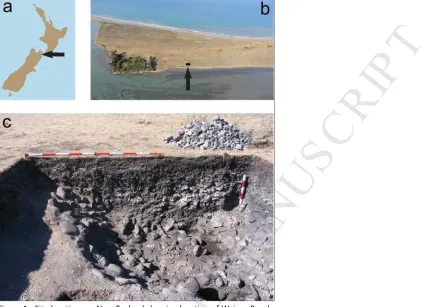
of one of these, Oven Pit 1 (Figure 1), showed that the feature contained a midden deposit
that was likely accumulated over a very brief span of time. The radiocarbon samples were
derived from this pit feature.
Oven Pit 1
Oven Pit 1 was 6 m in diameter by 1.2 m deep, and contained a range of faunal material,
charcoal, and fire-cracked rocks, excavated into a sterile, pebbly silt subsoil. About a third
of the feature was excavated stratigraphically according to natural layers and, within layers,
in 100 mm spits by quadrant (NE, NW, SE, SW).
The oven feature had a relatively simple stratigraphy of three layers:
Layer 1 (0-200 mm) – Plough zone, a mixture of topsoil and fragmented midden.
Layer 2 (200-1200 mm) – Pit fill, a mix of shell and bone midden in an ashy soil matrix. The
lower 500 mm or so was dominated by ashy soil, gravel and fire-cracked rocks, with fewer
faunal remains.
Layer 3 (1200 mm to base of excavation) – Sterile grey, silty, subsoil overlying a layer of
large oven stones.
All material was sieved (3.2 mm screen size) on site and the residue in the sieves was
returned to the Otago Archaeology Laboratories (University of Otago) for analysis. The
material in this study was from a 1 x 1 m column sample, “Column Sample A” (Area 4, Unit
J), selected for detailed faunal analysis. The fauna from Oven Pit 1 included the extinct moa
(bone and eggshell) and at least 20 species of other birds, including the extinct eagle
Hieraaetus moorei, as well as marine mammals (pinnipeds), dog (Canis familiaris), fish, and
shellfish (cf Scofield et al. 2003). The moa eggshell, 1135 fragments (356 g), was of
particular interest for this study because of its ideal qualities for radiocarbon dating.
The construction, use and infilling of the oven feature can be described in terms of a
four-phase event sequence. 1) the construction of the oven, 2) its use for cooking, 3) the
generation of the midden, 4) the infilling of the oven feature with the midden deposit 5)
M
AN
US
CR
IP
T
AC
CE
PT
ED
artefacts). It is likely that events 1 – 4 happened as a single activity given the absence of
sterile layers within the fill. Further evidence that the midden deposit represents a single
event is the fact that the faunal content of each spit is the same, and that at least one
individual moa egg was represented by fragments found in spits 1, 2 and 4 (see below).
Although we cannot demonstrate that the midden represents food that was cooked in the
oven, there is no doubt that there is very little time depth involved in the generation of the
midden (event 3) within the context of a site that was only occupied for a matter of decades
(Higham et al. 1999: 425).
R E S E A R C H A I M S A N D M E T H O D S
This work was aimed at refining the chronology of the Wairau Bar site by generating the first
high precision age estimate from a single, short-duration feature.
We adopted a three-stage methodology as follows:
1. Sample selection.
The selected substrate for dating, moa eggshell, has already been shown to have ideal
dating properties (Higham 1994). However, it has one big drawback and that is that all the
fragments available for dating could be from the same egg. To avoid this situation we used
aDNA methods (Oskam et al. 2011) to isolate a sample for dating that comprised material
from different eggs.
From the total sample of 1135 eggshell fragments a least one fragment was selected from
each quadrant of each spit that contained eggshell (n = 36 fragments). Each fragment was
divided into two sub-samples – one for aDNA analysis and one for AMS 14C dating. Using
methods described in Oskam et al. (2010; 2012) each of the aDNA sub-samples was
genetically profiled to parent species and haplotype. Analysis of nuclear microsatellite was
carried out using markers developed specifically for moa by MA (Allentoft et al. 2009;
Allentoft et al. 2011) and applied to the eggshell (Oskam et al. 2012). This allowed further
potential differentiation of the source of each piece on the basis of preserved and highly
M
AN
US
CR
IP
T
AC
CE
PT
ED
2. AMS Dating
Samples generated in stage one of the program were submitted to the radiocarbon dating
laboratory of the Institute for Geological and Nuclear Sciences, Wellington, for AMS dating.
The AMS dates were obtained on samples prepared by cleaning all exterior surfaces to
reduce contamination, first mechanically (by grinding using a Dremel® bur), and then
chemically by acid etching (0.5 M HCl for 2 min).
3. Bayesian Analysis
The “single-phase” nature of the distribution of the dated materials within the midden
deposit meant that Bayesian methods could be applied to constrain the age range (Nichols
and Jones 2001). Bayesian analysis under the assumption that the samples represented
independent estimates of onset, end, and duration of a single phase was carried out using
DateLab® V3.5 (Jones & Nicholls 2002). OxCal (4.1) produced identical probabilities but the
DateLab® software produces additional detail on the HPDs.
R E S U L T S
The results of sample selection and dating are described below.
Sample Selection:
The DNA analysis identified the 36 samples to 3 moa species; Dinornis robustus(D. robustus)
n=4,Emeus crassus (E. crassus) n=13, Eurapteryx curtus (E. curtus) n=19. Of these, the
mtDNA haplotypes were established (D. robustus n=2; E. crassus n=3; E. curtus n=3) (Table
1) from all 36 pieces, indicating a minimum of 8 individual eggs that were distinguishable
from one another on the basis of species and mitochondrial haplotype (Oskam et al. 2011).
Microsatellites were used to identify specific individuals within haplotype. Five
microsatellite loci (MS2, Allentoft et al. 2009; MA21, MA38, MA44, MA46, Allentoft et al.
2011) were used for this analysis, although not all fragments yielded a full 5-locus profile. As
discussed in Oskam et al. (2012), the reduced nuclear DNA preservation within eggshells
resulted in a high proportion of allelic dropout. The principal use for the genotyping in that
M
AN
US
CR
IP
T
AC
CE
PT
ED
had that objective but also used the genetic profiles to determine if eggshell fragments
could, on the basis of genotype, be reasonably assigned to a single egg.
The results of the DNA analysis were used to group the samples into one of three categories
(Table 1) as follows.
Category A. Suitable dating samples. Each fragment was genetically distinct from all
other fragments, based on the mtDNA haplotype, the microsatellite profile or on both
features. To fall into this category, eggshell fragments must not have any shared alleles or,
if they do have shared alleles then they must also have at least one contradictory allele.
Category B. Fragments of the same eggs. Groups of fragments that were genetically
identical in both the mtDNA haplotype and microsatellite profile. To fall into this category,
eggshell fragments must have at least four shared alleles and must have no contradictory
alleles. These samples could be used to argue for contemporaneity of the deposit, if
samples were found in different spits.
Category C Remainder. The fragment could be genetically identical to others based on
its mtDNA haplotype and microsatellite profile but there was not enough microsatellite
information to confirm this. To fall into this category, eggshell fragments share at least one
allele and must have no contradictory alleles. These samples should not be dated but
should also not be used to support the single event argument and are therefore not used in
any of the subsequent analysis.
Despite incomplete microsatellite data of most pieces, it was possible to definitively assign
three fragments to a single egg (Table 2: Eucu2.1). The DNA analysis showed that samples
CJ15, CJ21 and CJ39 were genetically identical at both the mtDNA and at four genotyped
microsatellite loci (Category B). A ‘Probability of Identity’ (PI) assessment for these samples
was carried out as implemented in GenAlEx (Peakall & Smouse, 2006). The PI estimates the
probability that two unrelated samples, will by chance have the same multilocus genotype.
To calculate the PI we used the microsatellite allele frequencies for E. curtus in North
Canterbury as a reference (Allentoft et al. in press), as these are likely to represent the true
level of genetic diversity in a population of this species. For the three E. curtus samples in
M
AN
US
CR
IP
T
AC
CE
PT
ED
identical alleles in four of the five markers. The chance of this happening for unrelated
samples was calculated to PI = 1.5E-5 and 0.001 respectively, confirming that these pieces
were very likely from the same egg. The fact that these fragments were from spits i, ii and iv
of the oven shows that the oven fill accumulated rapidly and provides additional support for
the single event hypothesis.
AMS Dating
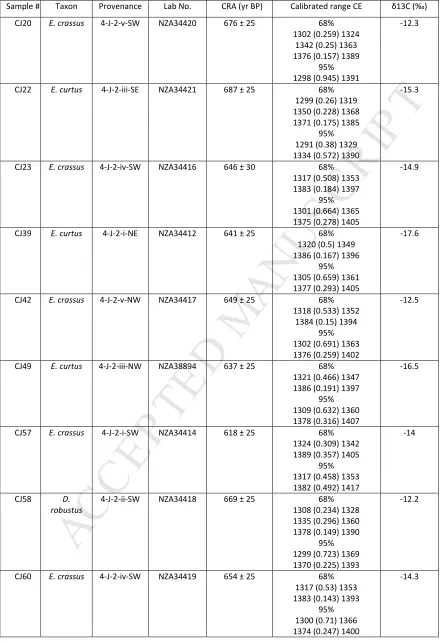
At least one Category A fragment from each of the five spits was dated (n=9).
The AMS conventional radiocarbon age (CRA) results all lie within the range of 618-687 yr
b.p. Calibrated using the Southern Hemisphere curve, SHCal04 (McCormac et al. 2004),
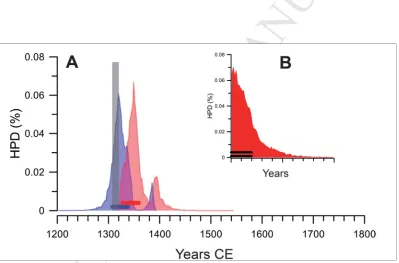
there is no suggestion of time depth: the AMS date series (Table 3; Figure 2) is statistically
an isochron. Calibrated ages for this time period derived from the SHCal13 (Hogg et al.
2013) curve do not differ by more than a year from those derived from the SHCal04 curve.
Although the almost complete overlap of all the likelihood ranges shows that the corpus of
dates represents an isochron, the major fourteenth-century fluctuation in the radiocarbon
calibration curve results in a bimodal plot with a span of ≈140 years. The greater areas
under the earlier peaks of the calibration probability curves suggest that the event was
more likely to have occurred in the first half of the 14th century than later.
4. Bayesian Analysis
The results of the Bayesian recalibration are shown in Figure 3. We generated HPDs
(Highest Posterior Densities) for the start and end of the sequence (Figure 3). The 68% HPD
for the start was very sharp and had its maximum probability at about 1320. Similarly the
peak of the 68% HPD for the end of the sequence was very sharp and firmly in the first half
of the 14th century. We also generated an HPD for the duration of the sequence (Figure 3
inset) which indicates (95% confidence) that the duration was no more than 25 years.
Therefore the sequence represents, at most, a period of no greater than thirty years and is
entirely consistent, given the nature of the calibration curve in the 14th century CE, with the
oven having been filled with midden in a single event that occurred some time after the
M
AN
US
CR
IP
T
AC
CE
PT
ED
D I S C U S S I O N
The application of new aDNA techniques to archaeological dating methods has allowed us,
for the first time, to obtain multiple independent radiocarbon dates on an “ideal” dating
substrate from a single, rapidly accumulated deposit. The contemporaneity of materials in
the deposit meant that Bayesian methods could be employed to develop a high-precision
chronology for the deposition event. The results placed that event in the first half of the
14th century CE. This is some 50 years later than a postulated settlement date for New
Zealand of c. 1280 CE or earlier (Wilmshurst et al. 2008). In fact the 1280 (or earlier) date for
the settlement of New Zealand requires some consideration. It was based on the combined
probabilities of a number of AMS dates on moa eggshell from Wairau Bar (Higham et al.
1999). Since then palaeoecological data have been found to be not inconsistent with this
date (Newnham et al. 1998, Wilmshurst et al. 2004, 2013) and subsequently 1280 has been
used as the terminus post quem (TPQ) for New Zealand settlement as a whole (Wilmshurst
et al. 2008, 2013). In fact, the basis for the original 1280 date is a corpus of moa eggshell
dates from the Wairau Bar burials (Higham et al. 1999) with a similar probability span to our
series; the difference being largely a matter of interpretation. All of the dates (including
those on seeds cited as palaeoenvironmental evidence for human presence cited in
Wilmshurst et al. (2004)) have their highest probabilities in the 14th century, with tails that
stretch into the late 13th century. Yet these have been cited as evidence for a late 13th
century occupation, as if the calibration curves represent temporal spans rather than
probability distributions.
Tephrochronological evidence, specifically the Kaharoa tephra, can also be brought to bear
on the question of dating New Zealand settlement (Lowe et al 2000; 2004). The Kaharoa
eruption was dated using a “wiggle matching” method that took advantage of the otherwise
inconvenient shape of the calibration curve (Mcfadgen et al. 1994). The result was a very
precise age range for the eruption of 1314 ± 6 CE (Hogg et al. 2002). No intact cultural
horizon has ever been found sealed beneath a primary deposit of Kaharoa tephra so the
date of the event provides a possible TPQ for the colonization of New Zealand. Recently
cited evidence of a cultural horizon overlaid by Kaharoa tephra (Furey et al. 2008) is
unconvincing. The soil described is not a definite example of primary air fall tephra; if it is
M
AN
US
CR
IP
T
AC
CE
PT
ED
truly represents a single event, then the posterior probability age distribution of 1320-1350
CE, combined with the high precision age for the Kaharoa Tephra (Hogg et al. 2002), can
define a benchmark for the chronology of the site, and for the colonization phase in New
Zealand. The previous benchmark was the eggshell dates reported by Higham, Anderson
and Jacomb in 1999, which were calibrated using the earlier, IntCal98, Northern
Hemisphere, curve (refer McFadgen 2007) with a southern hemisphere correction
(McCormac et al. 1998). Recalibrated using SHCal04 (or SHCAL13, which generates identical
calendar ages for this period) and treated in the same way as the newly excavated oven
eggshell, the individual dates in the two series have very similar distributions, providing
strong support for the contention (Higham et al. 1999) that the site was occupied only
briefly. The revised calibrated age ranges (Fig. 2) for the dates presented in Higham et al.
(1999) include the period immediately after the Kaharoa event, which is consistent with the
chronology presented here.
Palaeoenvironmental data have been used to support arguments for a pre-Kaharoa
settlement date – estimated to be consistent with the often-cited 1280 CE date (Newnham
et al. 1998, Wilmshurst et al. 2013). However, non-archaeological data must be treated
with caution when drawing archaeological inferences; such data have been misinterpreted
in the past (e.g. Sutton 1987, 1994; reassessed by Anderson 1991, Higham et al. 1999) and
should be treated only as plausible indicators of pre-Kaharoa settlement until backed up by
direct archaeological data.
The TPQ status of the Kaharoa eruption is supported by our analysis wherein the span of the
Bayesian derived probability sequence commenced immediately after the Kaharoa event.
Although individual radiocarbon dates on short lived material from other parts of New
Zealand may suggest an earlier occupation, no other colonization phase site is as well dated
as Wairau Bar. At this point, any claim of human settlement substantially earlier than the
Kaharoa eruption would require a substantial suite of radiocarbon dates on well
provenanced, short-lived samples taken from an intact cultural horizon. A brief period of
pre-settlement activity that represents discovery of New Zealand by Polynesians and a
reconnaissance of the main islands is allowed in this model but the colonisation process
itself did not begin until about the time of the Kaharoa eruption. Once it did begin, Wairau
M
AN
US
CR
IP
T
AC
CE
PT
ED
The results of this study have global implications for the study of human migration and
colonization. New Zealand was the last major land mass to be colonized by pre-industrial
humans. Uniquely, many of the sites of the colonization phase are still there to be
investigated. In stark contrast to other theatres of prehistoric human colonization, New
Zealand has an abundant archaeological record dating from the earliest period of
settlement, and exceptionally well-preserved evidence of the fauna that the colonists
depended on. Wairau Bar is the best candidate globally for a primary colonization site of a
major land mass.
Acknowledgments
We would like to express our gratitude to Rangitane ki Wairau for their consent to analyse
moa eggshells from Wairau Bar, and especially to Richard Bradley for his work facilitating
and supporting the research at Wairau Bar on behalf of Rangitane ki Wairau. We also thank
the following people and institutions: Institute of Geological and Nuclear Sciences (GNS),
Andy Brown, Jean Spinks and Frances Jacomb for assistance with laboratory work, Martin
Jones for comments on the dating methodology. Financial support was provided by The
Marsden Fund of the Royal Society of New Zealand (Contracts 09-UOO-164 to the University
of Otago (CJ), and 06-PAL-001-EEB to Palaecol Research Ltd (RNH)), the University of Otago
(two UORG Grants to CJ and RW), and The Australian Research Council (FT0991741 to MB).
The paper has benefitted from comments and suggestions from three anonymous referees.
R E F E R E N C E S
Allentoft, M.E., Schuster, S., Holdaway, R.N., Hale, M.L., McLay, E., Oskam, C.L., Gilbert,
M.T.P., Spencer, P., Willerslev, E. and Bunce, M. 2009. Identification of microsatellites from
an extinct moa species using highthroughput (454) sequence data. Biotechniques 46: 195–
200.
Allentoft, M.E., Oskam, C., Houston, J., Hale, M.L., Gilbert, M.T.P., Rasmussen, M., Spencer,
P., Jacomb, C., Willerslev, E., Holdaway, R.N., Bunce, M. 2011. Profiling the Dead:
Generating Microsatellite Data from Fossil Bones of Extinct Megafauna – Protocols,
M
AN
US
CR
IP
T
AC
CE
PT
ED
Allentoft, M.E., Heller, R., Oskam, C.L., Lorenzen, E.D., Hale, M.L., Gilbert, M.T.P., Jacomb, C.,
Holdaway, R.N., Bunce, M. 2014. Extinct New Zealand megafauna were not in decline before
human colonization. Proceedings of the National Academy of Science, United States of
America. www.pnas.org/cgi/doi/10.1073/pnas.1314972111
Anderson, A.J. 1989. Prodigious Birds. Moas and Moa-hunting in Prehistoric New Zealand.
Cambridge University Press.
Anderson, A.J. 1991. The chronology of colonisation in New Zealand, Antiquity 65: 767–795.
Anderson, A.J., and Sinoto, Y. 2002. New radiocarbon ages of colonisation sites in East
Polynesia. Asian Perspectives 41(2): 242-257.
Brooks, E., Jacomb, C. and R. Walter 2009. Archaeological Investigations at Wairau Bar.
Archaeology in New Zealand 52(4): 259-269.
Brooks, E., Walter, R. and Jacomb, C. 2011. History of excavations at Wairau Bar. Records of
the Canterbury Museum 25: 13-58.
Challis, A.J. 1991. The Nelson–Marlborough region: an archaeological synthesis. New
Zealand Journal of Archaeology 13: 101-142.
Davidson, J. 1984. The Prehistory of New Zealand. Auckland: Longman Paul.
Duff, R. 1956. The Moa -hunter Period of Maori Culture, Wellington: Government Printer.
Furey, L., Petchey, F., Sewell, B. & Green, R. (2008). New observations on the stratigraphy
and radiocarbon dates at the Cross Creek site, Opito, Coromandel Peninsula. Archaeology in
New Zealand, 51(1), 46-64.
GOLSON, J. 1959. Culture change in Prehistoric New Zealand, in Anthropology in the South
Seas: Essays Presented to H. D. Skinner. New Plymouth: Freeman and Geddes.
Higham, T. 1994. Radiocarbon dating New Zealand prehistory with moa eggshell: Some
M
AN
US
CR
IP
T
AC
CE
PT
ED
Higham, T., Anderson, A., and C. Jacomb, 1999. Dating the first New Zealanders: the
chronology of Wairau Bar. Antiquity 73: 420-427.
Hogg, A.G., Higham, T.F.G., Lowe, D.J., Palmer, J., Reimer, P. and Newnham, R.M. 2002. A
wiggle-match date for Polynesian settlement of New Zealand. Antiquity 77: 116-125.
Hogg, A.G., Hua, Q. Blackwell, P.G., Niu, M., Buck, C.E., Guilderson, T.P., Heaton, T.J., Palmer,
J.G., Reimer, P.J., Reimer, R.W., Turney, C.S.M., Zimmerman, S.R.H. 2013. SHCAL13 Southern
Hemisphere calibration, 0–50,000 years cal BP. Radiocarbon 55(2), 1-15.
Jones, M.D. and Nicholls, G.K. 2002. New radiocarbon calibration software. Radiocarbon 44:
663-674.
Lowe, D.J., Newnham, R.M., McFadgen, B.G. and Higham, T.F.G. 2000. Tephras and New
Zealand archaeology. Journal of Archaeological Science 27: 859-870.
Lowe, D.J., Newnham, R.M. 2004. Role of tephra in dating Polynesian settlement and
impact, New Zealand. PAGES (Past Global Changes) News 12 (No. 3): 5-7.
McCormac F. G., A.G. Hogg, T.F.G. Higham, M.G.L. Baillie, J.G. Palmer, L. Xiong, J.R. Pilcher,
D. Brown & S.T. Hoper. 1998. Variations of radiocarbon in tree-rings: Southern hemisphere
offset preliminary results, Radiocarbon 40: 1153-9.
McCormac, F.G., Hogg, A.G., Blackwell, P.G., Buck, C.E., Higham, T.F.G., and Reimer P.J.
2004. SHCal04 Southern Hemisphere Calibration 0 – 11.0 calkyr BP. Radiocarbon 46:
1087-1092.
McFadgen, B.G., Knox, I.F.B. and Cole, T.R.L. 1994. Radiocarbon Calibration Curve Variations
and Their Implications for the Interpretation of New Zealand Prehistory, Radiocarbon 36(2):
221-236
McFadgen, B.G. 2007. Hostile Shores: Catastrophic Events in Prehistoric New Zealand and
their Impact on Maori Coastal Communities. Auckland: Auckland University Press.
Nicholls, G. K. & Jones, M. D. 2001. Radiocarbon dating with temporal order constraints.
M
AN
US
CR
IP
T
AC
CE
PT
ED
Oskam, C. L., Haile, J., McLay, E., Rigby, P., Allentoft, M., Olsen, M., Bengtsson, C., Miller, G.,
Schwenninger, J., Jacomb, C., Walter, R., Baynes, A., Dortch, J., Parker-Pearson, M., Gilbert,
T., Holdaway, R., Willerslev, E., and Bunce, M. 2010. Fossil avian eggshell preserves ancient
DNA. Proceedings of the Royal Society B 277: 1991-2000.
Oskam, C., Jacomb, C., Allentoft, M.E., Walter, R., Scofield, P., Haile, J., Holdaway, R.N. and
Bunce, M. 2011. Molecular and morphological analyses of avian eggshell excavated from a
late thirteenth century earth oven. Journal of Archaeological Science 38: 2589-2595.
Oskam, C., Allentoft, M.E., Walter, R., Scofield, P., Haile, J., Holdaway, R.N., Bunce, M. and
Jacomb, C. 2012. Ancient DNA analyses of early archaeological sites in New Zealand reveal
extreme exploitation of moa (Aves: Dinornithiformes) at all life stages. Quaternary Science
Reviews 52: 41-48.
Peakall, R., Smouse, P.E. 2006. GENALEX 6: genetic analysis in Excel. Population genetic
software for teaching and research. Molecular Ecology Notes 6: 288–295.
Scofield, P., Worthy, T. and Schlumpf, H. 2003. What birds were New Zealand’s first people
eating? – Wairau Bar’s avian remains re-examined. Records of the Canterbury Museum 17:
17-35.
Stuiver, M., Reimer P.J., Bard, E., Beck, J.W., Burr, G.S., Hughen, K.A., Kromer, B., McCormac,
G., van der Plicht, J., Spurk, M. 1998. IntCal98 radiocarbon age calibration, 24,000–0 cal BP.
Radiocarbon 40(3): 1041–83.
Trotter, M.M, 1977. Moa-hunter research since 1956. In Roger S. Duff, The Moa-hunter
Period of Maori Culture, 3rd edition, pp. 348-75. Wellington: Government Printer.
Wilmshurst, J.M. and Higham, T.F.G. 2004. Using rat-gnawed seeds to independently date
the arrival of Pacific rats and humans in New Zealand. The Holocene 14(6): 801-806.
Wilmshurst, J.M., Anderson, A.J., Higham, T.F.G., and Worthy, T. 2008. Dating the late
prehistoric dispersal of Polynesians to New Zealand using the commensal Pacific rat.
Proceedings of the National Academy of Sciences of the United States of America 105(22):
M
AN
US
CR
IP
T
AC
CE
PT
ED
Wilmshurst, J.M., Moar, N.T., Wood, J.R., Bellingham, P.J., Findlater, A.M., Robinson J.J. and
Stone, C. 2013. Use of Pollen and Ancient DNA as Conservation Baselines for Offshore
Islands in New Zealand. Conservation Biology 28(1): 202-212. DOI: 10.1111/cobi.12150.
Figure 1. Site location. a. New Zealand showing location of Wairau Bar; b. Wairau Bar showing location of oven pit (Oven Pit 1); c. Oven Pit 1 (horizontal scale – 2 m, vertical scale 0.5 m).
Table 1. Details of samples used in Categories A and B. Category A samples submitted for dating are underlined. Category C samples were discarded from subsequent analysis and are not shown.
Category
Sample No.
Species & Haplotype
Microsatellite
MS2 MA21 MA38 MA44 MA46
Allele Allele 2
Allele Allele 2
Allele Allele 2
Allele Allele 2
Allele Allele 2
A CJ20 EMCR1 - - 124 132 92 104 81 81 60 60
CJ21 EUCU2 124 130 116 144 94 102 79 83 60 69
CJ22 EUCU3 122 126 - - - - 79 79 60 66
CJ23 EMCR3 - - - 81 81 60 66
CJ28 EUCU3 122 126 118 130 - - 79 83 60 66
CJ30 EUCU3 122 126 - - 94 96 79 79 60 66
CJ31 EUCU2 124 130 - - - - 79 83 60 63
CJ34 EUCU3 122 124 - - - -
CJ39 EUCU2 124 130 - - 94 102 79 83 60 69
CJ42 EMCR1 108 112 - - 96 110 - - - -
CJ49 EUCU1 120 130 - - - -
CJ50 EUCU2 110 124 122 132 - - 79 83 66 66
CJ51 EUCU2 110 118 130 132 98 - 79 83 60 -
CJ57 EMCR1 108 108 118 130 96 104 79 81 - -
CJ58 DIRO1 - - - -
CJ60 EMCR1 108 108 - - - - 81 85 - -
M
AN
US
CR
IP
T
AC
CE
PT
ED
CJ21 EUCU2.1 124 130 116 144 94 102 79 83 60 69
M
AN
US
CR
IP
T
AC
CE
PT
ED
(Diro = D. robustus; Emcr = E. crassus; Eucu = E. curtus). Haplotypes and microsatellites indicated by digits separated by decimal point. Numbers in columns are sample nos. Samples 15, 21 and 39 (outlined) are genetically identical. Underlined samples were submitted for radiocarbon dating (see Table 2).
Provenanc
e
Eggshell sample ID by species, haplotype and microsatellite
DiRo 1 DiRo 2 EmCr 1 EmCr 2 EmCr 3 EuCu 1 EuCu 2 EuCu 2.1 EuCu 3
4-J-2-i-NE 18 80 39
4-J-2-i-SW 14 57 35
4-J-2-i-SE 27
4-J-2-ii-NE 51 15 34
4-J-2-ii-NE 13
4-J-2-ii-SW 58 4-J-2-ii-SW 24
4-J-2-ii 31
4-J-2-iii-NW 32,49 50
4-J-2-iii-NE 40,41, 46
4-J-2-iii-SW 56 30
4-J-2-iii-SE 22, 28
4-J-2-iii-SE 52
4-J-2-iv- 26
4-J-2-iv-NE 33 47
4-J-2-iv-SW 60,61 23
4-J-2-iv-SE 21
4-J-2-v-NW 42
4-J-2-v-SW 20
4-J-2-v 38
M
AN
US
CR
IP
T
AC
CE
PT
ED
Table 3. Moa eggshell AMS age determinations calibrated with DateLab v3.5 (Jones and Nicholls 2002) using the Southern Hemisphere terrestrial calibration curve SHCal04 (McCormac et al. 2004).
Sample # Taxon Provenance Lab No. CRA (yr BP) Calibrated range CE δ13C (‰)
CJ20 E. crassus 4-J-2-v-SW NZA34420 676 ± 25 68% 1302 (0.259) 1324
1342 (0.25) 1363 1376 (0.157) 1389
95% 1298 (0.945) 1391
-12.3
CJ22 E. curtus 4-J-2-iii-SE NZA34421 687 ± 25 68% 1299 (0.26) 1319 1350 (0.228) 1368 1371 (0.175) 1385
95% 1291 (0.38) 1329 1334 (0.572) 1390
-15.3
CJ23 E. crassus 4-J-2-iv-SW NZA34416 646 ± 30 68% 1317 (0.508) 1353 1383 (0.184) 1397
95% 1301 (0.664) 1365 1375 (0.278) 1405
-14.9
CJ39 E. curtus 4-J-2-i-NE NZA34412 641 ± 25 68% 1320 (0.5) 1349 1386 (0.167) 1396
95% 1305 (0.659) 1361 1377 (0.293) 1405
-17.6
CJ42 E. crassus 4-J-2-v-NW NZA34417 649 ± 25 68% 1318 (0.533) 1352
1384 (0.15) 1394 95% 1302 (0.691) 1363 1376 (0.259) 1402
-12.5
CJ49 E. curtus 4-J-2-iii-NW NZA38894 637 ± 25 68% 1321 (0.466) 1347 1386 (0.191) 1397
95% 1309 (0.632) 1360 1378 (0.316) 1407
-16.5
CJ57 E. crassus 4-J-2-i-SW NZA34414 618 ± 25 68% 1324 (0.309) 1342 1389 (0.357) 1405
95% 1317 (0.458) 1353 1382 (0.492) 1417
-14
CJ58 D. robustus
4-J-2-ii-SW NZA34418 669 ± 25 68% 1308 (0.234) 1328 1335 (0.296) 1360 1378 (0.149) 1390
95% 1299 (0.723) 1369 1370 (0.225) 1393
-12.2
CJ60 E. crassus 4-J-2-iv-SW NZA34419 654 ± 25 68% 1317 (0.53) 1353 1383 (0.143) 1393
95% 1300 (0.71) 1366 1374 (0.247) 1400
M
AN
US
CR
IP
T
AC
CE
PT
ED
Figure 2. Calibrated likelihood distributions of calendar ages of nine radiocarbon dates on moa eggshell pieces from Oven Pit 1. Horizontal bars are plots of the 68% (thick lines) and 95% (thin lines) confidence ranges for each of the two calibration peaks for all moa eggshell dates in Higham et al. 1999. All dates calibrated using Datelab® V 3.5 (Jones & Nicholls 2002) and the Southern Hemisphere terrestrial calibration curve SHCal04 (McCormac et al. 2004).
M
AN
US
CR
IP
T
AC
CE
PT
ED
Highlights
• A complex archaeological event is analysed using multiproxy data
• Ancient DNA identifications of moa eggshell fragments allow multiple dates on this short-life substrate
• Bayesian inference of AMS dates provides first high-precision chronology for Wairau Bar
• The results provide new insights into Polynesian colonisation of East Polynesia
Suggested referees
Referee 1. Professor Marshall Weisler
Research activity Exchange; Hawaiian and New Zealand prehistory; island adaptation;
chronology of colonisation.
Postal address Professor Marshall Weisler
Head of Archaeology School of Social Science
Faculty of Humanities and Social Sciences The University of Queensland
Brisbane St Lucia, QLD 407 AUSTRALIA
Email address [email protected]
Referee 2. Professor Peter Sheppard
Research activity. Emergence of contemporary Melanesian society; lithic studies and
long-distance exchange in Pacific prehistory; dating and chronology of environmental change.
Postal address Professor Peter Sheppard
Head of School of Social Sciences Department of Anthropology The University of Auckland 22 Princes St
Auckland 1010 NEW ZEALAND
Email address: [email protected]
Referee 3. Dr Christine Prior
Research activity Radiocarbon science; archaeometry; sample pretreatment protocols;
radiocarbon calibration.
Postal address Dr Christine Prior
Scientist/Team Leader, Rafter Radiocarbon Laboratory GNS Science
1 Fairway Drive Avalon
PO Box 30-368 Lower Hutt NEW ZEALAND
M
AN
US
CR
IP
T
AC
CE
PT
ED
Research activity. Chronology of settlement and colonisation in Pacific prehistory;
radiocarbon dating; subsistence; linguistics; human-environmental interactions.
Postal address Professor of Archaeology
School of Archaeology and Anthropology College of Arts and Social Science The Australian National University Canberrra, ACT 0200
AUSTRALIA
Email address [email protected]
Referee 5. Dr Stuart Bedford
Research activity Chronology and strategies of Pacific island colonisation; cultural
transformation; environmental impacts of humans on pristine landscapes.
Postal address ARC Future Fellow
School of Culture, History & Language College of Asia and the Pacific The Australian National University Canberrra, ACT 0200
AUSTRALIA
Email address [email protected]
Submission