
The Thirty-Third AAAI Conference on Artificial Intelligence (AAAI-19)
ColNet: Embedding the Semantics of Web Tables for Column Type Prediction
Jiaoyan Chen,
1Ernesto Jim´enez-Ruiz,
2,4Ian Horrocks,
1,2Charles Sutton
2,31Department of Computer Science, University of Oxford, UK 2The Alan Turing Institute, London, UK
3School of Informatics, The University of Edinburgh, UK 4Department of Informatics, University of Oslo, Norway
Abstract
Automatically annotating column types with knowledge base (KB) concepts is a critical task to gain a basic understanding of web tables. Current methods rely on either table metadata like column name or entity correspondences of cells in the KB, and may fail to deal with growing web tables with in-complete meta information. In this paper we propose a neu-ral network based column type annotation framework named ColNetwhich is able to integrate KB reasoning and lookup with machine learning and can automatically train Convolu-tional Neural Networks for prediction. The prediction model not only considers the contextual semantics within a cell us-ing word representation, but also embeds the semantics of a column by learning locality features from multiple cells. The method is evaluated with DBPedia and two different web ta-ble datasets, T2Dv2 from the general Web and Limaye from Wikipedia pages, and achieves higher performance than the state-of-the-art approaches.
Introduction
Tables on the Web, which often contain highly valuable data, are growing at an extremely fast speed. Their power has been explored in various applications including web search (Ca-farella et al. 2008), question answering (Sun et al. 2016), knowledge base (KB) construction (Ritze et al. 2016) and so on. For most applications, web table annotation which is to gain a basic understanding of the structure and meaning of the content is critical. This however is often difficult in prac-tice due to metadata (e.g., table and column names) being missing, incomplete or ambiguous.
An entity column is a table column whose cells are text phrases, i.e., mentions of entities. Type annotation of an en-tity column1means matching the common type of its cells
with widely recognized concepts such as semantic classes of a KB. For example, a column composed of “Mute swan”, “Yellow-billed duck” and “Wandering albatross” is anno-tated with dbo:Species and dbo:Bird, two classes of DBpe-dia (Auer et al. 2007). Column types not only enable under-standing the meaning of cells but also form the base of other table annotation tasks such as property annotation (Pham et al. 2016) and foreign key discovery (Zhang et al. 2010).
Copyright © 2019, Association for the Advancement of Artificial Intelligence (www.aaai.org). All rights reserved.
1
Note that data type prediction is not considered in this work.
Table annotation tasks are often transformed into match-ings between the table and a KB, such as cell to entity matching, column to class matching and column pair to property matching. Traditional methods jointly solve all the matching tasks with their correlations considered using graphical models (Limaye, Sarawagi, and Chakrabarti 2010; Mulwad, Finin, and Joshi 2013; Bhagavatula, Noraset, and Downey 2015) or iterative procedures (Ritze, Lehmberg, and Bizer 2015; Zhang 2014; Zhang 2017). Considering the inter-matching correlation improves the disambiguation, but their metrics for computing the matchings(i)mostly adopt lexical comparisons which ignore the contextual semantics, and (ii) rely on metadata like column names and some-times even external information like table description, both of which are often unavailable in real world applications.
Recent studies (Efthymiou et al. 2017) and (Luo et al. 2018) match column cells to KB entities with their con-textual semantics considered using machine learning tech-niques like word embeddings and neural networks. With the matched entities, the column type can be further inferred us-ing strategies like majority votus-ing. However, such a cell to entity matching based column type annotation procedure as-sumes that the table cells have KB entity correspondences. Its performance will decrease when the column has a small number of cells, or there are missing or not accurate cor-respondences between the table cells and the KB entities, which we refer to asknowledge gap.
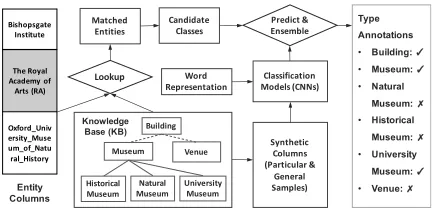
This study focuses on type annotation of entity columns, assuming table metadata like column names and table struc-tures are unknown. We propose a neural network based framework named ColNet, as shown in Figure 1. It first embeds the overall semantics of columns into vector space and then predicts their types with a set of candidate KB classes, using machine learning techniques like Convolu-tional Neural Networks (CNNs) and an ensemble of results from lookup. To automatically train robust prediction mod-els, we use the cells to retrieve the candidate KB classes, in-fer their entities to construct training samples, and deal with the challenge of sample shortage using transfer learning.
ta-Bishopsgate Institute
The Royal Academy of
Arts (RA)
Oxford_Univ ersity_Muse um_of_Natu ral_History
Type Annotations
• Building: ✓
• Museum: ✓
• Natural Museum: ✗
• Historical Museum: ✗
• University Museum: ✓
• Venue: ✗ Building
Museum
Natural Museum Historical Museum
Venue
Knowledge Base (KB)
University Museum
Matched
Entities Candidate Classes
Classification Models (CNNs)
Synthetic Columns (Particular &
General Samples) Predict & Ensemble
Lookup
Entity Columns
Word Representation
Figure 1: Column Type Annotation withColNet
bles but also general tabular data. The study also provides a general approach that embeds the overall semantics of a column where the correlation between cells is incorporated. Our experiments with DBPedia and two different web table sets, T2Dv2 from the general Web (Lehmberg et al. 2016) and Limaye from Wikipedia pages (Limaye, Sarawagi, and Chakrabarti 2010) have shown that our method is effective and can outperform the state-of-the-art approaches.
Next section reviews the related work. Then we introduce the technical details of our approach. We finally present the evaluation, conclude the paper and discuss our future work.
Related Work
Annotating web tables with semantics from a KB has been studied for several years. It includes tasks of matching (i)
table columns to KB classes, (ii) column pairs i.e., inter-column relationships to KB properties, and(iii)column cells to KB entities. More specifically, task (i) is equivalent to matching tables to KB classes while task(iii) is equivalent to matching rows to KB entities when one of the columns serves as a primary key (PK) which is defined as a column that can uniquely identify (most of) the table rows.
Collective Approaches
Collective approaches encompass multiple matching tasks and solve them together. We divide them into joint infer-ence models and iterative approaches. (Limaye, Sarawagi, and Chakrabarti 2010) represents different matchings with a probabilistic graphical model and searches for value as-signments of the variables that maximize the joint probabil-ity. (Mulwad, Finin, and Joshi 2013) extends this work with a more lightweight graphical model. TabEL (Bhagavatula, Noraset, and Downey 2015) weakens the assumption that columns and column pairs have KB correspondences, but assigns higher likelihood to entity sets that tend to co-occur in Wikipedia documents. (Venetis et al. 2011) proposes a maximum likelihood inference model that predicts the class of an column by maximizing the probability of all its cells. while (Chu et al. 2015) adopts a scoring model.
TableMiner+ (Zhang 2014; Zhang 2017) and T2K Match (Ritze, Lehmberg, and Bizer 2015) are two state-of-the-art iterative approaches. TableMiner adopts a bootstrapping pat-tern which first learns an initial interpretation with partial table data and then constrains the interpretation of the re-maining data with the initial interpretation. T2K Match
iter-atively adjusts the weight of matchings until the overall sim-ilarity values converge. Early work (Syed et al. 2010) and (Mulwad et al. 2010) adopt a straightforward process which first determines the class of a column by matching its cells to KB entities and then refines the matchings with the column class.
These methods can achieve good performance on some datasets by jointly or iteratively determining multiple match-ings with the inter-matching correlations modeled, but their performance will decrease on tabular data with cells pro-vided alone, as they utilize some table metadata like col-umn names and sometimes even external table information like table caption to calculate some correspondences. Mean-while, these methods assume that all the table cells have corresponding entities in the KB, without considering the knowledge gap between them.
Column Type Annotation
Different from those collective work, some studies focus only on cell-to-entity matching (Zwicklbauer, Seifert, and Granitzer 2016; Efthymiou et al. 2017; Luo et al. 2018). The matched KB entities in turn can determine the column type with strategies like majority voting (Zwicklbauer et al. 2013). Such an approach can work with table contents alone, without relying on any metadata, but still ignoring the cases where a large part of cells have no entity correspondences.
A few studies take such knowledge gap cases into con-sideration. (Pham et al. 2016) utilizes machine learning and handcrafted features to predict the similarity between a tar-get column and a seeding column whose type has been an-notated. It actually transforms the gap between KB and tar-get columns to the gap between seeding columns and tartar-get columns, with additional cost to annotate seeding columns. (Quercini and Reynaud 2013) does not match cells to enti-ties but directly predicts the type of each cell by feeding the web page queried by the cell into a machine learning classi-fier. The idea is close to ours, but our method(i) uses novel column semantic embedding and CNN-based locality fea-ture learning for high accuracy, and(ii)automatically trains machine learning models with samples inferred from a KB.
Semantic Embedding
Most table annotation methods calculate the degree of matchings with text comparison metrics like TF-IDF, Jac-card and so on, without considering the contextual seman-tics. The cell-to-entity matching by (Efthymiou et al. 2017) embeds cells and entities into vectors using word represen-tations to introduce contextual semantics in prediction. It ex-plores intra-cell semantic embedding (i.e., representing cells into vector space), but ignores inter-cell correlations.
Methodology
ColNet
Framework
ColNetis a framework that utilizes a KB, word
representa-tions and machine learning to automatically train prediction models for annotating types of entity columns that are as-sumed to have no metadata. As shown in Figure 1, it mainly includes three steps, each of which will be explained in de-tail in the following subsections.
The first step is calledlookup. Given an entity column, it retrieves column cells’ corresponding entities in the KB and adopts the classes of the matched entities as a set of candi-date classes for annotation. Meanwhile, this step generates labeled samples from the KB for model training, including particular samples which have a close data distribution to the column cells, and general samples that deal with the chal-lenge of sample shortage caused by the big knowledge gap, small column size, etc.
The second step is calledprediction, which calculates a score for each candidate class of a given column. For each candidate class, a customized binary CNN classifier which is able to learn both inter-cell and intra-cell locality features is trained and applied to predict whether cells of a column are of this class. In training,ColNetadopts word represen-tations to incorporate contextual semantics and uses transfer learning to integrate particular and general samples.
The third step is calledensemble. Given a column and a candidate class,ColNetcombines the vote from the matched entities of cells with the score predicted by the prediction model so as to keep the advantages of both. Cell to entity matching and voting with majority can contribute to a highly confident prediction, while prediction with CNNs, which considers the contextual semantics of words can deal with type disambiguation and recall cells missed by lookup.
Knowledge Lookup
InColNet, we use a KB that is composed of a terminology
and assertions. The former include classes (e.g.,c1andc2) and class relationships (e.g., subClass(c1, c2)), while the latter includes entities (e.g.,e) and classification assertions (e.g.,c1(e)). The KB can support entity type inference and reasoning with the transitivity ofsubClass.
In sampling, we first retrieve a set of entities from the KB, by matching all the column cells with KB entities according to the entity label and entity anchor text using a lexical in-dex. Those matched entities are calledparticular entities. The classes and super classes of each particular entity are inferred (via KB reasoning) and they are used ascandidate classesfor annotation, denoted asC. The reason of
select-ing candidate classes instead of usselect-ing all the KB classes is to avoid additional noise, thus reducing false positive predic-tions and computation. For each candidate class, we further infer all of its KB entities that are not matched. They are defined asgeneral entities.
We also repeat the above lookup step with another round for refinement, inspired by (Syed et al. 2010; Mulwad et al. 2010). The second round uses each column’s candidate classes from the first round to constrain the cell to entity
matching, thus refining the entity suggestions. This step fil-ters out some particular entities and candidate classes with limited matching confidence.
Synthetic Columns In training,ColNetautomatically ex-tracts labeled samples from the KB. A training samples=. (e, c)is composed of a synthetic columneand a classcin
C, while a synthetic column is constructed by concatenating
a specific number of entities. This number is denoted ash.
ColNetconstructs a set of training samples by selecting
dif-ferent sets of entities with sizehand concatenating entities in each set in different orders. In prediction, the input is a synthetic column that is constructed by concatenating table cells (cf. details in Prediction and Ensemble). Using the syn-thetic column as an input enables the neural network to learn the inter-cell correlation for some salient features like word co-occurrence, thus improving the prediction accuracy.
For example, given a column of IT Company that is com-posed of “Apple”, “MS” and “Google”, ColNetoutputs a high score if the three cells are input as a synthetic column, but a low score if they are predicted individually and then averaged. This is because “Apple” and “MS” alone can be easily classified as other types like Fruit and Operating Sys-tem, but will be correctly recognized as IT Company if their co-occurrence with “Google” is considered.
For another example, the combination of cell “Oxford University Museum of Natural History” and cell “British Museum” is more likely to be predicted as the right type Museum than the first cell alone, because the signal of Mu-seum is augmented in the locality feature learned from the inter-cell word sequence “Museum”, “of”, “Natural”, “His-tory”, “British” and “Museum”.
Sampling For each candidate classc inC, both positive
and negative training samples are generated, where a sample is defined as positive if each entity in its synthetic column is inferred as an instance ofc, and negative otherwise. To fully capture the hyperplane that can distinguish column cells for the class, we develop a table-adapted negative sampling ap-proach. Given the candidate classc,ColNetfirst finds out its neighboring candidate classes, each of which is defined to be a specific column’s candidate class co-occurring with
c. ThenColNetuses the entities that are of a neighboring class of c but are not of class c to construct the synthetic column of negative samples.
Meanwhile, ColNet extracts two sample sets for each candidate classc. They are i)particular sampleswhich are constructed with particular entities, denoted as Sp, and ii)
general samples which are constructed with general
en-tities, denoted as Sg. For example, given the above
col-umn of IT Company and its general entities retrieved from DBPedia “dbr:Google”, “dbr:Apple”, “dbr:Apple Inc.” and “dbr:Microsoft Windows”, synthetic columns constructed with “dbr:Google” and “dbr:Apple Inc.” (resp. “dbr:Apple” and “dbr:Microsoft Windows”) are particular positive (resp. negative) samples of IT Company, while synthetic columns constructed by general entities like “dbr:Amazon.com” and “dbr:Alibaba Group” are general positive samples.
Compared with Sg,Sp has a closer data distribution to
adaptive to the prediction data. However, because of the big knowledge gap, short column size, ambiguous cell to entity matching, etc.,Spin many cases is too small to train robust
classifiers, especially for those complex models like CNN. Consequently, we use transfer learning to incorporate both SgandSpin training (cf. details in the next subsection).
Model Training
Synthetic Column Embedding In model training, we first embed each synthetic column into a real valued matrix using word representation models like word2vec (Mikolov et al. 2013), so as to feed it into a machine learning algo-rithm with the contextual semantics of words incorporated.
The label of each entity is first cleaned (e.g., removing the punctuation) and split into a word sequence. Then the word sequences of all the entities of a synthetic column are concatenated into one. To align word sequences of differ-ent synthetic columns, their lengths are fixed to a specific valuen which is set to the length of the longest word se-quence. Those abnormally long sequences are not consid-ered in settingn. A word sequence shorter thannis padded with “NULL” whose word representation is a zero vector, while those that are longer thannare cropped.
Briefly, the word sequence of a synthetic columneis de-noted asws(e) = [word1, word2,· · ·, wordn], and its
em-bedded matrix is calculated as
x(e) =v(word1)⊕v(word2)· · · ⊕v(wordn) (1)
wherev(·)representsddimension word representation and
⊕ represents stacking two vectors. For example, consid-ering a synthetic column composed of DBpedia entities dbr:Bishopsgate Institute and dbr:Royal Academy of Arts, its matrix is the stack of the word vectors of “Bishopsgate”, “Institute”, “Royal”, “Academy”, “of”, “Arts” and two zero vectors, where we assumenis fixed to8.
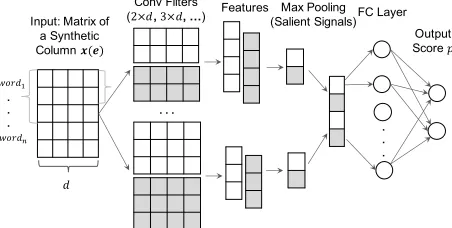
Neural Network We use a CNN to predict the type of a synthetic column, inspired by its successful application in text classification (Kim 2014). For each candidate classcin
C, one binary CNN classifierMcis trained.
𝑑
𝑤𝑜𝑟𝑑%
𝑤𝑜𝑟𝑑&
Input: Matrix of a Synthetic Column 𝒙(𝒆)
Conv Filters (2×𝑑, 3×𝑑, …)
. . .
Features Max Pooling (Salient Signals)
. . .
Output Score 𝑝
FC Layer
. . .
Figure 2: The CNN architecture used inColNet.
As shown in Figure 2, the CNN architecture includes one convolutional (Conv) layer which is composed of multiple filters (i.e., convolution operations over the input matrix)
with a fixed width (i.e., word vector dimension d) but dif-ferent heights. For each Conv filter w, one feature vector, with a specific granularity of locality, is learned:
f =g(w⊗x(e) +b) (2)
wherebis a bias vector,⊗represents the convolution opera-tion andg(·)is an activation function (e.g., ReLU). Consid-ering a convolution filter with size ofk×d, the dimension of its feature vectorfisn−k+ 1, and its ithelement is cal-culated asfi=g(w·x(e)i:i+k−1+bi), where·represents
the element-wise matrix multiplication.
After the Conv layer, a max pooling layer which selects the maximum value of each feature vector and further con-catenates all the maximum values is stacked:
f′ =[max(f1), max(f2), ..., max(fm)] (3)
wheremis the number of convolution filters andfj is the
feature vector of jthfilter.
Intuitively, f′ can be regarded as the salient signals of the learned features with regard to the specific classifi-cation task. For example, considering the input word se-quence composed of “Oxford”, “University”, “Museum”, “of”, “Natural” and “History”, the max pooling layer high-lights the signal of “Museum” in training a binary CNN clas-sifier for the class Museum and highlights the signal of “Uni-versity” for the class Educational Institute. The max pooling layer also reduces the complexity of the network, playing a role of regularization.
A fully connected (FC) layer which learns the nonlinear relationship between the input and output is further stacked:
y=g(f′×w′+b′) (4)
wherew′ andb′ are the weight matrix and bias vector to learn,×represents the matrix multiplication operation. For binary classification, the dimensions ofw′andb′arem×2
and1×2respectively. Withy, a Softmax layer is eventually added to calculate the output scorep. No regularizations are added to the FC layer, as the max pooling is already able to prevent the network from over fitting.
Transfer Learning The training of each CNN classifier incorporates both general sample setSgand particular
sam-ple setSp.ColNetfirst pre-trains the CNN with Sg, and
then fine tunes its parameters withSp. To make the model
fully adapted to the table data, the iteration number of fine tuning is set to be inversely proportional to the size ofSp.
Specially, when there are no matched KB entities, we can reuse candidate classes from other columns in the table set and train the classifiers using Sg alone. For example,
con-sider a column with (yet unknown) researcher names like “Ernesto Jimenez-Ruiz” and DBPedia as a KB. The partic-ular sample setSp is empty as there are not DBPedia
Prediction
For each column,ColNetuses the trained CNNs of its can-didate classes to predict its types. Synthetic columns are first extracted. However, traversing all the cell combinations costs exponential computation time, which is impractical.
ColNetsamplesNtesting synthetic columns by(i)sliding a
window with size ofhover the column, and(ii)randomly se-lecting ordered cell subsets with size ofhfrom the column.
Nis often set to a large number for a high coverage and sta-ble predictions. Each sampled synthetic column is embed-ded into a matrix by the same way used in model training, and then predicted by modelMcfor each candidate classc
of the column:pc k
Mc
←−−x(ek), wherek= 1,· · ·, N andpck
is a score in[0,1].ColNeteventually averages all the scores as the prediction score:pc = 1
N
∑N
k=1p
c k.
Ensemble
We integrate the prediction fromColNetwith the vote by KB entities that are retrieved by column cells. The latter method, denoted as Lookup-Vote is widely used for column type annotation (e.g., (Zwicklbauer et al. 2013)). Given a target column, it first matches cells to entities according to a lexical index, and then uses the rate of cells that have en-tity correspondences of classcas the score of annotating the column withc, denoted asvc.
There have been many methods for combing multiple classifiers (Ponti Jr 2011). We use a customized rule that can utilize the advantage of bothColNetand Lookup-Vote. For a candidate classc, we combinepcandvcas follows:
sc=
{vc, ifvc≥σ
1orvc< σ2
pc, otherwise (5)
whereσ1andσ2are two hyper parameters in[0,1], andσ1≥
σ2. The rule accepts classes supported by a large part of cells (i.e., vc ≥ σ1) and rejects classes supported by few cells
(i.e.,vc< σ2). By setting an intermediate or high value (e.g.,
0.5) toσ1and a small value (e.g.,0.1) toσ2, the rule helps achieve a high precision. For the classes with less confidence from voting (i.e.,σ2 ≤ vc < σ1), it adopts the predicted score, which helps recall some classes that have no entity correspondences. In final decision making, the column is annotated by classcifsc≥α, and not otherwise, whereαis
a threshold hyper parameter in[0,1]. The optimized setting ofσ1,σ2andαcan be searched with small steps.
Evaluation
Experiment Settings
We use DBPedia (Auer et al. 2007) and two web table datasets T2Dv2 and Limaye for our experiments. T2Dv2 includes common tables from the Web,2 with237 PK
en-tity columns, each of which is annotated by a fine-grained DBPedia class. We call such fine-grained classes as “best” classes, while their super classes which are right but not perfect as “okay” classes. We further extend T2Dv2 by
(i) annotating its 174 non-PK entity columns with “best”
2
http://webdatacommons.org/webtables/goldstandardV2.html
classes and(ii)inferring “okay” classes of all the columns. Limaye contains tables from Wikipedia pages. We adopt the version published by (Efthymiou et al. 2017) with 428
PK entity columns, manually annotate these columns with “best” classes and infer the “okay” classes. Some statistics of T2Dv2 and Limaye are shown in Table 1.
Name Columns Avg. Cells Different “Best” (“Okay”) Classes
T2Dv2 411 124 56 (35)
Limaye 428 23 21 (24)
Table 1: Some statistics of the web table sets.
In the experiment, we adopt the DBpedia lookup service to retrieve particular entities. The service, which is based on an index of DBPedia Spotlight (Mendes et al. 2011), re-turns DBpedia entities that match a given text phrase. The DBPedia SPARQL endpoint is used to infer an entity’s class and super classes. A word2vec model trained with the latest dump of Wikipedia articles is used. Each classifier is trained within 2 minutes on our workstation with Xeon CPU E5-2670, with our Tensforflow implementation3. Efficiency and scalability will be improved and evaluated in future work. We evaluate two aspects:(i)the overall performance of Col-Neton column type annotation, and(ii)the impact of learn-ing techniques on the prediction models (CNNs).
Overall Performance
We use precision, recall and F1 score to measure the over-all performance of ColNetunder both “strict” and “toler-ant” models. Given a target column, the “toler“toler-ant” model equally counts each of its predictions, while the “strict” model counts its predictions if the “best” class is hit and directly regards all of them as false positives otherwise. On both table datasets,ColNet, with and without ensemble (i.e., sc andpc), is evaluated and compared with Lookup-Vote (i.e.,vc) and T2K Match4(Ritze, Lehmberg, and Bizer
2015) whose authors developed T2Dv2. On Limaye, Col-Netis further compared with a voting method using entities matched by (Efthymiou et al. 2017), named Efthymiou17-Vote. On both table datasets,σ1 andσ2 are set to0.5and
0.08, whileαhas been adjusted and set to a value with the highest F1 score. αis set to 0.45, 0.55, 0.2, 0.2 and 0.1
for ColNetEnsemble,ColNet, Lookup-Vote, T2K Match and
Efthymiou17-Vote respectively. The results are shown in Ta-ble 2 and TaTa-ble 3.5
Prediction Impact We first present the impact of pre-diction models by comparingColNetEnsemble with
Lookup-Vote. On T2Dv2,ColNetEnsemblehas2.3%and0.8%higher
F1 score under “tolerant” and “strict” models, while on Li-maye, the corresponding improvements by integrating pre-diction are15.0%and23.8%. The comparison also verifies that the prediction can improves the recall as it can predict the type of columns that lack entity correspondences. The
3https://github.com/alan-turing-institute/SemAIDA 4
Runnable system from https://goo.gl/AGj3dg 5
Models Methods All Columns PK Columns
Tolerant
ColNetEnsemble 0.917,0.909,0.913 0.967,0.985,0.976
ColNet 0.845,0.896,0.870 0.927,0.960,0.943
Lookup-Vote 0.909,0.865,0.886 0.965,0.960,0.962
T2K Match 0.664,0.773,0.715 0.738,0.895,0.809
Strict
ColNetEnsemble 0.853,0.846,0.849 0.941,0.958,0.949
ColNet 0.765,0.811,0.787 0.868,0.898,0.882
Lookup-Vote 0.862,0.821,0.841 0.946,0.941,0.943
T2K Match 0.624,0.727,0.671 0.729,0.884,0.799
Table 2: Results (precision, recall, F1 score) on T2Dv2.
Models Methods PK Columns
Tolerant
ColNetEnsemble 0.796,0.799,0.798
ColNet 0.763,0.820,0.791
Lookup-Vote 0.732,0.660,0.694
T2K Match 0.560,0.408,0.472
Efthymiou17-Vote 0.759,0.414,0.536
Strict
ColNetEnsemble 0.602,0.639,0.620
ColNet 0.576,0.619,0.597
Lookup-Vote 0.571,0.447,0.501
T2K Match 0.453,0.330,0.382
Efthymiou17-Vote 0.626,0.357,0.454
Table 3: Results (precision, recall, F1 score) on Limaye.
average recall improvement is around3.9%on T2Dv2 and around32.0%on Limaye, each of which is much higher than the corresponding F1 score improvement. Meanwhile, we can also findColNet(pure prediction) has higher F1 score, precision and recall than Lookup-Vote on Limaye which has a small average column size and is hard to be voted with en-tity correspondences. The F1 score outperforming is14.0%
and19.2%under “tolerant” and “strict” models.
Ensemble Impact ColNet with an ensemble of lookup
(ColNetEnsemble) achieves higher F1 score thanColNet
with-out ensemble on both table sets. For example, the ensem-ble benefitsColNetwith7.9%and4.9%F1 score improve-ments on all columns of T2Dv2 under “strict” and “tolerant” models. Actually, ColNetEnsemble also outperformsColNet
on precision and recall in all the cases except for the recall on Limaye under “tolerant” model. Meanwhile, the results show that the improvement on precision is more significant than on recall. In the two cases of the above example, the precision (recall) improvements by ensemble are11.5%and
5.4%(4.3%and1.6%). This phenomena verifies that inte-grating the score from Lookup-Vote with our ensemble rule improves the precision.
Comparison with The State-of-the-art First, both
Col-Net andColNetEnsemble outperforms T2K Match on
preci-sion, recall and F1 score in all the cases. For example, the F1 score outperforming byColNetEnsembleis27.7%(20.6%) on
all (PK) columns of T2Dv2 under “tolerant” model. One po-tential reason is that the matchings in T2K Match, which ig-nore contextual semantics of words are ambiguous. Second,
ColNetEnsemble andColNet also outperform
Efthymiou17-Vote. On Limaye, F1 score ofColNetEnsemble is48.9%and 36.6%higher than Efthymiou17-Vote under “tolerant” and
“strict” models respectively. Efthymiou17-Vote has compet-itive precision but much lower recall, because a large part of cells have no entity correspondences. InColNet, for the cells without entity correspondences, the lookup part can get close entities with the same or overlapping classes, while the prediction part which considers the contextual semantics then accurately predict these cells’ classes.
Column Size Impact By comparing Table 2 with Table 3 (results on two different data sets), we find that all the meth-ods are more accurate on T2Dv2 than on Limaye, although the former has more “best” and “okay” ground truth classes. For example, ColNetEnsemble has14.4%and36.9%higher
F1 score on Limaye under “tolerant” and “strict” models. One potential reason is that the average cell number per col-umn in T2Dv2 is much larger than that in Limaye (i.e.,124
vs23). This provides more evidence for prediction and vot-ing. The results also show that the benefits of the predic-tion enhanced methods (ColNet andColNetEnsemble) over
the cell to entity matching based methods (Lookup-Vote, T2K Match and Efthymiou17-Vote) are much more signifi-cant on Limaye than on T2Dv2. Considering F1 score under “tolerant” model,ColNetEnsemble outperforms Lookup-Vote
by3.0%on T2Dv2, but by15.0%on Limaye.
The Prediction Models
We further evaluate the CNNs with the impact of synthetic columns, knowledge gap and transfer learning. To this end, we extract labeled synthetic columns as the testing samples, and divide the candidate classes into truly matched (TM) if they are among the ground truths, and falsely matched (FM) otherwise. For TM classes, we adopt Area Under ROC Curve (AUC) as the metric, while for FM classes, we use the average score (AS) of testing samples as only negative test-ing samples can be extracted. The higher AUC or the lower AS, the better performance. Results on four kinds of T2Dv2 columns are reported in Figure 3 and 4.
Synthetic Columns Figure 3 shows that the performance of CNNs with respect to both TM classes and FM classes mostly increases as the synthetic column size increases, es-pecially from1to4. For example, the average AUC of TM classes of Person increases from around0.93to0.97, while the average AS of its FM classes drops from around0.35
to0.22. This phenomenon verifies that classification of syn-thetic columns is more accurate than classification of cells. The synthetic column on one hand provides more evidence, on the other hand enables the CNN to learn additional inter-cell locality features. Figure 3 also indicates that4is an op-timized synthetic column size setting on T2Dv2.
Knowledge Gap Figure 4 shows that the performance of CNNs on both TM classes and FM classes significantly drops as the knowledge gap increases, especially when no transfer from general samples is conducted. For example, in the case without transfer, the average AUC of TM classes of Place, Person, Species and Organization drops by7.2%,
0.92 0.93 0.94 0.95 0.96 0.97 0.98 0.99 1
1 2 3 4 5
Place* Person* Species* Organization*
Synthetic Column Size
Av
g.
AU
C
0.18 0.23 0.28 0.33 0.38 0.43
1 2 3 4 5
Place* Person* Species* Organization*
Av
g.
AS
Synthetic Column Size
Figure 3: The performance of CNNs on TM classes [left] and FM classes [right] under different synthetic column sizes, trained by particular samples.
increases to higher than0.5, which means the classifiers pre-dict over half of the negative testing samples as positive. Such a performance drop is mainly caused by underfitting in training, due to particular sample shortage. The performance drop of CNNs on FM classes is more significant, because the FM classes, introduced by incorrect cell to entity match-ings, have a smaller number of particular entities. These re-sults support the fact that ColNetandColNetEnsemble
per-form worse on Limaye than on T2Dv2, since the per-former has small column size with fewer entity correspondences.
Transfer Learning Figure 4 shows that transfer learning with general samples significantly benefits the CNNs, espe-cially when the knowledge gap is large. When the ratio of particular entities used in training is set to 0.1, 0.25, 0.5,
0.75and 1.0, the average improvements of CNNs of TM (FM) classes are0.9%,0.8%,1.7%,2.7%and6.5%(56.4%,
68.7%, 70.2%,71.7% and77.7%) respectively. Figure 4 also shows that particular entities are essential in train-ing. For example, considering Organization, training with both particular and general samples for FM classes achieves
25.8%lower average AS than training with general samples alone. Fine tuning with particular samples helps bridge the data distribution gap between column cells and KB entities.
Discussion
On the one hand, we analyze the impact of the knowledge gap. By comparing the performance on two different web table datasets that have a big gap in average column size, we find the shorter columns, which have less entity corre-spondences in average, are harder to be annotated.ColNet
outperforms the latest collective approach T2K Match and two cell-to-entity matching based approaches Lookup-Vote and Efthymiou17-Vote, especially on shorter columns. This indicates that ColNetcan be distinguished from the other methods by dealing with the knowledge gap for higher per-formance. It is further verified by the analysis on CNNs’ performance under different simulated knowledge gaps. We could not compare our approach to TableMiner+ (Zhang 2017), T2K Match++ (Ritze 2017), and Efthymiou17-Vote on T2Dv2 (Efthymiou et al. 2017) as no runnable code was available at the time of conducting the evaluation.
On the other hand, we evaluate the impact of synthetic column size, which indicates that embedding the semantics
ΩΩ
0 0.25 0.5 0.75 1 0 0.25 0.5 0.75 1 0 0.25 0.5 0.75 1 0 0.1 0.2 0.3 0.4 0.5 0.6
0 0.25 0.5 0.75 1
Knowledge Gap
Av
g.
AS
0 0.25 0.5 0.75 1
Place*
Without Transfer With Transfer
0 0.25 0.5 0.75 1
Person*
0 0.25 0.5 0.75 1
Species*
0.9 0.92 0.94 0.96 0.98 1
0 0.25 0.5 0.75 1
Organization*
Av
g.
AU
C
Figure 4: The performance of CNNs of TM classes [above] and FM classes [below], under different knowledge gaps, with and without transfer learning. Knowledge gap is sim-ulated by randomly selecting a ratio of particular entities for training. The lower ratio, the larger gap.
of columns and learning locality features cross cells can im-prove prediction models’ performance. We do not compare
ColNetwith (Nishida et al. 2017) and (Luo et al. 2018),
al-though they also learn locality features of a table. There are two reasons. First,ColNettargets a different table annota-tion task and holds a different input assumpannota-tion, where tab-ular data are provided column by column without any struc-ture information. Second,ColNetautomatically supervises the learning of prediction models by KB lookup and reason-ing while those two studies use labeled tables. The former encounters some additional challenges like synthetic column construction, sample shortage and so on.
Conclusion and Outlook
The paper presents a neural network and semantic embed-ding based column type prediction framework named Col-Net. Different from existing methods, it(i)utilizes column cells alone without assuming any table metadata or table structures, thus being able to be extended to any tabular data,
(ii) learns both cell level and column level semantics with CNNs and word representation for high accuracy,(iii) auto-matically trains prediction models utilizing KB lookup and reasoning as well as machine learning methods like trans-fer learning, and(iv)takes the knowledge gap into consid-eration, thus being able to deal with growing web tables or be applied in populating KBs with new tabular data. The evaluation on two different web table sets T2Dv2 and Li-maye under both “tolerant” and “strict” models verifies the effectiveness ofColNetand shows that it can outperform the state-of-the-art approaches.
Acknowledgments
The work is supported by the AIDA project (UK Govern-ment’s Defence & Security Programme in support of the Alan Turing Institute), the SIRIUS Centre for Scalable Data Access (Research Council of Norway, project 237889), the Royal Society, EPSRC projects DBOnto, MaSI3and ED3.
References
Auer, S.; Bizer, C.; Kobilarov, G.; Lehmann, J.; Cyganiak, R.; and Ives, Z. 2007. Dbpedia: A nucleus for a web of open data.The Semantic Web722–735.
Bhagavatula, C. S.; Noraset, T.; and Downey, D. 2015. Tabel: entity linking in web tables. InInternational Seman-tic Web Conference, 425–441. Springer.
Cafarella, M. J.; Halevy, A.; Wang, D. Z.; Wu, E.; and Zhang, Y. 2008. Webtables: exploring the power of tables on the web.Proceedings of the VLDB Endowment1(1):538– 549.
Chu, X.; Morcos, J.; Ilyas, I. F.; Ouzzani, M.; Papotti, P.; Tang, N.; and Ye, Y. 2015. Katara: A data cleaning sys-tem powered by knowledge bases and crowdsourcing. In
Proceedings of the 2015 ACM SIGMOD International
Con-ference on Management of Data, 1247–1261. ACM.
Efthymiou, V.; Hassanzadeh, O.; Rodriguez-Muro, M.; and Christophides, V. 2017. Matching web tables with knowl-edge base entities: from entity lookups to entity embed-dings. InInternational Semantic Web Conference, 260–277. Springer.
Kim, Y. 2014. Convolutional neural networks for sen-tence classification. In Proceedings of the 2014 Confer-ence on Empirical Methods in Natural Language Processing
(EMNLP), 1746–1751.
Lehmberg, O.; Ritze, D.; Meusel, R.; and Bizer, C. 2016. A large public corpus of web tables containing time and con-text metadata. InProceedings of the 25th International
Con-ference Companion on World Wide Web, 75–76.
Limaye, G.; Sarawagi, S.; and Chakrabarti, S. 2010. An-notating and searching web tables using entities, types and relationships. Proceedings of the VLDB Endowment 3(1-2):1338–1347.
Luo, X.; Luo, K.; Chen, X.; and Q., Z. K. 2018. Cross-lingual entity linking for web tables. InAAAI, 362–369. Mendes, P. N.; Jakob, M.; Garc´ıa-Silva, A.; and Bizer, C. 2011. Dbpedia spotlight: shedding light on the web of doc-uments. InProceedings of the 7th international conference on semantic systems, 1–8. ACM.
Mikolov, T.; Sutskever, I.; Chen, K.; Corrado, G. S.; and Dean, J. 2013. Distributed representations of words and phrases and their compositionality. InAdvances in Neural Information Processing Systems, 3111–3119.
Mulwad, V.; Finin, T.; Syed, Z.; Joshi, A.; et al. 2010. Using linked data to interpret tables. InProceedings of the the First
International Workshop on Consuming Linked Data.
Mulwad, V.; Finin, T.; and Joshi, A. 2013. Semantic mes-sage passing for generating linked data from tables. In In-ternational Semantic Web Conference, 363–378. Springer.
Nishida, K.; Sadamitsu, K.; Higashinaka, R.; and Matsuo, Y. 2017. Understanding the semantic structures of tables with a hybrid deep neural network architecture. InAAAI, 168–174. Pham, M.; Alse, S.; Knoblock, C. A.; and Szekely, P. 2016. Semantic labeling: a domain-independent approach. In In-ternational Semantic Web Conference, 446–462. Springer. Ponti Jr, M. P. 2011. Combining classifiers: from the cre-ation of ensembles to the decision fusion. InGraphics, Pat-terns and Images Tutorials (SIBGRAPI-T), 2011 24th
SIB-GRAPI Conference on, 1–10. IEEE.
Quercini, G., and Reynaud, C. 2013. Entity discovery and annotation in tables. In Proceedings of the 16th Interna-tional Conference on Extending Database Technology, 693– 704. ACM.
Ritze, D.; Lehmberg, O.; Oulabi, Y.; and Bizer, C. 2016. Profiling the potential of web tables for augmenting cross-domain knowledge bases. InProceedings of the 25th
Inter-national Conference on World Wide Web, 251–261.
Ritze, D.; Lehmberg, O.; and Bizer, C. 2015. Matching html tables to dbpedia. In Proceedings of the 5th International Conference on Web Intelligence, Mining and Semantics, 10. ACM.
Ritze, D. 2017. Web-Scale Web Table to Knowledge Base
Matching. Ph.D. Dissertation, University of Mannheim,
Germany.
Sun, H.; Ma, H.; He, X.; Yih, W.-t.; Su, Y.; and Yan, X. 2016. Table cell search for question answering. InProceedings of the 25th International Conference on World Wide Web, 771– 782.
Syed, Z.; Finin, T.; Mulwad, V.; Joshi, A.; et al. 2010. Ex-ploiting a web of semantic data for interpreting tables. In
Proceedings of the Second Web Science Conference. Venetis, P.; Halevy, A.; Madhavan, J.; Pas¸ca, M.; Shen, W.; Wu, F.; Miao, G.; and Wu, C. 2011. Recovering semantics of tables on the web. Proceedings of the VLDB Endowment
4(9):528–538.
Zhang, M.; Hadjieleftheriou, M.; Ooi, B. C.; Procopiuc, C. M.; and Srivastava, D. 2010. On multi-column foreign key discovery. Proceedings of the VLDB Endowment 3(1-2):805–814.
Zhang, Z. 2014. Towards efficient and effective semantic table interpretation. InInternational Semantic Web Confer-ence, 487–502. Springer.
Zhang, Z. 2017. Effective and efficient semantic table inter-pretation using tableminer+. Semantic Web8(6):921–957. Zwicklbauer, S.; Einsiedler, C.; Granitzer, M.; and Seifert, C. 2013. Towards disambiguating web tables. In Interna-tional Semantic Web Conference, 205–208.

![Figure 3: The performance of CNNs on TM classes [left]and FM classes [right] under different synthetic columnsizes, trained by particular samples.](https://thumb-us.123doks.com/thumbv2/123dok_us/9658658.1948456/7.612.54.292.53.156/figure-performance-classes-classes-different-synthetic-columnsizes-particular.webp)
