The Thirty-Third AAAI Conference on Artificial Intelligence (AAAI-19)
Turbo Learning Framework for Human-Object Interactions
Recognition and Human Pose Estimation
Wei Feng,
1Wentao Liu,
2,1Tong Li,
1Jing Peng,
1Chen Qian,
1Xiaolin Hu
21SenseTime Group Ltd.
2Department of Computer Science and Technology, Tsinghua University
{fengwei, litong, pengjing1, qianchen}@sensetime.com, [email protected], [email protected]
Abstract
Human-object interactions (HOI) recognition and pose esti-mation are two closely related tasks. Human pose is an es-sential cue for recognizing actions and localizing the inter-acted objects. Meanwhile, human action and their interinter-acted objects’ localizations provide guidance for pose estimation. In this paper, we propose a turbo learning framework to per-form HOI recognition and pose estimation simultaneously. First, two modules are designed to enforce message passing between the tasks, i.e. pose aware HOI recognition module and HOI guided pose estimation module. Then, these two modules form a closed loop to utilize the complementary in-formation iteratively, which can be trained in an end-to-end manner. The proposed method achieves the state-of-the-art performance on two public benchmarks including Verbs in COCO (V-COCO) and HICO-DET datasets.
Introduction
Human-object interactions (HOI) recognition (Gkioxari et al. 2017; Gupta, Kembhavi, and Davis 2009; Yao and Fei-Fei 2010; Chen and Grauman 2014) aims to detect and rec-ognize triplets in the form < human, action, object >
from a single image. It has attracted increasing attention, due to its wide applications in image understanding and human-computer interfaces. Although previous methods have made significant progress, it is still a challenging task due to the diversity of human activities and the complexity of back-grounds.
Most existing methods perform HOI recognition in two steps. First, a detector is employed to detect all objects in the image. Then the action and interacted objects’ locations are obtained mainly based on the human appearance. However, these methods are easily influenced by the change of human appearance. In contrast to source human appearance, human pose contains structure information, which is a more robust reference for both action recognition and object localization. Though pose information also comes from appearance fea-tures, from the viewpoint of HOI recognition task, it pro-vides an indirect way to encode appearance features. There-fore, considering pose estimation in HOI recognition is thus a natural and intuitive idea. Gupta and Malik (2015) pro-pose a dataset named Verbs in COCO (V-COCO), in which
Copyright c⃝2019, Association for the Advancement of Artificial Intelligence (www.aaai.org). All rights reserved.
two kinds of information are labeled at the same time. How-ever, most existing methods treat HOI recognition and pose estimation as separate tasks, which ignore the information reciprocity between two tasks.
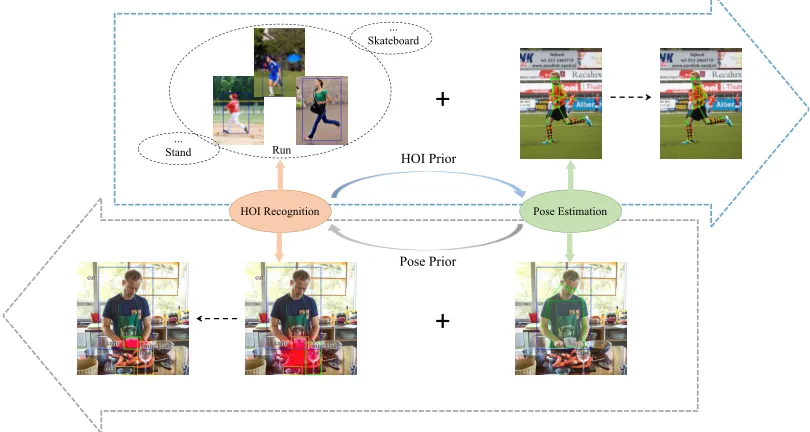
Constructing a closed loop between HOI recognition and pose estimation may bring improvement to each task as shown in Fig 1. On one hand, human pose can improve the robustness of HOI recognition. As for action recogni-tion, human pose offers accurate analysis of human structure rather than coarse information of human body appearance, thus reducing the impact of changes in human appearance. As for target localization, the locations of some keypoints can reveal the location and direction of the interacted ob-jects. For example, the keypoint of the wrist is very close to the object in the actionhold. Therefore, human pose is a powerful cue for recognizing actions and localizing the in-teracted objects. On the other hand, human action can guide the distribution of keypoints vice versa. As a result, the rel-ative position between the keypoints is clearer. Meanwhile, their interacted objects’ localization can help localize spe-cific keypoints. So human action and their interacted ob-jects’ localization provide guidance for pose estimation.
In this paper, we propose a turbo learning method to si-multaneously perform HOI recognition and pose estimation. Specifically, a pose aware HOI recognition module is used to perform HOI recognition based on both image and pose features, which can reduce the influence of changes in hu-man appearance. Meanwhile, a HOI guided pose estimation module is used to perform pose estimation with clear rela-tive distribution between keypoints, in which HOI features are encoded into space location information. Then these two modules form a closed loop in the similar way as an engine turbo-charger, which feeds the output back to the input to reuse the exhaust gas for better engine efficiency. The feed-back process can gradually improve the results of both tasks. To the best of our knowledge, this is the first unified end-to-end trainable network for simultaneous HOI recognition and pose estimation.
Run ...
Stand
... Skateboard
+
+
HOI Recognition Pose Estimation
HOI Prior
Pose Prior
Figure 1: HOI recognition and pose estimation can help each other. People doing the same action like running have similar keypoints distribution. When there is a priori action pattern, the wrong pose estimation might be corrected. Meanwhile, when there are several objects in the estimated action-type specific density area (red area), the model will be confused to find the target object (green box). However, Some keypoints like wrist can refine the red area and help the model to localize the interacted object successfully.
mask for pose estimation, which transforms the pattern of human action into the general distribution of keypoints. (3) A turbo learning framework is proposed to sequentially per-form HOI recognition and pose estimation using the two modules, which can gradually improve the results on both tasks. The proposed method achieves the state-of-the-art re-sults on two public benchmarks including V-COCO and HICO-DET (Chao et al. 2017).
Related Work
HOI Recognition
HOI recognition is not a new problem in computer vi-sion (Herath, Harandi, and Porikli 2017). Traditional meth-ods (Hu et al. 2013; Delaitre, Laptev, and Sivic 2010; Pishchulin, Andriluka, and Schiele 2014) usually use many contextual elements in images to predict action categories, including human pose, manipulated objects, scene, and other people in images (Gupta, Kembhavi, and Davis 2009; Maji, Bourdev, and Malik 2011; Desai and Ramanan 2012). Likewise, deep methods also use one or several of these el-ements to recognize HOIs, but most of them only consider human appearance to be the key point of HOI recognition. For example, Mallya and Lazebnik (2016) fuse CNN-based human appearance features and global context features to achieve the state-of-the-art performance on predicting HOI labels; Gkioxari et al. (2017) use merely human features to achieve the state-of-the-art performance in HOI recogni-tion. Beyond that, Chao et al. (2017) use spatial relations be-tween human and object positions to recognize HOIs. Shen et al. (2018) focus on the difficulty of obtaining all the
possi-ble HOI samples in reality, and propose a zero-shot learning method to tackle with the lack of data problem.
Combination of Action Recognition and Pose
Estimation
work. On top of that, we adopt a novel turbo learning frame-work that leads to better results in each sub-tasks.
Method
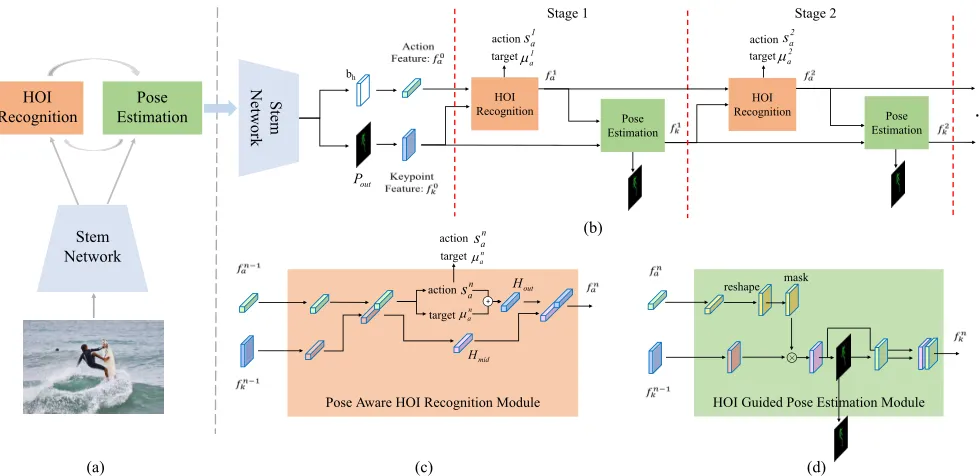
An overview of our framework is illustrated in Fig 2(a). We propose an end-to-end turbo learning framework to integrate two different tasks. After extracting the human appearance features by the stem network, the pose aware HOI recog-nition module is applied to predict HOI with both human appearance features and human pose features. Then, the pro-posed HOI guided pose estimation module updates the hu-man pose result depending on HOI recognition result. The two processes repeat for several times. The two modules form a closed loop to gradually improve the results of both pose estimation and HOI recognition. The closed loop can be expanded by the time sequence as shown in Fig 2(b).
Pose Aware HOI Recognition
Inspired by (Gkioxari et al. 2017), we decompose HOI recognition into two subtasks: action recognition and target localization. We treat the action recognition task as a multi-label task, since a person can simultaneously perform mul-tiple actions (e.g.,sitandhold). To avoid competition be-tween classes, a set of binary sigmoid classifiers are used for multi-label action classification as in (Gkioxari et al. 2017). Hence, the action recognition model outputs a confidence scoresafor actiona. Normally, the action scoresais calcu-lated only based on the human appearance featuresF, which can be written assa=sigmoid(I(F)), whereI( )refers to
the fully connected transformation of the feature maps. Previous methods predict two subtasks with appearance features extracted from human bounding box. However, we notice that the human region contains lots of background information and the rough feature of human make the HOI recognition easily influenced by the change in appearance. Instead of only considering the human appearance feature, we argue that the human pose estimation obtains detailed analysis of human structure and could provide robust pose prior for HOI recognition.
Therefore, we design two types of pose aware HOI mod-ules to integrate human pose constraints. The first one is a simple multi-task training, in which we extend the HOI recognition branch with a pose estimation branch. It needs to be noticed that these two tasks only share stem block. In the second design, instead of integrating human pose informa-tion implicitly, we further encode the human pose features as input of HOI recognition task as shown in Fig 2(c). In order to make full use of pose information, the pose estimation features fk consist of two parts: the intermediate features
Pmidfrom the eighth convolution layer of pose estimation branch, and the pose estimation branch’s outputPout. The featurePmidcontains rich information of human pose and it is abstract enough to encode all body part locations. The esti-mation resultPoutprovides the exact structure of the human body. Furthermore, the HOI features in the previous stage also contribute to the HOI recognition in this stage, which will be discussed in the later. Therefore, the concatenation of pose estimation features, human appearance featuresF
and the HOI features in the previous stage are used as input
hof this module, which can be written as:
h=I([fkn−1, F, Hmidn−1, Houtn−1]), (1)
where[ ] refers to the concatenation of the feature maps.
Hmidn−1 and Houtn−1 represent the intermediate features and
recognition results of the previous HOI recognition module respectively.
For the target localization task, each action predicts the location of the associated object. To enforce the prior that the interacting objects are around the human body, the position of each object is represented relative to the human proposal asboˆ|h.
ˆ bo|h={
xo−xh
wh
,yo−yh hh
,log wo wh
,logho hh
}, (2)
whereho,wo indicate the height and width of the ground
truth target object, andhh,whdenote the height and width of the human region proposal (i.e., its IoU overlap with the ground-truth box is≥0.5.). However, the human region pro-posal and target object may vary in sizes, so we use the smoothL1 loss as it is less sensitive to outliers. Note that
the actions without interactive objects will not produce loss in this task.
Predicting the precise location is a challenging task. For example, the target object usually does not appear in the re-gion proposalbhfor the actionthrow. Therefore, in the test phase, the target localization branch estimates a probability of object location instead of the precise position. We com-bine the predicted probability µa and the detected objects position bo|h from the object detection branch to precisely
localize the target. Specifically, given the human boxbhand actiona, the target localization branch outputs the relative position of associated objectµa, then the target localization probabilityga
h,ocan be written as:
gah,o= exp(−||bo|h−µa||2/2σ2), (3)
where σ is a hyperparameter to constrain search region, we set it to 0.3 in the experiment. The detected object po-sition bo|h is also encoded as Equation 2. After that, the
accurate localization of object boˆ|h is obtained by boˆ|h = argmaxb
o|hg a h,o.
HOI Guided Pose Estimation
The previous module has predicted action confidence and the position of the associated object, then we propose a HOI guided pose estimation module to improve the prediction of human pose. However, the results of action recognition and target localization are predicted by a fully connected net-work and lots of spatial structures are lost. To encode HOI feature into spatial constraint, which is important to human pose estimation, we propose a HOI attention mask to refine keypoint detection.
HOI Guided Pose Estimation Module Pose Aware HOI Recognition Module
bh
action target
1 a
s
1 a
Stem Network
reshape
× mask
+
mid
H
out H
(a)
(b)
action target
n a
s n a action target
n a
s n a
HOI
Recognition EstimationPose Stem
N
etw
ork
out
P
HOI
Recognition Pose
Estimation EstimationPose
action target
2 a
s
2 a
HOI Recognition
Stage 1 Stage 2
(c) (d)
...
Figure 2: (a) Overview of the proposed method. (b) Unfolded diagram of the turbo learning framework along time. (c) The architecture of pose aware HOI recognition module. (d) The architecture of HOI guided pose estimation module.
are utilized to generate refined results of human pose esti-mation. The HOI featuresfa include intermediate features Hmid and recognition output Hout simultaneously, where
Hout consists of the results of action recognition and
tar-get localization, andHmidcontains the implicit information about human action patterns. More formally, we define the attention maskAttactionas Equation 4, and useR( )to in-dicate reshape operation.
Attaction=R(sigmoid(I([fa]))), (4)
After that, the modulated keypoint featurespare achieved as the element-wise multiplication results of attention mask and pose estimation features in previous stagefkn−1.fkn−1
denotes the features of the previous pose estimation module. Specifically, given attention maskAttaction, we generate the
input feature mapspas follows:
p=Attaction·fkn−1. (5)
Then we feed the modulated featurespinto the keypoint detection block to predict the human pose estimation result in stage n. After the attention mask filtering, some false lo-cated keypoints are corrected as shown in experiments. The keypoint detection block consists of sequential 3×3 512-d convolution layers, one deconv layer, one upsample layer and the final convolution layer which projects 512 channels of feature maps into K masks (K is the number of keypoints). We model the location of ground truth as a one-hot mask like (He et al. 2017). Specifically, the ground truth mask is a one-hotm×m binary mask where only the pixel at the ground truth location is foreground. Therefore, we re-gard the pose estimation task as a kind of m×m categories of classification tasks, so the training objective is to min-imize the cross-entropy loss over anm×m-way softmax
output. Similar as the HOI recognition module, the pose es-timation module only calculate the loss of region proposals whose overlap of ground truth human boxbhexceed overlap threshold. Meanwhile, the invisible keypoints will not cause loss.
Turbo Learning Framework
Better pose estimation results lead to better HOI recognition result and better HOI recognition results lead to more ro-bust pose estimation. To utilize the flow of complementary information iteratively, we introduce a turbo learning frame-work, which can be expanded as a sequence of pose aware HOI recognition modules and HOI guided pose estimation modules by the time step. Among them, a pose aware HOI recognition module and a HOI guided pose estimation mod-ule form a stage as shown in Fig 2(b). On the one hand, the pose features provide the subsequent HOI recognition module an expressive non-parametric encoding of each key-point, allowing the HOI recognition module to learn explicit human appearance and location of the keypoints that need to be focused on. On the other hand, the HOI features provide the subsequent pose estimation module a comprehensive en-coding of a action pattern from all action classes, and the general scope of some keypoints. As a result, each stage of the turbo learning framework increasingly refines the action classification results, the locations of target objects and each keypoint. This framework is fully differentiable and there-fore can be end-to-end trainable using backpropagation. The whole loss function can be written as:
L=
N ∑
i=1
whereLdetis the loss function for the detection task,LiHOI
andLiposeare losses for HOI recognition and pose
estima-tion in stagei.λi
poseandλiHOI are the hyper-parameters to
control the balance in stagei. N is the total number of stages. In each stage of the turbo learning framework, the input consists of three parts: human appearance featuresF, HOI featuresfn−1
a and the pose featuresf n−1
k . Among them, the
latter two parts are produced in the previous stage. Specifi-cally, the set of input feature mapstnin stage(n < N−1)
can be written as:
tn ={
F, fkn−1, fan−1}
, (7)
wherefkn−1andfn−1
a denote the pose features and HOI
fea-tures in the(n−1)-th stage respectively. Then-th stage not only outputs the recognition results[sn
a, µna]and human pose
heatmapkn, but also the feature maps for the (n+ 1)-th stage, which contain pose featuresfn
k and HOI featuresf n a.
Experiment
Datasets and Metrics
V-COCO:V-COCO is a subset of COCO (Lin et al. 2014),
which is commonly used for HOI recognition. This dataset includes ∼5k images in the trainval set and ∼5k images in the test set. It annotates 17 keypoints of the human body and 26 common action classes. Three actions (cut, hit, eat) are annotated with two types of targets: instru-ment and direct object, which means that the action is as-sociated with two objects. For example, one man cuts the pizza with a knife. As accuracy is evaluated separately for the two types of targets, we extend the 26 action classes to 29 classes, same as in (Gkioxari et al. 2017). For eval-uation, we adopt the two Average Precision (AP) metrics as in (Gupta and Malik 2015). The ’agent AP’ (APagent)
evaluates the AP of the pair < human, action >. Note that APagent does note require localizing the target, so we
pay more attention to AProlewhich evaluates the AP of the
triplet< human, verb, object >.
HICO-DET: the HICO-DET dataset is an extension to
the “Humans Interacting with Common Objects” (HICO) dataset (Chao et al. 2015). In HICO-DET, the annotation of each HOI includes a human bounding box and an object bounding box with a class label respectively. HICO-DET contains about 48k images,∼38k for training and∼9k for testing. It includes 600 interaction types, 80 unique object types that are identical to the COCO categories, and 117 unique verbs. The official evaluation code of HICO-DET reports the mean AP over Full test set (including all 600 HOI categories), Rare test set (including HOIs with less than 10 training instances only) and Non-Rare test set (including HOIs with 10 or more training instances only) respectively.
Implementation Details
Our implementation is based on Faster R-CNN (Ren et al. 2015) built on ResNet-101 (He et al. 2016), and the Region Proposal Network (RPN) is frozen and does not share fea-tures with our framework for convenient ablation. We extract
7×7features from region proposals by ROIAlign, and the
HOI recognition branch consists of two 1024-d fully con-nected layers followed by dropout layers. The object detec-tion branch consists of 3 residual blocks followed by specific output layers, and the pose estimation branch consists of 8 convolution layers followed by 2 upsample layers(deconv, interp, conv) and output layer(keypoint). The weight decay is 0.0001 and the momentum is 0.9. We use synchronized SGD on 8 GPUs, with each GPU hosting 1 image (the effec-tive mini-batch size per iteration is 8 images). We train the network for 10k iterations with a learning rate of 0.001 and an additional 3k iterations with a learning rate of 0.0001.
For V-COCO, RPN and the object detection branch are initialized by a Faster R-CNN model pre-trained on MS-COCO, then we train on the V-COCOtrainval(5k images) split and report results on thetest(5k images) split. We fine-tune the object detection branch and train other branches from scratch.
The objects in HICO-DET are not exhaustively annotated. We adopt the same measure in (Gkioxari et al. 2017), using a ResNet50-FPN object detector pre-trained on COCO to de-tect objects in HICO-DET, and the object dede-tection branch is kept frozen during training. Due to the lack of pose anno-tations in HICO-DET, keypoint detection branch cannot be trained as well. Thus, we implement two strategies to adapt to the situations where only the annotation of HOI is avail-able. The details of these two strategies will be discussed later.
Model Performance Analysis
In order to demonstrate the effectiveness of turbo learning framework, we conduct some comparison experiments on the V-COCO dataset. We also compare two strategies on the HICO-DET dataset, where only the annotation of HOI is available.
HOI Recognition with vs. without Pose Estimation The
pose features are important cues for recognizing actions and localizing the interacted objects. Without pose features, ac-tion recogniac-tion may be misleading by the human appear-ance. Meanwhile, the target localization may be confused when there are close objects. To demonstrate the impor-tance of pose estimation to HOI recognition, we evaluate a variant of our method in which only has the HOI recog-nition model and the number of stages is one. The results are shown in Fig 3(a) and Fig 3(b). Removing the pose es-timation branch shows a degradation of 0.5% in APagent
and 1.1% inAProle, which demonstrates the contribution of pose estimation to HOI recognition. To demonstrate the ben-efits of regarding pose features as input, we also report the results of simple multi-task training in Fig 3(a) and Fig 3(b). Multi-task training means that when the number of stages is one, pose estimation branch and HOI recognition branch are jointly learned, but the pose features likePmidandPoutdo
not input to the HOI recognition branch. Using explicit in-put shows an improvement of 0.2% inAPagentand 0.8% in AProle, which demonstrates the benefits of explicit input.
52 53 54 55 56 57
w/o HOI recognition
RMPE one stage two stage three stage
65 66 67 68 69 70 71
w/o pose estimation
multi-task one stage two stage three stage
37 38 39 40 41 42 43
w/o pose estimation
multi-task one stage two stage three stage
(a) (b) (c)
kp 50
AP
role
AP
agent
AP
Figure 3: Recognition results on the V-COCO test set. From left to right:APagent,AProlefor HOI recognition andAP50kpfor pose estimation.
baseball hold
horse ride
Figure 4: Examples showing that pose estimation helps HOI recognition (a, b) and that HOI recognition helps pose estimation (c, d). In each group of figures, from left to right: original recognition results, the other task’s recognition results and recognition results with the other task’s features. (c,d) only show the keypoints to be improved.
snowboard kick
sports ball
skateboard
skateboard talk on phone
hold
book
stand run hold
tennis racket
hit
tennis racket
look sports ball
sit horse ride horse smile
sit horse
ride horse
(a)
(b)
(c)
snowboard cell phone
Table 1: Results on HICO-DET test set.
Method full rare non-rare
Gupta&Malik (Gupta and Malik 2015) 7.81 5.37 8.54
InteractNet (Gkioxari et al. 2017) 9.94 7.16 10.77
Proposed (Pre-train) 10.9 6.5 12.2
Proposed (Semiautomatic) 11.4 7.3 12.6
Table 2: Results on V-COCO test set.
Method APagent AProle
Gupta&Malik (Gupta and Malik 2015) 65.1 31.8 InteractNet (Gkioxari et al. 2017) 69.2 40.0
Proposed 70.3 42.0
far from the keypoint of the face. With the pose features, the action is correctly classified as cutting. In the Fig 4(b), the estimated area is in front of the human body. However, the estimated area is near the left wrist with the pose features, which help the model to successfully locate objects.
Pose Estimation with vs. without HOI Recognition To
demonstrate that HOI can guide the keypoints distribution, we also evaluate a variant of our method which removes the HOI recognition branch, so the pose estimation task only re-lies on the image features extracted by the ROIAlign layer. The pose estimation branch is the same as Mask-RCNN (He et al. 2017) architecture, so “w/o HOI recognition” is actu-ally the result of the Mask-RCNN baseline, and “RMPE” is the result of the RMPE (Fang et al. 2017) baseline. But in order to perform HOI recognition, we need not only detect the person, but also detect other kinds of objects. Fig 3(c) shows that removing HOI recognition task leads to 1% drop onAP50kp, indicating that the HOI recognition features pro-vide guidance on the relative distribution of keypoints.
We show two examples of improvement in keypoints de-tection in Fig 4. In the Fig 4(c), the legs are easy to be missed when people ride horse. However, the action “ride” has sim-ilar keypoints distribution. With the HOI recognition fea-tures, the keypoints are correctly detected. In the Fig 4(d), the location of baseball provides guidance for the keypoints of wrists, which improves the keypoints localization.
Benefits of Turbo Learning Framework Turbo learning
framework aims to reuse the cooperation of two tasks, and refine both of the results. To demonstrate the benefits of turbo learning framework, we show the recognition results from stage 1 to stage 3 in Fig 3. From stage 1 to stage 2, the improvement ofAPagent,AProleandAP
kp
50 is 1.7%, 0.2%
and 0.4% respectively. From stage 2 to stage 3, the improve-ment ofAPagent,AProleandAP50kpis 0.9%, 1.3% and 0.8% respectively. As the number of stages increases, the results of both HOI recognition and pose estimation are improved.
Pre-training vs. Semiautomatic Annotation Although
there are not many datasets where both annotations are avail-able, e.g. HICO-DET dataset, we implement two strategies to avoid the lack of pose annotations. The first strategy is pre-training, in which we pre-train the model on the dataset which has both annotations. Then we finetune the network
from the model pre-trained on V-COCO and remove the key-point loss. Still, we allow the weights in keykey-point detection branch to be updated following gradients produced by HOI recognition loss, and we find it yields better results. The sec-ond strategy is semiautomatic annotation, in which we use the model proposed in (Newell, Huang, and Deng 2017) to semi-automatically annotate the keypoints on HICO-DET dataset. The used model is trained on the COCO dataset, which is readily applicable to other open source pose detec-tors like Mask-RCNN. Then we take the keypoints detection results as annotations for training the model on HICO-DET dataset.
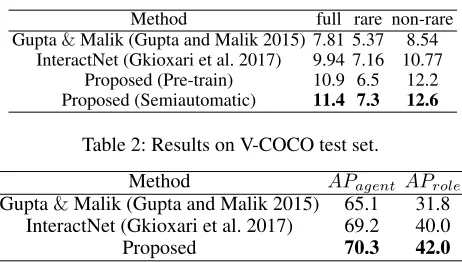
In Table 1, we show the comparison of two strategies. The experiment on HICO-DET in (Gkioxari et al. 2017) has the similar settings as ours, except that we do not use the Feature Pyramid Network (FPN) (Lin et al. 2017) and interaction branch in (Gkioxari et al. 2017). So we adopt their results as a solid baseline. Table 1 shows that pre-training on a dataset having both annotations will improve the HOI recognition results, which is mainly because precise human body struc-ture information learned on V-COCO can help the model to be more robust to the changes in human appearance. The last row of Table 1 shows that semiautomatic annotation can fur-ther improve the HOI recognition results, which verifies that our model is also applicable to the case where both HOI and keypoint annotations are not simultaneously available.
Comparsion with the State-of-the-art Methods
As shown in Tables 1 and 2, the proposed method can achieve the state-of-the-art performance on HICO-DET and V-COCO. As (Gupta and Malik 2015) only reportedAProle
on a subset that consists of 19 actions and only evaluated on the val set of V-COCO, we adopt the solid baseline im-plemented in (Gkioxari et al. 2017). It is worth noting that our method does not use the FPN and interaction branch as (Gkioxari et al. 2017), but the final AProle still
outper-forms 2%on V-COCO, which further proves the effective-ness of our method. Although the keypoints of HICO-DET are obtained by semiautomatic annotation rather than ground truth, our method still outperforms 1.5% than InteractNet.
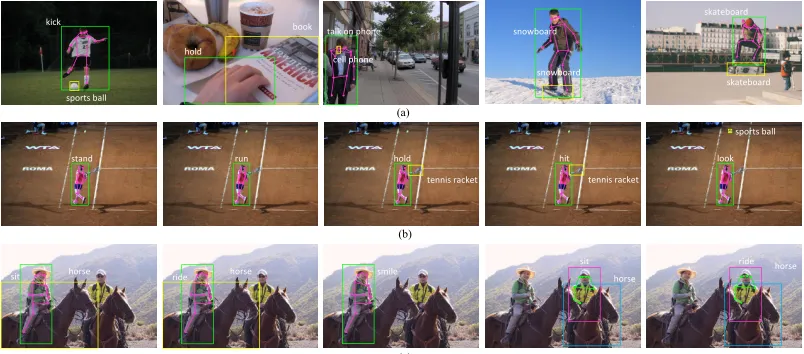
We also show some HOI recognition and pose estimation results of the proposed model. In Fig 5(a), we only show one triplet< human, action, object >. The results of one per-son with several actions are shown in Fig 5(b), and results of multiple persons are shown in Fig 5(c). These results show our model can handle different HOI cases.
Conclusion
Acknowledgement
This work was supported in part by the National Natural Sci-ence Foundation of China under Grant Nos. 61332007 and 61621136008.
References
Cao, Z.; Simon, T.; Wei, S.-E.; and Sheikh, Y. 2017. Re-altime multi-person 2d pose estimation using part affinity fields. InProceedings of the IEEE Conference on Computer Vision and Pattern Recognition, volume 1, 7.
Chao, Y.-W.; Wang, Z.; He, Y.; Wang, J.; and Deng, J. 2015. Hico: A benchmark for recognizing human-object interac-tions in images. InProceedings of the IEEE International Conference on Computer Vision, 1017–1025.
Chao, Y.-W.; Liu, Y.; Liu, X.; Zeng, H.; and Deng, J. 2017. Learning to detect human-object interactions. In arXiv preprint arXiv:1702.05448.
Chen, C.-Y., and Grauman, K. 2014. Predicting the location of “interactees” in novel human-object interactions. In Pro-ceedings of the Asian conference on computer vision, 351– 367. Springer.
Delaitre, V.; Laptev, I.; and Sivic, J. 2010. Recognizing hu-man actions in still images: a study of bag-of-features and part-based representations. In Proceedings of the British Machine Vision Conference, 1–11.
Desai, C., and Ramanan, D. 2012. Detecting actions, poses, and objects with relational phraselets. In Proceedings of the European Conference on Computer Vision, 158–172. Springer.
Fang, H.; Xie, S.; Tai, Y.-W.; and Lu, C. 2017. Rmpe: Regional multi-person pose estimation. InProceedings of the IEEE International Conference on Computer Vision, vol-ume 2.
Gkioxari, G.; Girshick, R.; Doll´ar, P.; and He, K. 2017. De-tecting and recognizing human-object interactions. InarXiv preprint arXiv:1704.07333.
Gupta, S., and Malik, J. 2015. Visual semantic role labeling. InarXiv preprint arXiv:1505.04474.
Gupta, A.; Kembhavi, A.; and Davis, L. S. 2009. Observ-ing human-object interactions: UsObserv-ing spatial and functional compatibility for recognition. InProceedings of the IEEE Transactions on Pattern Analysis and Machine Intelligence, volume 31, 1775–1789. IEEE.
He, K.; Zhang, X.; Ren, S.; and Sun, J. 2016. Deep residual learning for image recognition. InProceedings of the IEEE Conference on Computer Vision and Pattern Recognition, 770–778.
He, K.; Gkioxari, G.; Doll´ar, P.; and Girshick, R. 2017. Mask r-cnn. InProceedings of the IEEE International Con-ference on Computer Vision, 2980–2988. IEEE.
Herath, S.; Harandi, M.; and Porikli, F. 2017. Going deeper into action recognition: A survey. InProceedings of the Im-age and Vision Computing, volume 60, 4–21. Elsevier. Hu, J.-F.; Zheng, W.-S.; Lai, J.; Gong, S.; and Xiang, T. 2013. Recognising human-object interaction via exemplar
based modelling. InProceedings of the IEEE International Conference on Computer Vision, 3144–3151. IEEE. Lin, T.-Y.; Maire, M.; Belongie, S.; Hays, J.; Perona, P.; Ra-manan, D.; Doll´ar, P.; and Zitnick, C. L. 2014. Microsoft coco: Common objects in context. InProceedings of the Eu-ropean Conference on Computer Vision, 740–755. Springer. Lin, T.-Y.; Doll´ar, P.; Girshick, R.; He, K.; Hariharan, B.; and Belongie, S. 2017. Feature pyramid networks for ob-ject detection. In Proceedings of the IEEE Conference on Computer Vision and Pattern Recognition, 4.
Luvizon, D. C.; Picard, D.; and Tabia, H. 2018. 2d/3d pose estimation and action recognition using multitask deep learning. InarXiv preprint arXiv:1802.09232.
Luvizon, D. C.; Tabia, H.; and Picard, D. 2017. Human pose regression by combining indirect part detection and contex-tual information. InarXiv preprint arXiv:1710.02322. Maji, S.; Bourdev, L.; and Malik, J. 2011. Action recog-nition from a distributed representation of pose and appear-ance. InProceedings of the IEEE Conference on Computer Vision and Pattern Recognition, 3177–3184. IEEE.
Mallya, A., and Lazebnik, S. 2016. Learning models for actions and person-object interactions with transfer to ques-tion answering. InProceedings of the European Conference on Computer Vision, 414–428. Springer.
Newell, A.; Huang, Z.; and Deng, J. 2017. Associative em-bedding: End-to-end learning for joint detection and group-ing. InAdvances in Neural Information Processing Systems, 2277–2287.
Ning, G.; Zhang, Z.; and He, Z. 2017. Knowledge-guided deep fractal neural networks for human pose estimation. In
Proceedings of the IEEE Transactions on Multimedia. IEEE. Pishchulin, L.; Andriluka, M.; and Schiele, B. 2014. Fine-grained activity recognition with holistic and pose based fea-tures. InProceedings of the German Conference on Pattern Recognition, 678–689. Springer.
Ren, S.; He, K.; Girshick, R.; and Sun, J. 2015. Faster r-cnn: Towards real-time object detection with region pro-posal networks. InProceedings of the Advances in Neural Information Processing Systems, 91–99.
Shen, L.; Yeung, S.; Hoffman, J.; Mori, G.; and Fei-Fei, L. 2018. Scaling human-object interaction recognition through zero-shot learning. In2018 IEEE Winter Conference on Ap-plications of Computer Vision, 1568–1576. IEEE.
Wei, S.-E.; Ramakrishna, V.; Kanade, T.; and Sheikh, Y. 2016. Convolutional pose machines. InProceedings of the IEEE Conference on Computer Vision and Pattern Recogni-tion, 4724–4732.
Xiaohan Nie, B.; Xiong, C.; and Zhu, S.-C. 2015. Joint action recognition and pose estimation from video. In Pro-ceedings of the IEEE Conference on Computer Vision and Pattern Recognition, 1293–1301.