Reprinted from
ECOSYSTEMS OF THE WORLD 16
VETE COPY
ECOSYSTEMS OF DISTURBED GROUND
Edited by
Lawrence R. Walker
Department of Biological Sciences, Unsur ►stv of Nevada, Las Vegas, 4305 Maryland hirkway. Bas 4,14004,
1-rgai, NI' 89134-4004, USA
I 999
ELSEVIER
PHYSICAL ASPECTS OF SOILS OF DISTURBED GROUND
R.E. SOJKA
INTRODUCTION
Humanity's presence on earth has forced the selective adoption of both anthropocentric and naturalistic per-spectives of soil as an ecosystem component. From the anthropocentric perspective, soil is an ecosystem component used by humans for specific purposes (e.g., to grow forests and crops; support structures or roadways; and as a filtration medium). The naturalistic perspective sees soil primarily as the natural foundation or backdrop for other ecological systems and processes, and philosophically excludes many soil-management technologies and scenarios, favoring only soil uses and management practices that derive from natural ecosystem processes. The naturalistic perspective is more willing to concede that soil, like other ecosystem elements, may at times respond to perturbations counter to human needs and aesthetics.
The role of environmental managers and scientists is to know when and how firmly to embrace the validity of either or both outlooks. That requires an appre-ciation of the properties of ecosystem components, and how those properties affect a given management objective. Familiarity with fundamental soil properties is essential to understanding the physical aspects of soils of disturbed ground, regardless of the interpreter's perspective.
This chapter presents a summary of essential soil-science concepts necessary to begin understanding the interactive role of soil in a disturbed ecosystem. The emphasis is on soil physical properties and processes. However, soil is a biologically and chemically dynamic system with strong interactions, interdependencies, and feedback among all its compartments, phases, and functions. Thus, some fundamental chemical and biological concepts relevant to soil physical status are also briefly outlined. The framework of fundamental
concepts is used to explain the role of soil physical status in several important kinds of land disturbance. A detailed analysis of all aspects of soil physical perturbation from all conceivable kinds of physical land disturbance is beyond the scope of the chapter and the expertise of the author. But application of principles to several key types of ecological disruption in which soil physical disturbance is important provide a conceptual framework that can be extended to other scenarios.
THREE-PHASE SOIL MODEL
The essential physical aspects of soil are often rep-resented by a simple three-phase model (Fig. 21.1). The three phases are solid, liquid, and gas. The proportion, arrangement, and constitution of each phase dictates soil properties and functionality within a given ecosystem or for a given use. Typically, and perhaps surprisingly, half the volume of soil beneath one's feet is composed of air and water.
Fig. 21.1. The three-phase conceptual model of soil, showing typical liquid, gas, and solid composition, including the distribution of mineral vs. organic solids in a productive soil from the United States "corn belt".
Soil Organic Matter Typically 1-5%
t
Win
504
Table 21.1
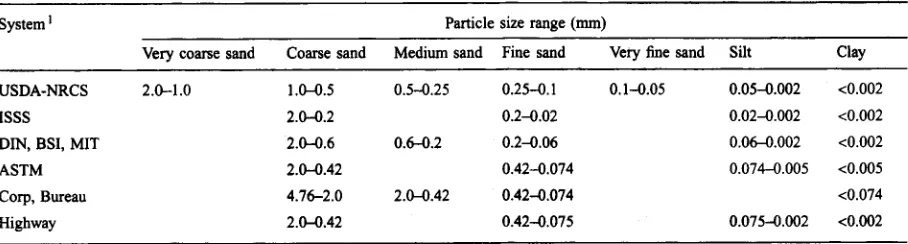
Limits of soil size separates for various classification schemes
R.E. SOJKA
System' Particle size range (mm)
Very coarse sand Coarse sand Medium sand Fine sand Very fine sand Silt Clay
USDA-NRCS 2.0-1.0 1.0-0.5 0.5-0.25 0.25-0.1 0.1-0.05 0.05-0.002 <0.002
ISSS 2.0-0.2 0.2-0.02 0.02-0.002 <0.002
DIN, BSI, MIT 2.0-0.6 0.6-0.2 0.2-0.06 0.06-0.002 <0.002
ASTM 2.0-0.42 0.42-0.074 0.074-0.005 <0.005
Corp, Bureau 4.76-2.0 2.0-0.42 0.42-0.074 <0.074
Highway 2.0-0.42 0.42-0.075 0.075-0.002 <0.002
System: USDA-NRCS, United States Department of Agriculture, Natural Resources Conservation Service; ISSS, International Soil Science Society; DIN, German Standards; BSI, British Standards Institute; MIT, Massachusetts Institute of Technology; ASTM, American Society for Testing and Materials; Corp, United States Army Corps of Engineers; Bureau, United States Department of Interior, Bureau of Reclamation; Highway, American Association of State Highway and Transportation Officials.
Human use and natural processes alter the physical and chemical aspects of all three phases. While each phase may be altered somewhat independently, the effects are nearly always the result of interactions among the phases. The physical aspects of soil behavior on disturbed ground are affected foremost by changes in the arrangement and proportion of the phases, especially with respect to the amount and arrangement of the pores which hold and conduct soil gases and liquids. Chemical changes in one or more of the phases, however, can also bring about significant physical effects.
Solid phase
Solid-phase properties are affected by the proportion of particles of various sizes (texture), their arrange-ment (structure), their mineralogy and organic-matter content, the composition of ions and other chemical constituents adsorbed on their surfaces or filling the interstices, and the degree of hydration of the system. Disturbance of any one of these aspects can affect a given system component singly, but usually also causes cascading effects within the three-phase model.
Unlike many other soil properties, texture is regarded as nearly unchangeable in all but the most drastic of soil alterations (Soil Survey Staff, 1993). In the United States, there are several classification schemes for soil textures (Table 21.1). These can sometimes come into conflict, because soils and landscapes are usually classified and mapped under one scheme, but, if not for farming, are often managed or manipulated using different standards. In the United States, for
example, the Natural Resources Conservation Service textural standards (Soil Survey Staff, 1993) are used to map soils, but one of several engineering stan-dards (Table 21.1) might be used for engineering or construction purposes. Furthermore, when soils are mapped, the mapping unit texture is based on the surface diagnostic horizon (topsoil layer). The texture of underlying horizons may vary greatly.
Table 21.1 presents the size range for soil sepa-rates, as classified by several systems. The ostensible immutability of soil texture derives from basing its assessment solely on the proportional composition of size separates of the mineral fraction. Texture analysis excludes organic material, which is oxidized before determination of the size separates, and is performed on the remaining mineral material which is first entirely dispersed into individual (primary) particles – that is, the non-aggregated or non-structured mineral fraction (Gee and Bauder, 1986). Except as the result of catastrophic natural events or anthropogenic intervention, the proportion of these constituents in soil is very stable, because these soil mineral constituents change size (weather or accrete) very slowly – over many decades or longer (Lyles and Tatarko, 1986).
below, p. 509). Changes in the proportion of mineral size separates can be accelerated by mass displacement, either in-situ (e.g., through tillage-associated mixing of the surface horizons) or by displacement across the landscape (e.g., by erosion and deposition, landslides, or anthropogenic earth-moving).
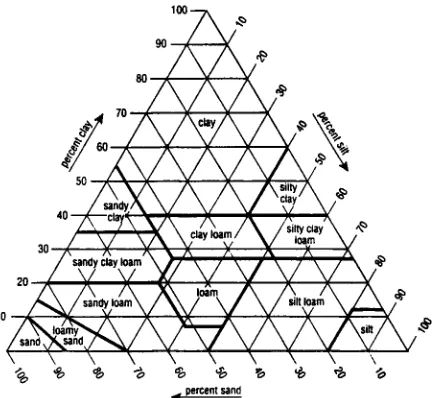
The textural classification scheme most commonly used in the United States is represented in the NRCS soil textural triangle (Fig. 21.2). Texture does not change by addition of organic matter, or through any manipulation of soil that does not add or remove a specific mineral size fraction. The perception of textural change, by many unfamiliar with the technical definition of texture, usually depends on change in soil structure, particularly aggregation (structural units, typically a few millimeters in size), and is often recognized as a difference in "tilth" or "friability". Both of these terms are non-specific, but refer in a general sense to improved stability of soil structure, ease of soil penetration by roots, gases, or infiltrating fluids, and a resistance to "slaking", or rapid loss of structure upon wetting or mechanical disturbance.
The presence of durable aggregates can make coarse, so-called light-textured (sandy) soil or fine, so-called heavy-textured (clay) soil, feel and behave more like a medium-textured (loamy) soil, without actually chang-ing the proportion of mineral size separates (Russell, 1976). The colloquial use of "light" vs. "heavy" as textural terms derives from the wet weight of soils, the feature commonly encountered by farmers in the field. Since clays hold more water per unit volume, they are heavier when wet than are sands. Interestingly, the opposite is generally true when the soils are oven-dried to 105°C to remove all water.
The presence of some organic matter and clay, which act as particle binders and adhesives, favors formation of the kind of aggregates generally associated with tilth and ease of rooting. Aggregation and structure are more prevalent in medium-textured soils, such as loamy (see Fig. 21.2), which have a balanced mixture of particle sizes, than in soils heavily dominated by a single size fraction, such as clays or sands. The thoroughly decomposed (stable) organic matter of soil is one of the most potent binding agents for soil aggregates. Aggregate stability tends to be highly correlated with organic matter content (Chaney and Swift, 1984; Soane, 1990). The desirability of organic matter and aggregation depend upon the intended soil use (see below, p. 511).
100
MAYA
70
AVAVAVA
Cik
30
A
SSE
A
WL
n
VA t 1 Et 74 galas
6127
OFA A rr
A
percent sand
Fig. 21.2. Soil textural triangle, showing limits of sand, silt, and clay size separates composing the various textural classes recognized by the United States Natural Resources Conservation Service.
silty clay loam
Detailed soil structural classification and terminol-ogy, though beyond the scope of this chapter, are explained in a variety of sources (Soil Survey Staff, 1975; Russell, 1976). The key consideration is that the ordered arrangement of primary soil particles into structural units alters the relationship of solid particles and interstices to one another. This spatial reorgani-zation of the three-phase system affects mechanical behavior and strength, transport of fluids and gases through the soil, and retention of water in the bulk soil profile and within structural units. These properties in turn influence the behavior of soil organisms and oxidation-reduction chemistry.
Mineralogy of the solid phase, particularly of the clay size fraction, significantly influences soil phys-ical characteristics and behavior, as well as greatly influencing the chemistry and biotic properties of the soil. Again, the subject of clay-mineral effects on soil physical properties is extensive and is only briefly outlined in this chapter. Clay mineralogy is determined by the composition of secondary layer-silicate minerals, sometimes referred to as clay minerals or 1:1 and 2:1 layer silicates.
In general, clay minerals are broadly grouped into classes determined by the ratio of silica layers (joined tetrahedral structures forming a thin mineral sheet) to alumina layers (joined octahedral structures forming a thin mineral sheet) in their crystalline structures. Isomorphic substitutions of elements displacing silicon or aluminum within the tetrahedra and octahedra result
so
50
40
20
506 R.E. SOJKA
in a negative charge which varies among the mineral species.
The 1:1 layer-silicates have a single tetrahedral layer and a single octahedral layer, and the degree of substitutions is usually low. Thus, the charges of these minerals are only slight. Kaolinite is a representative 1:1 clay species. Because the charge, quantified as cation exchange capacity (centimoles of charge per kilogram of solid), is low (3-15 cmoles kg- 1 ), these minerals are relatively inactive in retaining cations (e.g., the plant nutrient ions Mg'', K+ , or NH-4'). Soils dominated by kaolinitic clays have low mineral fertility. These clays are also less effective in aggregate forma-tion, and retain relatively stable physical configuration regardless of hydration or cation composition on the exchange sites.
The 2:1 layer silicates have two tetrahedral layers, oriented basal side to basal side, resting on top of a single alumina layer. Isomorphic substitutions occur more commonly, and thus cation exchange capacity is higher (up to 100 cmoles kg- 1 ). Soils dominated by 2:1 clays tend to have greater mineral fertility than soils dominated by 1:1 clays. The 2:1 clays are also more active physically than the 1:1 clays, playing a larger role in joining soil primary particles to form aggregates (Hagin and Bodman, 1954).
Because of the weak repulsion of adjacent 2:1 clay crystal laminae, water molecules easily invade the space between laminae. Thus, as hydration increases, 2:1 clays swell, earning them the common designation of "shrink–swell clays." As the degree of isomorphic substitution increases and cation exchange capacity rises, 2:1 minerals are more influenced by hydration. As pure clays hydrate from an air-dry state, volume changes of a few percent for kaolinite occur, compared to 30-60% expansion for the expanding-lattice 2:1 clay mineral montmorillonite, depending upon the ions dominating exchange sites (Hillel, 1980). In soils which have mixed mineralogy and contain organic matter and other non-clay mineral solids, expansion figures of several percent for a given mass of soil are common if the soils are high in montmorillonitic clay. These changes can greatly affect construction of roads, foundations, or other structures, as a result of the large deep cracks that form when the soil is dry, and strong internal pressures when the soil is wet.
The composition of cations adsorbed on clay sur-faces and dissolved in soil water has physical conse-quences for soils with high clay content (Brooks et al., 1956; Auerswald et al., 1996). When exchange sites are
dominated by sodium ions, which have large hydrated radii compared to divalent calcium or magnesium cations, the clay laminae become separated. This causes the fine solids in soil, especially the clay material, to disperse, degrading or preventing development of stable aggregates (Velasco-Molina et al., 1971). These fine dispersed solids (largely clay) are susceptible to movement and rearrangement with water, usually resulting in blockage of soil pores, which reduces infiltration and drainage (Shainberg and Singer, 1985; Shainberg et al., 1992). Pore blockage near the surface can accelerate runoff and lead to erosion (see p. 513). When the soil is wet, blocked pores in surface crusts have been shown to hamper soil aeration (see p. 512) by impeding diffusion of oxygen into internal pore spaces (Sale, 1964; Miller and Gifford, 1974).
Organic matter is a very important component of the solid phase, having consequences with respect to physi-cal and chemiphysi-cal properties greatly disproportionate to its relatively small proportion in the soil mass. Even minor changes in the small amounts of organic matter present in soils can result in significant changes in soil properties. Soil organic-matter content is especially important for maintenance of soil structure, particularly soil aggregation, the crumb-like structure of soil that so greatly influences such soil properties as aeration, water infiltration, and resistance to erosion. These soil properties are exceedingly important at the scale of phenomena associated with tillage, perhaps the single most pervasive form of soil disruption on the planet (see pp. 510-511).
of polysaccharides of high molecular weight (Molope et al., 1985; Metzger et al., 1987; Roberson et al., 1991).
Liquid phase
The water contained in a soil greatly influences its physical properties and its ability to sustain plants, microbes, and soil mesofauna (e.g., ants, termites and worms). Soil water retention is quantified in terms of the amount of water per unit weight or per unit volume of soil that is held against a given free-energy gradient. This is usually expressed in terms of water content at a specific value of tension, "negative" pressure, suction, or matric potential. Plant-available water is sometimes defined as the amount of water held between saturation (zero potential) and —1.5 MPa of soil matric potential. In high-salinity soils, the osmotic component of soil water must be added to the matric potential to assess adequately a plant's ability to utilize the water present. At zero potential soil is saturated, and water can drain freely in response to gravity. At —1.5 MPa potential it would take an atmospheric pressure of 1.5 Mpa in a confined system to drive water from the soil matrix.
Water-retention characteristics are affected by soil texture (Ehlers et al., 1995) and structure (Taylor and Box, 1961). Coarse-textured soils (sands) hold relatively little water compared to fine-textured soils (clays) (Richards, 1959). As mean soil pore size decreases, water retention generally increases (Donat, 1937). Compaction or aggregation thus affect water retention through their effects on pore-size distribution. The sufficiency of the water for the needs of soil biota and plants is dependent upon what fraction of the volume of water retained can be extracted from soil between about 0 and —1.5 MPa of negative pressure. The sufficiency of this amount of water (often referred to as the available water holding capacity) within an ecosystem is further determined by the desiccating strength of the climate or microclimate and the ability of the organisms to regulate water loss. Soil disturbance often affects ecosystems by altering soil water-holding capacity, either by changing the water-retention characteristics of the soil, by decreasing soil depth (and hence water-storage volume), or by compacting the soil to strength levels that roots cannot penetrate, reducing rooting volume and de facto water storage.
Water content affects several solid-phase properties. Soil strength (hardness or penetration resistance) is
a function of water content. Soil strength decreases rapidly from a plateau value at desiccation, and reaches an asymptotic minimum value determined by solid-phase characteristics as soil becomes wet (Camp and Gill, 1969; Mirreh and Ketcheson, 1972; Ayers and Perumpral, 1982; Gerard et al., 1982; Campbell et al., 1988). As water content increases and mechanical strength decreases, soil is more easily deformed or compacted. Thus, compaction of soils, whether intentional or not, occurs more easily when traffic or other applied stress is imposed while soil is wet (see p. 510). Texture also affects the relationship between soil water content and soil strength (Spivey et al., 1986). At medium textures, soils that have been compacted when wet often have a very low porosity. This is because under compression the various size fractions are arranged to almost completely fill the interstices between soil particles (Campbell et al.,
1988).
Water content, rapidity of wetting, and length of time without disturbance affect the durability of soil structure (Blake and Gilman, 1970; Arya and Blake, 1972; Utomo and Dexter, 1981; Kemper and Rosenau, 1984). Rapid wetting of dry soil is highly destructive of exposed aggregates and surface structure, resulting in loss of surface porosity and formation of surface seals which impede infiltration and increase runoff (Segeren and Trout, 1991), contributing to erosion (see pp. 513-515).
The salinity of water that is in the soil or is being applied to soil can affect solid-phase relationships, depending on total salinity and the relative amount of sodium in the water (United States Salinity Laboratory Staff, 1954). Saline water low in sodium tends to preserve soil structure, whereas water high in sodium relative to other cations (especially if total salinity is low) is destructive to soil structure and increases soil erodibility (Le Bissonais and Singer, 1993; Lentz et al., 1996; see also p. 513).
Gas phase
508 R.E. SOJKA
e.1
adequate for plant growth when air-filled pore space or the concentration of oxygen equals or exceeds 10% (Wesseling and van Wijk, 1957; Anderson and Kemper, 1964; Grable and Siemer, 1968; Wesseling, 1974).
The composition of the atmosphere near the earth's surface is 21% oxygen, 78% nitrogen, and, as of 1993 (Keeling and Worf, 1994), about 0.035% carbon dioxide. The balance is composed of various trace gases. In soil air, oxygen depletion through respiration lowers the amount of oxygen present, and raises by an equivalent amount the content of carbon dioxide and trace organic gases such as methane and ethylene, which are byproducts of anaerobic respiration. Thus, oxygen and carbon dioxide levels of 10-12% in soil are common. Carbon dioxide levels can approach 20% and oxygen levels can fall to virtually 0% in extreme circumstances (Russell and Appleyard, 1915). Therefore, merely determining the volume of soil air gives an incomplete picture of aeration. Determining the intensity factor (concentration or partial pressures of gases) in addition to capacity is an improvement. However, chemical reactions in soil, and biological processes of soil micro- and mesobiota and the roots of higher plants, experience or utilize soil aeration as a rate factor. They depend on the rate at which oxygen can be exchanged at a specific microsite in the soil relative to the required rate of oxygen use (Letey and Stolzy, 1967).
Soil air exchanges oxygen within the soil profile and with the atmosphere through a variety of processes including surface turbulence, variation in barometric pressure and changes in soil temperature, and by phys-ical displacement by and dissolution from infiltrating water. The most active mechanism of oxygen exchange, however, is by diffusion from the ambient atmosphere (Russell, 1952). Oxygen diffuses through air 10 4 times faster than through water (Greenwood, 1961) and only one-fourth as rapidly through dense protoplasm as through water (Krogh, 1919; Warburg and Kubowitz, 1929). Thus, the hydration of the soil system and the organisms active within it profoundly influence the system's ability to supply oxygen at rates necessary for oxygen-dependent reactions, such as aerobic respira-tion, or to prevent reduction of compounds or elements such as iron, which can produce phytotoxins when the oxygen diffusion rate is low.
MAJOR SOIL DISTURBANCE CATEGORIES
All forms of soil disturbance draw their consequences
from the same collection of soil processes described as parts of the three-phase soil model. However, the systematics of each disturbance scenario, that is, the extent of such processes and their interaction with other processes differ from one kind of disturbance to another. Sometimes these systematics differ only incrementally and subtly, sometimes wholly and dra-matically. Furthermore, the scale and intensity of certain kinds of disturbance can vary greatly, with obvious implications for evaluation or management of the particular disturbance. Thus, it is impossible to cover thoroughly the considerations with respect to soil physics for every conceivable category of disturbance. Based upon extent of phenomena and annual impact I have selected three specific categories of disturbance for more detailed consideration. I have called these categories Loosening and Compaction, Flooding and
Erosion.
Loosening and Compaction is almost entirely
an-thropogenic, particularly as the result of agricultural traffic and tillage. Flooding is almost entirely non-anthropogenic. Erosion is an intimate combination of anthropogenic and natural disturbance factors.
Other categories can certainly be identified. Some may be more visible to the general public (which is mainly urban and suburban), as is the case with construction disturbance (considered briefly under
Loosening and Compaction – p. 511). Some may be
more intense and noticeable in their effects on the landscape within their contained areas of influence, as with mining. Yet, compared to Loosening and Compaction, Flooding, and Erosion, the global extent of impacts of these other categories on ecosystems is much less. Furthermore, many of these less extensive categories of soil physical disturbance are strongly analogous to the major categories mentioned. An understanding of their systematics can be derived from applications of principles from the three-phase soil model, and sometimes, for instance in the case of mining, with the overlay of potent impacts caused by changes in environmental chemistry.
ii •
land used for grazing. These figures compared to a total of only 1.5 x 10⁶ ha (0.2%) of land disturbed for mining during the period from 1930 to 1971, half of which had been reclaimed by 1978. By way of further contrast, farm roads and farmsteads accounted for 4.6 x 10⁶ ha (0.5%) and ungrazed forested land totalled 213 x 106 ha (23%).
Recent estimates would indicate a 2% decline over the years in the combined non-forested area farmed and grazed. This was despite maintaining or improving the food supply of a large increase in population and expanding agricultural exports. The more recent area totals are 162 x 106 ha in all croplands excluding pasture (but including idle land), 266 x 10 6 ha in pasture, range, and grassland, and 262 x 106 ha in forested land (Hunst and Powers, 1993). The more recent estimates for forested lands include areas used for grazing, which prevents direct comparison with the earlier figures for forested and grazing lands.
While agricultural areas in the United States are extensive, they are also remarkably productive, with much of the output going to export. The proportion of agriculture in the landscapes of the world is generally similar to that in the United States or greater, though the production efficiency is often much less (see Giampietro, Chapter 32, this volume). Production efficiency is improving rapidly in less developed countries, however, with the successful adoption of high-output agricultural technology. This latter point is especially important if viewed in terms of the role of high-output agriculture in preserving earth's natural ecology.
Waggoner (1996) studied the effect of improved agricultural technology on land use in India between 1966 and 1994. About 13 million hectares were devoted to the production of 11 million tons of wheat. In 1994 about 24 million hectares were cultivated to produce 57 million tons of wheat. Had the low technology of the sixties still been used, the land requirement for the same 57 million tons would have been 69 million hectares. In a similar analysis, Avery (1997) estimated that land spared from agricultural development worldwide since 1960 by adoption of advanced farming methods "is equal to the total land area of the United States, Europe, and Brazil."
There are just under 1.5 x 10⁹ ha of land in arable crop production in the world (Higgins et al., 1988), not counting pasture, range, and grasslands. Most of this cropland receives tillage at least once a year, as well as extensive wheeled traffic for other operations;
hence the importance of loosening and compaction as a disturbance category.
Loosening and compaction
Loosening and compaction affect the arrangement of solids and pores, with secondary effects on soil properties that depend on these relationships. Some mixing of soil horizons during loosening events or operations may influence both physical and chemical properties (Campbell et al., 1988; Chapman, 1990; Sumner, 1995).
Soil loosening and compaction rarely occur rapidly on a large scale through natural processes, but they occur quite commonly in agriculture, surface mining, and construction. A typical hectare of soil contains about 2.3 x10 6 kg of soil in the surface 15 cm of depth. This entire mass can be inverted and mixed in a few hours by mechanized tillage. In nature, loosening of an equivalent mass by earthworms and burrowing animals occurs on landscape scales, but at rates that are typically apparent in their cumulative effects only over decades or longer. Individual species of earthworms can ingest from 10 t ha- 1 yr- I of soil (for the species Aporrectodea rosea) to 500 t ha- I yr' (for the species Millsonia anomala). A group of species including M. anomala occurring together are capable of combined consumption rates of 1200 t ha-' yr' (Lee and Smettem, 1995). If all ingested material were deposited on the soil surface, these figures would correspond with a complete turnover of the top 15 cm of soil in periods ranging from 230 to 1.9 years. How-ever, incomplete soil displacement, inconsistent rates of ingestion in time and space (caused by variations of temperature, moisture substrate, etc.), and mixed-species and variations in field populations, reduce mean soil mixing rates, as measured by deposits on the surface. Lee and Smettem (1995) also summarized data that would suggest that the contribution to soil loosening by other mesofauna, such as termites and ants, is one to two orders of magnitude less than for earthworms.
510 R.E. SOMA
even after decades and despite organic enrichment of surface horizons to increase earthworm populations (Horn, 1986).
Earth slippage is one example of intense natural loosening. Trampling under the hooves of migratory herd animals is an example of natural compaction. However, since the degree of compaction is related to the load and extent of contact of the load-transferring surface, trampling does not result in the extensive or intense compaction often seen as a result of human activity.
Soil compaction occurs primarily as the result of traffic or other forces imposed from near the surface, or immediately below the depth of tillage; these forces are transmitted into the soil, causing compression well below the depth of direct wheel or implement contact (Horn, 1995). Persistent layers of compaction are often called pans (e.g., traffic pans, tillage pans, or hardpans). Subsoil compaction pans can last a decade or more, even in the presence of annual freezing and thawing (Blake et al., 1976; Voorhees et al., 1978). In some soils, hard pans are formed in situ through natural forces of soil consolidation, usually under high rainfall, and sometimes as a result of illuviation of materials from overlying horizons filling pores and interstices in the layer that eventually becomes the genetic hardpan.
Agricultural tillage is one of the most extensive forms of soil disturbance. Tillage is commonly per-formed to kill weeds, bury residues, reduce soil strength and/or ameliorate subsoil rooting restrictions, accelerate drying and warming, improve aeration and/or infiltration, incorporate fertilizer and/or pes-ticides, and provide seedbed preparation, levelling, and drainage. When the surface is tilled, there is an initial increase in the porosity of the surface and infiltration rates are higher. However, prolonged surface tillage disrupts the continuity between surface and subsurface pores in the vicinity of the "plow sole", the subsoil layer supporting the weight of moving tillage implements (Douglas and Goss, 1987).
The greater porosity and aeration following tillage temporarily accelerates microbial activity (Carter, 1991). This can be seen in the immediate increase in release of carbon dioxide (Reicosky and Lindstrom, 1993, 1995), and in the long-term decline of soil organic matter (Bauer and Black, 1981, 1983; Dalal and Mayer, 1986; Rasmussen and Collins, 1991; Ehlers and Claupein, 1994) and decrease in aggregate stability (Schonning and Rasmussen, 1989). Following many years of conventional tillage, surface soils tend to
have higher bulk density after consolidation and traffic than untilled soils (Bauer and Black, 1981; Ehlers and Claupein, 1994). This is caused by the loss of resistance to aggregate breakdown, compactibility, and compressibility accompanying lowered soil organic matter levels (Zhang and Hartge, 1995).
Subsoiling (Sojka, 1995) is performed specifically to loosen soil at depths of –0.30-0.45 m, that is, through the normal depth of crop rooting. Soil loosening (natural or imposed) is generally a transitory effect. The duration of the effect depends upon the organic-matter content and texture of the soil, the frequency and intensity of rainfall or irrigation, the amount of subsequent traffic over the surface, and the water content of the soil at the time of the traffic (Busscher et al., 1986; Busscher and Sojka, 1987; Sojka et al.,
1990, 1991, 1997).
The duration of loosening from agricultural sub-soiling has been extensively studied. The various soil properties affected by loosening often persist for different lengths of time. Depending on soil properties, water content at the time of subsoiling, climate, and indicator crop, subsoiling effects have been found to persist from 1 to 5 years, but typically only 1-2 years (Lindner, 1974; Schulte, 1974; Swain, 1975; Bokerman and Graichen, 1981; Hartge, 1981; Threadgill 1982; Jager and Boersma, 1983; Kouwenhoven and Vulinck, 1983; Martinovic et al., 1983; Schulte-Karring, 1983; Busscher et al., 1986; Ide et al., 1987; Simmons and Cassel, 1989; Chapman, 1990). However, the effect generally only lasts for about one year in sandy soils, and two years on medium- to fine-textured soils. The persistence of the disruption effect is shortened in environments with high rainfall. The effect can seldom be detected by measurement of bulk density for longer than one year, or by penetration resistance for longer than two years. Plant response to disruption is sometimes measurable for as long as five years in silt-or clay-textured soils, and all measures of disruption tend to show longer duration of the effect if the soils were relatively dry at the time of disruption.
6.5
ci _cs 6.0
rn
2
-o 5.5
5.0
2 0 2.2 2.4 2.6 2.8 30
Strength (MPa)
Fig. 21.3. The dependence of yield of corn (Zea mays) on profile soil strength, as measured with a standard ASAE cone penetrometer (both averaged over two years), in a two-dimensional grid across corn rows, showing effects of varying extent of subsoil disruption from three subsoil-loosening implements (from Sojka et al., 1991). Data are from two cropping systems: Conventional Tillage (Cony), soil surface-tilled bare of residue before planting; and Minimum Tillage (MM), soil surface-tilled to a shallow depth before planting, with a substantial amount of loose residue left unincorporated or partially incorporated on the soil surface. Three 45 cm deep, non-inverting subsoiling implements were compared: a straight-shanked subsoiler (SS) with 13 cm wide ripping surfaces, a parabolic-shanked subsoiler (10E) with 7.5 cm wide ripping surfaces, and a subsoil lifting surface (termed a Paratill; PT) capable of extensive lateral soil disruption.
Elkins and Hendrick (1983) and Karlen et al. (1991) demonstrated that an entire mass of soil need not be disrupted to greatly improve plant growth on fields with root-restrictive subsoils. When small root-sized channels were made to penetrate restrictive layers in the subsoil, and the openings were quickly stabilized with thick, persistent plant roots, considerable yield improvement was realized. If plant establishment could be achieved with minimal disruption, the requirements for fuel and horsepower to ameliorate compaction could be much reduced. Busscher et al. (1988) demonstrated that there was a considerable range in the thoroughness and pattern of subsoil disruption among subsoiling implements commonly available.
Some deep tillage is done more for chemical remediation than for the direct physical loosening. Sandoval et al. (1972) demonstrated that certain dispersed-clay sodic soils could be reclaimed using deep plowing tillage that mixed large amounts of calcium carbonate from lower horizons with high-sodium soil of the affected upper horizons. The calcium reduced the percentage of exchangeable sodium in the soil, enhanced flocculation and stabilized aggregation,
thus improving the physical properties of the soil (Sandoval and Jacober, 1977; Sandoval, 1978).
The type of soil structure desired by engineers for roadways or foundations is very different from that needed for plant growth (Zhang and Hartge, 1995). These two uses manipulate the three-phase soil model to achieve nearly opposite outcomes. Organic matter promotes and stabilizes aggregation and porosity while reducing soil compressibility (minimum void ratio achievable as stress increases) and compactibility (maximum achievable bulk density). Roadways and foundations require densely compacted soils to prevent consolidation and settling after construction. Where the local soils are high in swelling clays, compaction lowers porosity, inhibits water entry into the subsoil, and thereby reduces the fluctuations in water content that disrupt foundations and roadways. For these reasons, construction procedures often remove topsoil to minimize the influence of organic matter, and intentionally work to reduce porosity, increase runoff, and reduce the ease of rooting in soils supporting the roadways or structures.
Compaction effects associated with construction are often criticized because, until the construction is completed, these processes can promote erosion from an unprotected work site. New technologies (Roa, 1996) and environmental law have begun to reduce off-site sediment problems. Most construction operations now seek rapidly to revegetate work sites immediately upon completion of the construction, both for aesthetic reasons, and to protect the structures and roadways from being undermined by accelerated runoff and erosion from the low-permeability soils that have been created. Thus, in the revegetation phase a balance is struck to enhance surface-soil properties sufficiently to support sod, or other non-intrusive vegetative cover, without undermining the intensive earthwork that must remain undisturbed to support the structures.
Flooding
512 R.E. SOJKA
1993 in the midwestern United States, it was estimated that 8 x 10⁶ ha were damaged by floodwaters, and at one time 2.8 x 10⁶ ha were under water. In addition to flooding, Dudal (1976) estimated that 12% of the world's soil resource has excess water on a sustained basis.
Flooding can wreak its damage swiftly, particularly if flows are large and energetic, through aeration, disease effects, and erosional and alluvial processes. But even placid water or rising water tables can inflict a severe toll in less than 48 hours (Stolzy and Sojka, 1984).
Some flooding is predictable and controllable, even if unavoidable. Some is unpredictable, and characteris-tically all the more devastating. In any case, flooding is, more often than not, a primarily natural phenomenon -one of the most potent forces in natural ecosystems. Humans are particularly affected by flooding because of their proclivity to live and grow crops in floodplains. This tendency is prompted by the ease of property development on flat land, and proximity to rivers for water and transportation, as well as proximity to the land itself, which is usually highly productive farmland.
Flooding damage to soil often goes unnoticed because of the degree of destruction above the soil surface, both to the works of humankind and to the natural landscape. Flooding can cause settling and disruption of earthworks, roadbeds, and foundations. The extreme reduction in soil strength, when coupled with high winds, often results in uprooting of trees, and the toppling of powerlines and other upright structures.
Flooding can have direct or indirect effects on soil systems. Direct effects include soil cooling, interference with soil aeration, degradation of soil structure, accelerated consolidation, erosion, and leach-ing of nutrients. Indirect effects include proliferation and carriage of soil-borne plant pathogens (Stolzy and Sojka, 1984), and if soils are inundated long enough, soil reducing conditions will eventually lead to denitrification, and the production of phytotoxic chemicals (Ponnamperuma, 1984).
Many floods occur in temperate climates in the spring, when rivers swell with snow-melt and cold spring rains. Soils in the spring are usually still cool, and floodwaters can further delay spring warming by raising the heat capacity, and lowering the thermal dif-fusivity during periods of reduced incoming radiation. Bonneau (1982) reported a reduction in the temperature of flooded soil by 6°C compared to well-drained soil.
This is enough to hamper the absorption by roots of some nutrients, particularly phosphorus, which is highly responsive to soil and root temperature in some crops, such as corn (Zea mays).
Uptake of phosphorus and other nutrients is di-rectly inhibited by soil hypoxia; these effects were comprehensively reviewed by Glinski and Stepniewski (1985). One of the most consistent effects of soil hypoxia and flooding is potassium deficiency. Uptake of the potassium ion by plant roots stops immediately when oxygen diffusion to the root zone is impaired. This deficiency is interesting because of its possi-ble link to stomatal closure in a range of higher plants when soil oxygen diffusion rate drops below 20x 10-8 g (Sojka et al., 1975; Sojka and Stolzy, 1980; Sojka, 1985).
As explained earlier, oxygen diffusion through water is much slower than in the gaseous phase. Thus, oxygenation of the root zone depends on mass flow of water through the profile. This mass flow is often impeded by swelling of soil and the dispersion of fine materials blocking soil pores (Wickham and Singh, 1978). Ponnamperuma (1984) made an insightful and concise analysis of the effects of floodwater in the soil profile. Reviewing the work of Grable (1966), Greenland (1981), and Houng (1981), Ponnamperuma further noted that 1.5 m per day of water movement through the soil profile is needed to meet root oxygen requirements and that at least 1 cm per day of water movement is needed to remove toxic products of reducing chemistry. However, movement of up to 3 cm per day is only capable of oxygenating the surface 1 cm of flooded soil.
Daily soil percolation rates are seldom enough to oxygenate more than a few centimeters of soil near the surface. So, if water stands for any length of time, plants begin to suffer stress or die from the combined effects of inadequate aeration and accumulation of toxic substances.
Virtually all forms of management for flooding avoidance or control are costly and difficult to im-plement. They include regional dam and waterway projects, land contouring and other forms of surface drainage leading to improvement in infiltration, instal-lation of subsurface drainage, selection and breeding of plant species and varieties for flooding tolerance or resistance, protection of large wetlands and enhance-ment of their ability to slow storm-water discharge, and limited techniques for improvement of soil aeration once flooding has occurred, such as the use of peroxide fertilizers (Cannell and Jackson, 1981; Kozlowski, 1984a; Stolzy and Sojka, 1984; Sojka and Stolzy, 1988).
Erosion
The topic of erosion is covered in detail elsewhere in this volume (Pimentel and Harvey, Chapter 4, this volume), with an emphasis on negative impacts on agriculture. This section will focus on limited aspects of water-induced erosion. Wind- and water-induced erosion both result from the interaction of the soil, in whatever physical state it exists upon initiation of the erosion event, with energetic fluids (wind and water). Soil losses from each have been documented in natural and managed environments, commonly ranging from nearly zero to extremes of hundreds of metric tons per hectare per year.
There is also a growing recognition of "tillage erosion", with rates dependent on slope and implements reaching 140 t ha-I yr-I in severely affected areas such as hill crests (Mech and Free, 1942; Lindstrom et al., 1990, 1992; Govers et al., 1994; Lobb et al., 1995). Tillage erosion results from the gradual, but systematic, mass movement of soil downslope during tillage of sloping land. A natural analogue of tillage erosion is mass displacement of soil on slopes by the hooves of grazing or migrating animals and by burrowing soil macrofauna [e.g., marmots (Marmota sp.) or foxes]. The extent of these natural activities may rival the extent, but not the accumulated impact, of tillage erosion.
Wind- and water-driven soil erosion processes have been intensively investigated since early in the 20th cen-tury. The physical processes involved have been described in well-recognized statistically based models: USLE, the Universal Soil Loss Equation (Wischmeier and Smith, 1978), RUSLE, the Revised Universal Soil Loss Equation (Renard et al., 1994), and the Wind
Erosion Equation (Woodruff and Siddoway, 1965). Recently, intensive efforts have been mounted to produce process-driven models: WEPPS, the Water Erosion Prediction Project (Laflen et al., 1991) and WEPS, the Wind Erosion Prediction System (Hagin, 1991). These new models strive to predict erosion from basic soil and landscape characterization data and fluid dynamics, rather than solely through empirically derived calibrations for a particular soil. The unique-ness of irrigation-induced erosion and irrigation-driven erosion processes is an important refinement in erosion prediction technology that has not yet been successfully undertaken (Trout, 1996, 1999; Sojka, 1997).
Soil properties influence water erosion through several avenues. Water erosion cannot occur until runoff begins. Runoff occurs when water is added at the surface faster than it can infiltrate. Infiltration rate is determined by soil structure and the water content of the soil profile. When a soil profile is saturated, runoff will occur regardless of structure. If the soil or the infiltrating water is high in sodium, structure near the surface can rapidly degrade, sealing the surface against water infiltration, and rapidly promoting runoff and increasing erosion. Erosion can increase by as much as 50% if the eroding water is high in sodium (Le Bissonais and Singer, 1993; Lentz et al., 1996).
Regardless of salinity, the amount of energy (in all its various manifestations) associated with water interacting with soil affects the structural integrity of the surface soil and its erodibility (Laflen et al., 1991). The ability of raindrops and flowing water to cause erosion depends upon the energy of the falling drops and the shear force of the flowing water to cause detachment.
Erosion takes place more easily when flow over the soil surface is fed by large raindrops. The high energy of large raindrops destroys surface soil structure and detaches soil in the splash process. Al-Durrah and Bradford (1981) showed that the mass of surface soil detached by raindrops was linearly correlated with the ratio of raindrop kinetic energy to soil shear strength. Detached and displaced soil then washes away in runoff and contributes to sealing of the surface pores, further increasing runoff volume and shear force (Mohammed and Kohl, 1987). Finer-textured soils can be dispersed into finer particles and therefore generally form surface seals more easily than coarse-textured soil (Bradford and Huang, 1992).
Runoff volume and velocity increase downslope, making the slope angle and slope length important
514 R.E. SOJKA
soil properties with respect to erosion. For a given volume of runoff, surface ponding depth decreases with slope steepness (Liu, 1991; Bradford and Huang, 1996). Ponding depths greater than 2 mm can reduce splash-induced detachment (Palmer, 1963; Kirkby and Kirkby, 1974; Moss and Green, 1983).
Slope and slope length tend to increase runoff, and therefore flow shear force, resulting in increased erosion. Toni (1996) recently pointed out that many soil and landscape factors interact in governing the effects of slope and slope length on erosion. Simple estimates of how much erosion increases for a given increase in either slope or slope length are difficult to make accurately without considering other soil factors. Renard et al. (1996) recently demonstrated the effectiveness of new tools for predicting erosion such as RUSLE and WEPP, because of their ability to integrate numerous soil properties.
In considering slope, it is also important to consider landscape position. Soil disturbance from erosion on upper-slope-reaches will be primarily the result of soil loss. On foot slopes, erosion-caused disturbance effects will be from deposition of soil as slope decreases, reducing flow velocity, shear strength, and carrying capacity of the runoff (Franzmeier, 1990). These soil conditions affecting erosion can be greatly mitigated by increased surface roughness or coverage of the soil surface with modest amounts of vegetation, plant litter, or crop residues. Less well known but equally effective are erosion mitigation by dominance of divalent cations in the soil or in the runoff water (impeding the clay dispersion that results in aggregate destruction and particle detachment), or by stabilization with surface-applied soil conditioners that enhance aggregate stability and cohesion among aggregates (Renard and Mausbach, 1990; Lentz et al., 1992, 1996; Sojka, 1997).
In the manageable upper portion of the soil profile, soil organic matter is once again a very important soil property indirectly affecting erosion through its impact on soil structure. Higher organic-matter content promotes and stabilizes aggregation and, because of the improved macro-porosity, increases infiltration (Boyle et al., 1989).
Some erosion always occurs in natural systems as the topographies of land masses change through geomorphic forces such as uplift, vulcanization, and glaciation. "Natural" (pre-anthropogenic) erosion rates for the southeastern United States were estimated from geological data to range from 0.2 to 0.8 t ha- 1 yr- 1
for the Piedmont and from 2.6 to 4.7 t ha- 1 yr- 1 for the mountainous areas (Schumm, 1963; Hack, 1965; Young, 1969).
Natural erosion can be as imperceptible or as catastrophic as anthropogenic erosion. Erosion is also essential to the development of various natural land-forms, such as river deltas, floodplains, and valleys. Cyclical erosion is vital to the nutrient enrichment of certain natural land-forms and ecosystems for the survival of terrestrial plant growth and the fauna they support, as well as for lacustrine, fluvial, and marine flora and fauna in various environments.
Ecosystem balance can also be destroyed if over-whelmed by excess erosion. The activities of man in the 20th century have greatly obscured the degree to which erosion occurs as a natural process. Most of the study of the phenomenon of erosion has been from the anthropogenic perspective, particularly with regard to agriculture and construction.
Erosion effects can be divided into effects on depositional areas and on eroded areas within the context of landscape processes (Daniels and Bubenzer, 1990; Franzmeier, 1990). Deposition increases soil depth, and can alter soil chemistry, water retention, and aeration. Some organisms may be buried by deposition, and others may be seeded or translocated. Deposition or erosion may alter landscape contours enough to affect microclimate through slope and aspect changes, and may alter the availability of water by changing the depth to the water table or by interception of runoff. Aside from the immediate negative impact of the burial of some species, enrichment from soil deposition can also benefit the depositional microhabitat (Cassel and Fryrear, 1990).
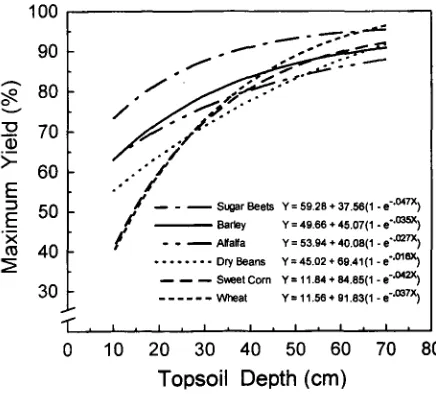
On eroded areas, soil loss can create rills or gullies, and expose subsoil horizons that often are less supportive of vegetative growth. Erosional soil loss can undermine root support for higher plants. Most analysis of erosion has focussed on its negative impacts on crop yield (Cassel and Fryrear, 1990; Hajek et al., 1990). In an agricultural setting, erosion carries away topsoil, which usually has greater long-term yield potential than the subsoil that is exposed (Fig. 21.4). Furthermore, inputs including fertilizer and pesticides are lost, decreasing short-term productivity, while also risking non-point pollution downstream of the erosional site.
4, • • . • •
* /**'
- - - Sugar Beets Y = 59.28 + 37.56(1 - e.°47x) Y = 49.66
e°
35X)Barley
--- - Alfalfa Y = 53.94 + 45.07(1 + 40.08(1 -- e°27X)
Dry Beans Y = 45.02 + 69.41(1 - 141635
- - - Sheet Corn Y = 11.84 + 84.85(1 - e0425)
Wheat Y =11.56 + 91.83(1 - 13-M7X)
0 10 20 30 40 50 60 70 80
Topsoil Depth (cm)
:n-cs 70
tv
2 30
Fig. 21.4. Relationship of crop yield (normalized as percent of maximum yield without erosion) of six irrigated crops to uneroded depth of the surface horizon, demonstrating increased loss of yield potential with increased severity of erosion (from Carter, 1993). The six crops represented are: sugar beet (Beta uulgaris), barley (Hordeum vulgare), alfalfa (Medicago sativa), dry beans (Phaseolus uulgaris), sweet corn (Zea mays), and wheat (Triticum aestiuum).
in soil characteristics such as bulk density, clay content, and surface horizon thickness. However, these changes vary systematically with position on the landscape (Walker, 1966; Malo et al., 1974; Matzdorf et al., 1975), and vary somewhat unpredictably among individual soils.
CONCLUSIONS
The physical aspects of soils of disturbed ground are best examined from the effect of the disturbance on the gas, liquid, or solid phases of soils. Soil properties can greatly influence the extent to which a given disturbance force affects the soil. Some of the effects of soil disturbance can be managed by utiliz-ing current understandutiliz-ing of physical and chemical principles. Agriculture is probably the largest single activity on the planet causing ecological disturbance of soils. Yet agricultural disturbance is a managed factor, whereas many other disturbance sources are not. The intensity of environmental impact depends on the skill of management and/or the intensity of environmental or anthropogenic disturbance. It is the manager's role to utilize understanding of the soil system to mitigate negative environmental effects of management, regardless of the outcome being sought.
REFERENCES
Al-Durrah, M. and Bradford, J.M., 1981. New methods of studying soil detachment due to waterdrop impact. Soil Sci. Soc. Am. J., 45: 949-953.
Anderson, W.B. and Kemper, WD., 1964. Corn growth as affected by aggregate stability, soil temperature, and soil moisture. Agron. J., 56: 453-456.
Arya, L.M. and Blake, G.R., 1972. Stabilization of newly formed soil aggregates. Agron. 1, 64: 177-180.
Auerswald, K., Kainz, M., Angermuller, S. and Steindl, H., 1996. Influence of exchangeable potassium on soil erodibility. Soil Use Manage., 12: 117-121.
Avery, D.T., 1997. Avery testifies before senate ag committee. Global Food Q., 20.
Ayers, P.D. and Perumpral, J.V., 1982. Moisture and density effect on cone index. Trans. ASAE, 25: 1169-1172.
Bauer, A. and Black, Al., 1981. Soil carbon, nitrogen, and bulk density comparisons in two cropland tillage systems after 25 years and virgin grassland. Soil Sci. Soc. Am. J., 45: 1166-1170. Bauer, A. and Black, A.L., 1983. Effect of tillage management on
soil organic carbon and nitrogen. N D. Agric. Exp. Stn. Bull., 40: 27-31.
Blake, G.R. and Gilman, R.D., 1970. Thixotropic changes with aging of synthetic soil aggregates. Soil Sci. Soc. Am. Proc., 34: 561-564.
Blake, G.R., Nelson, W.W. and Allmaras, R.R., 1976. Persistence of subsoil compaction in a mollisol. Soil Sci. Soc. Am. J., 40: 943-948.
Bokerman, R. and Graichen, M., 1981. Ein Kostenvergleich ausgewahlter Boden meliorationen. Landtechnik, 36: 571-574. Bonneau, M., 1982. Soil temperature. In: M. Bonneau and B. Souchier
(Editors), Constituents and Properties of Soils. Academic Press, New York and London, pp. 366-371.
Boyle, M., Frankenberger Jr., W.T. and Stolzy, L.H., 1989. 1 Prod. Agric., 2: 290-299.
Bradford, J.M. and Huang, C., 1992. Mechanisms of crust formation: Physical components. In: M.E. Sumner and B.A. Stewart (Editors), Soil Crusting - Chemical and Physical Processes. Advances in Soil Science. Lewis Publishers, Ann Arbor, Michigan, pp. 55-72. Bradford, J.M. and Huang, C., 1996. Splash and detachment by
waterdrops. In: M. Agassi (Editor), Soil Erosion, Conservation, and Rehabilitation. Marcel Decker, New York, pp. 61-76. Brooks, R.H., Bower, C.A. and Reeve, R.C., 1956. The effect of
various exchangeable cations upon the physical conditions of soils. Soil Sci. Soc. Am. Proc., 20: 325-327.
Burns, R.G. and Davies, J.A., 1986. The microbiology of soil structure. In: J.M. Lopez-Real and R.D. Hodges (Editors), The Role of Microorganisms in a Sustainable Agriculture. AB Academic Publishers, Kent, pp. 1-8.
Busscher, W.J. and Sojka, R.E., 1987. Enhancement of subsoiling effect on soil strength by conservation tillage. Trans. ASAE, 30: 888-892.
Busscher, W.J., Sojka, R.E. and Doty, C.W., 1986. Residual effects of tillage on coastal plain soil strength. Soil Sci., 141: 144-148. Busscher, W.J., Karlen, D.L., Sojka, R.E. and Burnham, K.P., 1988.
Soil and plant response to three subsoiling implements. Soil Sci. Soc. Am. J., 52: 804-809.
100
90
80
60
50
516 R.E. SOJKA
Camp, C.R. and Gill, W.R., 1969. Effect of drying on soil strength parameters. Soil Sci. Soc. Am. Proc., 33: 641-644.
Campbell, R.B., Busscher, W.J., Beale, O.W. and Sojka, R.E., 1988. Soil profile modification and cotton production. In: Proceedings, Beltwide Cotton Production Research Conference, 3-8 Jan., 1988, New Orleans, Louisiana, pp. 505-510.
Cannell, R.Q. and Jackson, M.B., 1981. Alleviating aeration stresses. In: G.F. Arkin and H.M. Taylor (Editors), Modifying the Root Environment to Reduce Crop Stress. American Society of Agricultural Engineers, St. Joseph, Michigan, pp. 141-192. Carter, D.L., 1993. Furrow irrigation erosion lowers soil productivity.
ASCE Paper No. 4143. J Irrig. Drainage Eng., 119: 964-974. Carter, L.M. and Tavemetti, J.R., 1968. Influence of precision tillage
and soil compaction on cotton yields. Trans. ASAE, 11: 65-67, 73.
Carter, L.M., Stockton, J.R., Tavemetti, J.R. and Colwick, RE, 1965. Precision tillage for cotton production. Trans. ASAE, 8: 177-179. Carter, M.R., 1990. Relative measures of bulk density to characterize
compaction in tillage studies on fine sandy loams. Can. .1 Soil Sci., 70: 425-433.
Carter, MR., 1991. Influence of tillage on the proportion of organic carbon and nitrogen in the microbial biomass of medium textured soils in a humid climate. Biol. Fertil. Soils, 11: 135-139. Cassel, D.K. and Fryrear, D.W., 1990. Evaluation of productivity
changes due to accelerated soil erosion. In: W.E. Larson, G.R. Foster, R.R. Alhnaras and C.M. Smith (Editors), Proceedings of Soil Erosion and Productivity Workshop. University of Minnesota. St. Paul, Minnesota, pp. 41-54.
Chaney, K. and Swift, R.S., 1984. The influence of organic matter on aggregate stability in some British soils../. Soil Sci., 35: 223-230. Chapman, R., 1990. Changes in soil structure and texture after
subsoiling soils under permanent pasture. Proceedings of 5th National Land Drainage Seminar, 16-17 August 1990. Massey University, Palmerston North, New Zealand.
Dalai, R.C. and Mayer, R.J., 1986. Long-term trends in fertility of soils under continuous cultivation and cereal cropping in Southern Queensland. II. Total organic carbon and its rate of loss from the soil profile. Aust. J Soil Res., 24: 281-292.
Daniels, R.B. and Bubenzer, G.E., 1990. Landscape processes soil erosion and soil productivity. In: W.E. Larson, G.R. Foster, R.R. Allmaras and C.M. Smith (Editors), Proceedings of Soil Erosion and Productivity Workshop. University of Minnesota, St. Paul, Minnesota, pp. 1-22.
Dommergues, Y.H., Diem, H.D. and Ganry, E, 1979. The effect of soil microorganisms on plant productivity. In: H.O. Mongi and P.A. Huxley (Editors), Soils Research in Agroforestry. International Council for Research in Agroforestry, Nairobi, Kenya, pp. 205-241.
Donat, J., 1937. Das Geflige des Bodens and dessen Kennzeichung. Transactions of the 6th Commission of the International Society of Soil Science (Zurich), Vol. B, pp. 423-439.
Douglas, J.T. and Goss, M.J., 1987. Modification of porespace by tillage in two Stagnogley soils with contrasting management histories. Soil Tillage Res., 10: 303-317.
Dudal, R., 1976. Inventory of the major soils of the world with special reference to mineral stress hazards. Cornell Univ. Agric. Exp. Stn., 3-13 (spec. publ.).
Ehlers, W and Claupein, W, 1994. Approaches toward conservation tillage in Germany. In: M.R. Carter (Editor), Conservation Tillage
in Temperate Agroecosystems. Lewis Publishers, Boca Raton, Florida, pp. 141-165.
Ehlers, W, Wendroth, 0. and de Mol, F, 1995. Characterizing pore organization by soil physical parameters. In: K.H. Hartge and B.A. Stewart (Editors), Soil Structure: its Development and Function. Lewis Publishers, Boca Raton, Florida, pp. 257-275.
Ekwue, E.I., 1990. Effect of organic matter on splash detachment and the process involved. Earth Surf Process. Landforms, 15: 175-181.
Elkins, C.B. and Hendrick, J.G., 1983. A slit-plane tillage system. Trans. ASAE, 26: 710-712.
Franzmeier, D.P., 1990. Soil landscapes and erosion processes. In: W.E. Larson, G.R. Foster, R.R. Allmaras and C.M. Smith (Editors), Proceedings of Soil Erosion and Productivity Workshop. University of Minnesota, St. Paul, Minnesota, pp. 81-104.
Gee, G.W. and Bauder, J.W., 1986. Particle-size analysis. In: A. Klute (Editor), Methods of Soil Analysis. Part I. Physical and Mineralogical Methods. 2nd ed. Agronomy Monograph 9. American Society of Agronomy, Madison, Wisconsin, pp. 383-411.
Gerard, C.J., Sexton, P. and Shaw, G., 1982. Physical factors influencing soil strength and root growth. Agron. 1,74: 875-879. Glinski, J. and Stepniewski, W, 1985. Soil Aeration and its Role for
Plants. CRC Press, Boca Raton, Florida, 229 pp.
Govers, G., Vandaele, K., Desmet, P., Poesen, J. and Bunte, K., 1994. The role of tillage in soil redistribution on hillslopes. Eur .1 Soil Sci., 45: 469-478.
Grable, A.R., 1966. Soil aeration and plant growth. Adv. Agron., 18: 57-106.
Grable, A.R. and Siemer, E.G., 1968. Effects of bulk density, aggregate size, and water suction on oxygen diffusion, redox potentials, and elongation of corn roots. Soil Sci. Soc. Am. Proc., 32: 180-186.
Greenland, D.J., 1981. Recent progress in studies of soil structure, and its relation to properties and management of paddy soils. In: Institute of Soil Science Academia Sinica (Editors), Proceedings of Symposium on Paddy Soils. Science Press, Beijing, China, pp. 42-58.
Greenwood, D.J., 1961. The effect of oxygen concentrations on decomposition of organic materials in soil. Plant Soil, 14: 360-376.
Hack, J.T., 1965. Geomorphology of the Shenandoah Valley Virginia and West Virginia and origin of the Residual Ore Deposits. U.S. Geol. Survey Prof. Paper 484.
Hagin, J. and Bodman, G.B., 1954. Influence of the polyelectrolyte CRD-186 on aggregation and other physical properties of some California and Israeli soils and some clay minerals. Soil Sci., 78: 367-378.
Hagin, Li., 1991. A wind erosion prediction system to meet user needs. J. Soil Water Conserv., 46: 105-111.
Hajek, B.F., Karlen, D.L., Lowery, B., Power, J.F., Shumacher, T.E., Skidmore, E.L. and Sojka, R.E., 1990. Erosion and soil properties. In: W.E. Larson, G.R. Foster, R.R. Allmaras and C.M. Smith (Editors), Proceedings of Soil Erosion and Productivity Workshop. University of Minnesota, St. Paul, Minnesota, pp. 23-39. Harris, R.F., Chesters, G., Allen, O.N. and Attoe, 0.J., 1964.
Mechanisms involved in soil aggregate stabilization by fungi and bacteria. Soil Sci. Soc. Am. Proc., 28: 529-532.
of soil structure - demonstrated on a deep ploughed less parabraunerde (Udalf). Soil Tillage Res., 1: 187-194.
Hepper, C.M., 1975. Extracellular polysaccharides of soil bacteria. In: N. Walker (Editor), Soil Microbiology. Butterworths, London, pp. 93-110.
Higgins, G.M., Dieleman, P.J. and Abernathy, C.L., 1988. Trends in irrigation development, and their implications for hydrologists and water resources engineers. J. Hydrol. Sci., 33: 43-59.
Hillel, D., 1980. Nature and behavior of clay. In: D. Hillel (Editor), Fundamentals of Soil Physics. Academic Press, New York, pp. 71-92.
Hook, D.D., 1984. Adaptations to flooding with fresh water. In: T.T. Kozlowski (Editor), Flooding and Plant Growth. Academic Press, Inc., Orlando, Florida, pp. 265-293.
Horn, R., 1986. Auswichung unterschiedlicher Bodenbearbeitung auf die mechanische Belastbarkeit von Ackerboden. Z. Pflanzenerz Bodenkd., 149: 9-18.
Horn, R., 1995. Stress transmission and recompaction in tilled and segmentally disturbed subsoils under trafficking. In: N.S. Jayawardane and B.A. Stewart (Editors), Advances in Soil Science: Subsoil Management Techniques. Lewis Publishers, Boca Raton, FL, pp. 187-210.
Houng, K.H., 1981. A theoretical evalulation of percolating rate on the thickness of oxidizing zone of paddy soils. Proc. Natl. Sci. Council, 5: 274-278.
Hunst, M.A. and Powers, BN., 1993. Agricultural Statistics 1993. United States Government Printing Office, Washington, DC. Ide, G., Hoffman, G., Ossemerct, C. and Van Ruymbeke, M., 1987.
Subsoiling: time dependency of its beneficial effects. Soil Tillage Res., 10: 213-223.
Jackson, M.B. and Drew, M.C., 1984. Effects of flooding on growth and metabolism of herbaceous plants. In: T.T. Kozlowski (Editor), Flooding and Plant Growth. Academic Press, Orlando, Florida, pp. 47-127.
Jager, A. and Boersma, O.H., 1983. Negatieve effekten bij het opheffen van bodemverdichting. Landbouwkd. TIjdschr., 95: 24-27.
Karlen, D.L., Edwards, J.H., Busscher, W.J. and Reeves, D.W., 1991. Grain sorghum response to slit-tillage on Norfolk loamy sand. Prod. Agric., 4: 80-85.
Keeling, C.D. and Worf, T.P., 1994. Atmospheric CO 2 records from sites in the SIO air sampling network. In: T.A. Boden, D.P. Kaiser, R.J. Sepanski and F.W. Stoss (Editors), Trends '93: A Compendium of Data on Global Change. ORNL/CDIAC-65. Carbon Dioxide Information Analysis Center, Oak Ridge National Laboratory, Oak Ridge, Tennessee, U.S.A., pp. 16-26.
Kemper, W.D. and Rosenau, R.C., 1984. Soil cohesion as affected by time and water content. Soil Sci. Soc. Am. J., 48: 1101-1006. Kennedy, H.E., 1970. Growth of newly planted water tupelo seedlings
after flooding and siltation. For. Sci., 16: 250-256.
Kirkby, A. and Kirkby, M.J., 1974. Surface wash and the semi-arid break in slopes. Z. Geomorph. (Suppl.), 21: 151-176.
Kouwenhoven, J.K. and Vulinck, T.J.G., 1983. De zin van woelen. Landbouwmechanisatie, 34: 519-523.
Kozlowski, T.T., 1984a. Extent, causes, and impacts of flooding. In: T.T. Kozlowski (Editor), Flooding and Plant Growth. Academic Press, Orlando, Florida, pp. 1-7.
Kozlowski, T.T., 1984b. Responses of woody plants to flooding. In:
T.T. Kozlowski (Editor), Flooding and Plant Growth. Academic Press, Orlando, Florida, pp. 129-163.
Kozlowski, T.T. and Pallardy, S.G., 1984. Effect of flooding on water, carbohydrate, and mineral relations. In: T.T. Kozlowski (Editor), Flooding and Plant Growth. Academic Press, Orlando, Florida, pp. 165-193.
Krogh, A., 1919. The rate of diffusion of gases through animal tissues with some remarks on the coefficient of invasion. J. Physiol. (London), 52: 391-408.
Laflen, J.M., Lane, J. and Foster, G.R., 1991. The water erosion prediction project - a new generation of erosion prediction technology. J. Soil Water Conserv., 46: 34-38.
Le Bissonais, Y. and Singer, M.J., 1993. Seal formation, runoff, and interill erosion from seventeen California soils. Soil Sci. Soc. Am.
57: 224-229.
Lee, K.E. and Smettem, K.R.J., 1995. Identification and manipulation of soil biopores for the management of subsoil problems. In: N.S. Jayawardayne and B.A. Stewart (Editors), Advances in Soil Science. Subsoil Management Techniques. Lewis Publishers, Boca Raton, Florida, pp. 211-244.
Lehrsch, G.A., Sojka, R.E., Carter, D.L. and Jolley, P.M., 1991. Freezing effects on aggregate stability affected by texture, mineralogy, and organic matter. Soil Sci. Soc. Am. J., 55: 1401-1406.
Lentz, R.D., Shainberg, I., Sojka, R.E. and Carter, D.L., 1992. Preventing irrigation furrow erosion with small applications of polymers. Soil Sci. Soc. Am. J, 56: 1926-1932.
Lentz, R.D., Sojka, R.E. and Carter, D.L., 1996. Furrow irrigation water quality effects on soil loss and infiltration. Soil Sci. Soc. Am. 1., 60: 238-245.
Letey, J. and Stolzy, L.H., 1967. Limiting distances between root and gas phase for adequate oxygen supply. Soil Sci., 103: 404-409. Lindner, H., 1974. Zur Technologie und Oekonomie der Tieflockerung
verdichteter Boden mit dem Anbautieflockerer B. 371 Archiv der Acker-Planzenbau Bodenkunde, 18: 629-638.
Lindstrom, M.J., Nelson, W.W., Schumacher, T.E. and Lemme, G.D., 1990. Soil movement by tillage as affected by slope. Soil Tillage Res., 17: 255-264.
Lindstrom, M.J., Nelson, W.W. and Schumacher, T.E., 1992. Quantifying tillage erosion rates due to moldboard plowing. Soil Tillage Res., 24: 243-255.
Liu, B., 1991. Interrill Erosion Processes as Affected by Slope Steepness. M.S. Thesis. Purdue University, West Lafayette, Indiana,
125 pp.
Lobb, D.A., Kachanoski, R.G. and Miller, M.H., 1995. Tillage translocation and tillage erosion on shoulder slope landscape positions measured using I37 Cs as a tracer. Can. J. Soil Sci., 75: 211-218.
Lyles, L. and Tatarko, J., 1986. Plant response to topsoil thickness and to fertilizer on an eroded loess soil. J. Soil Water Conserv., 41: 59-63.
Maio, D.D., Worcester, B.K., Cassel, D.K. and Matzdorf, K.D., 1974. Soil-landscape relationships in a closed drainage system. Soil Sci. Soc. Am. Proc., 38: 813-818.
Martin, J.P., 1945. Microorganisms and soil aggregation. I. Origin and nature of some aggregating substances. Soil Sci., 59: 163-174. Martinovic, L., Muckenhausen, E. and Schroder, D., 1983.