The Advanced Data Acquisition Model (ADAM):
A Process Model for Digital Forensic Practice
This thesis is presented for the degree of
Doctor of Philosophy of Murdoch University
By
Richard Brian Adams
Declaration
I declare that this thesis is my own account of my research and contains as its
main content work which has not previously been submitted for a degree at any
tertiary education institution.
Signature:
Acknowledgments
I would like to express my sincere gratitude to my supervisors, Dr Val Hobbs
and Dr Graham Mann, for their unfailing support and encouragement – I could
not have completed this thesis without them.
Special thanks are due to Phill Russo, Tim Thomas and Dr Colin Armstrong for
their help and willingness to provide constructive feedback on my ideas and to
all those who took part in the evaluation process.
Finally, I would like to acknowledge the love and support of my wife, Jane, and
Abstract
Given the pervasive nature of information technology, the nature of
evidence presented in court is now less likely to be paper-based and in most
instances will be in electronic form . However, evidence relating to computer
crime is significantly different from that associated with the more ‘traditional’
crimes for which, in contrast to digital forensics, there are well-established
standards, procedures and models to which law courts can refer.
The key problem is that, unlike some other areas of forensic practice,
digital forensic practitioners work in a number of different environments and
existing process models have tended to focus on one particular area, such as law
enforcement, and fail to take into account the different needs of those working in
other areas such as incident response or ‘commerce’.
This thesis makes an original contribution to knowledge in the field of
digital forensics by developing a new process model for digital data acquisition
that addresses both the practical needs of practitioners working in different areas
of the field and the expectation of law courts for a formal description of the
process undertaken to acquire digital evidence.
The methodology adopted for this research is design science on the basis
that it is particularly suited to the task of creating a new process model and an
‘ideal approach’ in the problem domain of digital forensic evidence. The process
model employed is the Design Science Research Process (DSRP) (Peffers,
Tuunanen, Gengler, Rossi, Hui, Virtanen and Bragge, 2006) that has been widely
utilised within information systems research.
A review of current process models involving the acquisition of digital
perspective, by drawing on the work of Carrier and Spafford (2003)1, and from a
legal perspective by reference to the Daubert test2. The result of the model
assessment is that none provide a description of a generic process for the
acquisition of digital data, although a few models contain elements that could be
considered for adaptation as part of a new model.
Following the identification of key elements for a new model (based on
the literature review and model assessment) the outcome of the design stage is a
three-stage process model called the Advance Data Acquisition Model (ADAM)
that comprises of three UML3 Activity diagrams, overriding Principles and an
Operation Guide for each stage. Initial testing of the ADAM (the Demonstration
stage from the DSRP) involves a ‘desk check’ using both in-house
documentation relating to three digital forensic investigations and four narrative
scenarios. The results of this exercise are fed back into the model design stage
and alterations made as appropriate.
The main testing of the model (the DSRP Evaluation stage) involves
independent verification and validation of the ADAM utilising two groups of
‘knowledgeable people’. The first group, the Expert Panel, consists of
international ‘subject matter experts’ from the domain of digital forensics. The
second group, the Practitioner Panel, consists of peers from around Australia that
are digital forensic practitioners and includes a representative from each of the
areas of relevance for this research, namely: law enforcement, commerce and
1
Who provide a list of the essential requirements for a digital forensic process model 2
This is a test originating from the United States that has been used by courts to assess
‘scientific’ evidence in various jurisdictions (for instance it is mimicked in a discussion paper by the Law Commission for England and Wales (Edmond, 2010)).
3
incident response. Feedback from the two panels is considered and modifications
applied to the ADAM as appropriate.
This thesis builds on the work of previous researchers and demonstrates
how the UML can be practically applied to produce a generic model of one of
the fundamental digital forensic processes, paving the way for future work in this
area that could include the creation of models for other activities undertaken by
digital forensic practitioners. It also includes the most comprehensive review and
critique of process models incorporating the acquisition of digital forensics yet
Table of contents
CHAPTER 1: INTRODUCTION TO THE RESEARCH ... 1
1.1 BACKGROUND ... 1
1.2 RESEARCH PROBLEM ... 7
1.3 RESEARCH OBJECTIVE AND QUESTIONS... 7
1.4 RESEARCH SCOPE ... 8
1.5 RESEARCH CONTRIBUTION ... 12
1.6 METHODOLOGY ... 12
1.7 OUTLINE OF THE THESIS ... 22
1.8 SUMMARY ... 23
CHAPTER 2: LITERATURE REVIEW... 25
2.1 INTRODUCTION... 25
2.2 DIGITAL EVIDENCE ... 26
2.3 STANDARDS AND GUIDELINES IN DATA ACQUISITION ... 29
2.4 THE FIRST DIGITAL FORENSIC RESEARCH WORKSHOP ... 36
2.5 REVIEW OF DIGITAL FORENSIC PROCESS MODELS ... 37
2.6 SUMMARY ... 81
CHAPTER 3: MODEL REQUIREMENTS ... 82
3.1 INTRODUCTION... 82
3.2 ASSESSMENT CRITERIA FOR PREVIOUS MODELS ... 82
3.3 ASSESSMENT OF PREVIOUS MODELS ... 85
3.4 SUMMARY OF MODEL ANALYSIS ... 118
3.5 SUMMARISING THE REQUIREMENTS FOR A NEW MODEL ... 121
3.6 SUMMARY ... 124
CHAPTER 4: DESIGN AND DEVELOPMENT ... 125
4.1 INTRODUCTION... 125
4.2 MODEL DESIGN ELEMENTS ... 125
4.3 STAGE 1:INITIAL PLANNING ... 130
4.4 STAGE 2:THE ONSITE PLAN ... 141
4.5 STAGE 3:ACQUISITION OF DIGITAL DATA ... 144
4.6 MODEL CREATION ... 145
4.7 SUMMARY ... 157
CHAPTER 5: DEMONSTRATION ... 158
5.1 INTRODUCTION... 158
5.2 CASE DOCUMENTATION COMPARISON... 159
5.3 SCENARIO ‘WALKTHROUGHS’ ... 167
5.4 SUMMARY ... 184
CHAPTER 6: EVALUATION ... 185
6.1 INTRODUCTION... 185
6.2 USE OF EXPERT AND PEER REVIEWERS ... 186
6.3 THE EXPERT PANEL ... 186
6.4 THE PRACTITIONER PANEL ... 188
6.5 FEEDBACK FROM PANELS ... 191
6.6 COMPLETED ADAM ... 208
6.7 SUMMARY ... 208
CHAPTER 7: CONCLUSION ... 209
7.1 INTRODUCTION... 209
7.2 COMMUNICATION ... 209
7.3 RESEARCH SUMMARY ... 210
7.5 RESEARCH OBJECTIVE ACHIEVED ... 214
7.6 RESEARCH CONTRIBUTION ... 215
7.7 LIMITATIONS AND FUTURE WORK ... 216
7.8 SUMMARY ... 218
APPENDIX 1 – DEMONSTRATION RESULTS ... 220
APPENDIX 2 - THE ADAM ... 225
Figures
Figure 1 Design Science Research Process (DSRP) model after Peffers et al (2006) ... 15
Figure 2 Digital Crime Scene Investigation Phases after Carrier and Spafford (2004) ... 39
Figure 3 The IDIP after Carrier and Spafford (2004) ... 40
Figure 4 The EDIPM after Baryamureeba and Tushabe (2004)... 40
Figure 5 The Three Stage Process after Kohn et al (2006) ... 46
Figure 6 The Four Step Forensic Process (FSFP) after Kent et al (2006) ... 48
Figure 7 TDERAPM Phases after Khatir et al (2008) ... 53
Figure 8 Digital Forensic Principles after Ieong (2006) ... 61
Figure 9 Process Flow Between Roles in a Forensic Investigation after Ieong (2006)... 62
Figure 10 EEDI stages after Stephenson (2003) ... 70
Figure 11 Kruse & Heiser Activity diagram after Kohn et al (2008) ... 75
Figure 12 Kruse & Heiser Use Case diagram after Kohn et al (2008) ... 75
Figure 13 US DoJ Activity diagram after Kohn et al (2008) ... 76
Figure 14 US DoJ Use Case diagram after Kohn et al (2008) ... 76
Figure 15 Forensic Process Use Case after Ruan and Huebner (2009) ... 77
Figure 16 Forensic Process Activity Diagram after Ruan and Huebner (2009) ... 77
Figure 17 The Perambulation Procedure after Wang and Yu (2007) ... 80
Figure 18 The ADAM Stage 1 – Initial Planning (version 1) ...148
Figure 19 The ADAM Stage 2 – The Onsite Plan (version 1) ...149
Figure 20 The ADAM Stage 3 – Acquisition of Digital Data (version 1) ...150
Figure 21 The ADAM Stage 3 – Acquisition of Digital Data (version 2) ...166
Figure 22 The ADAM Stage 2 amended (within shaded area) for MOD #3 ...204
Figure 23 The ADAM Stage 3 amended (within shaded area) for MODs #3 and #4 ...205
Figure 24 The ADAM Stage 3 amended (within shaded area) for MOD #6 ...206
Figure 25 The ADAM Stage 3 amendments catering for network/cloud/live acquisition ...207
Figure 26 The ADAM STAGE 1 (Initial Planning) ...225
Figure 27 The ADAM STAGE 2 (Creating the Onsite Plan) ...226
Chapter 1: Introduction to the research
This thesis addresses the fundamental issue that there is no comprehensive
description for the process of acquiring digital evidence that can be applied by
Australian practitioners operating in the different digital forensic areas of law
enforcement, incident response (who tend to work mainly within their own
organisation) and third-party providers of digital forensic services (who
undertake their work on behalf of external clients, often lawyers). This is not an
isolated weakness within the subfield of acquisition of digital evidence because,
as Cohen (2011) points out, the whole field of digital forensics still lacks
consensus in fundamental areas. By providing a formal model for a significant
aspect of the digital forensic process this research will not only be of immediate
value to digital forensic practitioners but it will establish a starting point from
which other researchers can continue to develop the field’s scientific credentials.
1.1
Background
Given the pervasive nature of information technology the nature of
evidence presented in court is less likely to be paper-based as has previously
been the case and in most instances will be in electronic form (Stanfield, 2009).
However, evidence relating to computer crime, regardless of definition, is
significantly different from that associated with the more traditional crimes for
which there are well-established standards and procedures (Smith, Grabosky, &
Gregor Urbas, 2004; Stanfield, 2009). This has required the courts in Australia
In Australian courts the admissibility of evidence is governed by both
statute and common law. Each State and Territory have their own Evidence Act,
with some combined to echo the Evidence Act 1995 (Cth) (Mason, 2007). The
general principle adopted by these courts for copies of documents presented as
evidence is that a copy of a document is recognised as equivalent to the original
and that this applies to computer records. As with other types of evidence, the
courts make no presumption that such evidence is reliable without some
evidence of empirical testing in relation to the theories and techniques associated
with the production of the copy (Mason, 2007). Edmond (2010) states that
“…reliability assessments should focus on the technique and its accuracy as well
as the proficiency of the operator/analyst” (p. 94). This issue of reliability means
that courts pay close attention to the manner in which digital evidence has been
obtained and in particular the process in which the data is captured and stored
(Cohen, 2011; Hargreaves, 2009; Kessler, 2010; Mason, 2007).
Because the tools and procedures employed by digital forensic
practitioners are generally outside the knowledge and understanding of the courts
and juries they need to be described in such a way that they can be understood by
the layperson. In addition, they should also conform to some standards of
practice and be recognised by other practitioners working in the field
(Armstrong, 2003; Kessler, 2010).
Australian Courts may apply methods used for testing scientific evidence
to digital evidence presented before them and this is commonly based on
American practice (Kessler, 2010; Moles, 2007) which is to apply the Daubert
test, named after Daubert v Merrell Dow Pharmaceuticals (U.S.) (1993). In this
scrutinise evidence, particularly if it is of an innovative or unusual scientific
nature, to ensure that it meets with the requirements of the Federal Rules of
Evidence rule 702 (Committee on the Judiciary, 2010)4. According to these rules
the process for determining the admissibility of evidence requires that expert
testimony must be derived from ‘specialised knowledge’ requiring that reliable
principles and methods have been applied. This led to the court in Daubert v
Merrell Dow Pharmaceuticals (U.S.) (1993) establishing what has become
known as the Daubert test. In practice the Daubert test is often summarised as
four5 components that provide clarity around determination of ‘sufficient facts or
data’ and ‘reliable principles and methods’ (Gosh, 2004a; Stephenson, 2003a):
Whether the theory or technique in question can be and has been
tested
Whether the theory or technique has been subjected to peer review
and publication
The theory or technique’s known or potential rate of error together
with the existence and maintenance of standards controlling the
technique’s operation
The degree of acceptance of the theory or technique within the
relevant scientific community.
Another American case, Kumho Tire Company v. Carmichael (U.S.)
(1999), expanded the Daubert test to allow for non-scientists to give expert
4
This has often been identified as the judge taking on the role of ‘gatekeeper’ (Kessler, 2010) 5
evidence, such as engineers and other technical witnesses, as noted more recently
by Gianelli (2007), Calhoun (2008) and Rogers (2006). This shows that despite
the fact that the Daubert case was heard in 1993 its influence is still strong in
relation to digital evidence, further demonstrated by the more recent consultation
paper issued by the Law Commission for England and Wales which effectively
mimics the Daubert test (Edmond, 2010). However, when applying the Daubert
test to cases involving digital forensic tools and techniques it appears that
regarding digital forensics as a science causes some issues, in particular the lack
of generally accepted standards and procedures (Carrier, 2002; Meyers &
Rogers, 2004). Peisert et al (2008) suggest a reason for this is that the discipline
has been developed without the typical initial research that would have provided
the sound scientific basis necessary for admitting digital forensic evidence. This
view has also been strongly expressed by Meyers and Rogers (2004), who
warned of digital forensics being labelled as ‘junk science’ due to the lack of
certifications, standards or peer-reviewed methods. This view is understandable
given that the practice of digital forensics was initially undertaken by
practitioners who were not scientists but law enforcement officers and only more
recently has it become a role for IT professionals.
The United States Computer Emergency Readiness Team (US-CERT,
2012) also identify the immaturity of digital forensics as a significant issue and
comment:
Because computer forensics is a new discipline, there is little
standardization and consistency across the courts and industry. As a
Contrary to the contention of Buskirk and Liu (2006), who suggest that
digital evidence is automatically presumed to be reliable, we have a situation in
which, in the absence of anything better, courts are often using methods that
apply to ‘classical’ science to determine the reliability of objects from digital
forensics (Calhoun, 2008; Cheng, 2007; Kenneally, 2005; Kessler, 2010;
Limongelli, 2008; Meyers & Rogers, 2004). In relation to this question of
evidence reliability, two of Palmer’s (2001) six phases of digital forensics relate
directly to the acquisition of digital evidence; Preservation and Collection. These
two acquisition phases are open to challenges in relation to breaks in the chain of
evidence, the integrity of the evidence, the completeness of the evidence or
questioning the policies, procedures and resources used to gather the evidence.
As Rogers (2004) points out “If doubt is cast on the initial collection and
management of evidence, output from the other phases is moot” (p. 12).
The multi-jurisdictional, multi-environmental nature of cases results in
different applications of digital forensic principles being seen by courts in
different ways; therefore the methodology employed by digital forensic
practitioners will always come under scrutiny (Kessler, 2010; Rogers, 2006).
This issue is not confined to the law enforcement environment as it applies
equally to the activities of many commercial practitioners working in the field of
digital forensics and incident response who may also be involved in legal
proceedings (Kohn, Eloff, & Olivier, 2006; Meyers & Rogers, 2004; Peisert, et
al., 2008; Turnbull, 2008).
Ciardhuáin (2004) suggests that a comprehensive model would have
the legal process due to the increasing incidence of crimes involving computers.
Ciardhuáin goes on to state:
A comprehensive model of cybercrime investigations is important for
standardising terminology, defining requirements, and supporting the
development of new techniques and tools for investigators (2004, p. 1).
Going further still, Trcek, Abie, Skomedal and Starc (2010) suggest the
notion of an widely agreed-upon ‘template legislation’ that would harmonize the
practice of digital forensics on an international basis.
Many researchers writing in this field have adopted their own
terminology for describing their digital forensic process model. However, rather
than being generic these models have often been aimed at particular
environments, such as law enforcement (Rogers, 2006) and incident response
(Cummins & Lowry, 2003; Mandia & Prosise, 2001; Stephenson, 2003b).
Although some researchers have tried to utilise existing formal languages and
methods rather than invent their own terminology they too have tended to focus
on a particular environment (M. M. Pollitt, 2007). There has therefore been little
progress in refining and defining a generic digital forensic process since the
initial meeting of the Digital Forensic Workshop in 2001 (Cohen, 2011;
ISO/IEC, 2011; Nance, et al., 2010; Scholtz & Narayanan, 2010; Trcek, et al.,
2010; US-CERT, 2012). Furthermore, Agarwal et al (2011) note that recent
process models have been mainly ad hoc and they recommend that more research
1.2
Research problem
These considerations lead us to the research problem which is that:
There is no formal generic process model for the acquisition of digital data
that encompasses the activities of practitioners working in the different
environments of law enforcement, commerce and incident response such
that it can assist courts of law in determining the reliability of the
acquisition process employed to collect potential digital evidence.
1.3
Research objective and questions
1.3.1
Research objective
The research objective is to develop a formal model of the process for the
forensic acquisition of digital data that is generic in that it can be employed by
digital forensic practitioners in the fields of commerce, law enforcement and
incident response. The objective therefore consists of two goals:
There must be a formal representation of the model
The model must be relevant to the fields of commerce, law
enforcement and incident response.
1.3.2
Research questions
In order to achieve the research objective the following three research
1. What are the essential components necessary in a model that
describes a generic and forensically sound digital data acquisition
process?
2. How can the identified components for a generic and forensically
sound digital data acquisition process be combined into a working
model?
3. What is a suitable way for describing, presenting and using model for
acquiring digital data?
In obtaining answers to these research questions this research will enable
the development of a new model for the forensic acquisition of digital data that
can be used by practitioners working within the fields of law enforcement,
incident response and third-party services.
1.4
Research Scope
1.4.1
Limitation of process scope
McKemmish (1999) defines the process of forensic computing as “…the
process of identifying, preserving, analysing and presenting digital evidence in a
manner that is legally acceptable” (p. 1). McKemmish also describes four key
elements associated with this process:
The identification of digital evidence
The preservation of digital evidence
The analysis of digital evidence
Although many attempts have been made to develop a model that covers
all aspects of this definition of digital forensics the process scope of this research
will be limited to the context of digital evidence acquisition which only covers
the first two elements of McKemmish’s (1999) definition. This limitation has
been introduced on the basis that a review of the literature suggested that the task
of incorporating the other key elements, particularly the analysis stage, would be
beyond the limits of a single research thesis, particularly in the light of criticism
of many other models which is that they have tried to take on too big a task
making them unwieldy and complex (Rogers, 2004; Schatz, 2007).
1.4.2
Limitation of environment scope
Although digital forensic tools and processes are employed across a
number of environments the environment scope for this research has been
restricted to the three areas of ‘commerce’, ‘incident response’ and ‘law
enforcement’ digital forensic activity within Australia. The military environment
has been excluded on the basis that for anyone outside of this area of the armed
forces it is extremely difficult to obtain data on their processes and procedures
and it has therefore been considered practical to only identify essential key
elements across the three stated environments.
The geographical restriction to Australia is imposed because of the
complexity of evaluating the model against the needs of a large number of
jurisdictions where digital evidence may be presented, although this could be an
element of future research. However, this restriction will not prevent the new
model from having relevance in other environments that have a similar legal
1.4.3
Limitation of model detail scope
The field in which computer forensic practitioners work is constantly
evolving through advances in technology and tools (Garfinkel, 2010, p. 66;
Mercuri, 2005; Schatz, 2007). Given this rapidly-changing environment, from a
practical perspective, it would be highly unlikely that every situation could be
anticipated and the necessary detail instructions provided as part of the new
process model (Garfinkel, 2010, p. 66; McDermott & Fox, 1999). Furthermore,
from a risk-mitigation perspective, a low-level prescriptive list of actions could
involve practitioners in complicated legal challenges as they may have to explain
why they didn’t follow every single item on the list where many will be
irrelevant in the particular circumstances (Garfinkel, 2010, p. 67). Limiting the
level of detail of the new model, and thereby making it more practical and
therefore more likely to be adopted, addresses the issue raised with respect to
some other process models that have been criticised for their large amount of
detail which is claimed to have made them cumbersome and too specific or
complex to use (McDermott & Fox, 1999; Reith, et al., 2002; Schatz, 2007;
Selamat, et al., 2008). Schatz (2007) refers to this issue as the ‘complexity
problem’ which relates to the ever-changing technical environment in which
digital forensic practitioners work that quickly makes lists that are too
prescriptive become obsolete very quickly.
In terms of the ‘target audience’, unlike some earlier process models
where the practitioner is expected to have very little (if any) computer forensic
experience the new model is aimed at those operating in the area of computer
forensics who are professionals and who already have the necessary skills and
procedures (Brown, 2006; Bunting & Wei, 2006; Calhoun, 2008; B. D. Carrier,
2006; Jones, et al., 2006; Kent, et al., 2006). The new model is intended to help
structure their existing processes in a formal way that can be readily described to
the court instead of completely replacing them. In addition, existing procedures
and practices.
The need for practitioners to have specific guidance in new areas of
technology is already addressed in the form of academic papers and other
publications (many of which are available online) that are constantly being
updated and that can assist practitioners with new or unfamiliar technology and
best practices (Kim, Hong, & Chung, 2008; Sammes & Jenkinson, 2007; Savoldi
& Gubian, 2008; Sutherland, Evans, Tryfonas, & Blyth, 2008).
1.4.4
Excluded from scope
The field of digital forensics is continually changing as new technology is
developed both as the focus of a digital forensic practitioner’s activities and in
relation to the tools available to undertake those activities. This has led to the
difficulties being faced by the U.S. National Institute of Standards and
Technology (NIST) who have been unable to keep pace with new digital forensic
software being released or even updates to existing software. For instance, the
NIST handbook revised on 1 February 2012 (Lyle, 2012) refers to the testing
results of EnCase version 6.5, but by 23 February 2012 the production version of
EnCase was v7.03. This problem comes about because the tools themselves are
victims of the fast-moving environment of digital forensics and the need for
those “… tools designed solely for forensic purposes to keep abreast of the broad
range of technology” (Slay & Beckett, 2007, p. 4). Therefore this research does
computer systems that a digital forensic practitioner may choose to utilise in the
course of their work.
1.5
Research contribution
This thesis adds to the body of knowledge by building upon existing
digital forensic research in relation to process models and synthesises key
elements to produce the first formal generic model for the acquisition of
potential digital evidence, the ADAM. In addition, it contains the most
comprehensive review to date of existing process models relating to the field of
digital forensics. Finally, by demonstrating the instantiation of the theoretical
requirements of a digital forensic acquisition process model through the adoption
of the Unified Modelling Language (UML)6 this thesis paves the way for using
UML to describe the other aspects of the digital forensic environment that could
lead to a complete formal description encompassing all digital forensic activities.
1.6
Methodology
1.6.1
Selection of methodology
This section presents the methodology used in this research. The methods
and processes used in this research are discussed in relation to how they address
the research objectives.
Design science (A. Hevner & Chatterjee, 2010; AR Hevner, March, Park,
& Ram, 2004; A. R. Hevner, 2007; Kuechler & Vaishnavi, 2008; Lee, 2000;
6
McKay & Marshall, 2007; Peffers, et al., 2006; Storey, 2008; Venable, 2006) has
been selected as the methodology used for this research. The selection of Design
Science rather than alternatives such as Requirements Engineering (Nuseibeh &
Easterbrook, 2000) was made on the basis that it is particularly suited to the task
of creating a new process model (an artefact). Armstrong & Armstrong (2010)
point out that with design sciences’ focus on designing solutions it is an ‘ideal
approach’ in the problem domain of digital forensic evidence.
The design science paradigm is concerned with the creation, and
subsequent evaluation, of IT artefacts within an organisational context to solve
specific problems (A. Hevner & Chatterjee, 2010; AR Hevner, March, Park, &
Ram, 2004).These artefacts include constructs, models, methods and
instantiations (real-life products such as prototype systems) (AR Hevner, et al.,
2004). Design science has as its goals the creation of effective artefacts and
utility (Applegate, 1999; AR Hevner, et al., 2004; Simon, 1996).
Hevner et al (2004) make the distinction between routine design and
design science research by stating that routine design applies existing
knowledge, such as current best practices, to organisational problems whereas
design science research addresses either unsolved problems in new ways or
solved problems more efficiently or more effectively.
Design science researchers come to understand the problem that is
addressed by the artefact and its appropriateness for providing a solution through
the artefact’s construction and use in the field (Nunamaker, Chen, & Purdin,
1990). In so doing they are not seeking ‘truth’ but attempting to improve an
existing situation through the application of the artefact having considered the
(McKay & Marshall, 2005). McKay and Marshall argue that because
Information Systems usage is within an environment in which some part of
human activity is aided by computer technology the context and use of such
systems should be considered when carrying out research in this area. In
addition, Applegate (1999) has called for ‘industry-relevant’ research as opposed
to adopting the more traditional functionalist paradigm that is usually associated
with the IS discipline.
The artefact associated with this research is a new model that describes
the forensic acquisition of digital data, the Advanced Data Acquisition Model
(ADAM). The organisational context is that of a generic digital forensic
practitioner, i.e. they may be working in law enforcement (in its broadest
meaning), commercial practice or incident response. This research addresses an
unsolved problem: that there is no formal generic model for the acquisition of
digital data that encompasses the activities of practitioners working in the
different environments of law enforcement, commerce and incident response.
1.6.2
Process model for the research
A paper produced by Hevner et al. (2004) on the topic of design science
was intended to present design science as an alternative paradigm for IS research
and as such it does not provide detail on the actual process for undertaking that
research (A. Hevner & Chatterjee, 2010; Venable, 2006). Nunamaker et al
(1990) place the building of the artefact as the central activity but Venable
(2006) argues that research papers in design science have neglected to emphasise
the importance of theory building as a key aspect of design science research and
While both the Venable and Nunamaker et al frameworks are useful as
high-level guides for this research they lack sufficient detail in their application.
The process model selected for this research is the Design Science
Research Process (DSRP) model developed by Peffers, Tuunanen, Gengler,
Rossi, Hui, Virtanen and Bragge (2006) that has been frequently used within
information systems research7. The DSRP is intended to meet three objectives:
(1) to be consistent with prior literature; (2) to provide a nominal process model
for doing DS research and (3) to provide a mental model for presenting and
appreciating DS research in IS. From the synthesis of the common design
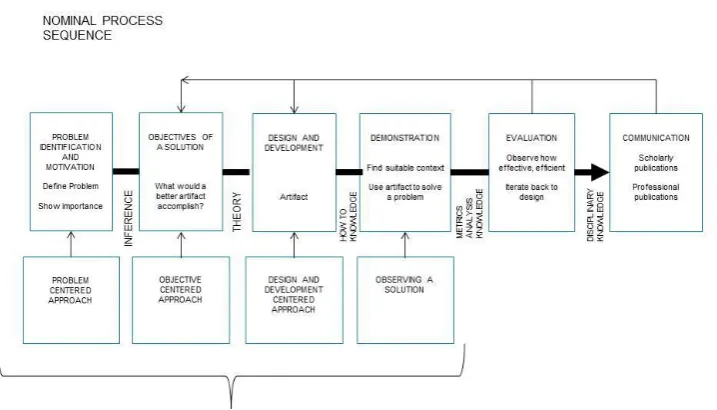
process elements Peffers et al developed the DSRP that consists of six activities
as shown in Figure 1.
Figure 1 Design Science Research Process (DSRP) model after Peffers et al (2006)
7
Brief descriptions of the activities in the DSRP are outlined below:
Activity 1
The first of the activities, ‘Problem Identification and Motivation’,
involves establishing the problem to be addressed and justifying the
research based on the perceived benefits of the resulting artefact.
Activity 2
This involves creation of the ‘Objectives of a Solution’ and requires the
researcher to define the objectives which will be based on the problem to
be solved.
Activity 3
The activity ‘Design and Development’ involves the creation of the
artefact.
Activity 4
For the ‘Demonstration’ activity the artefact is used in some appropriate
environment to solve the stated problem.
Activity 5
In the ‘Evaluation’ activity the performance of the artefact is reviewed
with reference to the stated objective(s) from activity 2. It may be the
case that at this stage the researcher considers that the artefact requires
further design and development and therefore resorts to activity 3 as part
of an iterative process.
Activity 6
The final activity is ‘Communication’ in which the researcher puts
forward their research to add to the body of knowledge in their field.
proposed by both Archer (1984) and Hevner et al (2004), in order to
publicise the problem, its significance and the resulting artefact. This
communication should be addressed to practicing professionals,
academics and other relevant parties.
Peffers et al (2006) identify several points in relation to the activities that
comprise the DSRP at which a researcher may start their research process
(Figure 1). The entry point for this research is now discussed.
1.6.3
Applying the methodology to the research problem
This research has as its focus the problem that there is currently no
generic process model for the digital forensic acquisition process. The research is
therefore based on a ‘problem centred approach’ and as such the entry point in
the DSRP is at the first activity.
The following sections describe how the chosen methodology will be
followed in the course of this research. In addition, as the DSRP does not include
the low-level detail of how to carry out the activities within the individual stages;
this section will also describe the process that will be followed with reference to
the appropriate methodologies.
DSRP Activity 1 - Problem Identification and Motivation
The problem that this thesis addresses is:
There is no formal generic model for the acquisition of digital data that
encompasses the activities of practitioners working in the different
Checkland and Poulter (2006) consider a real-world problematic situation
that requires some form of intervention in order to improve it. This intervention
requires the identification and analysis of a given problem situation by a
researcher to develop a deep understanding of the problem area in order that an
appropriate solution can be identified (Rhalibi, England, & Hanneghan, 2005). A
deep knowledge of the problem area for this research will be satisfied through an
extensive review of the associated literature with respect to relevant process
models added to the thesis author’s own practitioner experience in the domain of
computer forensics.
DSRP Activity 2 - Objectives of a Solution
The objective of this research is to develop a formal model of the process
for the forensic acquisition of digital data that is generic in that it can be
employed by digital forensic practitioners in the fields of commerce, law
enforcement and incident response.
DSRP Activity 3 - Design and Development
The contributions from previous researchers in the literature review,
personal experience and interactions with other digital forensic practitioners will
be used to create the new model. For the design and development stage the
top-level approach taken will be to:
1. Identify criteria against which existing models will be assessed
A review of the comments from other researchers on existing models that
are relevant to this research will be used to formulate criteria for the
overall assessment of the models or to identify existing criteria that may
In addition to the identified assessment criteria the models will also be
considered in the light of the Daubert tests (Supreme Court of the United
States, 1993) as described on page 2. The two methods of assessment
will be considered for relevance following on from the argument
presented in 1.1 above in which the appropriateness of the Daubert test
was brought into question with regard to assisting a court of law to assess
the scientific merit of the process of digital data acquisition.
2. Evaluate existing models against criteria
Each existing model will be reviewed to determine which, if any, of the
identified assessment criteria have been met by that model. For each
model the results of the comparison will be stated and then the overall
results summarised.
3. Identify common requirements across different environments
The environments for this research are commerce, incident response and
law enforcement. Those models most closely meeting the assessment
criteria will be considered for their possible contribution to the ADAM.
A set of model attributes will be constructed to obtain both the core
elements that are common across the three areas of digital forensic
practice that form the focus of this research as well as any innovative
suggestions made by individual researchers that might enhance the
ADAM.
4. Propose a new model incorporating the requirements of the
different environments
The contributions of previous researchers through their process models
attention to ‘domain-specific’ attributes (i.e. those associated specifically
with either the commerce, incident response or law enforcement
environments) to ensure that they are accommodated. Attention will also
be paid to criticisms of previous models to gain insight into potential
design or implementation pitfalls whilst ensuring that the model remains
‘forensically sound’.
DSRP Activity 4 - Demonstration
The purpose of the model is to describe the data acquisition activities of
digital forensic practitioners and therefore the ‘appropriate environment’ for the
demonstration activity required by the DSRP will be addressed by applying the
ADAM within a commercial computer forensic service provider. The aim of the
Demonstration activity (covered in Chapter 5) will be to determine how well the
model compares with a sample of previous cases based on documentation
produced contemporaneously. Given the confidential nature of the type of
documentation being examined and its restricted access the thesis author will
take advantage of his position within a service provider of digital forensic
services by undertaking the Demonstration activity in-house. This also has the
advantage that any obvious shortcomings in the ADAM can be addressed
without impinging on the time of external reviewers. As this activity only
constitutes a pilot trial the fact that it is to be performed within the thesis author’s
own environment will not affect the independent evaluation of the ADAM that
occurs in the following activity.
DSRP Activity 5 – Evaluation
Cleven et al (2009) state that, in order to realise utility when developing
fundamental requirements which are ‘relevance’ and ‘rigour’. Relevance requires
that the artefact addresses a real business need whilst rigour requires the
researcher to appropriately apply the existing body of knowledge.
The evaluation activity will be conducted by two independent panels of
external reviewers who between them will be able to address the relevance
aspect of the development of the ADAM. With regard to the Cleven et al ‘rigour’
requirement the issue of enhancing the credibility of this research through
triangulation of data (Creswell, 2005) has been balanced with the practical
aspects of obtaining quality feedback through in-depth reviews by authoritative
reviewers. Bruce (2007) points out that the trustworthiness of the reporting is a
more significant factor for credibility than the number of ‘data events’ and so,
despite the relatively small number of reviewers planned to assist with this
research, they are all authorities within the field of digital forensics whose
feedback should be both insightful and reliable.
DSRP Activity 6 – Communication
As the research is presented in the form of a thesis, the Communication
activity cannot be completed by the time of its submission. However, a
submission detailing the potential for ADAM to be deployed in a ‘cloud’
environment has been accepted for publication and will appear in a refereed book
chapter to be published in December 2012 8. The communication aspect of the
DSRP will also be covered with respect to academic knowledge through direct
communications with academic leaders in this field (also as part of the
8
Evaluation process) and publications in refereed journals together with the
publication of this thesis within the Murdoch University Research Repository9.
With respect to communicating with practitioners, this will be
accomplished through the involvement of the High Technology Crime
Investigators Association and by introducing the ADAM as part of a
postgraduate course in the Centre for Forensic Science at the University of
Western Australia (course ref. FNSC8617 – Forensics and Information
Technology).
1.7
Outline of the thesis
Chapter 1 (Introduction to the research) provides a brief summary of the
digital forensic environment and highlights the importance of digital evidence
acquisition. The challenges faced when presenting digital evidence in court are
reviewed and the contribution this thesis intends to make to the field stated,
including the methodology that will be employed and the limitations of this
research.
Chapter 2 (Literature review) will provide a general review of the field of
digital evidence followed by detailed review of previous process models
involving the forensic acquisition of digital data.
Chapter 3 (Requirements) will introduce the Assessment Criteria and
cover the process for identifying the requirements for the new model by
evaluating each of the models from the literature review against the Assessment
Criteria. The essential components of the new model will be identified.
9
Chapter 4 (Design and development) will describe the design activity for
the ADAM together with the rationale behind the requirements for each of the
model’s stages.
Chapter 5 (Demonstration) will cover an appraisal of the ADAM through
the Demonstration activity that involves reviewing the contemporaneous
documentation from three previous in-house investigations and comparing the
activities against the ADAM. This chapter will also include a walkthrough of
the model using four scenarios. Based on the results of the Demonstration
process, amendments to the ADAM will be identified in preparation for its
submission to the external reviewers consisting of a Panel of Experts and a Panel
of Practitioners.
Chapter 6 (Evaluation) will describe the composition of the Expert and
Practitioner Panels, the tasks they were set and the results of their feedback
including detailed changes to the ADAM.
Chapter 7 (Conclusion) will discuss the limitations of this research
together with the potential future research opportunities. The research will be
summarised in relation to the research objective and its contribution to the field
of digital forensics stated. Finally, the forums in which this research has been, or
will be, communicated will be identified.
1.8
Summary
In this chapter the justification for this research has been set out and
background information in relation to the research problem and the generic
environment for digital forensics has been provided. The research problem has
Science research methodology has been covered and the process of applying the
selected methodology to the research question based on the Design Science
Research Process of Peffers, Tuunanen, Gengler, Rossi, Hui, Virtanen and
Chapter 2: Literature review
2.1
Introduction
In relation to the DSRP used for this research this chapter will cover the
‘knowledge of the state of the problem’ and the ‘current solutions’. This chapter
first presents a literature review on the field of digital evidence. This provides
the necessary background for the review of previous process models involving
the forensic acquisition of digital data.
The review of previous models was undertaken using online data
resources accessed via the Murdoch University library such as ScienceDirect and
the ACM Digital Library. Online search engines were also used to identify
conference papers, personal websites and university repositories. The following
free-text search terms were used in various combinations and forms: digital,
computer, forensics, process, models, cyber, acquisition, imaging, activities,
capture, standards, guidelines, incident response, crime and evidence.
Several papers provided summaries of relevant process models and these
were cross-checked to identify any missing models or references. The review
suggested three central themes which provide the framework for this chapter.
These themes are:
The use of ‘ad hoc’ design elements
Adopting a ‘process flow’ approach
2.2
Digital evidence
Prior to the existence of digital data storage devices the Best Evidence
Rule (in use since the 18th century) meant that the original writing, recording or
photograph needed to be produced in court unless these had been destroyed or
were unavailable in which case a certified copy or duplicate was admissible
(Steel, 2006). This Common Law rule of ‘best evidence’ had been applied in
many jurisdictions, including Australia, but over the years there have been
various challenges, particularly with respect to differences between hard copy
(paper-based) and soft copy (digital data based) records (Argy, 2006). Some
examples of these differences are:
There may be differences between hard copy and soft
copy versions of a document such that some information
associated with the document may only be visible during
the examination of the digital version, e.g. comments and
alterations
Hard copy documents need no special tools and can be
viewed and read by the naked eye, whereas soft copy
documents require the appropriate hardware and software
Soft copy documents can easily be altered
Soft copy documents can be easily copied and
In addition, unlike a paper document, the act of viewing a digital
document or record by using a computer and a software application or other
facility can cause changes to be made to the original data contained on the digital
storage device, i.e. the original evidence is no longer in the form it was in when
it was obtained. The requirement to produce original documents was abandoned
in some states through the introduction in Australia of the Evidence Act 1995
(Cth) (Austl.) that applies to the Federal Court, New South Wales, Australian
Capital Territory and Tasmanian proceedings and is in the process of being
adopted by other Australian jurisdictions as the Uniform Evidence Acts. Section
51 of the Uniform Evidence Acts now allows for the copy of a document to have
the same evidentiary status as the original.
The Uniform Evidence Acts defines a document as any record of
information and includes:
1. Anything on which there is writing;
2. Anything on which there are marks, figures, symbols or
perforations having a meaning for persons qualified to interpret
them;
3. Anything from which sounds, images or writings can be reproduced
with or without the aid of anything else; or
4. A map, plan, drawing or photograph.
The wording of the Uniform Evidence Acts also means that a digital
storage device is itself a document and in relation to computer records the
evidence derived from computer records will be admissible (although subject to
certain conditions of reliability). Whilst the remaining jurisdictions do not
provide specific provisions, each of them recognise a copy of a computer record
(Argy, 2006).
The “conditions of reliability” are generally the same for most
jurisdictions and Steel (2006, p.26) states that electronic copies of data are
admissible provided that:
1. They were from the indicated source
2. They were acquired using proven tools and techniques
3. They have not been altered since the time of acquisition.
The use of “proven tools and techniques” is consistent with the Daubert
test mentioned in 1.1. In relation to Steel’s “conditions of reliability” a process
methodology that ensures that comprehensive notes are maintained from the start
of the acquisition process will aid in addressing condition (1) by confirming the
source of the data; it will aid in addressing the need to show the use of “proven
tools and technique” required in condition (2) by recording which tools and
techniques were adopted (assuming the digital forensic practitioner has made
appropriate choices in this regard), and it will also assist in meeting condition (3)
by showing that the data has not been altered since it was acquired through the
A further aspect of reliability in relation to the activities of digital
forensic practitioners who are handling digital evidence is the concept of
“forensically sound tasks” as identified by Rogers (2006) who states that they are
derived from properties of digital forensics and comprise of Authenticity, Chain
of Custody, Integrity, Minimization and Reproducibility. Rogers cites
McKemmish (1999) and Mocas (2004) as sources for these properties.
2.3
Standards and Guidelines in data acquisition
There are significant differences between the activities associated with
law enforcement agencies and those practicing digital forensics in another
environment. Where there does seem to be a large degree of consistency is in
acceptance of the basic principles associated with the handling of digital devices,
although there are still many issues surrounding the precise implementation of
these principles in the different environments. Noblett et al (2000) suggest a
‘Three-Level Hierarchical Model for Developing Guidelines for Computer
Forensic Evidence’ on the basis that despite short-term changes within the
environment in which digital forensic practitioners work there should be a
consistent long-term standardised approach to their activities. In order to achieve
this, the three stages of the Noblett et al model include a limited number of
overarching principles which are then reflected in policies/practices which then
lead to specific procedures and techniques. This hierarchy moves from industry
best practice principles through to organisational polices for ensuring quality and
efficiency and culminates in those activities that are likely to be introduced or
software tool or the release of a different type of storage device. Common areas
for identifying the details of best practice are published standards and guidelines.
Standards Australia is the Australian non-government body given
responsibility by the Commonwealth Government to meet Australia's need for
“contemporary, internationally aligned Standards and related services”
(Standards Australia, 2012a). Standards Australia provides the following
wide-ranging definition for a Standard:
Standards are published documents setting out specifications and
procedures designed to ensure products, services and systems are safe,
reliable and consistently perform the way they were intended to. They
establish a common language which defines quality and safety criteria
(Standards Australia, 2012b).
The following sections summarise the various references and guides that
are associated with digital data and legal processes. The first two references are
described as Standards with the remainder being ‘guides’ or ‘guidelines’.
2.3.1
International Organization for Standardization (ISO)
The main international body that is relevant to standards within the field
of digital forensics is the International Organization for Standardization10 which
is a non-government organisation and is an international standard-setting body
that is composed of representatives from 164 countries11, one of which is
10
http://www.iso.org/iso/home htm 11
Standards Australia12. ISO is based in Geneva, Switzerland and although it has
no government-enforced powers the standards that it creates are often adopted as
law by its member countries. In addition to the standards that it sets, ISO also
publishes technical reports, guides and other technical literature, normally based
on the output from special committees that are established for a particular
purpose. One of these committees, JTC1 (the only joint committee of ISO), is the
specialist standards-setting organisation for electrical, electronic and related
technologies. At a meeting held in Kyoto in April 2008 a sub-committee of JTC1
(JTC1/SC 27 – IT Security Techniques) proposed a Study in the area of
Evidence Acquisition Procedure for Digital Forensics13. The ongoing
contribution of the Australian Standards Working Group, of which the author of
this thesis is a member, is currently being coordinated by Ajoy Gosh who has
authored previous standards and guidelines in this area (Gosh, 2004a, 2004b)
with input from law enforcement, education and commerce.
2.3.2
British Standards Institute (BSI)
The British Standards Institute has produced a standard, BS 10008,
whose title, ‘Evidential weight and legal admissibility of electronic information –
Specification’, suggests that it may be related to the acquisition of digital
evidence. However, the standard relates to the production of electronic
documents that may be required as evidence of business transactions and
provides advice for practices and procedures involving information management
systems.
12
http://www.standards.org.au/ 13
In contrast to the limited number of Standards associated with the field of
digital forensics there are several guidelines with each having a particular focus
area such as law enforcement, electronic discovery, commercial digital forensics
and incident response. The main references encountered during the literature
review are now covered in more detail.
2.3.3
Association of Chief Police Officers (ACPO) Guide
The UK National Hi-Tech Crime Unit produces (on behalf of the
Association of Chief Police Officers) its Good Practice Guide for Computer
Based Electronic Evidence (Association of Chief Police Officers, 2003) which
contains definitions of the four Principles:
Principle 1: No action taken by law enforcement agencies or their agents
should change data held on a computer or storage media which may
subsequently be relied upon in court.
Principle 2: In exceptional circumstances, where a person finds it
necessary to access original data held on a computer or on storage media,
that person must be competent to do so and be able to give evidence
explaining the relevance and the implications of their actions.
Principle 3: An audit trail or other record of all processes applied to
computer based electronic evidence should be created and preserved. An
independent third party should be able to examine those processes and
achieve the same result.
Principle 4: The person in charge of the investigation (the case officer)
has overall responsibility for ensuring that the law and these principles
Fundamental to the concept of work undertaken in a forensic
environment is the ability to use any material or information discovered in a
court of law. As quoted above, Principles 1 and 2 require that, if possible, the
original digital data is not altered by any activities of the investigator or, if data
has been altered, the person responsible is able to explain what was altered and
the implications of this on the evidence being presented.
2.3.4
International Organization on Computer Evidence (IOCE)
In general terms the ACPO rules are mirrored by the International
Organization on Computer Evidence in its draft guidelines (I.O.C.E, 2002)
which themselves are based on the ISO 17025 Standard14. The IOCEs purpose is
stated as being a forum with an international focus in which law enforcement
agencies can exchange information in relation to computer forensic issues. The
IOCE’s guidelines can be summarised as:
The general rules of evidence should be applied to all digital evidence
Upon seizing digital evidence, actions taken should not change that
evidence
When it is necessary for a person to access original digital evidence
that person should be suitably trained for the purpose
All activity relating to the seizure, access, storage or transfer of
digital evidence must be fully documented, preserved and available
for review
14
An individual is responsible for all actions taken with respect to
digital evidence whilst the digital evidence is in their possession.
2.3.5
McKemmish’s rules
McKemmish (1999) introduces four rules that must be followed by
digital forensic practitioners during the course of their work but although they
provide the framework under which the digital forensic practitioner should be
working they do not provide detailed guidance (although McKemmish does
provide justification and examples of their application in context).
McKemmish’s rules are:
First Rule: This involves the handling of evidence and requires that
the original source of the data should be handled as little as possible
and only to the extent needed in order to obtain an authenticated
copy.
Second Rule: While accommodating situations in which the
practitioner has no choice but to undertake some activity that alters
the data, such as entering a password to access a computer, the
Second Rule requires the practitioner to account for changes they
may make to any of the data which comes under their control.
Identifying and recording these changes will require the practitioner
to have a deep technical knowledge of the environment such that they
are aware of the implications of their actions.
Third Rule: This states the need to comply with the rules of evidence
question. This involves adhering to the other rules as well as
maintaining a chain of custody and other documentation in order that
any challenges relating to admissibility may be defended.
Fourth Rule: This states that the digital forensic practitioner should
not proceed with activities in a situation where they have exceeded
their knowledge of the environment or situation. Given the
ever-changing environment this requires practitioners to keep their training
program updated.
2.3.6
Gosh’s guidelines
The focus of the document ‘Guidelines for the Management of IT
Records’ (Gosh, 2004b) is to assist organisations to manage the data stored on
their systems in such a way that it may be readily accessed and provided in an
admissible form in the event that it may be relevant in some form of litigation.
Although digital forensic methods are referenced the focus of this document is
with Electronic Discovery rather than third-party investigations and does not
take into account the wider needs of digital forensic practitioners.
2.3.7
Brezinski & Killalea’s guidelines
The document ‘Guidelines for Evidence Collection and
Archiving’(Brezinski & Killalea, 2002) is a Network Working Group memo that
is focussed on incident response. It does however provide advice on a range of
digital forensic activities in the form of actions to be carried out under various
2.4
The First Digital Forensic Research Workshop
The First Digital Forensic Research Workshop (DFRWS) took place in
2001 and included a session titled “A Framework for Digital Forensic Science”
whose stated purpose was to “Build a taxonomy to guide and direct research”
and “Identify the areas or categories that define the ‘universe’ of Digital
Forensic Science” (Palmer, 2001, p. 21). Palmer suggested that digital forensic
practitioners, whose activities are investigative in nature, would benefit from a
properly categorized process.
The first attempt at the ‘properly categorized process’ appeared in the
DFRWS’s final paper (Palmer, 2001) and consisted of elements that had been
included on the basis that they were derived from processes used in digital
forensic analysis, although with the recognition that not all of them may come
under the heading of ‘forensic’. Getting agreement on exactly what constitutes
the ‘forensic process’ seems to have been problematic with the final summary
being produced that describes the included tasks as being “…subject to the least
confusion” amongst practitioners (Palmer, 2001, p. 23).
The DFRWS produced a summary of the ‘major categories’ for the
forensic process and ‘candidate techniques or methods’ based on what
“…appears to be used in digital forensic analysis” (Palmer, 2001, p. 17),
although the term ‘preservation’ appears four times under different categories.
The DFRWS name is now used to describe the US non-profit organisation that