PhD Dissertation
International Doctorate School in Information and Communication Technologies
DISI - University of Trento
Distributed Contact and Identity Management
Alethia Graciela Hume LLamosas
Advisor:
Prof. Fausto Giunchiglia
Universit`a degli Studi di Trento
Co-Advisor:
Prof. Luca Cernuzzi
Universidad Cat´olica “Nuestra Se˜nora de la Asunci´on
Abstract
Contact management is a twofold problem involving a local and global level where the separation between them is rather fuzzy. Locally, users need to deal with contact management, which refers to a local need to store, organize, maintain up to date, and find information that will allow them contacting or reaching other people, organizations, etc. Globally, users deal with identity management that refers to peers having multiple identities (i.e., profiles) and the need of staying in control of them. In other words, they should be able to manage what information is shared and with whom.
We believe many existing applications try to deal with this problem looking only at the data level and without analyzing the underlying complexity. Our approach focus on the complex social relations and interactions between users, identifying three main subproblem: (i) management of identity, (ii) search, and (iii) privacy.
The solution we propose concentrates on the models that are needed to address these problems. In particular, we propose a Distributed Contact Management System (DCM System) that:
• Models and represents the knowledge of peers about physical or abstract objects through the notion of entities that can be of different types (e.g., locations, people, events, facilities, organizations, etc.) and are described by a set of attributes.
• By representing contacts as entities, allows peers to locally organize their contacts taking into consideration the semantics of the contact’s characteristics.
• By describing peers as entities allows them to manage their different identities in the network, by sharing different views of themselves (showing possibly different in-formation) with different people.
The contributions of this thesis are, (i) the definition of a reference architecture that allows dealing with the diversity in relation with the partial view that peers have of the world, (ii) an approach to search entities based on identifiers, (iii) an approach to search entities based on descriptions, and (iv) the definition of the DCM system that instantiates the previously mentioned approaches and architecture to address concrete usage scenarios.
Acknowledgements
First I would like to express my special appreciation and thanks to my co-advisor Professor Dr. Luca Cernuzzi, this would not have been possible without your encourage-ment. I would also like to thank my advisor Professor Dr. Fausto Giunchiglia, you have been a great mentor for me. I would like to thank you for your trust, for encouraging my research and for allowing me to grow as a research scientist. Your advice on both research as well as on my career have been priceless. I would especially like to thank my colleagues from the KnowDive group. All of you have been there to support me with good advice and interesting discussions. You have contributed significantly to my personal and professional growth.
A thought to all my friends here in Trento who supported me in writing, and pushed me to strive towards my goal. Thanks also to my friends from Paraguay who, from the distance, were always present and knew how to give me the extra strength that I needed. A special thanks to my family for all their love and encouragement. Words cannot express how grateful I am to my two pillars, my mother and my husband. To my mom, thank you for all of the sacrifices that you’ve made on my behalf, your prayer for me was what sustained me thus far. To my beloved husband Eduardo, whose faithful support during the final stage has been of key importance. You spent sleepless nights and you were always my support in the most difficult moments.
Alethia Hume University of Trento April 2014
The work compiled in this thesis has been partially supported by the European Commu-nity’s Seventh Framework Program (FP7/2007-2013) under grant agreement n. 600854 Smart Society: hybrid and diversity-aware collective adaptive systems: where people meet machines to build smarter societies http: // www. smart-society-project. eu/
Contents
I General Notions 1
1 Introduction 3
1.1 The context . . . 3
1.2 The problem . . . 4
1.3 The solution . . . 5
1.4 Structure of the thesis . . . 6
2 The problem 9 2.1 Problem setting scenarios . . . 9
2.2 Discussion . . . 11
3 Ground knowledge 15 3.1 Fundamental notions . . . 15
3.2 Knowledge schema . . . 17
3.3 Instantiation of knowledge . . . 18
3.3.1 Entity identifiers . . . 19
3.3.2 Entity instances . . . 20
3.4 Contacts classification . . . 21
3.4.1 Classification of subjects . . . 22
3.4.2 Classification of objects . . . 24
3.5 Summary . . . 25
II The Proposed Approaches and System 27 4 Reference architecture 29 4.1 Requirements . . . 30
4.2 High-level design . . . 32
4.3 System logical view . . . 34
4.3.1 Contact management portal . . . 35
4.3.2 Contact management application . . . 37
4.3.3 Contact management network . . . 38
4.4 System dynamic view . . . 39
4.5 Summary . . . 44
5 A name-based approach to search in the DCM system 45 5.1 Motivating example . . . 47
5.2 A name-based overlay for linking directories . . . 48
5.2.1 Formalization of the model elements . . . 48
5.2.2 Building the name-based overlay . . . 50
5.3 Name matching . . . 52
5.4 Algorithms . . . 53
5.5 Summary . . . 56
6 A description-based approach to search in the DCM system 57 6.1 Motivating example . . . 59
6.2 A semantic overlay for linking directories . . . 61
6.3 Semantic link discovery . . . 65
6.4 Algorithms . . . 66
6.4.1 Identifying semantically relevant peers . . . 67
6.4.2 Searching inside a relevant peer . . . 69
6.4.3 Aggregation of search results . . . 70
6.5 Summary . . . 70
7 The distributed contact management (DCM) system 73 7.1 Presentation Cards . . . 74
7.2 DCM Users . . . 77
7.3 Usage scenarios . . . 78
7.3.1 Initialization Scenarios . . . 78
7.3.2 Sharing Scenarios . . . 85
7.3.3 Search Scenarios . . . 91
7.4 Summary . . . 97
III Evaluation 99 8 Experimental evaluation of name-based search 101 8.1 Implementation . . . 101
8.2 Evaluation . . . 105
8.3 Summary . . . 107
9 Experimental evaluation of description-based search 109 9.1 Implementation . . . 109
9.2 Evaluation . . . 110
9.2.1 Data-set generation . . . 110
9.2.2 Evaluation of results . . . 112
9.3 Summary . . . 114
IV Conclusions 117 10 Related work 119 10.1 Contact and Identity Management . . . 119
10.2 Distributed entity directory . . . 120
10.3 Semantic flooding . . . 122
11 Conclusions and future work 129 11.1 The context . . . 129
11.2 The contributions . . . 130
11.3 The evaluations . . . 133
11.4 Future work . . . 134
Bibliography 137
List of Tables
8.1 Implementations of Kadelmlia protocol. . . 102 8.2 Average query time . . . 106
10.1 Search Methods in P2P networks. . . 125
List of Figures
3.1 An example of an ET to describe entities of type “Person” and two in-stances showing the different descriptions of the same entity from the points
of view of peers P1 and P2 respectively. . . 22
3.2 An example of a classification of contacts as subjects. . . 23
3.3 An example of a classification of contacts as objects. . . 24
4.1 General system view . . . 32
4.2 Third party platforms . . . 33
4.3 Logical Architecture . . . 35
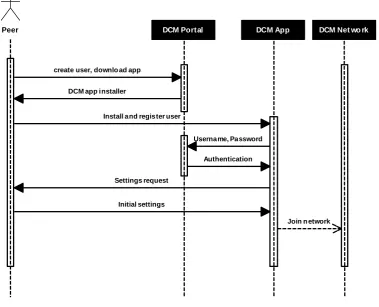
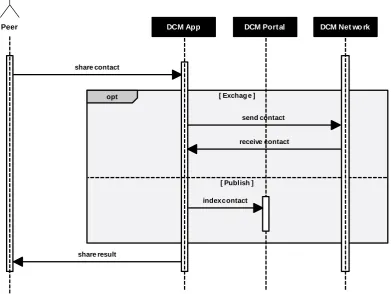
4.4 Sequence diagram of the initialization process of a new peer in the system. 40 4.5 Sequence diagram of a peer sharing its contact information. . . 41
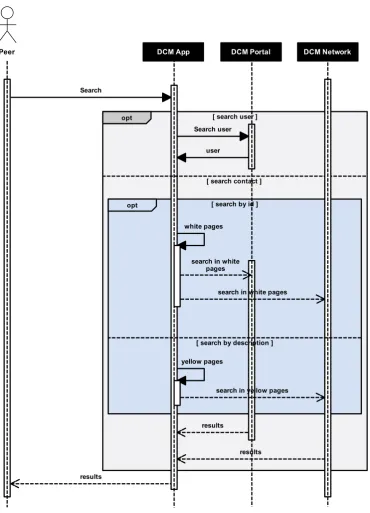
4.6 Sequence diagram of a peer searching the system. . . 43
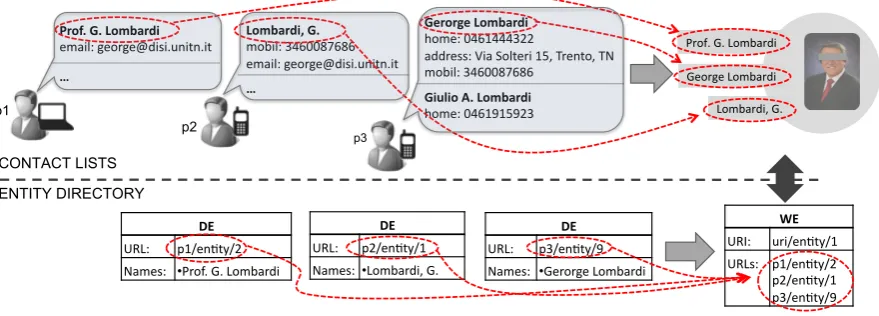
5.1 Example of Contact Lists Related by Identifiers . . . 47
6.1 DCM Network of User-Generated Classifications . . . 58
6.2 Example of Contacts with Similar Characteristics . . . 60
6.3 Classification . . . 62
6.4 A Semantic Overlay Network . . . 64
7.1 Example of Person Presentation Cards . . . 76
8.1 Query time of different networks . . . 106
9.1 Topics Popularity Distribution . . . 112
9.2 Evaluation Results: Random queries . . . 113
9.3 Evaluation Results: Popular vs. Unpopular Queries . . . 114
Part I
Chapter 1
Introduction
1.1
The context
In the general context of this thesis, we see Internet as a network of peers (a P2P network) organizing their content in directories (e.g., contact lists, document directories and event directories, like calendars or agendas, etc.), which store information about a number of “things” that are of their interest. We refer to these things that exist in the real world asentities. They can be of different types (e.g., locations, people, events, facilities, organizations, etc.) and are described by a set of attributes. In particular, we focus the attention in contact information, hence directories of contacts or contact lists. Within this context, a contact is seen as a profile of an entity where the type of entity may be constrained to certain types (i.e., corresponding to entities that can be contacted).
Different profiles of an entity can show different aspects of such entity. When talking about directories of contact, this can be reflected in different contact information. For example, a professor at the University of Trento may have a profile as a professor including his university email address and university home page. Another profile of the same person may include his mobile phone number, home address, and personal email address. As we can see, the former shows a professional (or work) aspect while the latter shows a more social aspect of the same person.
corre-4 Introduction
sponding to different peers. On the other hand, all his students will have the same infor-mation (i.e., the same profile as a professor), and this also means that the same profile can be stores in different peers’ directory. Further, we see the root of the difference be-tween peers storing one profile or the other in the ties or relations (e.g., student-professor, colleagues, family ties, etc.) between each peer and the entity being described.
This thesis looks at many situations in everyday activities requiring managing such profiles (i.e., contacts), including how they are created, shared, updated, searched and organized in contact lists (also called contact directories).
1.2
The problem
Within the context described in Section 1.1, the problem this thesis address is twofold, (i) management of contacts stored in peer’s contact list, and (ii) management of identities or profiles shared by peers in the network.
• The contact management refers to a local dimension of peers that need to store, organize, maintain up to date, and find information that will allow them contacting or reaching other people, organizations, etc.
• The identity management refers to a global dimension of peers having multiple identities (i.e., profiles) and the need of staying in control of them. In other words, they should be able to manage what information is shared and with whom.
However, both part of the problem can not be separated because a profile shared by a peer needs to be managed (i.e., stored, organized) as a contact in the contact list of another peer. Also, the need of finding contact information about someone can be seen as a sharing request from the point of view of the owner of the information and so on. This evidence the inherently distributed nature of the problem.
The solution 5
Taking into consideration these different aspects we believe that there is a complexity associated to theDistributed Contact and Identity Managementproblem, which re-quires the definition of appropriate models addressing the underlying subproblems rather than looking only the data level. We identify the following subproblems:
1. Management of identity. On one hand, the identity of contacts has to be managed in order to avoid duplicate contacts in local directories of peers. On the other hand, the identity of peers has to be managed in order to allow them to stay in control of their contact information globally (i.e., what it is shared and with whom).
2. Search. In the context described above, peers may have different information needs. On one hand, the search problem refers to the need of taking into consideration the different nature of possible search queries (e.g., search a specific contact or search contacts with certain characteristics). On the other hand, it refers to the need of taking into consideration different scopes for the search (e.g., search locally, search among friends, search globally in the network, etc.).
3. Privacy. The problem of privacy refers to the need of taking into consideration the privacy concerns that may appear as a consequence of manipulating contacts which can include personal sensitive information. In this sense, peers should be able to define what information can be shared and with whom.
1.3
The solution
In this PhD Thesis we propose aDistributed Contact Management System (DCM System)with the following features:
1. It takes into account that different peers can describe physical or abstract object (called entities) from different points of view showing possibly different information about them.
2. It allows peers to locally organize their contacts in a meaningful manner, taking into consideration the semantics of the contact’s characteristics.
3. It allows peers to manage their different identities in the network by defining and sharing different contact profiles of themselves with different people.
6 Introduction
5. It allows peers to exploit links connecting different peers directories to search infor-mation about entities (possibly contacts) based on identifiers.
6. It also allows peers to exploit links connecting different peers directories to search contacts based on descriptions.
7. It takes into account the importance of privacy with regard to contact information and proposes a privacy-friendly design that can facilitate the adoption of privacy enhancing technologies.
In short, the contributions of the thesis are:
A reference Architecture that takes into consideration the different actors interacting with the system, identifies different system components and define how they interact with each other. This architecture allows dealing with the diversity in relation with the partial view that peers have of the world, by accommodating multiple representations (from the perspectives of different peers) for the same real world entity. This includes also the case of peers describing other peers from different perspectives as part of their contact directories.
An approach to search based on Identifiers that proposes a model to build the con-necting links between local directories of peers based on different types of identifiers that are used to refer to the entities that are stored in those directories.
An approach to search based on Descriptions that proposes a model to build se-mantic links in order to connect local directories of peers that store information about entities with similar or related characteristics.
The DCM System that has two roles: (i) on one hand, it is a case study that evaluates the three above-mentioned contributions by integrating them into a concrete system that shows the added value of the three elements as a whole; and (ii) on the other hand, the definition of the system is in itself a contribution of this thesis, including the definition of models that are application dependent (i.e., custom) and concrete usage scenarios.
1.4
Structure of the thesis
The rest of the thesis is organized as follows:
Structure of the thesis 7
in everyday activities. It also identifies and discusses a set of subproblems that are motivated by these situations.
• The Chapter 3 presents basic notions and models that are adopter in this thesis for the representation and organization of information.
• The Chapter 4 presents the reference architecture proposed by this thesis for the Distributed Contact Management System (DCM System). This includes the identi-fication of requirements for the architecture; the discussion of the high-level system design identifying also actors interacting with it; the introduction of the system log-ical view discussing the different system components; and the discussion of system component interactions as a consequence of main system functionalities.
• The Chapter 5presents an approach to build a distributed directory that can link data from peers directories based on their identifiers in order to provide search ser-vices analogous to those of telephone book white pages. This includes the definition of models for the directory and the algorithms for the search.
• The Chapter 6presents an approach to build a semantic overlay that can link data from peers directories based on their characteristics in order to provide search ser-vices analogous to those of telephone book yellow pages. This includes the definition of models for the semantic overlay as well as the algorithms for the search.
• The Chapter 7 presents a the DCM System, introducing more application specific models and an extensive description of different usage scenarios, which include the actions performed by the system in order to support them.
• TheChapter 8presents details of a preliminary evaluation of the approach proposed in Chapter 5.
• TheChapter 9presents details of a preliminary evaluation of the approach proposed in Chapter 6.
• The Chapter 10presents the related work in the different related areas.
Chapter 2
The problem
The goal of this thesis is to define a distributed infrastructure for managing contacts, which enables peers to manage their knowledge about the contact information of other peers and to easily share their own contact information.
Although the contact management problem is essentially not new and it might look rather simple, we believe that it has not been solved in an efficient manner. Moreover, we consider that there is an underlying complexity that has been overlooked by many existing applications and it is related to the fact that managing contacts is at the core of man-aging/understanding social relations and social interactions. In order to deal with such complexity, the attention has to focus on appropriate models to address the underlying subproblems rather than looking only the data level.
In this chapter, first, we introduce some problem scenarios related to the management of contacts that depict some issues that users usually face. Second, we identify and discuss subproblems that are motivated by these scenarios.
2.1
Problem setting scenarios
10 The problem
Problem setting scenario 1. Andrea is a 40 years old clerk. Recently he moved from mobile to a smartphone. He wishes his contacts in Facebook, Twitter and Skype auto-matically in his agenda. He finds out that it is possible to import such contacts to his smart phone. The problem with this is that instead of having a single coherent contact list, he got an extended list with a lot of contacts that seem to be repeated. Instead he has to switch from a social network to another and manually copy his contacts, or he has to import and then check manually for duplicates in order to merge the information from different accounts.
Problem setting scenario 2. Liza is a PhD student of DISI, recently she moved from IPhone to Android and she bought a recent HTC. For some reason she ignore, she wasn’t able to maintain phone numbers and email addresses in her SIM card, but she still have the email addresses of some people on GMail and some of her contacts are also friends of her on Facebook. At the moment the only solution she has found is to spread on Facebook, Twitter and Skype a message telling friends about this problem and asking them back their phone numbers. She is upset by having to spread this message so widely but this is the easiest way that found to do it. Now she has to memorize again all the information that she is receiving in her contact list. She is also upset because she has to put the addresses, emails and phone numbers manually. Moreover, she recently has made new friends and she has no clue about how to rescue their mobile numbers.
Problem setting scenario 3. Giovanni was a Master student of DISI. At present he has a contract in a local company as programmer. He never changed phone company and always has had the same brand of smartphone (Samsung). Anyways, as years go by, his friends have been messing his contact data, some moved house, some changed mobile phone number, and some abandoned their email for a new one. Just few of them let him know about those switches, therefore he regularly find his contact data as old. He his irritated by this, because he often finds himself sending message to people that never receives them. He is also irritated by having so often to put his hands on his contact data in order to update them when he would have thousand of other things to do.
Discussion 11
some references and start working together for a manuscript, she can’t find his card. She doesn’t know how to get his email or phone number. She saw Carlo speaking with other people she knows, but she does not know who of them (or if any of them) may have a way to reach him.
Problem setting scenario 5. Carlo is a PhD student at the University of Trento. He is very social, he likes sports and he enjoy participating at students activities. Last Friday, he went to a party in the main hall of the students’ residence, San Bartolommeo. At the party he first met Anna, a researcher, they agreed to discuss ideas for working together and he gave her his business card. Right before leaving the party, Carlo met also Peter and his friends. After some minutes chatting with them he learned that they also enjoy playing at soccer as much as he does. In fact, they play almost every week and invited Carlo to join them. Carlo wishes to give them his phone number or personal email so they can contact him for next week’ match. He has his business card, which contains only his work email address and does not contains the information he wishes to share. He then decides to take note of the phone number of one of the guys with whom he agrees to get in touch during the week. Unfortunately, when Carlo tries to contact the guy, he realizes that he has the wrong number. He is upset because he was really looking forward to play soccer and now he has no idea of how to contact those guys.
Problem setting scenario 6. John is a 45 years old father. He started to use a smart-phone a couple of years ago. He is italian and lives with his family in Milan, where John and his wife recently found out that one of their daughter has a very rare skin disease. The doctor that diagnosed her in Milan was very clear with them, he explained that although hi recognized the disease, he was not an expert on it. They are now trying to find a doctor that can treat their daughter. They started by asking their current doctor for references to other doctors. They are also searching information in internet and posting messages on social networks (e.g., Facebook, Twitter) asking if anyone knows an specialist on skin conditions. His next step is to talk to his friends and ask them if they know any expert on the disease (or any dermatologist) but looking at his contact list, he does not know where to start, who of his contacts is more likely to have the information he needs. John wishes to have an easier way to search for the contact of a doctor that can help them. He is upset and worry about his daughter.
2.2
Discussion
12 The problem
setting scenarios presented above show that the management of contact information in-cludes local and global dimensions.
• The Local dimension refers to managing the local contact list of peers. This includes enabling basic operations that allow peers to create, update, delete and search con-tacts. We have to take into consideration that the creation of new contacts can often be the result of importing information from different sources (e.g., Facebook, Gmail, Skype, etc.) and these sources may contain (possibly different) information about the same contact. An example of this situation is what happen to Andrea in problem setting scenario 1. In this sense, avoiding duplicate contacts in the local contact lists of peers is an identity management problem.
On the other hand we also consider the search problem as part of this dimension because it represents a need that is local (for the peer) regardless of the scope of the search (i.e., if the peer wants to search in its local contact list or search in whole network). We can distinguish between two types of search, which are analogous to the white and yellow pages from phone book directories1.
In the first case (i.e., white pages), the peer knows exactly what is the (one) target contact and the search is based on a given identifier. For example, in the problem setting scenario 4, Anna knows exactly who she wants to contact (i.e., Carlo), she knows his name and if a description of him is presented to her she will be able to recognize him. This is also similar to the problem of Liza in problem setting scenario 2. In the second case (i.e., yellow pages), the target of the search is not one particular contact but a set of contacts fulfilling a given set of characteristics. We say that search is based on a given description in this case. An example of this is the problem of John in problem setting scenario 6.
• The Global dimension refers to the awareness of an intrinsic connection between peers that may be storing information about the same contact. Moreover, people often need to share different contact information (e.g., in different contexts or with different people) showing possibly different profiles of themselves. An example of this is the situation of Carlo in problem setting scenario 5, he wishes to show different profiles to Anna and Peter. In the context of contact management, we need to allow peers (such as Carlo) to stay in control of their own contact information, deciding what information is shared and with whom. On one hand, this is related with the peers’ right to privacy and, to data protection as way to guarantee it. On the other hand, the models to manage contacts identity at a global level has to enable the
1
Discussion 13
description of the same contact (i.e., of Carlo) from diverse points of view (i.e., from Anna and Peter).
As this discussion shows, there are many subproblems that can be derived from the analysis of different aspects of the Contact Management problem. In particular, we dis-tinguish the following:
1. Identity management from a local and a global perspective. On one hand, the identity of contacts has to be managed in order to avoid duplicate contacts in local directories of peers. On the other hand, the identity of peers has to be managed in order to allow them to stay in control of their contact information globally (i.e., what it is shared and with whom).
2. Search based on identifiers and descriptions (i.e., similar to white pages and yellow pages). When dealing with management of contacts and in particular with search, peers have different information needs in different scenarios. On one hand, the search problem refers to the need of taking into consideration the different nature of possible search queries (e.g., search a specific contact or search contacts with certain characteristics). On the other hand, it refers to the need of taking into consideration different scopes for the search (e.g., search locally, search among friends, search globally in the network, etc.).
Chapter 3
Ground knowledge
This chapter aims at introducing general notions in order to set the basis (i.e., ground knowledge) for the discussions and approaches that are presented throughout this thesis. Therefore, we define here basic elements that serve as a building blocks for the Distributed Contact Management System (DCM system).
We start by presenting the notions of contact, peer and entity, which are fundamental for the definition of our system. Then, we present the semantic schema we adopt in this thesis for the representation of data. Next, we show how this semantic schema is instantiated into actual data describing peer’s knowledge. Finally, we show how contacts can be classified in hierarchical structures based on characteristics of different nature.
Acknowledgement. Some of the notions and definitions presented in this chapter are the result of previous work developed by members of the Knowdive1 group. In particular,
some of the notions we adopt are based in the definitions introduced in [Pane, 2012] and D1.1 (deliverable 1.1) from SmartSociety2 project.
3.1
Fundamental notions
Three fundamental notions for our system are:
Contacts. When thinking in contact information, people may often think in name, ad-dress, phone numbers and maybe email address. However, with the extensive use of personal devices (e.g., notebooks, smart- phones, PDAs) in combination with many
1
http://disi.unitn.it/~knowdive/ 2
16 Ground knowledge
web-based technologies and services (e.g., social networks, instant messaging appli-cations and others), the notion of contact information becomes more complex. A contact in our system refers to an entity from the real world that is somehow “con-tactable” (i.e., is capable of getting involved in communication activities), could be a person, a facility, an organization, etc. Then, the representation of a contact is seen as a profile describing characteristics that are known of such entity. This may include information about different ways to reach the contact (e.g., phone number, mobile number, skye user, and others), as well as other general characteristics (e.g., name, age, place of birth in the case of people) that can help distinguishing contacts from one another.
Peers. We discussed in Chapter 2 the contact management at a large scale as a problem that is inherently distributed. Therefore, when thinking in users of the DCM system, we see a network of interacting peers. A peer refers to a user of the system that maintains a contact list, is capable of acting, making decisions and participating in communications activities (i.e., is contactable).
Entity. We use the notion of entity to refer to a “thing” that exists in the real world. Entities are defined as abstract or physical objects, can be of different types (e.g., person, location, event, etc.) and are described by attributes (e.g., name, birth date, latitude-longitude, size, duration, etc.), which can be different for different types of entities. Within the system, we formalize the notion of entities and we use it to represent structured information about contacts and peers. In other words, we adopt an entity-centric approach that uses entities as the basic element of knowledge.
We say then that the peer’s contact list contains its knowledge about known entities, including a description of itself as an object (i.e. a person) from the real world. In order to understand the semantics of entities within the context of distributed contact management, we need to take into consideration that:
• Peers represent their own “versions” of entities. As a consequence, different peers may describe different points of view, showing possibly different aspects of the same entity.
• Peers have a partial view of the world. This is a consequence of the fact that different peers may know different subset of entities that exist in the world.
Knowledge schema 17
To reason about contacts and peers, we need to represent entities in such a way that will allow peers to understand each other (i.e., interoperability). For example, a peer should be able to find all the different versions of an entity describing the same contact that are available even if different peers generated them. Another example is the case of a peer sharing its (own) contact with another peer; they need certain level of agreement regarding the structure they use to represent the data.
Achieving interoperability between peers at the data level requires an agreement on the formal models that they will follow for the representation of data (i.e., their knowledge). In other words, in order to make the knowledge comparable, the same format should be followed by different peers in the system. The entity-centric approach adopted in this thesis distinguishes between a schema level that defines this “format” and a knowledge level that defines how to instantiate the schema into actual knowledge. In the following sections, we formally present the elements that are part of these two levels.
3.2
Knowledge schema
The Schema.org3 initiative defines schemas as “A set of types, each associated with a set
of properties and where the types are arranged in a hierarchy”. We adopt an approach that is align with this idea and allows the definition of templates for each type of entity used in the system. These templates serve to establish restrictions on the set of attributes that can be used to describe a given type of entity. The meaning is further specified by mapping single elements from the schema (i.e., types of entities, the names of attributes and their values) to concepts from a knowledge base.
A concept is defined as “An abstract or general idea inferred or derived from specific instances”in WordNet4; and as“An idea, something that is conceived in the human mind”
in Wikipedia5. In general, in the area of knowledge representation, concepts are used to
formalize and represent the meaning of words in a language independent manner.
In what follows, we formalize our notion of entity type and other related notions (i.e., basic schema elements) in a recursive manner.
An Entity Type (ET)is formalized as the tuple
ET =hC,{AD}i where,
• C represents a concept associated to the name of the entity type and which defines the class of entities that are describe by it;
3http://schema.org/ 4
http://wordnet.princeton.edu 5
18 Ground knowledge
• {AD} is a non-empty set of attribute definitions denoting the type of attributes that can be used to describe an entity of the corresponding ET. We assume that a distinction can be made between those mandatory and optional attributes but for the sake of simplicity we avoid going into more details about this in the models.
The notion of Attribute Definition (AD) is aimed to explicitly state constraints regarding how can be describe certain property of an entity. It is formally defined as the tuple
AD =hC, ATi where,
• C is a concept associated to the name of the attribute, which provides a meaning for the property that an instance of the corresponding AD is describing;
• AT is a data type that establishes constraints on the values for the definition of the attribute. We can distinguish among those that are natively supported by the system (e.g., integer, string, float, date, etc.), complex concepts from a knowledge base, and the application defined ET s.
3.3
Instantiation of knowledge
In order to actually represent knowledge about entities from the real world, a schema defined following the models presented in Section 3.2 has to be instantiated. An entity type ET is instantiated to represent a particular description of a real world entity, which we call Digital Entity (DE). In turn, an attribute definition ADis instantiated as part of a DE to represent a property (or characteristic), called Attribute (A) of the entity.
The representation of entities may look rather similar to each other when they describe entities having similar characteristics (e.g., people with similar interests, born in the same city maybe also in the same month, etc.). On the other hand, in the DCM system the peers describe entities from their own point of view and therefore it may also happen that two descriptions (from different peers) that appear to be different actually refer to the same entity. We distinguish an entity from others in the system by mean of identifiers. These identifiers are defined as labels assigned to entities and used as a reference to them (used to “call” them) 6. Moreover, from our point of view, entities can be assigned with
multiple identifiers that serve different purposes.
Let us first discuss the entity identifiers and then we will formally define the entity instances.
6
Instantiation of knowledge 19
3.3.1 Entity identifiers
The identity of an entity encodes its uniqueness within certain context and allows to distinguish it from other entities. It is defined by characteristics of the entity that can be intrinsic (i.e. that belongs by nature) or extrinsic (i.e. acquired from the out-side) [Do Van Thanh, 2007]. Identity is as a fundamental notion when reasoning about entities, it allows position entities (that can be individuals or objects from the real world) and understand their relations with other objects in the environment [Windley, 2005; Camp, 2004].
Following the notion of identity, identifiers are used in order to refer (i.e., iden-tify) a person, an organization or any type of entity within a context. One entity can have, in fact, multiple identifiers that serve for different purpose or in different con-texts. In the DCM system, we can distinguish between identifiers used by humans (called human-understandable identifiers) and identifiers used by computers (called machine-understandable identifiers).
People usually refer to an entity by a name, for example, when talking about the entity. In their minds this name is uniquely mapped to the description they have (their view) of such entity [Pane, 2012]. The context is implicit in the conversation in this case. An entity can be called by multiple names (e.g., the same person being identified by the names: Anne Smith, Anne Elizabeth Smith and Little Annie) and different entities can be referred by (called using) the same name (e.g., Anne Smith and Alice Smith can be also identified by the name A. Smith) as a consequence of being arbitrarily assigned. This does not change their importance as human-understandable identifiers but makes impossible for the machine to dereference names into the entity they represent. Therefore, we need machine-understandable identifiers to allow computers to refer to entities.
On the other hand, a machine-understandable identifier is one that can be uniquely solved by computers. Many standards were proposed in the WWW for digital identifiers, among them the most widely known are URIs7, URLs8 and URNs9 In the DCM system we need to distinguish the different descriptions of the same real world entity (i.e., from local directories of peers) while still maintaining the track about what entity from the real world the peer is describing (i.e., global identification). With the purpose of distinguishing between local and global identifiers, the work of Pane [2012] creates two new identifiers, called SURL and SURI.
A SU RL is defined as a semantic URL that represents a particular description (in local directories) of a real world entity. A SURL is created in local directories for each
7RFC1630 - Universal Resource Identifiers 8
RFC1738 - Uniform Resource Locators
9
20 Ground knowledge
entity being described in it, it is globally unique and can be dereferenced to obtain the full description of the entity. In other words, it encodes the location of a particular description of a real world entity.
A SU RI is defined as a semantic URI that represents a real world entity without attaching it to a particular description. The same SURI is shared by different directories describing the same real world entity, it is also globally unique. A SURI cannot be directly used to retrieve an entity description, because it does not commit to one single description and it rather includes the different points of view from which an entity is described.
Differently from other approaches from the Semantic Web that combine URIs and URLs to identify entities in the Web (e.g., OKKAM, semanticweb.org10, www.w3.org11), the separation between local and global identifiers allow us to split the identification of a real world entity and its description(s). Further, other approaches implicitly impose a description for the real world entity when re-using the identifier, while we (by adopting the local/global identifiers) embrace diversity with regard to the point of views represented in different directories, enabling also the creation of a network of interconnected directories (we discuss in more details this in Chapter 5).
3.3.2 Entity instances
As we described before, knowledge in the system is represented through the instantiation of the models presented in Section 3.2.
A Digitally Entity (DE) instantiates an entity type ET and describe a real world entity from a particular point of view (i.e., the point of view of the directory’s owner). This description represents known characteristics of the entity through a set of attributes. Then, the description is also attached with the different types of identifiers that are used to refer to it (i.e., human-understandable and machine-understandable identifiers). Formally, it is defined as the tuple
DE =hSU RL, SU RI,{N}, ET,{A}i where,
• SU RL is unique identifier of this particular DE;
• SU RI is a unique identifier of the real world entity that the corresponding DE is describing;
• {N} is a set of strings representing names used by the corresponding description
DE to identify a real world entity;
10
http://semanticweb.org/wiki/Uniform_Resource_Identifier 11
Contacts classification 21
• ET is the entity type among those defined for the corresponding system;
• {A}is a non-empty set of attributes describing the characteristics of the entity. An Attribute (A) instantiates an attribute definition AD to represent a particular characteristic of the entity within a DE. Some attributes may have multiple values, its values may be mapped to a meaning in some knowledge base (i.e., semantic values) or can represent a relation to another entity when the value is a reference to another DE (i.e., relational attribute). Formally, it is defined as the tuple
A=hAD,{V}i where,
• AD is an attribute definition among those defined for the corresponding system and denotes constraints on possible values for this attribute;
• {V}is a set of attribute values of the typeAT of the correspondingAD. Note that, if the corresponding AT is an ET, then A is called a relational attribute as it defined relations between two entities. For example, relations like friend-of, colleague-of, mother-son, etc., would be defined as relational attributes.
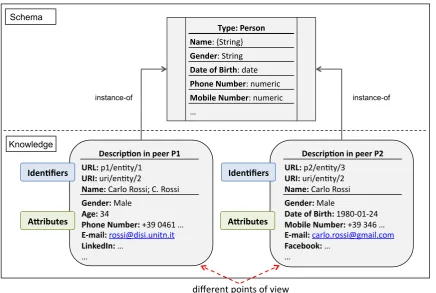
A simplified example of the schema and its instantiation is shown in Figure 3.1. It is important to note, (i) first, that the specific definition of entity types depends of the domain; (ii) second, that this example shows only one entity type (i.e., Person) but in our system we will need to describe other types of entities (e.g., locations, events, organizations, facilities, etc.) in order to represent general knowledge of peers about contacts and other related entities.
3.4
Contacts classification
Classifications has been used for a long time as a mechanism to organize different types of objects. Some well known examples of its extensive use and effectiveness are web directories, file systems, email directories, business catalogs, among others. These clas-sifications are tree-like structure hierarchies used to organize objects of different types depending on their characteristics and the purpose of the classification in the target ap-plication [Giunchiglia et al., Winter 2006].
22 Ground knowledge
Descrip(on in peer P1 URL: p1/en&ty/1
URI: uri/en&ty/2
Name: Carlo Rossi; C. Rossi Gender: Male
Age: 34
Phone Number: +39 0461 … E-‐mail: [email protected] LinkedIn: …
…
Iden(fiers
ABributes
different points of view
Descrip(on in peer P2 URL: p2/en&ty/3
URI: uri/en&ty/2 Name: Carlo Rossi Gender: Male
Date of Birth: 1980-‐01-‐24 Mobile Number: +39 346 … E-‐mail: [email protected] Facebook: …
…
Iden(fiers
ABributes Type: Person Name: {String} Gender: String Date of Birth: date Phone Number: numeric Mobile Number: numeric …
instance-of instance-of
Schema
Knowledge
Figure 3.1: An example of an ET to describe entities of type “Person” and two instances showing the different descriptions of the same entity from the points of view of peers P1 and P2 respectively.
same object can be classified at different classification nodes or at different nodes from different classifications. This means that the same object can be classified from different perspectives, (i.e., considering different subsets of characteristics), which in turn allows finding objects by following different paths (from different perspectives) in the hierarchies.
Within the context of this thesis, we are interested in using classifications (also called lightweight ontologies [Giunchiglia and Zaihrayeu, 2008]) to organize contacts from peer’s contact lists (i.e., the entities describing contacts) based on certain properties. Two main dimensions can be distinguished for the organization of contacts, (i) contacts organized as subjects with whom the user is connected (or linked) through a social relation; and (ii) contacts organized as objects that are known by the peer and have certain characteristics.
3.4.1 Classification of subjects
Contacts classification 23
Then, the organization of the groups themselves into a hierarchy defines a classification of subjects.
An abstract example of a possible classification of contacts as subjects is shown in Figure 3.2. In this example, social groups are mainly separated between groups of “Fam-ily” members, “Work” related contacts and “Friends”, while nodes that are lower in the hierarchy further separate the groups of the nodes that are one level above. As we also mentioned before, contacts can be classified at more than one node. For example, a close friend who happens to be also a colleague at work will be classified at two nodes, namely, “Colleagues” and “Close friends”.
Family
Parents Brothers and Sisters
Friends Work
Colleagues Bosses
Managers Director
Close friends Acquaintances
All social relations
Figure 3.2: An example of a classification of contacts as subjects.
Formally, we can define a classification of subjects as a rooted treeCS=h{n},{e},{l}i, where {n} is a set of nodes, {e} is a set of edges on {n}, {l} is a set of labels, and for any node n ∈ {n} there is label l ∈ {l} associated with n. In CS, the label of a node represents an intended relation between entities contained by the node and the peer that owns the classification (i.e., parents of the peer, colleagues of the peer, etc.). Note that the actual meaning of a node should be understood as the meaning of all the nodes in the path to the root.
24 Ground knowledge
3.4.2 Classification of objects
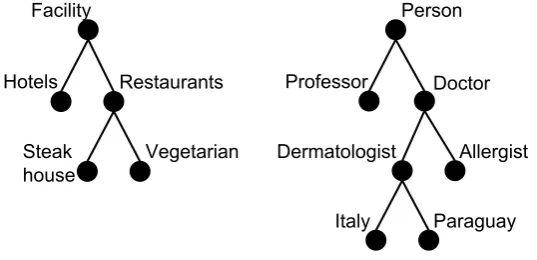
As objects that exists in the real world and are described by certain attributes, contacts can be organized in groups with similar characteristics. For example, those contacts that have the same profession, live in the same city, have the same nationality, etc. Such groups can be formed by specifying only one constraint regarding the characteristics of objects or by combining one or more constraints. Then, groups can be organized in a hierarchy, from more general to more specific groups, to define a classification of objects. An abstract example of possible classifications of contacts as objects is shown in Fig-ure 3.3. Given that contacts are represented in our system through the notion of entities, the characteristics used to classify them include their types and attributes. In this exam-ple, we can see two classifications that correspond to different types, namely, “Facility” and “Person”. In the case of contacts that are persons, we can see that the peer is inter-ested in distinguishing between those that are “Doctors” and those that are “Professors” (i.e., based on their profession). Among the doctors, we can also see that the peer is inter-ested in “Dermatologists”, “Dermatologists” located in “Italy”, “Dermatologists” located in “Paraguay”, and “Allergists” (without distinguishing where they are located).
Facility
Hotels Restaurants
Person
Professor Doctor
Dermatologist Allergist Steak
house
Vegetarian
Italy Paraguay
Figure 3.3: An example of a classification of contacts as objects.
Formally, we can define a classification of objects as a rooted treeCO =h{n},{e},{l}i, where {n} is a set of nodes, {e} is a set of edges on {n}, {l} is a set of labels, and for any node n ∈ {n} there is labell ∈ {l} associated with n. In CO, the label of a node is used to describe a characteristic that is intended on entities contained by the node. Also in this case the actual meaning of a node should be understood as the meaning of all the nodes in the path to the root.
Summary 25
3.5
Summary
This chapter introduced the foundational notions for this thesis, which will be used in the following chapters to build the Distributed Contact Management System (DCM system) on top of them. First, the notions of contact, peer and entity were defined. A contact is defined as an entity from the real world that is somehow contactable by possibly diverse means; Apeer is defined as a user of the system, maintaining a contact list and capable of participating in communication activities; and Anentity represents an abstract of physical object that exist in the real world, it has a type and is described by a set of attributes. Moreover, it was established the adoption of an entity-centric approach, which uses entities to represent contacts and peers.
Next, the notion of a knowledge schema was presented as a mean to achieve interop-erability between peers. It defines templates for the different types of entities used in the system, establishing restrictions on the set of attributes used to describe a given type. These templates are then instantiated into Digital Entities (DEs) and their Attributes (As) to actually represent knowledge about entities from the real world. Two types of identifiers were introduced in association to entities in order to distinguish among many possibly different descriptions of the same real world entity. A semantic URL (SU RL) represents a particular description, while a semantic URI (SU RI) represents the actual entity without attaching any specific description to it.
Part II
The Proposed Approaches and
Chapter 4
Reference architecture
In this chapter we present an architecture of reference for the Distributed Contact Manage-ment System (DCM System), which integrates different system components that interact in a complex manner. Moreover, we discuss the different roles played by each compo-nent in addressing the problem tackled in this thesis. This architecture is one of the contributions of this thesis.
The first step for the definition of the architecture was the elicitation of high-level requirements through the analysis of the subproblems identified from problem setting scenarios. Requirements are organized around dimensions considered of key importance in the design of such a complex system (i.e., dynamic, with socio-technical implications, inherently distributed), and cover the properties that should be met by it.
After the requirements analysis, the overall system design was thought with the fol-lowing main objectives in mind:
• To meet the requirements identified in the first step of the architecture definition. These requirements imply functional as well as non-functional properties that the system should have.
• To provide an architecture that is generic enough, and that can therefore be ab-stracted from application specific details in order to be applicable to diverse knowl-edge management scenarios.
30 Reference architecture
1. The identification of actors interacting with the system and the discussion of their roles in a high-level system design (Section 4.2).
2. The identification of system components in a logical view that analyzes the role of each of them. Such analysis must include also the modules that are needed within each component (Section 4.3).
3. The identification of interactions that happen between the different components as a consequence of different types of functionalities provided by the DCM system (Section 4.4).
Finally, it is important to note that the approaches presented in subsequent chapters of this thesis, namely Chapters 5 and 6 as well as the case study from Chapter 7 will be framed within this architecture.
4.1
Requirements
The requirements analysis for the architecture of the DCM system takes as a starting point the problem setting scenarios from Chapter 2. In particular, we focus on deriving requirements from the different subproblems that were identified from such scenarios. In the following, we report the output of this analysis.
Data Storage. We follow a model that is centered in the notion of entities to represent
data (i.e., knowledge)1, which means that data is stored in the DCM system using entity
bases. The DCM system deals with a scenario that is inherently distributed. The direct impact on data storage of this inherent distribution is twofold:
• First, storage of data is also distributed among peers (i.e., peers have their own local contact list).Therefore, the system will support the storage of peers knowledge locally in their personal devices. This means that each peer should be able to maintain its own entity base.
• Second, peers need to find a minimal agreement about their entity representations in order to understand each other (i.e., for communication and interactions). Therefore, the system should provide a point of reference to get a basic (and extendable) schema as well as general purpose knowledge (i.e., information about entities of general interest).
1
Requirements 31
Peers interaction and linking. Peers in the DCM system are also inherently connected.
The links that connect peers in this network can be of different nature: (i) peers can be explicitly connected because they know each other (i.e., one peer is in the contact list of the other and vice versa), (ii) they can be indirectly connected by knowing the same people (i.e., having the contact information about the same person, facility, etc.) even if they do not know each other; (iii) peers can also be implicitly connected because they have similar characteristics, interests, or needs (e.g., one peer may have the information that another peer needs). As a consequence,
• The DCM system should support the identification and representation of different type of links between peers.
• The system have to provide mechanisms that allow exploiting these links, for example to search.
Services. Through the DCM system it should be possible to access different services
allowing peers to manage their local contact information, search for new contacts, match existing contacts to other peers in the network, and publish (or share) their own contact information. This means that:
• The system should provide search services that can run at different levels and with different scope.
• Matching services should be provided in the system, (i) at a local level to avoid duplicates, and (ii) at a global level to link peers and contacts.
• The system should support publishing services, connected to search mechanisms in order to allow peers to be “findable” (when this is desired).
• Direct exchange services should also be supported by the system.
Privacy. In the DCM system, the mechanisms used for representing and searching
con-tacts might involve the manipulation of sensitive information, for example human personal data. This may raise privacy concerns that we need to take into account. Fully address-ing privacy in the system will require an extensive study of the state of the art as well as the adoption/implementation of privacy enhancing technologies that can technically enforce basic privacy principles2. Moreover, the study of privacy in the context of the
DCM system represents another big research area and it is out of the scope of this thesis.
2as defined in the EU-Directive 95/46/EC [European Commission, 1995] and the newly proposed GDPR
32 Reference architecture
However, we consider that privacy is a very important dimension in this type of complex socio-technical systems. To partially deal with privacy, the DCM system will provide a privacy-friendly design. This means that the system design should take into consid-eration main privacy principles in order to facilitate the adoption of privacy enhancing technologies.
Performance. The system is expected to be designed to handle a potentially large
num-ber of peers managing information about an even larger numnum-ber of objects. This is reflected in the following architectural requirements:
• The system should be able to scale in the number of peers that can manage while maintaining a coherent system behavior.
• The system should also scale to handle diversity of peers, in terms of their different points of view, different needs and different interests; while still providing good quality services.
4.2
High-level design
The design of the DCM system aims at defining an architecture that supports the manage-ment of peers’ contacts and identities in a distributed manner. In this section, we present a general view of this system that takes into consideration the different (external) actors that can interact with the DCM system in order to define the nature and mechanisms for these interactions.
High-level design 33
From this general perspective, the actors that interact with the system are (i) peers that use the system to manage their contacts and identities; (ii) a system administrator, who is responsible for verifying that the system works properly; and (iii) external systems possibly acting as data providers, service providers, or both. The Figure 4.1 introduces the general view of the system.
The term Peer refers to users of the system, which has the ability to make decisions. The Peers in the DCM system will always act on behalf of someone, might be a person, a company, organization, etc. Further, peers can decide to what extend the identity of this someone is revealed and to whom (e.g., a central authority in the system, other peers, etc.). Peers will interact with the system through applications running on personal devices (e.g., smart-phones, tablets, laptops, etc.). When interacting with the system, the peers will identify using a pseudonym (i.e., a user name), which implies the creation of an user account. The notion of a user account enables the system to link the actions and data of the same peer thereby maintaining a long-term relationship. This relation could, in turn, enable different types of services, which are available only for system users. We will discuss services in more details in the following sections.
A Web Portal GUI has a twofold goal. First, it will provide an interface that can be used by peers to create an user account (i.e., when interacting with the system for the first time) and to download an application for their personal device. Second, it will also provide an interface that can be used by the administrator(s) of the system to very an monitor that everything is working properly (i.e., to monitor system behavior). Note that this presupposes the existence of a central authority that stores user accounts, allow authentication, and (in general) deploys the different components of the system. This is further discussed as part of the system logical view (Section 4.3)
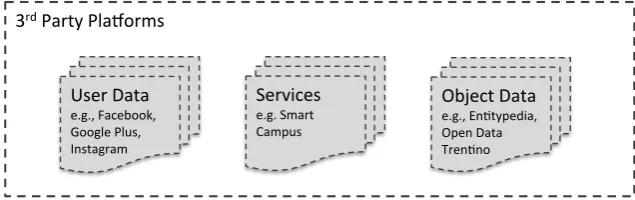
Theexternal data and external services are access by the DCM system through exter-nal systems that we call 3rd Party Platforms. They are systems over which we have no control, but that are part of the context in which our system has to function and therefore can not be ignored.
3rd Party Pla*orms
User Data e.g., Facebook, Google Plus, Instagram
Services e.g. Smart Campus
Object Data e.g., EnDtypedia, Open Data TrenDno
34 Reference architecture
According to their characteristics (information they store and the functionalities they have), the 3rd party platforms can be distinguished in three types (as shown in Figure 4.2):
• First, there are systems that are mainly based on User Data, all social networks are a good examples of this category. They store user information, which include personal data, preferences, and tracking of users actions. Their added value is in their user base, which can be used as target for, for example, advertisement.
• Second, we can identify other systems that are based on Object Data, they can be seen also as information providers. They center the attention in building big dataset of information about different types of entities from the real world (i.e., entity bases). Usually, they invest a lot of effort in producing high quality data aiming to become a referent source for a particular domain(s). Some examples of this type are, Wikipedia3, Freebase4, Entitypedia5, DBpedia6, Open Data Trentino
(ODT)7.
• Third, we can distinguish those that serves as Service providers. These are systems that usually connect user and object data, i.e., are in the middle. An example of this are systems that process information from object data systems based on user data in order to provide customized services to users, like in SmartCampus8 project.
4.3
System logical view
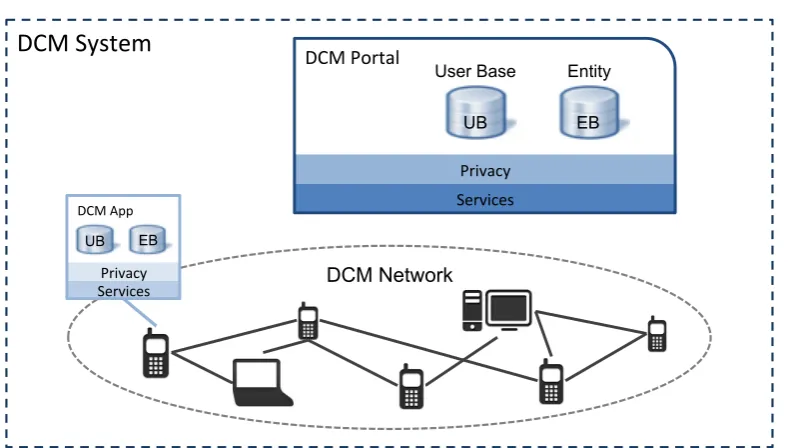
A logical view of the architecture is presented in Figure 4.3. This view shows the different components that are part of the system architecture.
The entry point and a point of reference in the system is theDCM Portal component. The portal can be access by a new peer through a web interface, as we mentioned before, in order to create an account and download an application that will run locally in its device. This application that we call DCM App represents the second component of the system. The app allow peers to interact with each other and with the portal in order to have access to different type of services (like search). Finally, the peers interacting through the app represent the third component of the system, namely, the DCM Network. In what follows we present each component of the system in more details.
3
www.wikipedia.org 4http://www.freebase.com/ 5
http://entitypedia.org 6http://dbpedia.org 7
http://dati.trentino.it/ 8
System logical view 35
DCM Network
Entity Base User Base
Services Privacy
EB UB
Services Privacy
EB UB
DCM System
DCM PortalDCM App
Figure 4.3: Logical Architecture
4.3.1 Contact management portal
The DCM Portal is composed by three layers, namely, (i) a data layer, (ii) privacy layer and a (iii) service layer.
TheData layer stores information of users in aUser Base (UB)and information about entities that are known to the portal in anEntity Base (EB):
• The UB of the portal is intended for identifying users, called peers in the DCM system. It stores information about the pseudonyms (i.e., user names) under which the system recognizes peers, regardless of the real world entity on behalf of whom they are acting. The UB can also maintains other peer-related information, such as, the last time the peer was seen, available mechanisms to send them notifications, etc. The identification of a peer in the UB is based on a user name, which can be any arbitrary unique combination of characters (i.e., letters, numbers and symbols). Moreover, user names are not mapped to a concepts from a knowledge base (e.g., WordNet9). However, a user name can be linked (although it is not mandatory) to
an entity in order to show that the corresponding peer is acting on behalf of such real world entity.
• On the other hand, an EB is intended to store the knowledge of the portal, namely, descriptions of the real world entities (e.g., persons, organizations, facilities,
loca-9
36 Reference architecture
tions, events, etc). This include, first, the definition of the semantic schema10 (i.e.,
set of templates) used to describe entities in the DCM system. Second, it includes the description of entities on behalf of whom peers act, called the profile of the peer. Last, it also includes other related entities that are needed to describe the general knowledge that the portal has about the real world. The place of birth of a person or the location where he/she lives; the place where an organization has its head-quarters, or even the institution where a person works are all examples of general interest entities that can be part of the portal knowledge and can also be used to describe the profile of a peer.
ThePrivacy layer plays the role of a filter that knows who can access what and under which circumstances. We define a privacy layer as part of a privacy-friendly design. This layer is intended to account for the need of an agreement between the peers and the portal regarding how peers data will be manipulated in the portal. Such agreement could be achieved and technically enforced in an automatic (or semi-automatic) manner with the adoption of appropriate privacy-enhancing technologies. As we mentioned before, providing concrete solutions for this layer is out of the scope of this thesis and we leave it as part of our future work. However, we invite the interested reader to find more information in [PrimeLife, 2011].
TheService layer encapsulates a number of services that are supported by the system. They include, among others: creation of user accounts, downloading the DCM App, searching users (for example, to find if a local contact is also a user of the system), searching contacts that were published int he portal, etc. The portal also offers services for the protection of user’s data in the network. It is important to note that between this layer and the data layer (as shown in Figure 4.3) we have the privacy layer. This means that all services provided by the portal presuppose the evaluation of privacy (what data can be revealed by the services, for what purpose and to whom).
Finally, It is important to point out that the separation among layers is mainly con-ceptual and the actual implementation of privacy policies or services might be transversal to different layers. For example, the privacy policies could require additional metadata to be stored with the data they protect, in the data layer (UB and EB). Similarly, different services might also require storing some additional information (e.g., indexes, statistics, etc.).
10
System logical view 37
4.3.2 Contact management application
Another key component in the architecture is theDCM Application (DCM App) running on local devices of peers. Once a peer creates a user account and installs the DCM app, this will be its everyday interface to into the system. In fact, we say peers become part of the system through the DCM app. As it can be seen in Figure 4.3, the internal structure of the DCM App is in principle the same as the DCM Portal (i.e., composed by three layers). It can also be seen that a slightly different color is used for the DCM App, which is aimed to point out that they work at different levels (i.e., the portal at a global level and the app at a local level).
The Data Layer at peer Pi maintains a User Base U BPi and a Entity Base EBPi,
which contain the following information:
• TheU BPi at peerPi stores information regarding the DCM user account of the local
peer. This information will be used, for authentication purposes, in any interaction that the peer has with the DCM portal. Additionally, the U BPi stores information
about others (external) user accounts (e.g., Facebook, Google Plus, Skype, etc.) of the peer and relevant user information related to these accounts (for example, contacts of the peer in external accounts).
• TheEBPi at the samePi stores only the information about the entities of the user(s)
in U BPi, i.e., entities that Pi knows or that are somehow relevant for Pi. We say
that the EBPi represents Pi’s point of view or knowledge about objects from the
real world.
Let us give an example to clarify the difference between the information stored in the different bases. Take the example of Anna and Liza, they are friends in Facebook and Anna is a user o the DCM system. Let us callU BPa and EBPa, respectively, to the user
base and entity base in Anna’s DCM app. If Anna has the contact information (i.e., name, cellphone number, address, etc.) of Liza in the DCM app, the description of Liza as a person will be in EBPa. This description may include attributes like, name, gender,
nationality, cellphone number, address, and Liza’s user name in Facebook. However, knowing that Liza has a Facebook account does not imply that they are Facebook friends. If Anna imports information about her Facebook friends into the DCM app, then Liza’s user name from Facebook will be stored in theEBPi as a contact associated to an external
account of Anna.
The Privacy layer at peer Pi filters who can have access to the local information in
U BPi and EBPi. Following the same reasoning as in the case of the DCM portal, this
38 Reference architecture
privacy layer at the DCM app is intended to negotiate and agree with corresponding privacy layers, at the DCM portal and at other peers.
TheService layer at peerPiis intended to communicate with the corresponding service
layers at the DCM portal or at other peers, in order to have access to services that they can offer toPi. At the same time, other peers can access to services provided byPithrough
this layer (for example, in a peer-to-peer manner). In general, this service layer can be seen as the set of APIs through which the DCM app communicates with other components of the system. This presupposes that the service layer, at the portal and at different peers, speak the same language and can therefore understand each other. However, the computation of a particular service is subject to privacy constraints regarding the data they are allowed (or not) to reveal.
4.3.3 Contact management network
The third component of this architecture is the network formed by peers running the DCM app and i