Readability Assessment for Text Simplification
Sandra Aluisio
1, Lucia Specia
2, Caroline Gasperin
1and Carolina Scarton
11Center of Computational Linguistics (NILC) 2Research Group in Computational Linguistics
University of São Paulo University of Wolverhampton
São Carlos - SP, Brazil Wolverhampton, UK
{sandra,cgasperin}@icmc.usp.br, [email protected]
Abstract
We describe a readability assessment ap-proach to support the process of text simplifi-cation for poor literacy readers. Given an in-put text, the goal is to predict its readability level, which corresponds to the literacy level that is expected from the target reader: rudi-mentary, basic or advanced. We complement features traditionally used for readability as-sessment with a number of new features, and experiment with alternative ways to model this problem using machine learning methods, namely classification, regression and ranking. The best resulting model is embedded in an authoring tool for Text Simplification.
1
Introduction
In Brazil, the National Indicator of Functional Lite-racy (INAF) index has been computed annually since 2001 to measure the levels of literacy of the Brazilian population. The 2009 report presented a worrying scenario: 7% of the individuals are illite-rate; 21% are literate at the rudimentary level; 47% are literate at the basic level; only 25% are literate at the advanced level (INAF, 2009). These literacy levels are defined as:
(1) Illiterate: individuals who cannot perform simple tasks such as reading words and phrases;
(2) Rudimentary: individuals who can find ex-plicit information in short and familiar texts (such as an advertisement or a short letter);
(3) Basic: individuals who are functionally lite-rate, i.e., they can read and understand texts of av-erage length, and find information even when it is necessary to make some inference; and
(4) Advanced: fully literate individuals, who can read longer texts, relating their parts, comparing and interpreting information, distinguish fact from opinion, make inferences and synthesize.
In order to promote digital inclusion and acces-sibility for people with low levels of literacy, par-ticularly to documents available on the web, it is important to provide text in a simple and easy-to- read way. This is a requirement of the Web Con-tent Accessibility Guidelines 2.0’s principle of comprehensibility and accessibility of Web con-tent1. It states that for texts which demand reading skills more advanced than that of individuals with lower secondary education, one should offer an al-ternative version of the same content suitable for those individuals. While readability formulas for English have a long history – 200 formulas have been reported from 1920 to 1980s (Dubay, 2004) – the only tool available for Portuguese is an adapta-tion of the Flesch Reading Ease index. It evaluates the complexity of texts in a 4-level scale corres-ponding to grade levels (Martins et al., 1996).
In the PorSimples project (Aluísio et al., 2008) we develop text adaptation methods (via text sim-plification and elaboration approaches) to improve the comprehensibility of texts published on gov-ernment websites or by renowned news agencies, which are expected to be relevant to a large au-dience with various literacy levels. The project provides automatic simplification tools to aid (1) poorly literate readers to understand online content – a browser plug-in for automatically simplifying websites – and (2) authors producing texts for this audience – an authoring tool for guiding the crea-tion of simplified versions of texts.
This paper focuses on a readability assessment approach to assist the simplification process in the authoring tool, SIMPLIFICA. The current version of SIMPLIFICA offers simplification operations addressing a number of lexical and syntactic phe-nomena to make the text more readable. The
1 http://www.w3.org/TR/WCAG20/
thor has the freedom to choose when and whether to apply the available simplification operations, a decision based on the level of complexity of the current text and on the target reader.
A method for automatically identifying such level of complexity is therefore of great value. With our readability assessment tool, the author is able to automatically check the complexi-ty/readability level of the original text, as well as modified versions of such text produced as he/she applies simplification operations offered by SIMPLIFICA, until the text reaches the expected level, adequate for the target reader.
In this paper we present such readability as-sessment tool, developed as part of the PorSimples project, and discuss its application within the au-thoring tool. Different from previous work, the tool does not model text difficulty according to linear grade levels (e.g., Heilman et al., 2008), but in-stead maps the text into the three levels of literacy defined by INAF: rudimentary, basic or advanced. Moreover, it uses a more comprehensive set of fea-tures, different learning techniques and targets a new language and application, as we discuss in Section 4. More specifically, we address the fol-lowing research questions:
1. Given some training material, is it possible to detect the complexity level of Portuguese texts, which corresponds to the different literacy levels defined by INAF?
2. What is the best way to model this problem and which features are relevant?
We experiment with nominal, ordinal and interval-based modeling techniques and exploit a number of the cognitively motivated features proposed by Coh-Metrix 2.0 (Graesser et al., 2004) and adapted to Portuguese (called Coh-Metrix-PORT), along with a set of new features, including syntactic fea-tures to capture simplification operations and n-gram language model features.
In the remainder of this paper, we first provide some background information on the need for a readability assessment tool within our text simpli-fication system (Section 2) and discuss prior work on readability assessment (Section 3), to then present our features and modeling techniques (Sec-tion 4) and the experiments performed to answer our research questions (Section 5).
2. Text Simplification in PorSimples
Text Simplification (TS) aims to maximize reading comprehension of written texts through their sim-plification. Simplification usually involves substi-tuting complex by simpler words and breaking down and changing the syntax of complex, long sentences (Max, 2006; Siddharthan, 2003).
To meet the needs of people with different le-vels of literacy, in the PorSimples project we pro-pose two types of simplification: natural and
strong. The first type results in texts adequate for people with a basic literacy level and the second, rudimentary level. The difference between these two is the degree of application of simplification operations to complex sentences. In strong simpli-fication, operations are applied to all complex syn-tactic phenomena present in the text in order to make it as simple as possible, while in natural sim-plification these operations are applied selectively, only when the resulting text remains “natural”. One example of original text (a), along with its natural (b) and strong (c) manual simplifications, is given in Table 1.
(a) The cinema theaters around the world were show-ing a production by director Joe Dante in which a shoal of piranhas escaped from a military laborato-ry and attacked participants of an aquatic show. (...) More than 20 people were bitten by palometas (Serrasalmus spilopleura, a species of piranhas) that live in the waters of the Sanchuri dam. (b) The cinema theaters around the world were
show-ing a production by director Joe Dante. In the pro-duction a shoal of piranhas escaped from a military laboratory and attacked participants of an aquatic show. (…) More than 20 people were bitten by pa-lometas that live in the waters of the Sanchuri dam. Palometas are Serrasalmus spilopleura, a species of piranhas.
(c) The cinema theaters around the world were show-ing a movie by director Joe Dante. In the movie a shoal of piranhas escaped from a military laborato-ry. The shoal of piranhas attacked participants of an aquatic show. (...). Palometas have bitten more than 20 people. Palometas live in the waters of the Sanchuri dam. Palometas are Serrasalmus spilop-leura, a species of piranhas.
Table 1: Example of original and simplified texts
strong levels and analyzed their linguistic struc-tures according to the description of the two litera-cy levels. We verified that strong simplified sen-tences are more adequate for rudimentary level readers, and natural ones for basic level readers. This claim is supported by several studies which relate capabilities and performance of the working memory with reading levels (Siddharthan, 2003; McNamara et al., 2002).
2.1 The Rule-based Simplification System
The association between simplification operations and the syntactic phenomena they address is im-plemented within a rule-based syntactic simplifica-tion system (Candido Jr. et al., 2009). This system is able to identify complex syntactic phenomena in a sentence and perform the appropriate operations to simplify each phenomenon.
The simplification rules follow a manual for syntactic simplification in Portuguese also devel-oped in PorSimples. They cover syntactic con-structions such as apposition, relative clauses, coordination and subordination, which had already been addressed by previous work on text simplifi-cation (Siddharthan, 2003). Additionally, they ad-dress the transformation of sentences from passive into active voice, normalization of sentences into the Subject-Verb-Object order, and simplification of adverbial phrases. The simplification operations available are: sentence splitting, changing particu-lar discourse markers by simpler ones, transform-ing passive into active voice, inverttransform-ing the order of clauses, converting to subject-verb-object order, relocating long adverbial phrases.
2.2 The SIMPLIFICA Tool
The rule-based simplification system is part of SIMPLIFICA, an authoring tool for writers to adapt original texts into simplified texts. Within SIMPLIFICA, the author plays an active role in generating natural or strong simplified texts by ac-cepting or rejecting the simplifications offered by the system on a sentence basis and post-editing them if necessary.
Despite the ability to make such choices at the sentence level, it is not straightforward for the au-thor to judge the complexity level of the text as whole in order to decide whether it is ready for a certain audience. This is the main motivation for the development of a readability assessment tool.
The readability assessment tool automatically detects the level of complexity of a text at any moment of the authoring process, and therefore guides the author towards producing the adequate simplification level according to the type of reader. It classifies a text in one of three levels: rudimenta-ry, basic or advanced.
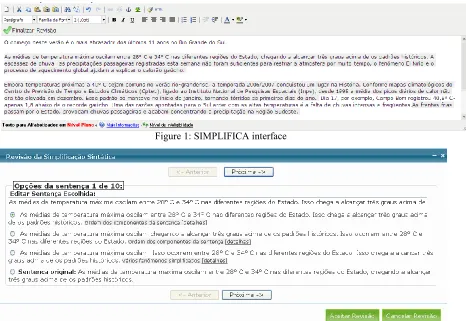
Figure 1 shows the interface of SIMPLIFICA, where the complexity level of the current text as given by the readability assessment tool is shown at the bottom, in red (in this case, “Nível Pleno”, which corresponds to advanced). To update the readability assessment of a text the author can choose “Nível de Inteligibilidade” (readability lev-el) at any moment.
The text shown in Figure 1 is composed of 13 sentences, 218 words. The lexical simplification module (not shown in the Figure 1) finds 10 candi-date words for simplification in this text, and the syntactic simplification module selects 10 sen-tences to be simplified (highlighted in gray).
When the author selects a highlighted sentence, he/she is presented with all possible simplifications proposed by the rule-based system for this tence. Figure 2 shows the options for the first sen-tence in Figure 1. The first two options cover non-finite clause and adverbial adjuncts, respectively, while the third option covers both phenomena in one single step. The original sentence is also given as an option.
It is possible that certain suggestions of auto-matic simplifications result in ungramauto-matical or inadequate sentences (mainly due to parsing er-rors). The author can choose not to use such sug-gestions as well as manually edit the original or automatically simplified versions. The impact of the author’s choice on the overall readability level of the text is not always clear to the author. The goal of the readability assessment function is to provide such information.
Figure 1: SIMPLIFICA interface
Figure 2. Simplification options available for the first sentence of the text presented in Figure 1
3. Readability Assessment
Recent work on readability assessment for the English language focus on: (i) the feature set used to capture the various aspects of readability, to evaluate the contribution of lexical, syntactic, se-mantic and discursive features; (ii) the audience of the texts the readability measurement is intended to; (iii) the genre effects on the calculation of text difficult; (iv) the type of learning technique
which is moreappropriate: those producing nomi-nal, ordinal or interval scales of measurement, and (v) providing an application for the automatic as-sessment of reading difficulty.
Pitler and Nenkova (2008) propose a unified framework composed of vocabulary, syntactic, elements of lexical cohesion, entity coherence and discourse relations to measure text quality, which resembles the composition of rubrics in the area of essay scoring (Burstein et al., 2003).
The following studies address readability as-sessment for specific audiences: learners of Eng-lish as second language (Schwarm and Ostendorf, 2005; Heilman et al., 2007), people with intellec-tual disabilities (Feng et al., 2009), and people with
cognitive impairment caused by Alzheimer (Roark at al, 2007).
Sheehan et al. (2007) focus on models for literary and expository texts, given that traditional metrics like Flesch-Kincaid Level score tend to overpredict the difficulty of literary texts and underpredict the difficulty of expository texts.
Heilman et al. (2008) investigate an appropriate scale of measurement for reading difficulty – nominal, ordinal, or interval – by comparing the effectiveness of statistical models for each type of data. Petersen and Ostendorf (2009) use classification and regression techniques to predict a readability score.
4. A Tool for Readability Assessment
In this section we present our approach to readabil-ity assessment. It differs from previous work in the following aspects: (i) it uses a feature set with cognitively-motivated metrics and a number of ad-ditional features to provide a better explanation of the complexity of a text; (ii) it targets a new audi-ence: people with different literacy levels; (iii) it investigates different statistical models for non- linear data scales: the levels of literacy defined by INAF, (iv) it focus on a new application: the use of readability assessment for text simplification sys-tems; and (v) it is aimed at Portuguese.
4.1 Features for Assessing Readability
Our feature set (Table 2) consists of 3 groups of features. The first group contains cognitively-motivated features (features 1-42), derived from the Coh-Metrix-PORT tool (see Section 4.1.1). The second group contains features that reflect the incidence of particular syntactic constructions which we target in our text simplification system (features 43-49). The third group (the remaining features in Table 2) contains features derived from n-gram language models built considering uni-grams, bigrams and trigrams probability and per-plexity plus out-of-vocabulary rate scores. We later refer to a set of basic features, which consist of simple counts that do not require any linguistic tool or external resources to be computed. This set cor-responds to features 1-3 and 9-11.
4.1.1 Coh-Metrix-Port
The Coh-Metrix tool was developed to compute features potentially relevant to the comprehension of English texts through a number of measures in-formed by linguistics, psychology and cognitive studies. The main aspects covered by the measures are cohesion and coherence (Graesser et al., 2004).
Coh-Metrix 2.0, the free version of the tool, con-tains 60 readability metrics. The Coh-Metrix-PORT tool (Scarton et al., 2009) computes similar metrics for texts in Brazilian Portuguese. The ma-jor challenge to create such tool is the lack of some of the necessary linguistic resources. The follow-ing metrics are currently available in the tool (we refer to Table 2 for details):
1. Readability metric: feature 12. 2. Words and textual information:
Basic counts: features 1 to 11.
1 Number of words 2 Number of sentences 3 Number of paragraphs 4 Number of verbs 5 Number of nouns 6 Number of adjectives 7 Number of adverbs 8 Number of pronouns
9 Average number of words per sentence 10 Average number of sentences per paragraph 11 Average number of syllables per word
12 Flesch index for Portuguese
13 Incidence of content words 14 Incidence of functional words 15 Raw Frequency of content words 16 Minimal frequency of content words 17 Average number of verb hypernyms 18 Incidence of NPs
19 Number of NP modifiers
20 Number of words before the main verb 21 Number of high level constituents 22 Number of personal pronouns 23 Type-token ratio
24 Pronoun-NP ratio 25 Number of “e” (and) 26 Number of “ou” (or) 27 Number of “se” (if) 28 Number of negations 29 Number of logic operators 30 Number of connectives
31 Number of positive additive connectives 32 Number of negative additive connectives 33 Number of positive temporal connectives 34 Number of negative temporal connectives 35 Number of positive causal connectives 36 Number of negative causal connectives 37 Number of positive logic connectives 38 Number of negative logic connectives 39 Verb ambiguity ratio
40 Noun ambiguity ratio 41 Adverb ambiguity ratio 42 Adjective ambiguity ratio 43 Incidence of clauses
44 Incidence of adverbial phrases 45 Incidence of apposition 46 Incidence of passive voice 47 Incidence of relative clauses 48 Incidence of coordination 49 Incidence of subordination 50 Out-of-vocabulary words 51 LM probability of unigrams 52 LM perplexity of unigrams
53 LM perplexity of unigrams, without line break 54 LM probability of bigrams
55 LM perplexity of bigrams
56 LM perplexity of bigrams, without line break 57 LM probability of trigrams
58 LM perplexity of trigrams
59 LM perplexity of trigrams, without line break
Frequencies: features 15 to 16. Hypernymy: feature 17. 3. Syntactic information:
Constituents: features 18 to 20. Pronouns: feature 22
Types and Tokens: features 23 to 24. Connectives: features 30 to 38. 4. Logical operators: features 25 to 29.
The following resources for Portuguese were used: the MXPOST POS tagger (Ratnaparkhi, 1996), a word frequency list compiled from a 700 million-token corpus2, a tool to identify reduced noun phrases (Oliveira et al., 2006), a list of connectives classified as positives/negatives and according to cohesion type (causal, temporal, additive or logi-cal), a list of logical operators and WordNet.Br (Dias-da-Silva et al., 2008).
In this paper we include seven new metrics to Coh-Metrix-PORT: features 13, 14, 21, and 39 to 42. We used TEP3 (Dias-da-Silva et al., 2003) to obtain the number of senses of words (and thus their ambiguity level), and the Palavras parser (Bick, 2000) to identify the higher level constitu-ents. The remaining metrics were computed based on the POS tags.
According to a report on the performance of each Coh-Metrix-PORT metric (Scarton et al., 2009), no individual feature provides sufficient in-dication to measure text complexity, and therefore the need to exploit their combination, and also to combine them with the other types of features de-scribed in this section.
4.1.2 Language-model Features
Language model features were derived from a large corpus composed of a sample of the Brazilian newspaper Folha de São Paulo containing issues from 12 months taken at random from 1994 to 2005. The corpus contains 96,868 texts and 26,425,483 tokens. SRILM (Stolcke, 2002), a standard language modelling toolkit, was used to produce the language model features.
4.2 Learning Techniques
Given that the boundaries of literacy level classes are one of the subjects of our study, we exploit three different types of models in order to check
2 http://www2.lael.pucsp.br/corpora/bp/index.htm
3 http://www.nilc.icmc.usp.br/tep2/index.htm
which of them can better distinguish among the three literacy levels. We therefore experiment with three types of machine learning algorithms: a stan-dard classifier, an ordinal (ranking) classifier and a regressor. Each algorithm assumes different rela-tions among the groups: the classifier assumes no relation, the ordinal classifier assumes that the groups are ordered, and the regressor assumes that the groups are continuous.
As classifier we use the Support Vector Ma-chines (SVM) implementation in the Weka4 toolkit (SMO). As ordinal classifier we use a meta clas-sifier in Weka which takes SMO as the base classi-fication algorithm and performs pairwise classifi-cations (OrdinalClassClassifier). For regression we use the SVM regression implementation in Weka (SMO-reg). We use the linear versions of the algo-rithms for classification, ordinal classification and regression, and also experiment with a radial basis function (RBF) kernel for regression.
5. Experiments
5.1 Corpora
In order to train (and test) the different machine learning algorithms to automatically identify the readability level of the texts we make use of ma-nually simplified corpora created in the PorSimples project. Seven corpora covering our three literacy levels (advanced, basic and rudimentary) and two different genres were compiled. The first corpus is composed of general news articles from the Brazil-ian newspaper Zero Hora (ZH original). These ar-ticles were manually simplified by a linguist, ex-pert in text simplification, according to the two levels of simplification: natural (ZH natural) and strong (ZH strong). The remaining corpora are composed of popular science articles from differ-ent sources: (a) the CadernoCiência section of the Brazilian newspaper Folha de São Paulo, a main-stream newspaper in Brazil (CC original) and a manually simplified version of this corpus using the natural (CC natural) and strong (CC strong) levels; and (b) advanced level texts from a popular science magazine called Ciência Hoje (CH). Table 3 shows a few statistics about these seven corpora.
5.2 Feature Analysis
As a simple way to check the contribution of dif-ferent features to our three literacy levels, we com-
Corpus Doc Sent Words Avg. words per text (std.
deviation)
[image:7.612.334.518.65.514.2]Avg. words p. sentence ZH original 104 2184 46190 444.1 (133.7) 21.1 ZH natural 104 3234 47296 454.7 (134.2) 14.6 ZH strong 104 3668 47938 460.9 (137.5) 13.0 CC original 50 882 20263 405.2 (175.6) 22.9 CC natural 50 975 19603 392.0 (176.0) 20.1 CC strong 50 1454 20518 410.3 (169.6) 14.1 CH 130 3624 95866 737.4 (226.1) 26.4
Table 3. Corpus statistics
puted the (absolute) Pearson correlation between our features and the expected literacy level for the two sets of corpora that contain versions of the three classes of interest (original, natural and strong). Table 4 lists the most highly correlated features.
Feature Corr.
1 Words per sentence 0.693
2 Incidence of apposition 0.688
3 Incidence of clauses 0.614
4 Flesch index 0.580
5 Words before main verb 0.516 6 Sentences per paragraph 0.509 7 Incidence of relative clauses 0.417
8 Syllables per word 0.414
[image:7.612.72.300.69.190.2]9 Number of positive additive connectives 0.397 10 Number of negative causal connectives 0.388
Table 4: Correlation between features and literacy levels
Among the top features are mostly basic and syn-tactic features representing the number of apposi-tive and relaapposi-tive clauses and clauses in general, and also features from Coh-Metrix-PORT. This shows that traditional cognitively-motivated features can be complemented with more superficial features for readability assessment.
5.3 Predicting Complexity Levels
As previously discussed, the goal is to predict the complexity level of a text as original, naturally or strongly simplified, which correspond to the three literacy levels of INAF: rudimentary, basic and ad-vanced level.
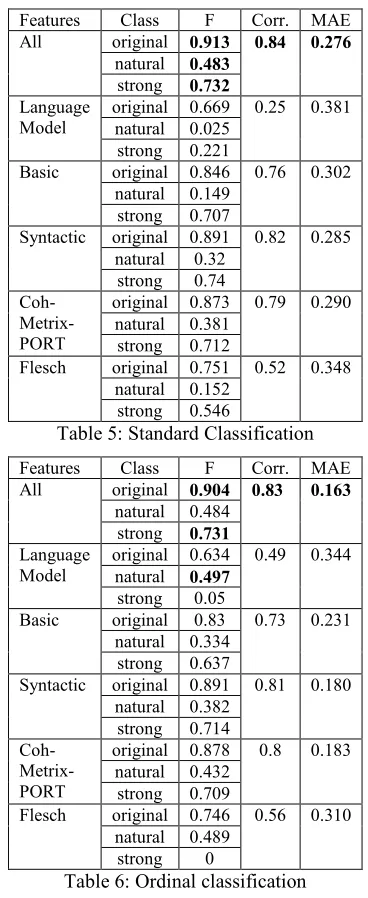
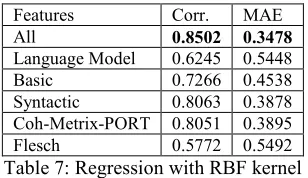
Tables 5-7 show the results of our experiments using 10-fold cross-validation and standard classi-fication (Table 5), ordinal classiclassi-fication (Table 6) and regression (Table 7), in terms of F-measure (F), Pearson correlation with true score (Corr.) and mean absolute error (MAE). Results using our complete feature set (All) and different subsets of it are shown so that we can analyze the performance of each group of features. We also experiment with the Flesch index on its own as a feature.
Features Class F Corr. MAE All original 0.913 0.84 0.276
natural 0.483
strong 0.732
Language
Model original 0.669 natural 0.025 0.25 0.381 strong 0.221
Basic original 0.846 0.76 0.302 natural 0.149
strong 0.707
Syntactic original 0.891 0.82 0.285 natural 0.32
strong 0.74
Coh- Metrix-PORT
original 0.873 0.79 0.290 natural 0.381
strong 0.712
Flesch original 0.751 0.52 0.348 natural 0.152
strong 0.546
Table 5: Standard Classification
Features Class F Corr. MAE All original 0.904 0.83 0.163
natural 0.484 strong 0.731
Language
Model original 0.634 natural 0.497 0.49 0.344
strong 0.05
Basic original 0.83 0.73 0.231 natural 0.334
strong 0.637
Syntactic original 0.891 0.81 0.180 natural 0.382
strong 0.714
Coh- Metrix-PORT
original 0.878 0.8 0.183 natural 0.432
strong 0.709
Flesch original 0.746 0.56 0.310 natural 0.489
strong 0
Table 6: Ordinal classification
The results of the standard and ordinal classifica-tion are comparable in terms of F-measure and cor-relation, but the mean absolute error is lower for the ordinal classification. This indicates that ordi-nal classification is more adequate to handle our classes, similarly to the results found in (Heilman et al., 2008). Results also show that distinguishing between natural and strong simplifications is a harder problem than distinguishing between these and original texts. This was expected, since these two levels of simplification share many features. However, the average performance achieved is considered satisfactory.
[image:7.612.73.300.274.402.2]among all models. However, its mean error rates are above the ones found for classification. A lin-ear SVM (not shown here) achieves very poor re-sults across all metrics.
Features Corr. MAE
All 0.8502 0.3478
Language Model 0.6245 0.5448
Basic 0.7266 0.4538
[image:8.612.109.263.117.206.2]Syntactic 0.8063 0.3878 Coh-Metrix-PORT 0.8051 0.3895 Flesch 0.5772 0.5492
Table 7: Regression with RBF kernel
With respect to the different feature sets, we can observe that the combination of all features consis-tently yields better results according to all metrics across all our models. The performances obtained with the subsets of features vary considerably from model to model, which shows that the combination of features is more robust across different learning techniques. Considering each feature set independ-ently, the syntactic features, followed by Coh-Metrix-PORT, achieve the best correlation scores, while the language model features performed the poorest.
These results show that it is possible to predict with satisfactory accuracy the readability level of texts according to our three classes of interest: original, naturally simplified and strongly simpli-fied texts. Given such results we embedded the classification model (Table 5) as a tool for read-ability assessment into our text simplification au-thoring system. The linear classification is our simplest model, has achieved the highest F-measure and its correlation scores are comparable to those of the other models.
6. Conclusions
We have experimented with different machine learning algorithms and features in order to verify whether it was possible to automatically distin-guish among the three readability levels: original texts aimed at advanced readers, naturally simpli-fied texts aimed at people with basic literacy level, and strongly simplified texts aimed at people with rudimentary literacy level. All algorithms achieved satisfactory performance with the combination of all features and we embedded the simplest model into our authoring tool.
As future work, we plan to investigate the con-tribution of deeper cognitive features to this prob-lem, more specifically, semantic, co-reference and
mental model dimensions metrics. Having this ca-pacity for readability assessment is useful not only to inform authors preparing simplified material about the complexity of the current material, but also to guide automatic simplification systems to produce simplifications with the adequate level of complexity according to the target user.
The authoring tool, as well as its text simplifica-tion and readability assessment systems, can be used not only for improving text accessibility, but also for educational purposes: the author can pre-pare texts that are adequate according to the level of the reader and it will also allow them to improve their reading skills.
References
Sandra M. Aluísio, Lucia Specia, Thiago A. S. Pardo, Erick G. Maziero, Renata P. M. Fortes (2008). To-wards Brazilian Portuguese Automatic Text
Simpli-fication Systems. In the Proceedings of the 8th ACM
Symposium on Document Engineering, pp. 240-248.
Eckhard Bick (2000). The Parsing System "Palavras":
Automatic Grammatical Analysis of Portuguese in a
Constraint Grammar Framework. PhD Thesis.
Uni-versity of Århus, Denmark.
Jill Burstein, Martin Chodorow and Claudia Leacock (2003). CriterionSM Online Essay Evaluation: An Application for Automated Evaluation of Student
Essays. In the Proceedings of the Fifteenth Annual
Conference on Innovative Applications of Artificial Intelligence, Acapulco, Mexico.
Arnaldo Candido Jr., Erick Maziero, Caroline Gasperin, Thiago A. S. Pardo, Lucia Specia, and Sandra M. Aluisio (2009). Supporting the Adaptation of Texts for Poor Literacy Readers: a Text Simplification
Editor for Brazilian Portuguese. In NAACL-HLT
Workshop on Innovative Use of NLP for Building Educational Applications, pages 34–42, Boulder’. Helena de M. Caseli, Tiago de F. Pereira, Lúcia Specia,
Thiago A. S. Pardo, Caroline Gasperin and Sandra Maria Aluísio (2009). Building a Brazilian Portu-guese Parallel Corpus of Original and Simplified
Texts. In the Proceedings of CICLing.
Max Coltheart (1981). The MRC psycholinguistic
data-base. In Quartely Jounal of Experimental
Psycholo-gy, 33A, pages 497-505.
Scott Deerwester, Susan T. Dumais, George W. Furnas, Thomas K. Landauer e Richard Harshman (1990).
Indexing By Latent Semantic Analysis. In Journal of
the American Society For Information Science, V. 41, pages 391-407.
Bento C. Dias-da-Silva and Helio R. Moraes (2003). A construção de um thesaurus eletrônico para o
47, N. 2, pages 101-115.
Bento C Dias-da-Silva, Ariani Di Felippo and Maria das Graças V. Nunes (2008). The automatic mapping of Princeton WordNet lexical conceptual relations onto
the Brazilian Portuguese WordNet database. In
Pro-ceedings of the 6th LREC, Marrakech, Morocco.
William H. DuBay (2004). The principles of readability.
Costa Mesa, CA: Impact Information: http://www.i mpact-information.com/impactinfo/readability02.pdf
Christiane Fellbaum (1998). WordNet: An electronic
lexical database. Cambridge, MA: MIT Press.
Lijun Feng, Noémie Elhadad and Matt Huenerfauth (2009). Cognitively Motivated Features for
Reada-bility Assessment. In the Proceedings of EACL
2009, pages 229-237.
Ingo Glöckner, Sven Hartrumpf, Hermann Helbig, Jo-hannes Leveling and Rainer Osswald (2006b). An architecture for rating and controlling text
readabili-ty. In Proceedings of KONVENS 2006, pages 32-35.
Konstanz, Germany.
Arthur C. Graesser, Danielle S. McNamara, Max M. Louwerse and Zhiqiang Cai (2004). Coh-Metrix:
Analysis of text on cohesion and language. In
Beha-vioral Research Methods, Instruments, and
Comput-ers, V. 36, pages 193-202.
Ronald K. Hambleton, H. Swaminathan and H. Jane
Rogers (1991). Fundamentals of item response
theory. Newbury Park, CA: Sage Press.
Michael Heilman, Kevyn Collins-Thompson, Jamie Callan and Max Eskenazi (2007). Combining lexical and grammatical features to improve readability measures for first and second language texts. In the
Proceedings of NAACL HLT 2007, pages 460-467.
Michael Heilman, Kevyn Collins-Thompson and Max-ine Eskenazi (2008). An Analysis of Statistical Models and Features for Reading Difficulty
Predic-tion. In Proceedings of the 3rd Workshop on
Innova-tive Use of NLP for Building Educational Applica-tions, pages 71-79.
INAF (2009). Instituto P. Montenegro and Ação
Educa-tiva. INAF Brasil - Indicador de Alfabetismo
Funcio-nal - 2009. Available online at http://www. ibope. com.br/ipm/relatorios/relatorio_inaf_2009.pdf Teresa B. F. Martins, Claudete M. Ghiraldelo, Maria
das Graças V. Nunes e Osvaldo N. de Oliveira Jr.
(1996). Readability formulas applied to textbooks in
brazilian portuguese. ICMC Technical Report, N. 28, 11p.
Aurélien Max (2006). Writing for Language-impaired
Readers. In Proceedings of CICLing, pages 567-570.
Danielle McNamara, Max Louwerse, and Art Graesser, 2002. Coh-Metrix: Automated cohesion and coher-ence scores to predict text readability and facilitate comprehension. Grant proposal. http://cohmetrix. memphis.edu/cohmetrixpr/publications.html
Eleni Miltsakaki and Audrey Troutt (2007). Read-X:
Automatic Evaluation of Reading Difficulty of Web
Text. In the Proceedings of E-Learn 2007, Quebec,
Canada.
Eleni Miltsakaki and Audrey Troutt (2008). Real Time Web Text Classification and Analysis of Reading
Difficulty. In the Proceedings of the 3rd Workshop
on Innovative Use of NLP for Building Educational
Applications, Columbus, OH.
Cláudia Oliveira, Maria C. Freitas, Violeta Quental, Cí-cero N. dos Santos, Renato P. L. and Lucas Souza (2006). A Set of NP-extraction rules for Portuguese:
defining and learning. In 7th Workshop on
Computa-tional Processing of Written and Spoken Portuguese, Itatiaia, Brazil.
Sarah E. Petersen and Mari Ostendorf (2009). A
ma-chine learning approach to reading level
assess-ment. Computer Speech and Language 23, 89-106.
Emily Pitler and Ani Nenkova (2008). Revisiting reada-bility: A unified framework for predicting text
quali-ty. In Proceedings of EMNLP, 2008.
Adwait Ratnaparkhi (1996). A Maximum Entropy
Part-of-Speech Tagger. In Proceedings of the First
Em-pirical Methods in Natural Language Processing
Conference, pages133-142.
Brian Roark, Margaret Mitchell and Kristy Holling-shead (2007). Syntactic complexity measures for
de-tecting mild cognitive impairment. In the
Proceed-ings of the Workshop on BioNLP 2007: Biological, Translational, and Clinical Language Processing, Prague, Czech Republic.
Caroline E. Scarton, Daniel M. Almeida, Sandra M. A-luísio (2009). Análise da Inteligibilidade de textos via ferramentas de Processamento de Língua Natu-ral: adaptando as métricas do Coh-Metrix para o
Português. In Proceedings of STIL-2009, São Carlos,
Brazil.
Sarah E. Schwarm and Mari Ostendorf (2005). Reading Level Assessment Using Support Vector Machines
and Statistical Language Models. In the Proceedings
of the 43rd Annual Meeting of the ACL, pp 523–530. Kathleen M. Sheehan, Irene Kostin and Yoko Futagi (2007). Reading Level Assessment for Literary and Expository Texts. In D. S. McNamara and J. G.
Trafton (Eds.), Proceedings of the 29th Annual
Cog-nitive Science Society, page 1853. Austin, TX: Cog-nitive Science Society.
Advaith Siddharthan (2003). Syntactic Simplification
and Text Cohesion. PhD Thesis. University of
Cam-bridge.
Andreas Stolcke. SRILM -- an extensible language