Nitrogen and its Oxides
General properties
• 1st member of group VA
• Colourless, odourless gas
• 78% by volume in air
• Liquid nitrogen used as a coolant
• Most important use is in the manufacture of
ammonia and nitrogenous fertilizers
• Can form a large number of inorganic compounds
• A major constituent of organic compounds such as
Unreactive nature of nitrogen
N N
Strong NN bond,
Bond energy:944 kJ/mol
Reactions involving N2 have high activation energy and
unfavourable equilibrium constant.
N2+O22NO Kc =4.5x10⁻³¹
Nitrogen can be prepared from the air as shown.
Air flows into the aspirator and onto caustic soda
which dissolves carbon dioxide gas.
It is then passed through a heated combustion tube
containing heated copper turnings which remove
oxygen. Nitrogen is then collected over water.
Laboratory Preparation of
Nitrogen
Reactions of nitrogen
• With reactive metals, Li and Mg, to form
nitrides.
– 3Mg(s) + N
2(g)
Mg
3N
2(s), an ionic compound.
• With oxygen at very high temperature
– N
2(g) + O
2(g)
2NO(g) , at very high T
–
2NO(g) + O
2
2NO2(g)
• With hydrogen at special conditions
Nitrous oxide:
Other methods of preparation
Heating a mixture of sodium nitrate and ammonium sulfate.
2NaNO3 + (NH4)2SO4 → Na2SO4 + 2N2O+ 4H2O.
The reaction of urea, nitric acid and sulfuric acid
2 (NH2)2CO + 2 HNO3+ H2SO4 → 2 N2O + 2 CO2 + (NH4)2SO4 + 2H2O.
Direct oxidation of ammonia with a manganese dioxide-bismuth oxide catalyst: Ostwald process.
2 NH3 + 2 O2 → N2O + 3 H2O
Reacting HNO3 with SnCl2 and HCl:
2 HNO3 + 8 HCl + 4 SnCl2 → 5 H2O + 4 SnCl4 + N2O
Hyponitrous acid decomposes to N2O and water with a half-life of 16 days at 25 °C at pH 1–3.
Structure
The bond orders have been calculated as N-N 2.73
•
Nitrous oxide is a linear
molecule. It has a boiling point
of -88 ºC, and a melting point
of -102 ºC.
•
It is colourless and has a faintly
sweet smell.
•
It is used as an anesthetic,
NITRIC OXIDE
Nitric oxide, NO, may be prepared by the action of dilute nitric acid on copper:
• In the laboratory, nitric oxide is conveniently generated by reduction of dilute nitric acid with copper:
Preparation
• In commercial settings, ·NO is produced by the oxidation of ammonia at 750–900 °C (normally at 850 °C) with platinum as catalyst:
4 NH3 + 5 O2 → 4 ·NO + 6 H2O
• The uncatalyzed endothermic reaction of O2 and N2, which is performed at high temperature (>2000 °C) by lightning has not been developed into a practical commercial synthesis
N2 + O2 → 2 ·NO
by the reduction of nitrous acid in the form of sodium nitrite or potassium nitrite:
2 NaNO2 + 2 NaI + 2 H2SO4 → I2 + 4 NaHSO4 + 2 ·NO
2 NaNO2 + 2 FeSO4 + 3 H2SO4 → Fe2(SO4)3 + 2 NaHSO4 + 2 H2O + 2 ·NO 3 KNO2(l) + KNO3(l) + Cr2O3(s) → 2 K2CrO4(s) + 4 NO(g)
Reactions
•When exposed to oxygen, ·NO is converted into nitrogen dioxide.
2 ·NO + O2 → 2 NO2
In water, ·NO reacts with oxygen and water to form
HNO2 or nitrous acid. The reaction is thought to proceed via
the following stoichiometry: 4 ·NO + O2 + 2 H2O → 4 HNO2
•·NO will react with fluorine, chlorine, and bromine to form the NOXspecies, known as the nitrosyl halides, such as nitrosyl
chloride. Nitrosyl iodide can form but is an extremely short-lived species and tends to reform I2.
2 ·NO + Cl2 → 2 NOCl
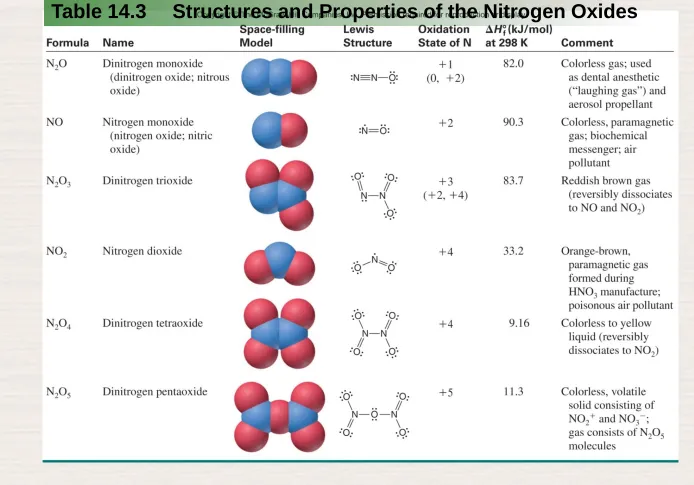
Dinitrogen trioxide or Nitrogen sesquioxide
Dinitrogen trioxide (N
2O
3) is formed from the
stoichiometric reaction between NO and O
2or NO
and N
2O
4.
Thermal dissociation of N
2O
3, occurs above -30
°
C,
and some self-ionization of the pure liquid is
observed.
Structure
Dinitrogen trioxide, however, has N–N bond at 186 pm. The N2O3 molecule is planar.
Nitrogen dioxide
• The nitrogen dioxide molecule contains an unpaired electron, which is responsible for its color and paramagnetism.
• It is also responsible for the dimerization of NO2.
• At low pressures or at high temperatures, nitrogen dioxide has a deep brown color that is due to the presence of the NO2 molecule.
• At low temperatures, the color almost entirely disappears as dinitrogen tetraoxide, N2O4, forms.
Uses
NO2 is used as an intermediate in the manufacturing of nitric acid, as a nitrating agent in manufacturing of chemical explosives, and as a flour bleaching agent.
Dinitrogen pentoxide
N2O5 is a rare example of a compound that adopts two
structures depending on the conditions: most commonly it is a salt, but under some conditions it is a polar molecule: [NO2+][NO
Synthesis and properties
N
2O
5was first reported by Deville in 1840, who
prepared it by treating AgNO
3with
Cl
2.A recommended
laboratory synthesis entails dehydrating HNO
3with
phosphorus(V) oxide
:
P
4O
10+ 12 HNO
3→ 4 H
3PO
4+ 6 N
2O
5In the reverse process, N
2O
5reacts with water
(
hydrolyses
) to produce nitric acid. Thus, nitrogen
pentoxide is the
anhydride
of nitric acid:
N
2O
5+ H
2O → 2 HNO
3N
2O
5exists as colourless crystals that sublime slightly
above room temperature. The salt eventually
Structure
Solid N2O5 is a salt, consisting of separated anions and cations. The cation is the linear nitronium ion NO2+ and the anion is the planar nitrate NO3− ion. Thus, the solid could be called nitronium nitrate. Both nitrogen centers have oxidation state +5.
The intact molecule O2N–O–NO2 exists in the gas phase (obtained by subliming N2O5)
Reactions and applications
Dinitrogen pentoxide, has been used as a reagent to introduce the NO2functionality. This nitration reaction is represented as follows:
N2O5 + Ar–H → HNO3 + Ar–NO2
where Ar represents an arene moiety.
N2O5 is of interest for the preparation of explosives.
In the atmosphere, dinitrogen pentoxide is an important
Nitrogen oxides as precursors to
smog and acid rain
Nitrogen oxides (NOx) emissions are estimated to be in the range of 25 - 100 megatonnes of nitrogen per year.
Natural sources are thought to make up approximately 1/
3 of the
total. The generations of NOx (primarily a mixture of NO2 and NO) is the main source of smog and a significant contribution to atmospheric pollution;
Atmospheric reactions leading to acid rain
• The nitrogen dioxide reacts with the hydroxide radical, formed by the photochemical decomposition of ozone, in the presence of a non-reactive gas molecule such as
nitrogen to form nitric acid vapor.
• The conversion rate for NOx to HNO3 is approximately ten times faster than the equivalent reaction for sulfur dioxide.
NO
2+ h
v
NO
.
+ O
.
.
.
.
At night, conversion takes place via the formation of
a nitrate radical, which subsequently forms
nitrogen pentoxide, that reacts with water on the
surface of aerosol particles to form nitric acid,
.
.
The Haber Process
In the early 1900’s a German chemist called Fritz
Haber came up with his chemical process to make
ammonia using the “free” very unreactive Nitrogen
from the air. (N
2is 80% of atmosphere)
This is the reaction:
Nitrogen + Hydrogen Ammonia
Raw Materials
•N
2(g) is taken from the air via a process of
fractional distillation.
•H
2(g) comes from natural gas, CH
4(g)
CH
4(g) + H
2O (g) 3H
2(g) + CO (g)
•The carbon monoxide then reacts with more steam:
Raw Materials cont
Reaction Vessel H2 (g)
from methan
e
N2 (g) from
air
NH2 (g)
The Reaction
•This reaction is exothermic. We increase yield by running
the reaction at low temperatures. However at low
temperatures the reaction rate is incredibly slow.
•Compromise between rate and yield has to be reacted.
The Reaction cont
•The reversible reaction to form ammonia:
N
2(g) + 3H
2(g) 2NH
3(g)
4 moles of gas 2 moles of gas
96 litres (4x24) 48 litres (2x24)
•If pressure is increased in reaction vessel, the reversible
reaction favours ammonia production.
The Reaction cont
•Third condition present within the reaction vessel is an Iron
catalyst.
•The catalyst is a fine mesh designed to maximise surface
area. Iron is a transition metal, and like many transition
metals it makes a good catalyst.
450oc
200 atmospheres Iron catalyst N2 from
air
H2 from
methane and steam
NH3 (g)
After the Reaction Vessel
•Coming out the reaction vessels is NH
3(g) and unreacted
N
2(g) and H
2(g).
•First job is to isolate the NH
3(g). This is done by cooling.
The NH
3(g) changes state. The nitrogen and hydrogen are
Chemical properties of NH
3
• Weak alkali
• Reaction with acids
• Reaction with metal ions
• As a reducing agent
– Burning in oxygen
4NH3 + 3O2 2N2 + 6H2O– Catalytic oxidation
4NH3 + 5O2 (Pt) 4NO + 6H2ONitric(V) Acid
• A very strong acid.
• Turns yellow because of dissolved NO
2formed from the decomposition of HNO
3.
• Commonly used in making explosives,
The Ostwald Process
The Ostwald process was invented by Wilhelm Ostwald. In
the Ostwald process ammonia is oxidised to form Nitric acid.
Nitric acid is one of the largest user’s of ammonia.
The
process has 3 stages:
Stage 1
•Mixture of air & ammonia heated to
230oC
and is passed
through a metal gauze made of
platinum (90%) & Rhodium
(10%).
•Reaction produces a lot of heat energy..
Stage 1 cont
•Reaction produces nitrogen monoxide (NO) and water.
Ammonia + oxygen Nitrogen monoxide + water
4NH
3(g) + 5O
2(g) 4NO (g) + 6H
2O (g)
Stage 2
Stage 2 cont
Nitrogen monoxide + oxygen Nitrogen dioxide
2NO (g) + O
2(g) 2NO
2(g)
Stage 3
•The nitrogen dioxide is then dissolved in water to produce
nitric acid.
•Nitrogen dioxide + water Nitric acid + nitrogen
monoxide
Ostwald process
• Catalytic oxidation of NH
3– 4NH3 + 5O2 (Pt/heat) 4NO + 6H2O
• Oxidation of NO
– 2NO + O2 2NO2
• Dissolving NO
2in water and O
2– 4NO2 + O2 + 2H2O 4HNO3
Oxidizing properties of HNO
3
• Concentrated HNO
32NO
3-+ 8H
++ 6e
-
2NO + 4H
2O
• Diluted HNO
32NO
3-+ 4H
++ 2e
-
2NO
2+ 2H
2O
• Reacts with
– Copper
Uses of Nitric acid
Nitric acid produced is used in the manufacture of the
following:
•Artificial fertilisers – Ammonium nitrate.
•Explosives, such as 2,4,6-TNT.
•Dyes.
Nitrates(V)
• Thermal stability
– K,Na 2MNO
32MNO
2+ O
2Brown ring test for NO
3
-Fresh FeSO4(aq) and NO3-(aq) Concentrated H2SO4(l)
NO3- + H2SO4 HNO3 + HSO4 -HNO3 + 3Fe2+ + 3H+ 2H
2O + NO + 3Fe2+
Nitrogen Oxoacids and Oxoanions
• Nitric acid (HNO3) is produced by the Ostwald process:
– The third step is 3NO2(g) + H2O (l) → 2HNO3 + NO(g)
• Nitric acid is a strong oxidizing agent as well as a strong acid.
• The nitrate (NO3-) also acts as an oxidizing agent.
– All nitrate salts are water soluble.
• Nitrous acid (HNO2) is a much weaker acid than nitric acid.
Important oxides of phosphorous.
P4O6 has P in its +3 oxidation state.
P4O10 has P in its +5 oxidation state.
H3PO3 has only two acidic H atoms; the third is bonded to the central P and does not dissociate.
The diphosphate ion and polyphosphates.
Oxoacids of Sulphur
Oxoacids are basically the acids that contain oxygen. Sulphur is known to form many oxoacids, for example H2SO4, H2SO3, etc.
In oxoacids of sulphur, sulphur exhibits a tetrahedral structure when coordinated to oxygen.
Generally, oxoacids of sulphur contain at least one S=O bond and one S-OH bond.
Sulphuric acid, H2SO4:
• Sulphuric acid is the most popular among the oxoacids of sulphur.
• It is a diprotic acid that is, it ionizes to give two protons.
• In sulphuric acid, one atom of sulphur is bonded to two
hydroxyl groups and the rest two oxygen atoms form pie bonds with the sulphur atom.
• Thus, sulphuric acid exhibits tetrahedral geometry.
• As the bond length of sulphur oxygen bond (S=O) is smaller in comparison to the bond length of S-OH, OH groups are
repelled by the oxygen atoms. Hence, the bond angle of O=S=O bond is larger than the HO-S-OH bond angle.
Sulphurous acid, H2SO3:
• Sulphurous acid is a diprotic acid that is, it ionizes two protons.
• In sulphurous acid, one atom of sulphur is bonded to
two hydroxyl groups and one oxygen atom forms a
pie bond with the sulphur atom.
• It is prepared by dissolving sulfur dioxide in water.
• Although, we don’t have any evidence of existence of sulphurous acid in solution phase, but the
Peroxodisulphuric acid, H2S2O8:
Peroxodisulphuric acid contains sulphur in +6 oxidation state. Thus, it is a strong oxidizing agent and highly explosive in
nature.
It is popularly known as Marshall’s acid.
It contains one peroxide group forming a bridge between the two sulphur atoms. Each sulphur atom is connected to one hydroxyl group (S-OH bond) and two oxygen atoms (S=O bond)other than the peroxide group.
It is prepared by the reaction of chlorosulfuric acid with hydrogen peroxide: