Present status of peanuts and progression in its processing and
preservation techniques
Ravinder Kumar Sahdev
1*, Mahesh Kumar
2, Ashwani Kumar Dhingra
1(1. Department of Mechanical Engineering, University Institute of Engineering & Technology, Maharshi Dayanand University, Rohtak, 124001, Haryana, India;
2. Department of Mechanical Engineering, Guru Jambheshwar University of Sciences and Technology, Hisar, 125001, Haryana, India)
Abstract: Peanut or groundnut is one of the major oilseed crops in the world. It is rich in oil and proteins. Developing countries account for about 95% of the world peanut production. Asia alone accounts for 70% of this amount where the major producers India and China together represent over two-third of global output. Traditionally, groundnuts are dried in open sun to its safe moisture level for storage. Natural and artificial (hot air drying) drying methods of groundnuts are being used throughout the world. Artificial peanuts drying devices consume very large amount of energy. In this paper, present status of peanut and a comprehensive review of its drying methods are discussed. Recent developments in preservation and storage of groundnuts are also highlighted.
Keywords: Groundnut/peanut; peanut drying; peanut preservation; peanut storage; moisture content; curing
Citation: Sahdev, R. K., M. Kumar, and A. K. Dhingra. 2015. Present status of peanuts and progression in its processing and preservation techniques. AgricEngInt: CIGR Journal, 17(3): 309-327.
1 Introduction
1Peanuts or groundnuts (arachis hypogaea) are
important and powerful food source for people
throughout the world (Reese and Leherer, 1999; Chang
et al., 2013). Groundnut belongs to the Fabaceae (bean) family, is the ‘King’ of oilseeds derived from two Greek
words, arachis means legume or beans and hypogaea
means below groundnut (refers to formation of pods in
the soil). It is also called a wonder nut, earth nut,
monkey nut, goobers, pinder, panda, manila nut and poor men’s cashew nut (Woodroof, 1983; Madhusudana,
2013; Chang et al., 2013; Gadhiya et al., 2014).
Groundnuts are reported to be originated in South
America and spread to Brazil (Zhao et al., 2012). It
was introduced by Portuguese from Brazil to West
Received date: 2015-03-31 Accepted date: 2015-06-08
*Corresponding author: Ravinder Kumar Sahdev, Department of Mechanical Engineering, University Institute of Engineering & Technology, Maharshi Dayanand University, Rohtak, 124001, Haryana, India.
Email Address: [email protected].
Africa and then to South Western India in the 16th
Century. These are grown in almost all the tropical and
subtropical countries of the world. Light, sandy loam
soil is preferred for the production of groundnuts.
Climatic conditions significantly influence the growth of
groundnuts. Temperature of 30oC is considered to be
the optimum for rapid germination and development of
pods (Nautiyal, 2002).
The worldwide groundnut production has reached to
about 39.9 million metric tons per year (Torres et al.,
2014). China is the world’s largest groundnut producer,
followed by India and the United States (USDA, 2013).
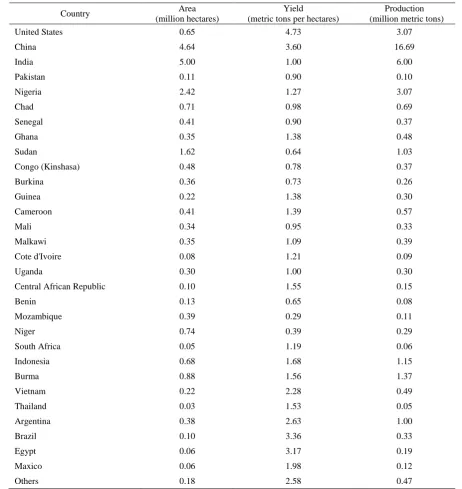
The area, yield and production of groundnut in world are
shown in Table 1
Groundnut is the major edible oilseed crop of India.
It accounts for 45% of the area and 55% of the
production of total oilseeds in the country. It also
accounts for 43% of total oil production in the country
(Aher, 2014). Total area and production of groundnut
in India are approximately 5 million hectares and 6
2013). About 75% of groundnut crop is produced in
Karif (June – September) and remaining 25% in Rabi
season (November – March). The major groundnut
producing states in India are Andhra Pradesh, Gujarat,
Tamil Nadu, Karnataka, Rajasthan, Madhya Pradesh,
Maharashtra, Uttar Pradesh, West Bengal, Chhattisgarh
and Punjab. The area and production of groundnut in
India, state wise for the year 2012-13, are shown in
Figure 1 (Production of Agriculture and Animal Sector,
2012-2013) and state wise productivity of groundnut in
India is shown in Figure 2 (Production of Agriculture
and Animal Sector, 2012-2013). Export of groundnuts
since 1999-2000 to 2012-2013 is shown in Figure 3
(Export Import Data Bank, Ministry of Commerec, India,
2012-13). From Figure 1, it is seen that Andhra
Pradesh is the leading state in area and production of
groundnuts followed by Gujarat in Area and Tamilnadu
in production respectively, whereas West Bengal is the
leading state in productivity followed by Tamilnadu and
Punjab.
Table 1 Area, yield and production of groundnut in various countries of world (USDA, 2013)
Country Area
(million hectares)
Yield
(metric tons per hectares)
Production (million metric tons)
United States 0.65 4.73 3.07
China 4.64 3.60 16.69
India 5.00 1.00 6.00
Pakistan 0.11 0.90 0.10
Nigeria 2.42 1.27 3.07
Chad 0.71 0.98 0.69
Senegal 0.41 0.90 0.37
Ghana 0.35 1.38 0.48
Sudan 1.62 0.64 1.03
Congo (Kinshasa) 0.48 0.78 0.37
Burkina 0.36 0.73 0.26
Guinea 0.22 1.38 0.30
Cameroon 0.41 1.39 0.57
Mali 0.34 0.95 0.33
Malkawi 0.35 1.09 0.39
Cote d'Ivoire 0.08 1.21 0.09
Uganda 0.30 1.00 0.30
Central African Republic 0.10 1.55 0.15
Benin 0.13 0.65 0.08
Mozambique 0.39 0.29 0.11
Niger 0.74 0.39 0.29
South Africa 0.05 1.19 0.06
Indonesia 0.68 1.68 1.15
Burma 0.88 1.56 1.37
Vietnam 0.22 2.28 0.49
Thailand 0.03 1.53 0.05
Argentina 0.38 2.63 1.00
Brazil 0.10 3.36 0.33
Egypt 0.06 3.17 0.19
Maxico 0.06 1.98 0.12
Groundnut is mainly produced in Asian countries
with China the largest groundnuts producer followed by
India. In area, India ranked first with 22.27% share of
the world during 2012-2013.
Figure 1 Area and production of groundnut for the year 2012-13 (Production of Agriculture and Animal Sector, 2012-2013)
2 General and physical aspects of peanuts
Groundnut is a major oilseed crop in India and is
highly nutritious. It is major source of oil and
proteins (Reddy and Bentilan, 2012). Nutrient values of groundnuts along with its types, qualities and
utilities are discussed in this section. Groundnuts
kernels are rich and cheap source of oil, proteins,
minerals, vitamins (Dwivedi et al., 1996). The
nutrients values for groundnut are given in Table 2
(Gadhiya et al., 2014; Akcali et al., 2006; and
Woodroof, 1983) and the comparative nutrient values
with other protein foods are shown in Table 3 (Talawar,
2004).
Table 2 Nutrients value for 100 g of groundnut (Gadhiya et al., 2014; Akcali et al., 2006; Woodroof, 1983; Torres et al., 2014; and Misra, 2004)
Nutrients Nutrition value (per 100 g)
Calories 593 calories
Proteins 20-50%
Calcium 61 mg
Potassium 725 mg
Magnesium 176 mg
Phosphorous 396.4 mg
Sodium 320 mg
Folate 120 mcg
Carbohydrates 10-20%
Dietary Fibre 9.3 g
Total fat 40-50%
Edible oil 43-55%
Figure 3 Export of groundnut from India (Export Import Data Bank, Ministry of commerce, India, 2012-13.)
Table 3 Food value of groundnuts (Talawar, 2004)
Protein foods Milk (cow) Egg (fowl) Mutton Beef Red gram Groundnut
Protein, % 3.3 13.3 18.5 22.6 22.3 25.33
Carbohydrate, % 4.8 - - - 57.2 10.2
Fat, % 3.6 13.3 13.3 2.6 1.7 40.5
The various popular types of groundnuts are Spanish,
Runner, Virginia and Valencia (USDA, 1954; Woodroof,
1983; and Talawar, 2004) where Spanish types are
generally grown in South Africa and the Southern
western United States and are still extensively grown in
California, Texas and Oklahoma and India. After 1940,
Spanish type of peanuts was shifted to Runner type in
Southern United States. This was due to higher yields
and wider use of Runner varieties in peanut butter and
salted peanuts. Virginia types of peanuts are grown in
India, Virginia, North Carolina, Tennessee and parts of
Georgia. These large seeded peanuts are very popular
due to its demand for large peanuts for processing.
Valencia types of peanuts are grown in Portaies Valley
of New Mexico. These are large, smooth, and bright
with red, white, pink or purple kernels. These are
sweet flavoured nuts with 3-4 seeds per pod. These are
popular because of ease of hand shelling and roasting
(Woodroof, 1983).
Qualities of groundnuts are decided by flavour, texture
and colour (Misra, 2004; Chang et al., 2013). Among
these factors flavour of the groundnut plays an important
role in acceptability of the groundnut products. Most of
the flavour of peanuts lies in its oil. Crunchy and crisp
are textural attributes which are important and desirable
qualities of groundnuts. Crisp food is one which is stiff
and snaps easily with crunchy sound. Crispness has
been reported to be the most versatile single texture
parameter. Colour of raw groundnut is attributed to
taste and oil.
Indian groundnuts are very popular in the international
market because of its characteristic natural flavour, taste
and crunchy texture. Therefore, Indian groundnuts
have better export opportunity. Groundnuts are
consumed in the form of nuts. Groundnuts are being
consumed throughout world in many forms (Woodroof,
1983). About every part of groundnut is of commercial
use such as groundnut oil which is 43% to 55% present
in the groundnut and is primarily used as a cooking oil
and salad oil. It is also used in preparations of soap
making, cosmetics, shaving cream, leather dressings,
furniture cream, lubricants, preservation medium,
chutney etc. It is used in vanaspati ghee also.
Groundnut/peanut oil can be used as an alternate fuel for
diesel engines (Oniya and Bamgboye, 2014). Roasted
groundnuts/peanuts are used for the manufacturing of
peanut butter (Smartt, 1994). It is consumed at houses
and large quantities are also used in manufacturing of
sandwiches, candies, and bakery items. Although the
food value of peanuts is highest when it is eaten raw
(peanut kernels). Dry and oil roasted, boiled peanuts
are excellent foods and can even be combined with other
commonly used foods. Peanuts are added in salads,
desserts, cookies, chocolates, coffee cakes, breads,
bakery products, ice cream etc. to make them more
nutritious. The residue left after the extraction of
groundnut oil is called groundnut oil cake and is mainly
used as cattle feed. Every part of groundnut has
economical and agricultural value. The plant is a
legume and produces Rhizobia genus bacteria on the
roots, which is a soil improvement crop. The high
nutritional value of groundnut vines and leaves make it
good feed for cattle, sheep, goats, mules etc.
Groundnut shells are used as fuel.
3 Harvesting and curing of groundnuts
Groundnut is one of the most important oil and protein
producing crop in the world. In most of the countries,
groundnut kernels are used for oil extraction, food and
ingredients or confectionery products. The residual
cake, after extraction, is processed for animal feed and is
used for human consumption also. Production of
fungus ‘Aspergillus flavus’ to the groundnut kernels is a
serious problem in the trade of groundnuts in the
international market which has hampered the export
market of the developing countries. Most of the
developing countries have poor drying and storage
facilities. Therefore, the need is felt to look for
minimizing fungus and use of proper drying and storage
Therefore, pre-harvest control of fungus of groundnuts
must be taken into consideration. The factors can vary
from one location to another and season to season of the
same location. Although proper use of agricultural
practices such as crop rotation, proper tillage, accurate
planting date, proper use of fertilizers and properly
managed irrigation may save groundnuts from fungus
contamination.
Fields, selected for growing of groundnuts, should
have suitable type of soil, as groundnuts grow in deep
well drained, friable, loose and sandy loam. Sand
should be light textured and free from stones, gravel,
glass pieces and other materials that cannot be easily
removed or blown out of groundnuts. Soil should
contain slightly acid reactive (pH of 6.0 – 6.4), enough
lime and other elements for normal development.
Groundnut crop rotation with other crops such as
maize, cotton, sorghum, pigeon pea and castor is
beneficial (Nautiyal, 2002; Torres et al., 2014) in respect
of effective use of residual soil fertility, controlling
weeds and reducing soil borne disease.
Sowing depends on weather and soil conditions. It
is always desirable to plant groundnut seeds early with
settled weather and a well warm soil. Seed should be
covered to a depth of 5-6 cm. For rapid emergence soil
temperature above 21oC is required. The temperature
of the most rapid germination and seedling development
was reported to be about 30oC (Nautiyal, 2002). The
groundnut plant produces horizontal stems, which in turn
produce flowers at each node which are self-pollinate
and produce peg which penetrates the ground. And pods
are produced at the tips of the pegs. High yield and
superior quality peanuts require a moderate growing
period of 4–5 months. The growing season should be
long, warm and moist and the harvesting season should
be dry (Beattie, 1954).
Harvesting usually consists of operations like digging,
lifting, windrowing, stocking and threshing.
Groundnuts should be harvested when approximately
75% of the pods have reached maturity (vine begins to
turn yellow and leaf shedding starts and pods have dark
markings inside the shell). If harvested too early, the
seeds will shrink during drying and lowering the oil
content and quality of the seed. But delays in
harvesting will result in poor quality pod due to mould
infection and aflatoxin contamination of the pods.
These are best harvested during clear weather when the
soil is dry enough such that it will not stick to the stems
and pods. Plants are lifted and collected in bundles of
10-20 plants and are placed in stacks. The harvested
groundnuts have a moisture content of approximately
35%-50% (Woodroof, 1983). Groundnuts are
separated from all other materials during threshing
which can be done manually or operated by a diesel
engine.
Groundnuts, after harvesting, are dried naturally or
artificially. Some of the naturally adopted methods in
different countries are: (i) spread on ground, (ii)
windrow, (iii) DOR method, (iv) NRCG method, (v)
stacks, (vi) platform, (vii) racks, (viii) trays and (ix) solar
driers. Some of the artificial methods available in the
literature are (i) batch dryers, (ii) in bulk and (iii)
continuous flow dryers.
In natural methods of drying, groundnuts are dried by
spreading the plants on ground directly exposed to sun
for several days to its optimum moisture content. Open
sun drying is the oldest and most common traditional
method to preserve agricultural products in which
products are spread on ground directly exposed to solar
radiations. The solar radiations falling on the surface is
partly reflected and partly absorbed. The absorbed
radiations and surrounding air heat up the surface. A
part of this heat is utilized to evaporate the moisture
from the surface to the surrounding air. The part of this
heat is lost through long wave length radiations to the
atmosphere and through the conduction to the ground.
If groundnuts are left for a longer duration, then sunlight
may discolour the nuts. Mould may develop and may
cause breaking of pods. In case of windrow drying,
field. Windrow drying is recommended prior to drying
in sacks.
DOR (Directorate of Oilseeds Research, 1983)
method and NRCG (National Research Centre for
Groundnut) (Figure 4) method have also been attempted
for drying of groundnuts.
Figure 4 Schematic of NRCG method of drying pods
(Nautiyal, 2002)
In some countries, plants are spread on trays and
exposed to sun during day time and shifted into house at
night. Sometimes cured pods form the plants were kept
on platforms to complete drying. Whereas high
moisture pods are kept in bags and every day these are
brought out of the store-room and spread in open sun for
drying. Sometimes, groundnuts of 30% moisture
content kept in open bags and suspended vertically
supported at both ends by strong vertical posts. This
method (rack drying) took around 10 days to dry the
groundnut pods to reach safe moisture level. During
humid conditions, heat was used to reach safe moisture
level.
After partial windrow drying groundnuts on the
haulms are to be dried in batch dryers by using a heater
and fan. In Tanzania tests were carried out in batch
dryers and maximum temperature was reported to be
54oC in single layer of sacks to dry groundnuts from
moisture content of 48% to 8%. Groundnuts were also
dried in tray drier in Tanzania and two feet deep freshly
harvested pods were dried from initial moisture content
of 48% to final moisture content of 8% using air
temperature maintained at 38oC. Simple twin tray
dryers were also used in Tanzania in which fan was
driven by diesel engine. In continuous flow dryers,
temperature of hot air was also maintained at 38oC
which was drawn under gravity through the product
(Woodroof, 1983).
4 Previous studies carried out on drying of
groundnuts
Groundnuts are required to be dried to its safe moisture
level before delivering to buyer or stored. Otherwise
fungal infection (aflatoxins contamination) may induce
and reduce the seed quality for consumption. For
drying purpose, groundnuts, traditionally are spread in
thin layer on ground directly exposing to solar radiations
for 2-5 days to dry to its required moisture content for
storing. During curing process groundnuts are to be
dried to an average moisture content of approximately
10%–15% (Nautiyal, 2002). Groundnuts are being
cleaned of the foreign materials (about 5%) such as dirt,
rock pieces, sticks, previous crop residue, immature pods,
leaves, stems, weed fruit, seed, grass, metal etc. Many
researchers have carried out studies on drying of
groundnuts by different methods which are discussed in
this section
4.1 Natural drying
In natural method of drying, groundnuts are placed on
the ground exposed to solar radiations for removal of
moisture content from the pods. Ahmed et al. (1967)
carried out the natural sun drying and accelerated drying
of groundnuts. Sun dried groundnuts were reported to
have low value of free fatty acids during the storage
period. The economic and management characteristics
of five types of on farm peanut drying systems were
compared by Bloome et al. (1983). Blankenship and
Davidson (1984) presented automatic cut-off method of
full scale peanut dryer when peanuts approach
prescribed moisture content without periodic sampling.
The method was compared with the conventional
methods. Automatic cut-off method was reported to
require less labour, provide better moisture control and
characteristics of Thai peanuts (variety Tainan-9) were
studied by Phongpipatpong (1991). Various thin layer
equations were used and among them two term
exponential and modified exponential equation were
reported to be the best fit for peanuts with initial
moisture contents more than 55% (db) and below 55%
(db) respectively. Noomhorm et al. (1992) compared
sun drying and conduction drying for wet season
groundnut (Taiwan – 9). Conduction drying was
reported to be seven to ten fold faster than sun drying.
Syarief et al. (1996) presented the free convection
type drier for peanut seed drying from initial moisture
content of 47.12% to final moisture content of 10.23%
and determined the quality of the seed. 150 kg peanut
seeds were reported to be dried from initial moisture
content of 47.21% to final moisture content of 10.23%.
The dryer consumed 86 kg of coconut stone as fuel.
Dimante et al. (1998) carried out the simulation study of
deep bed drying of peanut at various drying conditions
by a simple model based on the Hukill’s analysis. The
simulation model was reported to be adequate to
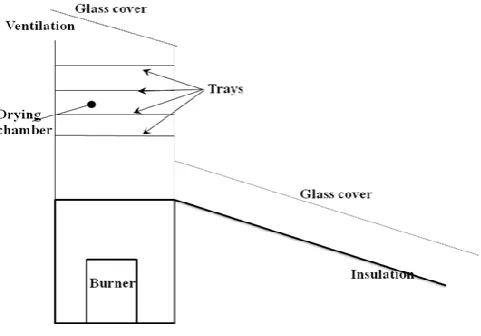
describe the deep bed drying of peanuts. Ezekoya and
Enebe (2006) designed and developed a modified
portable low temperature solar grain dryer (Figure 5), for
drying pepper and groundnuts. Eight days were
reported to be taken to dry groundnuts at average relative
humidity of 43% and average temperature of 63oC.
The average collector efficiency was found to be 10%,
while the dryer efficiency was 22%.
Recently Mannouche et al. (2014) studied the peanut
drying in natural indirect solar dryer in the climatic
conditions of Ouarbla, Algeria. The effect of drying on
peanut extraction process was also carried out. Yield of
oil in dried peanut was reported to be increased by
16.26% as compared to the fresh peanut.
Figure 5 Schematic of solar grain dryer (Ezekoya and
Enebe, 2006)
From the literature, it is found that groundnuts/peanuts
were dried naturally under open sun or by using natural
dryers to the safe moisture level. But time taken for
drying of groundnuts was more and qualities of dried
groundnuts were also reported to be low. The analysis
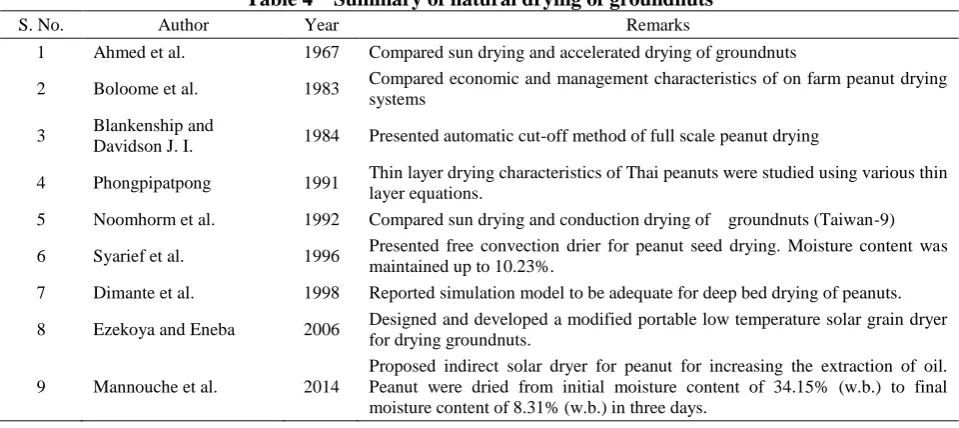
of the natural drying of groundnuts are summarised in
Table 4.
Table 4 Summary of natural drying of groundnuts
S. No. Author Year Remarks
1 Ahmed et al. 1967 Compared sun drying and accelerated drying of groundnuts
2 Boloome et al. 1983 Compared economic and management characteristics of on farm peanut drying systems
3 Blankenship and
Davidson J. I. 1984 Presented automatic cut-off method of full scale peanut drying
4 Phongpipatpong 1991 Thin layer drying characteristics of Thai peanuts were studied using various thin layer equations.
5 Noomhorm et al. 1992 Compared sun drying and conduction drying of groundnuts (Taiwan-9) 6 Syarief et al. 1996 Presented free convection drier for peanut seed drying. Moisture content was
maintained up to 10.23%.
7 Dimante et al. 1998 Reported simulation model to be adequate for deep bed drying of peanuts. 8 Ezekoya and Eneba 2006 Designed and developed a modified portable low temperature solar grain dryer
for drying groundnuts.
9 Mannouche et al. 2014
4.2 Mechanical drying
Disadvantages of open sun drying has led to replace it
with mechanical dryers which use fossil fuels to heat the
drying air and air is forced through the agricultural
products. Limtragoal and Directkstaporn (1985)
studied the performance of solar groundnut dryers and
the quality of the dried groundnuts in Northwest of
Thailand. They also discussed the economic aspects.
Delwiche et al. (1986) performed the analysis of
variance of microwave vacuum drying of Florunner
peanuts (at 4, 8, 16 and 32 times the normal rate of
conventional wagon drying). The percentage of normal
strong germinated kernels from microwave treatments
was reported to be significantly lower than from the deep
bed dried and dried within shell treatments. Parti and
Young (1992) compared the peanut bulk drying model
result and Virginia-type peanuts experiments test results.
Chung-Pfost equation was reported to be more accurate
in describing the hull moisture content but less accurate
in describing the kernel moisture content history as
compared to Henderson equation. Dowell et al. (1993)
reported the average and single kernel moisture
measured during curing and storage and studied the
drying behaviour of kernels during mechanical drying
and storage. Samples (average moisture content less
than 13.5%) were reported to be safe from mold or
aflatoxins problems.
Ketkaeo (2002) presented oven with heater infrared
drying for peanuts and proposed 70oC suitable
temperature for baking the groundnut. Boldor et al.
(2005) investigated the effect of microwave energy level
on temperature profiles and moisture reduction of farmer
stock peanuts during continuous microwave drying using
a planar applicator. Solar drying of groundnuts was
also carried out in a mixed mode natural convection
solar dryer with biomass burner (Figure 6) in Thailand
(Tarigan and Tekasakul, 2005). The dryer consisted of
a collector of (2.75 × 1.75) m2 area, absorber (made of
black painted zinc plate 0.05 cm thick), glass cover 0.5
cm thick, a biomass burner as a backup heating system
and drying chamber. Drying tests were conducted at 35
kg and 64 kg fresh unshelled groundnuts. During the
test of drying 35 kg groundnuts, the biomass burner was
used at night by burning 40 kg of wood. About 16
hours were taken to dry groundnuts from initial moisture
content of 135 % (db) to final moisture content of 13%
(db). However, it took three days for drying of 64 kg of
groundnuts when burner was not used at night. System
efficiency was reported to be 21.3% and 23% and
backup heater was reported to have efficiency of 40%.
Krzyzanowski et al. (2006) determined the potential of
the heat pipe technology (HPT) system in drying peanut
seed. Peanut seeds were dried from initial moisture
content of 17.4% to final moisture content of 7.3%.
The effect of drying on physical and physiological
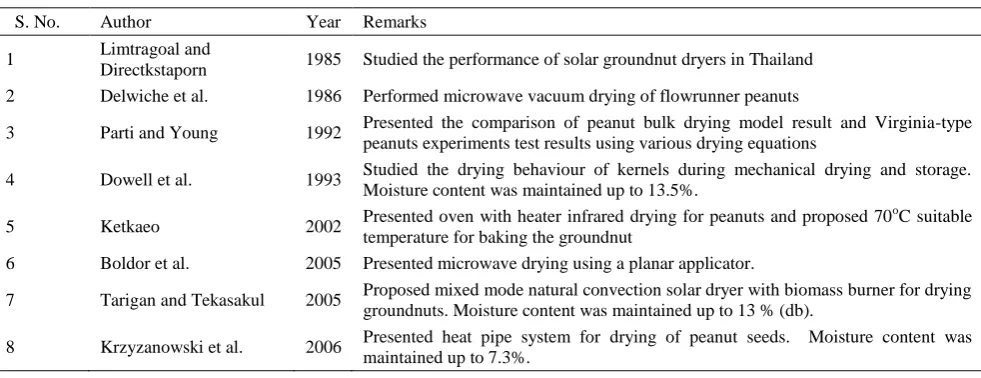
qualities of peanut was also determined. Summary of
peanut drying mechanically is given in Table 5.
Figure 6 Schematic of Solar Dryer with biomass
burner (Tarigan and Tekasakul; 2005)
It is observed from the literature, that peanut kernels
are dried mechanically to increase the quality of
groundnuts and reduce the drying time. But
mechanically dried peanuts consume much energy and
4.3 Forced drying
Natural drying of groundnuts is the cheapest method
but the qualities of groundnuts were found to be low and
drying time was also more. Therefore, to improve the
qualities of groundnuts and reduce the drying time,
forced drying of groundnuts is discussed in this section.
Blankenship and Chew (1979) studied the drying of
peanuts in single and double trailer dryer and total
peanut drying time was reported to be shorter in single
trailer dryer as compared with double trailer dryer.
Troeger and Butler (1980) studied the drying of peanuts
of different moisture contents by interrupting airflow for
15, 30 or 45 min/h. They used solar heated water or
liquefied petroleum gas to heat the drying air. Troeger
and Butler (1980a) constructed a solar drier to compare
three systems (solar heated water, solar heated air with
rock storage and conventional liquefied petroleum gas)
for drying peanuts. The dryer used fans and LPG
burners. Heat energy from solar storage was used to
preheat the air entering the fan. The solar heated water
and air systems used 41% and 74% solar energy
respectively, the remaining energy supplied by petrol
burners. Troeger (1982) carried out the analysis of
various factors affecting energy consumption and drying
time of peanut using a computer simulation model.
Airflow was recommended to speed up the drying of
peanut. Steele (1982) developed microprocessor based
peanut dryer control system and proposed energy
controlled techniques for drying peanut to minimize
energy consumption and compared with conventional
control procedures. First energy control technique was
reported to reduce liquid petroleum gas consumption by
49%, electric energy by 39% and increased time on dryer
by 65%. Net saving of $5.61 per tonne or 25%
reduction in peanut drying costs was reported for
Virginia conditions.
Nawungkalatusart and Tamtawatchai (1989) carried
out the continuous drying of groundnut kernels at
various temperatures (35oC, 40oC, 45oC, 50oC and 55oC).
Kernels dried at 55oC were reported to have lowest
germination of seed. Kumar and Kanagarajah (1990)
investigated the drying characteristics of peanut in
forced air oven and batch type rotary drier at various
temperatures. They designed and developed a rotary
conduction drier with sand as heating medium. Peanut
dried in forced air oven was reported to be superior than
dried in batch type rotary drier. Also, conduction
drying using sand as heating medium was reported to
increase the drying rate and quality of peanut as
compared to conduction drying using batch type rotary
drier. Gowda et al. (1991) studied the drying of
groundnut (DH-3-30) seeds at various drying air
temperatures with initial moisture contents of 35, 43 and
67 % (db), at air flow rate of 4 m3/min and loading
Table 5 Summary of peanuts drying mechanically
S. No. Author Year Remarks
1 Limtragoal and
Directkstaporn 1985 Studied the performance of solar groundnut dryers in Thailand 2 Delwiche et al. 1986 Performed microwave vacuum drying of flowrunner peanuts
3 Parti and Young 1992 Presented the comparison of peanut bulk drying model result and Virginia-type peanuts experiments test results using various drying equations
4 Dowell et al. 1993 Studied the drying behaviour of kernels during mechanical drying and storage. Moisture content was maintained up to 13.5%.
5 Ketkaeo 2002 Presented oven with heater infrared drying for peanuts and proposed 70
o
C suitable temperature for baking the groundnut
6 Boldor et al. 2005 Presented microwave drying using a planar applicator.
7 Tarigan and Tekasakul 2005 Proposed mixed mode natural convection solar dryer with biomass burner for drying groundnuts. Moisture content was maintained up to 13 % (db).
weight of 5 kg using the drying unit and were stored for
180 days to evaluate the seed quality. Among these
groundnut dries at 45oC and 50oC with initial moisture
content of 67 and 43% (db) respectively were reported to
be stored safely for 180 days.
Noomhorn et al. (1994) proposed rotary conduction
drier using sand as the heating medium for drying
peanuts up to the safe moisture content of 10% wb.
The performance characteristics of the drier were also
determined in terms of peanut quality and drying time.
Quality indexes of peanuts were reported to be
dependent on the operating conditions of the drier.
Optimum kernel temperature during conduction drying
was reported to be 40oC for good quality dried peanuts.
Bader et al. (1996) evaluated the total energy
consumption and curing time for various methods of
curing peanuts with dual-trailer driers. Three dryers
were operated continuously and three dryers were
operated intermittently. Electrical demand was
reported to be 23.8 kW and 32.1 kW for cycled and
continuous dryers respectively. Tumbel et al. (1997)
presented a rack type dryer “tray dryer” for peanut
drying from 63.23% moisture content to 10.12%
moisture content. They also studied and investigated
the quality of the dried beans. The energy consumption
and overall thermal efficiency of the dryer were reported
to be 790,000 kCal and 3.35% respectively.
Butts and Omary (1999) presented the comparison
between conventional peanut curing wagons and the bin
dryer in which the moisture content was maintained up
to 11%. A total of 451,717 kg peanuts were reported to
be cured in two stage dryer and 215,460 kg in
convectional dryers. A single batch in the two-stage
dryer was reported to be equivalent to three wagons.
Ertas et al. (1999) also proposed a semi trailer drying
system for drying peanuts for West Texas in which the
temperature inside the dryer was maintained at 35oC.
Labour cost was also reported to be reduced. Jain et al.
(2004) compared the drying of groundnut, ginger and
garlic in a forced convection solar dryer consisting of
flat plate collector panel and electrically operated tray
type mechanical dryer. The benefit cost ratio for the
solar dryer and mechanical dryer was found to be 1.56
and 1.18 respectively. The drying cost for drying
groundnuts in forced convection solar dryer was found to
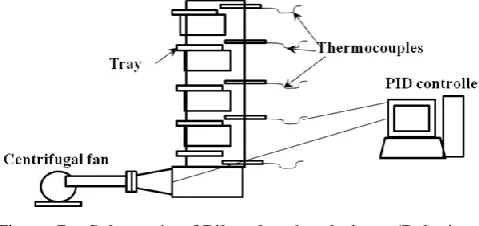
be 20% less as compared to mechanical dryer. Palacios
et al. (2004) dried the remoistened peanut pods (various
initial moisture contents) in batch dryer (Figure 7) at
different temperatures. They also evaluated effective
diffusivity for peanuts (in-shell and shelled) by applying
short time analytical model to measured data and
analysed its values in connection with structures of shell
and grains.
Decision support system was developed by Butts et al.
(2004) to manage commercial peanut drying facilities
and developed an empirical method for determining
peanut drying time and compared with the observed
drying time. Yang et al. (2007) carried out the
simulation study of peanut drying in a trailer-type dryer
with various thin layer drying models. Among these
models Henderson-Pabis model along with the
Hummeida model for Barberton model variety and
modified Oswin EMC model was reported to be the most
suitable. Ahmed and Murani (2012) proposed low cost
mobile flat-bed dryer for drying of groundnuts from
initial moisture content of 23.3% to final moisture
content of 14%. The drying efficiency was reported to
be 69%. Capacity of the dryer was reported to be 1818
kg. The cost of drying of groundnut was reported to be
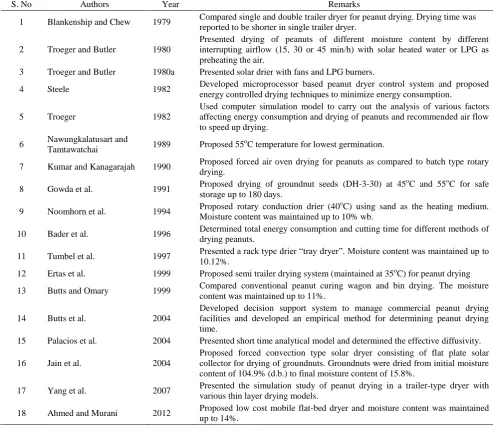
Rs. 1.45 per kg. Study carried out on forced drying of
groundnuts are summarised in Table 6.
Figure 7 Schematic of Pilot plant batch dryer (Palacios
Different types of dryers have been used to dry the
peanuts to safe moisture level. Peanuts dried under
forced convection drying were reported to be superior.
Various means were also used to increase the drying rate
and quality of peanuts.
5 Studies on storage and preservation of
groundnuts/peanuts
Work carried out on storage and preservation of
groundnuts is discussed in this section. After drying,
groundnuts are to be stored in gunny bags for storage.
Some of the requirements for successful storage of
groundnuts are: (i) place should be free from mold,
insects, and rancidity, (ii) temperature should be low.
Storage life of shelled and unshelled groundnuts at
various temperatures is given in Table 7 (Woodroof,
1983), (iii) relative humidity should be low. At relative
humidity of 65%-70%, groundnuts equalize at a moisture
content of about 7%. Above 70% of groundnuts are
likely to mold and below this they lose weight, become
brittle and may split during handling, and (iv). The
atmosphere should be well circulated and free from
odors. Groundnuts can be stored from about four
months to ten years by varying the temperature from 0
o
C to -12.2oC (Woodroof, 1983).
Anjelo and Ory (1974) studied the development of
peroxidation in peanut varieties for 12 months at 4oC.
They proposed packing under nitrogen or vacuum for
retarding peroxidation. Hoover and Miller (1974)
Table 6 Summary of forced drying of groundnuts
S. No Authors Year Remarks
1 Blankenship and Chew 1979 Compared single and double trailer dryer for peanut drying. Drying time was reported to be shorter in single trailer dryer.
2 Troeger and Butler 1980
Presented drying of peanuts of different moisture content by different interrupting airflow (15, 30 or 45 min/h) with solar heated water or LPG as preheating the air.
3 Troeger and Butler 1980a Presented solar drier with fans and LPG burners.
4 Steele 1982 Developed microprocessor based peanut dryer control system and proposed energy controlled drying techniques to minimize energy consumption.
5 Troeger 1982
Used computer simulation model to carry out the analysis of various factors affecting energy consumption and drying of peanuts and recommended air flow to speed up drying.
6 Nawungkalatusart and
Tamtawatchai 1989 Proposed 55
o
C temperature for lowest germination.
7 Kumar and Kanagarajah 1990 Proposed forced air oven drying for peanuts as compared to batch type rotary drying.
8 Gowda et al. 1991 Proposed drying of groundnut seeds (DH-3-30) at 45
oC and 55oC for safe
storage up to 180 days.
9 Noomhorn et al. 1994 Proposed rotary conduction drier (40
o
C) using sand as the heating medium. Moisture content was maintained up to 10% wb.
10 Bader et al. 1996 Determined total energy consumption and cutting time for different methods of drying peanuts.
11 Tumbel et al. 1997 Presented a rack type drier “tray dryer”. Moisture content was maintained up to 10.12%.
12 Ertas et al. 1999 Proposed semi trailer drying system (maintained at 35oC) for peanut drying 13 Butts and Omary 1999 Compared conventional peanut curing wagon and bin drying. The moisture
content was maintained up to 11%.
14 Butts et al. 2004
Developed decision support system to manage commercial peanut drying facilities and developed an empirical method for determining peanut drying time.
15 Palacios et al. 2004 Presented short time analytical model and determined the effective diffusivity.
16 Jain et al. 2004
Proposed forced convection type solar dryer consisting of flat plate solar collector for drying of groundnuts. Groundnuts were dried from initial moisture content of 104.9% (d.b.) to final moisture content of 15.8%.
17 Yang et al. 2007 Presented the simulation study of peanut drying in a trailer-type dryer with various thin layer drying models.
presented the pre treatment of Green peanuts with hot
water (120oF) and fungicides before packaging which
improved the reduction of microbial infection. Sanders
et al. (1981) studied the parameters (excess moisture,
high temperature and mechanical damage) on peanuts
from five warehouses. They suggested improved
storage environment such as improved ventilation for
minimizing the damage to peanuts during storage and
increase its quality. Smith et al. (1983) determined and
compared the temperature profiles within the peanuts in
flat type storage with natural and mechanical ventilation
for during the storage season. The mechanical
ventilated warehouse was found to be at a mean
temperature of 1oC–4oC less than the naturally ventilated
warehouse throughout of the storage period.
Smith et al. (1984) determined the effects of
mechanical and natural ventilation on over space
environment throughout the normal storage period for
farmers stock peanuts. Wilson et al. (1985) carried out
pilot scale peanut (US No. 1) storage tests using several
sizes of containers with peanuts stored under air, burner
gas (BG), N2, CO2 atmospheres. Peanuts were stored at
26oC±2oC for one year. Moisture content, relative
humidity, temperature, seed microflora aflatoxin
contamination and CO2, N2, O2 and N2 levels in the
storage containers were measured periodically. Branch
et al. (1987) carried out the studies to examine the
immersion of peanuts in hot water at 79oC for 90
seconds as a means of enhancing shelf life of peanut
stored at non-refrigerated conditions for 8 months.
Smith and Sander (1987) developed a new concept of
semi-underground storage of farmers stock peanuts by
developing a small semi-underground warehouse.
Temperatures and relative humidity were measured at
various locations during storage and quality of peanuts
was compared with the conventionally stored peanuts.
Troeger (1989) developed a model for estimating the
effects of curing conditions in the simulation model on
milling quality and on aflatoxin production. Smith et al.
(1989) evaluated the parameters (temperature, relative
humidity and quality changes) occurring in farmers stock
peanuts stored at 8% and 10% moisture content in
naturally and mechanically ventilated warehouses.
Baker et al. (1993) developed a new dryer heat control
method i.e. drying rate control (DRC) to avoid mold
problems and milling quality losses. DRC was tested
and compared with humidistat control (HC) and
conventional control (CC) using a simulation model and
laboratory tests. Airflow rates of 5, 10 and 15
m3/min/m3 were used. HC was reported to be better in
respect of peanut quality as compared to CC with lower
fuel cost but increased curing time. And DRC was
reported to be better in respect of peanut quality as
compared to CC with similar curing time and similar
fuel cost.
Tripathi and Kumar (2007) proposed Putranjiva
roxburghii oil as a preservative for peanut seeds against
spoilage by fungi and insects during storage.
Putranjiva leaf oil showed as a potent herbal preservative
for management of post-harvest infestation of peanuts on
the basis of its strong fungal toxicity at a low minimum
inhibitory concentration, insect repellency and long shelf
life. Poly lined gunny bag (PLGB), for highest
germination (72%), as packing material with desiccant
for storage of rabi or summer groundnuts were reported
by Gowda and Reddy (2008). Silica gel (30g/kg pod)
or Calcium chloride (10g/kg pod) was used as desiccant
material.
Morton et al. (2008) determined the effect of different
storage environment on peanut germination. Peanut pods
of four cultivars were stored in four environments and
seeds were subjected to standard germination tests and
field emergence evaluation. Passone et al. (2008)
studied the effect of food grade antioxidant emulsion on
aflatoxigenic growth and aflatoxin accumulation on
stored peanut pods to preserve the shelf life. Butylated
hydroxyanisole (BHA), propyl paraben (PP) and
butylated hydroxytouene (BHT) were reported to be
reduced significantly during the storage of peanuts.
occurrence of aflatoxins in stored hull and kernel
samples from Tupa, State of Paulo, Brazil. And Dorner
(2008) reviewed the techniques developed for managing
aflatoxins contamination when it occurs and presented a
newly developed methodology to prevent maximum
contamination.
Borker and Dharanguttikar (2014) evaluated twenty
two groundnut genotypes to study the physiological
analysis of growth and yield variation in groundnut
genotypes. Ozonation technique was presented by
Chen et al. (2014) to detoxify of aflatoxins in peanuts.
HPLC-FLD (high performance liquid chromatography
coupled to a fluorescence detector) method was also
used to detect the presence and levels of aflatoxins in
groundnuts in Turkey (Hepsag et al., 2014). Villers
(2014) has reviewed the field experience and research on
prevention of growth of aflatoxins during post harvest
storage in hot and humid countries. Various
preservation techniques for the farm products were
presented by Olunike (2014).
Torres et al. (2014) also presented the various
strategies and recent advances to prevent aflatoxins
contamination in peanuts. Modified atmospheric
storage condition was proposed by Vasudevan et al.
(2014). The seeds stored with the gaseous combination
of 60% N2 + 0% O2 + 40% CO2 were reported to show
better germination throughout the storage period
followed by the seeds stored under vacuum. To
increase the yield of groundnuts Aher (2014) proposed
the use of improved technology i.e. Rhizobium
bio-fertilizer. Gadhiya et al. (2014) studied the
effectiveness of insecticides for the management of
Helicoverpa armigera (Hubner) Hardwick and
Spodoteralitura (Fabricius) infesting groundnut.
Recently Sudini et al. (2014) suggested the triple layer
“Purdue Improved Crop Storage (PICS)” bags for the
sage storage of groundnut seeds.
Giradri et al. (2015) attempted to encapsulate the
food grade antioxidants (butylated hydroxyanisolz i.e.
BHA and butylated hydroxytoluene i.e. BHT) to increase
the storage time for peanuts. The storage and
Groundnuts are to be stored just after drying to its safe
moisture content. From the literature, it is found that
studies have been carried out to detect aflatoxins in
stored groundnuts and methods have been proposed to
detoxify them. Various methods have also been
proposed for safe storage and preservation of groundnuts
by using antioxidants, PICS bags, PLGB as packing
materials, modified atmospheric conditions, Putranjiva
oil etc. Use of bio-fertilizer has also been suggested to
increase the yield of groundnut.
Summary
Groundnut is one of the major oilseed crops in the
world and can be consumed as food. It is rich source of
proteins. Its production is about 39.9 million metric
tons per year. China is the leading country in world in
groundnut production followed by India. Various types
of groundnuts are consumed throughout the world in
many forms. Groundnuts are grown in warm and dry
season. Harvesting of groundnuts include digging,
lifting, windrowing, stocking and trashing. After
harvesting groundnuts are dried to its safe moisture
content by various means. Open sun drying is the most
primitive method of groundnut drying which is weather
dependant and also prone to microbial and other
contamination. In spite of many disadvantages open
sun drying is still practised throughout the world.
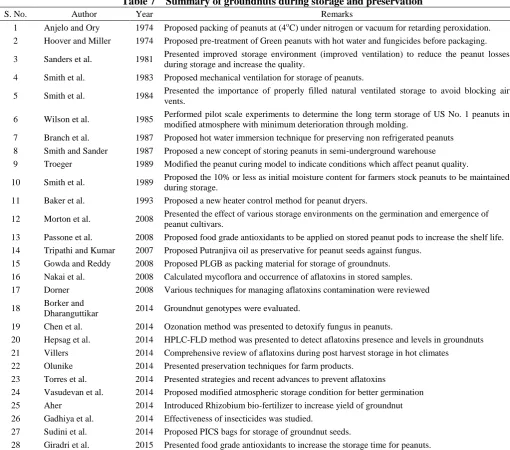
Table 7 Summary of groundnuts during storage and preservation
S. No. Author Year Remarks
1 Anjelo and Ory 1974 Proposed packing of peanuts at (4oC) under nitrogen or vacuum for retarding peroxidation. 2 Hoover and Miller 1974 Proposed pre-treatment of Green peanuts with hot water and fungicides before packaging. 3 Sanders et al. 1981 Presented improved storage environment (improved ventilation) to reduce the peanut losses
during storage and increase the quality.
4 Smith et al. 1983 Proposed mechanical ventilation for storage of peanuts.
5 Smith et al. 1984 Presented the importance of properly filled natural ventilated storage to avoid blocking air vents.
6 Wilson et al. 1985 Performed pilot scale experiments to determine the long term storage of US No. 1 peanuts in modified atmosphere with minimum deterioration through molding.
7 Branch et al. 1987 Proposed hot water immersion technique for preserving non refrigerated peanuts 8 Smith and Sander 1987 Proposed a new concept of storing peanuts in semi-underground warehouse 9 Troeger 1989 Modified the peanut curing model to indicate conditions which affect peanut quality.
10 Smith et al. 1989 Proposed the 10% or less as initial moisture content for farmers stock peanuts to be maintained during storage.
11 Baker et al. 1993 Proposed a new heater control method for peanut dryers.
12 Morton et al. 2008 Presented the effect of various storage environments on the germination and emergence of peanut cultivars.
13 Passone et al. 2008 Proposed food grade antioxidants to be applied on stored peanut pods to increase the shelf life. 14 Tripathi and Kumar 2007 Proposed Putranjiva oil as preservative for peanut seeds against fungus.
15 Gowda and Reddy 2008 Proposed PLGB as packing material for storage of groundnuts. 16 Nakai et al. 2008 Calculated mycoflora and occurrence of aflatoxins in stored samples. 17 Dorner 2008 Various techniques for managing aflatoxins contamination were reviewed 18 Borker and
Dharanguttikar 2014 Groundnut genotypes were evaluated.
19 Chen et al. 2014 Ozonation method was presented to detoxify fungus in peanuts.
20 Hepsag et al. 2014 HPLC-FLD method was presented to detect aflatoxins presence and levels in groundnuts 21 Villers 2014 Comprehensive review of aflatoxins during post harvest storage in hot climates
22 Olunike 2014 Presented preservation techniques for farm products. 23 Torres et al. 2014 Presented strategies and recent advances to prevent aflatoxins
24 Vasudevan et al. 2014 Proposed modified atmospheric storage condition for better germination 25 Aher 2014 Introduced Rhizobium bio-fertilizer to increase yield of groundnut 26 Gadhiya et al. 2014 Effectiveness of insecticides was studied.
27 Sudini et al. 2014 Proposed PICS bags for storage of groundnut seeds.
Although the hot air industrial driers are available to get
the good quality of the product, but they consume large
amount of energy. The scarcity of fossil fuel, steep rise
in the energy cost, and environmental pollution are the
driving factors in the use of energy efficient and
renewable drying process.
Groundnuts are stored and preserved in godowns for
future consumption. Small farmers store groundnuts
in-shell, in earthen pots, mud bins, bamboo baskets,
gunny bags, polythene bags. Groundnuts are subjected
to quality losses during storage through fungus, insects,
rodent infestation etc. About 6%-10% of the groundnut
kernels stored in bags are destroyed by insects. The
post harvest losses of food grains are also considered to
be about 20%-30%.
Solar energy is an important alternative source
because it is abundant, non-pollutant, and inexhaustible.
Also, it is environmentally benign, cheap, and renewable
which can be effectively used for drying purposes, if
harvested properly. Thus, there is urgent need for the
assessment of post harvest losses and develop some
means of drying and storage of groundnuts which are
cheap, energy saving and easily available for farmers so
that the losses can be minimized.
Acknowledgements
The author is obliged to Maharshi Dayanand
University for providing laboratory facilities.
References
Aher, D. K. 2014. Effective communication modes increases yield of groundnut in rural agriculture of kalwan tahsil of nashik district, maharashtra, India. Research Journal of Recent Sciences, ISSN 2277-2502, 3(ISC-2013), 6-8. Ahmed, M., and A. A. Mirani. 2012. Heated air drying of
groundnut. Pakistan Journal of Agricultural Research, 25(4): 272-279.
Ahmed, S. A., D. Ramachar, M. Allabaksh, and S. D. T. Rao. 1967.
Accelerated drying of groundnuts Journal of the Science of Food and Agriculture, 18(3): 116–118.
Akcali, I. D., A. Ince, and E. Guzel. 2006. Selected physical properties of peanuts. International Journal of Food Properties, 9(1): 25–37.
Anjelo, A. J. St., and R. L. Ory. 1974. Effects of lipid per-oxidation during storage on raw and roasted peanut proteins 1. Peanut Science, 2(2): 41-11.
Baker, K. D., J. S. Cundiff, and F. S. Wright. 1993. Peanut quality improvement through controlled curing 1.
Peanut Science, 20(1): 12-16.
Bader, M. J., S. W. Adkins, and C. L. Butts. 1996. Peanut curing by intermittent heat and air using dual-trailer dryers.
Applied engineering in agriculture, 12(2): 163-165. Beattie, J. H. 1954. Peanut growing. U.S. Farmer’s Bull. 2063.
U.S. Dept. Agric., Washington D.C. [online] (Accessed on June 15, 2014].
Blankeship, P., and V. Chew. 1979. Peanut drying energy consumption. Peanut Science, 6(1): 10-13.
Blankenship, P. D., and Jr. J. I. Davidson. 1984. Automatic monitoring and cutoff of peanut dryers. Peanut Science, 11(2): 58-60.
Branch, A. L., R. E. Worthington, I. L. Roth, M. S. Chinnan, and T. O. M. Nakayama. 1987. Effect of hot water immersion on storage of non-refrigerated peanuts. Peanut Science, 14(1): 26-30.
Bloome, P. D., D. D. Kletke, and J. R. Sholar. 1983. Comparisons of on-farm peanut drying systems in the southwest. Peanut Science, 10(2): 69-72.
Boldor, D., T. H. Sanders, K. R. Swartzel, and J. Simunovic. 2005. Thermal profiles and moisture loss during continuous microwave drying of peanuts. Peanut Science, 32(1): 32-41.
Borkar, V. H., and V. M. Dharanguttikar. 2014. Evaluation of groundnut (arachis hypogaea L.) genotypes for physiological traits. International Journal of Scientific and Research, 4(1): 1-8.
Burden, J. 1989. Prevention of post-harvest food losses: fruits, vegetables and root crops; a training manual. FAO. Butts, C. L., and M. S. Omary. 1999. Feasibility tests for a two
stage batch dryer for curing farmers stock peanuts.
Peanut science, 26(2): 68-73.
Butts, C. L., J. I. Davidson, M. C. Lamb, C. V. Kandala, and J. M. Troeger. 2004. Estimating drying time for a stock peanut curing decision support system. Transaction of the ASAE, 47(3): 925-932.
Chen, R., F. Ma, P.W. Li, W. Zhang, X. X. Ding, Q. Zhang, M. Li, Y. R. Wnag, and B. C. Xu. 2014. Effects of ozone on aflatoxins detoxification and nutritional quality of peanuts.
Food chemistry, 146: 284-288.
Delwiche, S. R., W. L. Shupe, J. L. Pearson, T. H. Sanders, and D. M. Wilson. 1986. Microwave vacuum drying effect on peanut quality. Peanut Science, 13(1): 21-27.
Dimante, L. M., M. S. Chinnan, and P. Mallikarjunan. 1998. Simplified simulation analysis of deep bed peanut drying.
Philippine Journal of Crop Science, 23(1): 53.
Dorner, J. W. 2008. Management and prevention of mycotoxins in peanuts. Food Additives and Contaminants, 25(2): 203–208.
DOR. 1983. Simple and effective post-harvest techniques for increasing seed viability of rabi/summer groundnut. Directorate of Oilseeds AA.
Dowell, F.E., C. L. Butt, and Jr. J. S. Smith. 1993 Effect of drying and storage on individual peanut kernel moisture contents. Presented at the 1993 ASAE International Winter Meeting sponsored by ASAE, Chicago, Illinois, 14-17 December 1993.
Dwivedi, S. L., S. N. Nigam, and G. Renerd. 1995. Groundnut: A food crop. Proceedings of national seminar on the prospects of groundnuts agribusiness development in Indonesia, Malang (Indonesia): 18-19 Dec. 1995.
Ertas, A., S. Firenza, B. T. Tanju, O. Cuvalci, T. T. Maiwall, M. Schubert, R. Henning, and C. Butts. 1999. Design and Development of A new Peanut Curing Process For West-Texas. Drying Technology, 17(6): 1149-1159. Export Import Data Bank, Ministry of Commerce, India. 2013.
[online] Available from
http://www.commerce.nic.in/eidb/ecom.asp (Accessed on March 17, 2014).
Ezekoye, B. A., and O. M. Enebe. 2006. Development and performance evaluation of modified integrated passive solar grain dryer. The Pacific Journal of Science and Technology, 7(2): 185-190.
Gadhiya, H. A., P. K. Borad, and J. B. Bhut. 2014. Effectivness of synthetic insecticides against helicoverpa armigera (hubner) hardwick and spodoptera litura (fabricius) infesting groundnut. The Bioscan, An International Journal of Life Sciences, 9(1): 23-26.
Girardi, N. S., D. Garcia, A. Nesci, M. A. Passone, and M. Etcheverry. 2008. Stability of food grae antioxidants formulation to use as preservatives on stored peanuts.
Food Science and Tachnology, 1-8.
Gowda D.J., Shivaprasad V. and Ramaiah H., 1991. Drying an storage studies on Groundnut (DH-3-30) seeds (Arachis hypogea L.). Karnataka J. Agri. Sci. 4 (1&2), 32-35. Gowda, B., and Y. A. N. Reddy. 2008. Storage of rabo or
summer groundnut with desiccant to prolong seed viability and seeding vigour. Karnataka J. Agric. Sci., 21(3): 353-356.
Hepsag, F., O. Golge, and B. Kabak. 2014. Quantitation of aflatoxins in pistachios and groundnuts using HPLC-FLD method. Food Control, 38: 75-81.
Hoover, M. W., and N. C. Miller. 1974. Storage of prepacked fresh “green” peanuts. Peanut Science, (2): 50-52. Jian, N. K., S. Kothari, and A. N. Mathur. Techno-economic
evaluation of s forced convection solar dryer. Journal of Agriculture Engineering, 41(3): 6-12.
Ketkaeo, S. 2002. Peanuts drying box using infrared.
Agriculture Science Journal, 33(6): 313-317.
Krzyzanowski, F. C., S. H. West, and J. D. B. F. Neto. 2006. Drying peanut seed using air ambient temperature at low relative humidity. Revista Brasileira de Sementes, 28(3): 01-05.
Kumar, P., and Kanagarajah. 1990. Study on convection and conduction drying of peanut. Summary Thesis. Non-conventional.
Limtragoal, J., and B. Directkstaporn. 1985. Solar groundnut dryer. ASEAN Technical seminar on grain post Harvest technology, Manila (Philippines).6-9Aug.
Madhusudana, B. 2013. A Survey on area, production and productivity of groundnut crop in India. IOSR Journal of Economics and Finance, 1(3): 01-07.
Mannouch, D., B. Bouchekima, S. Zibhmi, A. Boubekri, Boughali, and A. Matallah. 2014. International Conference on Clean Energy 2014 Istanbul, Yurkey, June 8–12, 2014. Misra, J. B. 2004. A Mathematical approach to comprehensive
evaluation of quality in groundnuts. Journal of food composition and analysis, 17(?): 69-79.
Morton, B. R., B. L. Tillman, D. W. Gorbet, and K. J. Boote. 2008. Impact of seed storage environment on field emergence of peanut (Arachis hypogaea L.) cultivars. Peanut Science, 35(2): 108-115.
Nakai, V. K., L. D. O. Rocha, E. G. Alez, H. Fonseca, E. Moise, M. Ortega, and B. Corre. 2008. Distribution of fungi and aflatoxins in a stored peanut variety. Food Chemistry, 106(1): 285–290.
Nautiyal, P. C. 2002. GROUNDNUT: Post Harvest Operations. Food and Agriculture Organization of the United Nations.
http://www.fao.org/fileadmin/user_upload/inpho/docs/Post _Harvest_Compendium_-_Groundnut.pdf (Accessed on June 14, 2014).
Nawungkalatusart, S., and C. Tamtawatchai. 1989. Groundnut drying by hot air. Proceedings of the eight Thailand National Groundnut Meeting, Khon Kaen University, Khon Kaen (Thailand): 432-436.
Noomhorm, A., K. Premkumar, and C. C. Ting. 1992. Accelerated drying of groundnuts in batch type rotary drier. ASEAN Journal 7(3).
Noomhorm, A., K. Premakumar, and H. T. Sabarez. 1994. Design and development of a conduction drier for accelerated drying of peanuts. Journal of Food Engineering, 21(4): 411–419.
Oniya, O. O., and A. I. Bamgboye. 2014. Production of biodiesel from groundnut (Arachis hypogea, L.) oil. Agric Eng Int.: CIGR Journal, 16(1): 143-150.
Olunike, A. A. 2014. Storage, Preservation and Processing of Farm Produce. Food Science and Quality Management, 27: 28-33.
Parti, M., and J. H. Young. 1992. Evaluation of a bulk drying model for peanuts. Peanut Science, 19(1): 1-7.
Palacios, T. R., L. B. Potes, R. A. Montenegro, and A. G. Sergio. 2004. Peanut Drying Kinetics: Determination of the effective diffusivity for in-shell and shelled peanuts by applying a short-time analytical model to measured data.
Drying 2004 – Proceedings of the 14th International Drying Symposium (IDS 2004), São Paulo, Brazil, 22-25 August 2004, vol. B, 1448-1455.
Passone, M. A., G. J. Funes, S. L. Resnik, and M. G. Etcheverry. 2008. Residue levels of food-grade antioxidants in postharvest treated in-pod peanuts during five months of storage. Food Chemistry, 106(2): 691-697.
Phongpipatpong, M. 1991. Thin layer drying characteristics of Thai peanuts. Summary Thesis.
Production of Agriculture and Animal Sector 2012-2013. Department of food processing, Punjab, India [online]
Available from
http://www.dofppunjab.info/Production%20Data%20Relat ed%20to%20Agriculture%20Sector.pdf (Accessed on June 13, 2014).
Reddy, A. A., and M. C. S. Bentilan. 2012. Competitiveness and technical efficiency: Determinants in the groundnut oil sector of India. Food Policy, 37(3): 255–263
Reese, G., and S. B. Lehrer. 1999. Food allergens in M. Frieri, & B. Kettelhut (Eds.), Food hypersensitivity and adverse
reactions: A Practical Guide for Diagnosis and Management: 69-97. New York: Marcel Dekker, Inc. Sanders, T. H., J. S. Smith, J. A. Lansden, and J. I. Davidson.
1981. Peanut quality changes associated with deficient warehouse storage. Peanut Science, 8(2): 121-124. Smartt, J. 1994. The groundnut crop: A scientific basis for
improvement. Springer Science and Business Media Dordrecht. [online] Available from: http://download.springer.com/static/pdf/124/bfm%253A97 8-94-011-0733-4%252F1.pdf?auth66=1421219099_87d7f 675d5e8ad45ceef9bb3979f2223&ext=.pdf
Smith, J. S., Jr. I. Davidson, T. H. Sanders, J. A. Lansden, and R. J. Cole. 1983. Changes in the temperature profile of farmers stock peanuts during storage. Peanut Science, 10(2): 88-93.
Smith, J. S., J. I. Davidson, T. H. Sanders, and R. J. Cole. 1984. Overspace environment in mechanically and naturally ventilated peanut storages. Peanut Science, 11(1): 46-49. Smith, J. S., and T. H. Sander. 1987. Potential for
Semi-Underground storage of farmers stock peanuts.
Peanut Science, 14(1): 34-38.
Smith, J. S., J. T. H. Sander, and K. L. Crippen. Storability of farmers stock peanuts at two moisture levels in mechanically and naturally ventilated miniature warehouses. Peanut Science, 16(1): 58-62.
State of Indian Agriculture, 2012-13. Government of India, Ministry of Agriculture, Department of Agriculture and Cooperation, Directorate of Economics and Statistics, New Delhi. [Online] Available from http://agricoop.nic.in/Annual%20report2012-13/ARE2012 -13.pdf [Accessed on December 25, 2013].
Steele, J. L. 1982. A microprocessor control systems for peanut drying. Peanut science, 9(2): 77-81.
Sudini, H., G. V. R. Rao, C. L. L. Gowda, Chandrika R., Margam V., Rathore A. and Murdock L.L., 2014. Purdue Improved Crop Stotage (PICS) bags for safe storage of groundnuts. Journal of Stored Products Research (in press),1-6. Syarief, A. M., W. Q. Mugnisjah, S. Kuncoro, and J. Umendong.
1996. Drying of peanut seed using free convection type drier. Journal Penelitian Pengembabgan Wilayah Lhan Kering, 17: 1-16.