CUBIC INTERPOLATION BASED CHANNEL ESTIMATOR FOR
RECTANGULAR
M
-QAM
O. O. Ogundile
1,*, O. A. Osanaiye
2and E. O. Falayi
31, 3,
D
EPT OFP
HYSICS&
T
ELECOMMUNICATION,
T
AIS
OLARINU
NIV.
OFE
DUCATION,
I
JEBU-O
DE,
O
GUNS
TATE.
NIGERIA.
2
D
EPARTMENT OFT
ELECOMMUNICATION,
F
EDERALU
NIVERSITY OFT
ECHNOLOGYM
INNA,
N
IGERS
TATE,
NIGERIA.
E-mail addresses:
1[email protected],
2[email protected],
3[email protected]
ABSTRACT
This paper propose a Pilot Symbol Assisted Modulation (PSAM) channel estimation and compensation technique for rectangular M-QAM based on Cubic interpolation in order to determine the channel state information (CSI) over flat Rayleigh fading channels. The proposed Cubic channel estimator technique is based on sliding window approach and pilot symbol estimates adjustment in order to reduce its computational time complexity. The Cubic estimator is combined with the Koetter and Vardy (KV) Reed-Solomon (RS) decoder to test its performance. The simulation results show that the Cubic interpolation gives the same performance as the Linear, and Sinc interpolators over slow flat Rayleigh fading channel; however, it achieves significant performance improvement of +1.0dB in symbol error rate (SER) over fast flat Rayleigh fading channel.
Keywords: CSI, cubic estimator, fading channel, M-QAM, PSAM
1. INTRODUCTION
Pilot Symbol Assisted Modulation (PSAM) channel estimation techniques have been used extensively and effectively in practical estimation of the channel state information (CSI) for M-ary quadrature amplitude modulation (M-QAM) systems over Rayleigh fading channels with Additive White Gaussian Noise (AWGN). In practice, the CSI is not available to the demodulator; therefore, different channel estimation techniques have been proposed in literature to analyse the effect of channel errors and improve the performance of the demodulator [1–7]. Emphasis has been on the trade-off between the complexity and performance of these channel estimation techniques over flat Rayleigh fading channels.
With high data transmission rate demand and reduced bandwidth consumption in wireless technology, the use of spectral efficient and high data rate modulation schemes is of practical importance. For high M, M-QAM systems achieve high throughput without additional bandwidth expansion. However, the performance of M -QAM over Rayleigh fading channels is dependent on pinpoint accurate estimations of the CSI. In [2], a PSAM channel estimation technique using Gaussian interpolation to estimate the CSI was proposed. Although, the Gaussian interpolation method is simple
with low complexity, the performance of the estimator rapidly degrades with increase in the frame length size L. The author in [1] and [3] employed Wiener filtering interpolation and Sinc interpolator respectively to estimate the CSI. Both methods give comparable symbol error rate (SER) performance at small Doppler frequencies but the Wiener interpolation comes with increased complexity as it requires priori information of the channel in order to estimate the filter coefficients [3]. The Sinc interpolator method yields better SER performance over flat Rayleigh fading channel as compared to Gaussian interpolation; however, the performance of these estimation techniques degrade rapidly as the Doppler frequency increases.
CSI estimates for M-QAM over flat Rayleigh fading channels using Linear interpolation were analysed in [6] and [8]. The Linear interpolation PSAM channel estimation technique achieves considerable good SER performance over fast flat Rayleigh fading channel. This interpolation technique offers low computational time complexity compared to most interpolation techniques found in literature. The performance of this interpolation technique degrades with increase in L but the technique is very useful when low implementation complexity is key to the system design. Since there should be a balance between the performance of the
Vol. 37, No. 2, April 2018, pp.
445 – 449
Copyright© Faculty of Engineering, University of Nigeria, Nsukka,Print ISSN: 0331-8443, Electronic ISSN: 2467-8821
www.nijotech.com
channel estimation technique and its implementation complexity, this work proposes an estimation technique for rectangular M-QAM based on Cubic interpolation. The proposed Cubic channel estimator is based on a sliding window approach and pilot symbol estimates adjustment in order to reduce the computational time complexity of the estimation technique.
The rest of the paper is structured as follows. In Section 2.0, the general system model for the channel estimators and notations are explained. A brief overview at the existing PSAM channel estimation techniques is carried out in Section 3.0. Section 4.0 explains the proposed Cubic channel estimator for rectangular M-QAM in detail. Comparison and discussion of results are presented in Section 5.0. Section 6. 0 summarises and conclude the paper.
2. SYSTEM MODEL
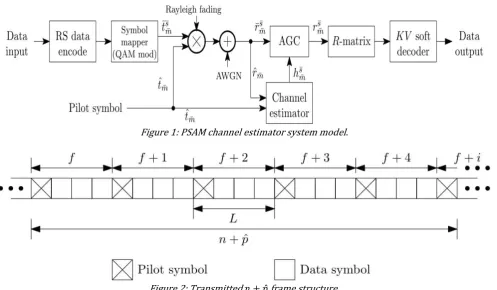
Consider the PSAM system model shown in Figure 1. The input data is encoded using an RS (15,7) low rate code. The encoded data is mapped to rectangular 16-QAM complex data symbols in which both the real and imaginary parts take values from a set where Γ is of the form M = [9]. Known pilot symbols ̂ are
periodically inserted to the transmitted QAM symbols as shown in Figure 2. The total number of pilot symbols inserted in each transmitted codeword n is defined by
̂. The frame number, and total number of frames in each transmitted codeword n are denoted as f, and respectively (note, that
i
is the total number of frames). Each frame starts with a pilot symbol and subsequently data symbols. The data and pilot symbols are transmitted over a flat Rayleigh fading channel with a Doppler frequency .The faded received signal corrupted with AWGN in the current ̅ frame after down-converting and matched filtering is given as:
̅̅ ̅ = ̅ ̅̅ ̅ ̅̅ ̅ ̅ =
where ̅ ̅̅ is the complex zero mean Gaussian variables
denoting the fading distortion at the data symbol positions, ̅ is the complex AWGN with variance No/2,
and ̅ ̅̅ is the transmitted QAM symbols.
The noisy fading estimates at the ̅ pilot symbol positions is obtained by dividing the received pilot symbols by the known transmitted pilots as:
̅ =
̂̅
̂̅
= ̂̅ ̅
̂̅
where ̂̅ and ̂̅ are the transmitted and received pilot
symbols respectively, ̂̅ is the complex zero mean
Gaussian variables representing the fading distortion at the pilot symbol positions. The fading estimates ̅̅ in
the current ̅ frame at the data symbol position is computed by interpolating the known pilot symbol fading estimates ̅
Figure 1: PSAM channel estimator system model.
The received data symbol ̅̅ ̅ is scaled to compensate
for the channel error in a process called Automatic Gain Control (AGC). This is achieved by dividing the received data symbol ̅̅ ̅ by the fading channel estimates ̅̅ as:
̅ ̅ = ̅̅
̅
̅
̅
where ̅ ̅ is the scaled received data symbol. The scaled
received data symbols ̅ ̅ are used in computing the R
-matrix which is fed into the KV soft decoder [10]. The KV algorithm converts the received soft probabilistic reliability information from the channel into a choice set of interpolation points along with their multiplicities in the Guruswami and Sudan algorithm [10] [11] [12]. A list size ̅ = is assumed for the KV soft decoder [10] in the system model of Figure 1 for reduced simulation complexity. The list size ̅ ̅ determines the decoding performance of the KV soft-decision decoder. The higher the value of the list size the better the decoding performance of the KV algorithm but at the price of increased decoding complexity.
3. PSAM INTERPOLATION TECHNIQUES 3.1. Linear Interpolation
The Linear interpolation based channel estimation for M-QAM offers very low computational time complexity (O(n)) to the overall system design. Basically, the interpolation process to estimate the CSI at the data symbol positions is achieved by using the fading estimates ̅ of two nearest pilot symbols. Considering
the transmitted frame structure (L = 4) of Figure 2, the CSI at the ̅ data symbol positions in the current ̅ frame is given as:
̅ ̅ = ∑
̅
̅
̅ ̅
where is the Linear interpolation coefficient defined as ̅ ⁄ .
3.2 Sinc Interpolation
Sinc interpolation circumvents the computational load inherent in the Wiener filtering interpolation. This technique do not require priori information of the channel to estimate the CSI ̅̅ at the data symbol
positions. The CSI ̅̅ at the data symbol positions is
determined using Io nearest pilot symbol fading
estimates ̅, where Io is the interpolation order.
Depending on the interpolation order, the Sinc interpolation technique uses ⌊ ⁄ ⌋ previous
pilot fading estimates ̅ ⌊ ⁄ ⌋ the current pilot
fading estimate ( ̅) and ⌊ ⁄ ⌋ next pilot fading
estimates ̅ ⌊ ⁄ ⌋ to compute the ̅ data symbol in
the ̅ frame [4]. Thus, the estimated fading distortion in the ̅ frame is given as:
̅
̅ = ∑ ̅ ⌊ ⁄ ⌋
̅ ⌊ ⁄ ⌋
where is the Sinc interpolator coefficient defined as Sinc ( ̅ ⁄ ) [3], [4]. The interpolation coefficient is weighted with a window function. An interpolation order Io = 4 is assumed in this paper, and a Hamming
window is applied to the Sinc interpolation coefficient [7]. Note, as mentioned in [7], the computational time complexity of the Sinc interpolator increases with increase in the interpolation order Io, which
subsequently delays the interpolation process.
4. PROPOSED CUBIC INTERPOLATION
It is natural to maintain a balance between the performance of the channel estimation technique and its implementation complexity. This work propose a Cubic polynomial channel estimation technique based on Least Square (LS) approximation. The CSI ̅̅ at ̅
data symbol position using this proposed interpolation technique is computed by interpolating the four nearest pilot symbol fading estimates ̅.
Given that ( ̅, ̅ ) are the four nearest pilot symbol
fading estimates to the ̅ data symbol and ( ̅,...., ̅ ) are the known positions of the pilot
symbols in the transmitted frame structure as shown in Figure 2. Thus, we compute the fading estimates in the current ̅ frame as:
̅
̅ = ∑ ̅
̅
̅ ̅
where ( ,..., ) are the Cubic interpolation coefficients which we define as:
[
̅ ̅ ̅ ̅
] =
[
̅ ̅ ̅
̅ ̅ ̅ ̅ ̅ ̅
̅ ̅ ̅ ]
[ ]
estimator for large input data. Therefore, a sliding window approach is assumed in computing the cubic interpolation coefficients in order to reduce the computational time complexity from (O(n3 →
(O(n2)).
The four nearest pilot symbols positions are fixed as ( ), and we shift (adjust) the
fading estimates at the pilot symbol positions from ̅
to ̅ while computing the interpolation coefficients
from frame f to f + i. Thus, Eq. (7) is modified as:
[
̅ ̅ ̅ ̅
] =
[
]
[ ]
In order to reduce the computational complexity in computing the interpolation coefficients. As shown in Figure 2, each frame starts with a pilot symbol, so is always equal to one ( = ) for any transmitted structure frame length size L. Using Eqs. (8) and (6), we can estimate the fading distortion at the data symbol positions in the current ̅ frame.
5. SIMULATION RESULTS
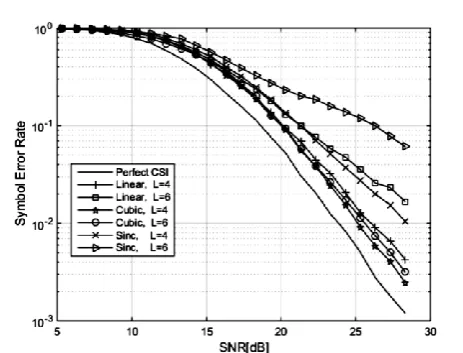
To verify the performance of the proposed Cubic estimator technique, the estimator is tested with rectangular 16-QAM combined with the KV soft decoder [10]. The system is simulated using MATLAB software. The estimator is applied assuming a slow-varying flat Rayleigh fading channel (Doppler frequency = 50Hz), and a fairly fast flat Rayleigh fading channel (Doppler frequency = 100Hz) as shown in Figures 3 and 4, respectively. Frame length sizes L = 4 and L = 6 are used in order to test the performance of the cubic estimator for increase in L. All other parameters for each channel estimation technique are defined as above.
Figure 3: SER performance comparison for different PSAM channel interpolators and frame length sizes L for rectangular 16-QAM combined with KV soft decoder
over slow flat Rayleigh fading channel. Doppler frequency, = 50Hz, and ̅ = .
As shown in Figure 3, the Cubic channel estimator offers comparable SER performance with the Linear, and Sinc channel estimators, even with increase in L. However, the performance of the Linear, and Sinc interpolators degrade with increase in the Doppler frequency (from =50Hz to =100Hz), more significantly when L increases (from L=4 to L=6) as depicted in Figure 4. The proposed Cubic estimator offers significant improvement in SER performance (+1.0dB) as compared to the Linear, and Sinc interpolators over fast-varying flat Rayleigh fading channel. Also as shown in Figure 4, at SNR > 15dB, it is observed that the performance of the Cubic interpolator at L = 6, surpasses the Linear interpolator performance by +1.0dB, and the Sinc interpolator performance by +0.3dB at frame length size L = 4. The cubic interpolator adds delay to the interpolation complexity time as it requires four nearest pilot fading estimates ( ̅, ...., ̅ ) to calculate the CSI. The
proposed Cubic estimator provides a practical computational time complexity (O(n2)) to the overall
system model for large input data size compared to the time complexity (O(n)) provided by the Linear, and Sinc interpolation (complexity of the Sinc interpolator increases with increase in Io, which may become more
complex than the Cubic interpolation technique for high Io). The Cubic interpolator offers a SER gain of
+1.0dB over the Linear, and Sinc channel estimators at SNR >15dB assuming a fast flat Rayleigh fading channel. Thus, the proposed estimation technique for rectangular M-QAM offers a reasonable balance in the channel estimator performance and complexity, and it can be implemented for real time systems.
Figure 4: SER performance comparison for different PSAM channel interpolators and frame length sizes L for rectangular 16-QAM combined with KV soft decoder
6. CONCLUSION
The PSAM channel estimation for rectangular M-QAM using Linear, Sinc, and Cubic interpolation techniques combined with KV soft decoder has been analysed for different frame length sizes L. The proposed Cubic channel estimator exhibits considerably higher complexity than the Linear, and Sinc estimators, but it offers superior SER performance to the Linear, and Sinc estimators over fast flat fading channel. Furthermore, at high signal to noise ratio (SNR > 25dB), it can be observed from the simulation results that the Cubic estimator gives significant SER gain performance (+1.5dB) as compared to the other channel estimators analysed in the paper over fast flat Rayleigh fading channel. Simulation results of the SER performance for the different channel estimators confirm our analysis.
7.REFERENCES
[1] J C vers “A A lysis of Pilot Symbol Assiste Mo ul tio for R yleigh F i g Ch els ” IEEE, Transaction on Vehicular Technology, vol. 40, no. 4, pp. 686–693, November 1991.
[2] S S mpei T Su g “R yleigh Fading Compensation for QAM in Land Mobile Radio Commu ic tio s ” IEEE Transaction on Vehicular Technology, vol. 42, pp. 137–146, May 1993.
[3] Y. Kim, C. Kim, G. Jeong, Y. Bang, H. Park and S. Choi, "New Rayleigh fading channel estimator based on PSAM channel sounding technique," Communications, 1997. ICC '97 Montreal, Towards the Knowledge Millennium. 1997 IEEE International Conference on, Montreal, Que., pp. 1518-1520 vol.3, 1997.
[4] X. Tang, M. S. Alouini and A. J. Goldsmith, "Effect of channel estimation error on M-QAM BER performance in Rayleigh fading," in IEEE
Transactions on Communications, vol. 47, no. 12, pp. 1856-1864, Dec 1999.
[5] O. Oyerinde and S. Mneney “Iter tive receiver with soft-input-based-channel estimation for orthogonal frequency division multiplexing-i terle ve multiplexing-ivmultiplexing-ismultiplexing-io multmultiplexing-iple ccess systems ” Communications, IET, vol. 8, no. 14, pp. 2445– 2457, Sept 2014.
[6] M Be jill hi L Szczeciński “Low Complexity Channel Estimation with Pilot Symbol Assisted Mo ul tio ” IEEE Signal Processing and Its Applications, vol. 2, pp. 471–474, August 2005.
[7] L Xi o X Do g A C K Soo g “O the Desig of Sinc Interpolator for Pilot Symbol Assisted Modulation Systems ” IEEE Tr s ctio o Wireless Communication, vol. 5, no. 9, September 2006.
[8] A Mämmelä V K sil “Smoothi g Interpolation in a Pilot Symbol Assisted Diversity System ” International Journal of Wireless Information Networks, vol. 4, no. 3, 1997.
[9] O Ogu ile D Versfel “Perform ce evaluation of polynomial based channel estimation for OFDM systems on time-varying frequency-selective f i g ch els ” i AFRICON Sept 2015, pp. 1–6. 2015,
[10] R. Koetter A V r y “Algebr ic soft-decision decoding of Reed-Solomo co es ” IEEE Transactions on Information Theory, vol. 49, no. 11, pp. 2809–2825, Nov 2003.
[11] V Gurusw mi M Su “Improve eco i g of reed-Solomon and algebraic-geometry co es ” IEEE Transactions on Information Theory, vol. 45, no. 6, pp. 1757–1767, Sep 1999.