ISSN 0975-928X
Research Article
Gene action and combining ability analyses to develop NPT based rice hybrids
in Chhattisgarh plains
Ishu Kumar Khute, Satyapal Singh, Parmeshwar Sahu and Deepak Sharma Department of Genetics and Plant Breeding, Indira Gandhi Krishi Vishwavidyalaya, Raipur 492012, Chhattisgarh.
Email: [email protected]
(Received: 13 Aug 2014; Accepted:13 May 2015)
Abstract
Combining ability in New Plant Type (NPT) lines of rice for hybrid rice breeding programme has been carried out in line x tester mating design involving 3 CMS lines and 6 testers. The analysis of variance for combining ability of all the traits showed that variances due to treatments, parents, hybrids were highly significant. The analysis further revealed highly significant differences for all the characters among the lines, testers and line X tester and parents’ vs hybrids. Among the CMS lines IR 58025A was identified as a good general combiner for grain yield per plant. Among the testers NPT line HR 703 (3.09) was found to be good combiner for grain yield per plant followed by Jirashankar (NPT-Sel) (2.36) and IIRON N-1-114(0.79). The significant difference between lines x tester interaction indicates that SCA attributed heavily in the expression of these traits and demonstrates the importance of dominance or non additive variances for all the traits. Three crosses viz., IR 58025A/HR 703, IR 79156A/IIRON N-1-114, and CRMS 31A /PAU1196 were identified as most promising based on SCA effects, better per se
performance and both the parents with high or low GCA effects.
Key words
Rice, Combining ability, gene action, cytoplasmic male sterile line.
Introduction
Rice has been one of the most important food crop in the world and feeding more than half of the world’s population. Chhattisgarh is popularly known as “Rice bowl of India” and occupies an area around 3.61 millions hectare with the production of 5.48 millions tones and productivity 1517 kg/hectare (Anonymous 2013).
The rising demand and saturation of cultivable field are likely to cause a supply shortage of rice in future. Hybrid rice technology offers an opportunity to boost the yield of rice. Breeding strategies for developing hybrids with high yield potential and better grain quality require the expected level of heterosis and combining ability. Combining ability offers a powerful tool for estimating the value of a parent to produce superior hybrids and helpful for selection of better parents for effective breeding programme. Its role is important to decide parents, cross and appropriate breeding procedures to be followed to select desirable segregants’ (Salgotra et al., 2009) keeping this in view the present investigation was carried out to study the combining ability in order to identify good combiners and superior hybrid combinations.
Materials and method
The material for the present study comprised 18 F1s
of rice generated by using 3 CMS lines (IR 58025A, IR 79156A and CRMS 31A) and 6 testers (PAU 1196, Jirashankar (NPT-sel), R1138-396-821-3-1, TCN 518, IIRON N-1-114 and HR HR 895) through line X tester design during rabi season 2012. The resultant 18 F1 s and 9 parents are grown in
Randomized Completely Block Design with two replications during kharif 2013 in research farm hybrid rice field Department of Genetics and Plant Breeding, College of Agriculture, I.G.K.V. Raipur (C.G.)
Twenty one days old seedlings of parents were transplanted in crossing block in five rows of one meter length keeping 20 X 15 cm spacing and three CMS lines were transplanted in separate blocks to avoid out crossing with other parents. Single seedlings per hill was transplanted, package of practices were followed. Observations were recorded on 5 randomly selected plants in both the replications for eleventh character viz. Days to 59% flowering, Plant height, Productive tiller per plant, panicle length, No. of spikelet per panicle, spikelet fertility percentage, Pollen fertility percentage, 1000 grain weight, Grain yield per plant, biological yield per plant and harvesting index.
ISSN 0975-928X
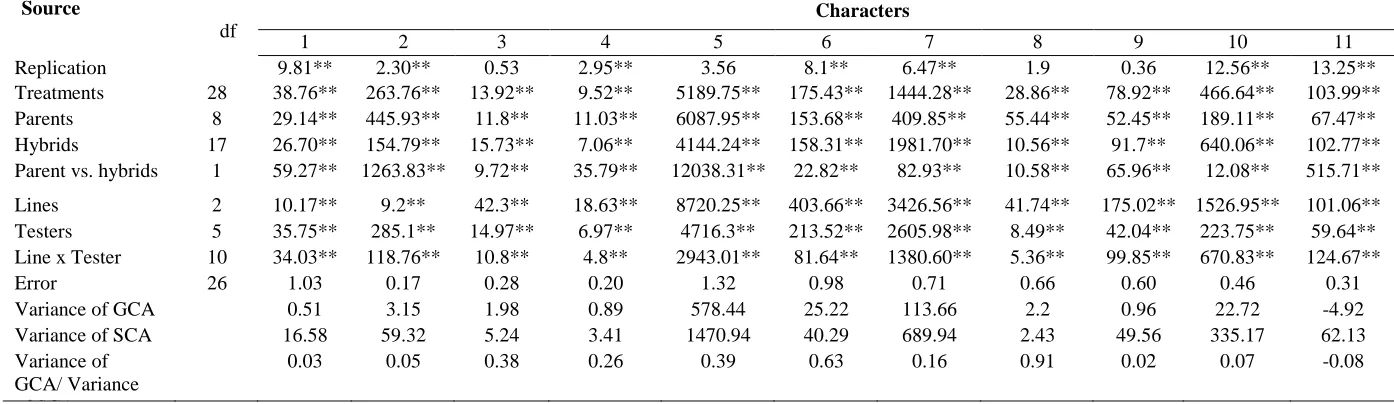
Analysis of variance for yield and different yield contributing characters ( Table-1) revealed significant variations for all the characters viz., days to 50% flowering, plant height(cm), productive tiller per plant, panicle length(cm), no. of spikelet per panicle, spikelet fertility percentage, pollen fertility percentage, 1000 grain weight(gm), grain yield per plant(gm), biological yield per plant(gm) and harvesting index(%).The analysis further revealed highly significant differences for all the characters among the lines, testers and their hybrids these indi-cates that they are suitable for combining ability studies. The treatments are highly significant for all the character. The parents, parent X hybrid are significant for all traits that revealed good scope for manifestation of heterosis in all the studied traits. These results coincide with the findings of (Jayasudha and Sharma, 2009; Rahimi et al., 2010). Line X Tester analysis is also found significant for all the character, indicated that specific combining ability attributed heavily in the expression of these traits and provide the importance of dominance or non additive variances for all the traits. Several researchers have reported the predominance of dominant gene action for a majority of the yield traits in rice (Faiz et al., 2006; Satyanarayan et al., 2000).
The GCA variance was found highest for no. of spikelet/panicle (578.44) followed by Pollen fertility percentage (113.66), Spikelet fertility (%) (25.22) and Biological yield per plant (g) (22.72). The SCA variance was found highest for number of spikelet/panicle (1470.94) followed by pollen fertility percentage (689.94), biological yield per plant (335.17), harvest index (62.13), plant height (cm) (59.32), grain yield per plant (49.56) and spikelet fertility percentage (40.29). Similar results were also observed by Siva Subramanian and Menon (1973) Siddiq et al. (1992), Satyanarayana et al. (2000) and Bisne and Motiramani (2005). The present results indicate the preponderance of non-additive gene action in the expression of all the traits studied and a very good prospect for the exploitation of non-additive genetic variation for traits through hybrid breeding.
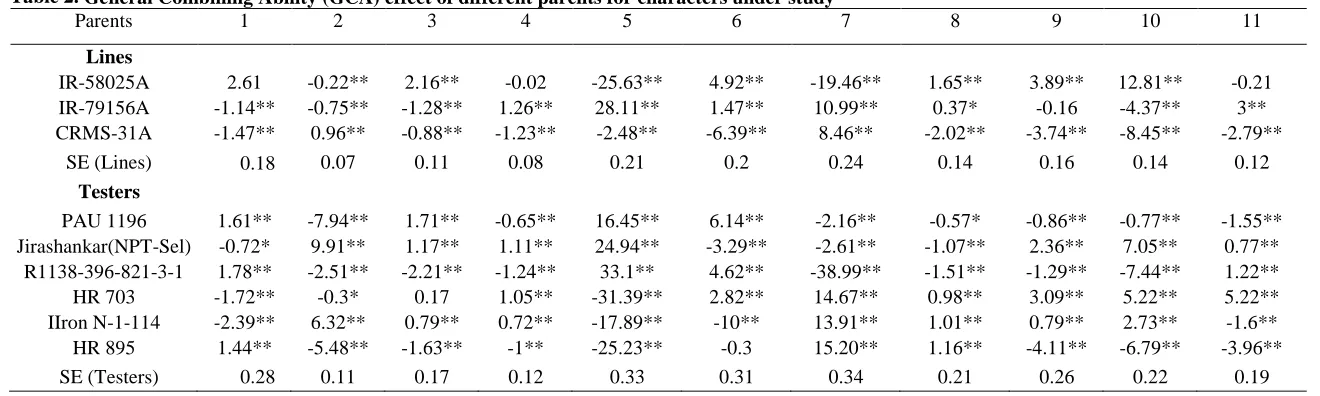
Estimation of GCA effects (Table-2) of lines revealed that IR 58025A (3.89) was identified as a good general combiner for grain yield per plant. Among the testers HR 703 (3.09) was found to be good combiner for grain yield per plant and followed by Jirashankar(NPT-Sel) (2.36) and IIRON N-1-114(0.79). For lines GCA effects is significant for all the character excepts days to 50% flowering, panicle length and grain yield per plant for tester GCA effects is significant for all the character excepts
productive tillers per plant and spikelet fertility percentage.
Specific combining ability (SCA) of a cross is the estimation and the understanding of the effect of non additive gene action for a trait. Non-additive gene action of a trait is an indicator for the selection of a hybrid combination. Therefore, a highly significant SCA effect is desirable for a successful hybrid breeding program. Among the 18 hybrids, 12 hybrids have shown significant SCA effects (Table-3). 5 hybrids have shown the positive significant SCA effects and 7 hybrids have shown the negative significant SCA effects. The highest positive significant SCA effects have shown by cross IR 79156A /IIRON N-1-114 (10.52). On the basis of mean per se performance, GCA effects of parents and SCA effects of hybrids (Table-4) the hybrids IR 58025A/HR 70, IR 79156A/IIRON N-1-114 and CRMS 31A/PAU 1196 found promising. Among this first cross have the high x high GCA and other two crosses have one is high and other one have the low GCA effects.
Similar findings were also supported by Bisne and Motiramani (2005), Sharma et al. (2005), Kumar et al. (2006), Murugan and Ganesan (2006), Sao and Motiramani (2006), Sharma (2006), Singh et al. (2007) Bagheri and Jelodar (2010), Mirarab et al. (2011) and Ghara et al. (2012).
Superior testers viz. HR-703, Jirashankar (NPT-sel.) and IIRON N1-114 were identified as good general combiner for grain yield per plant and contributing characters may be used for further study to develop good hybrids with other new CMS lines. The superior identified hybrids viz., IR 58025A/HR 703 and IR 79156A/IIRON-1-114 should be tested in next year. These promising NPT hybrids offer greater scope for further exploitation of hybrid vigour commercially.
References
Gujja, B. and Thiyagrajan, T.M. 2012. Knowledge and practice SRI (System of Rice Intensification), reducing agriculture foot print and ensuring food security. Hyderabad. 12p.
Anonymous, 2013. Annual report 2012-13. Department of agriculture and cooperation, Ministry of Agriculture, Government of India. New Delhi. 4p.
Anonymous, 2013. Krishi Digdarshika. 2013. Directorate of Extension Services. I.G.K.V., Raipur (C.G.) Jayasudha S, Sharma D (2009). Combining ability and gene
ISSN 0975-928X
Rahimi R, Rabiei B, Samizadeh H, Kafi Ghasemi A (2010). Combining ability and heterosis in rice cultivars.
J. Agric. Sci. Technol., 12:223-231.
Faiz FA, Sabar M, Awan TH, Ijaz M, Manzoor Z (2006). Heterosis and combining ability analysis in basmati rice hybrids. J. Animal Plant. Sci., 16:1-2.
Satyanarayan PV, Reddy MSS, Kumar I, Madhuri J (2000). Combining ability studies on yield and yield components in rice. Oryza, 37(1):22-25
Bisne, Rita and Motiramani, N.K. 2005. Study on Gene Action and Combining Ability in Rice. Oryza,42 (2):153-155.
Siva Subramanian, S. and Madhavamenon, P. 1973. Genetic Analysis of Quantitative Characters in Rice Through Diallel Crosses. Madras Agric. J.,
60: 1097-1102.
Sarawgi, A.K., Shrivastava, M.N. and Chowdhary, B.P. Partial diallel cross analysis of yield and its related characters in rice (Oryza sativa L.) under irrigated and rainfed situations. Indian J. Genet.,
5(1): 30-36. 1991.
Narasimman, R., Kumar, Thirugnana S., Eswarn R., Kumer, S., Praveen C. and Anandan, A. 2007. Combining ability and heterosis for grain yield and its component characters in rice (Oryza sativa L.).
Crop improv., 34(1): 16-18.
Peng, J.Y. and Virmani, S.S.. Combining ability for yield and yield related traits in relation to breeding in rice (Oryza sativa L.). Oryza, 27: 1-10. 1990 Kumar,P.S. and Ram, S.R.R. Combining ability studies in
rice (Oryza sativa L.). Res. Crops, 7(3): 720-722. 2006.
Salgotra, R.K., Gupta, B.B. & Praveen Singh. (2009). Combining ability studies for yield and yield components in basmati rice. Oryza, 46 (1), 12-16. Sanghera GS, Hussain W (2012a). Heterosis and combining ability estimates using line x tester analysis to develop rice hybrids for temperate conditions. Not. Sci. Biol., 4(3):131-142. Sarawgi, A.K., Shrivastava, M.N. and Chowdhary, B.P.
1991. Partial diallel cross analysis of yield and its related characters in rice (Oryza sativa L.) under irrigated and rainfed situations. Indian J. Genet.,
5(1):30-33.
Kempthone, O. 1957. An introduction of Genetic statistics. John Willy & Sons Inc. New York, USA pp: 468-473.
Kumar, A., N. K. Singh and V. K. Chaudhory. 2004. Line x Tester analysis for grain yield and related characters in rice. Madras Agric. J. 91(4-6): 211-214.
Panwar, L.L. 2005. Line × tester of combining ability in rice (Oryza sativa L.). Indian. J. Genet., 65(1): 51-52.
Prakash, N., Mishra, C.H., Giri, S.P. and Dixit, S. 2003. Combining ability analysis for yield and other yield contributing traits in rice (Oryza sativa L.) CMS system. Annuals of Agric. Res., 24(3): 552-558.
Peng, H.T., Liu, R.X., Yan, Z.L., Peng, B.S., Zheng, D.M., Xu., X.H. 2009. Breeding and utilization of a
new indica rice restorer line Ganhui 3 with fine grain quality. Hybrid-Rice, 24(2): 23-25. Alam, A.S. M.S., Sarker, U and Mian, M. A.K. 2007. Line x
tester analysis in hybrid rice (Oryza sativa L.).
Annals of Bangladesh Agric., 11(1): 37-44. Bagheri, N and Jelodar, N.B. 2010. Heterosis and
Combining ability analysis for yield and yield related traits in hybrid rice. Internat. J. Biol.,
2(2): 222-226.
Bisne, R. and Motiramani, N.K. 2005a. Study on gene action and combining ability in rice. Oryza,
42(2): 153-155.
Mirarab, M., Ahmadikhah, A. and Pahlavani, M.H. 2011. Study on combining ability, heterosis and genetic parameters of yield traits in rice.African J. Biotechnol., 10(59): 12512-12519.
Murugan, S. and Ganesan, J. 2006. Combining ability studies in rice. J. Interacademicia,10(1): 1-4. Padmavathi, P.V., Satyanarayana, P.V., Ahamed , M., Rani,Y.
and V. Rao,S. 2012. Studies for Yield and Yield Components Trait in Hybrid Rice (Oryza sativa L.). Electron. J. Pl. Breed., 3(3): 836-842.
Pandey, M.P., Verulkar, S.B. and Sharma, D. 2010. Rice Research: Past Achievements, Present scenario and Future trust. Indian J. Agri. Sci., 80 (6): 447-469. Singh, N.K., Singh, S., Singh, A.K., Sharma, C.L., Singh,
P.K. and Singh, O.N. 2007. Study of heterosis in rice (Oryza sativa L.) using line x tester mating system. Oryza, 44(3): 260-263.
Sao, A. and Motiramani, N.K. 2006. Combining ability analysis for yield and yield contributing traits using cytoplasmic male sterility fertility system restoration system in rice hybrids. Jordan J. Agril. Sci,2(1): 29-34.
ISSN 0975-928X
Table 1. Analysis of Variance for Line x Tester and combining ability Source
df
Characters
1 2 3 4 5 6 7 8 9 10 11
Replication 9.81** 2.30** 0.53 2.95** 3.56 8.1** 6.47** 1.9 0.36 12.56** 13.25**
Treatments 28 38.76** 263.76** 13.92** 9.52** 5189.75** 175.43** 1444.28** 28.86** 78.92** 466.64** 103.99** Parents 8 29.14** 445.93** 11.8** 11.03** 6087.95** 153.68** 409.85** 55.44** 52.45** 189.11** 67.47** Hybrids 17 26.70** 154.79** 15.73** 7.06** 4144.24** 158.31** 1981.70** 10.56** 91.7** 640.06** 102.77** Parent vs. hybrids 1 59.27** 1263.83** 9.72** 35.79** 12038.31** 22.82** 82.93** 10.58** 65.96** 12.08** 515.71**
Lines 2 10.17** 9.2** 42.3** 18.63** 8720.25** 403.66** 3426.56** 41.74** 175.02** 1526.95** 101.06** Testers 5 35.75** 285.1** 14.97** 6.97** 4716.3** 213.52** 2605.98** 8.49** 42.04** 223.75** 59.64** Line x Tester 10 34.03** 118.76** 10.8** 4.8** 2943.01** 81.64** 1380.60** 5.36** 99.85** 670.83** 124.67**
Error 26 1.03 0.17 0.28 0.20 1.32 0.98 0.71 0.66 0.60 0.46 0.31
Variance of GCA 0.51 3.15 1.98 0.89 578.44 25.22 113.66 2.2 0.96 22.72 -4.92
Variance of SCA 16.58 59.32 5.24 3.41 1470.94 40.29 689.94 2.43 49.56 335.17 62.13
Variance of GCA/ Variance of SCA
0.03 0.05 0.38 0.26 0.39 0.63 0.16 0.91 0.02 0.07 -0.08
*=significant of p= 0.05 level, **= significant of p=0.01 level
1. Days to 50% flowering 4. Panicle length (cm) 7. Pollen fertility percentage 10 Biological yield per plant (g) 2. Plant height (cm) 5. No. of spikelet/panicle 8. 1000 grain weight (g) 11. Harvest index (%)
ISSN 0975-928X
Table 2. General Combining Ability (GCA) effect of different parents for characters under study
Parents 1 2 3 4 5 6 7 8 9 10 11
Lines
IR-58025A 2.61 -0.22** 2.16** -0.02 -25.63** 4.92** -19.46** 1.65** 3.89** 12.81** -0.21 IR-79156A -1.14** -0.75** -1.28** 1.26** 28.11** 1.47** 10.99** 0.37* -0.16 -4.37** 3** CRMS-31A -1.47** 0.96** -0.88** -1.23** -2.48** -6.39** 8.46** -2.02** -3.74** -8.45** -2.79**
SE (Lines) 0.18 0.07 0.11 0.08 0.21 0.2 0.24 0.14 0.16 0.14 0.12
Testers
PAU 1196 1.61** -7.94** 1.71** -0.65** 16.45** 6.14** -2.16** -0.57* -0.86** -0.77** -1.55** Jirashankar(NPT-Sel) -0.72* 9.91** 1.17** 1.11** 24.94** -3.29** -2.61** -1.07** 2.36** 7.05** 0.77** R1138-396-821-3-1 1.78** -2.51** -2.21** -1.24** 33.1** 4.62** -38.99** -1.51** -1.29** -7.44** 1.22** HR 703 -1.72** -0.3* 0.17 1.05** -31.39** 2.82** 14.67** 0.98** 3.09** 5.22** 5.22** IIron N-1-114 -2.39** 6.32** 0.79** 0.72** -17.89** -10** 13.91** 1.01** 0.79** 2.73** -1.6** HR 895 1.44** -5.48** -1.63** -1** -25.23** -0.3 15.20** 1.16** -4.11** -6.79** -3.96**
SE (Testers) 0.28 0.11 0.17 0.12 0.33 0.31 0.34 0.21 0.26 0.22 0.19
*= Significance p > 0.05, **= Significance p > 0.01
1. Days to 50% flowering 4. Panicle length (cm) 7. Pollen fertility percentage 10 Biological yield per plant (g) 2. Plant height (cm) 5. No. of spikelet/panicle 8. 1000 grain weight (g) 11. Harvest index (%)
ISSN 0975-928X
Table 3.Specific Combining Ability (SCA) effect of hybrids for various characters
*= Significance p > 0.05, **= Significance p > 0.01
1. Days to 50% flowering 4. Panicle length (cm) 7. Pollen fertility percentage 10 Biological yield per plant (g) 2. Plant height (cm) 5. No. of spikelet/panicle 8. 1000 grain weight (g) 11. Harvest index (%)
3. Productive tillers per plant 6. Spikelet fertility (%) 9. Grain yield per plant (g)
Hybrids 1 2 3 4 5 6 7 8 9 10 11
IR 58025A
PAU 1196 1.22** -11.85** -3.71** 0 13.46** -1.62** -36.34** -2.2** -5.13** -25.61** 8.5** Jirashankar(NPT-Sel) 3.56** 6.82** -0.12 -1.26** -8.52** -0.79 -35.87** -0.3 -0.74 4.53** -4.6**
R1138-396-821-3-1 3.06** -2.83** -0.49 -0.07 28.8** 8.71** 0.56 -1.37** 7.26** -5.99** 5.8** HR 703 -5.44** 1.46** 1.28** 0.73** 10.3** -2.74** 15.01** 0.85* 10.32** 31.88** -5.62** IIRON N-1-114 -3.78** 6.55** 1.36** 0 -45.19** -0.21 22.65** 1.06** -5.88** -7.16** -4.63**
HR 895 1.39** -0.15 1.68** 0.6** 1.14* -3.35** 34.00** 1.36** 0.17 2.35** 0.56 IR 79156A
PAU 1196 -0.03 2.13** -1.02** -1.68** -50.27** 6.68** 20.33** 1.93** -5.28** 4.5** -15.03** Jirashankar(NPT-Sel) -3.19** -5.39** -0.19 0.32 13.71** -0.83 11.27** -0.97** 1.46** -3.32** 5.34** R1138-396-821-3-1 -1.69** -5.17** 1.69** 1.61** 9.55** -3.57** -1.05 1.66** 0.21 -1.26** 3.46**
HR 703 1.81** 2.71** 0.31 -1.1** -38.43** 1.56** -3.88** -1.87** -6.33** -18.99** 3.94** IIRON N-1-114 2.97** 2.54** -0.01 -0.75** 57.05** 3.33** -12.80** -1** 10.52** 19.04** 4.6** HR 895 0.14 3.17** -0.79** 1.61** 8.39** -7.36** -13.87** 0.25 -0.58 0.04 -2.32**
CRMS 31A
PAU 1196 -1.19** 9.72** 4.73** 1.67** 36.81** -5.24** 16.01** 0.27 10.41** 21.11** 6.53**
Jirashankar(NPT-Sel) -0.36 -1.43** 0.31 0.94** -5.19** 1.61** 24.60* 0.67* -0.71 -1.21** -0.74* R1138-396-821-3-1 -1.36** 8** -1.21** -1.54** -38.35** -5.14** 0.49 -0.29 -1.46** 7.26** -9.25** HR 703 3.64** -4.17** -1.59** 0.38* 28.12** 1.18** -11.13** 1.02** -3.99** -12.89** 1.68** IIRON N-1-114 0.81 -9.09** -1.36** 0.76** -11.86** -3.12** -9.85** -0.06 -4.64** -11.88** 0.03 HR 895 -1.53** -3.02** -0.89** -2.21** -9.53** 10.71** -20.13** -1.61** 0.41 -2.38** 1.76**
ISSN 0975-928X
Table 4. Promising Hybrids Based on Mean Performance, Heterosis and Combining Ability for Grain Yield per Plant
Hybrids Mean value GCA effects SCA effects
Lines Testers Hybrids
IR 58025A/HR 703 34.50 3.89** 3.09** 10.32**
IR 79156A/IIRON N-1-114 28.35 -0.16 0.79** 10.52**
IR 58025A/R1138-396-821-3-1 21.05 3.89** -1.29** 7.26**