Predictive Effect of Gender and Sector Differences on Internet Usage Among
Employees
Ibrahim Akman, Alok Mishra
Department of Computer Engineering, Atilim University Incek 06836, Ankara, Turkey
e-mail: [email protected], [email protected]
Internet has become the foundation for the world’s new information infrastructure. This impact could be attributed to the Internet’s universal access to information as well as its applications in all walks of life. Various services of the Internet and tools (chat rooms, e-mails, etc.) provide users with a wide range of benefits. In their study, Colley and Maltby (2008) indicated that one important research area over the last decade has been the impact of the Internet upon different social groups in the society. The differences in various aspects of Internet usage across demographic groups have also become an interesting research area (Yang and Tung, 2007; Jaeger, 2003) because demographic attributes were found to influence individuals’ actions before they engage in a given behaviour (Ajzen and Fishbein, 1980; Zhang, 2005; Jaeger, 2003). Zhang (2005) reported that although studies of computer and Internet attitudes are abundant, the majority of these researches use college students (Zhang, 2005; Hwang et al., 2006; Li and Kirkup, 2007; Chen, 2008) or ordinary citizens (Fisher and Jacob, 2006; Fang and Yen, 2006; Colley and Maltby, 2008) as samples. However, employee populations constitute one of the largest groups and play a very important role in the adoption of new technologies. Additionally, employees’ use of Internet services may show entirely different patterns than other groups in the society (Jin et al., 2007). Furthermore, the basic concepts of the Internet have been developed in the Western World and most of the empirical research focusing on Internet usage is either US/EU or Far East based (Teo and Lim, 2000; Usiner, 2005). Although they cover very valuable territory and provide useful insights that can provide direction in the examination of the issues from a global perspective, the results of these studies may not be applicable to other parts of the world due to the existence of social and economic differences (Bertot, McClure and Owens, 1999; Zhang, 2005). Nowadays, there is a growing divide between Western countries and the developing countries and, comparatively, very little has been researched in the field of ICT in the latter.
Keeping these in view, the present study was undertaken to investigate the predictive effect of employees’ gender and sector in their Internet usage and purpose of using the Internet. For the purpose of this study, “public sector” refers to national government departments and “private sector” comprises private corporations (Akman et al., 2005). Here, it is important to note that institutions providing nonprofit public services
(e.g. universities, local government, etc.) have been categorized as a public sector. Our study focused on employees from private and public sector organizations. A sample of employees was used for this purpose.
The independent (decision) variables were gender and sector of employees. The dependent variables were categorized into two empirical factors: (i) usage profile (average daily use of Internet and reason for using Internet) and (ii) usage pattern (average daily use of Internet for communication services, average daily use of Internet for information services and average daily use of Internet for electronic services). For this purpose, a survey was conducted among employees from public and private sector organizations. Interestingly, the results indicated that gender and sector both have significant impact on average daily use of Internet for communication services. This impact is significant for gender on average daily use of Internet for information services and for sector on average daily use of Internet. Another interesting finding is that there is no significant predictive effect of gender and sector on the reason for using Internet.
Keywords: Internet, employee, gender, sector, multiple
ordinal logistic regression, chi-square test.
Introduction
become a part of many employees’ daily work in all levels of government, and has changed in many ways how government employees do their work (Ting and Grant, 2005). Today organizations are challenged to improve Internet usage policy compliance in non-restrictive Internet environments (Saran and Zavarsky, 2009).
In their study, Colley and Maltby (2008) indicated that one important research area over the last decade has been the impact of the Internet upon different social groups in the society. The differences in various aspects of Internet usage across demographic groups have also become an interesting research area (Yang and Tung, 2007; Jaeger, 2003) because demographic attributes were found to influence individuals’ actions before they engage in a given behaviour (Ajzen and Fishbein, 1980; Zhang, 2005; Jaeger, 2003; Startiene & Remeikiene, 2009). Therefore, to achieve the full potential of the Internet and to create Internet policies in organizations, demographic attributes of employees must be addressed (Schofield and Davidson, 1997). In general, gender is identified as one of the most important attributes found to affect Internet usage and has attracted special interest in recent years (see for example Levy, 2002; Hills and Argyle, 2003; Zhang, 2005 Hwang et al., 2006; Mishra, 2006; Potosky, 2007; Jackson et al., 2008). Additionally, in their studies, Li and Kirkup (2007), Fang and Yen (2006) and Hills and Argyle (2003) provide evidence of male dominance and resistance to female participation on the Internet. Punamaki et al. (2007) also found that while boys more frequently played games, used the computer for writing and e-mailing, and surfed the Internet, girls were more frequent users of mobile phones in Finland. All these can be taken as evidences for the existence of gender differences in Internet usage among employees’ in organizations.
Zhang (2005) reported that although studies of computer and Internet attitudes are abundant, the majority of these researches use college students (see for example, Zhang, 2005; Hwang et al., 2006; Li and Kirkup, 2007; Chen, 2008) or ordinary citizens (see for example, Fisher and Jacob, 2006; Fang and Yen, 2006; Colley and Maltby, 2008) as samples. However, in general, employee populations constitute one of the largest groups and play a very important role in the adoption of new technologies. Additionally, employees’ use of Internet services may show entirely different patterns than other groups in the society (Jin et al., 2007). This implies that findings reported by various studies for different groups in the society (academics, students, citizens etc.) may not be applicable to employees. This may be due to differences in understanding the required knowledge, subject knowledge, technical skills and perception of proficiency achieved (Yen et al., 2003).
According to Frank & Lewis (2004), some differences exist between public and private sectors in terms of organizational characteristics. This means organizational characteristics and values play an important role in shaping individuals’ attitudes towards the use of IT (Jin et al., 2007) However, existing literature paid little attention to the impact of organizational factors. Some studies reported significant differences between the type of IT applications among organizations from public and private
sectors (Lau, 2003; Shrivatsava and Shaw, 2003; and Gupta et al., 2004; Bonson and Escobar, 2006). Similarly, Lau (2003) and Gupta et al. (2004) reported significant differences between the types of IT applications among organizations from different sectors. Some other studies reported that individuals’ business sector with regard to their opportunities to access information and communication technologies (ICT's) has an important influence on the use of ICT’s (Levy, 2002). All these may be taken as an evidence of the fact that the employees’ use of Internet may be shaped according to the sector of their organizations.
Zhang (2005) further observed that the pervasive usage of Internet warrants a study of the employee’s determinants related to the Internet. Mahatanankoon (2002) suggested that employees in the workplace should be encouraged to increase Internet productivity by changing employee’s attitudes. This means that organizations’ Internet usage policies can be invaluable for deterring Internet misuse among employees (Welebir and Kleiner, 2005) since employees’ misuse leads to their being less productive in fulfilling their duties (Foster, 2001). In other words, the organizations must choose what level of access to the Internet is appropriate, making it beneficial as a tool and not a risk to productivity (Saran and Zavarsky, 2009). Creating Internet usage policies should be based on the evidence of “why employees use the Internet and what they do on the Internet” (Egghe, 2000). Therefore, employees’ Internet usage profile and Internet usage pattern is an interesting research area which, to the best of our knowledge, has not yet been studied in the context given in this paper.
Keeping these in view, the present study was undertaken to investigate the predictive effect of gender and sector in using the Internet and purpose of using the Internet. For the purpose of this study, “public sector” refers to national government departments and “private sector” comprises private corporations (Akman et al., 2005). Here, it is important to note that institutions providing nonprofit public services (e.g. universities, local governments, etc.) have been categorized as public sector. Our study focused on employees from private and public sector organizations. A sample of employees was used for this purpose.
The basic concepts of the Internet have been developed in the Western World and most of the empirical research focusing on Internet usage is either US/EU or Far East based (Teo and Lim, 2000; Usiner, 2005). Although they cover very valuable territory and provide useful insights that can provide direction in the examination of the issues from a global perspective, the results of these studies may not be applicable to other parts of the world due to the existence of social and economic differences (Bertot, McClure and Owens, 1999; Zhang, 2005). Nowadays, there is a growing divide between Western countries and the developing countries and, comparatively, very little has been researched in the field of ICT in the latter. Turkey is a relatively young, highly populated
developing country and is the world’s 17th most
customs union with the European Union (EU) in 1996 (Aycan, 2001), and its decision for the start of negotiations with the EU in 2004. These changes have had a certain impact on the IT strategies of organizations. Therefore, we have undertaken the current study to investigate the impact of gender and sector on the use of Internet among employees in Turkey.
The remainder of this paper is organized as follows: The following section introduces the theoretical development for the hypotheses. Method of analysis is clearly stated in the next section. The results of the study are then presented and discussed. Finally, the paper concludes with recommendations, limitations and further research in this direction.
The aim of the article is to investigate the predictive effect of gender and sector on Internet usage profile (average daily use of Internet and the reason for using the Internet) and Internet usage pattern (average daily use of Internet for communication, information and electronic services) among employees.
Goals of the article are to analyze the predictive effect of gender and sector on Internet usage profile and Internet usage pattern, to provide significant insight for policy makers regarding how to promote and enhance positive Internet usage among employees, to provide valuable information for management studies and researchers to understand professionals’ attitude towards use of Internet and, more generally, online services.
The objective of the article is a predictive model regarding employees’ Internet usage.
The methods used in the article are as follows: survey approach, selected statistical methods such as chi-square tests and multivariate regression.
Research Novelty. This study investigates the significance of the predictive effect of gender and sector of employees on the use of Internet from government and private sector organizations. Available studies generally focused on academic populations and ordinary citizens and Internet usage for specific groups such as employees remains unexplored. Additionally, most studies have been reported in the Western World (Engel et al. 1993, Usunier 2005) and most of the relevant studies are either US/EU or Far East based. The results of these studies may not be applicable to other parts of the world due to social and economic differences and comparatively, very little has been researched in the field of ICT in developing countries. Against this backdrop, the present study was undertaken based on data collected from employees of government and private sector organizations in a developing country, Turkey.
Research Methodology and Hypotheses
The present study performs a systematic analysis to investigate the impact of independent (decision) variables gender and sector on Internet use among employees. Dependent variables were categorized into two empirical factors: (i)usage profile (average daily use of Internet and reason for using Internet) and (ii) usage pattern (average daily use of Internet for communication services, average daily use of Internet for information services and average daily use of Internet for electronic services). The
justification for empirical factors and their corresponding hypotheses are provided below.
Usage Profile: Internet studies should consider usage profile of individual users since they are the ones receiving the widest array of benefits from the Internet (Jaeger, 2003). Recently, various researchers studied relationships between demographic/organizational factors and the use of the Internet among professionals from different perspectives. For example, Ting and Grant (2005) investigated how local government employees use the Internet to carry out their daily work. They reported that individual acceptance of the Internet and perceived Internet importance have a significant impact on their Internet usage at work. They also argued that limited research has been done on the Internet usage of government employees. Another survey found that, on average, employees waste a little over two hours workday and that most common distraction at work is surfing the Internet for personal use (Malachowski, 2005). This means organizations continue to face the challenge of improving adherence to their Internet usage policies (Saran and Zavarsky, 2009). Additionally, Alder et al. (2006) examined how the implementation of the Internet affects employees’ trust in the organization and found that advance notice and perceived organizational support exerted significantly major and interactive effects on post-implementation trust. Iscan and Naktiyok (2005) used data obtained from 664 IT professionals to examine the effects of demographic characteristics, household attributes, support factors, and perceived advantages and disadvantages of telecommuting to individuals, organizations and society on individuals’ attitudes towards telecommuting. These studies are limited to certain subsets of professionals. Furthermore, McIvor et al. (2002) suggested further research for formal evaluation of the impact of demographic and organizational factors on the Internet technologies. Although the perception of the role of ICT in organizations changes from study to study there is no doubt that employees’ use of ICT dramatically influences the organizations (Gupta et al., 2004). Employees’ increased usage of the Internet prompts organizations to create Internet usage policies to establish appropriate use (Welebir and Kleiner, 2005). For this reason, Zhang (2005) reported that, to achieve the full potential of Internet, organizational characteristics and the users’ profile must be addressed. On the basis of this rationale, the hypotheses H1ij (i=gender, sector; j=1,2) are
Table 1
Hypotheses on Usage Profile
Hyp. Definition
H1i1 employees’ characteristic i does not have significant predictive effect on average daily use of Internet at their
work place.
H1i2 employees’ characteristic i does not have significant predictive effect on the reason for using the Internet at their
work place.
Usage Pattern: Even though Internet usage policies are widespread, most companies do not actively enforce their policies (Greenfield and Davis, 2002). With effective Internet policies, network traffic can be limited allowing employees to use e-mail, and the Internet, and this can build trust and a greater commitment by the employee to the employer (Saran and Zavarsky, 2009). Building trust with employees is a key to productivity (Arnesen and Weis, 2007). To date, a considerable number of studies have addressed the relationship between behavioral and attitudinal factors influencing the ICT usage pattern. For example, Cakir et al.(2002) and Losh (2003) reported that some gender differences in the purpose of using ICT should be expected. Available literature also provides indications regarding professionals attitude for Internet usage. For example, Taylor et al. (2003) reported that Internet usage pattern may have different dispersions for different gender groups. They also pointed out that the analysis of gender differences is important for public agencies and industries in future policy formulation and development. Furthermore, the results of such analysis may also be important to guide public and private sector organizations to develop effective ICT strategies for their fields of interest. In a more recent study, Seyal and Pijpers (2004) considered major factors influencing the senior
public sector employees’ attitude towards Internet usage. The demographic (gender and age) and organizational (type of organization and organizational support) characteristics were amongst the factors that they used. They reported that 70% of the senior employees have positive attitudes towards the Internet. However, they did not target the impact of these characteristics on Internet usage pattern among employees explicitly. Ting and Grant (2005) also studied Internet usage pattern among government employees in terms of individual preferences, group influences and administrative factors. Similarly, Zhang (2005) studied frequency of employees’Internet usage. The sample used in this study was limited to a telecommunication enterprise and he did not pay any attention to the impact of gender and sector on Internet usage pattern. However, Frank & Lewis (2004) indicated the existence of differences between government and private sectors in terms of organizational characteristics, which leads to significant differences between the types of IT applications among organizations from different sectors (Lau, 2003; Gupta et al., 2004). The present study
therefore proposes the hypotheses H2ij (i=gender, sector;
j=1,2,3) (Table-2).
Table 2
Hypotheses on Usage Pattern
Hyp. Definition
H2i1 employees’ characteristic i does not have significant predictive effect on using Internet for communication services
(e-mailing, chat etc.) at their work place.
H2i2 employees’ gender and sector do not have significant predictive effect on using Internet for information services
(access, downloading etc.) at their work place. identical in terms of usage pattern (j=2, 3, 4)
H2i3 employees’ gender and sector do not have significant predictive effect on using Internet for electronic services
(e-commerce, e-shopping, e-banking, e-government etc.) at their work place.
Research Design
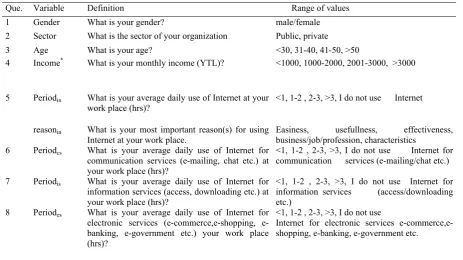
A survey instrument corresponding to the proposed hypotheses was developed in the respondent’s native language (Turkish). A pilot instrument was face validated and revised based on suggestions from a group of professionals. Several managers were also interviewed in this regard. The questionnaire contains 8 items and each item reflects a discrete variable as given in Table 3. The proposed independent variables of this study are:
“gender” and “sector” whereas the dependent (empirical) variables are “periodin”, “reasonin”, “periodcs”, “periodis”
and“periodes”. The variables “age and income” are used
for descriptive purposes. The definitions, scales and range of values for these variables are given in Table 3.
government and private sector organizations using “judgment sampling” based on the size and the sector of organizations. The number of invitations were limited to 265 organizations and this was assumed to constitute our research sample. A total of 212 completed survey questionnaires were received. Twelve responses were discarded from the analysis due to the existence of unqualified data. Thus, the approximate response rate was
75% which can be considered acceptable for the purpose of this study (Fleming and Nellis, 2000; Seyal et al., 2000). The overall internal reliability as measured by Cronbach alpha (Brown, 2002) was found to be 0.71. This means the data is reliable since, usually, 0.7 and above is acceptable (Yu, 2007). Furthermore, the correlation between the dependent variables gender and sector was observed to be not correlated (r= 0.079; p-value= 0.433).
Table 3
Summary of Research Questions and Variables
Que. Variable Definition Range of values
1 Gender What is your gender? male/female
2 Sector What is the sector of your organization Public, private
3 Age What is your age? <30, 31-40, 41-50, >50
4 Income* What is your monthly income (YTL)? <1000, 1000-2000, 2001-3000, >3000
5 Periodin What is your average daily use of Internet at your
work place (hrs)?
<1, 1-2 , 2-3, >3, I do not use Internet
reasonin What is your most important reason(s) for using
Internet at your work place.
Easiness, usefullness, effectiveness, business/job/profession, characteristics
6 Periodcs What is your average daily use of Internet for
communication services (e-mailing, chat etc.) at your work place (hrs)?
<1, 1-2 , 2-3, >3, I do not use Internet for communication services (e-mailing/chat etc.)
7 Periodis What is your average daily use of Internet for
information services (access, downloading etc.) at your work place (hrs)?
<1, 1-2 , 2-3, >3, I do not use Internet for information services (access/downloading etc.)
8 Periodes What is your average daily use of Internet for
electronic services (commerce,shopping, e-banking, e-government etc.) your work place (hrs)?
<1, 1-2 , 2-3, >3, I do not use
Internet for electronic services e-commerce,e-shopping, e-banking, e-government etc.
* at the time of the survey 1 YTL = US$ 1.45
Multiple ordinal regression technique was used to test the main predictive effects of independent variables on the dependent ones. This technique is used to perform logistic regression on ordinal response variables which are categorical with 3 or more possible levels. We treated the problem as linear for each dependent variable as follows:
Y= a0i + a1 gender + a2 sector.
The chi-square test method is used whenever there is a need to examine the relationship between the dependent and independent variables.
Characteristics of Respondents
The percentage of the respondents from the government sector appears to be 62%. Of the public sector respondents 8% were above 50 years of age whereas respondents with 31-40 and 41-50 years of age constitute 44% and 45%, respectively. These percentages are 5%, 42% and 40% for private sector organizations. The income distribution showed highest percentage for the group of 1000-2000 YTL (38%). This is not surprising because most of the respondents were from public sector organizations (62%) and the salary standards in the public
sector are lower than those of the private sector in Turkey. Finally, an interesting observation was that income and age showed parallel dispersions for public sector organizations. This means, promotions and salary increments are based on certain mechanisms which mainly consider not the merit but the number of years spent in the public sector. This is not applicable to private sector organizations.
Test results
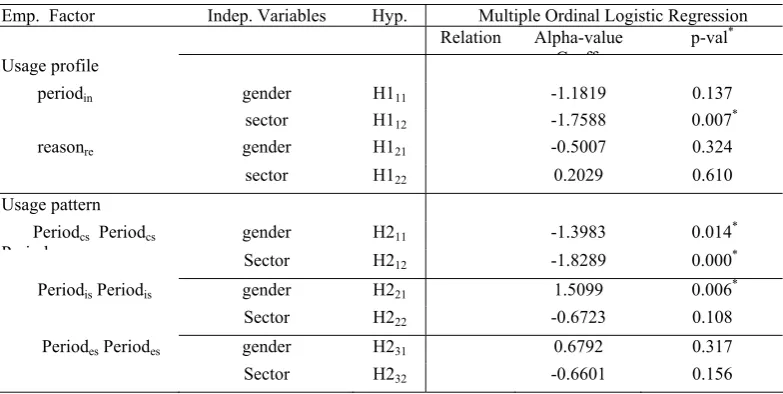
All the five hypotheses were investigated at 5 percent significance level. The hypotheses, along with the results of multiple ordinal logistic regression and their perspective p-values are given in Table 4.
Gender
Surprisingly, based on nominal regression results H111
leads to the acceptance of H121, which means employees’
“gender” does not have predictive effect on their reason for using Internet. This may be partly due to the fact that our respondents were employees and it does not seem to be reasonable to expect gender differences for groups with similar backgrounds. Another plausible explanation is that the traditional dominating role of males in the society is not valid for professional life, and males and females are equally likely to share the opportunities including ICT. Our finding is in parallel with that reported by Husing and Selhofer (2002), Levy (2002) and Zhang (2005). Husing and Selhofer (2002) observed that “gender divide” in using the Internet is closing nearly in all member states of the EU. Levy (2002) also concluded that disparity in Internet usage between men and women has largely disappeared. Similarly, no statistically significant difference was found in terms of Internet subscale usefulness between male and female employees (Zhang, 2005). In two other recent studies, Smith et al. (2008) and Jackson et al. (2008) reported that gender is not a significant indicator of difference in Internet use. However, contradictory findings were reported by Teo and Lim (2000), and Nachmias et al. (2000). In their study, Teo and Lim (2000) examined gender differences in Internet usage in Singapore and concluded that males and females perceive the Internet differently. Nachmias et al. (2000) also found that males
used the Internet more often than females. In more recent studies, Schumacher and Morahan-Martin (2001), DeYoung and Spence (2004) and Potosky (2007) also supported this view. Schumacher and Morahan-Martin (2001) suggested that males exhibit greater competency and comfort with the Internet and computers and spend more time online than females. Similarly, DeYoung and Spence (2004) noted that women are more anxious and less confident than men regarding using computers and the Internet. Finally, Potosky (2007) observed that men have significantly greater Internet knowledge as well as computer understanding and experience. One plausible explanation for the contradictory findings is that culture influences preferences and there are differences among different cultures from the HCI (Human Computer Interface) point of view (Losh, 2003). Organizational culture is influenced by national culture where the organization is operating (Ubius and Alas, 2009). Cakir and Cagiltay (2002) also mentioned the existence of cultural tendencies that lead to the use of certain on-line communication styles. According to their observations language style and expressions of emotions can vary depending on context, content and the recipient of on-line communication. Another explanation may be based on the differences in the characteristics of the samples.
Table 4
Test Results
Emp. Factor Indep. Variables Hyp. Multiple Ordinal Logistic Regression
Relation Alpha-value
C ff p-val
*
Usage profile
periodin gender H111 -1.1819 0.137
sector H112 -1.7588 0.007*
reasonre gender H121 -0.5007 0.324
sector H122 0.2029 0.610
Usage pattern Periodcs Periodcs
P i d gender H211 -1.3983 0.014
*
Sector H212 -1.8289 0.000*
Periodis Periodis gender H221 1.5099 0.006*
Sector H222 -0.6723 0.108
Periodes Periodes gender H231 0.6792 0.317
Sector H232 -0.6601 0.156
*indicates statistically significant at 5 per cent significance level.
Interestingly, in our study, it was found that female employees (70.5% use the Internet more than 3 hours a day) use the Internet more than males (60.9% use the Internet more than 3 hours a day). This is in parallel with the work of Iscan and Naktiyok (2005), who claimed that women have a more favorable attitude towards telecommuting than men. However, this difference between males and females was not found significant (χ2=1.270; df=3; p-value = 0,736).
The test results lead to the rejection of H211
(alpha-value=-1.3983, p-value=0.014), which indicate that “gender” has statistically significant predictive effect on employees’ average daily use of Internet for communication
services. This also means, male and female employees have significant impact on predicting average daily use of the Internet for communication. Fang and Yen (2006) and Jackson, et al. (2001) were supporters of this finding. Fang and Yen (2006) reported that messaging/entertainment and information access appear to be the main goals for most Chinese Internet users whereas Jackson, et al. (2001) found that women used e-mail more than men in this respect.
Another finding is that “gender” has a statistically significant predictive effect (alpha-value=-1.5099, p-value=0.006) in terms of using the Internet for information
services (periodis) and, therefore, we reject H221.
result of corresponding regression analysis. This implies that female employees use the Internet for information access/downloading/entertainment activities for longer durations than male employees. This may be due to the fact that, in recent years, a rapidly increasing number of female employees jumped on the Internet bandwagon and they view the Internet as being at least as useful as the male employees do (Zhang, 2005). Our finding may also be explained by the fact that traditional roles of males and females change when it comes to employees’ Internet usage.
Inspection of p-values for employees’ using Internet for electronic services indicated that there is no sufficient
evidence to reject H231 (alpha-value=0.6792,
p-value=0.317). In other words, “gender” does not have significant predictive effect on using Internet for electronic
services. We found that 94% of younger (age<=40) and
93% of older (age>50) employees reported spending less than 1 hour daily for electronic services. The reader should note here that, the chi-square test results for independence indicated that there is no evidence for a relationship between age and use of electronic services (χ2= 0.00, df=3,
p-value=1.000). Our finding is consistent with that reported by Akman et al. (2005). They have shown particularly that e-government implementations and related activities are not systematic and matured yet.
Sector
The corresponding results of nominal regression for the variable “sector” are statistically significant (alpha-value=-1.7588, p-value=0.007) for employees’ average daily use of Internet and not significant for the reason of using Internet (alpha-value=0.2029, p-value=0.610). This means, H112 is rejected and H122 is accepted. This may
also be interpreted as “sector” of respondents’ organization has statistically significant predictive impact on employees’ average daily time spent on using the Internet but not on their reason for using the Internet. It was observed that respondents from private sector are using the
Internet (88.89% for periodin>3 hrs) more than public
sector counterparts (56.16% for periodin>3 hrs). The
difference between sectors was found to be significant (χ2=9,562; df=3; p-value=0,023). Critics pointed out that
every new technology has been adopted first by wealthier citizens and income level of individuals is higher in private sector organizations (Liff and Shepherd, 2004). Kiiski and Pohjola (2002), in examining a panel of 60 countries from 1995 to 2000, found relevance for the role of income, telephone access costs, and level of schooling on the number of internet hosts in a particular country. This is also probably because the public sector employees do not feel the need to keep up with the latest developments in ICT assuming that their jobs are always secured. However, the public sector adapts ICT in order to provide more qualitative services to business and consumers and in this context ICT is treated only as an instrument which allows reorganizing public business in order to provide services more efficiently (Gatautis, 2008). Additionally, many public sector employees worry that Internet usage may increase security risks by creating more opportunities for
computer hackers and equipment thieves (Iscan and Naktiyok, 2006).
It can be observed from the last column of Table 4
that, except for hypotheses H212, all the remaining ones
regarding the variable “sector” were supported by the survey results in usage pattern category. In other words, there is sufficient evidence to
• reject the hypotheses H212 that “sector” does not
have predictive effect on average daily use of the Internet for communication services (alpha-value=-1.8289, p-value=0.000).
• accept the hypotheses H222 that “sector” does not
have predictive effect on average daily use of the Internet for information services (alpha-value=-0.6723, p-value=0.108).
• accept the hypotheses H232 that “sector” does not
have predictive effect on average daily use of the Internet for electronic services (alpha-value=-0.6601, p-value=0.156).
In other words, the “sector” of employees’ organization has statistically significant impact on average daily use of the Internet for communication services but not on the other empirical variables in this category. Additionally, private sector respondents are using the Internet more (40.74% for periodcs>3 hrs) than public sector counterparts
(12.33% for periodcs>3 hrs) for communication services.
This difference between sectors was also found to be
significant (χ2=18,796; df = 3; p-value = 0.000). One
possible reason for these observations lies in the working environments and styles in these sectors as also noted by Mishra et al. (2007). For private sector organizations, the Internet can offer a huge range of information and services including information for research, public forms (documents) and services, public policy information, employment and business opportunities, tax filing, license registration or renewal, payment of fines, submission of comments to decision makers and many other official procedures. However, public organizations have strict rules regarding their implementations due to laws and regulations which do not allow the use of Internet in most cases. This means that the key to usage of Internet is not technology but the organizations’ rules and regulations as public sector organizations do not or cannot have access to computers and/or Internet. The private sector is more practical in using the Internet in this regard. Another explanation may be based on the findings of Liff and Shepherd (2004), Farag et al. (2006) and Gardner and Oswald (2001) who concluded that as income increases, the individual is more likely to use information and communication technologies.
Conclusions
Similarly, the variable “sector” has significant impact on “average daily use of Internet” and “Internet usage for communication services”. This means employees’ gender and sector both show significant disparity in using Internet for e-mail, chat and other means of online communication. The independent variables of “gender” and “sector” were not found to have statistically significant predictive effect on the other empirical variables. The results also indicated some differences between male and female employees and their organizations’ sector (public and private). For example “gender” has an impact on average daily use of Internet for information services whereas this impact is significant on average daily use of Internet for the variable “sector”. Our results may provide significant insight for policy makers regarding how to promote and enhance Internet usage among employees. We hope this study will enhance the readers’ and IS professionals’ understanding regarding Internet use among employees and start a discussion of the implications that will help guide IS practitioners as they develop effective strategies and tactics to penetrate the highly competitive cybermarkets (Fang and Yen, 2006).
This research investigated the predictive effect of “gender” and “sector” on factors of different aspects of Internet usage. We recognize some limitations of our study. First, for the followers of this paper, we propose the
use of larger samples which may lead to more insight into the relationships towards using Internet among employees. Second, this study assessed the relationships between gender/sector and profile/pattern of Internet usage. Therefore, an extension to consider work climates’ impact on Internet usage in organizations of different sectors would also be of interest. Actually, analyses of individual preferences, group influences and administrative factors may provide very interesting results. Third, this study should be designed to include small and medium size organizations from all sectors. Final limitation may be based on the studies of Calhoun et al. (2002) Chirkov et al. (2003) and other researchers who concluded that culture affects the use of ICT in significant ways and the effect of culture on Internet usage among organizations may be studied from organizational perspective among different countries in the future.
Acknowledgement
We would like to thank editor and reviewers for their valuable comments to improve the quality of this paper. We would also like to thank Dr. Ceylan Ertung Academic Writing & Advisory Center (AWAC) of Atilim Unversity for nicely editing the manuscript.
References
Ajzen, I., & Fishbein, M. (1980). Understanding attitudes and predicting social behavior. Englewood Cliffs, NJ: Prentice-Hall, Inc.
Akman, I., Yazici, A, Mishra, A., & Arifoglu, A. (2005). E-Gov: a global perspective and an empirical assessment of citizens’ attributes. Government Information Quarterly, 239-257.
Alder, G. S., Noel, T. W., & Ambrose, M. L. (2006). Clarifying the effects of Internet monitoring on job attitudes: the mediating role of employee trust. Information & Management, 43, 894-903.
Arnesen, D. W., & Weis, W. L. (2007) Developing an effective company policy for employee Internet and e-mail use. Journal of Organizational Culture, Communications and Conflict, 11, 53-56.
Aycan, Z. (2001). Human resource management in Turkey current issues and future challenges. International Journal of
Manpower, 22(3), 252-260.
Bertot, J. C., McClure, & Owens, K. A. (1999). Universal service in a global networked environment: selected issues and
possible approaches. Government Information Quarterly, 16(4), 309-327.
Bonson, E., & Escobar, T. (2006). Digital reporting in Eastern Europe: An empirical study. International Journal of
Accounting Information Systems, 7, 299-318
Brown, J. D. (2002). The Cronbach alpha reliability estimate. Shiken: JALT Testing & Evaluation SIG Newsletter, 6(1), 17-19.
Cakir H., Bichelmeyer, B. A., & Cagiltay K. (2002). Effects of cultural differences on e-mail communication in multicultural environments. paper presented in CATAC’02 International Conference on Cultural Attitudes towards Technology and Communication, Montreal, Canada.
Calhoun, K. J., Teng, J. T. C., & Cheon, M. J. (2002). Impact of national culture on information technology usage
behaviour: an exploratory study of decision making in Korea and the US. Behaviour and Information Technology,
21, 293-302.
Chirkov, V., Ryan, R. M., & Kim, Y. (2003). Differentiating autonomy from individualism and independence: a self-determination theory perspective on internalization of cultural orientations and well-being. Journal of Personality and Social Psychology, 84, 97-110.
Colley, A., & Maltby, J. (2008). Impact of the Internet on our lives: male and female personal perspectives. Computers in Human Behavior, 24, 2005-2013.
Egghe, L. (2000). New informetric aspects of the Internet: some reflections - many problems. Journal of Information Science, 26(5), 329-335.
Fang, X., & Yen, D. C. (2006). Demographics and behavior of Internet users in China. Technology in Society, 28, 363-387. Farag, S., Krizek, K. J., & Dijst, M. (2006). E-Shopping and its relationship with in-store shopping: empirical evidence
from the Netherlands and the USA. Transport Reviews, 26(1), 43-61.
Fisher, Y., & Jacob, O. B. (2006). Measuring Internet usage: the Israeli case. International Journal of Human-Computer Studies, 64, 984-997.
Fleming, M. C., & Nellis, J. G. (2000). Principles of Applied Statistics.Thomson Learning.
Foster, M. (2001). Create a positive organizational culture to reduce Internet misuse. The National Public Accountant, 46(7), 34- 38. Retrieved on 1 August 2002, from ProQuest Database: http://www.pro quest.com.
Frank, A. S., & Lewis, G. B. (2004). Government employees, working hard or hardly working. The American Review of
Public Administration, 34(1), 36-51.
Gatautis, R. (2008). The Impact of ICT on Public and Private Sectors in Lithuania. Inzinerine Ekonomika- Engineering
Economics(4), 18-28.
Gatautis, R., & Vitkauskaite, E. (2009). eBusiness Policy Support Framework. Inzinerine Ekonomika-Engineering
Economics(5), 35-47.
Gardner, J., & Oswald, A. (2001). Internet use: the digital divide, www2.warwick.ac.uk/fac/soc/economics/ staff/faculty/oswald/bsago12.pdf
Greenfield, D. N., & Davis, R. A. (2002). Lost in cyberspace: the web at work. CyberPsychology and Behavior, 5(4), 347-353.
Gupta, P. B., Gould, S. J. & Pola, B. (2004). To pirate or not to pirate: a comparative study of the ethical versus other influences on the consumer’s software acquisition mode decision. Journal of Business Ethics, 55(3), 255-274. Hills, P., & Argyle, M. (2003). Uses of the Internet and their relationships with individual differences in personality.
Computers in Human Behavior, 19, 59-70.
Hüsing, T., & Selhofer, H. (2002). Measuring the digital divide a proposal for a new index. ECIS Conference, Gdansk. Hwang, W., Jung, H. S. & Salvendy, G. (2006). Internationalisation of e-commerce: a comparison of online shopping
preferences among Korean, Turkish and US populations. Behaviour & Information Technology, 25(1), 3-18.
Iscan, O. F., & Naktiyok A. (2005). Attitudes towards telecommuting: the Turkish case. Journal of Information
Technology, 20, 52-63.
Jackson, L. A., Zhao, Y., Qiu, W., Kolenic III, A., Fitzgerald, H. E., Harold, R. & Evy, A. von (2008). Culture, gender and
information technology use: A comparison of Chinese and US children. Computers in Human Behavior, 2817-2829.
Jackson, L. A., Ervin, K. S., Gardner, P. D. & Schmitt, N. (2001). Gender and the Internet: women communicating and men searching. Sex Roles, 44(5/6), 363-379.
Jaeger, P. T. (2003). The endless wire: e-government as global phenomenon. Government Information Quarterly, 20, 323-31. Jin, K. G., Drozdenko, R., & Bassett, R. (2007). Information technology professionals’ perceived organizational values and
managerial ethics: an empirical study”. Journal of Business Ethics, 71(2), 149-159.
Kiiski, S., & Pohjola, M. (2002). Cross-country diffusion of the internet. Information Economics and Policy, 14(2), 297-310. Lau, E. K. W. (2003). An empirical study of software piracy. Business Ethics: An European Review, 12(3), 233-245. Levy, K. (2002). Overcoming the digital divide. panel discussion: e-government and citizen centered government round
table. Available: http://www.epa.gov/customerservice/2002conference/levy.pdf
Li, N., & Kirkup, G. (2007). Gender and cultural differences in Internet use: a study of China and the UK. Computers & Education, 48, 301-317.
Liff, S., & Shepherd, A. (2004). An Evolving Gender Digital Divide? OII Issue Brief No. 2 (Oxford: Oxford Internet
Institute). www.ox.oii.ac.uk/resources
Losh, S. C. (2003). Gender and educational digital chasms in computer and Internet access and use of over time: 1983-2000. IT & Society, 1(4), 73-86.
Mahatanankoon, P. (2002). Explaining production deviant use of the Internet technology in the workplace: An integrated model. Dissertation Abstract International, 63, 03A.
McIvor, R., Mchugh, M., & Cadden, C. (2002) Internet technologies. supporting transparency in the public sector, The
International Journal of Public Sector Management, 15(3), 170-187.
Malachowski, D. (2005) Wasted time at work costing companies billions. Available: http://www.salary.com/careers/ layouthtmls/crel_display_nocat_Ser374_Par555.html.
Mishra, A., Akman, I., & Yazici, A. (2007). Organizational software piracy: An empirical assessment. Behavior &
Mishra, A., Akman, I., & Yazici, A. (2006) Software piracy among IT professionals in organizations.International Journal of Information Management 26 (5), 401-413.
Nachmias, R., Mioduser, D., & Shemla, A. (2000). Internet usage by students in an Israeli high school. Journal of
Educational Computing Research, 22(1), 55-73.
Nithya, H. M., & Julius, S. (2007). Extroversion, neuroticism and self-concept: their impact on internet users in India. Computers in Human Behavior, 23, 1322-1328.
Pilinkus, D., & Boguslauskas, V. (2005). Implementation of new technologies in information socities. Inzinerine
Ekonomika- Engineering Economics(2), 35-44.
Potosky, D. (2007). The Internet knowledge (iKnow) measure. Computers in Human Behavior, 23, 2760-2777.
Punamaki, R. L, Wallenius, M., Nygard, C. H, Saarni, L., & Rimpela, A. (2007). Use of information and communication technology (ICT) and perceived health in adolescence: The role of sleeping habits and waking-time tiredness. Journal of Adolescence, 30, 569-585.
Saran, M., & Zavarsky, P. (2009) A study of the methods for improving Internet usage policies, cse. International
Conference on Computational Science and Engineering, 3, 371-378.
Schofield, J. W. & Davidson, A. L. (1997). The Internet in school: The shaping of use by organizational, structural, and cultural factors, Toronto, Canada: WebNet 97 World Conference of the WWW. internet & Intranet Proceedings (ERIC Document Reproduction Service No. ED 429 545).
Shrivatsava, S., & Shaw, J. B. (2003). “Liberating HR through technology”. Human Resource Management, 42(3), 201-222.
Schumacher, P., & Morahan-Martin, J. (2001). Gender, Internet, and computer attitudes and experiences. Computers in
Human Behavior, 17, 95-110.
Seyal, A. H., Rahim, Md. M., & Rahman, M. N. A. (2000). An empirical investigation of use of information technology
among small and medium business organizations: Bruneian scenario. The Electronic Journal on Information
Systems in Developing Countries, 2(7), 1-17.
Seyal, A.H. & Pijpers, G.G.M. (2004). Senior government executives’ use of Internet: a Bruneian scenario. Behaviour & Information Technology, 23(3), 197-210.
Smith, P., Smith, N., Sherman, K., Kriplani, K., Goodwin, I., Bell, A., & Crothers, C. (2008). The Internet: Social and Demographic Impacts in Aotearoa New Zealand. Observatorio (OBS*) Journal, 6, 307-330. Available: www.obercom.pt/ojs/index.php/obs/article/viewPDFInterstitial/234/202
Startiene, G., & Remeikiene, R. (2009). The Influence of Demographical Factors on the Interaction between
Entrepreneurship and Unemployment. Inzinerine Ekonomika-Engineering Economics(4), 60-70.
Taylor, et al., (2003). Socio-economic factors affecting home Internet usage patterns in Central Queensland. Informing
Science Journal, 6, 233-246.
Teo, T. S. H., & Lim, V. K. G. (2000). Gender differences in internet usage and task preferences. Behaviour &
Information Technology, 19(4), 283-295.
Ting, Y., & Grant, R. (2005). Internet usage of local government employees:A study of the effect of individual preferences, group influences, and administrative factors. The Social Science Journal, 42 323-331.
Ubius, U., & Alas, R. (2009) Organizational culture types as predictors of corporate social responsibility. Inzinerine Ekonomika- Engineering Economics(1), 90-99.
Usunier, J. C., & Lee, J. (2005). Marketing Across Cultures. Pearson Education, 4th edition.
Welebir, B., & Kleiner, B. H. (2005). How to write a proper Internet usage policy. Management Research News, 80-87 Available: www.acpr.gov.au/pdf/ACPR147_1.pdf
Yang, Shu Ching., & Tung, Chieh-Ju. (2007). Comparison of Internet addicts and non-addicts in Taiwanese high school. Computers in Human Behavior, 23, 79-96.
Yu, A. (2007). Assess students: Item analysis. Instructional Assessment Resources, IAR. Available from
http://www.utexas.edu/academic/diia/assessment/iar/students/report/itemanalysis.php.
Zhang, Y. (2005). Age, gender, and Internet attitudes among employees in the business world. Computers in Human Behavior, 21, 1-10.
Ibrahim Akman, Alok Mishra
Prognozuojamas lyties ir sektoriaus skirtumų poveikis interneto vartojimui tarp darbuotojų
Santrauka
visuomenei. Įvairūs interneto panaudojimo aspektai visose demografinėse grupėse analizei buvo svarbūs (Yang ir Tung, 2007; Jaeger, 2003), nes demografiniai aspektai veikia individo veiksmus (Ajzen ir Fishbein, 1980; Zhang, 2005; Jaeger, 2003; Startiene ir Remeikiene, 2009). Zhang (2005) teigė, kad daugelis iš dažna atliekamų kompiuterio ir interneto studijų remiasi studentų (Zhang, 2005; Hwang ir kt., 2006; Li ir Kirkup, 2007; Chen, 2008) arba paprastų piliečių (Fisher ir Jacob, 2006; Fang ir Yen, 2006; Colley ir Maltby, 2008) nuomone. Tačiau darbuotojai sudaro didžiausią grupę ir atlieka labai svarbų vaidmenį diegiant naujas technologijas. Be to, darbuotojams naudojantis internetu gali būti visai kitokie duomenys negu juo naudojantis kitoms visuomenės grupėms (Jin ir kt., 2007).
Taigi, šis tyrimas buvo skirtas nustatyti lyties ir sektoriaus poveikį interneto vartojimui. Svarbu pažymėti, kad institucijos, siekiančios ne pelno paslaugų (pvz. universitetai, vietinė valdžia ir t. t.) buvo priskirtos viešajam sektoriui. Šiame tyrime dalyvavo viešojo ir privačiojo sektorių darbuotojai.
Taigi, kaip jau buvo minėta, šiuo tyrimu analizuojamas lyties ir sektoriaus poveikis interneto vartojimui. Priklausomi kintamieji buvo suskirstyti į du empirinius veiksnius: panaudojimas (vidutiniškas panaudojimas kasdien ir jo priežastys) ir panaudojimo pavyzdžiai (kasdienis interneto panaudojimas komunikavimo tikslais, informacijos ir elektroninės paslaugos). Šiuo tikslu tyrimas buvo atliktas tarp darbuotojų viešojo ir privačiojo sektorių organizacijose. Pasiūlytos hipotezės buvo pateiktos gimtąja respondentų kalba (turkų). Respondentai buvo įvairių sektorių darbuotojai, kurie lankė kasmetinius trijų dienų kursus, skirtus interneto panaudojimo galimybėms. Šiuos kursus organizavo Turkijos informatikos asociacija. Organizacijos - dalyviai buvo atrinkti remiantis organizacijos dydžiu ir sektoriumi. Pakvietimų skaičius apribotas iki 265 organizacijų. Buvo gauta 212 anketų. Buvo nustatyta, kad bendras vidinis patikimumas pagal Cronbacho alpha (Brown, 2002) prilygo 0,71, o tai reiškė, kad duomenys yra patikimi, nes 0,71 ir didesnis skaičius yra priimtinas (Yu, 2007). Buvo pastebėta, kad nėra priklausomybės tarp lyties ir sektoriaus kintamųjų (r=0,079; p=0,433). Buvo pritaikytas daugybinės regresijos metodas, norint išbandyti nepriklausomų kintamųjų pagrindinį poveikį priklausomų kintamųjų atžvilgiu. Metodas taikomas atliekant logistinę regresiją. Problema buvo laikoma linijine kiekvienam kintamajam: Y= a0i + a1 lytis + a2 sektorius. Šis metodas taikomas tada,
kai reikia ištirti priklausomybę tarp priklausomų ir nepriklausomų kintamųjų.
Vyriausybės sektoriaus atstovų procentas yra 62 %. 50 metų amžiaus atstovai sudarė 8 % viešojo sektoriaus atstovų, 31–40 metų ir 41–50 metų amžiaus atstovai sudarė 44 % ir 45 % atitinkamai viešojo sektoriaus atstovų. 5% (50 metų amžiaus), 42% (31–40 metų amžiaus) ir 40% (41–50 metų amžiaus) atstovų buvo iš privačiojo sektoriaus. Pajamų pasiskirstymas parodė, kad jų yra mažiausiai viešosiose organizacijose, nes šiame sektoriuje atlyginimai yra daug mažesni nei privačiame Turkijoje. Ypač įdomu tai, kad pajamos ir amžius paraleliškai pasiskirstė viešose organizacijose.
Remiantis nominalios regresijos rezultatais, priešingai, negu buvo tikėtasi, lyties poveikio interneto vartojimui nepastebėta (alfa reikšmė =1,819, p reikšmė=0,137). Vadinasi lyčių skirtumo kasdien naudojant internetą nėra. Taigi testo rezultatai patvirtina hipotezę (alfa=0,5007, p=0,324), kad lytis neturi įtakos naudojant internetą. Tai iš dalies pabrėžia tą faktą, kad mūsų respondentai buvo tarnautojai, todėl nereikėjo tikėtis skirtumo panašiose grupėse. Antra, tradiciškai vyraujantis vyrų vaidmuo visuomenėje nelemia profesinio gyvenimo, t. y. tiek vyrai, tiek moterys yra lygios realizuodamos savo galimybes, įskaitant ir interneto vartojimą. Galima teigti, kad tam tikra sritis (sektorius) turi didelę įtaką darbuotojų laikui, kurį jie skiria internetui, tačiau tai nėra naudojimosi internetu priežastis. Kritikai nurodo, kad kiekvieną technologiją pirmiausia įsisavina turtingesni piliečiai, todėl plačiau interneto paslaugomis naudojasi privačiųjų organizacijų darbuotojai (Liff ir Shepherd, 2004). Tai priklauso dar ir nuo to, kad viešojo sektoriaus darbuotojai neturi didelio poreikio neatsilikti nuo naujų technologijų įsisavinimo, nes jų darbo vietos yra daugmaž saugios.
Testų rezultatai (alfa=1,3983; p=0,014 ir alfa=1,5099; p=0,006) taip pat parodė, kad lytis statistiškai turi prognozuojamą poveikį kasdieniam interneto vartojimui bendravimo tikslais ir vidutiniam vartojimui informacijos gavimo tikslais. Tai reiškia, kad vartotojai vyrai ir moterys turi įtakos prognozuojant interneto panaudojimą šiems tikslams. Be to, tyrimai parodė, kad lytis neturi įtakos elektroninių paslaugų panaudojimo srityse. Pastebėta, kad yra pakankamai įrodymų paaiškinti šiuos aspektus:
9 atmesti hipotezę, kad sektorius neturi įtakos vidutiniam kasdieniam interneto panaudojimui bendravimo srityje (alfa reikšmė=1,8289; p reikšmė=0,000);
9 pritarti hipotezei, kad sektorius neturi poveikio vidutiniam kasdieniam interneto panaudojimui informacijos teikimo srityje (alfa reikšmė=0,6723; p reikšmė=0,108);
9 pritarti hipotezei, kad sektorius neturi įtakos interneto panaudojimui elektroninių paslaugų srityje (alfa reikšmė=0,6601; p reikšmė=0,156). Privačiojo sektoriaus respondentai internetu labiau naudojasi bendravimo tikslais negu viešojo sektoriaus atstovai. Šis skirtumas yra gana didelis (χ2=18,796; df=3; p-value=0,000). Privačiojo sektoriaus organizacijoms internetas gali suteikti daug informacijos ir paslaugų, įskaitant informaciją
mokslinių tyrimų srityje, dokumentų tvarkymo ir paslaugų sferose, taip pat daug informacijos viešosios politikos, įdarbinimo, verslo galimybių, mokesčių, licencijų, mokėjimų ir kitose srityse. Tačiau viešosios organizacijos turi daug taisyklių, susijusių su interneto panaudojimo apribojimais. Tai reiškia, kad būdas, kaip panaudoti internetą, nėra tik technologijų įsisavinimas, bet ir organizacijos taisyklės bei reglamentavimas, ribojantis naudojimosi internetu galimybes. Privatusis sektorius yra laisvesnis šia prasme. Kitas paaiškinimas remiasi tyrimais, kuriuos atliko Liff ir Shepherd (2004), Farag ir kt. (2006) and Gardner ir Oswald (2001). Jie teigia, kad pajamoms didėjant individas yra laisvesnis naudotis informacijos ir komunikacijos technologijomis.
Literatūroje yra ir prieštaringų rezultatų. Tai galima paaiškinti tuo, kad kultūra veikia kai kuriuos aspektus, todėl susiduriame su įvairiais požiūriais į ją (Losh, 2003). Organizacijos kultūrai daro poveikį nacionalinė kultūra, kurioje veikia ta organizacija (Ubius ir Alas, 2009). Cakir ir Cagiltay (2002) mini kultūros tendencijų buvimą, o tai veikia ir kompiuterinį stilių. Anot šių autorių, emocijų kalbos stilius ir posakiai gali skirtis priklausomai nuo konteksto, turinio ir nuo to, kaip informacija priimama. Kitas paaiškinimas remiasi atskirų pavyzdžių skirtumais.
Šio tyrimo rezultatai gali suteikti informacijos ir įžvalgią politiką kuriantiems asmenims ir parodyti, kaip sustiprinti ir įdiegti interneto vartojimą tarp darbuotojų. Be to, tai gali skatinti diskusijas apie interneto svarbą organizacijos darbe ir padėti kurti strategijas bei tendencijas ir prasiskverbti į kompetentingas kibernetines rinkas (Fang ir Ien, 2006). Reikia pripažinti ir kai kuriuos šio tyrimo ribotumus. Pirma, siūloma parinkti daugiau pavyzdžių, kurie leistų geriau apibrėžti santykius interneto paslaugų srityje ir jų vartojimą organizacijose. Antra, šis tyrimas įvertino sąsajas tarp lyties ir sektoriaus bei profilio ir pavyzdžio naudojant internetą. Būtų įdomu ištirti ir darbo klimato poveikį interneto panaudojimui įvairių sektorių organizacijose. Įdomią informaciją galėtų suteikti individualus pasirinkimas, grupės poveikis ir įvairūs valdymo veiksniai. Trečia, šis tyrimas turėtų apimti mažas ir vidutines įvairių sektorių organizacijas. Be to, reikėtų giliau ištirti Calhoun ir bendraautorių (2002), Chirkov ir bendraautorių (2003) ir kitų tyrėjų darbus, kuriuose teigiama, kad kultūros poveikį kompiuterinių technologijų diegimo srityje ir interneto panaudojimui organizacijose reikėtų analizuoti ateityje organizacijai plėtojantis įvairiose šalyse.
Raktažodžiai: internetas, tarnautojas, lytis, sektorius, logistinė regresija.